

Why Did Triceratops Have a Big Nose?
Recently published research reveals Triceratops possessed a surprisingly complex nose. Famed for its huge size and impressive horns, “three horned face” had specialised structures that helped regulate heat and conserve moisture. The Triceratops nasal cavity study has been published in the journal “The Anatomical Record.” Triceratops is one of the most recognisable dinosaurs ever discovered. It lived during the Late Cretaceous in North America, and two species have been named. This ceratopsian regularly tops our dinosaur popularity polls. Fossils of Triceratops are on display in museums all over the world. However, this new research demonstrates that there is still much to learn about this dinosaur.
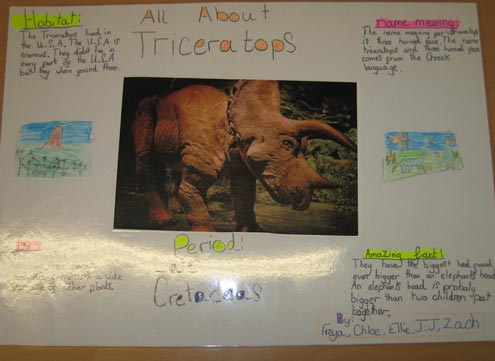
A Triceratops dinosaur poster. This Late Cretaceous dinosaur is one of the most easily recognisable of all the dinosaurs. Picture credit: Everything Dinosaur.
Picture credit: Everything Dinosaur
Investigating the Triceratops Nasal Cavity
The new study suggests the Triceratops nasal cavity was far more complex than previously thought. Scientists now think its enormous snout housed specialised tissues linked to breathing, moisture regulation and temperature control. Researchers examined several fossil skulls of Triceratops and other horned dinosaurs. First, they used CT scans to look inside the bones. Next, they created sophisticated 3D computer models of the nasal region. The team then compared these fossils with the noses of extant reptiles, birds and crocodilians. Extant phylogenetic bracketing was employed to model the probable soft tissues associated with the nasal region.
As a result, the researchers produced the first comprehensive hypothesis for the soft tissues inside the ceratopsid snout.

A cast of a Triceratops skeleton on display at the Naturmuseum Senckenberg (Natural History Museum – Frankfurt). On the left a wall mounted example of a Plateosaurus can be seen. Picture credit: Everything Dinosaur.
Picture credit: Everything Dinosaur
Nerves, Blood Vessels and Nasal Glands
The results suggest the Triceratops nasal cavity contained an intricate network of nerves and blood vessels. In addition, the scientists identified pathways for neurovascular structures within the narial region. They also inferred the locations of a nasal gland and a nasolacrimal duct. Interestingly, the pattern of nerve supply in ceratopsids appears unique among reptiles. Researchers suggest this unusual arrangement evolved as the nostril openings became larger during ceratopsian evolution. Therefore, the enlarged snout of Triceratops likely supported more than just breathing.
Acquisition of such a structure might have mitigated a thermal problem associated with the large size of the ceratopsid head. After all ceratopsians such as Pentaceratops, Torosaurus and Triceratops are famed for their super-sized skulls.
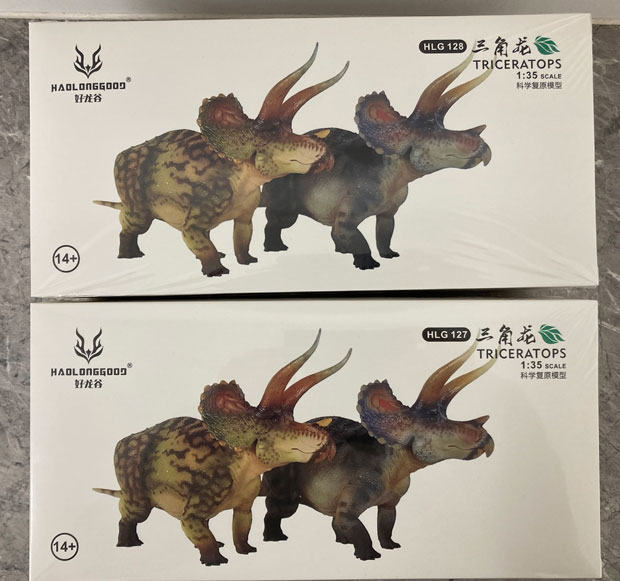
Two spectacular Haolonggood horned dinosaur models. The two Triceratops figures (Qin Ming and Hu Yan Zhuo). Triceratops is represented by dozens of dinosaur models. Picture credit: Everything Dinosaur.
Picture credit: Everything Dinosaur
The picture (above) shows two recent Triceratops figures produced by Haolonggood. Collectors and dinosaur fans have dozens of Triceratops figures to choose from; this horned dinosaur is extremely popular.
To view the Haolonggood range of prehistoric animal figures: Haolonggood Dinosaur Models.
Evidence for Respiratory Turbinates
The study also suggests the presence of respiratory turbinates in ceratopsid dinosaurs. Respiratory turbinates are delicate, curled structures found inside the noses of birds and mammals today. They help warm and moisten incoming air. In addition, they reduce water loss when animals breathe out. The researchers identified an osteological correlate that suggests these structures may have existed in ceratopsids. If correct, this would represent the first evidence for respiratory turbinates in these dinosaurs.
Cooling a Horned Giant
Respiratory turbinates may have played another important role. In living animals, these structures can help regulate body temperature. This function may have been especially useful for Triceratops. The dinosaur possessed a very large skull, which could potentially trap heat in warm environments. Blood vessels within the nasal tissues may have helped cool the head as air passed through the nose. Consequently, the nasal cavity may have helped prevent overheating in such a large animal.

The magnificent Triceratops skull on display in the “Dinosaurs! Age of the Giant Lizards” gallery at the Berlin Naturkundemuseum. Picture credit: Lukasz Papierak.
Picture credit: Lukasz Papierak
The horns and frill of Triceratops often attract the most attention. Yet this new research highlights another remarkable feature. The Triceratops nasal cavity appears to have been a complex biological system. It likely supported breathing, moisture balance and temperature control. As a result, this famous dinosaur’s impressive snout was not just for show. Instead, it helped the animal maintain stable internal conditions in the Late Cretaceous world.
The scientific paper: “Nasal soft-tissue anatomy of Triceratops and other horned dinosaurs” by Seishiro Tada, Takanobu Tsuihiji, Hiroki Ishikawa, Noriyuki Wakimizu, Soichiro Kawabe and Kodai Sakane published in The Anatomical Record.
The award-winning Everything Dinosaur website: Triceratops Models.