

New Early Jurassic Sauropodomorph Described from China
A recently published scientific paper has revealed the discovery of a new Chinese sauropodomorph. The new species, Xiangyunloong fengming, helps fill an important gap in our understanding of early sauropodomorph diversity. The fossils of Xiangyunloong fengming were discovered in the Lower Jurassic Fengjiahe Formation. This site is located in Luming Town, Xiangyun County, Yunnan Province.
Importantly, this locality lies around 125 miles (200 kilometres) west of the famous Lufeng fossil beds. Although the Lufeng Formation has produced abundant fossils, including sauropodomorphs such as Lufengosaurus, Jingshanosaurus, and Yunnanosaurus, other Lower Jurassic deposits of the same geological age remain comparatively underexplored.
Xiangyunloong fengming
This dinosaur is described from a partial skeleton that includes cervical, dorsal and caudal vertebrae, fragments of dorsal ribs, chevrons, part of the left ilium and a right ischium. Although incomplete, the remains preserve enough detail to identify a new dinosaur taxon. Several unique autapomorphies were identified. For example, the neck vertebrae show unusual lateral expansions. In addition, the ilium displays a distinctive flared crest. This suggests differences in muscle attachment and locomotion.
The robust nature of the hip bones suggests that Xiangyunloong fengming was a relatively large animal, likely comparable in size to some of the bigger Early Jurassic sauropodomorphs. It has been speculated that this dinosaur could have been around 9-10 metres long.
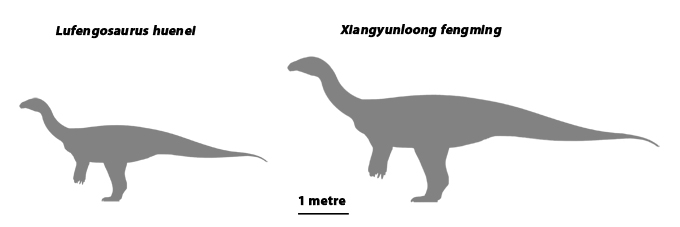
At around 9-10 metres in length Xiangyunloong is much larger than the coeval Lufengosaurus. Picture credit: Everything Dinosaur.
Picture credit: Everything Dinosaur
Phylogenetic analysis indicates that Xiangyunloong may represent a transitional form between the Massospondylidae and more derived sauropodiform dinosaurs.
Expanding Early Jurassic Dinosaur Diversity
This discovery highlights the diversity of early sauropodomorphs in China. Previously, most fossils came from a limited number of locations. Now, Xiangyunloong fengming demonstrates that these dinosaurs were more widespread than previously thought. Consequently, this find improves our understanding of their distribution.
Moreover, it suggests that regional ecosystems may have supported a wider variety of species. This has important implications for Early Jurassic palaeoecology.
The name Xiangyunloong translates to “auspicious cloud dragon”. It references the name of the county where the fossils were found. In addition, it incorporates the traditional term for dragon. The species name honours Lin Fengmian, the artistic master and founding president of the China Academy of Art, whose staff participated in the excavation and preparation of the fossil material. Furthermore, the species name translates as “phoenix calling”. It is a reference to Luming (deer calling), a town close to the fossil quarry. The species name reminds us that birds are living dinosaurs. Hence the dinosaur’s name symbolises both the locality and the evolutionary link between dinosaurs and birds.
The Significance of Xiangyunloong fengming
In summary, Xiangyunloong fengming provides new insight into early dinosaur evolution. It fills a geographic gap and adds to the growing diversity of known sauropodomorphs.
Furthermore, its mix of primitive and derived features makes it especially important. It helps bridge the gap between early forms and later giants. The large body size, proportionally short cervical vertebrae and the robust hip bones indicate an initial stage of gigantism and a potential bipedal locomotion. This may represent an alternative evolutionary pathway to the neck elongation seen in other early-diverging sauropodomorphs.
As a result, this discovery represents another step forward in understanding how some of the largest animals to ever walk the Earth evolved.
The scientific paper “A new sauropodomorph dinosaur from the Lower Jurassic Fengjiahe Formation of Dali of Yunnan Province, China” by Shao-Bin Hu, Yan-Chao Wang, Xiong Mo, Xiao-Qin Zhang, Wen-Tao Zeng, Tao Wang, Zai-Bo Sun, Qi-Xing Dong, Qi Guan, Yi-Hong Liu, Yu-Shen Zhang, Yin Bing, Ya-Ming Wang and Hai-Lu You published by The Royal Society Open Science.
The award-winning Everything Dinosaur website: Models of Prehistoric Animals.