

A new study by an international team of scientists shows that early amniotes – the ancestors of all modern reptiles, birds and mammals, developed significantly more diverse jaw shapes than amphibians (non-amniotes). This anatomical diversity enabled them to tap into new food sources and successfully adapt to life on land. The results of the study into early tetrapod jawbone evolution are published this week in the open-access journal PeerJ.
The research team included scientists from the Museum für Naturkunde Berlin and Humboldt University of Berlin. In addition, researchers from the Staatliches Museum für Naturkunde Stuttgart, the Oertijdmuseum in Holland and the North Carolina Museum of Natural Sciences were involved in this study.
The Transition from Aquatic to Terrestrial Environments
The transition from aquatic fish to land-dwelling vertebrates is one of the most significant changes in the history of life. In the Devonian period around 370 million years ago, the first tetrapods – four-legged vertebrates – ventured onto land. This exposed them to new challenges: their bodies had to be stable enough to stand and walk without water to help support their bodyweight. Furthermore, how they obtained food had to change. Fish feed differently from other vertebrates. For example, many fish suck in prey by opening their jaws rapidly. This creates low pressure which sucks in water and any prey. This method does not work when feeding on land.
Lead author of the study, Dr Jasper Ponstein, a former doctoral student at the Museum für Naturkunde Berlin stated:
“Many fish suck in their prey by opening their jaws at lightning speed. This method no longer works on land. There, animals have to actively grab their prey. This made changes to the jaw particularly important.”
Studying Early Tetrapod Jawbone Evolution
During the Carboniferous and later Permian periods, early land vertebrates diversified and spread into new habitats. These animals adapted to different diets. Some hunted the abundant arthropods such as insects, whilst others became herbivorous. These diets required adaptations to the jaw and muscles associated with the jawbones. This period in the history of vertebrates is extremely significant as back-boned animals adapted to non-aquatic environments on a large scale for the first time.
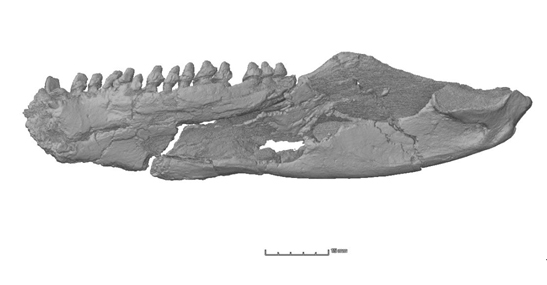
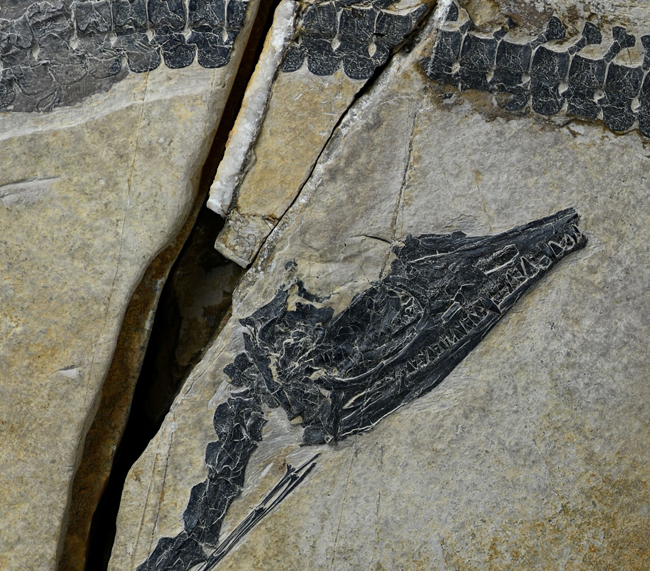
New research into early tetrapod jawbone evolution reveals that amniotes evolved diverse jawbones compared to non-amniotes. The image shows a jawbone of the reptiliomorph Diadectes absitus from the Early Permian. It was one of the first herbivorous tetrapods and one of the first terrestrial vertebrates to attain large size. Picture credit: Jasper Ponstein.
Picture credit: Jasper Ponstein
To find out how early tetrapods might have eaten, the team focused on the lower jaw – an element consisting of several bones whose shape reveals a lot about an animal’s diet. To this end, the researchers compiled the largest data set of fossil tetrapod jaws from the Carboniferous and Permian periods to date. The research covers more than two hundred different species. A significant portion of the fossils studied came from the collection of the Museum für Naturkunde Berlin.
Two Key Findings
This in-depth analysis of early tetrapod jawbone evolution identified two key findings:
(1). Immediately after the transition to terrestrial habitats the jaw morphology of early tetrapods remained remarkable constant. Long, slender jaw types predominated. It is likely that animals with this type of jaw fed on fish and/or insects. Despite becoming much more terrestrial, the basic shape of the jawbone initially changed very little.
(2). With the emergence of the first amniotes (reptiliomorphs) jaw morphology evolved rapidly.
During the Early Permian (approximately 300 million years ago), amniotes developed a much wider range of jaw shapes than contemporary amphibians. Their jaws became more robust, and the muscle attachment points more varied. These adaptations enabled amniotes to feed on a greater variety of food resources. For example, some amniotes such as Diadectes became herbivores.
Other amniotes evolved into hypercarnivores, specialising in catching large prey. Conversely, amphibians remained largely limited to a conservative jaw morphology that was simpler than those evolving in the Amniota. Moreover, extant amphibians retain their simply jaw morphology with most feeding on small invertebrates.
The Basis for Modern Ecosystems and Terrestrial Animal Diversity
This research suggests that jaw development permitted the exploitation of new food resources by tetrapods. It could be argued that these jawbone adaptations laid the foundations for modern ecosystems. In addition, the ability to exploit new resources led to an increase in animal diversity during the Late Palaeozoic.
Jasper Ponstein added:
“The early diversity of jaw shapes probably enabled amniotes to exploit ecological niches that remained closed to amphibians. In doing so, they laid the foundation for the impressive diversity of reptiles, birds and mammals that we see around the world today.”
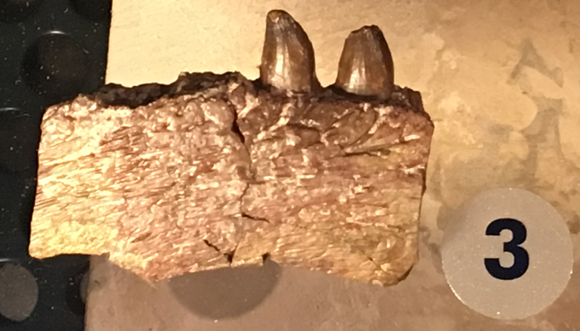
A close-up view of a jaw fragment from a Dimetrodon (Dimetrodon spp.). Early tetrapod jawbone evolution led to the emergence of hypercarnivores in the Early Permian such as Dimetrodon. Picture credit: Everything Dinosaur.
Picture credit: Everything Dinosaur
Today, the amniote group includes everything from turtles to birds to big cats – an enormous range of lifestyles. The study shows that this success is deeply rooted in Earth’s history: in the ability to adapt early and flexibly to exploit new food resources.
Everything Dinosaur acknowledges the assistance of a media release from the Museum für Naturkunde Berlin in the compilation of this article.
The scientific paper: “Mandibular form and function is more disparate in amniotes than in non-amniote tetrapods from the late Palaeozoic” by Jasper Ponstein, Mark J. MacDougall, Joep Schaeffer, Christian F. Kammerer and Jörg Fröbisch published in PeerJ.
The multi-award-winning Everything Dinosaur website: Prehistoric Animal Models.

Leave A Comment