

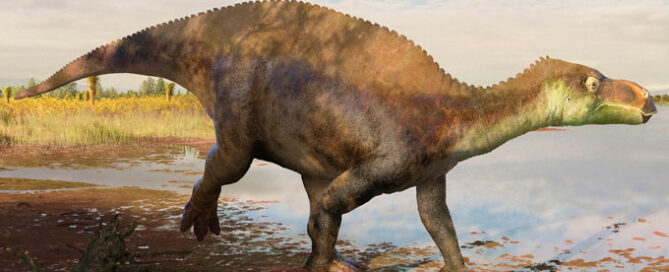
A New Iguanodontian Dinosaur from the Weald Clay Formation
A new species of British dinosaur has been scientifically described more than two decades after its fossils were discovered in Surrey. Named Paludohadros proudlovii, this plant-eating dinosaur lived approximately 125 million years ago during the Early Cretaceous. The fossils were excavated from a brickworks in 2001 and subsequently donated to the Natural History Museum in London. A detailed examination of the fossil material has revealed that the specimen represents a previously unrecognised species of iguanodontian dinosaur.
The discovery also has a poignant human story. The dinosaur has been named in honour of a former quarry manager who died shortly before the fossils were unearthed.
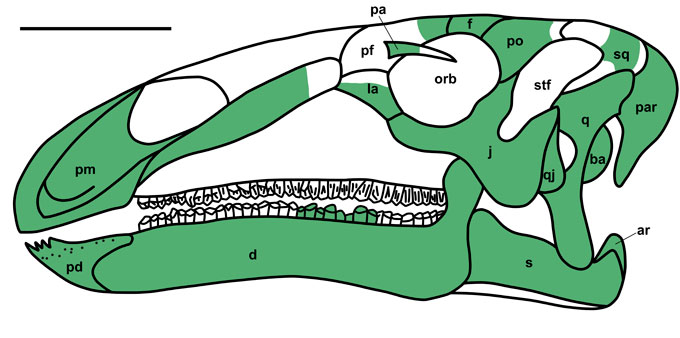
Skull reconstruction: Shaded areas represent material present in the holotype. Abbreviations: ar, articular; ba, basioccipital; d, dentary; f, frontal; j, jugal; orb, orbit; pa, palpebral; par, paraoccipital process; pd, predentary; pf, prefrontal; pm, premaxilla; q, quadrate; qj, quadratojugal; s, surangular; sq, squamosal, stf, supratemporal fenestra. Scale bar equals 10 cm. Picture credit: Sacamoto et al.
Picture credit: Sacamoto et al
Paludohadros proudlovii – A New Iguanodontian Dinosaur
Paludohadros proudlovii belonged to the Iguanodontia, a diverse group of predominantly herbivorous ornithopod dinosaurs. Famous members of this group include Iguanodon and Mantellisaurus. These dinosaurs are often associated with distinctive thumb spikes and adaptations for processing tough vegetation.
The newly named dinosaur was discovered at the Ewhurst brick and roof tile works, also known as Smokejacks Brickworks, in Surrey. Its fossils come from the Weald Clay Formation, deposited when much of southern England consisted of wetlands, rivers and muddy floodplains.
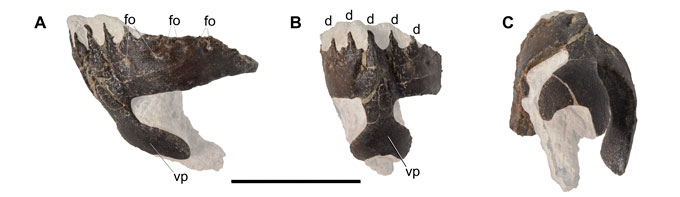
Predentary in left lateral (A), anterior (B) and ventral (C) views. Abbreviations: d, denticle; fo, foramen; vp, ventral process. Scale bar equals 5 cm. Picture credit: Sacamoto et al.
Picture credit: Sacamoto et al
The genus name reflects this ancient environment. It incorporates the Latin word “palus”, meaning swamp.
The specimen was approximately five metres long and is estimated to have weighed between 1.5 and two tonnes. However, examination of its bones suggests that it had not reached skeletal maturity when it died. A fully grown adult could potentially have been substantially larger.
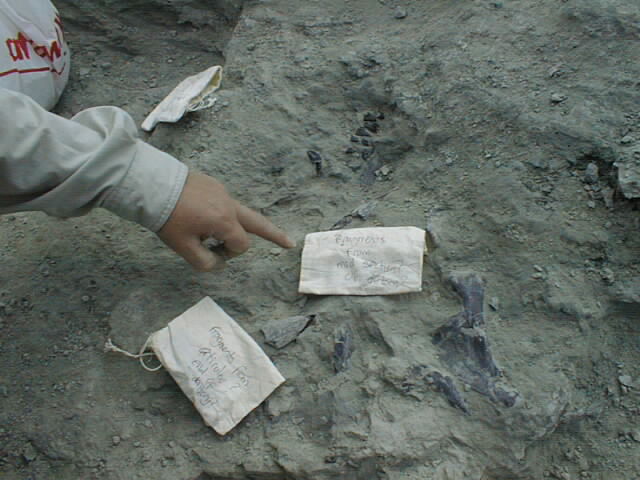
Identifying in situ skull bones. Picture credit: Tim Burgess (Wienerberger Ltd).
Picture credit: Tim Burgess (Wienerberger Ltd)
A Dinosaur Named in Honour of Will Proudlove
The species name “proudlovii” honours Will Proudlove, who worked at the Ewhurst brickworks and eventually became its manager. Will had a keen interest in fossils and was fascinated by the possibility of discovering prehistoric animals as successive layers of clay were removed from the quarry. Sadly, he died aged just 35, shortly before the dinosaur was excavated.
His wife Rachael and their two young children, Ellie and Matt, were invited to see the fossil excavation in 2001. More than twenty-five years later, the family has learnt that the fossils represent an entirely new type of dinosaur. The naming of Paludohadros proudlovii provides a lasting tribute to Will and his enthusiasm for natural history.
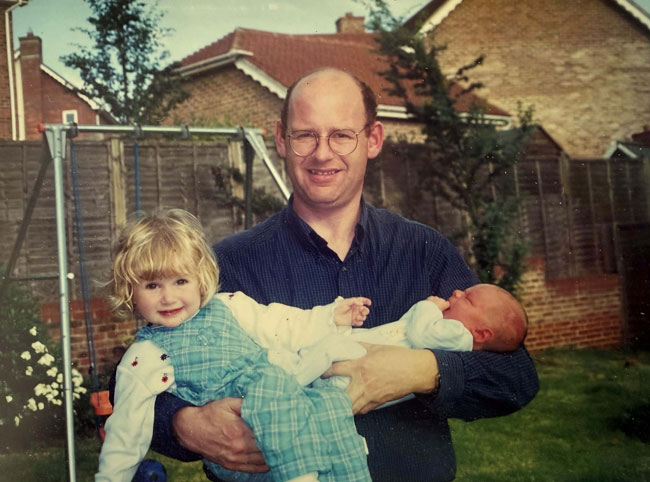
Will Proudlove with his children Ellie and Matt. Picture credit: The Proudlove Family.
Picture credit: The Proudlove Family
Did Paludohadros Live Alongside Baryonyx?
Intriguingly, the fossils of Paludohadros were discovered approximately a hundred metres from the location where the famous theropod dinosaur Baryonyx walkeri was found in 1983. Baryonyx was a large, predominantly fish-eating predator characterised by an elongated snout, conical teeth and enormous claws on its hands. However, fossil evidence indicates that fish were not its only food source. Remains of a juvenile iguanodontian were discovered in association with the original Baryonyx specimen.
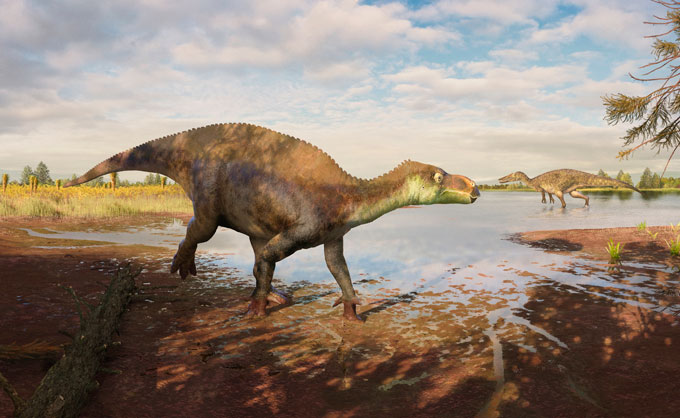
The newly described iguanodontian Paludohadros proudlovii in the foreground. In the background a Baryonyx wades through a shallow lake. The fossils of Paludohadros were found within a hundred metres of the Baryonyx walkeri holotype. Picture credit: Guilherme Gehr.
Picture credit: Guilherme Gehr
Professor Susannah Maidment, a senior author of the new study, explained that the identity of this young dinosaur remains uncertain.
Professor Maidment commented:
“Paludohadros was found just 100 metres away from Baryonyx, whose fossils we also look after at the Natural History Museum. While Baryonyx is best known for eating fish, this dinosaur’s last meal also included a baby iguanodontian. We can’t tell for certain which species this came from, so it’s possible that Baryonyx could have been scavenging on the remains of young Paludohadros or even hunting them when it had the opportunity.”
It is possible that Baryonyx occasionally hunted juvenile Paludohadros or scavenged their carcasses. However, there is currently insufficient evidence to establish a direct predator-prey relationship between these two dinosaurs. Nevertheless, their discoveries provide a fascinating insight into the dinosaur communities that inhabited southern England during the Early Cretaceous.
More British Dinosaurs Awaiting Discovery
For many years, numerous iguanodontian fossils from southern England were assigned to familiar genera such as Iguanodon and Mantellisaurus. More detailed anatomical studies have challenged these traditional classifications. Recent research has resulted in the naming of several additional British iguanodontians, including Brighstoneus, Comptonatus and the distinctive sail-backed Istiorachis.
To read Everything Dinosaur’s article about the discovery of Brighstoneus: New Iguanodontid from the Isle of Wight.
Everything Dinosaur’s article from 2024 highlighting the discovery of Comptonatus: Comptonatus – Another New Ornithopod from the Isle of Wight.
The scientific description of Paludohadros proudlovii adds to this growing diversity.
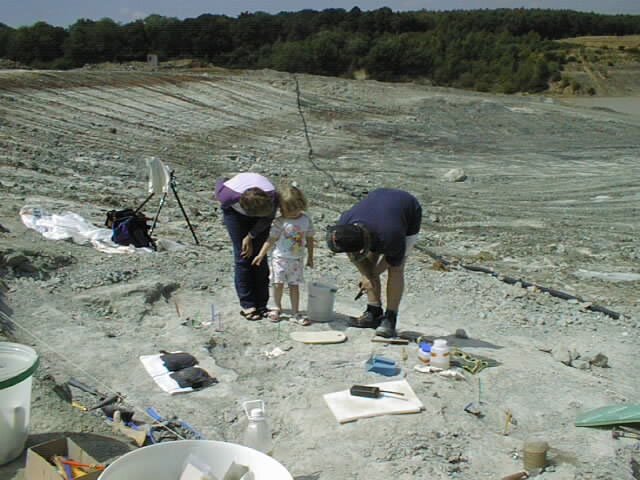
Ellie Proudlove, daughter of Will, being shown the dinosaur during its excavation from the quarry. Picture credit: Tim Burgess (Wienerberger Ltd) and used with permission from Ellie Proudlove.
Picture credit: Tim Burgess (Wienerberger Ltd) and used with permission from Ellie Proudlove
Our 2025 post about the discovery of Istiorachis macarthurae: New Sail-backed Iguanodontid Described.
The research was led by Ricardo Sacamoto, a PhD student associated with the Natural History Museum and the University of São Paulo. The team identified distinctive anatomical characteristics in the teeth, jaws and limb bones that support the establishment of the new genus and species.
Further examination of museum collections has already identified additional fossils attributable to Paludohadros, including material originally collected during the 1950s.
Sacamoto intends to continue studying the Natural History Museum’s extensive iguanodontian collections as part of his doctoral research.
There may be more previously unrecognised dinosaur species waiting to be identified.
The discovery of Paludohadros proudlovii demonstrates the enduring scientific importance of natural history collections. Sometimes, discovering a new dinosaur does not require another expedition into the field. Instead, the next remarkable discovery could already be sitting in a museum drawer.
Everything Dinosaur acknowledges that assistance of a media release from the London Natural History Museum in the compilation of this article.
The scientific paper: “A new iguanodontian dinosaur from the Weald Clay Formation (Lower Cretaceous) of Smokejacks Brickworks, southern England” by Ricardo J. Sacamoto, Jeremy A. F. Lockwood, Max C. Langer, Brett Clark, Paul M. Barrett, Alice Turner and Susannah C. R. Maidment published in the Journal of Systematic Palaeontology.
The award-winning Everything Dinosaur website: Dinosaur Models Including British Prehistoric Animal Figures.