

Amazing “Hell Chicken” Discovery Reveals a Fruit-Eating Dinosaur
A remarkable theropod discovery is providing fresh insights into the diets of prehistoric animals. Scientists have identified a new species of small, feathered dinosaur that appears to have been specially adapted to eat fruit. Named Infernogallus jamesi, this unusual, potential fruit-eating dinosaur lived in North America during the Late Cretaceous and shared its environment with famous dinosaurs such as Tyrannosaurus rex and Edmontosaurus annectens.
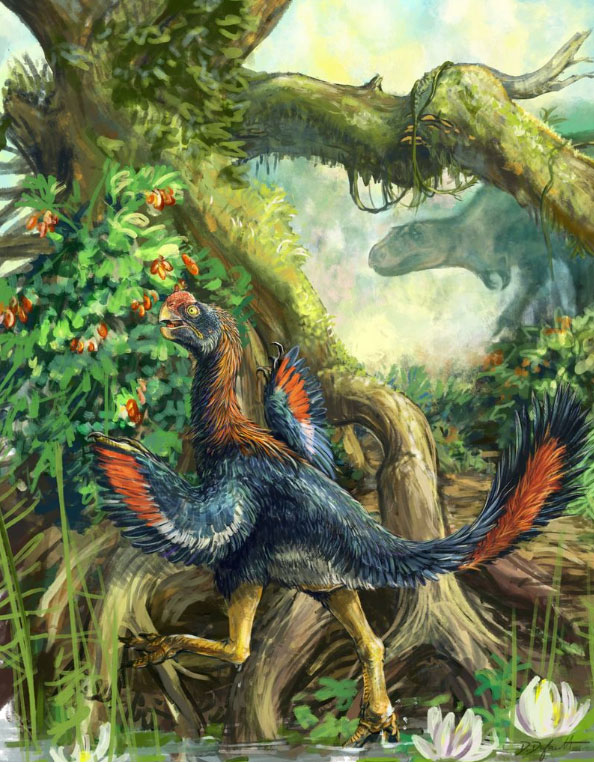
Life reconstruction of the Hell Chicken Infernogallus munching on early fruit, while a T. rex lurks in the background. Picture credit: Danielle Dufault.
Picture credit: Danielle Dufault
Nicknamed the “Hell Chicken”, Infernogallus jamesi belonged to a group of bird-like dinosaurs called caenagnathids (pronounced seen-nag-nay-thids). Although these dinosaurs were related to meat-eating theropods, the new research suggests that this particular species had evolved a highly specialised diet, feeding on fleshy fruits produced by flowering plants. The discovery is particularly significant because it provides some of the strongest evidence yet that dinosaurs developed specialised adaptations for eating fruit.
An article from 2024 providing further information on the Caenagnathidae family: Getting to Grips with the Remarkable Caenagnathidae Family.
Meet Infernogallus – The “Hell Chicken” Dinosaur
The fossils of Infernogallus jamesi were discovered in the famous Hell Creek Formation, a geological formation that extends across parts of Montana, North Dakota, South Dakota and Wyoming in the United States. This is one of the most celebrated dinosaur-bearing deposits in the world. During the Late Cretaceous, approximately sixty-six million years ago, the region was home to an extraordinary variety of prehistoric animals, including Tyrannosaurus rex, Triceratops, Nanotyrannus, Ankylosaurus, Edmontosaurus and numerous other dinosaurs.
Despite living alongside some of the largest dinosaurs ever to walk on land, Infernogallus was relatively small. It was approximately the size of a modern turkey and weighed around twelve kilograms.
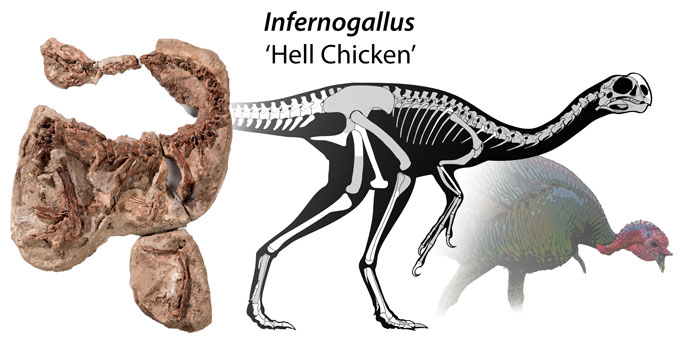
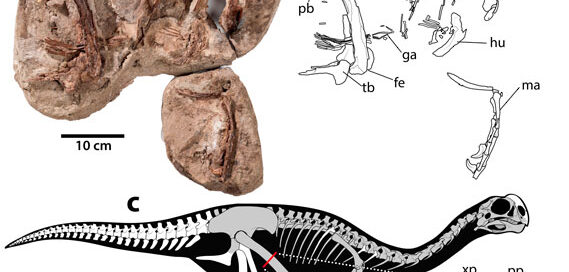
Infernogallus jamesi “Hell Chicken” fossil specimen (left), skeletal drawing (centre) and a size comparison with a turkey (right). Picture credit: Funston et al (2026).
Picture credit: Funston et al (2026)
The name Infernogallus translates as “hell chicken”, a reference to the Hell Creek Formation where its fossils were discovered. The specific name, “jamesi”, honours James William Boyd, the grandfather of Clint Boyd from the North Dakota Geological Survey, and one of the authors of the scientific paper. Clint’s grandfather inspired his interest in palaeontology.
Importantly, the holotype specimen includes a nearly complete, articulated skull and part of the skeleton. The holotype skull of I. jamesi is the first articulated and nearly complete skull discovered for a caenagnathid oviraptorosaur. Complete skulls of small theropod dinosaurs are exceptionally rare, making this fossil particularly valuable to palaeontologists.
The fossils are currently on display at the Royal Ontario Museum (ROM) in Toronto, Canada.
An Extraordinary Skull Reveals a Taste for Fruit
The most remarkable feature of Infernogallus is its unusual skull anatomy. Researchers from Stony Brook University, the Royal Ontario Museum and the North Dakota Geological Survey used CT scanning to reconstruct the skull and investigate how its jaw muscles operated. Their analysis revealed an arrangement of chewing muscles that is highly unusual among non-avian dinosaurs.
The researchers discovered that the palatal bones, which form the roof of the mouth, curved downwards into the oral cavity. This altered the arrangement of important jaw muscles, positioning some of them to work in a forward-and-backward direction rather than simply powering an up-and-down biting movement.
Consequently, Infernogallus appears to have been capable of moving its beak backwards and forwards while processing food.
This is quite different from the powerful vertical biting action associated with large predatory dinosaurs such as Tyrannosaurus rex.
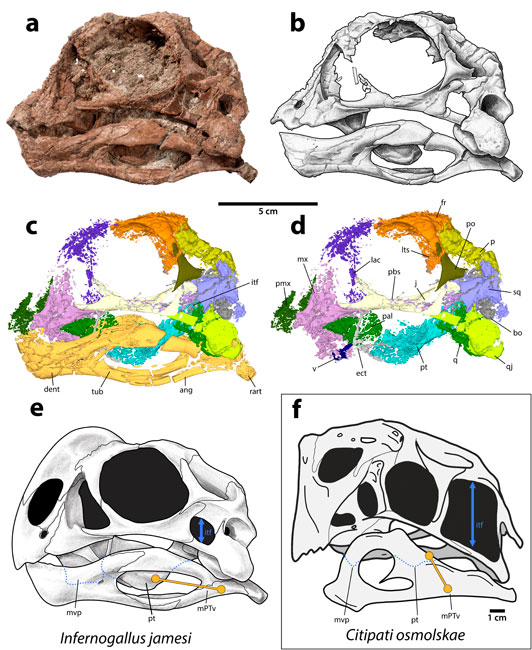
Cranial anatomy of Infernogallus jamesi gen. et. sp. nov. Photograph (a) and line drawing (b) of the skull of ROM VP 65050 in left lateral view. A μCT reconstruction of the skull and mandible (c), with each bone segmented separately (colours) and retrodeformed. A μCT reconstruction (d) with the mandible removed to show the palatal bones, which protrude ventrally below the cheek margin and the mandibular articulation point of the quadrate. An idealised reconstruction of the skull and mandible (e) as they would have appeared in life, showing distinctive reduction of infratemporal fenestra (blue arrow), and rearrangement of pterygoid musculature (orange line) compared to archetypal oviraptorid Citipati osmolskae (f). Picture credit: Funston et al (2026).
Picture credit: Funston et al (2026)
The researchers identified similarities between the jaw mechanics of Infernogallus and those of certain modern fruit-eating birds, particularly the vulturine parrot (Psittrichas). Although these animals are not closely related, their similar feeding adaptations provide an excellent example of convergent evolution. This occurs when unrelated animals independently evolve comparable anatomical features because they face similar ecological challenges.
In this instance, the researchers suggest that the unusual chewing mechanism evolved to help Infernogallus process soft foods, particularly fleshy fruits.
A Fruit-eating Dinosaur?
Unlike many plant-eating dinosaurs, which relied on their teeth or swallowed stones to help break down vegetation, Infernogallus had a toothless beak adapted for a different feeding strategy. Its skull contained specialised ridges and grooves that would have helped the animal mash and shear soft plant material.
The researchers propose that it was particularly well adapted to processing stone fruits, removing the fleshy material surrounding the central seed. This is an important distinction. Rather than simply swallowing pieces of vegetation, Infernogallus appears to have been capable of mechanically processing food inside its mouth. Such adaptations are relatively unusual in the animal kingdom. Complex chewing mechanisms are found in mammals, including humans, and in certain birds that specialise in eating fruit.
The discovery suggests that some dinosaurs developed similarly sophisticated feeding mechanisms.
Did Fruit-Eating Dinosaurs Help Flowering Plants Spread?
The discovery of Infernogallus jamesi has implications that extend beyond our understanding of dinosaur diets. During the Cretaceous Period, flowering plants, known scientifically as angiosperms, were becoming increasingly diverse and widespread. They were gradually transforming terrestrial ecosystems, with fruits becoming an increasingly important food resource.
The researchers identified an intriguing relationship between the diversification of caenagnathid dinosaurs and the increasing abundance and diversity of fleshy fruits.
Could these small dinosaurs have helped flowering plants spread?
Modern birds, mammals and reptiles play an important role in seed dispersal. By eating fruits and subsequently depositing the seeds elsewhere, these animals help plants colonise new areas. The researchers suggest that caenagnathid dinosaurs might have performed a similar ecological role during the Late Cretaceous.
However, this remains a hypothesis requiring further investigation. The fossils provide compelling evidence of specialised fruit-eating adaptations, but they do not directly demonstrate how far these dinosaurs transported seeds or how important they were to the spread of flowering plants. Nevertheless, the possibility introduces an exciting new dimension to our understanding of Cretaceous ecosystems.
Fossil Proves Mahogany evolved during the Cretaceous: Mahogany Dates Back to the Dinosaurs.
A New Perspective on Dinosaur Diversity
The discovery of Infernogallus demonstrates just how much there is still to learn about dinosaur evolution. For many years, palaeontologists have recognised that theropod dinosaurs evolved into a remarkable variety of ecological specialists. However, the discovery of a dinosaur with such specialised adaptations for eating fruit highlights how diverse their feeding strategies may have been.
It also raises interesting questions about the relationship between dinosaurs and flowering plants during the final stages of the Cretaceous. The researchers suggest that caenagnathids may have evolved alongside the increasing availability of fleshy fruits, developing specialised skull anatomy to exploit this food source.
This discovery also contributes to wider discussions about dinosaur diversity towards the end of the Cretaceous and whether dinosaur populations were already experiencing a decline before the mass extinction event approximately sixty-six million years ago.
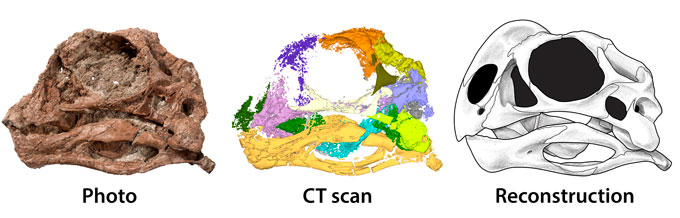
The holotype skull (left), a CT scan of the fossil material (centre) and a line drawing of the reconstructed skull (right). Picture credit: Funston et al (2026).
Picture credit: Funston et al (2026)
To read a recently published article about the discovery of another new species of caenagnathid: Student Discovers New Species of Caenagnathid.
Fruit-eating Theropod Discovery Provides Insights into Dinosaur Evolution and Ecology
Senior author of the paper, Dr David Evans (Royal Ontario Museum) commented:
“Complete remains of small dinosaurs like Infernogallus are very rare in the fossil record. The strange skull of Infernogallus is an exciting find because it reveals surprising insights into dinosaur evolution and feeding specialization. This discovery shows that we still have a lot to learn about the world of T. rex, and about dinosaurs more generally.”
The unusual skull of Infernogallus reveals surprising insights into dinosaur evolution and feeding specialisation. It reminds us that the dinosaur dominated food webs of the Mesozoic were just as complex as those we see today.
Sometimes, the most remarkable dinosaur discoveries are not the biggest or most fearsome animals, but the small and unusual species that reveal something entirely unexpected about prehistoric life.
Everything Dinosaur acknowledges the assistance of a media release from the Royal Ontario Museum in the compilation of this article about a fruit-eating dinosaur.
The scientific paper: “Fruit-eating adaptations in a Late Cretaceous oviraptorosaur (Theropoda)” by Gregory F. Funston, Thomas W. Dudgeon, D. Jade Simon, Danielle M. Dufault, Clint Boyd, Denver Fowler, Philip J. Currie and David C. Evans published in Nature Communications.
Visit the Everything Dinosaur website: Models of Theropods and Other Dinosaurs.