

Spinosaurids Originated in Europe According to Recently Published Research
A recently published scientific study suggests that spinosaurid dinosaurs originated in Europe before spreading to Africa, South America and Asia. These remarkable theropods, characterised by their elongated, crocodile-like jaws and adaptations for life around water, were amongst the most unusual predatory dinosaurs of the Mesozoic. The research indicates that the evolutionary history of the Spinosauridae involved several distinct dispersal events, with climate and environmental conditions potentially restricting their geographical distribution.
The study was published in the journal “Royal Society Open Science”. The research provides new insights into the origins, evolution and geographical distribution of this fascinating group of theropod dinosaurs.
The European Origins of Spinosaurid Dinosaurs
Spinosaurids are a distinctive group of theropod dinosaurs that include Spinosaurus, Baryonyx, Suchomimus and Irritator. Many possessed elongated snouts, conical teeth and powerful forelimbs. These anatomical characteristics have frequently been interpreted as adaptations associated with capturing fish and other aquatic prey.
Although spinosaurid fossils have been discovered on several continents, their evolutionary origins and the routes by which they dispersed have remained uncertain.
The new research supports the hypothesis that the Spinosauridae originated in Europe, with important early representatives known from the Lower Cretaceous deposits of England and the Iberian Peninsula.
For example, Baryonyx walkeri, which was discovered in Surrey in 1983, provides important evidence of the presence of these theropods in Early Cretaceous Europe.
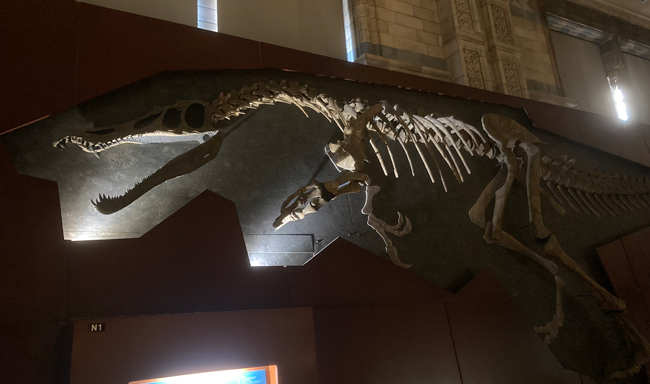
The mounted cast of the Baryonyx skeleton on display at the London Natural History Museum. Picture credit: Everything Dinosaur.
Picture credit: Everything Dinosaur
The researchers suggest that Europe played a pivotal role in the early evolutionary history of the Spinosauridae before members of this family dispersed into other parts of the world.
Multiple Dispersal Events into Africa and South America
One of the most significant findings concerns the movement of spinosaurid dinosaurs between ancient landmasses. Using computational biogeographical analyses, the scientists reconstructed possible dispersal routes and examined how these theropods spread across the changing geography of the Mesozoic. The results indicate that there were at least two distinct dispersal events from Europe into Africa and South America, together with at least one dispersal from Europe into Asia.
These findings suggest that the distribution of spinosaurids cannot be explained by a single migration event. Instead, the research supports a more complex evolutionary history involving repeated movements between geographical regions.
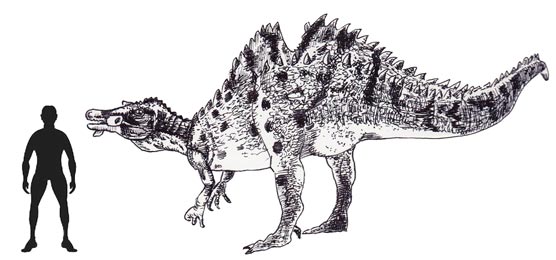
A scale drawing of the spinosaurid from Laos (Ichthyovenator laosensis). Picture credit: Everything Dinosaur.
Picture credit: Everything Dinosaur
During the Early Cretaceous, the configuration of continents differed considerably from that of the modern world. Africa and South America were gradually separating as the South Atlantic Ocean developed, whilst changing sea levels periodically altered the connections between landmasses.
The researchers propose that these geographical changes may have created opportunities for spinosaurid dispersal, although the precise routes taken remain uncertain.
To read Everything Dinosaur’s recent article highlighting the discovery of a second Spinosaurus species in Africa: A New Scimitar-crested African Spinosaurus is Described.
Climate May Have Restricted Spinosaurid Distribution
The study also investigated the environmental conditions associated with spinosaurid fossil occurrences. Using existing palaeoclimate model data, the researchers found that spinosaurids generally inhabited warm, semi-aquatic environments with estimated mean annual temperatures of approximately 26.1°C to 33.1°C.
These environments also appear to have experienced relatively limited seasonal temperature variation, estimated at approximately ±8.46°C. Such conditions would have provided suitable habitats for theropods adapted to exploiting aquatic and shoreline food resources.

Wandering close to the water. An image of the new for 2024 Maxim the Baryonyx dinosaur model. A new study highlights the evolution and distribution of spinosaurid dinosaurs.
The image above shows a Baryonyx model which is part of the PNSO model range.
To view the extensive range of PNSO prehistoric animal figures: PNSO Prehistoric Animal Models.
Importantly, the researchers found that the inferred environmental preferences of spinosaurids were more restricted than those of several other groups of medium-to-large theropod dinosaurs. This suggests that climate may have played an important role in determining where spinosaurids could successfully establish populations.
Two new spinosaurids described from the Isle of Wight: Two New Spinosaurid Taxa Described from Isle of Wight Fossils.
Regions characterised by cooler temperatures, greater seasonal variation or unsuitable aquatic habitats may have presented significant barriers to their dispersal. Consequently, the geographical distribution of the Spinosauridae may have been more limited than that of other large theropod groups.
Why Are Spinosaurid Fossils Absent from Some Continents?
Spinosaurid fossils are known from Europe, Africa, South America and Asia. However, there are no generally accepted spinosaurid fossil discoveries from North America, Australia or Antarctica. This uneven distribution has puzzled palaeontologists. The new study suggests that climatic barriers and environmental preferences could help explain why spinosaurids failed to establish themselves in some geographical regions.
Unlike other large theropods that occupied a broad range of habitats, spinosaurids may have depended more heavily on particular combinations of temperature, aquatic environments and available prey. However, the absence of confirmed fossils does not necessarily demonstrate that these dinosaurs never inhabited a particular region. Differences in fossil preservation, exposure and collecting effort must also be considered.
Nevertheless, the research provides a plausible explanation for the comparatively restricted geographical distribution of this distinctive theropod family.
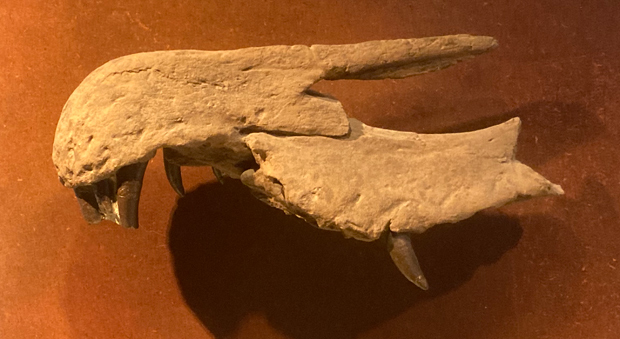
Casts of the preserved premaxilla and the maxilla of Baryonyx on display at the London Natural History Museum. Picture credit: Everything Dinosaur.
Picture credit: Everything Dinosaur
New Insights into Spinosauridae Evolution
The findings demonstrate that the evolutionary history of spinosaurid dinosaurs was influenced by a combination of geographical change, dispersal opportunities and environmental conditions.
Rather than spreading freely across the ancient continents, these theropods may have followed particular routes that provided suitable climatic conditions and access to aquatic habitats. The study also highlights the importance of European fossil discoveries in understanding the origins of the Spinosauridae.
Famous European taxa such as Baryonyx and other spinosaurids from the Iberian Peninsula continue to provide valuable evidence concerning the early evolution of this remarkable dinosaur family. For palaeontologists, the research offers a new perspective on how geography and climate influenced the distribution of large predatory dinosaurs during the Cretaceous Period.
A new spinosaurid dinosaur from the Iberian Peninsula: Baryonychine from the Early Cretaceous of Spain.
Further fossil discoveries and more refined palaeoclimate models should help scientists test these hypotheses and develop a clearer understanding of how spinosaurids spread across the ancient world.
The scientific paper: “Sailing to Gondwana: multiple waves of spinosaurid dispersal to the southern continents” by Zak E. Lewis, Charlie R. Scherer, Tom T. P. van der Linden, Paul J. Byrne Bethany Burke, Colin Boisvert, Ezekiel V. O’Callaghan; Kenneth C. Rayburn, Robert Mayer; Chance Guest; Harry T. Jones, Tristan Moran; Steven J. R. Allain and Cassius Morrison published in Royal Society Open Science.
The multi-award-winning Everything Dinosaur website: Models of Spinosaurids and Other Dinosaurs.