

Major Evolution Study Delivers Powerful Evidence Supporting Darwin’s Theory
A major new study from the University of Bath has found no evidence that important genes receive special protection from mutations, challenging claims that scientists need to rewrite our established understanding of evolution. This study suggests there is no need to amend Darwin’s theory of evolution. The research, published today (12th November, 2026), in the journal “PLOS Biology”, represents the largest analysis of its kind. Scientists examined spontaneous mutations in two microorganisms: the bacterium Escherichia coli (E. coli) and baker’s yeast (Saccharomyces cerevisiae).
Dr Sofia Radrizzani and Professor Laurence D Hurst, from the University of Bath’s Centre for Evolution, led the research. Their findings challenge a long-standing proposal that natural selection might reduce mutation rates in genes that perform essential functions.
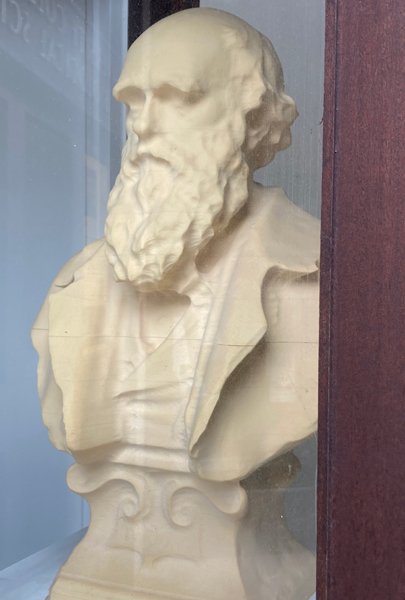
The Sir Charles Darwin bust on display at the Darwin Building of the Wellcome Trust in London. New research provides further evidence to support the fundamental principles of Darwin’s theory of evolution. Picture credit: Everything Dinosaur.
Picture credit: Everything Dinosaur
The researchers found no evidence to support this idea, providing further backing for the conventional understanding of how evolution works.
How Does Darwin’s Theory of Evolution Work?
Charles Darwin’s theory of evolution describes how natural selection influences the characteristics of populations over successive generations. Evolution is traditionally understood as a two-stage process. First, mutations generate genetic variation within populations. Natural selection then acts on that variation, favouring characteristics that improve an organism’s chances of survival and reproduction under particular environmental conditions.
Darwin’s famous observations of finches on the Galápagos Islands in 1835 provide a useful illustration. Different finch species possess differently shaped beaks, allowing them to exploit different food sources. Random genetic mutations generate variation, while environmental conditions influence which characteristics give individuals a reproductive advantage. Over many generations, natural selection can make advantageous traits more common within a population.

Although probably descended from a common ancestor, over time, different finch species on the Galapagos archipelago evolved differently shaped beaks, allowing them to exploit a wide variety different food sources on the resource depleted islands. Picture credit: Everything Dinosaur (with AI assistance).
Picture credit: Everything Dinosaur with assistance from AI
The famous book: The Origin of Species (Full Title).
However, some scientists have questioned whether mutations occur randomly across the genome. They have suggested that organisms might protect important genes from mutations while allowing genes that could help them adapt to environmental changes to mutate more frequently. For example, genes involved in DNA replication and essential cellular processes might receive protection, while mutations affecting other genes could help bacteria develop antibiotic resistance.
The new University of Bath research challenges this proposal.
The Problem with Protecting Essential Genes
At first glance, the idea of protecting important genes from mutations might seem logical. Mutations affecting essential genes can cause serious problems, potentially damaging the organism or preventing a cell from surviving. However, the researchers identified theoretical difficulties with this proposal.
Gene mutation rates are already extremely low. Reducing them further in individual genes would provide only a small additional benefit. This makes it difficult to explain how natural selection could favour biological mechanisms that specifically protect particular genes from mutations.
The researchers also highlighted a problem with earlier studies: natural selection can remove harmful mutations before scientists have an opportunity to identify them.
Professor Hurst described these missing changes as “ghost mutations”.
He added:
“We’d expect natural selection to rapidly remove mutations when they occur in more important genes, because these mutations are more likely to be harmful to the organism. This can create the illusion that important genes have fewer mutations when, in reality, some mutations have simply disappeared before we have a chance to analyse them – what you can think of as ‘ghost mutations’.”
Mutations affecting essential genes are more likely to damage an organism. Natural selection can therefore remove affected individuals or cells from a population, making those mutations harder to detect in subsequent studies. This process could create the misleading impression that important genes experience fewer mutations, even when their original mutation rates remain unchanged.
Scientists Investigate ‘Ghost Mutations’
To address this problem, the research team examined data from mutation accumulation experiments involving E. coli and baker’s yeast (Saccharomyces cerevisiae). Scientists design these experiments to minimise the influence of natural selection, allowing mutations to accumulate over successive generations. This approach gives researchers a clearer picture of how frequently different parts of the genome experience mutations.
The team conducted three separate tests to establish whether natural selection had significantly distorted the results. All three tests supported the reliability of the data.
Dr Radrizzani described the resulting dataset as the largest and cleanest collection of mutations assembled to date. The researchers then investigated whether essential genes really did experience lower mutation rates.
They compared mutation frequencies with experimental evidence showing what happens when scientists remove individual genes. Some genes are essential for survival, meaning that their removal kills the cell. Other genes can disappear without producing a significant effect. The team found no evidence that essential genes mutated less frequently in either E. coli or baker’s yeast.
Professor Hurst explained that the researchers found no support for the proposed relationship, regardless of how they analysed the data.
What Other Factors Influence Mutation Rates?
The scientists also examined alternative ways of measuring the importance of individual genes. These included the amount of protein a cell produces from a particular gene and the strength of natural selection acting on that gene over evolutionary timescales. Neither measure predicted lower mutation rates.
Genes that produce more abundant proteins did not experience fewer mutations. Similarly, the evolutionary history of a gene did not reliably indicate how frequently it mutated. However, the researchers did identify structural features of the genome that influence mutation rates. For example, genes that DNA replication machinery copies later during the replication process tend to experience more mutations.
This finding highlights how the physical organisation and activity of the genome can influence genetic variation.
No Need to Rewrite Darwin’s Theory of Evolution
The University of Bath study provides important evidence against the suggestion that natural selection protects essential genes by reducing their mutation rates. The researchers found no support for this proposed mechanism in either of the two microorganisms they investigated. Although the study identified known influences on mutation rates, none supported the claims that have challenged the conventional understanding of evolution.
Darwin highlights the Quagga to explain variation: The Extinct Quagga Helps to Explain the Laws of Variation.
Professor Hurst concluded that the findings provide no grounds for a fundamental change in the established evolutionary paradigm. The research reinforces the importance of distinguishing between the generation of genetic variation through mutation and the subsequent influence of natural selection. It seems there is no need to modify Darwin’s theory of evolution, not for the time being anyway.
Understanding how these processes interact remains central to evolutionary biology, helping scientists investigate how organisms adapt, diversify and respond to changing environments.
Everything Dinosaur acknowledges the assistance of a media release from the University of Bath in the compilation of this article.
The scientific paper: “The importance of genes does not predict their mutation rate” by S. Radrizzani and L. D. Hurst published in PLOS Biology.
The award-winning Everything Dinosaur website: Models of Prehistoric Animals.