

Bizarre Pygmy Sperm Whale from the Late Miocene
An international team of palaeontologists has described a remarkable prehistoric whale with an extraordinarily asymmetrical skull. The newly named Scaphokogia huachafo lived approximately six million years ago during the Late Miocene. Its bizarre skull anatomy challenges our understanding of mammalian evolution. The researchers published their findings in the scientific journal “Communications Biology”. They suggest that this extinct relative of modern pygmy sperm whales possessed the most asymmetrical skull known in any cetacean, and possibly any mammal.
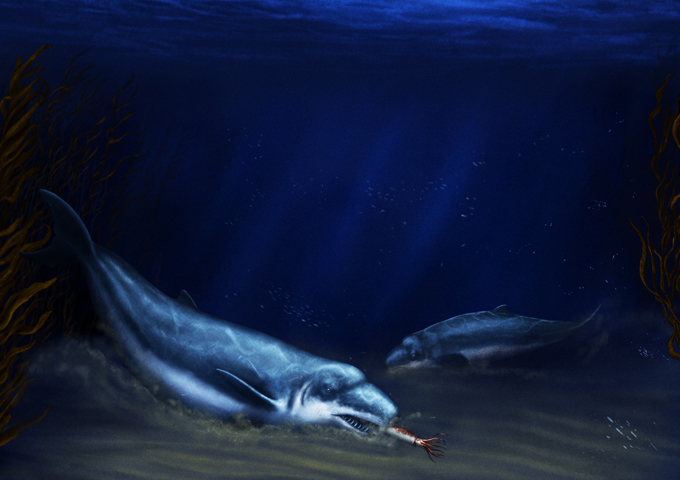
Life reconstruction of the extinct pygmy sperm whale Scaphokogia huachafo. The animal (~2.7 m long) is shown foraging along the muddy seafloor in the Sacaco basin (southern Peru) during the Late Miocene (~6.3 to 5.6 million years ago), in a coastal bay partially blanketed by kelp forests. Dense cranial ballast and a downturned snout allowed it to cruise the bottom and scan the soft substrate for prey using specialised biosonar. Picture credit: Jaime Bran Sarmiento.
Picture credit: Jaime Bran Sarmiento
Scaphokogia huachafo – An Extraordinary Prehistoric Whale
Scientists estimate that Scaphokogia huachafo measured approximately 2.7 metres in length. Its skull exhibits extreme distortion, with both bony nostrils displaced entirely to the left side. Unlike most vertebrates, toothed whales possess naturally asymmetrical skulls. These adaptations accommodate specialised structures associated with sound production and echolocation. However, the newly described species takes this evolutionary adaptation to an extraordinary extreme.
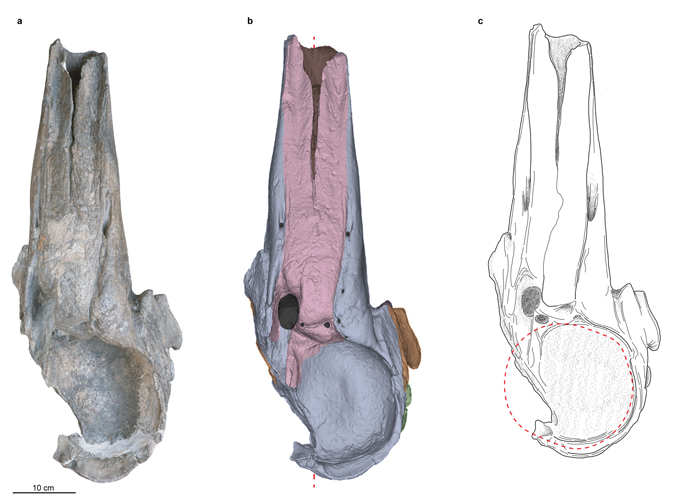
Holotype skull of Scaphokogia huachafo (MUSM 972) in dorsal view: original fossil specimen showing fully fused sutures with no crushing or pathologies (left/a), 3D digital segmentation of cranial bones (middle/b), and schematic line drawing (right/c). Note the extreme, unprecedented cranial asymmetry: both bony nares are displaced entirely to the left, and facial bone distortion extends into the orbits and neck articulation. Picture credit: Aldo Benites-Palomino.
Picture credit: Aldo Benites-Palomino
Lead author Assistant Professor Aldo Benites-Palomino of Friedrich-Alexander-Universität Erlangen-Nürnberg explained:
“The skull looks completely crooked.”
The researchers named the species “huachafo”, a term from Peruvian Spanish describing something extravagant, bizarre or exaggerated. The name reflects the whale’s astonishing cranial anatomy.
A Remarkable Fossil Discovery in Peru
Peruvian palaeontologist Mario Urbina discovered the fossil skull during fieldwork in the mid-1990s. He found the specimen in the famous Pisco Formation of southern Peru. The fossil dates to approximately 6.3–5.6 million years ago (Late Miocene Epoch).
For decades, the skull remained in the collections of the Museo de Historia Natural in Lima. Its unusual appearance initially raised questions about whether geological processes had distorted the bones. However, detailed examination revealed no evidence of crushing, fractures or pathological abnormalities. The extraordinary skull shape represented genuine biological anatomy.
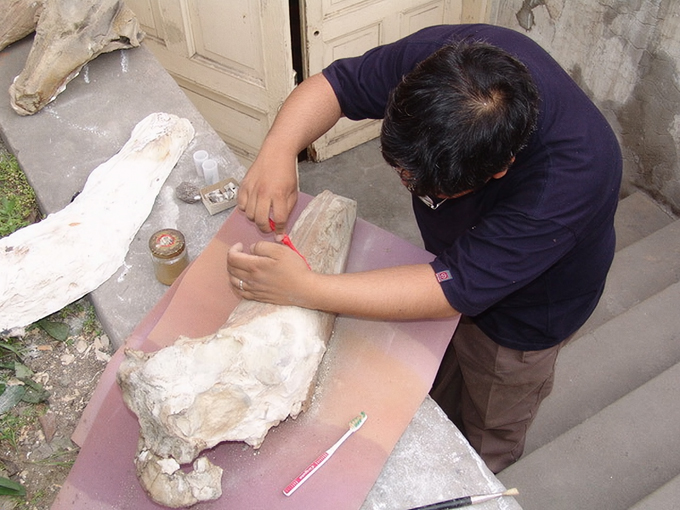
Dan Omura (fossil preparator and study co-author, Centro de Desarrollo para la Educacion Lima Nikko / Museo de Historia Natural UNMSM) during the mechanical preparation of the holotype skull of Scaphokogia huachafo (MUSM 972). Picture credit: Aldo Benites-Palomino.
Picture credit: Aldo Benites-Palomino
Benites-Palomino began investigating the specimen in 2015 while completing his undergraduate studies. His research eventually developed into a decade-long scientific investigation.
An Unusual Prehistoric Marine Predator
The anatomy of Scaphokogia huachafo suggests that it specialised in searching for food along the seabed. Its thick, reinforced snout angled downwards by approximately 31 degrees. Furthermore, reconstructions of the skull and neck articulation indicate that the animal could flex its head downwards by as much as 55 degrees.
The researchers propose that these adaptations helped the whale forage in shallow coastal environments.
Co-author Dr Gabriel Aguirre-Fernández of the University of Zurich explained:
“The entire cranio-cervical complex is modified to point the snout directly toward the bottom.”
The scientists also hypothesise that the animal used its sophisticated echolocation system to detect prey hidden within soft marine sediments.
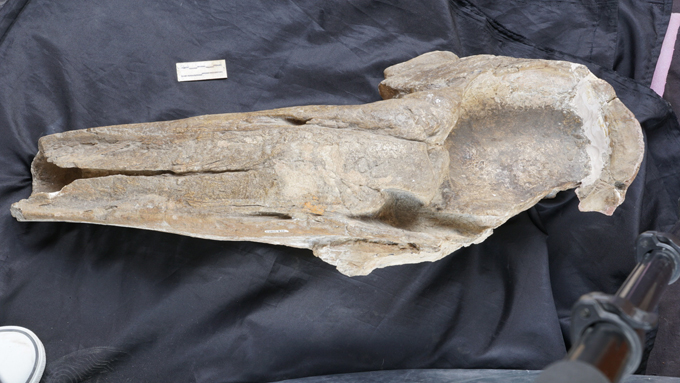
The holotype skull of Scaphokogia huachafo (MUSM 972) in 2023 undergoing comprehensive anatomical description and digital 3D modelling during doctoral research at the University of Zurich. Picture credit: Aldo Benites-Palomino.
Picture credit: Aldo Benites-Palomino
Understanding the Evolution of Sperm Whales
The discovery of Scaphokogia huachafo highlights the remarkable evolutionary diversity of prehistoric whales. Modern sperm whales typically hunt in deep ocean waters. However, their extinct relatives occupied a much wider variety of ecological niches.
This extraordinary fossil provides important evidence of how skull asymmetry evolved in toothed whales. It also demonstrates how specialised adaptations enabled ancient marine mammals to exploit different feeding environments.
Everything Dinosaur acknowledges the assistance of Dr Aldo Marcelo Benites Palomino and the University of Zurich in the compilation of this article.
The scientific paper: “Extreme cranial asymmetry in extinct benthic feeding sperm whales” by Aldo Benites-Palomino, Marcelo R. Sánchez-Villagra, Florencia Paolucci, Jorge Vélez-Juarbe, Alberto Collareta, Apolline Alfsen, Alton Dooley, Dan Omura, Mario Urbina, Rodolfo Salas-Gismondi and Gabriel Aguirre-Fernández published in Communications Biology.
The Everything Dinosaur website: Models of Extinct Marine Mammals and Other Prehistoric Animals.