

Fascinating New Research Reveals How Spinosaurids Spread Across the Ancient World
Spinosaurid dinosaurs, made famous by their appearance in the Jurassic Park film franchise, have a fascinating evolutionary history. Recently published research suggests that this unusual group of predatory theropods originated in Europe before spreading into Africa, South America and Asia.
The findings provide fresh insights into how these remarkable theropods travelled across the ancient world and why they failed to establish themselves in some regions where other large predatory dinosaurs were present.
The research, led by scientists from the University of Bristol in collaboration with the University of Leeds, used computer modelling to investigate the evolutionary history and geographical distribution of the Spinosauridae.
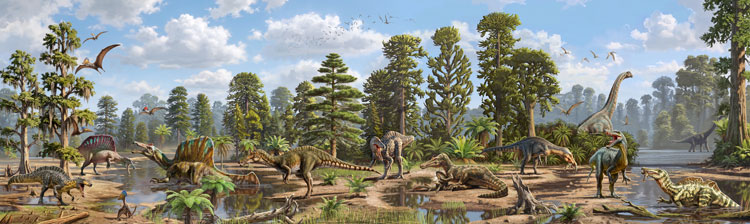
An illustration of Cretaceous spinosaurid diversity, each in their respective palaeoenvironments. From left to right: South America (Irritator, Oxalaia); Africa (Spinosaurus, Suchomimus); Europe (Vallibonavenatrix, Riparovenator, Ceratosuchops, Baryonyx); and Asia (Ichthyovenator). Picture credit: Pedro Salas and Sergey Krasovskiy.
Picture credit: Pedro Salas & Sergey Krasovskiy
Everything Dinosaur posted information about this research earlier this month. We have now received the official media release from Leeds University.
To read our earlier article, which explores the European origins of spinosaurid dinosaurs and examines their multiple dispersal events: Study Suggests Spinosaurids Originated in Europe.
Interestingly, the study suggests that changing sea levels may have provided temporary opportunities for these dinosaurs to move between ancient landmasses. However, their apparent preference for warm, semi-aquatic environments may have restricted their ability to colonise new territories.
Spinosaurid Dinosaurs First Evolved in Europe
Spinosaurids were an unusual group of theropod dinosaurs, many of which possessed elongated, crocodile-like snouts, conical teeth and adaptations associated with catching fish and other aquatic prey. Perhaps the most famous member of this family is Spinosaurus, which became particularly well known following its appearance in the film “Jurassic Park III”, where it famously confronted Tyrannosaurus rex.
Other members of this distinctive group include Baryonyx, Suchomimus and Irritator.
A new species of Spinosaurus is described: New Scimitar-crested Spinosaurus Species Described.
Although fossils attributed to spinosaurids have been discovered across several continents, their evolutionary origins and the routes by which they spread have remained difficult to establish. The new research supports the hypothesis that the Spinosauridae originated in Europe. During the Early Cretaceous, members of this group diversified in areas that today form southern England, Portugal and Spain. European fossils, including those of Baryonyx walkeri, discovered in Surrey in 1983, provide important evidence of the presence of these distinctive theropods in Europe.
This research adds further weight to the significance of European fossil discoveries in understanding the evolutionary history of the Spinosauridae.
How Did Spinosaurid Dinosaurs Spread Across the Ancient World?
One of the most interesting aspects of the research concerns the geographical routes taken by these dinosaurs. The scientists used computer modelling to investigate the evolutionary relationships and geographical distribution of spinosaurids. Their analysis indicates that there were at least two separate dispersal events from Europe into Africa and South America, together with at least one dispersal from Europe into Asia.
These findings suggest that the worldwide distribution of spinosaurids was not the result of a single migration event. Instead, their evolutionary history involved several separate movements between ancient geographical regions.
The new research also provides an intriguing explanation for how spinosaurids might have reached Asia.
The scientists suggest that falling sea levels may have exposed land connections across an ancient ocean that had submerged much of Eastern Europe. These temporary land bridges could have provided opportunities for dinosaurs to move between geographical regions. The proposed dispersal into Asia may have occurred during one of two periods, approximately 140 million or 120 million years ago.
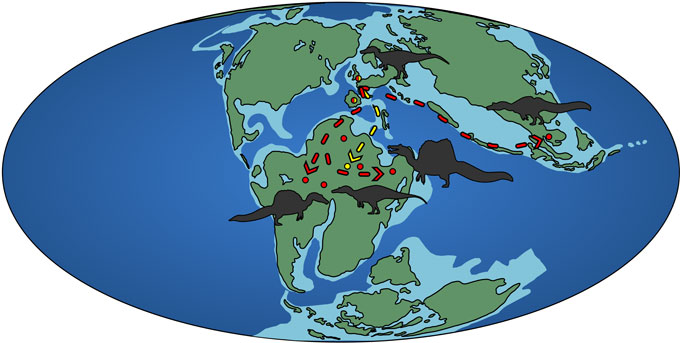
Probable pathways for the dispersal of Spinosauridae. Dispersal pathways relate to spinosaurines (red) and baryonychines (yellow). The dispersal routes were reconstructed using BioGeoBEARS and plotted on an Early Aptian (approx. 121.8 Ma) base map redrawn from Scotese. Points indicate where spinosaurid taxa occur in the BioGeoBEARS dataset. Picture credit: Zak Lewis.
Picture credit: Zak Lewis
This is an interesting reminder that the geography of the Cretaceous Period was very different from the modern world. Continental positions, changing sea levels and the development of new ocean basins continually altered the distribution of suitable habitats and opportunities for animal migration.
Why Were Spinosaurid Dinosaurs Missing from Some Continents?
Despite their widespread distribution, spinosaurid fossils have not been reliably identified from North America, Australia or Antarctica. This is particularly intriguing because other large predatory dinosaurs successfully colonised these regions. Why did spinosaurids apparently fail to establish populations in these parts of the world?
The research suggests that their specialised ecological requirements may provide an explanation.
By examining existing palaeoclimate models, the scientists investigated the environmental conditions associated with spinosaurid fossil discoveries. Their findings indicate that these dinosaurs generally inhabited warm, semi-aquatic environments, with estimated mean annual temperatures of approximately 26.1°C to 33.1°C. The environments also appear to have experienced relatively limited seasonal temperature variation, estimated at approximately ±8.46°C.
These conditions may have been particularly important for dinosaurs that relied on aquatic and shoreline habitats for feeding. The researchers found that the environmental preferences inferred for spinosaurids were more restricted than those identified in several other medium-to-large theropod groups.
Consequently, cooler climates, greater seasonal temperature fluctuations and unsuitable aquatic habitats may have presented significant barriers to their geographical expansion.
It is important to remember that the absence of confirmed spinosaurid fossils from a particular continent does not necessarily prove that these dinosaurs never lived there. Fossil preservation is uneven, and the amount of geological material available for investigation varies considerably between regions.
Nevertheless, the research provides a plausible explanation for the comparatively restricted geographical distribution of this fascinating dinosaur family.
Could Climate Have Contributed to the Extinction of Spinosaurids?
The researchers believe that their findings may have implications for understanding the eventual extinction of spinosaurid dinosaurs.
Dr Cassius Morrison from the University of Leeds explained that these specialised dinosaurs appear to have been particularly sensitive to their environments and habitats.
This raises an interesting possibility. If spinosaurids depended on relatively warm climates and suitable semi-aquatic environments, significant environmental changes could have reduced the availability of the habitats they needed to survive.
Mike from Everything Dinosaur commented:
“Spinosaurids are among the most fascinating of all the predatory dinosaurs. We tend to think of large theropods as highly adaptable animals, but this research reminds us that different dinosaur groups occupied very specific ecological niches. Their evolutionary success may have depended on having access to just the right combination of climate, water and food resources. It is fascinating to think that changes in these conditions could have influenced the distribution and eventual extinction of such remarkable animals.”
The researchers also suggest that their findings have relevance to modern conservation biology. Understanding how specialised animals respond to changing environmental conditions may help scientists assess the vulnerability of species facing today’s climate crisis.
New Insights into the Evolution of Spinosaurid Dinosaurs
This latest research adds another important piece to the evolutionary puzzle surrounding the Spinosauridae. The study suggests that these remarkable theropods originated in Europe before spreading into other parts of the ancient world through several separate dispersal events.
Changing sea levels may have created temporary opportunities for migration, whilst climatic conditions and habitat requirements appear to have influenced where these dinosaurs could successfully establish populations.
For palaeontologists, the findings demonstrate the importance of combining fossil discoveries, evolutionary relationships and computer modelling to reconstruct the history of prehistoric animals.
The research also highlights the continuing importance of European fossil discoveries, particularly those from southern England and the Iberian Peninsula, in helping scientists understand the origins of this distinctive group of dinosaurs.
Everything Dinosaur acknowledges the assistance of a media release from the University of Leeds in the compilation of this article.
The scientific paper: “Sailing to Gondwana: multiple waves of spinosaurid dispersal to the southern continents” by Zak E. Lewis, Charlie R. Scherer, Tom T. P. van der Linden, Paul J. Byrne Bethany Burke, Colin Boisvert, Ezekiel V. O’Callaghan; Kenneth C. Rayburn, Robert Mayer; Chance Guest; Harry T. Jones, Tristan Moran; Steven J. R. Allain and Cassius Morrison published in Royal Society Open Science.
Visit the Everything Dinosaur website: Dinosaur Toys and Prehistoric Animal Models.