All about dinosaurs, fossils and prehistoric animals by Everything Dinosaur team members.

Everything Dinosaur’s product news.

7 01, 2008

Make yourself your very own Dinosaur Money Box

By |2023-02-14T13:33:53+00:00January 7th, 2008|Categories: Everything Dinosaur Products, Main Page, Press Releases|2 Comments

Dinosaur Money Box Kit – A Great Project for a Wet Weekend

Now is the time for New Year resolutions, hopefully the resolve to keep them will have lasted until at least the time to take down the Christmas decorations.  One of our team members was talking with a parent of a young dinosaur fan and it turns out that one of the resolutions set by the father for the budding palaeontologist was to try to encourage them to save – after all the child had received some money for Christmas.

Dinosaur Money Box

Saving is certainly a good habit to get into and the younger you start the better it will be, so we thought we would publish today a little article about dinosaur money boxes and a money box building project ideal for a wet January weekend.

Team members at Everything Dinosaur have looked at a number of different types of dinosaur themed money boxes, made from china, plastic and even wood.  Many of them are impractical, for example it would be difficult to mail out a china money box as breakages might occur.  We have even come across some money boxes where the slots are not big enough to take something like a £2 coin and getting the money out from the small bung in the bottom can be a real problem.  No doubt we will continue to look at the options available in 2008.

Meantime, our popular Paper Mâché Dino Making kit represents a credible alternative to purchasing a money box – why not make your own?

You can create your very own paper mâché Stegosaurus, paint it with your own design and put a coin slot in the top and a hole in the bottom and you have your own unique money box.

The Stegosaurus Dinosaur Making Kit

The dinosaur making kit.

Picture credit: Everything Dinosaur

Stegosaurus Money Box

Everything you need to make the Stegosaurus money box is contained in the kit, “Chinese paper” for making the skin, balloons for the head and body, glue, paints,  paint brush, adhesive tapes, sponges and of course the all important step-by-step instructions.

To view Dinosaur Crafts for Kids: Dinosaur Themed Crafts and Toys.

The Colour of Dinosaurs

Scientists do not actually know what colour dinosaurs were since colour does not normally fossilise, so you can paint your dinosaur any colour and pattern you want and your guess will be as good as the most experienced palaeontologist.  We have received pictures from customers who have made these kits and it never ceases to amaze us how many different colours and patterns they come up with.  We have seen photos of pink ones, dinosaurs striped like a zebra, yellow ones with red spots – all the colours of the rainbow.

Suitable for Young Children

The kits are suitable for children aged 5 years and above, although we have worked with some very artistic 4 year-olds as well.  This is the sort of ideal “kitchen table top” activity for a wet weekend.  We would advise to put plenty of newspaper down and for parents to get involved to.  After all, parents can supervise and why should the kids have all the fun.  The paper mâché kits can be used to create models, or with the aid of a piece of string or fishing line they can be suspended from the ceiling.  By popping the balloon that makes up the body, cutting a slot in the top and creating a hole in the bottom which can be bunged up, you can make a handy and unique dinosaur money box.

There are lots and lots of fun things to do and make within our product range, you can find the money box kit (as well as lots of other things to do and make) in our “Learning” section of our website.

As always we would love to see your pictures of the dinosaurs, we have a big cork notice board in our warehouse and we put them up on it as well as having them around the Everything Dinosaur offices.


12 12, 2007

Why does a Baby Diplodocus have a Short Neck?

By |2022-11-06T08:04:57+00:00December 12th, 2007|Categories: Everything Dinosaur News and Updates, Everything Dinosaur Products, Main Page|0 Comments

The Joys of Working with Baby Dinosaurs – the wonders of Ontogeny

Ask any young dinosaur fan to draw a Diplodocus, an Apatosaurus and even a Brachiosaurus and they will most likely produce a picture of a big animal with a large body, a long tail and of course a very long neck, just the way these animals are depicted in books, CDs and television programmes.  These dinosaurs, known as sauropods, are also commonly called long-necked dinosaurs as one of their distinguishing features is of course their elongated, muscular necks.

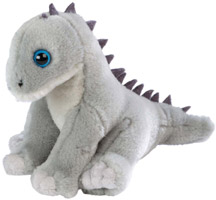
Baby Diplodocus

However, when it comes to working on a soft toy that depicts a baby Diplodocus, our thoughts about the typical long-necked dinosaur shape have to be discarded.   Baby dinosaur fossils are extremely rare, baby sauropods are no exception.  Unfortunately, a baby Diplodocus would have made a nice bite-sized snack for a hungry Allosaurus so if a youngster happened to perish in a location where fossilisation had a chance of occurring, chances are the body would have been eaten before sediments could cover the remains up.

Very occasionally a baby or a juvenile fossil sauropod is found.  One nearly complete specimen was discovered at the Howe Quarry, near the town of Shell in Wyoming, USA.  When fully excavated this little long-neck measured just over 2.4 metres long.  Although, the skeleton was just about complete, the head was missing (a problem palaeontologists usually face with all sauropod remains); so it has proved difficult to assign this animal to any genus of sauropod, but the consensus of opinion is that this little chap (or young lady) was an Apatosaurus.  The fossil shows a relatively, short neck compared to the adults.  This fossil was extracted from sediments which make up the famous Morrison formation, it has been dated to the late Jurassic, approximately 145 million years ago.  The original fossils are on display in a museum in Switzerland.

But how do we know that this animal was a youngster?  Could it be a new species of mini-sauropod?  The fossils have provided us with a number of clues to indicate that this animal was a juvenile, only a few years old.  Firstly, as we get older some of our bones grow closer together and fuse, the same applies to dinosaurs.  The fossil shows unfused bones in the hip region, tail and the scapula (shoulder blade).  The lack of wear and tear on the wrist and ankle bones also supports the theory that this animal was quite young when it died.  Dinosaur bones, if thinly sliced and studied under a powerful microscope can show growth rings, similar to the growth rings seen in wood.  The tiny femur (thigh bone) was analysed and its study revealed that the animal was less than 5 years old.

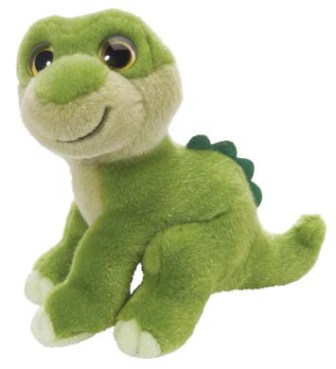
The  Baby Diplodocus Soft Toy (with a short-neck)

Diplodocus Soft Toy.

Picture credit: Everything Dinosaur

Dinosaur Stuffed Animals: Dinosaur Soft Toys.

So when it comes to thinking about  a baby Diplodocus soft toy we have to consider the process of ontogeny.  As animals grow their body proportions change, its physical features change in relation to body size.  A foal looks very different from its mother.  Its head looks larger, and the legs are proportionately longer.  This trait is related to a process called distal growth.  Another beautifully preserved and virtually complete skeleton of a baby long-necked dinosaur was discovered in Utah in 1922.   This time the head was preserved and the fossil was identified as a Camarasaurus, it had a large head and a relatively short neck when compared to an adult.   This was the basic blueprint for our baby Diplodocus in both the Itsy Bitsy and the Pocket Pals range of soft toys.

Eggs the Size of Footballs

Scientists think that animals like Diplodocus laid eggs about the size of footballs, buried in clutches of about 100 eggs or so.  After incubation the eggs hatched and the young sauropodlets emerged on mass just as turtles and crocodiles do.  This would give some of the babies the opportunity to get away from predators.  Palaeontologists estimate that at hatching a baby Diplodocus was around 1 metre in length.  Hiding in the fern undergrowth of forests the youngsters probably spent their first few years away from the adults living in small groups, using the dense forest as cover to protect them from the many predators that were about.  Their growth rates were astonishing, it has been estimated that in their first year these animals with their constant feeding on mosses and ferns, were able to put on about 2 kilogrammes per day and that after 12 months these young dinosaurs were over 3 metres in length and weighed as much as an adult Friesian cow.

The Pocket Pals Diplodocus

Pocket Pal Diplodocus.

Picture credit: Everything Dinosaur

As Everything Dinosaur is a company made up of parents, teachers and real dinosaur experts we have tried to illustrate scientific principles behind the products that we put into our shop.  As with the Itsy Bitsy soft toy Diplodocus, in the slightly larger (and older) Pocket Pal Diplodocus we have tried to keep the head relatively large with the neck and tail short.  Naturally, this process can only go so far, because with the adults the heads were very small compared to the body proportions.  For example, a fully grown Diplodocus could exceed 30 metres in length, the head being about the size of a horse’s balanced on a neck that was as long as a bus.

Dinosaur Stuffed Animals: Dinosaur and Prehistoric Animal Soft Toys.

25 11, 2007

Megalosaurus – A Dinosaur Waste Basket

By |2023-02-24T16:00:42+00:00November 25th, 2007|Categories: Dinosaur and Prehistoric Animal News Stories, Everything Dinosaur Products, Main Page|0 Comments

Megalosaurus – A Dinosaur Waste Basket

Megalosaurus represents a very important genus within the Dinosauria cladogram.  As a meat-eater it is part of the theropod group and as a family, the megalosaurs tend to be overshadowed by their more illustrious relatives the tyrannosaurs, Maniraptoriformes and allosaurs.  However, Megalosaurus will still hold a special place in the hearts of scientists as it was the first Dinosaur to be named and described.

Megalosaurus

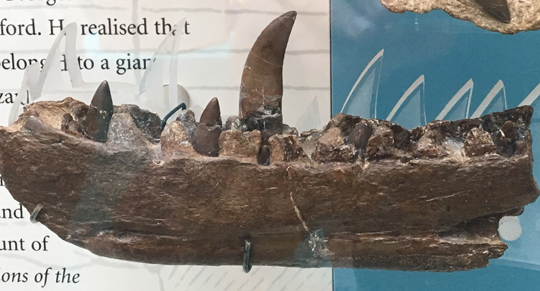
This momentous event took place in 1824, nearly 20 years before the name dinosaur was invented.  An English clergyman and geologist the Reverend William Buckland was appointed to examine and review a piece of fossilised lower jaw plus a number of other strange fossil bones which had been found in quarries in Oxfordshire.  He had been aware of these bones for a number of years and collected several specimens himself.  In his review, William Buckland incorporated studies of upper and lower limb bones, parts of the pelvis, scapula and vertebrae.  It was the lower jaw that played the most important role in his studies.  Although the bones were assumed to come from the same genus, but from different individuals, it was the lower jaw that was most striking.

The teeth were different from any other living animals, known to science at the time and the jaw had a number of teeth embedded within it ready to emerge, replacing older teeth in the jaw.

Identifying the fossils as belonging to a reptile, William Buckland used living lizards anatomy to estimate the size of this new animal.  He calculated that the creature was over 13 metres in Length (in excess of 40 feet), and would have weighed more than an elephant.  In the light of this evidence the name Megalosaurus (means huge or great lizard) was adopted, although the name had been already ascribed to this animal by another British scientist – James Parkinson two years earlier.

Lithographic Plates

The Reverend Buckland’s article contained five beautifully detailed lithographic plates that depicted the fossils.  Special attention was paid to illustrating the jaw fragment, as Buckland understood the significance of this particular find.  Even today, skull bones, teeth and jaws are the prize finds for palaeontologists as they can tell them so much about the animal’s lifestyle and possible relationships to other dinosaur species.  On one plate Buckland provided views of the inside (lingual view – what the teeth look like facing the tongue) and the outside (labial view – what the teeth look like when viewed from the side that would have faced the lips).  These were drawn at 1/2 scale but in addition he provided a fold out section within his paper that illustrated the lingual view of the jaw at full size.  Perhaps he was aware of the need to demonstrate the size of the animal using this full size drawing with its socket-ed teeth, or maybe this additional illustration was added to give a “flourish” to his work.  Certainly, in the scientific circles of the gentry in the 1820s a bit of “embellishment” was quite common place.

Ironically, William Buckland in his published paper never actually stated that the jawbone came from a carnivore, an obvious deduction given the shape and size of the teeth, but in the final print of his work, this fact was not included.

The Fossil Dentary Assigned to Megalosaurus

The lower jaw of Megalosaurus.

The partial dentary for teeth associated with Megalosaurus bucklandii.

Picture credit: Everything Dinosaur

Little is known about Megalosaurus, with very few finds of this type of Jurassic carnivore being made to add to our knowledge.  In fact, for much of the 19th and early 20th Centuries many partial fossils and fragments from carnivores discovered in Europe were assigned to the genus Megalosaurus.  So many finds were labelled as belonging to megalosaurs that this genera became known as “a Dinosaur Waste Basket” with virtually every indeterminate piece of carnosaur fossil being placed within this group.  It is only in the last few years, as our knowledge of European theropods has improved that scientists have taken a fresh look at these “Megalosaurus bones” and have begun to sort them out into other genera.

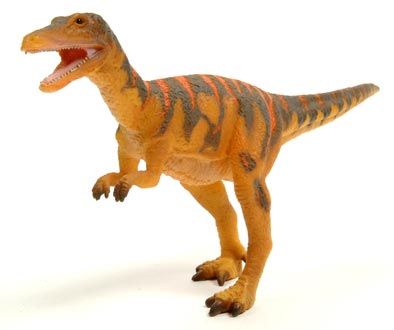
Megalosaurus was one of the top predators around at the time, it reached lengths of around 9 metres and weighed approximately 1 tonne.  As a result, a number of Megalosaurus dinosaur models have been produced.

It remains a favourite amongst model collectors and dinosaur enthusiasts and in recognition of this it was one of the first dinosaurs commissioned by the Natural History museum when they created their own model collection.

Models of dinosaurs including Megalosaurus here: Dinosaur and Prehistoric Animal Models.

A Picture of the Model Megalosaurus from the Natural History Museum

Megalosaurus replica dinosaur model.

Source: Natural History Museum Picture Library

13 11, 2007

Is it a New Book or is it a New Board Game? It’s Both!

By |2024-04-02T21:28:31+01:00November 13th, 2007|Categories: Everything Dinosaur Products, Main Page, Press Releases|0 Comments

The Book of Prehistoric Pop-Up Board Games

A novel twist to a conventional book about prehistoric animals, “Prehistoric Pop-Up Board Games”, combines the features of a book about dinosaurs and other animals from the Age of Reptiles with four prehistoric themed board games.

The Book of Prehistoric Board Games

Is it a book or a game – it is both!

Picture Credit: Everything Dinosaur (Tango)

To view the range of dinosaur themed products in stock: Everything Dinosaur.

Beautifully illustrated by the well-known commercial artist Bob Nicholls, the book takes players through four prehistoric adventures from the Jurassic and Cretaceous.  Each game section can be played by four players and individual game counters are provided within the book’s contents for you – although more players can join in, little model dinosaurs make excellent counters too.

In the first game, you become an Allosaurus, a fierce meat-eater from the Late Jurassic and you have to hunt down a Stegosaurus.  Players then move onto the Cretaceous and face the perils of being a baby pterosaur just hatched looking for a tasty fish to eat; before plunging into the sea to confront the mighty Mosasaurus and other marine perils as you attempt to swim to safety, with your counter which could either be an ichthyosaur, plesiosaur or pliosaur.

Of course any children’s book would not be complete with out an appearance by Tyrannosaurus rex.  Your travels send you to very last days of the dinosaurs and choosing your herbivorous dinosaur game counter you face the dangers of the Late Cretaceous of North America and try to avoid becoming a snack for the ever-hungry predator.

We found the book/games fun and suitable for children aged 5+, although it did appeal to a couple of very enthusiastic 4-year olds we know, who took to it with equal relish.

12 11, 2007

Digging for Dinosaurs – Finding New Fossils

By |2024-04-02T21:29:28+01:00November 12th, 2007|Categories: Everything Dinosaur Products, Main Page, Press Releases|0 Comments

Digging for Dinosaurs – Excavate your own Prehistoric Animals

We often get asked by school children “what does it feel like when you find a fossil?”.  No matter how small and insignificant the find we still get a thrill out of finding fossils, especially when you have been working all day at a dig site, or wandering up and down some shoreline with a gale blowing into your face.

Digging For Dinosaurs

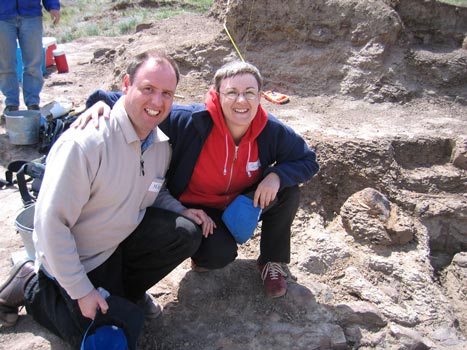
I recall one occasion when we were working with a team of palaeontologists excavating an assemblage of hadrosaur remains that had been deposited in an ancient stream bed.  The carcases had accumulated and become heaped up onto each other, there were at least three adult hadrosaurs within the matrix.  Although it was early days and no skull material had yet been found we were confident that they were the remains of  Edmontosaurus.  Before the bones were buried this pile of corpses had attracted a number of scavengers.  We found crocodilian teeth and a single tooth from a troodontid.

Digging for Dinosaurs

Pause for a pic next to a digs station. Rocks, fossils and digging for dinosaurs.  Picture credit: Everything Dinosaur.

Picture credit: Everything Dinosaur

All in all the site yielded a lot of palaeontological evidence, although I do remember one day when I toiled under the hot sun (we were digging in Alberta as part of a Royal Tyrrell museum team); for hours and hours and although stations either side of me were working on impressive fossils (tibia and fibia to be precise), where I had chosen to dig I could find nothing.  I even went back over the sediment I removed and sieved it again in case I had missed some tiny fragment.  After all my labour, late in the afternoon I uncovered my first fossil of the day – a piece of ossified tendon, tiny, but to me I was thrilled!

No matter whether it is the simplest brachiopod, bivalve, belemnites or an articulated brachiosaur, finding something that lived millions of years ago, and exposing it to human eyes for the first time – it still is an enormous thrill.

When we work on designing items for young palaeontologists we try to create products and games that give them a chance to relive the experience of excavating their very own fossils.

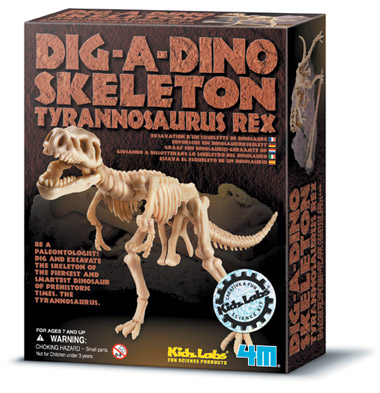
One such product is the “Digging for Dinosaurs” range.  Models of prehistoric animal skeletons are set into a solid block of gypsum and then using the tools provided in the kit, children can have a go at excavating their own prehistoric animal.  If only the real thing was as much fun and came with the guarantee of finding a complete specimen in a single block.

Still, that is not the point, these kits are fun and give a real sense of achievement when all the digging is done.  There are a number of such kits available – the larger ones (house brick size) are called “Dig a Dino” animals in the series include Tyrannosaurus rex, Velociraptor, Triceratops, Stegosaurus and a pterosaur (Pteranodon).

Dinosaur crafts, models and toys: Dinosaur Toys, Models and Gifts.

Dig-a- Dino Range Product Shot

Source: Everything Dinosaur (Kids Labs)

Here are a couple of tips for all the parents of budding palaeontologists:

1).  It is a good idea to put plenty of newspaper down (we use lots of newspaper to wrap specimens in real dig), but in this case it is best to do this as it saves a lot of cleaning up afterwards.

2).  A thump with a mallet is a good way to start the dig (get Dad to do this).

3).  Keep the gypsum bits away from your sink and certainly don’t flush bits away down the plughole, you might lose part of your model skeleton and in extreme cases block the drain.

10 11, 2007

New Dinosaur Pencil Sharpeners – an Ideal Stocking Filler

By |2024-04-03T06:59:25+01:00November 10th, 2007|Categories: Everything Dinosaur Products, Main Page, Press Releases|0 Comments

Dinosaur Pencil Sharpeners – 8 Dinosaurs to Choose From

Every week the team at Everything Dinosaur gets together to have a meeting, this usually takes place on a Friday or after we have finished work on a Saturday afternoon.  The first item on the agenda is to “put the kettle on” and whilst one of us makes the tea the rest of the team draw up an agenda and make sure all the points, issues and ideas that have arisen over the last few days are recorded so that they can be discussed amongst ourselves.

Dinosaur Pencil Sharpeners

One item raised a couple of weeks ago was to add Dinosaur Pencil sharpeners to our product range, we had looked a this product a while ago and although it had favourable reviews from our testers at the time, we never got round to adding it to our product range.

We reviewed the comments that had been made about these little plastic sharpeners with a model of a dinosaur on top.  Customers liked the quality of the item, it certainly sharpened pencils – which is always a promising start for a pencil sharpener.  They also liked the choice of eight different dinosaurs in the product range we had examined.

With one eye on all the school visits and Christmas Fairs that Everything Dinosaur attends at this time of year we decided to give these sharpeners a go.

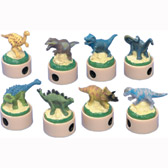
Dinosaur Pencil Sharpeners – Eight to choose from

Picture credit: Everything Dinosaur

To visit the Everything Dinosaur website: Everything Dinosaur.

There are eight different Dinosaur pencil sharpeners to choose from.  I don’t know whether the manufacturers were aware of what they had done but there are are four saurischian (lizard-hipped) Dinosaurs represented by an ornithomimid (ostrich mimic), a sauropod and two theropods plus four ornithischians in the mix.   The ornithischians represented are an ankylosaur, stegosaur, ceratopsian and a pachycephalosaur.

My these manufacturer’s are clever!  They have created a simple product range that just about covers the diversity of the Dinosauria.  Somehow I don’t think this was done as a deliberate attempt to represent the main dinosaurian clades, more likely the different models were chosen because they looked good.  However, this little set illustrates the diversity of the dinosaurs very nicely – and that will do for us.  It is an excellent example of the dinosaur themed school supplies that are available from Everything Dinosaur.

6 11, 2007

Game on this Christmas – A New Dinosaur Board Game

By |2024-04-02T21:35:01+01:00November 6th, 2007|Categories: Everything Dinosaur News and Updates, Everything Dinosaur Products, Main Page, Press Releases|0 Comments

Dinosaur Dino-opoly Featured in National Women’s Magazine

The November edition of “Prima” – a women’s magazine with a strong practical content featuring crafts, cookery, fashion and beauty as well as shopping tips and ideas, carried a feature on Dinosaur Dino-opoly.

In an article, which featured on the “Family Notebook” page of the magazine, the top five suggested family games for Christmas were reviewed.

Lovely to see Dino-opoly given the number one spot.

This is what the reviewer said:

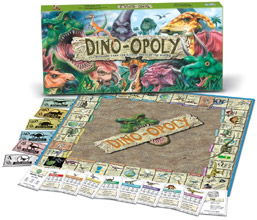
“Have hours of fun with Dino-opoly (age 7 and up), a prehistoric version of a classic family board game.  Players can buy their favourite dinosaur, collect bones and trade them in for museum exhibits.”

The Dino-opoly Board Game

Picture Credit: Everything Dinosaur

To view the range of toys and games available at Everything Dinosaur: Dinosaur Toys and Gifts.

It certain is a twist on the traditional family board game, there is even a quick 1 hour whizz round the board version.  The best thing of all is that it provides children with lots and lots of facts and information about dinosaurs, helping them learn.

2 11, 2007

A Picture of the Head of Megalodon

By |2023-02-19T10:47:50+00:00November 2nd, 2007|Categories: Everything Dinosaur Products|0 Comments

A Picture of the Head of Megalodon (Carcharodon megalodon)

We get lots of young palaeontologists asking us about the fearsome prehistoric fish known as Megalodon (C. megalodon)*, so team members at Everything Dinosaur have created a picture of the “business end” of this ferocious marine predator.  We also receive lots of emails about the availability of a Megalodon shark model.

A Close up of the Jaws of the Giant Shark (C. megalodon)

Giant shark model.

Picture credit: Everything Dinosaur

Megalodon Shark Model

Scientists estimate that his shark may have reached lengths in excess of sixteen metres.  Fossils of its triangular shaped teeth have been found in Europe, Asia, Australia, Africa and the Americas.  A few Megalodon shark models have been made.  For example, PNSO a Chinese manufacturer currently have two Megalodon shark models within their product range.

To view the PNSO range of prehistoric animal models and figures: PNSO Dinosaur Museum Models and Figures.

Please note – following a taxonomic revision of shark fossil material this animal has been reclassified as Otodus megalodon.

22 10, 2007

Christmas Gift Ideas from Everything Dinosaur

By |2023-02-13T08:21:45+00:00October 22nd, 2007|Categories: Everything Dinosaur Products, Main Page, Press Releases|0 Comments

Why Not Try Dinosaur This Christmas?

From cuddly toys, to educational posters, books, puzzles and kits, to mind-boggling inflatables and funky T-shirts Everything Dinosaur offers fabulous gift ideas for Christmas. Run by passionate dinosaur enthusiasts, parents and teachers, this is no ordinary web site but one which strives to promote the love of dinosaurs and educate people about this wondrous period in history.   If you’re looking for a Christmas gift which is big on fun and makes prehistoric times bang up to date, then a website all about dinosaurs is the perfect place to explore – Everything Dinosaur.

Christmas Gift Ideas

From the adorable cuddly Woolly Mammoth and baby to the clever Dinosaur Excavation Game to the fascinating and educational posters there is truly something for everyone, of all ages.

Soft toy prehistoric animals: Prehistoric Animal Soft Toys.

Dinosaur toys and gifts: Dinosaur Gifts and Toys.

Plus if you need to give Santa a hand to fill stockings, then take  a look at the Dinosaur Erasers, Dinosaur Pens or the fantastic value Woodencraft Velociraptor.  It’s enough to make you want to flatten bushes by swishing your tail with excitement!

Maybe there is a dinosaur for everyone?  An inflatable Tyrannosaurus rex will add “roooar” to a children’s party or bedroom, whilst little sister will love the pink Diplodocus T-shirt.

Dinosaur Gifts and Toys

Creative family members or friends will really enjoy the Mould & Paint Dino or the Dino Making Kit.  For the person who loves an unusual gift, why not surprise them with a Mammoth Skull Kit or the Replica Sabre-Tooth, a cast from a real tooth from the Natural History museum.

However, the people behind Everything Dinosaur are more than on-line retailers – they are dinosaur enthusiasts who promote education and knowledge on this huge subject.  The team specialise in the supply of dinosaur and prehistoric animal related hobby products and merchandise.  Working in association with museums and educational bodies, the company has proved there is a market for accurate, exciting, imaginative and educational products for people of all ages.

17 10, 2007

The Clever Catch – A Unique Inflatable Dinosaur Ball that Tests Your Knowledge

By |2024-02-22T12:44:55+00:00October 17th, 2007|Categories: Everything Dinosaur News and Updates, Everything Dinosaur Products, Main Page, Press Releases|0 Comments

The Clever Catch – Inflatable Dinosaur Ball and Prehistoric Animal Quiz

Introducing the Dinosaur themed Clever Catch inflatable quiz ball, a bit of a mouthful, but if you can say it, you will have the wherewithal to blow up this huge inflatable and test your knowledge on prehistoric animals.  This wonderful gift idea is a great way to test your knowledge about dinosaurs.

Dinosaur Knowledge

The “Clever Catch” concept is an American idea which has been accepted by many schools and educational establishments.  Building on the principle that learning can be fun, a giant dinosaur themed inflatable has been created covered in pictures of dinosaurs and lots of prehistoric animal questions to test the knowledge of young palaeontologists – what a clever idea!

The Giant Inflatable Dinosaur Quiz Ball

Source Everything Dinosaur images

A Great Way to Learn About Dinosaurs

A great way to learn about dinosaurs, an inflatable that tests your knowledge on prehistoric animals.  Ideal for school, the beach or home.

Using the nozzle the ball can be hung up in the bedroom, for a cool dinosaur feature.  This inflatable has seventy prehistoric animal themed questions designed to test the knowledge of young dinosaur fans and help them to learn all about these amazing creatures.

Do you have what it takes to be a palaeontologist?

This is a big inflatable (130 cm circumference, with a diameter of 60 cm), it can be inflated by blowing into the nozzle, or cheat like we did, use a pump!

For further dinosaur themed product suggestions: Visit Everything Dinosaur.

Go to Top