All about dinosaurs, fossils and prehistoric animals by Everything Dinosaur team members.

Everything Dinosaur’s product news.

27 03, 2008

A Beautiful Sabre-Tooth Cat Up Close

By |2024-04-12T08:31:24+01:00March 27th, 2008|Categories: Adobe CS5, Everything Dinosaur Products|0 Comments

Capturing the Essence of a Sabre-Toothed Cat

Team members at Everything Dinosaur have tried to capture the essence of the Smilodon genus in a single picture.  It was obviously really, we had to focus on these huge upper canines that give these cats their name.  Remember these animals were not closely related to extant tigers.

Smilodon

A Close up of a Model of the Head of a Sabre-Toothed Cat

A Picture of a Sabre-Toothed Cat

Can’t call it a Sabre-Toothed Tiger.

Picture credit: Everything Dinosaur

Slowly but surely Everything Dinosaur team members are getting more confident when it comes to using Photoshop CS5 and other tools.  It really was an excellent Smilodon model to practice our skills on.

Everything Dinosaur stocks a wide range of Smilodon models and replicas, some of which are museum quality scale models.  To view a selection of prehistoric mammal models and figures available from Everything Dinosaur, including Smilodon replicas: Models of Prehistoric Mammals.

4 03, 2008

Long-limbed Albertosaurs – a Clue to Dinosaur Predation

By |2022-11-10T11:32:45+00:00March 4th, 2008|Categories: Everything Dinosaur Products, Main Page, Palaeontological articles|0 Comments

Long-limbed Albertosaurs – possible hints at Dinosaur Hunting Habits

Despite their frequent appearance in monster movies the Tyrannosauridae are perhaps not as well known as many people might think, especially when they are faced with the overwhelming number of tyrannosaur exhibits on display at Natural History museums.  In truth, even the mighty Tyrannosaurus rex has provided less than 40 fossil specimens for palaeontologists to study and the vast majority of these are far from complete.  The popularity of these fierce carnivores is easy to understand, they were certainly impressive beasts but scientists still have a great deal to learn about these animals, their ancestry, social behaviour and morphology.

The likes of Tyrannosaurus rex is synonymous with the Hell Creek Formation of Montana in the north western United States.  The exposed strata  of sandstone, siltstone and mudstone represent sediment laid down towards the very end of the Cretaceous (late Maastrichtian faunal stage).  It was from these beds that the first T. rex fossils were unearthed.  However, a greater number of Tyrannosauridae fossils have been recovered from Canada, specifically areas such as the Dinosaur Provincial Park Formation in Alberta.    The extensive outcrops of Campanian faunal stage strata from deposits termed the Belly River Group and the Judith River Formation have been dated to approximately 75 million years ago.  The Theropod fossils recovered from these sites along with other body and trace fossils have enabled palaeontologists to build up a detailed picture of the eco-system that existed in this area at the end of the Cretaceous.  This has led to some speculation as to the hunting habits and specialisation of the tyrannosaurs in this faunal community.

Late Cretaceous tyrannosaurids of Alberta can be classified into two sub-families, the Albertosaurinae and the Tyrannosaurinae (based on research from Phil Currie et al).  The albertosaurines from the Dinosaur Provincial Park can be split into two genera, Gorgosaurus and Albertosaurus), the Tyrannosaurinae are represented by Daspletosaurus (D. torosus [Russell 1970], D horneri [Carr et al 2017]).  In the 1970s the genus Gorgosaurus was dropped and it was synonymised with Albertosaurus, following a review of existing specimens where no significant characteristics were identified, permitting both genera to be valid.  This viewpoint was overturned in 2003 when following a study by a Canadian led team looking at fossils recovered after the review in the early 1970s, several anatomical differences were identified between Albertosaurus and Gorgosaurus and so both taxa were validated.  The Gorgosaurus genus was reinstated.

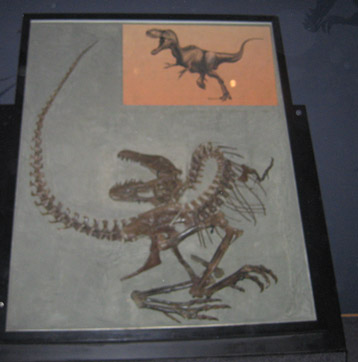
Albertosaurus Exhibit – Royal Tyrrell Museum (Alberta in Canada)

Picture credit: Everything Dinosaur

The photograph shows an almost complete and articulated restoration of an Albertosaurus specimen on display at the Royal Tyrrell museum (Alberta, Canada).  The neck and head presented in a curved position over the back and hips is typical of articulated Dinosauria fossils, this effect is believed to occur as ligaments and tendons are desiccated in the carcase and their drying out leads to the head and neck curving over the back of the animal.

The albertosaurs shared their Late Cretaceous world with the likes of Daspletosaurus, (Daspletosaurus means “frightful lizard”).  Both these types of tyrannosaur were apex predators, hypercarnivores and at the top of the food chain, however, examination of their fossils reveals that they may have specialised in different hunting strategies and prey.

Albertosaurs had shorter, lower skulls than many other tyrannosaurs.  Their leg bones, especially the tibia (shin bone) were proportionately longer than equivalent sized tyrannosaurs.  They had longer toes and although the weight of an adult Albertosaurus (A. sarcophagus), has been estimated at 2.5 metric tonnes, these animals were lighter than equivalent sized Tyrannosaurinae.

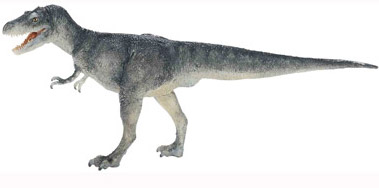
A 1:40 Scale Model of Albertosaurus (Carnegie Collection Albertosaurus)

Albertosaurus (from the now retired [2014] Carnegie Collectibles range of figures).

Picture credit: Everything Dinosaur

The picture above shows an Albertosaurus dinosaur model, part of the Carnegie Collectibles dinosaur model range (Safari Ltd) which has been retired and is out of production.

To see this model and other tyrannosaurid figures: Visit Everything Dinosaur’s Shop.

The Albertosaurus Genus

It has been speculated that the genus Albertosaurus may represent the fastest large tyrannosaurs around at the end of the Cretaceous.  Models and computer simulations have estimated running speeds of up to 25mph (40kmh), this is up to 50% faster than an equivalent member of the sub-family Tyrannosaurinae.  Putting this into perspective this long-limbed, long-toed carnivore could complete the 100 metres in around about 10 seconds.  Assuming that an Albertosaurus could be given a running start (crossing the start line at approximately full speed), and assuming that this fierce meat-eater did not stop along the way to feast on any athletes, an Albertosaurus could compete for a medal in the sprints at the Beijing Olympics.

Some scientists have speculated that tyrannosaurs began to evolve in different ways, exploiting specific niches within the eco-system.  As Albertosaurus was lighter and faster than equivalent sized Tyrannosaurinae, it could have specialised in catching lighter and faster prey types like hadrosaurs, pachycephalosaurs and ornithomimids.  Indeed, a diorama of an Albertosaurus chasing a group of ostrich-like dinosaurs greets visitors to the Royal Tyrrell museum.  The heavier members of Tyrannosaurinae may have specialised in hunting ceratopsians or possibly titanosaurs.

Lighter and More Gracile Tyrannosaurs

Fossil evidence does indicate that the albertosaurs evolved into lighter and more gracile forms, perhaps indicating that this genus specialised in hunting faster moving animals than the heavier predators.

The fossil evidence is complicated when social behaviour is considered.  Albertosaurus bone-beds have been found in Canada.  Excavations from Royal Tyrrell museum staff have revealed the remains of at least nine variously sized albertosaurs from one fossil site.  Could this be evidence of pack behaviour?

The Safari Carnegie model of Albertosaurus (shown in the picture above) has been designed to replicate much of the latest scientific thinking concerning this particular dinosaur.   Working on the guidance of scientists from the Carnegie museum the model has been sculpted to show the long legs and graceful features of this predator.  The colouration of the model, muted greys and browns would have make this hunter inconspicuous in shadow and the dappled understorey of woodland.  The back, tail and hind quarters of this particular model has darker, stripped markings, again helping to camouflage the animal and break up its outline if it was stalking from cover.  In addition, the stripped markings, particularly those on the tail are a concession towards those scientists that speculate that Albertosaurus may have been a social, pack hunter.  A group of these animals moving towards a potential group of prey animals at speed would have been a confusing site.  Their rapid speed, the dust kicked up and the stripped markings could have disorientated prey, the stripes helping to break up the outline of individual hunters within the pack as they closed in on their unfortunate victims.

3 03, 2008

Beautiful Albertosaurus (Safari Ltd)

By |2024-04-12T08:33:48+01:00March 3rd, 2008|Categories: Everything Dinosaur Products|0 Comments

Albertosaurus Dinosaur Model

One of our favourite models of tyrannosaurs from northern Laramidia.  A wonderful replica of the tyrannosaur known as Albertosaurus (fossils found in Alberta Province, Canada).  At Everything Dinosaur, we research and write our own dinosaur and prehistoric animal fact sheets.  Buyers of Albertosaurus models and figures (and most other prehistoric animal models for that matter), from our website also receive a fact sheet about that animal.  The fact sheets explain some of the science and research behind the extinct creature.

An Albertosaurus Dinosaur Model (Safari Ltd)

A Model of Albertosaurus (Safari Ltd)

Carnegie Collectibles Albertosaurus dinosaur model.  This dinosaur model has been retired and is out of production – update.

Picture credit: Everything Dinosaur

Albertosaurus Dinosaur Model

Safari Ltd make a wide range of dinosaur and prehistoric animal themed replicas.  The company’s scale model range of which Albertosaurus is part, is very collectible.

To view the range of Safari Ltd models available from Everything Dinosaur and other prehistoric animal replicas and figures: Dinosaur and Prehistoric Animal Models.

The Carnegie Collectibles Albertosaurus dinosaur model is a scale model of this Late Cretaceous meat-eater.  Update – the Carnegie Collectibles range of dinosaur and prehistoric animal figures has been retired and is out of production (2014).

24 02, 2008

New Dinosaur Melamine Dinner Set

By |2023-02-24T22:04:05+00:00February 24th, 2008|Categories: Everything Dinosaur News and Updates, Everything Dinosaur Products, Main Page, Press Releases|4 Comments

New Dinosaur Melamine Dinner Set

Turn meal times into a Mesozoic adventure with the new range of children’s’ tableware from Everything Dinosaur.  With plates, utensils, bowls and a cup including a matching vinyl coated placemat, this new range of dinnerware will have young dinosaur fans eager to take their place at the dinner table.

Everything Dinosaur

Made from tough, durable melamine, these new items have just been added to the “Dinosaurs at Home” section of the Everything Dinosaur website: Everything Dinosaur.

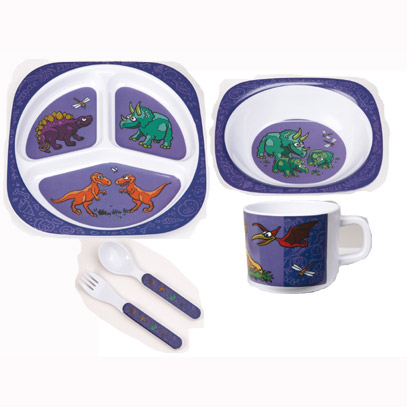
An Illustration of the New Tableware

Picture credit: Everything Dinosaur

Melamine Dinosaur Dinner Set

The design on this range depicts a number of prehistoric animals including a friendly looking Pteranodon, a turquoise Triceratops, a purple Stegosaurus and a hungry looking Tyrannosaurus rex, just what a young palaeontologist would expect to find on a dinner set designed with the Age of Reptiles in mind.  Available as individual items, to enable Everything Dinosaur customers to be flexible with their purchasing, these items are also available as a set.

The dinner set price has been discounted as an added incentive to encourage customers to purchase.  Included in the tableware set is the hard-wearing, matching dinosaur placemat, so Mums and Dads have everything they need to turn meal times into a dinosaur adventure.  The tough, robust tableware set is dishwasher safe and is suitable for young dinosaur fans from 12 months and upwards.

Ideal for Young Children

The table ware has been designed with little ones in mind, the plate is segmented to permit food items to be served separately if required, a good idea – parents and guardians can check what has been eaten.  The sections also assist young children with their eating as the walls of each section can assist with them getting food onto the fork and spoon.  Thought and attention has also gone into the design of the utensils and the cup.  They are ideal for little hands to grasp.  Even the bowl has been designed with care, its steep sides help prevent splashes.

Having proved popular on test, looks like the three geological periods of the Mesozoic – Triassic, Jurassic and the Cretaceous will have to renamed – breakfast, lunch and dinner!

Visit Everything Dinosaur’s award-winning website: Everything Dinosaur.

12 02, 2008

New Soft-Touch Giant Pteranodon

By |2022-11-09T11:59:40+00:00February 12th, 2008|Categories: Everything Dinosaur News and Updates, Everything Dinosaur Products, Main Page, Press Releases|0 Comments

New Soft-Touch Pteranodon (Flying Reptile)

Flying reptiles, more correctly termed pterosaurs are very popular with young dinosaur fans and budding palaeontologists.  Although not dinosaurs, these flying reptiles did evolve from archosaurs so they share a common ancestor with the dinosaurs.  Appearing some time in the Triassic, the pterosaurs were the first group of back-boned animals to develop powered flight and they dominated the skies for over 100 million years evolving into all shapes and sizes until the emergence of the birds hastened their decline.

Towards the very end of the Age of Reptiles, the last pterosaurs evolved into giant gliding forms, some with wingspans bigger than a small plane.  Perhaps, the best known of these flying reptiles was Pteranodon, with its toothless beak (the name means toothless flyer) and bizarre bony crest.  Remains of Pteranodon have been found all over the world in North America, England and Asia.  Some species of Pteranodon had wingspans in excess of 9 metres.

Giant Pteranodon Model

Team members at Everything Dinosaur have been searching for a reasonably accurate model of Pteranodon, this new model, just added to our range is very nicely painted and very detailed.  For example the crest is a bright colour and patterned.  Palaeontologists believe that Pteranodon may have used its crest not only in flight to stabilise it, but also in displays to put off rivals and attract a mate.

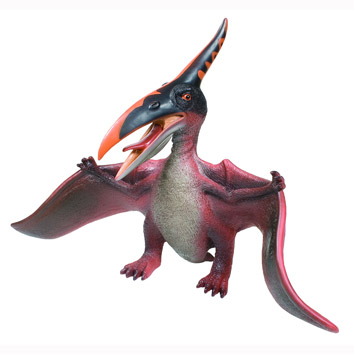
The New, Large Pteranodon Figure from Everything Dinosaur

Picture credit: Everything Dinosaur

This figure is moulded in soft-touch plastic, it is easy for a youngster to carry around, soft and squeezy and makes an ideal addition to a young dinosaur fan’s collection.  The wings and body even show texturing, given the impression of fur, as scientists now believe that pterosaurs were warm-blooded and they may have been covered with fur to help insulate their bodies and keep them warm.

To view Everything Dinosaur’s range of dinosaur soft toys: Prehistoric Animal Soft Toys.

The close up of the head shows the fine detail and painting, also it illustrates one of the points crucial to our dinosaur experts and enthusiasts.  The model shows Pteranodon with no teeth, like many later flying reptiles, the teeth were lost, perhaps to lose weight just as birds have lost their teeth as well.  As fossils of Pteranodon have been found in marine sediments, palaeontologists believe this animal was a fish-eater, flying low over the surface of the sea and jabbing its head down to pick up fish at the water’s surface.

To read a post about pterosaur feeding habits: Could Pterosaurs Skim the Water and Snatch Fish?

9 02, 2008

A Picture of a Triceratops Dinosaur Model

By |2022-11-09T11:37:39+00:00February 9th, 2008|Categories: Everything Dinosaur Products, Photos/Schools|0 Comments

Triceratops Dinosaur Model Pictured

When it comes to horned dinosaurs (Ceratopsians), the most popular member of this particular clade of the Dinosauria amongst boys, girls and general fans of dinosaur models is Triceratops (T. horridus).  To celebrate this and in tribute to all those emails and letters we receive asking for Everything Dinosaur to post up pictures of “three horned face” we have popped up a picture of the Schleich Triceratops.

To view the Schleich prehistoric animal model range available from Everything Dinosaur: Schleich Prehistoric Animal Figures.

Picturing a Horned Dinosaur (T. horridus)

Schleich Triceratops.

Picture credit: Everything Dinosaur

Schleich Triceratops Dinosaur Model

Schleich, the German based manufacturer, have produced a number of dinosaur models.  Triceratops has always featured prominently in Schleich dinosaur model lists and it is likely that this perennial favourite will continue to feature in dinosaur model and prehistoric animal replica ranges.

To view Schleich dinosaur and prehistoric animals: Dinosaur and Prehistoric Animal Models.

24 01, 2008

Trying to Trace the Dinosaur Family Tree – Summarising New Research

By |2024-04-03T07:44:57+01:00January 24th, 2008|Categories: Everything Dinosaur News and Updates, Everything Dinosaur Products, Main Page|77 Comments

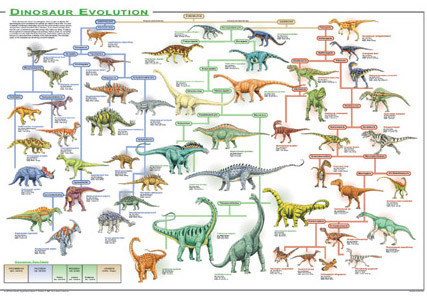
Dinosaur Evolution Poster – Tracing the Dinosaur Family Tree – A Tricky Business

Trying to organise Dinosauria into clades or family groups has kept many palaeontologists burning the midnight oil.  Unfortunately, unlike extant animals; when it comes to organising the family tree of extinct animals such as dinosaurs, a new fossil find, or some new research into existing specimens can throw everything into confusion.  It can be difficult trying to trace the dinosaur family tree.

What were once accepted relationships are often questioned and new fossils provide tantalising glimpses into the true nature of the relationship between different types of dinosaur.

The two great groups of dinosaurs are the saurischians (Lizard-hipped Dinosaurs) such as the sauropods and the theropods and the ornithischians (Bird-hipped Dinosaurs) examples being the ornithopods such as Iguanodon and the ceratopsians such as Triceratops.

The Dinosaur Family Tree

Much of the general classification was carried out in the late 19th century and this can lead to further problems.  The Victorian scientists cannot be criticised for their enthusiasm and endeavour, they worked according to the principles and practices of the era and of course their technology was very limited.  Often dinosaurs were grouped together and described using comparative anatomical measures, which is fine in itself, but we now have a lot more specimens to study.  Even the names for the suborders can lead to false assumptions.  For example, the ornithopods were so named as it was thought that the feet and footprints of these type of animals resembled birds.  In contrast, the word theropod means “Beast Foot”.  However, the common consensus amongst scientists today is that it is some of the theropods, specifically the maniraptorans such as Microraptor and Velociraptor which are closely related to true birds (Aves).

Knowledge About the Dinosauria

As our knowledge builds up of the 160-million-year-long fossil legacy left by the dinosaurs; a group so diverse that at one extreme tiny dinosaurs such as Micropachycephalosaurus could perch in the palm of your hand whilst others such as Seismosaurus could exceed 50 metres in length, scientists are still trying to classify these animals.

With thousands of different genera (and new ones being discovered all the time), it is quite difficult to piece dinosaur evolution together.  You can get a good idea from one of our posters which attempts so show the inter-relationships between the main dinosaur family groups.  The poster illustrates the complexity of the dinosaur family tree, as well as the diversity and it is certainly impressive to see so many different animals featured on one poster.

Dinosaur Evolution – See the Dinosaur Family Tree

Picture credit: Everything Dinosaur

To view posters and dinosaur themed toys and gifts: Visit Everything Dinosaur.

One interesting viewpoint put forward recently is to re-classify all dinosaurs using our understanding of their relationship to living creatures – the birds.  Two main groups of dinosaurs would emerge but not “Lizard-hipped or Bird-hipped” as before but “Non-avian” and “Avian Dinosaurs”.  If this classification was adopted it would make the dinosaur family tree look very different and the birds in your garden, penguins, pelicans, kiwis, in fact all birds would be basically classified as dinosaurs.

19 01, 2008

Dinosaur Colours and Camouflage Examined in Research

By |2024-04-03T07:39:52+01:00January 19th, 2008|Categories: Dinosaur and Prehistoric Animal News Stories, Everything Dinosaur News and Updates, Everything Dinosaur Products, Main Page, Palaeontological articles|0 Comments

The Bright and Colourful Mesozoic

In the past, many scientists thought that dinosaurs were uniformly grey and drab, perhaps influenced by the relatively plain colouration of large land animals today such as elephants, rhinos and hippopotamuses (although hippos can turn a fetching shade of pink under the African sun).  Today’s experts believe that the dinosaur world may have been a surprisingly colourful place.

Dinosaur Colours and Camouflage

Dinosaurs were around for a long time before the first flowering plants appeared (the angiosperms), their world was dominated by greens and browns and although the few entirely herbivorous reptiles left today such as Iguanas generally tend to be green and brown in colour, many scientists believe that dinosaurs were brightly coloured.  Palaeontologists have cited a number of reasons why many dinosaurs could have been colourful with many skin pigment variations.

Firstly, those fossils that have traces of of skin tissue associated with them indicate that many dinosaurs were covered in scaly skin with some pebble like nodules.  These scales could possibly have contained pigment cells which would have provided many dinosaurs with an assortment of colours, perhaps even allowing them to change colour to express emotions or to provide extra camouflage like many lizards today.

The recently discovered and beautifully preserved “mummified” Hadrosaur from Dakota has actual fossilised skin.  Close examination of the this indicates that this animal may have had stripes along its tail, a suggestion put forward by Dr Phil  Manning of Manchester University who helped study this remarkably well preserved specimen.

To read more about this discovery:

Dinosaur Mummy unlocks Duck-Billed Dinosaur Secrets.

Another reason why dinosaurs may have been brightly coloured is that if they are closely related to birds, then if feathered birds are colourful, why not feathered dinosaurs?  As well as providing insulation; protofeathers could have been used in display, they could indicate which animals were reproductively mature.  Scientists believe that dinosaurs could see in colour (crocodiles and birds can, so why not their close relatives dinosaurs)?

Many herbivorous dinosaurs lived in herds.  The Duck-Billed dinosaurs such as Parasaurolophus could have been stripped in order to make it difficult for a predator to pick out an individual – in the same way that zebras use colours today.

A Model of a Parasaurolophus
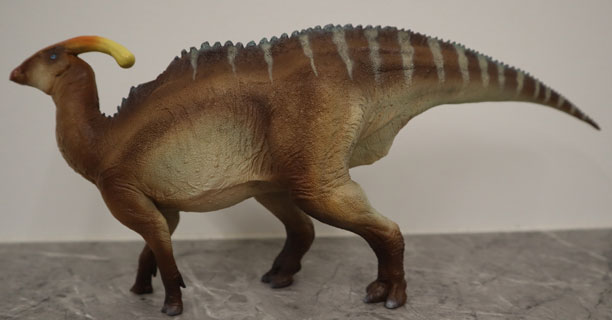
PNSO Wyatt the Parasaurolophus dinosaur model in lateral view.

PNSO Wyatt the Parasaurolophus dinosaur model in lateral view, a stunning replica of a Late Cretaceous duck-billed dinosaur.  The stripes will help to camouflage this herbivorous dinosaur.  Picture credit: Everything Dinosaur.

Picture credit: Everything Dinosaur

The picture (above), shows a PNSO Parasaurolophus model: PNSO Age of Dinosaurs.

Communication within the Herd

Also, with animals living in herds there would need to be some way for these creatures to communicate with each other, perhaps colourful crests and patches were used to indicate social status and social order within such herds.

The latest model Parasaurolophus from Bullyland demonstrates this principle.  Scientists believe that the crest of this dinosaur may have varied between males and females.  The males may have had the bigger crests, some of which exceeded 1.8 metres long.  Juvenile Parasaurolophus have little or no crest, perhaps the crest grew as the animals reached maturity.  If this is the case then a large crest would perhaps indicate social dominance and status within the herd.  This would have been emphasised if the crest was a different colour from the rest of the animal, a bright colour for instance, like orange.  This is why the new Bullyland model has been depicted with an orange coloured crest.

The Bullyland Model Parasaurolophus (Orange Crest)
Picture credit: Everything Dinosaur

The model depicts a male Parasaurolophus with a distinctive and large head crest.

A Picture of a scale Model – Parasaurolophus

A crested lambeosaurine hadrosaur.

Picture credit: Everything Dinosaur

To view the model: Dinosaur and Prehistoric Animal Models.

The orange strips may have helped camouflage this animal as it moved through woodland (helping to break up it’s body outline).  Stripped animals moving in a herd are also given a degree of protection as the colour scheme can prevent a predator from selecting an individual to attack.

There are a number of interpretations available regarding the colouration of dinosaurs.  Fossils can reveal a great deal of detail about these ancient creatures but they rarely include any signs of the skin.  The softer body parts usually rot away before preservation and things like colouration do not normally fossilise.  This means that scientists can speculate as to the actual colour of dinosaurs and as a result many variants have been put forward.

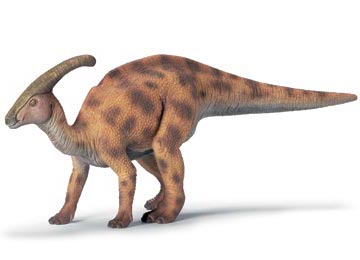
The Parasaurolophus from German model makers Schleich is depicted with a very different colouration.  In this model, a leopard like spotted coat is favoured.  Palaeontologists using evidence from Alberta believe that this animal may have favoured woodland environments.  Spots as well as stripes would have made good camouflage.  Hence in this instance, Parasaurolophus is depicted as having a spotted coat.

Another View of the Parasaurolophus Model from Schleich
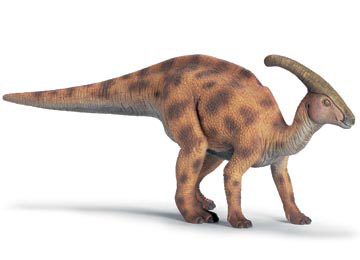
Picture credit: Everything Dinosaur

To view the Schleich prehistoric animal range and other models: Dinosaur Models and Toys.

The speculation is likely to continue, what is almost for certain is that the grey, drab models of yesteryear will continue to be replaced by more colourful ones.  Could be this reflects the latest scientific research, or perhaps it is more to do with appealing to collectors and dinosaur fans.


18 01, 2008

Models of the Dinosaur Parasaurolophus

By |2022-11-08T13:25:43+00:00January 18th, 2008|Categories: Everything Dinosaur Products|0 Comments

Parasaurolophus Dinosaur Model

The other day, team members at Everything Dinosaur met an enthusiastic, young dinosaur fan who informed us that her favourite dinosaur was the duck-billed dinosaur known as Parasaurolophus.  Not only was this particular member of the Ornithischia her absolute favourite, but she then went onto show us her favourite dinosaur model, this too happened to be a Parasaurolophus.

Parasaurolophus Dinosaur Model (CollectA Prehistoric Life/Age of Dinosaurs)

Parasaurolophus model.

Parasaurolophus model – click image to view models.

Picture credit: Everything Dinosaur

Parasaurolophus Dinosaur Model

We enquired why this particular replica deserved special merit and she confidently told us that this dinosaur had a long crest on its head that was brightly coloured and that it could run on its hind legs to get away from the meat-eating dinosaurs who lived nearby.  We could not argue with her assessment.

Everything Dinosaur stocks an extensive range of ornithischian dinosaur models including several models of Parasaurolophus.  To view the range of prehistoric animal models in stock: Everything Dinosaur Models and Figures,

14 01, 2008

A New Dilophosaurus Dinosaur Model

By |2024-04-10T08:45:58+01:00January 14th, 2008|Categories: Everything Dinosaur Products|0 Comments

Dilophosaur Dinosaur Model

It is always a pleasure to see models of meat-eating dinosaurs introduced into what we at Everything Dinosaur call the ranges of  “mainstream model manufacturers”.  This replica of the theropod dinosaur Dilophosaurus is no exception.  It is great to see “double crested lizard” as a dinosaur model, especially one that has been so finely painted.  This is a very colourful Dilophosaurus dinosaur model.

Dilophosaurus Dinosaur Model

Articulated Dilophosaurus model.

Picture credit: Everything Dinosaur

Dilophosaurus Dinosaur Model

There have been a number of dilophosaur models introduced in recent years.  Dilophosaurus (D. wetherilli), reached lengths of up to six metres and this dinosaur is regarded as a member of the Coelophysoidea, a distant ancestor of the mighty Tyrannosaurus rex.

To view the extensive range of dinosaur and other prehistoric animal models available from Everything Dinosaur: Dinosaur and Prehistoric Animal Models.

Go to Top