All about dinosaurs, fossils and prehistoric animals by Everything Dinosaur team members.

Everything Dinosaur’s work with schools and other educational bodies. Articles, features and stories about dinosaurs and their role in education and educating young people.

12 11, 2010

What are “Terror Birds”?

By |2023-01-13T21:48:09+00:00November 12th, 2010|Categories: Animal News Stories, Dinosaur and Prehistoric Animal News Stories, Educational Activities, Main Page|0 Comments

Question – What is a “Terror Bird”?

Featured in films such as 10,000 BC and the original King Kong film released in 1933 as well as in television documentaries such as “Walking with Beasts” and science fiction programmes such as “Primeval” – the “Terror Birds” as they are known are certainly in the public’s conscience.

“Terror Birds”

However, who or what exactly is a “Terror Bird”?  We do get asked this question quite a lot, usually by boys aged between six and eight years of age.

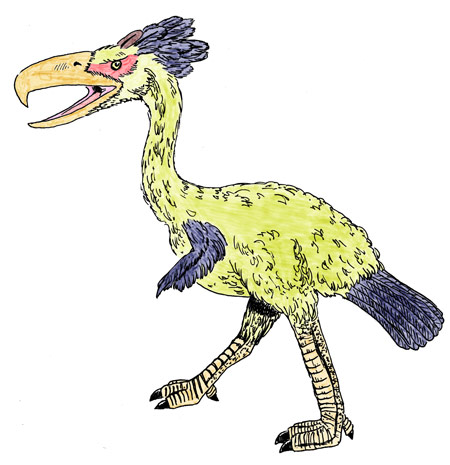
The term “Terror Bird” was first used to describe the fossils of a large, carnivorous, flightless bird, fossilised remains of which had been discovered in South America.  This particular genus was named Phorusrhacos and a number of species have now been ascribed.  These birds were apex predators competing alongside placental mammals in South America for millions of years, although phorusrhacids had once roamed widely with the oldest fossils dating from Europe.  Although the term “Terror Bird” was first used to describe a South American genus, this phrase is now used to describe most of the large, flightless carnivorous birds of the Cenozoic.  They were certainly terrifying with some specimens standing over 3 metres tall, with hugely powerful legs capable of running as fast as a race horse and with hatchet shaped beaks.

An Illustration of a Typical “Terror Bird”

A drawing of Kelenken. Phorusrhacids illustrated. The "Terror Birds".

The Kelenken in all its glory.  An illustration of a typical “Terror Bird”. Picture credit: Everything Dinosaur.

Picture credit: Everything Dinosaur

When the dinosaurs became extinct at the end of the Cretaceous period (66 million years ago) there were no large predators left on the land.  Into this space left vacant with the extinction of animals like Tyrannosaurus rex came the “Terror Birds” – large flightless birds that evolved long, powerful legs and sharp beaks to chase down the newly evolving mammals and to attack them.

The last of their kind, (in South America), became extinct as recently as 15,000 years ago.  Modern humans migrating into South America from the North would most certainly have encountered them.  One wonders what the people who actually saw these creatures would have called them.

CollectA have made a replica of a “Terror Bird”, to view this range including the Kelenken “Terror Bird”, whilst stocks last: CollectA Deluxe Prehistoric Life Models.

6 11, 2010

Hoard of Palaeogene Amber from Indian Coalmine

By |2023-01-13T20:49:00+00:00November 6th, 2010|Categories: Dinosaur and Prehistoric Animal News Stories, Educational Activities, Main Page|0 Comments

Prehistoric Creatures Preserved in 52 million year old Amber

The remains of hundreds of ancient arthropods have been discovered in a hoard of Palaeogene amber preserved in sediments discovered in a coalmine located in western India.  Researchers have been able to identify over 700 insects, mites and spiders, many of which are remarkably well preserved.  The fossils will help scientists to determine the extent to which Indian fauna and flora was influenced by the sub-continent’s gradual drift away from Africa towards Asia throughout the Mesozoic under the influence of plate tectonics.

Palaeogene Amber

Amber is a sticky, scented resin produced by certain types of trees since Jurassic times as protection against disease and to help seal wounds in the bark.  Occasionally, insects and other small creatures can become trapped in the resin and fossilised when it hardens into amber.

Everything Dinosaur has written extensively on fossil discoveries associated with organic remains preserved in amber, last year for example, we reported on the discovery of elements of a Jurassic spider’s web preserved in fossil amber.

To read more about this discovery: World’s Oldest Cobweb Preserved in Amber.

The international team of researchers excavated something approaching 150 kilogrammes of the light, brown, coloured amber pieces from the coalmine located in Gujarat Province (India).  This is one of the largest finds of amber ever recorded from Asia.  The animals, pollen grains and other items trapped inside the amber are helping to provide scientists with an insight into the Indian eco-system at around the time that the Indian subcontinent collided with Asia to form the Himalayas.

A spokesperson for the research team, palaeontologist Jes Rust, based at Bonn University (Germany) stated that the remarkably well preserved fossils consisted of ancient bees, termites, gnats, flies and ants – in total more than 700 arthropods.

Dr Rust commented:

“They [the organisms] are so well preserved.  It is like having the complete dinosaur, not just the bones.  You can see all the surface details on their bodies and wings.  It’s fantastic.”

The amber itself is helping scientists to understand more about the flora in India during this part of the Palaeogene.  Tests on the fossilised resin indicate that it comes from a type of hardwood tree, that today make up nearly 80% of lowland forest canopies in south-east Asia.  The amber and the fossilised wood found in the same rock strata suggests that India must have been extensively forested at the time the amber was formed.

Reporting in the American based, scientific journal “Proceedings of the National Academy of Sciences”, the researchers describe the creatures preserved and theorise on the changes undertaken in Indian flora and fauna as the sub-continent drifted towards Asia under the influence of plate tectonics.

As the Indian plate moved towards the Asian plate,  a chain of islands may have formed.  These would have permitted the interchange and mixing of different floras and faunas as the islands acted as stepping stones for organisms between the two landmasses.

Dr Rust stated:

“We think that, before the final collision between India and Asia, some sort of island arc was established.  Our findings suggest that the mixing of fauna was already so strong, that it was already happening for several million years.”

Once species from India had crossed into Asia, they could have spread further, eventually reaching Australia.  The team has so far recorded 100 different arthropod species.  They are hopeful that the amber will reveal more, some of which are likely to be close relatives of arthropods that live in Africa and Madagascar as the Indian sub-continent was once attached to these areas of land, for much of the Palaeozoic and into the Mesozoic forming the super-continent Gondwanaland.

For models and replicas of Palaeozoic creatures such as trilobites and ammonites: CollectA Prehistoric Animal Models.

4 11, 2010

The Twenty Best Blogs for Primatologists

By |2023-03-06T12:40:44+00:00November 4th, 2010|Categories: Animal News Stories, Educational Activities, Main Page|0 Comments

The Twenty Best Web Logs for Primatologists

For those of you wishing to follow in the footsteps of Dian Fossey or Jane Goodall and to study our nearest living relatives – the apes and monkeys, here is a heads up on the top blogs to be found on the subject of all things primatology, as provided by the E-advisor blog.  Everything Dinosaur provides information on blogs for primatologists.

Blogs for Primatologists

This particular article states that one of the fascinating things about primatology — the study of primates, for those who’ve forgotten their suffixes — is that it can be applied to so many professional fields, from biology and zoology to more far-reaching areas like anthropology and psychology.  Studying these animals means examining our close relatives and learning what makes them, us, and the world itself tick. 

Highlighting College Courses

The article highlights a number of college courses in the field that cover everything from animal behaviour to the languages of apes, and from the study of habitats to the exploration of human-primate interaction.

The blogs rounded up by the article team, perhaps the collective noun should be a “troop” of blogs given the nature of their specialism, are among the best in the field, especially for students looking to get a better understanding of all primatology has to offer.

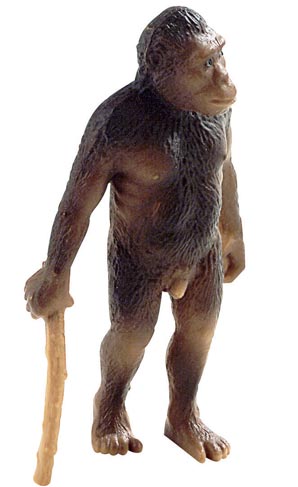
Became an Authority on Australopithecus

Australopithecus afarensis.

At home on the plains.

As the article writers at E-advisor say, the blogs provide insights and updates on research, plus monkey pictures!  Pictures of apes and their extinct relatives are provided too.

Visit Everything Dinosaur’s user-friendly website: Everything Dinosaur.

9 10, 2010

Manchester Science Festival Back with a Bang

By |2023-01-13T07:38:55+00:00October 9th, 2010|Categories: Educational Activities, Everything Dinosaur News and Updates, Main Page|0 Comments

Manchester Science Festival October 23rd to 31st

Celebrating the International Year of Biodiversity, the fourth annual Manchester Science Festival is fast approaching and this year’s event promises to be bigger than ever.  Those hard working organisers of the festival have over 200 science based events taking place in and around the Manchester area (England) over the nine days of the festival – a huge variety of activities from making frozen nitrogen ice cream, discovering the plight of the humble honey bee, and learning about maths through the medium of stand up comedy.

Manchester Science Festival

There will be something for everyone – from kids to adults, science buffs to the uninitiated.  Many events are interactive such as crafty work shops, but there will also be heated debates, music, stand-up, stories and science busking.  A number of the events are free and those with a charge are pretty reasonably priced.

Festival Director Natalie Ireland commented:

“Well what a line up we have this year!  It’s going to be an amazing Festival – personally I can’t wait to see the Super K Sonic Boooum – but we have such a breadth of events that I’m sure the whole of the north will find something to get excited about and get involved in.”

The list of events is very long but some of the highlights include, Super K Sonic Boooum, the Universe explained in a massive installation which gives you chance to ride in a dinghy over 50,000 tonnes of extremely pure water with scientists from Japan.  Also there is the chance to learn about real crime forensic work, take part in the making of your very own regional television programme and to learn all about the use of science in the kitchen.

If you are a dog owner, try to make the “Pedigree Chums” presentations, as they lift the lid on over 200 years of selective dog breeding and explore the relationship between dogs and humans.  One of the things we are most looking forward to is Manchester Museum’s Andrew Gray, the Museum’s Curator of Herpetology giving two hands-on talks about the diversity and current plight of reptiles and amphibians in the world today.  Your chance to get to grips with some of our scaly friends and to hear about the extinction threat facing half the species of amphibians known.

You can even get the chance to see how you would cope as a super-human or test your psychic abilities, there is so much packed into the festival this year, it sounds like it is going to be the best ever.

Everything Dinosaur is proud to have helped to support many schools in the Manchester area.

To visit the company’s award-winning website: Everything Dinosaur.

29 09, 2010

Forty Eight Million Years before Van Gogh – Eocene Sunflowers

By |2023-01-12T22:01:29+00:00September 29th, 2010|Categories: Dinosaur and Prehistoric Animal News Stories, Educational Activities, Main Page|0 Comments

Fossils of Ancient Member of the Daisy Family Discovered in Argentina

The Dutch born, post impressionist, artist Vincent Van Gogh famously painted a number of still life pictures of sunflowers.  One such painting was sold at auction in the late 1980s for a little under $40 million USD.  However, researchers at the Argentinian Museum of National Sciences have discovered their own “portrait of sunflowers” with the finding of two exquisitely preserved fossilised flowering heads in southern Patagonia (Argentina).  Sunflowers are members of the Asteraceae (otherwise known as Compositae – we think) Family.  This family of flowering plants (Angiosperms), is one of the most diverse and widespread of all the plant families.  This family includes plants such as the daisy, dandelion and commercially important plants such as the tea bush and sunflowers.

Plant material is rarely preserved as a whole fossil, for instance, a fossil of the entire plant with roots, leaves and flowers all together.  Fossils normally occur as isolated individual parts such as cones, pollen grains, pieces of trunk and such like.  Delicate flowering heads (capitula) are extremely rare in the fossil record.  However, the discovery of a fossil that shows two complete flower heads, winged seeds and the flower stem is helping scientists to understand the evolution of this very important group of plants.

The fossil has been dated to approximately 47.5 million years ago (Eocene Epoch) and it was found in strata along the Pichi Leufu river.  During the Eocene, this part of the world had a sub-tropical climate with average temperatures of around 19 degrees Celsius.  The dense flower-head would have been attractive to pollinating insects, suggesting that flowers such as these primitive ancestors of the sunflower already had a long established relationship with insect pollinators.

Sunflowers

Dr Viviana Barreda, one of the authors of the paper, the details of which have been published in the journal “Science”, suggests that the finding of this fossil supports the hypothesis that the ancestors of the Asteraceae Family evolved in the southern region of Gondwanaland and spread to most of this super-continent before this landmass began to break up.  This would explain the wide geographical dispersal of related genera.

Scientists believe that the common ancestor to a number of related plant families first evolved in sub-tropical Antarctica, (which was part of Gondwanaland), before migrating to Australia and South America as Antarctica cooled and became an unfavourable climate for most plant species.

Commenting on the discovery, University of Vienna (Austria) botanist, Dr Tod Stuessy stated that this fossil and the related pollen grains were clear evidence of the existence of the sunflower sub-family at the early stages of Asteraceae diversification.  Dr Stuessy wrote an accompanying article to the Argentinian scientific paper.  He went on to add that little is known about the origins of sunflowers and there is much still to learn about how these plants evolved and spread all over the world or indeed how members of the Asteraceae became so “incredibly diverse.”

The scientific paper on which the journal article is based is the culmination of two years of research.

Visit Everything Dinosaur’s award-winning website for models of prehistoric plants: Everything Dinosaur.

3 09, 2010

Oceans “Gripped” by Sixth Mass Extinction Event According to New Research

By |2024-04-19T19:06:48+01:00September 3rd, 2010|Categories: Dinosaur and Prehistoric Animal News Stories, Educational Activities, Geology, Main Page|0 Comments

Australian Scientist Warns of Marine Environment Mass Extinction Event

Our influence on the climate leading to global warming and the acidification of the oceans, over fishing and other human activities are leading to a sixth mass extinction according to an Australian study.

Extinction is the complete, global end for a species, mass extinctions are major reductions in the diversity of life and the geological fossil record shows that there have been five major extinction events in the Phanerozoic era (visible life – the last 545 million years).  In a new paper published in the journal “Science” the fossil record of marine life suggests that this current environmental pressure on the oceans could lead to such dramatic extinctions that the world could take tens of millions of years to recover.

Sixth Mass Extinction

Dr John Alroy from Macquarie University in Sydney analysed the fossil record for oceans, dating back to the Cambrian period (over 500 million years), to study how major changes in marine animal groups take place.

In the Late Ordovician for example, many types of arthropods, molluscs, corals, graptolites and echinoderms became extinct.  Extinction events are happening all the time, there is a “background” level of extinction and periodically this “background” rate increases.  However, scientists recognise just five major extinction events in the geological record, the last, and perhaps the most famous being the mass extinction event 66 million years ago that saw the end of the dinosaurs.

Dr Aloy used an example from the greatest mass extinction event known to science – the Permian mass extinction, that occurred approximately 250 million years ago.  Species of animals known as lamp shells, which had dominated sea-beds, were suddenly replaced by clams and snails.

He stated:

“The lamp shells were all over the place and diverse for a quarter of a billion years, then the biggest mass extinction in the history of life on earth happened – the Permian-Triassic extinction – and they went from being all over the place, to being rare and not very diverse.”

New Research Contradicts Hypothesis

Previously, scientists had thought that these mass extinctions were governed by the slow unwinding of predictable evolutionary “rules” that operated over  hundreds of millions of years.  However, this new research contradicts this hypothesis.

Dr Aloy commented:

“What my paper shows is that this story is fundamentally wrong, in that it doesn’t take into account the way a big evolutionary innovation or mass extinction can overturn the rules.  The change in the balance of groups is not random.  It’s not that some groups have good luck and some have bad luck.  There has actually been a resetting of the rules of evolution.”

From our own perspective, at Everything Dinosaur we do believe that serendipity does have an effect on evolutionary success.  For example, our species, H. sapiens are still around, but the Neanderthals are extinct.  To become extinct the Neanderthals did not have to fail, just to be slightly less successful than competing species.  Dr Aloy paints a bleak picture for the world’s oceans, human activities such as over-fishing, ocean acidification and the introduction of alien species are threatening to trigger a mass extinction event.

He added:

“It’s not just a mass extinction, but a massive reshuffling of species across the globe.  We’re simultaneously ruining the environment and selectively wiping out certain groups.”

The research paper indicates that a combination of pressures and stresses could leave ocean biodiversity devastated, Dr Aloy stated:

“Things are so bad right now in so many different ways it’s very hard to imagine that you wouldn’t have a big long-term overturn in the balance of groups.”

Examining the Geological Record

The geological record shows that life on Earth took many millions of years to recover from such extinction events.

“It will take tens of millions of years before there is a full recovery with respect to the number of species in the ocean and the balance of groups.  It will establish a new order that will persist for a very long time.”

Extinction is a consequence of natural selection and the interaction between ecosystems and the environment, a number of studies indicate that a large and diverse range of organisms are endangered or threatened with extinction.  Indeed, a rough estimate often quoted is that one species of vertebrate goes extinct every day.

Visit Everything Dinosaur’s award-winning website: Visit Everything Dinosaur.

26 08, 2010

Feathered Dinosaurs Inspire Australian Artist to Create Unique Art

By |2024-04-19T19:11:39+01:00August 26th, 2010|Categories: Dinosaur and Prehistoric Animal News Stories, Educational Activities, Main Page|0 Comments

Feathered Dinosaurs Inspire Artist (Renaissance Dinosaur)

Melbourne based artist Kate Rohde, a graduate of the Victorian College of the Arts, has been inspired by feathered dinosaurs to create some unique pieces of artwork in support of an Australian fashion event.

Working in collaboration with Sydney based fashion label Romance was born, Kate has helped create an elaborate installation of lurid, feathered, paper mache dinosaurs, prehistoric animals and other creatures inspired by the clothing company’s designs.

Feathered Dinosaurs

Part of the fashion collection is based around a Jurassic colour scheme and Kate’s vibrant sculptures made from synthetic fur, fabric and other modern materials provide an excellent accompaniment to the art/fashion installation.

The exhibition brings together sculpture, clothing, wall-paper, material and other unique objects of interest in a display where a fusion of art and creative activities meets fashion.

Whilst scientists are quite confident that dinosaurs had colour vision and many of them were indeed feathered, no one can be sure for certain what colour dinosaurs were.  Kate’s interpretations certainly paint a picture of bright and colourful creatures from the Mesozoic – but nobody can tell her she is wrong, her interpretation is as good as the most accomplished palaeontologist.

Her characteristic intricate resin detailing is located in a number of pieces and her own fantastical and imaginative use of materials is perfectly combined and complemented in this project.

Photographs show the beautifully crafted pterosaur, whilst one could perhaps point out one or two anatomical inaccuracies there is no denying that this is a striking piece.

The favourite sculpture amongst team members at Everything Dinosaur is the pink Triceratops.  There have been a number of news stories featuring Triceratops recently, most prominent of which is the view that this iconic dinosaur may actually be a immature Torosaurus and therefore not a unique dinosaur genus at all.  However, it is great to see Triceratops featured in the art exhibition, and we do know that some dinosaurs could flush blood into the skin to turn pink and red, so you never know – after all, protofeathers have been found on fossilised skeletons of the ornithischian dinosaur Psittacosaurus, an ancestor of Triceratops.

To read more about the Triceratops/Torosaurus controversy: The Extinction of Torosaurus – Second Time Around.

These amazing prehistoric animal sculptures are on display at an exhibition called “Renaissance Dinosaur” at the KW Gallery (Karen Woodbury Gallery, Richmond, Victoria, Australia) which runs from August 25th until September 18th.

Visit Everything Dinosaur’s award-winning website: Everything Dinosaur.

11 08, 2010

Darwin and Morphology – The Shape of Living Things

By |2023-01-11T08:32:52+00:00August 11th, 2010|Categories: Educational Activities, Main Page|0 Comments

Darwinism and the Shape of Living Things

A definition of life used by scientists is anything that may be subject to the laws of Darwinism such as natural selection.  For example, it could be argued that living things grow, however, so do stalactites and stalagmites and these items cannot be perceived as living creatures.  The works of Darwin are a fascinating source of information, they also provide an insight into the thinking and understanding of science during the Victorian era.  There are so many interesting passages in the “Origin of Species” for instance, one of our favourites and most thought provoking is a lesser known section to be found towards the back of the first few print runs.

Laws of Darwinism

In a chapter entitled “Classification” Darwin discusses how there is a form of order in the natural world.  He observes that members of the same Class independent of their habits of life, resemble each other in the general plan of their organisation.  Darwin refers to this as “Morphology”.

He postulates on why so many animals have appendages such as limbs that although designed for very different purposes all have the same or virtually the same bones making them up.

Darwin comments:

“What can be more curious than that the hand of a man, formed for grasping, that of a mole for digging, the leg of a horse, the paddle of a porpoise and the wing of a bat, should all be constructed on the same pattern and should include the same bones, in the same relative positions?”

A number of examples of morphology in the natural world are given by Darwin, he asks why the sepals, petals, stamens and pistils in any individual flower, though fitted for such varying purposes should all be constructed along the same design and basic pattern?  He argues that this is evidence that organisms have inherited these traits from the ancestors and these characteristics have been passed down (ultimately modified in most cases) the line of descent.

A visit to a museum can provide ample evidence of the point that Darwin is trying to make.  In the human skeleton there is but one bone in each limb connecting the arm or leg to the trunk of the body (humerus or femur).  We then have two bones connecting the lower portion of each limb to the hand or foot.  This pattern of bones is repeated in a huge range of vertebrate creatures from primitive amphibians, to modern predators such as lions, from enormous brachiosaurs to a tiny mouse.

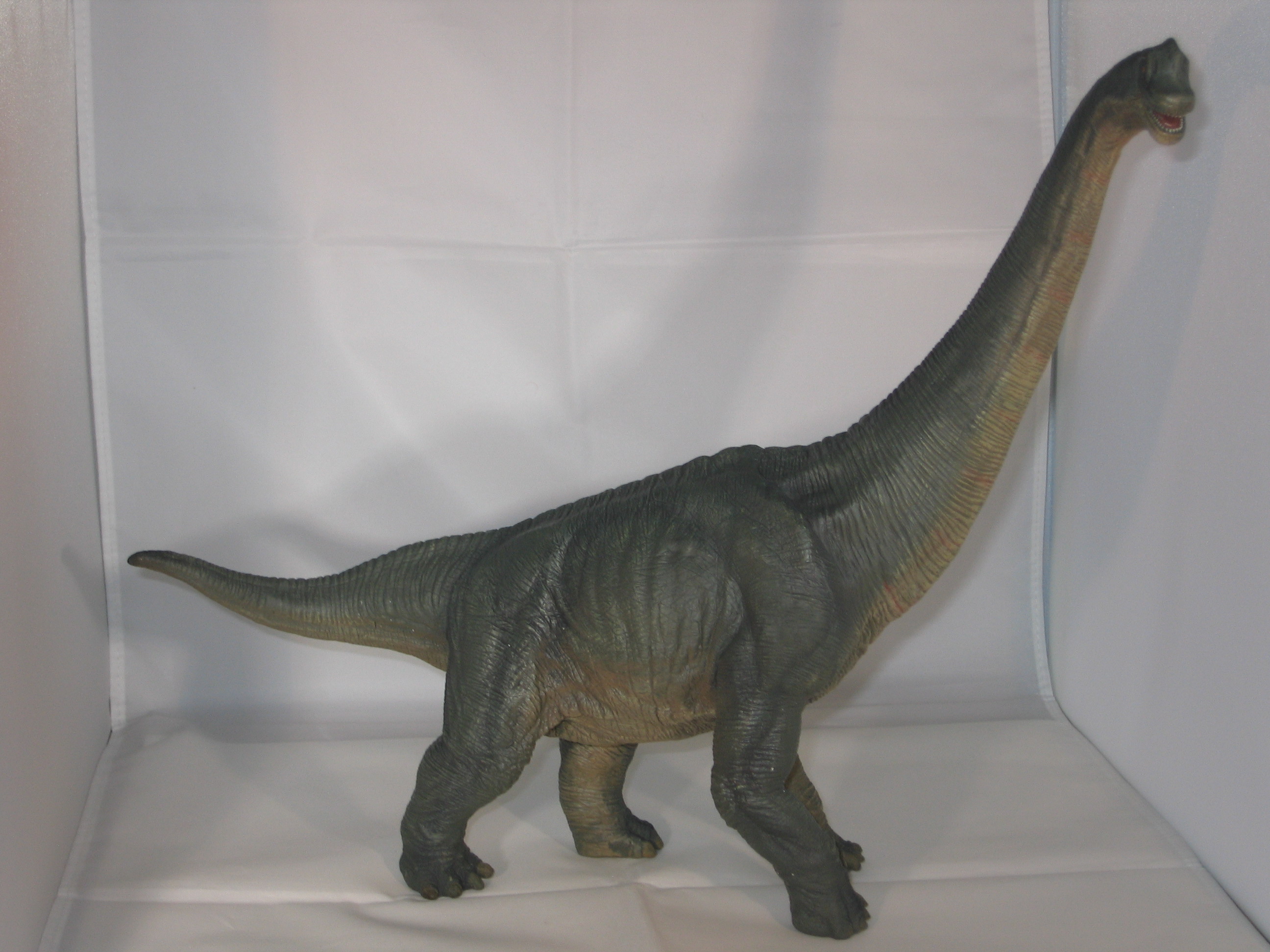
A Model of the Enormous Brachiosaurus

Papo Brachiosaurus dinosaur model. Exploring the laws of Darwinism.

In our studio – Papo Brachiosaurus. Pictrue credit: Everything Dinosaur.

Picture credit: Everything Dinosaur

The picture (above) shows a model of a Brachiosaurus by Papo.

To view the Papo range of dinosaur models: Papo Prehistoric Animal and Dinosaur Models.

Although Darwin was not the first scientist to make this point he presents this information and evidence for natural selection and inheritance in a very articulate way – helping to spread the interest in science and scientific issues amongst Victorian society.

7 08, 2010

Ancient African Crocodile that thought it was a Mammal

By |2023-01-10T18:54:07+00:00August 7th, 2010|Categories: Dinosaur and Prehistoric Animal News Stories, Educational Activities, Main Page, Palaeontological articles|0 Comments

Paper Published on Crocodile with Mammal-like Teeth

Scientists writing in the journal “Nature” have reported on their research into a strange and bizarre cat-sized, ancient African crocodile that filled a particular niche in the dinosaur dominated Cretaceous ecosystem.  The teeth of this particular reptile are similar to those seen in mammals and indicate that this little animal could bite and chew its food – a behaviour not seen in extant crocodilians.

Ancient African Crocodile

Palaeontologists unearthed an almost complete specimen in 2008, since then a number of other fossils of this 100-million-year-old creature have been found at a dig site in southwestern Tanzania.  No bigger than a domestic cat, this agile reptile scampered around the undergrowth chasing insects and small mammals whilst trying to avoid the attention of larger carnivorous dinosaurs that it shared its flood plain environment with.

Researcher Patrick O’Connor of Ohio University commented on the crocodile’s most striking feature, its teeth stating:

“If someone were just to describe those teeth, the shapes and how they interact with one another or work together, most people would read that as a very mammalian-like dental series.”

The scientist went on to discuss the latest discovery, an intact skull, complete with sharp incisors at the front of the jaws – ideal for tearing meat and interlocking upper and lower molars at the back of the jaw that were used for grinding, just like the teeth in the back of our own jaws.

The crocodile has been formally described and named Pakasuchus kapilimai.  The name means “Cat Crocodile”, from Paka the word for cat in the Swahili language and Suchus coming from the Greek word for crocodile.  A CT scan of this long-limbed terrestrial animal revealed that the molar-like teeth in the top and bottom jaws met very accurately when the animal bit down.  The creature would have eaten with a chewing action, mobile jaws in Reptilia are almost unknown (until now).

An Illustration of Pakasuchus kapilimai

Picture credit: Mark Witton (University of Portsmouth)

Pakasuchus kapilimai

The teeth of modern crocodiles are relatively simple in contrast to Pakasuchus kapilimai.  All the extant species of crocodilian have sharp, pointed conical teeth, the teeth (known as the dentition), may vary in size and angle but they are all virtually the same shape, with the same function to grab and hold onto prey.  Modern crocodiles cannot chew their food, they twist their bodies (known as a crocodile roll) and tear of chunks of flesh from their victims, these pieces are then swallowed whole.

Paul Filmer, Programme Director of Geology and Palaeobiology at the U.S. National Science Foundation, which co-funded the expedition with the National Geographic Society commented:

“The crocodilians with which you and I are familiar have a very characteristic smile, as it were.  The teeth or the dentition that they have is mainly a row of conical teeth which may vary a little bit in size and angle, but they’re pretty much all the same and they basically serve that function which is to grab and tear.”

Scientists say modern crocodiles did not evolve from the prehistoric crocodile-like creature that was a species of ancient reptiles called Notosuchian crocodyliforms that died out around the same time that other land-dwelling dinosaurs became extinct.

Notosuchian crocodyliforms

Paleontologists say Notosuchians are characterised by a variety of different tooth structures and patterns.

Researcher Patrick O’Connor says the 100-million-year-old reptiles, which flourished across a southern landmass the predated the African continent, probably filled a unique ecological niche.

“Maybe there was a certain place in the ecology or in the environment where these animals lived that allowed them to experiment with the shape of the teeth.  And as evolution works, if that was a successful experiment, then a group could go on and have a very long history.”

The crocodilians have evolved into a myriad of forms over their long evolutionary history to read an article about unusual crocodile-like animals: Five “Oddball” Crocodiles from the Mesozoic.

For models and replicas of early members of the Archosauria including models of ancient crocodilians: Prehistoric Crocodile Models and Figures.

19 07, 2010

New Fossil Discovery from Saudi Arabia provides Evidence of Monkey/Ape Divergence

By |2023-01-10T12:57:39+00:00July 19th, 2010|Categories: Dinosaur and Prehistoric Animal News Stories, Educational Activities, Main Page, Palaeontological articles|0 Comments

Saadanius hijazensis – New Oligocene Primate sheds light on Divergence of Apes

Saudi Arabia 30 million years ago, looked very different than it does today.  Much of this desert kingdom was a lush and verdant paradise for the rapidly diversifying mammalian species.  Bordering the last remnants of the once mighty Tethys ocean there were extensive mangrove swamps and thriving in this half-way house environment between the land and sea were a number of genera of monkeys and other arboreal creatures.  The discovery of a partial cranium (part of the skull) dating from approximately 28-29 million years ago, may have shed light on the divergence of the apes from Old World monkeys.

In the hills overlooking the Red Sea a team of scientists have unearthed the fossilised elements of a skull of an ancient creature that may be a transitional fossil showing a point in the evolution of apes from monkeys.

The skull could help palaeontologists to answer questions about the life of primates in a geological epoch that until now has provided few fossil clues.  The report on this fossil and its potential implications regarding the evolution of apes is published in the scientific journal “Nature”.

Commenting on the discovery, Iyad Zalmout, a palaeontologist with the University of Michigan and an author of the paper stated:

“It turns out it’s not an ape, it’s not a monkey, it’s something intermediate.”

The expedition were a little surprised to find the fossil, their primary objective being to explore the coastal sediments to excavate ancient whale fossils, helping to piece together the evolution of this particular group of mammals. They were not expecting to find ancient monkey/primate remains, especially skull material which could provide a fresh insight into the evolution of apes from Old World monkeys.

Fossil Discovery

Pictures show an anterior view of the skull material (view from the front) on the left and a ventral view (view from the side) on the right.  Although fragmentary, the nasal concha (hole where the nose tissue would be) is clearly visible, along with the nasal bone (links nose to the eyes) and elements of the maxilla.  The face although elongated and angular does have a flattened appearance, a characteristic of apes and of our own hominid ancestors.

This new genus has been named Saadanius hijazensis and it shares morphological features with a family of apes known as the Propliopithecoidea, an ancestor of apes and monkeys that lived more than 30 million years ago.  The fossil record of monkeys from this part of the Cenozoic is particularly poor, arboreal dwelling animals do not generally have a high potential for fossilisation to occur.  This is due to a number of factors but living in a forested environment leads to very few chances of a corpse being fossilised and preserved.  S. hijazensis lacks the advanced sinuses of extant apes and monkeys (collectively called Catarrhines), however, it does have a bony ear tube that was not fully developed in the Propliopithecoidea.

Commenting on the discovery, Erik Seiffert, an anatomist at Stony Brook University in New York said:

“This fossil is really key because it has that bony tube.”

He went on to add that comparison of the bony tube and other features such as the teeth and the forward facing position of the orbit (eye sockets) with those of other primates could help palaeontologists to build up a more complete picture of the ape/monkey family tree.

Saadanius hijazensis

Zalmout and his co-authors are confident that S. hijazensis could help scientists make sense of “competing hypothesis” about how the shape of Catarrhine skulls changed over time.  One theory put forward by palaeontologists based on the limited fossil evidence found to date is that the Catarrhines developed long, flat faces relatively early on in their evolutionary history.  Other scientists, such as comparative anatomists point out that modern, extant genera such as gibbons, have rounder faces and use this evidence to suggest that long, flat faces evolved much later.

The fragmentary Saadanius fossil has a long, flat face and this discovery has excited scientists as it lends support to the theory suggesting the evolution of the flat face very early on in ape evolution.

Erik Seiffert stated:

“This evidence [Saadanius fossil] very clearly supports the palaeontological point of view.”

However, other scientists warn on the over reliance of fossil evidence to prove a particular theory.  For example, facial features may be distorted over the long preservation and fossilisation process, geological pressure can crush, compact and distort features.  Eric Delson, a palaeontologist from Lehman College of the City University (New York), suggested that fossils may only reflect part of the diversity of a group of particular animals, making it difficult to draw precise conclusions.

All the scientists agree that the discovery of more ancient transitional fossils will help to shed light on the evolutionary relationships between different groups.  Saudi officials, keen to promote tourism have already taken steps to preserve this particular dig site.  This will afford palaeontologists the opportunity to explore the area in more depth, perhaps unearthing more fossils that can indicate how Saadanius moved around its mangrove environment and what it ate.

Delson put it succinctly stating:

“It would be interesting to know whether these primates were beginning to come down from the trees and to know something about what they were eating.”

Welcoming the news that Saudi officials want to preserve the site and to promote fossil tourism Zalmout concluded:

“In my experience, if you find one primate there should be more there.  This will be important to see the whole story about fauna in Arabia and Africa.”

We at Everything Dinosaur look forward to reading about future discoveries.

To view models of prehistoric animals including mammals from the Oligocene: Figures of Prehistoric Mammals.

Go to Top