All about dinosaurs, fossils and prehistoric animals by Everything Dinosaur team members.

Everything Dinosaur’s work with schools and other educational bodies. Articles, features and stories about dinosaurs and their role in education and educating young people.

27 01, 2011

The Giant Rodent on the Front Cover of Prehistoric Times

By |2023-01-15T10:47:41+00:00January 27th, 2011|Categories: Dinosaur and Prehistoric Animal News Stories, Educational Activities, Main Page|0 Comments

Identifying the Giant Rodent on the Front Cover of Prehistoric Times (issue 96)

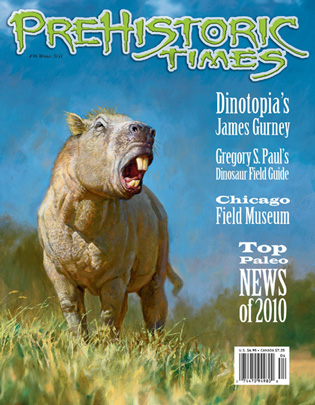
The animal featured on the front cover of the latest edition of the magazine Prehistoric Times is an extinct rodent from the genus Josephoartigasia (J. monesi).  Standing approximately 1.5 metres high at the shoulder, this animal, which lived in South America from 4-2 million years ago, looked like something crossed between a guinea pig and a rhinoceros.

Giant Rodent

Weighing as much as one tonne, this cow sized rodent is the biggest rodent genus known to science.  Known only from a partial skull, found in Uruguay and scientifically described just three years ago, the illustration was created by the renowned artist James Gurney.

The Front Cover of Prehistoric Times (Winter)

Picture credit: Everything Dinosaur

The sheer size of this giant, prehistoric rodent and the low point of view of the artwork, may have confused some viewers as to thinking this was some sort of prehistoric horse (the teeth provide the clue to the rodent heritage), perhaps even a toxodont, such as Toxodon.  These large notoungulates such as the toxodonts, had prominent incisors and also lived in South America, but the massive, pair of incisors at the front of the mouth identify the animal in the illustration as a member of the Order Rodentia.

To view models and figures of extinct prehistoric mammals: Models of Prehistoric Mammals.

21 01, 2011

Dancing with Dinosaurs – Helping to Inspire Schoolchildren

By |2024-04-21T12:00:05+01:00January 21st, 2011|Categories: Educational Activities, Everything Dinosaur News and Updates, Main Page, Teaching|0 Comments

Year 1’s Interpretation of a Mass Extinction

Yesterday, one of the team members at Everything Dinosaur was at a school, working with teachers and teaching assistants to deliver a dinosaur workshop and to conduct some outreach activities centred around the topic for the term – dinosaurs.  The eager young palaeontologists wanted to show us their dancing with dinosaurs drama routine.

Dancing with Dinosaurs

The students were all very keen and had lots and lots of questions, which were answered with our usual enthusiastic gusto.  At the end of a busy day, the children from Year 1 (aged 5-6) put on a dancing display as they interpreted how they thought the dinosaurs met their demise.  We moved to the hall, and in time to the music, the children at first pretended to be different types of dinosaurs, four-legged herbivores, giant long-necks and ferocious predators.

As the music grew louder (indicating the imminent arrival of an extraterrestrial body such as an asteroid), the “dinosaurs” became scarred and started running around in a panic.  At the crescendo of the music, the asteroid hit the Earth and all the children fell down and stayed very still, indicating the demise of the Dinosauria.

It was a very creative piece of music and movement, helping the young students to burn off some energy after they had been sitting down making dinosaur eggs, and digging for dinosaurs in the sand pit.

The teaching staff had considered how to appeal to different learning styles and to use differentiation in their teaching delivery.  The topic had been very well planned with lots of engagement for all the young students and it was a pleasure to have been a part of it.

I’m sure the children will really enjoy the rest of this term’s topic, after all, teaching about dinosaurs in school is fun.

To view the extensive range of dinosaur and prehistoric animal toys and gifts available from Everything Dinosaur’s award-winning website: Visit Everything Dinosaur.

19 01, 2011

The Remarkable Dinosaur Called “Sarah”

By |2024-04-21T11:59:33+01:00January 19th, 2011|Categories: Dinosaur Fans, Educational Activities, Everything Dinosaur News and Updates, Main Page|1 Comment

The Basal Sauropodomorph – Sarahsaurus

The other day, we were asked by a young dinosaur fan, that if she found a dinosaur could she name it “Sarahsaurus” after herself.  An interesting question, whereas there are certain rules that have to be followed when considering scientific nomenclature, technically there is nothing to stop a person describing an organism that is new to science in a way that commemorates them in some way.

However, in the case of this young girl and her ambition of being able to name a dinosaur after herself, the name Sarahsaurus has already been taken.  In the autumn of 2010, there was a paper published that described a basal sauropodomorph from North America, this animal had already been assigned the genus name Sarahsaurus (Sarahsaurus aurifontanalis).

Known from a single specimen, excavated from Lower Jurassic strata in Arizona (Kayenta Formation), this dinosaur is believed to an ancestor of the Diplodocids and Macronaria that thrived in the Late Jurassic.  Measuring approximately 4 metres in length, Sarahsaurus was much smaller than later sauropods and the fossil represents one of the most ancient (190 million years old) and most primitive long-necked dinosaur fossils discovered to date in North America.

An Illustration of Sarahsaurus

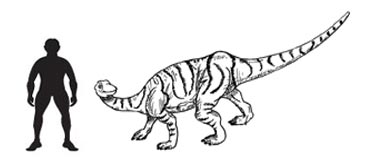
An illustration of Sarahsaurus.

Sarahsaurus illustrated.

Picture credit: Everything Dinosaur

The diagram shows a man next to the Sarahsaurus sketch to give scale.  Sarahsaurus had strong hands with claws and powerful forearms.  Scientists have suggested that this dinosaur, although preferring a quadrupedal stance, could rear onto its hind legs if required.  Perhaps the hands and claws were used to break open termite nests.  By the early Jurassic, termites living in large, social colonies were becoming widespread and Sarahsaurus may have been an omnivore, supplementing its diet of plants with termites and other small animals.

Sarahsaurus was named to honour a patron and supporter of the university that led the excavation (Sarah Butler).  So for our young dinosaur fan, she will have to think up another name to use, should she be lucky enough to discover an organism that proves to be new to science.

For models and figures of Sauropodomorpha dinosaurs: Everything Dinosaur Models and Figures.

9 01, 2011

New Everything Dinosaur Teaching Programme for 2011

By |2023-03-06T15:58:42+00:00January 9th, 2011|Categories: Educational Activities, Everything Dinosaur News and Updates, Main Page, Press Releases, Teaching|0 Comments

New Teaching Lesson Plans from Everything Dinosaur

With more and more schools in the UK adopting the creative curriculum, team members at Everything Dinosaur have responded by introducing a new range of teaching sessions and lesson plans to aid reception students through to key stage 4.  Our trained and qualified teachers have prepared a number of innovative and enriching lesson plans based around palaeontology and dinosaurs.  The aim of these sessions is to engage and involve  young people with the fascinating subject of Earth Sciences.

Everything Dinosaur

Working under the concept of “Dinosaur detectives” we use real case studies regarding new fossil discoveries to develop effective and very “hands on” dinosaur themed teaching schemes.

As part of our work in this important area of education, we have developed a number of advertisements to support our teaching activities and dinosaur workshops.

Everything Dinosaur’s Dinosaur Themed Teaching Activities

Picture credit: Everything Dinosaur

So if you want to involve your class in a dinosaur themed topic such as “Jurassic Forest” or Everything Dinosaur’s dinosaur detectives lesson plans simply log onto our website: Everything Dinosaur  to view the extensive range of dinosaur themed toys and gifts we stock.

The Everything Dinosaur Logo

Everything Dinosaur

Everything Dinosaur logo – a sign of quality and reliability.

Picture credit: Everything Dinosaur

In addition, if you require any advice about the products that we stock you are most welcome to drop Everything Dinosaur an email: Contact Everything Dinosaur.

19 12, 2010

What is an Ichnologist? A Helpful Explanation

By |2024-04-21T09:24:06+01:00December 19th, 2010|Categories: Dinosaur Fans, Educational Activities, Main Page|5 Comments

Ichnology – A Definition

The other day we were asked the question what is an Ichnologist?  This is an interesting question and gives us the opportunity to discuss a very important aspect of palaeontology, trace fossils.  An Ichnologist is someone who studies trace fossils, those marks preserved in the fossil record that show evidence of the activity of organisms.  Trace fossils have a major advantage over body fossils.   Unlike body fossils that may be transported a long distance from where the original organism actually lived, most trace fossils are direct evidence of the environment at the time and the place the organism lived.  For example, dinosaur trackways show where dinosaurs actually walked.

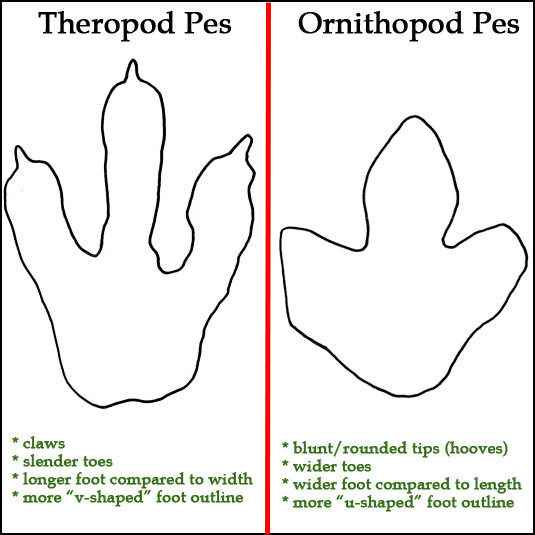
Examples of Dinosaur Footprints

Comparing different types of dinosaur footprint. Studying dinosaur tracks.

Theropod print compared to an ornithopod print. Picture credit: Everything Dinosaur.

Picture credit:  Everything Dinosaur

Ichnologist

The branch of geology that deals with the study of traces of organisms is called Ichnology.  Trace fossils include fossils of tracks, individual footprints, trails, burrows and borings.  Cave paintings made by our ancestors, as they are evidence of activity are classified as trace fossils.  The word Ichnology is derived from Latin and from Greek – ikhneumon “tracker” and from iknnos meaning “footstep”.

Visit Everything Dinosaur’s website: Everything Dinosaur.

3 12, 2010

What is a Nomen nudum? Here is the Answer

By |2024-04-21T09:30:20+01:00December 3rd, 2010|Categories: Educational Activities, Main Page|0 Comments

What is a Nomen nudum?

We were emailed this morning by a reader of our Everything Dinosaur blog with a question.  The emailer had come across the term Nomen nudum whilst reading an article about dinosaurs and asked us to explain what the term means.

Nomen nudum

When organisms are classified, be they animals, plants, or whatever, they are named.  However, to be properly accepted in scientific circles as a name for a specific organism (genus and species name), a formal description has to be made.  To make a formal description a “type” specimen has to be decreed, a sort of “master specimen” to which all other material ascribing to that species is compared.  This is known as the holotype.  In essence, the holotype represents the specimen on which the original scientific description of that organism is based.

Nomen nudum (usually written in italics), is a Latin phrase used to describe any organism whose definition in terms of a formal scientific description has not been completed – it has no holotype material assigned.  The plural of the phrase, indicating more than one type of organism being described in this way is Nomina nuda.  The phrase literally means “naked name”.

Visit Everything Dinosaur’s user-friendly and award-winning website: Everything Dinosaur.

30 11, 2010

Ichthyosaurs and their Young – Viviparous Marine Reptiles

By |2023-01-14T11:27:50+00:00November 30th, 2010|Categories: Dinosaur Fans, Educational Activities, Main Page|0 Comments

Ichthyosaurs and their Young – Mesozoic Marine Reptiles

Ichthyosaurs, otherwise known as “fish lizards” are group of marine reptiles, that have their origins in the Triassic Period.  These sea monsters evolved into a variety of forms and adapted to a number of different types of marine habitats and diets.  Although, widely regarded by scientists as being the most highly adapted reptiles in the Mesozoic seas, these creatures began to become rarer and rarer towards the end of the Cretaceous, and it is believed that they died out before the mass extinction event that led to the demise of the dinosaurs and other types of marine reptile.

Ichthyosaurs

Looking like a modern dolphin, ichthyosaurs were powerful swimmers, some of the more streamlined specimens, smaller animals such as Ophthalmosaurus were perhaps capable of swimming at speeds of more than 40 kph.

A Scale Drawing of an Ichthyosaurus
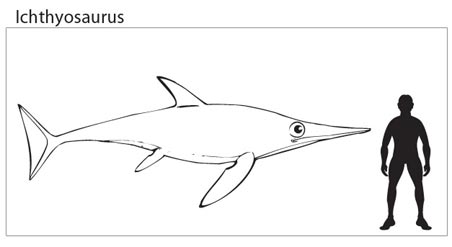
Picture credit: Everything Dinosaur

To read an article about a recent ichthyosaur fossil discovery: Getting Ahead with an Ichthyosaurus.

Many Different Species

Many different species of ichthyosaur are now known.  As a group, they were perhaps the best adapted to a life in the water of all the marine reptiles.  Fossils of Jurassic ichthyosaurs discovered in limestone quarries in Germany (Holzmaden) preserve these animals in exquisite detail.  Some ichthyosaur fossils are so well preserved that the outline of their body shape can still be made out (this is how scientists discovered that ichthyosaurs had a tail fluke).  Fossilised stomach contents that have been analysed indicate that different types of ichthyosaurs ate different types of food, with many of them hunting ammonites and their cephalopod relatives the belemnites.  Fossils of tiny embryos (unborn ichthyosaur young) can be seen inside the bodies of some of the preserved ichthyosaur specimens.  This means that ichthyosaurs did not lay eggs like most other reptiles, but instead gave birth to live young – what scientists refer to as viviparous behaviour.

The ancestors of the ichthyosaurs probably ventured out onto land to lay eggs, just like turtles do today.  However, over many thousands of generations, these creatures became completely adapted to a marine existence and with their highly modified flippers these animals could no longer move around on land.  Most ichthyosaurs would give birth to one or two single babies (often called pups), although one fossil of an ichthyosaur shows eleven embryos preserved inside the body chamber.  It seems that babies were born tail first.

As ichthyosaurs gave birth to fully developed young, there has been much speculation as to how ichthyosaurs behaved.  It has been suggested for example, that, just like modern whales, pregnant ichthyosaurs congregated together in special areas to give birth.  Perhaps, they chose an isolated, sheltered lagoon to give birth.  The calm waters would have helped the youngsters and being close to shore there may have been fewer marine predators and plenty of places for young animals to hide such as reefs and in amongst rocks.

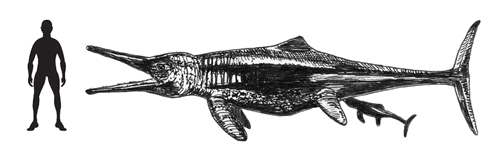
A Scale Drawing of the Viviparous Temnodontosaurus
Scale drawing of Temnodontosaurus.

Temnodontosaurus scale drawing. Picture credit: Everything Dinosaur.

Picture credit: Everything Dinosaur

Famous Fossils

Famous fossils from the Late Jurassic strata reveal that these marine reptiles were viviparous.  A female ichthyosaur died in the process of giving birth and her carcase was preserved, becoming one of the most famous fossils of all.  The fossilised remains of young ichthyosaurs can be seen in the body cavity, with another baby preserved as a fossil at the moment of birth.

In some species of ichthyosaur, the young have teeth, whereas the adults have no teeth in their snouts.  This suggests that baby ichthyosaurs may have had a different diet when compared to the adults.  Perhaps the young, agile ichthyosaur babies specialised in catching fish in shallower waters, before migrating to deeper waters to join the adults feeding many on cephalopods and jelly fish.

To view a variety of ichthyosaur and other marine reptile figures: CollectA Age of Dinosaurs Prehistoric Life Models.

27 11, 2010

Bias in the Fossil Record – Preservation Potential

By |2023-01-14T11:13:51+00:00November 27th, 2010|Categories: Educational Activities, Geology, Main Page|0 Comments

A Bias in the Fossil Record

The geological record of life on Earth, that is the fossil record, is not a fair sample of the life that existed in the past.  This is because fossilisation favours certain organisms in certain environments over others.  Fossilisation is more likely to occur if organisms have hard parts to preserve such as shells, teeth, bones and such like.  The habitat and the habits of any organism can also have a dramatic effect on the chances of becoming fossilised. Is there a bias in the fossil record?

Bias in the Fossil Record

Take for instance the following example:

Two species of bivalves (molluscs) are broadly similar and their shells are composed of the same material, one lives by being attached to rocks (mussel), the other lives by burrowing into soft sediment (cockle).  When the mussel dies, it is likely to be displaced from its rocky home and the shell would be most likely broken up against the rocks by wave and tidal action.  The cockle, in contrast when dead would remain buried in the sediment and if not attacked by scavengers it would soon become buried deeper and deeper.  The cockle by nature of its habit and the environment where it lived has a higher preservation potential than the mussel.

Abundant Hard-shelled Marine Invertebrates Have a Relatively High Fossil Preservation Potential

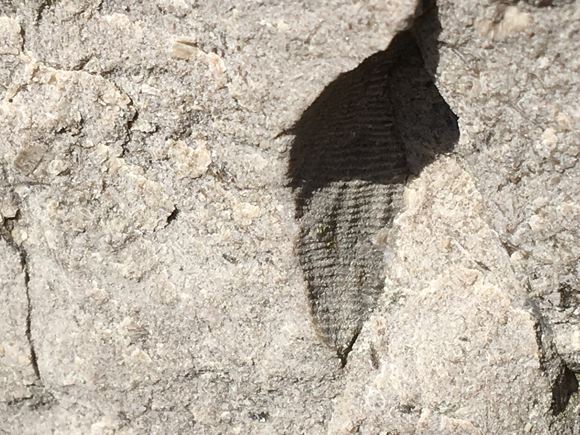
A view of a lost world, an impression of the shell of a brachiopod preserved in the limestone rock.

A glimpse into a lost world, an impression of the shell of a brachiopod preserved in the limestone. Picture credit: Everything Dinosaur.

Picture credit: Everything Dinosaur

The fossil record shows a bias towards invertebrates with hard shells, that lived in shallow-water, continental-shelf areas and inland lake basins.  Despite the huge size of the oceans compared to the land and the continental shelves and despite the lack of scavengers at the bottom of the deepest parts of the oceans compared to the sunlit areas, very few ocean-floor rocks or fossils are preserved.  Rocks on the ocean floor are prone to subduction back into the mantle as a result of plate tectonics.  In general, the fossil record tends to under represent the ancient life of ocean floors, upland areas on land, forested areas away from water and any organism without hard body parts.

For fossils of iconic invertebrates from the fossil record: Models of Fossil Animals.

Everything Dinosaur team members have put together a teaching guide on preservation potential.  This looks at four specific preservation factors – species abundance, geographical spread, marine versus non-marine and hard body parts versus soft body parts.  This is part of our work on how fossils are formed, explaining the difference between body and trace fossils.

18 11, 2010

Fact sheets, Fact sheets and more Fact sheets

By |2023-01-14T07:42:19+00:00November 18th, 2010|Categories: Educational Activities, Everything Dinosaur News and Updates, Main Page|0 Comments

Update on Everything Dinosaur Prehistoric Animal Fact sheet Production

For every named prehistoric animal that is represented in the Everything Dinosaur product range, from Palaeozoic invertebrates right up to prehistoric Ice Age mammals, we research and write a fact sheet on that animal.

Everything Dinosaur

Over the last six years or so, our team members have built up an extensive library, working on a huge variety of prehistoric creatures, we can’t say that we merely focus on extinct animals anymore, as a few months ago we added a Coelacanth fact sheet to our inventory.  Although, very much endangered, there are at least two species of the genus Latimeria extant (alive today) and known to modern science.

For each fact sheet, we commission a scale drawing so that readers can appreciate how big the animals were in relation to a fully grown adult human.  We provide information on the fossils found, who first discovered them, where the fossils were discovered and when.  We provide information on the likely diet (with T. rex that was easy, but for therizinosaurs and oviraptorids things get a little more tricky).  Team members try to add little snippets of information that would not be found in a reference book, something unusual about the particular animal being written about.

Prehistoric Animal Fact Sheets

We have just been briefed on the new fact sheet and drawing requirements for 2011, at least another eight fact sheets with illustrations will be required for the spring.  Some dinosaurs but mostly other extinct reptiles.

A Selection of Everything Dinosaur Prehistoric Animal Fact Sheets

Fact sheets prepared by Everything Dinosaur for the Beasts of the Mesozoic range of models.

A collection of Beasts of the Mesozoic fact sheets created by Everything Dinosaur. Picture credit: Everything Dinosaur.

Picture credit: Everything Dinosaur

Looks like our researchers and writers at Everything Dinosaur are going to be very busy.

Visit Everything Dinosaur’s award-winning website: Everything Dinosaur.

17 11, 2010

Chasmosaurus Pronunciation Providing Helpful Information

By |2024-04-20T07:56:04+01:00November 17th, 2010|Categories: Dinosaur Fans, Educational Activities, Everything Dinosaur News and Updates, Main Page|0 Comments

The Pitfalls of Dinosaur Pronunciation

Everything Dinosaur team members provide a guide to Chasmosaurus pronunciation and highlight a Chasmosaurus dinosaur model.

With a new dinosaur species being announced on average once every twenty days or so, it can be hard keeping up with all the developments in the dinosaur family tree.  One of the biggest problems we have when reading a scientific paper is the fact that in almost every paper or journal we have ever encountered, there isn’t a handy pronunciation guide provided.

This can cause problems when determining how a dinosaur, or indeed any other extinct organism name should be said.  We are not alone with this problem, a number of extinct animals are pronounced in slightly different ways by palaeontologists, remember the great debate about how to exactly say the genus Diplodocus for example.

One of the dinosaurs most commonly tripped over by young dinosaur fans when it comes to its name being said out loud is the dinosaur genus known as Chasmosaurus.  The name is not as tongue-twistingly difficult as some members of the Dinosauria, for example Micropachycephalosaurus (mike-row-pack-ee-sep-hal-low-sore-us), things become worse when you have to pronounce the formal binomial classification, i.e. the genus and the species name together, in this instance Micropachycephalosaurus hongtuyanensis.

Chasmosaurus belli

Chasmosaurus, for example Chasmosaurus belli, is known from extensive fossil material found in western North America from as far north as Alberta; to the deep south of the United States (Texas).  This five metre long, Late Cretaceous horned dinosaur, (Ceratopsian) is one of the most studied of all Campanian (Campanian faunal stage) ornithischian dinosaurs.  However, the name still catches out the unwary.

An Illustration of Chasmosaurus

“Chasm Lizard”. Picture credit: Everything Dinosaur.

Picture credit: Everything Dinosaur

To view a model of Chasmosaurus and other horned dinosaur figures: CollectA Age of Dinosaurs Prehistoric Life Models.

Despite this dinosaur being known about for almost 140 years, its name can still catch you out if you are not careful.  This dinosaur’s name means “Chasm Lizard”, from the Latin chasma which itself is derived from the Greek khasma which means “gaping hollow”.  This is why sometimes the meaning for this dinosaur’s name is stated as “Ravine Lizard”.  Anyway, the trick to saying this name correctly is to remember the original Greek root – Chasmosaurus is not stated as “Chas-mow-sore-us” as in “Chas and Dave” for example.  It is pronounced “Kaz-mow-sore-us”.

Following an extensive revision of the fossil material in the mid 1990s, the number of species assigned to the Chasmosaurus genus has been greatly reduced, but undoubtedly new species will come to light and there is a good chance that the unwary reader of a news article or report on a discovery will make the mistake that has haunted this dinosaur for all of its near 140 years of being known to science – the name will be pronounced incorrectly.

A Chasmosaurus Dinosaur Model

Chasmosaurus dinosaur model.

“Chasm Lizard” in the spotlight.

The Chasmosaurus dinosaur model is one of the horned dinosaurs available in the CollectA not-to-scale model range.

To view this range: CollectA Age of Dinosaurs Popular Range.

Go to Top