All about dinosaurs, fossils and prehistoric animals by Everything Dinosaur team members.

Everything Dinosaur’s work with schools and other educational bodies. Articles, features and stories about dinosaurs and their role in education and educating young people.

4 04, 2011

The Remarkable Shoshone Mountains Reptile

By |2024-04-21T10:02:09+01:00April 4th, 2011|Categories: Dinosaur Fans, Educational Activities, Main Page|0 Comments

Shonisaurus – Giant of the Ichthyosauria

Team members at Everything Dinosaur received an email the other day with a request for more information on giant ichthyosaurs.  There were certainly a number of very large members of the ichthyosaur family.  The Ichthyosauria are a very diverse Order, evolving in the Early Triassic and surviving for over 140 million years before becoming extinct shortly before the end of the Cretaceous Period.   There is the giant Cymbospondylus (pronounced Sim-bow-spon-die-lus), fossils of which have been found in North America and Europe.  This gigantic marine reptile had a large body, an eel-like tail, a metre long head with large jaws.  Cymbospondylus is the biggest marine reptile known from Late Triassic strata.

Shonisaurus

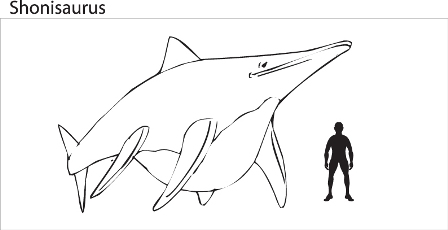
Perhaps our favourite large ichthyosaur is Shonisaurus (Shonisaurus popularis), a marine reptile that may reached lengths in excess of fifteen metres.  The first fossils of this ichthyosaur were found by miners around the now deserted mining town of Berlin, Nevada in North America.  The fossils were so plentiful that miners used them to decorate their dwellings and some of the large, flat vertebrae were even used as dinner plates!  Reports of these fossils had been made from as early as 1869 but the miners were too busy digging for gold and silver to worry.

Shonisaurus popularis is the largest ichthyosaur to have been discovered to date in the United States and was believed to be the biggest in the world until fossils of a new species of ichthyosaur over 23 metres long were unearthed in Canada just a few years ago.

A Scale Drawing of Shonisaurus popularis

Shonisaurus

Giant ichthyosaur of the Late Triassic and Early Jurassic. Picture credit: Everything Dinosaur.

Picture credit: Everything Dinosaur

This ichthyosaur had a very deep body, and four, long, narrow equally sized flippers.  Teeth were present only in the front of the jaw.  This animal probably hunted cephalopods – ammonites, belemnites, squid and octopi.

For models and replicas of giant marine reptiles including ichthyosaurs: Models of Sea Monsters.

31 03, 2011

Answering Questions from Teachers (Providing Helpful Answers)

By |2024-04-21T10:02:43+01:00March 31st, 2011|Categories: Educational Activities, Main Page|0 Comments

Advising Schools about Dinosaurs

Another day and another challenge for the team members at Everything Dinosaur.  Lots of primary schools are using dinosaurs as a teaching topic for their Summer term.  We seem to be getting more than our usual number of enquiries from teachers and teaching assistants who are busy preparing schemes of work in readiness for the start of next term.  It seems quite a popular subject area at the moment, teaching about dinosaurs and fossils in schools.

Everything Dinosaur

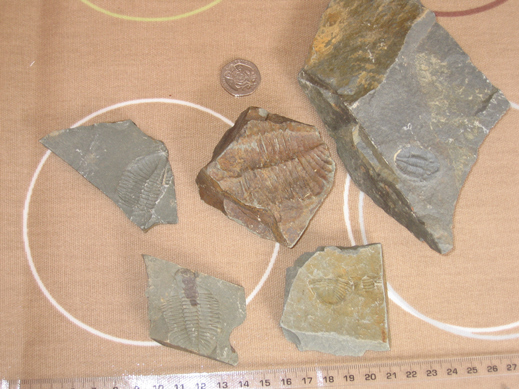
Our staff always try to help where they can.  Many of them have teaching qualifications of their own and they remember having to work Sundays to prepare the class lesson plans for the following week.  As far as the dinosaur information requested in the last few days, it has been eclectic to say the least.  We have helped with the provision of lesson plans involving how fossils form, pictures of different types and sizes of dinosaur bone, supplied details of dinosaur and other prehistoric animal teeth, as well as giving instructions on how to build a timeline from the beginning of the Mesozoic to the present day.  All good fun, but my particular favourite had nothing to do with the Dinosauria at all.  We received a request to provide some further information on the Cambrian explosion – trilobites and all.  These members of the Arthropoda have a special place in the hearts of many a palaeontologist, sure they don’t quite have the impact of a Tyrannosaurus rex, but they are an extremely important group in terms of the fossil record that they left behind.

An Illustration of a Trilobite

Cambrian extinction. Everything Dinosaur highlights trilobite fossils.

Terrific trilobites. Picture credit: Everything Dinosaur.

Picture credit: Everything Dinosaur

Examining Trilobites

For the uninitiated, trilobites are an extinct group of Palaeozoic, entirely marine arthropods with a distinct threefold longitudinal division of their body and hard, armoured exoskeleton.  These exoskeletons had to be moulted for the animals to grow and they have resulted in a rich and abundant fossil record from the early Cambrian to the end of the Permian geological period.  So diverse were the trilobites that we think at last count they constituted nine distinct Orders, represented by something like 15,000 species.

Great fun providing advice, guidance and information to teachers, we can sleep easy tonight as we have helped give some teachers and teaching assistants their Sundays back.

For models and replicas of Palaeozoic creatures including trilobites: CollectA Age of Dinosaur Popular Figures.

12 03, 2011

Remarkable Miocene Tarsier Fossils from Thailand

By |2024-04-21T10:10:17+01:00March 12th, 2011|Categories: Animal News Stories, Dinosaur and Prehistoric Animal News Stories, Educational Activities, Main Page, Palaeontological articles|0 Comments

Fossils from a Coal Mine in Thailand Reveal New Species of Primate

The Tarsiers are small, tree-dwelling prosimians found in Asia.  These small creatures are mainly nocturnal and voracious hunters of insects, tiny lizards, mammals and nestling birds.  They may not be very conspicuous up in the tree-tops but to anthropologists and palaeontologists they are extremely important in helping to decipher our own origins.  Scientists have announced the discovery of a Miocene Tarsier, fossils of which were found in a coal mine.

A number of fossilised jawbones found in a coalmine in Thailand have enabled scientists to identify a new species of Tarsier, one that may have been mainly herbivorous.  But first, why are Tarsiers so important when it comes to working out our own fossil lineage?

Miocene Tarsier

It is all to do with noses.  The Tarsier’s nostrils , which project sideways, are rounded.  Fur grows almost to the edge of them and surrounds them, separating them from the upper lip.  The nostrils of other prosimians, lemurs and pottos for example, in contrast are shaped like commas, permanently moist and linked to the upper lip by a strip of naked skin.  To a Tarsier the sense of smell is very much less important than to a lemur or another member of the prosimian group.

The only other tree-dwellers that have noses like the Tarsier’s are the true monkeys.  This suggests that the Tarsiers are ancestral to the monkeys, if this is the case, then as apes and ourselves are related to monkeys, the Tarsier may be a branch on that part of the tree of life that led to our own species H. sapiens.

The pictures circulated show a Tarsier from South-east Asia on the left compared to a Potto from West Africa on the right.  Although very similar, note the “comma” shaped nostrils of the Potto, whilst the nostrils of the Tarsier suggest that creatures such as these were the ancestors of true monkeys, and ultimately ourselves.

Tarsius sirindhornae

The new species, formally named as Tarsius sirindhornae, lived during the mid Miocene Epoch, approximately 13 million years ago.  Based on the size of the fossilised jawbones, this Tarsier species would have been a giant amongst its kind.  However, it probably weighed less than 200 grammes, about the weight of grapefruit.

Research leader, Yaowalak Chaimanee, a geologist with Thailand’s Department of Mineral Resources, stated that this Tarsier was the largest discovered to date and a total of eighteen jawbone fossils from the new species were found in deposits at disused coalmine in Lampang Province.  Each tiny jaw holds one to four teeth.

She stated:

“Tarsiers were, and still are pretty rare, so you can imagine to have eighteen jaws is marvellous.”

Like modern Tarsiers, the extinct species probably have had large eyes, would have been a great jumper and would have had the ability to rotate its neck 180 degrees.  But the fossils show that at least one trait makes the new species different from its modern cousins.

Chaimanee said:

“We know living Tarsiers eat insects or small mammals.  They have very sharp teeth.  Our fossils have very rounded teeth, every tooth has been worn.  We expect it ate something different.”

The large jaws and dentition suggest that this animal may well have been a vegetarian, perhaps feeding on leaves.  Plant material is much more difficult to digest and the teeth may have evolved to permit these prosimians to grind food up in their mouths efficiently to allow their digestive systems to extract nutrients effectively.  Being a vegetarian often leads to evolving a larger gut, perhaps this explains why this extinct Tarsier species grew to be a relative giant amongst its carnivorous relatives.

In a bid to explain why the jawbones were found in close proximity, Chaimanee and her colleagues have speculated that the area around the coalmine was dense, tropical jungle and the jawbones represent the regurgitated remains after these Tarsiers were predated upon by birds of prey.

She suggested:

“The predator made waste pellets, and then these pellets would wash out into the region that became the coal mine.  This would explain why our team found so many jaws together.”

To find the fossils of such an arboreal Miocene animal as a herbivorous Tarsier is rare, to find eighteen jawbones is truly remarkable.  The team hope to return to the coalmine site in the near future to explore the deposits in greater detail, perhaps revealing more evidence of ancient Tarsiers and of the other animals, may be even the predatory bird that shared their ancient jungle home.

For models of prehistoric mammals and other extinct creatures: CollectA Deluxe Scale Prehistoric Animal Models.

8 03, 2011

Celebrating International Women’s Day Around the World

By |2024-04-21T10:07:31+01:00March 8th, 2011|Categories: Educational Activities, Everything Dinosaur News and Updates, Main Page|0 Comments

March 8th – International Women’s Day

International Women’s Day is a global celebration of the economic, political and social achievements of women past and present.  In some countries this day is marked by a national holiday.

International Women’s Day

This is the one-hundredth anniversary of International Women’s Day, the first official commemorations took place in some European countries (Denmark, Austria, Germany and Switzerland) in 1911, a time of great social change when the rights and roles of women in Europe and the United States were becoming more prominent in the political debates of the age.

There have been many great female scientists, within the field palaeontology the role of the likes of Mary Anning is now widely recognised, however when Mary was alive her contribution to the nascent science of palaeontology was played down by her male peers.  Indeed, many of the thoughts, descriptions and explanations that Mary proposed relating to the fossil discoveries on the Dorset coast (southern England) were accredited to other (male) scientists rather than to Mary herself.

As a working class woman, she was shunned by the academics and scientists of her day.  For example, she was not permitted to join the Geological Society of London.  She spent most of her life in financial difficulties and it was only in her final years that she was awarded a pension by the British Association for the Advancement of Science, in recognition of her pioneering work.

In 2010, the Royal Society published a list of the ten women who had most influenced science in the United Kingdom – Mary Anning was one of them.

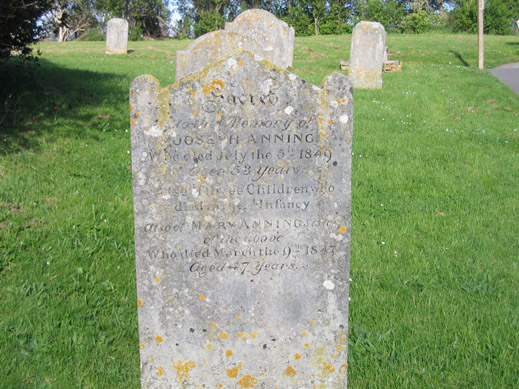
We have visited Lyme Regis on numerous occasions and when there we often take time out to visit St. Michael’s church and to spend a few moments of reflection besides Mary and her brother Joseph’s grave.  Her contribution may have been overlooked during her lifetime, but we at Everything Dinosaur, continue to use the inspirational story of Mary and other female scientists working in the Earth sciences to help motivate and encourage girls to take more of an interest in these sciences.

The Grave of Mary Anning at Lyme Regis

Picture credit: Everything Dinosaur

Visit Everything Dinosaur’s website: Everything Dinosaur.

1 03, 2011

Create Your own Prehistoric Scene with Helpful Advice from Everything Dinosaur

By |2024-04-21T12:23:30+01:00March 1st, 2011|Categories: Educational Activities, Everything Dinosaur News and Updates, Main Page|0 Comments

Dinosaurs Come Back to Life

Since Everything Dinosaur began, sometime back in the Holocene (the name of the Epoch that we are living in at the moment), staff have created drawing materials, quizzes, puzzles and games relating to dinosaurs and prehistoric creatures.  We have even helped young dinosaur fans create their own prehistoric scene. These items are part of our ongoing commitment to help young people learn more about Earth Sciences through their fascination with dinosaurs.

Our work with teachers and educators has been recognised and we have supplied lots of help and assistance when it comes to teaching science subjects.

Prehistoric Scene

A natural extension, (we like to think that we are evolving), is to take the vast number of prehistoric animal drawings, fact sheets and other data and utilise them in such a way so as to help schools, and mums and dads create their own prehistoric scenes for young dinosaur fans.

Our idea is very simple, we provide all the drawing materials of dinosaurs, prehistoric animals, vegetation, marine creatures and such like and dinosaur fans can create their very own prehistoric scenes featuring their favourite animals.  With so many illustrations, dinosaur drawings can be supplied by Everything Dinosaur.

A Mesozoic Timeline

We have created four scenes that link together providing a time-line from the Triassic through to the end of the Cretaceous.  We even have a marine environment scene so that prehistoric animal enthusiasts can depict marine reptiles swimming in the sea and create their version of sea monsters.

Life in the Late Jurassic

Picture credit: Everything Dinosaur

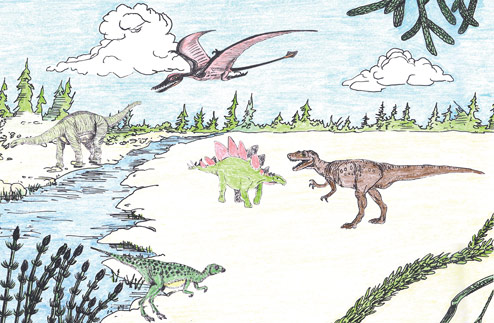
The scene shows a view of the Late Jurassic, sometime around 148 million years ago for instance.  A large allosaur (predator) confronts a Stegosaurus waiting for an opportunity to attack.  A sauropod wanders by in the background, whilst in the foreground a small, nimble ornithopod tries to avoid the gaze of the fierce Allosaurus and scampers back into the horsetails.  The vegetation is based on fossil plants from this geological period and the animals depicted are creatures whose fossils date from this time in the Late Jurassic.  The pterosaur flying overhead, surveying the scene is a long-tailed pterosaur, a Rhamphorhynchus, the dominant type of flying reptile that lived during this time.  Dinosaur fans can create their own Jurassic scene using our backdrop, we can supply a range of prehistoric animals so that they can have their own, unique dinosaur poster on their wall, or why not think big and make a wall mural?

To view the extensive range of dinosaur and prehistoric animal models available from Everything Dinosaur’s award-winning website: Dinosaur and Prehistoric Animal Models.

24 02, 2011

Discovering Dinosaurs – The Next Generation of Palaeontologists

By |2023-03-07T10:06:04+00:00February 24th, 2011|Categories: Educational Activities, Everything Dinosaur News and Updates, Main Page, Press Releases, Teaching|0 Comments

Pupils get to Grips with Dinosaurs and Fossils

Pupils at Hugo Meynell Primary School, near to the Shropshire town of Market Drayton, had the chance to travel back to the time and to learn about dinosaurs and fossils with a visit from one of Everything Dinosaur’s palaeontologists.

Taking part in a number of experiments, in what was a dinosaur themed workshop, the students in years 3 and 4 learned about these prehistoric animals and had the chance to get grips with a number of fossils, all part of a special topic on dinosaurs that they had been studying.

Young Palaeontologists

As part of the day’s activities, the lucky pupils were able to help cast museum replicas of some of the dinosaur fossils that are part of Everything Dinosaur’s collection, a collection that includes very rare and special items such as Tyrannosaurus rex teeth.  For the classes involved they, and the teaching staff, were able to keep their own very special souvenir of the visit from a dinosaur expert.

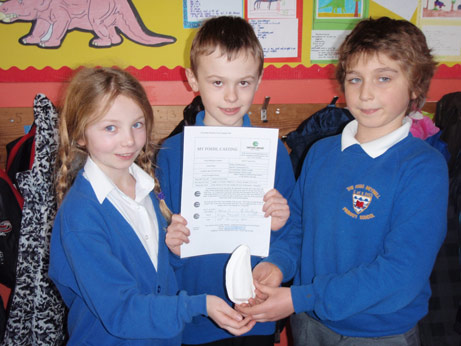
Pupils with a Cast of a Large Theropod Tooth (Tyrannosaurus rex)

Picture credit: C. Cowley

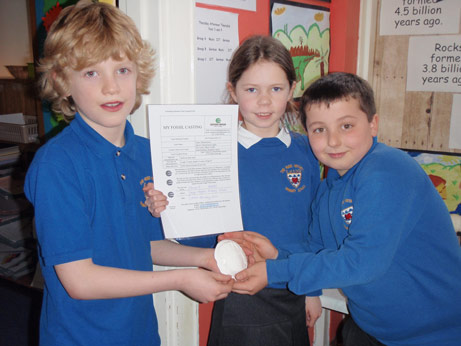
Hugo Meynell School Young Palaeontologists with Edmontosaurus Toe Bone

Everything Dinosaur’s visit to Hugo Meynell School.

Picture credit: C. Cowley

The pictures show some of the young palaeontologists from Hugo Meynell school with the cast replicas of dinosaur fossils, along with a special certificate given to them by which explained where the fossil from which the cast was made was found and from which dinosaur the fossil came from.

Dinosaurs and Fossils

Dinosaurs in schools, these young palaeontologists were thrilled at the prospect of getting to handle real fossils.

Visit Everything Dinosaur’s award winning website: Visit Everything Dinosaur.

18 02, 2011

Majungatholus or Majungasaurus – What’s the Difference? A Helpful Explanation

By |2024-04-21T12:25:42+01:00February 18th, 2011|Categories: Dinosaur Fans, Educational Activities, Main Page|0 Comments

The Joy of Junior Synonyms

Everything Dinosaur examines a probelmatic theropod dinosaur and its binomial name. Is it Majungatholus or Majungasaurus?

Today, some of our team members have been reviewing the fact sheets that are being produced for new prehistoric animal models being introduced into the Everything Dinosaur model range.  One such fact sheet concerns the abelisaurid Majungatholus atopus, or as it should, more correctly be called, Majungasaurus crenatissimus. 

Majungatholus or Majungasaurus?

The fossilised bones of a large, bipedal dinosaur were first discovered on the island of Madagascar by French scientists who accompanied a French military expedition to secure the island from the British in 1895.  The fossils were found in a region of exposed Upper Cretaceous strata in the north-west of the island.  As a result of this work, a new genus of theropod dinosaur – Majungasaurus was formally named and described.

In the 20th century, more fossil remains were discovered, some of which were ascribed to the Megalosaurus taxon – an example of a taxonomic waste basket, but clearly the fossil evidence suggested the presence of a large meat-eater present on the island at the end of the Cretaceous.  Scientists have studied the ancient fauna and flora of Madagascar, as technically, it is the world’s oldest island.

During the Cretaceous the landmasses that were to become India and Madagascar were still joined together, located in the southern hemisphere east of the broken up super continent of Gondwanaland.  Rising magma in the Earth’s mantle under Madagascar began to stretch the crust.  Eventually, the Earth’s crust at this point, rifted and lava began to pour out onto the surface of the Earth.  It was this rifting process that was to lead to the separation of India from Madagascar, so helping to isolate Madagascar and leading to the development of its unique flora and fauna.

In 1979, a team of German and French scientists excavated a partial skull from the same formation as where the earlier Majungasaurus fossils were found.  They identified this fossil as being part of the thickened skull of a pachycephalosaur and this specimen became the holotype for the genus Majungatholus atopus.

Studying Theropods

However, an almost complete skull of the theropod known as Majungasaurus was unearthed in 1996 and what was thought to have been a part of a pachycephalosaur was identified as being the frontal horn of an abelisaurid.  In 1979, when the pachycephalosaur from Madagascar was named and described it created a sensation amongst palaeontologists as no pachycephalosaur material had ever been discovered in the Southern Hemisphere.

However, we now know that this particular fossil was misidentified and in essence Majungatholus and Majungasaurus are effectively one and the same genus.  In taxonomy, an organism can have a number of names, the earliest names given to an organism are known as senior synonyms, whereas, later names are junior synonyms.

In this case, Majungatholus is a junior synonym of Majungasaurus as Majungasaurus was first used in 1896 and Majungatholus not used until 1979.  The two names effectively describe the same animal.

The act of declaring a name to be the synonym of another is called synonymisation.

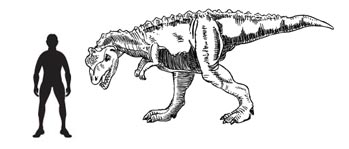
An Illustration of Majungasaurus crenatissimus (M. atopus)

Abelisaurid illustration.

Picture credit: Everything Dinosaur

The illustration above shows an adult man as an approximate scale.  Note the frontal horn on the top of the skull, the cause of the confusion between what was an abelisaurid and what was thought to be a pachycephalosaur.

In order to prevent confusion, and in recognition that this theropod was most probably the apex predator on the island of Madagascar in the Late Cretaceous, some of our team members have resorted to calling this dinosaur “the monster from Madagascar”.

The view a model of “the monster from Madagascar” and other dinosaur and prehistoric animal figures: CollectA Age of Dinosaurs Prehistoric Life Models.

14 02, 2011

One Small Step for Man a Giant Leap for Mankind

By |2023-03-06T15:26:23+00:00February 14th, 2011|Categories: Educational Activities, Main Page, Palaeontological articles|0 Comments

Best Foot Forward for Homo sapiens – Spring Loaded Heels

Our species may have had a crucial, anatomical advantage over Neanderthals when it came to surviving the environmental change that led to the development of wide expanses of tundra.  We were better at long distance running and walking.

For those of us who remember the perils of enforced cross-country runs when we were at school, it may be hard to imagine that our species may have had a mechanical advantage when it came to travelling distances, but the structure of the bones and tendons in our feet could have provided us with a crucial evolutionary advantage over Neanderthals.

Researchers studying the heels of modern humans have found that our bone structure stretches the Achilles tendon taut, storing energy more efficiently than the Neanderthal foot and allowing us to run better.

Neanderthals

However, Neanderthals (H. neanderthalensis), were no slouches when it came to walking, their feet and ankles gave them an advantage in walking uphill and the bones in the foot supported the ankle more if they jumped, so says the research team based at the University of Arizona in Tucson.

In our ancestors, just as with people today, a short, lower heel stretched the Achilles tendon tight.  This arrangement increases the tendon’s spring-like action, making it an efficient store of energy; helping us to run efficiently and to make long-distance treks.  This anatomical difference between our species and the Neanderthals, one of a number of subtle differences, could have given us the edge when hunting on the wide, open plains of prehistory.

Anthropologist, David Raichlen, who led the research, published in the “Journal of Human Evolution”, commented:

“We can say that energy costs of running differed between Neanderthals and modern humans, but our data does not really provide answers as to what happened to the Neanderthals.”

Extinction Around 28,000 Years Ago

Scientists believe that the last of the Neanderthals died out approximately 28,000 years ago.  These humans, were very well adapted to the cold European environment, they had bigger brains than us and were physically stronger, but for some reason or reasons, they became extinct and our species went onto thrive.

Anthropologists already know that compared to our ancestors, Neanderthals were stronger, heavier, had shorter legs and smaller inner-ear canals (important for co-ordination and balance) – all factors in making them less efficient runners compared to us.  However, this new line of study provides evidence to suggest that Neanderthals were disadvantaged compared to us when it came to moving long distances.

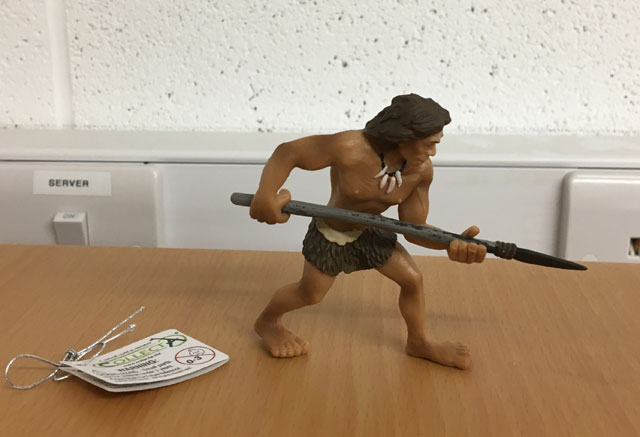
A Replica of a Neanderthal Man

CollectA Neanderthal man model

Selecting a CollectA Neanderthal man figure for an Everything Dinosaur customer. Picture credit: Everything Dinosaur.

Picture credit: Everything Dinosaur

To view the CollectA range of prehistoric figures: CollectA Prehistoric Life Figures and Models.

Homo sapiens

The research shows the distance runner’s foot and ankle was very efficient.  Measurements of part of the heel bone has helped the researchers determine how efficiently an individual could run long distances.

In a forested environment, the Neanderthals tactics of ambushing prey would have been a successful strategy.  Their strength and power would have given them an edge over H. sapiens.  However, if climate change led to a loss of forests and a more open environment, the ability to track animals over long distances, running prey to exhaustion would have been a tactic better suited to our ancestors.  Unfortunately, the lack of fossil human foot bones is preventing scientists from determining when our running-friendly, spring-loaded heels first evolved.

Raichlen and his team calculated rates of oxygen consumption for eight experienced long-distance runners as they performed on a treadmill for 10 minutes running at a pacy 16 km/h.  On a separate day, MRI scans of each person’s heel and Achilles tendons revealed the nature of the potential mechanical advantage.  Those runners who used oxygen most efficiently whilst running had shorter heel bones.

Heel Bone Measurements

Heel-bone measurements of 13 fossil Homo sapiens that lived between approximately 30,000 and 100,000 years ago resemble those of today’s runners, the scientists have stated.  On average, the measurements indicate that the ancient humans expended 6.9 percent more energy while running than their counterparts today did, not a substantial difference, according to the researchers.

Analyses of heel bones of six Neanderthals from the same time period indicate that these hominids used an average of 11.4 percent more energy while running than modern athletes did, a statistically notable disparity.

Energy efficiency while running depends far more on a person’s anatomy than on physical training, the researchers say. They used distance runners as a modern comparison group in order to account for any training effects.  The research concludes that our springy heels enabling us to run for longer may have proved decisive as hunting moved to the open plains.

Is this a case of best foot forward, in terms of hominid evolution?

10 02, 2011

Dinosaurs at National Science and Engineering Week

By |2023-01-15T11:50:25+00:00February 10th, 2011|Categories: Educational Activities, Everything Dinosaur News and Updates, Main Page, Teaching|0 Comments

Everything Dinosaur Prepared for National Science Week

Next month sees the annual National Science and Engineering Week, the event actually runs from March 11th through to March 20th and its aim is to showcase the best in science and engineering in the UK and to get people involved.  There are a huge number of events and activities taking place again this year, from intimate cafe venues holding discussions on science related topics to enormous science festivals all round the country.

National Science and Engineering Week

The dinosaur experts at Everything Dinosaur are not being left out, they are visiting a number of schools with fossils and other dinosaur related activities to enthuse the next generation of young scientists.

To view the extensive range of dinosaur and prehistoric animal toys and gifts available from Everything Dinosaur’s award-winning website: Dinosaur Toys and Gifts.

A Communication Theme

The theme for this event is communication, bringing the general public together to discuss science topics, discover new things and to communicate the role science and engineering has to play in everyone’s lives.

Organised by the British Science Association, this annual event goes from strength to strength and Everything Dinosaur are proud to be involved especially with the elements that involve teaching about dinosaurs in school.

Preparing a Fossil Hunting Activity (Everything Dinosaur)

Everything Dinosaur fossil hunting activity.

Fossil trays laid out at for a fossil hunting activity prepared by Everything Dinosaur team members.  Picture credit: Everything Dinosaur.

Picture credit: Everything Dinosaur

Everything Dinosaur

For educational, dinosaur themed toys, models and games visit Everything Dinosaur’s child-friendly and award-winning website: Everything Dinosaur.

9 02, 2011

David Attenborough’s Life Stories Series Two on Radio 4

By |2023-03-06T15:27:05+00:00February 9th, 2011|Categories: Educational Activities, Main Page, Radio Reviews|0 Comments

First Life – Back on Air

The highly acclaimed “First Life” radio series, a collection of stories and anecdotes by Sir David Attenborough is starting a second series.  One of the world’s best known and most popular presenters, Sir David examines twenty marvels of the natural world, a collection of experiences in some fifty years of broadcasting.

Each ten minute programme deals with a different subject and they are on radio four at 8.50pm on Friday evening (GMT) repeated the following Sunday at 8.50am.  Sir David’s enthusiasm is infectious and his curiosity for the natural world really comes out in these broadcasts.

Well worth a listen, and we suspect the series will be available on CD from the BBC in the Summer.

For models and replicas of many of the extinct and prehistoric animals featured in the Radio 4 series visit Everything Dinosaur’s award-winning website: Everything Dinosaur.

Go to Top