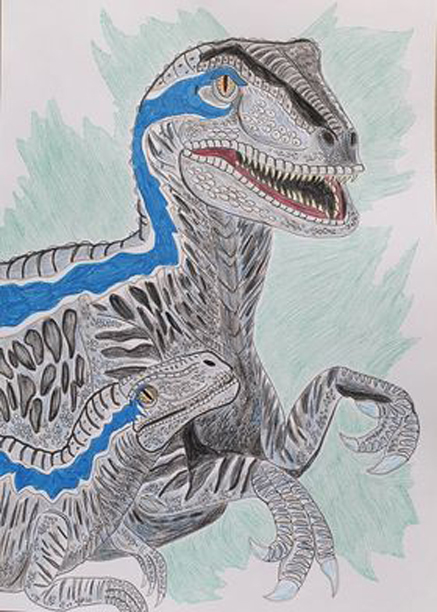
Our thanks to talented, young artist Caldey who sent into Everything Dinosaur an illustration of a mother and baby Velociraptor inspired by the recent film “Jurassic World Dominion”. The skilfully produced drawing features Blue and her offspring Beta from the latest and potentially the last movie in the “Jurassic Park/Jurassic World” franchise.
The beautiful illustration of a pair of “raptors”. The drawing was inspired by the recent (June 2022) movie “Jurassic World Dominion”. The adult Velociraptor Blue and her offspring Beta. Picture credit: Caldey.
A “Raptor” Legacy
Dinosaurs, marine reptiles and pterosaurs roam freely, and human/dinosaur interactions result in inevitable fatalities. The authorities strive to monitor the movements of the genetically engineered prehistoric animals. Blue, one of the Velociraptors trained by Chris Pratt’s character Owen Grady in previous incarnations of the franchise, resides in the Sierra Nevada Mountains, where Owen earns a living helping to capture and relocate stray dinosaurs. Owen discovers that Blue has a juvenile “raptor” with her, this is an asexually reproduced hatchling. The baby Velociraptor is named Beta by Maisie Lockwood (played by Isabella Sermon).
Whilst many different types of prehistoric animal have been depicted in the films, no dinosaur has had as much screen time dedicated to it as the iconic “raptors” which have featured in all the films in the “Jurassic Park/Jurassic World” genre.
A site safety notice at our local cinema spotted at the entrance as team members went to see “Jurassic World Dominion”.
Velociraptor Mother and Baby
A spokesperson from Everything Dinosaur thanked Caldey for her drawing and commented:
“Caldey’s choice of the Velociraptor pair for her illustration is fitting. These dinosaurs have featured in all six of the movies associated with this franchise. It is a wonderful drawing of Blue and Beta”.
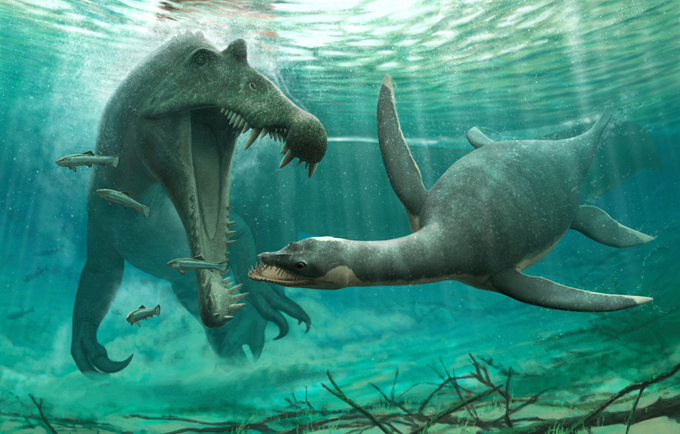
Plesiosaur fossils found in strata associated with a 100-million-year-old river system prove that some plesiosaurs, traditionally thought to be marine animals, may have lived in freshwater. These long-necked, piscivores co-existed with the giant dinosaur Spinosaurus (S. aegyptiacus).
A plesiosaur in freshwater encounters a Spinosaurus. Artwork by Andrey Atuchin. Picture credit: University of Bath.
Freshwater Plesiosaurs
Scientists from the University of Bath and University of Portsmouth in the UK, and Université Hassan II (Morocco), have reported evidence small plesiosaurs from Kem Kem Group deposits in Morocco.
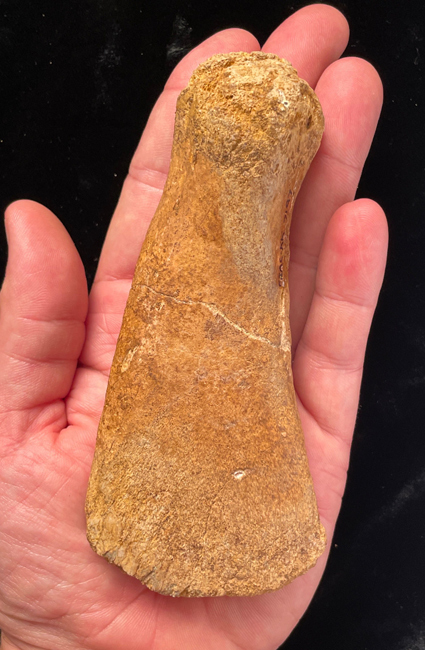
The fossils include bones and teeth from three-metre-long adults and an arm bone (humerus) from a 1.5- metre-long juvenile. They hint that these creatures routinely lived and fed in freshwater, alongside frogs, crocodiles, turtles, fish, and the huge aquatic dinosaur Spinosaurus.
The humerus (upper arm bone) from a juvenile plesiosaur. Picture credit: University of Bath.
When is a “Marine Reptile” a Marine Reptile?
The Plesiosauria clade was a long-lived and widely distributed group of marine reptiles. Most fossils, which date from the Upper Triassic to the end of the Cretaceous (Maastrichtian faunal stage), are associated with marine deposits, but a few specimens have been found in strata associated with brackish and freshwater environments. The researchers report plesiosaurs from river deposits of the Kem Kem Group. The numerous shed teeth show heavy wear similar to that observed in in the teeth of coeval spinosaurids. Contemporary plesiosaur fossils from the Bahariya Formation of Egypt have been identified as examples of the Polycotylidae plesiosaur family.
Kem Kem Fossils
The Kem Kem fossils probably represent leptocleidid plesiosaurs. Most Leptocleididae fossils come from shallow nearshore, brackish or freshwater palaeoenvironments suggesting that these small-bodied plesiosaurs were adapted to shallow, low-salinity environments.
A single plesiosaur tooth from the Kem Kem Group. Numerous teeth have been found indicating that these plesiosaurs were frequent visitors to freshwater habitats and perhaps were permanent residents. Picture credit: University of Bath.
As the fossil plesiosaur teeth show the same signs of wear as the teeth of Spinosaurus, the researchers imply that the plesiosaurs were eating the same food – chipping their teeth on the armoured fish that lived in the river. This indicates that they spent a lot of time in the river, rather than being occasional visitors.
As other types of Mesozoic marine reptile (mosasaurids and the crocodile-like teleosaurids), are thought to have inhabited (at least some of the time), freshwater environments, this suggests that so-called “marine reptiles” may have thrived in non-marine habitats.
Co-author of the scientific paper, Dr Nick Longrich (University of Bath Milner Centre for Evolution), commented:
“It’s scrappy stuff, but isolated bones actually tell us a lot about ancient ecosystems and animals in them. They’re so much more common than skeletons, they give you more information to work with. The bones and teeth were found scattered and in different localities, not as a skeleton. So, each bone and each tooth is a different animal. We have over a dozen animals in this collection.”
Diverse and Varied Kem Kem Group Freshwater Fauna
While extant marine mammals like whales and dolphins wander up rivers, either to feed or because they are lost, the number of plesiosaur fossils in the river deposits suggest that is unlikely. The team identified cervical, dorsal and caudal vertebrae, lots of teeth and the humerus from a juvenile. The researchers postulate that the plesiosaurs were able to tolerate fresh and salt water, like some whales, such as the beluga whale (Delphinapterus leucas).
Co-author Dr Samir Zouhri said:
“This is another sensational discovery that adds to the many discoveries we have made in the Kem Kem over the past fifteen years of work in this region of Morocco. Kem Kem was truly an incredible biodiversity hotspot in the Cretaceous.”
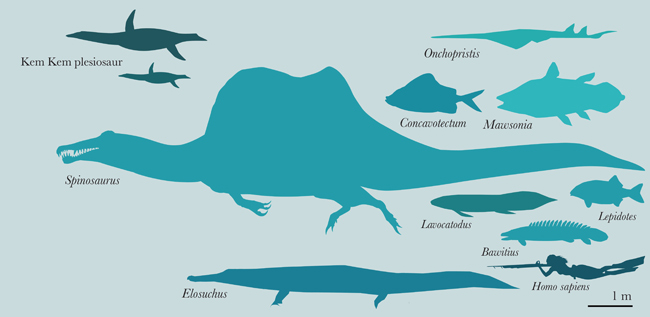
Silhouettes showing examples of Kem Kem Group freshwater fauna. Silhouettes show approximate size, the size and the diversity of predators suggests a rich ecosystem. Picture credit: University of Bath.
Plesiosaurs – Freshwater Incursions
The researchers compiled a list of all the geological formations that have shown evidence for the presence of members of the Plesiosauria clade in brackish or freshwater. Having collated this information, they re-examined the data identifying the different types of plesiosaur associated with the deposit.
As a result, a map documenting the incidences of freshwater incursions by different plesiosaur types was produced.
Plesiosaur distribution map. Evidence for freshwater/estuarine incursion by different types of plesiosaur. Picture credit: University of Bath.
For the key to the geological formations see the end of this article.
Co-author David Martill (University of Portsmouth) exclaimed:
“What amazes me is that the ancient Moroccan river contained so many carnivores all living alongside each other. This was no place to go for a swim.”
Plesiosaurus Swam Alongside Spinosaurus
Key to the Geological Formations Featured in the Plesiosaur Map
Everything Dinosaur acknowledges the assistance of a media release from the University of Bath in the compilation of this article.
The scientific paper: “Plesiosaurs from the fluvial Kem Kem Group (mid-Cretaceous) of eastern Morocco and a review of non-marine plesiosaurs” by Georgina Bunker, David M. Martill, Roy Smith, Samir Zouhri and Nick Longrich.
Twenty years ago, references to the end-Cretaceous mass extinction event confidently stated that this occurred around 65 million years ago, the date of the extinction of the Dinosauria et al seems to have been pushed back to a million years earlier. When did this change in chronology happen?
Sixty-five Million Years or Sixty-six Million Years?
Team members at Everything Dinosaur have been reviewing the huge inventory of blog posts that have been built up over the last fifteen years or so. It has been noted that the extinction of the dinosaurs, pterosaurs and a large portion of other types of life on Earth at the end of the Cretaceous in the numerous early blog articles that reference this event, is estimated to have occurred around sixty-five million years ago. In later articles, the date given is approximately sixty-six million years ago.
In 2013, Everything Dinosaur reported upon the work of an international team of scientists that had calculated the most accurate date for the extraterrestrial impact that created the Chicxulub crater. Researchers from the Berkeley Geochronology Centre (University of California), in co-operation with colleagues from Glasgow University and Vrije University (Amsterdam, Holland), have concluded that a meteorite, asteroid or possibly even an object such as a comet collided with the Earth approximately 66.038 million years ago (plus or minus 11,000 years).
Everything Dinosaur is an award-winning and highly respected supplier of prehistoric animal models and toys. To view the extensive range of dinosaur models and other replicas available: Dinosaur and Prehistoric Animal Models and Figures.
Could this scientific paper have marked the point in time, when the point in time marking the end of the non-avian dinosaurs was changed in popular culture?
The Everything Dinosaur blog consists of over 6,000 posts. The articles, features and news stories on the blog provide a valuable resource for teachers, academics and dinosaur fans. First started back in late May 2007, team members have built up an extensive library of dinosaur and prehistoric animal themed posts. The site, like all websites, needs to be occasionally modified and updated to help maintain and improve the customer experience. Over the next few weeks, the Everything Dinosaur blog will be undergoing some maintenance.
The Everything Dinosaur blog is undergoing routine maintenance and new updates are being added. These changes are being made to improve the efficiency and function of the site.
An Enormous Weblog
A review of each and every article posted on the blog is being undertaken. This is an immense amount of work, as there are thousands of articles and millions of words on the site. This maintenance work has been structured to ensure that visitors can access the blog posts with the minimum of disruption. Viewers will not notice the work going on, but behind the scenes our trained Velociraptors will be working hard to ensure that the weblog is in tip-top condition.
A spokesperson from Everything Dinosaur commented:
“We understand that our blog is very important to people, we will continue to post up articles and features whilst this work is going on. It will be business as usual for all the blog site visitors, but in the background we will be implementing changes to ensure our site is secure and provides the very best customer visitor experience. Around 3% of the site has been reviewed and checked over so far, but we intend to make rapid progress over the next few days.”
One of the first blog posts published by Everything Dinosaur fifteen years ago featured a model of Dodo that we had sourced for a customer. Team members still trace prehistoric animal models and figures requested by customers. Our commitment to customer service continues to be maintained.
The spokesperson for Everything Dinosaur commented that by the end of this year, team members would have posted up another 150 articles on the Everything Dinosaur blog and that the landmark of 7,000 blog posts was expected to be reached by the middle of 2025.
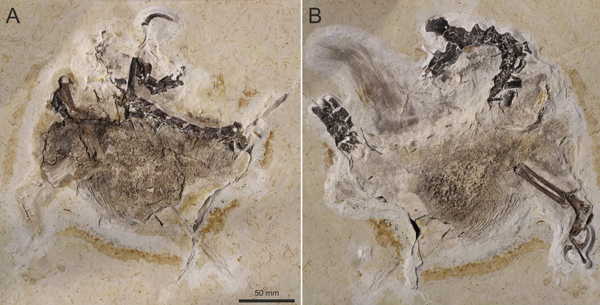
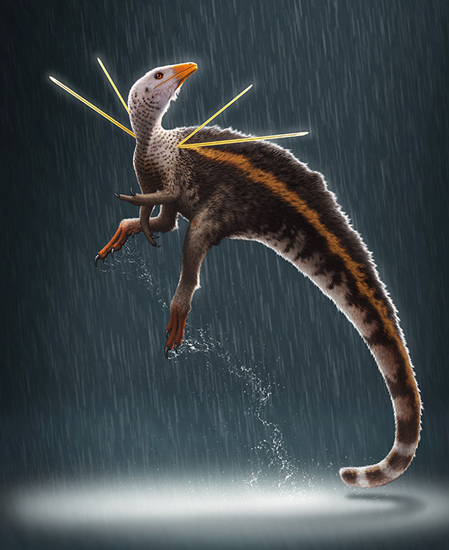
A unique, chicken-sized dinosaur fossil excavated from the Lower Cretaceous deposits of the Araripe Basin (Brazil) and currently residing at the State Museum of Natural History Karlsruhe (Baden-Württemberg, Germany) will be returned to Brazil. The specimen (Ubirajara jubatus), lacks properly documented paperwork detailing its acquisition and it may have been obtained without legitimate export permits.
The holotype of Ubirajara jubatus preserved as slab and counter slab. The fossil material is to be returned to Brazil after evidence emerged that the specimen may not have been obtained legally.Picture credit: Smyth et al/Cretaceous Research.
Conflicting Accounts about Fossil Acquisition
Conflicting accounts regarding the fossil’s acquisition emerged prompting the Baden-Württemberg science ministry to launch an internal investigation.
In the scientific paper (now withdrawn) published in the journal “Cretaceous Research” it was stated that the fossil specimen was brought to Germany in 1995. However, this statement was contradicted by researchers at the State Museum of Natural History Karlsruhe claiming the fossil was imported in 2006 by a private company and then acquired by the Museum in 2009.
Unique Dinosaur Fossil
As the documentation providing an audit trail for the obtaining of this specimen has not been supplied nor any evidence given to confirm the fossil material was imported before a German cultural protection law took effect in 2007, it has been decided to return the fossil to its country of origin.
Ubirajara jubatus life reconstruction by the very talented palaeoartist Bob Nicholls.
“Parachute Science”
In the days of empire and colonialism, many western powers took fossils from their colonies. These precious artefacts were then put on display. What we see today is another form of colonialism, whereby scientists from the more prosperous countries go to poorer countries to collect fossils. Scientists are “parachuted in” and there is a limited exchange of knowledge with local researchers.
There is a considerable movement to “kick back” against such practices.
To read an article from 2008 about calls from the Government of Tanzania to return fossils in German institutions: Return our Fossils.
Palaeontologists and other researchers are being accused of taking advantage of the natural resources of countries without leaving anything behind in return.
To read Everything Dinosaur’s original blog post about the formal naming and scientific description of this bizarre dinosaur: One Very Flashy New Dinosaur.
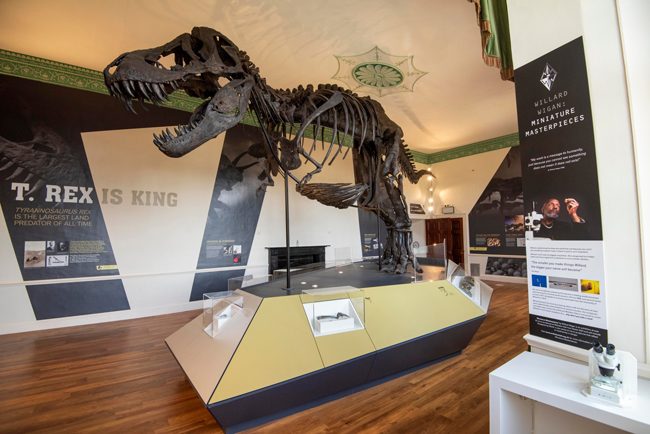
Fans of dinosaurs like to collect scale models, and there is one scale model on show at the Titus T. rex is King exhibition at Wollaton Hall Nottinghamshire, which puts any model collection into perspective.
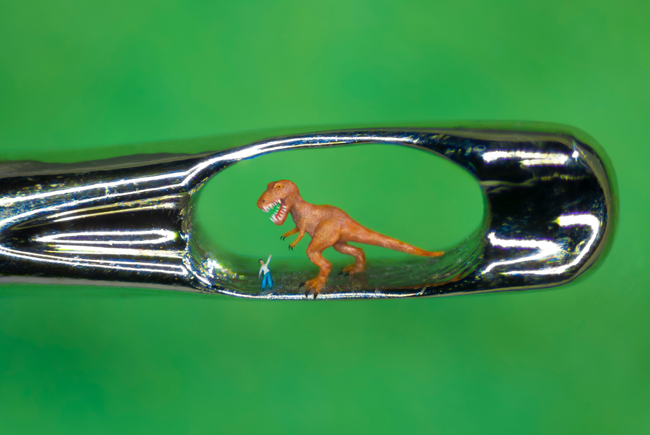
Internationally renowned micro-sculpturist, Dr Willard Wigan MBE, has created and installed a new extraordinary micro-sculpture of a perfectly formed Tyrannosaurus rex, measuring just 0.5 mm in length.
This amazing figure is so small, it sits comfortably within the eye of a needle.
The remarkable microscopic Titus the T. rex sculpted by Dr Willard Wigan MBE. The T. rex model measures 0.5 mm in length and it sits within the eye of a needle. Picture credit: Wollaton Hall/Dr Willard Wigan.
Celebrating the First-year Anniversary of this World-exclusive Event
The “microsaur” has been installed to mark the first-year anniversary of the opening of the Titus T. rex is King exhibition. Based on the estimated size for an adult T. rex at around 13 metres, the tiny “tyrant lizard king”, complete with fearsome teeth and sharp claws is approximately in 1/26,000th scale.
Now the very tiniest micro-depiction, and, Titus, the first real Tyrannosaurus rex to be exhibited in England for over a century, stand side by side. Titus the T. rex, demonstrates the immense power and impact of this king of the dinosaurs, while Willard Wigan’s creation presents the smallest, but no less powerful.
Dr Willard Wigan commented:
“It is a real honour to be exhibiting one of my sculptures alongside the breath-taking Titus T. rex exhibition. Wollaton Hall Natural History Museum is renowned for being home to rare specimens from across the globe, including Titus himself, which made it the perfect home for my T. rex sculpture.”
Titus the T. rex and the Willard Wigan miniature masterpieces exhibit at Wollaton Hall. Everything Dinosaur team members estimate that the 0.5 mm long T. rex sculpture is in approximately 1:26,000 scale! Picture credit: Wollaton Hall.
A Message to Humanity
Through his incredible sculptures, Dr Wigan is sending a message to humanity – just because you cannot see something does not mean that it does not exist. In palaeontology, including the study of the Dinosauria, a similar metaphor can be demonstrated in the concept of “ghost lineages”. A hypothesis that an animal would have existed in the past, but no fossils to prove its existence have been found, but fossils of related genera imply that it did exist.
Titus the T. rex is King Exhibition
Titus the T. rex is King opened in July 2021, to international acclaim. Over 70,000 visitors have already met Titus and engaged with the bespoke interactive exhibition designed around the remarkable skeletal mount.
Rachael Evans (Museums Development Manager at Nottingham City Museums and Galleries at Wollaton Hall), one of the UK’s most important Natural History Museums, added:
“It is an astonishing moment for us. We will have one the largest dinosaurs ever exhibited in the UK on display alongside one of the smallest. The T. rex that has been introduced to the exhibition is 0.5mm in size, with miniscule teeth made from glass. Since new information about the T. rex has been researched and made available, Willard has remodelled the sculpture to be as accurate as possible in his depiction. We can’t wait to see our visitors’ reaction to this new addition.”
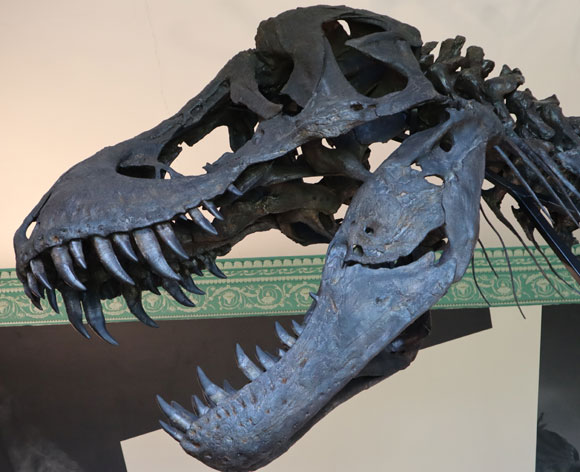
The skull of the T. rex exhibit on display at Wollaton Hall until August 2022.
Exhibition Details
Tickets for TITUS T. REX IS KING are on sale now, set at £13.00 for an adult, £8.75 for a child (under 16 years), students and concessions, £34.00 for a family ticket (2 adults and 2 children under 16 years) and under 3s and carers have no entry fees to pay. Car parking charges apply.
Everything Dinosaur acknowledges the assistance of a press release from Wollaton Hall in the compilation of this article.
A new scientific paper on the Early Cretaceous tyrannosauroid Eotyrannus lengi has been published. It is confirmed as a valid genus and the phylogenetic assessment places the enigmatic Megaraptora clade within the Tyrannosauroidea superfamily.
First named and scientifically described back in 2001 (Hutt et al), Eotyrannus is helping to provide significant insights into the early evolution of tyrannosauroids as well as potentially redefining how enigmatic “megaraptors” such as Australovenator, Megaraptor and the recently described Maip macrothorax fit within the Theropoda.
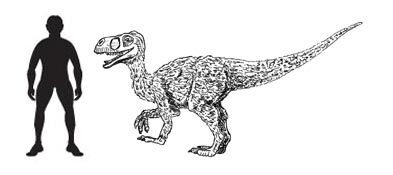
Isle of Wight tyrannosauroid (E. lengi). The recently published monograph (Naish and Cau) supports the earlier hypothesis that this dinosaur had proportionately long arms and a rectangular snout. The holotype specimen (IWCMS: 1997.550) indicates an animal around 4.5 metres in length. However, these fossils represent a sub-adult and the fully-grown, adult size of this Early Cretaceous predator remains undetermined.
The Carnivorous Dinosaurs of the Wessex Formation
Since the first fossils of Eotyrannus were found (1997), this theropod has attracted a lot of scientific interest. It is one of numerous carnivorous dinosaurs associated with the Wessex Formation (part of the Wealden Supergroup), indeed, back in 2021 we blogged about two new members of the Baryonychinae named and described from fossil remains found on the Isle of Wight (Wessex Formation). Last month, we wrote about an even bigger predator, an as yet, unnamed spinosaurid known as the “White Rock spinosaurid”.
The newly published paper provides further information on Eotyrannus autapomorphies (characteristic traits) that help to distinguish it from the often, fragmentary remains of other theropods associated with the Wessex Formation.
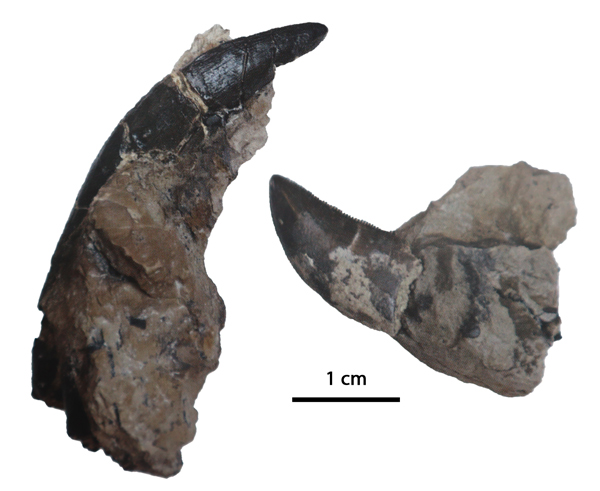
Isolated Eotyrannus teeth from the Wessex Formation.
Deciphering the Fossil Evidence
Many of the fossil bones associated with the Eotyrannus genus remain entombed in their concrete-like matrix. Anatomical traits helping to define and classify this dinosaur are only beginning to emerge and there is a substantial amount of further preparation work required to permit a comprehensive analysis.
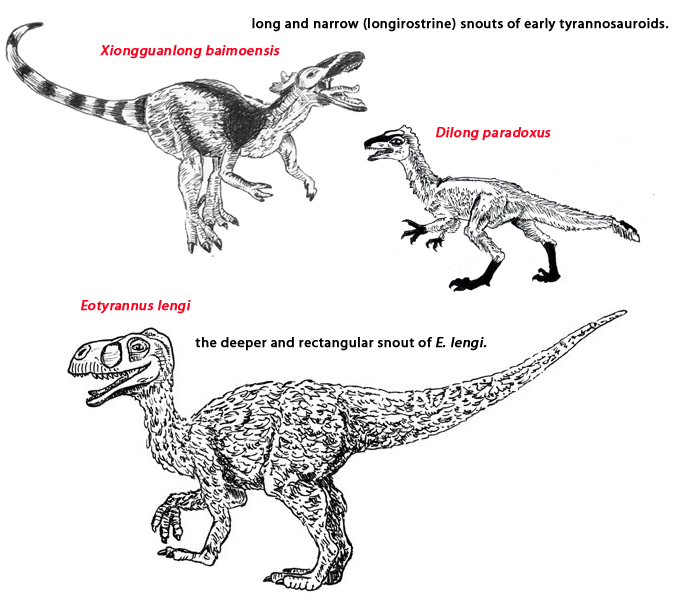
However, by combining all the new data since the formal description, the authors (Darren Naish and Andrea Cau) were able to produce a new skeletal reconstruction. The maxilla is confirmed as being quite rectangular in shape. Eotyrannus did not have the long, narrow snout (longirostrine) as seen in other early tyrannosauroids such as Dilong and Xiongguanlong from the Early Cretaceous of China. This suggests that longirostry evolved several times within the Tyrannosauroidea, perhaps in response to adaptations to permit these theropods to exploit a particular predatory niche.
Longirostry (having a long, narrow snout) in early members of the Tyrannosauroidea. Eotyrannus is confirmed as not exhibiting longirostry.
Where do the Megaraptora Fit?
The scientific paper also incorporated a revised phylogenetic analysis of Eotyrannus. No significant support was found for Eotyrannus having a close evolutionary relationship to Juratyrant (J. langhami), known from the Late Jurassic of Dorset or indeed to the Late Jurassic early tyrannosauroid Stokesosaurus (S. clevelandi) from the western United States.
Instead, it is grouped with gracile, mid-sized tyrannosauroids that represent a more derived state than proceratosaurids, stokesosaurs and Juratyrant.
If megaraptoran dinosaurs are tyrannosauroids and therefore coelurosaurs, then this challenges long-held views on Theropoda classification and suggests that after the Early Cretaceous most of the hypercarnivore niches within dinosaur dominated ecosystems were increasingly occupied by coelurosaurs. It also suggests that tyrannosauroids were much more diverse and widespread during the Cretaceous than previously thought.
Eotyrannus remains a fascinating dinosaur, a genus that has led to new insights into the evolution and radiation of the Theropoda. It offers a tantalising glimpse into the ecology represented by the Wessex Formation deposits and how a mid-sized theropod co-existed with other, larger members of the ever-widening collection of Wessex Formation meat-eating dinosaurs.
Everything Dinosaur Helping to Fund Research
The authors wanted to make their paper available to everyone. To do this they set up a GoFundMe campaign to cover publishing costs. Everything Dinosaur assisted with the funding.
A spokesperson from Everything Dinosaur stated:
“We were happy to support this excellent paper and we helped to make such studies possible. Your purchases from Everything Dinosaur genuinely help science”.
Team members at Everything Dinosaur were happy to assist with funding a newly published paper on the early tyrannosauroid Eotyrannus lengi.
The scientific paper: “The osteology and affinities of Eotyrannus lengi, a tyrannosauroid theropod from the Wealden Supergroup of southern England” by Darren Naish and Andrea Cau published in PeerJ.
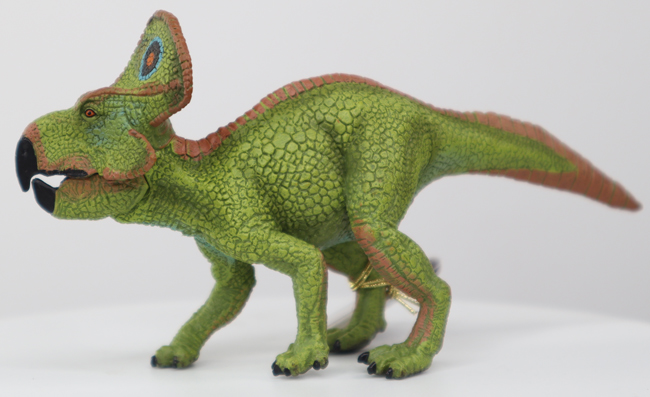
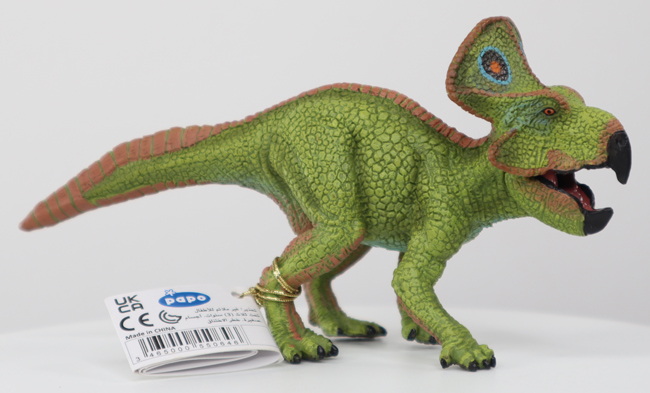
The new for 2022 Papo Protoceratops dinosaur model is in stock at Everything Dinosaur. This long-awaited replica of “first horned face”, the first of the new for 2022 prehistoric animal models from Papo is now available.
The Papo Protoceratops in left lateral view. This model of an early horned dinosaur has an articulated lower jaw.
Papo Protoceratops Dinosaur Model
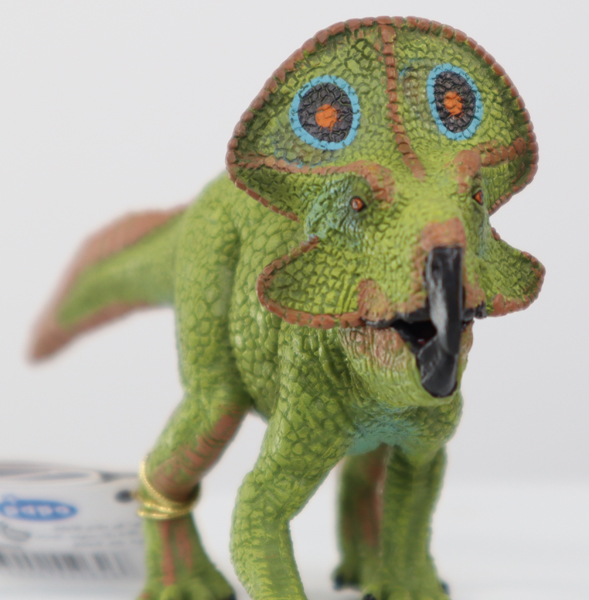
The Papo Protoceratops dinosaur model is around sixteen centimetres long. The model stands about eight centimetres high when measured from the top of that impressive head shield. Everything Dinosaur announced that this figure would be produced and made available this year (2022), back in the late autumn of 2021.
Papo Protoceratops in anterior view. A close-up view of the impressive head shield of the Protoceratops. There are two eyespots painted on the headshield.
Papo Protoceratops with an Articulated Jaw
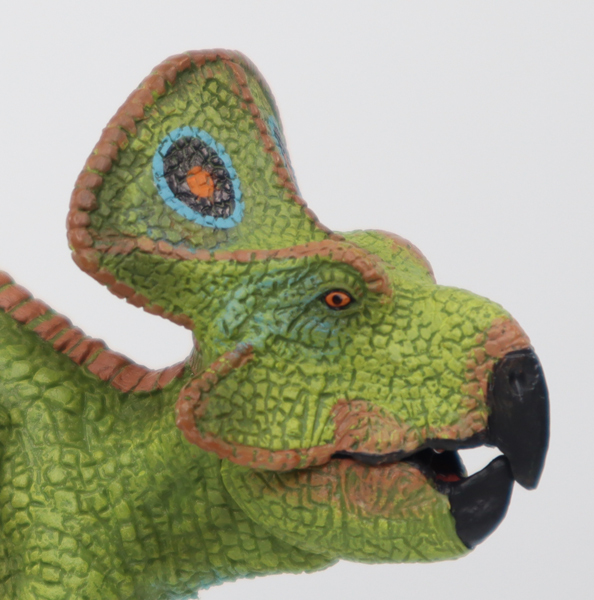
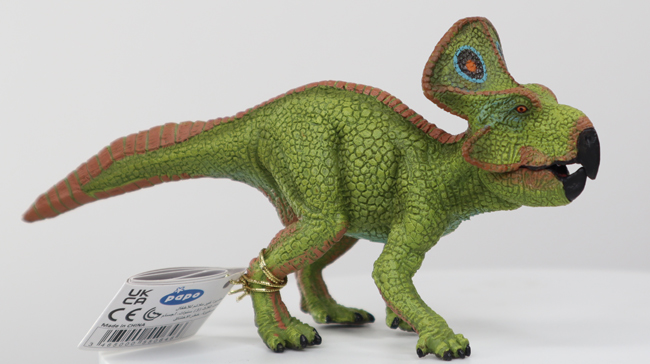
The Papo Protoceratops has been provided with a prominent beak for cropping tough vegetation and the model has an articulated lower jaw. The inside of the mouth has been well painted, and the Papo design team have provided the Protoceratops with rows of small white teeth in both the upper and lower jaw.
A close-up view of the head of the Papo Protoceratops dinosaur model. The figure has been given a prominent beak and, in the mouth, the Papo design team have added some teeth to their model.
Papo Protoceratops model in lateral view. In this image the mouth is open and some of the small, white teeth can be seen.
The Protoceratops Genus
The Protoceratops genus was erected in 1923 when the first species (P. andrewsi), was formally named and described (Granger and Gregory). The first fossils of this dinosaur were collected during the famous American Museum of Natural History expedition to the Gobi Desert. Protoceratops andrewsi is associated with the Mongolian Djadokhta Formation (Upper Cretaceous), a second species, the slightly larger Protoceratops hellenikorhinus was named and described in 2001 (Lambert et al). Fossils of P. hellenikorhinus are associated with the Bayan Mandahu Formation of Inner Mongolia (China).
Both the Djadokhta Formation and the potentially contemporaneous Bayan Mandahu Formation represent arid, desert-like palaeoenvironments.
Papo Protoceratops dinosaur model. This dinosaur model is one of three new Papo prehistoric animal models expected in stock in 2022.
Three Papo Prehistoric Animal Models Expected in 2022
The Papo Protoceratops dinosaur model is one of three Papo prehistoric animal models expected in 2022. A new colour variant of the Styracosaurus is expected in stock and, towards the end of the year (quarter 4), Papo are expected to introduce a model of a Mosasaurus.
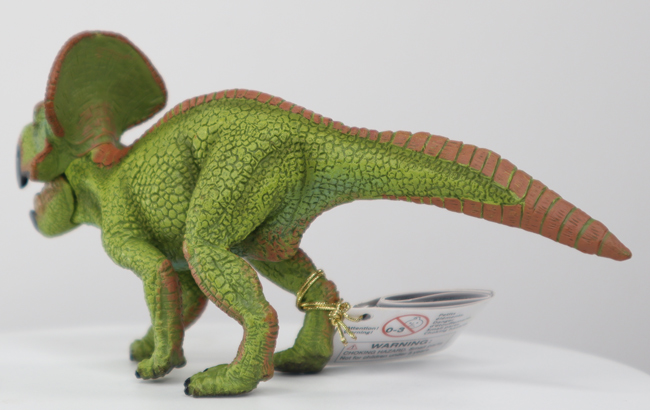
The new for 2022 Papo Protoceratops dinosaur model in posterior view.
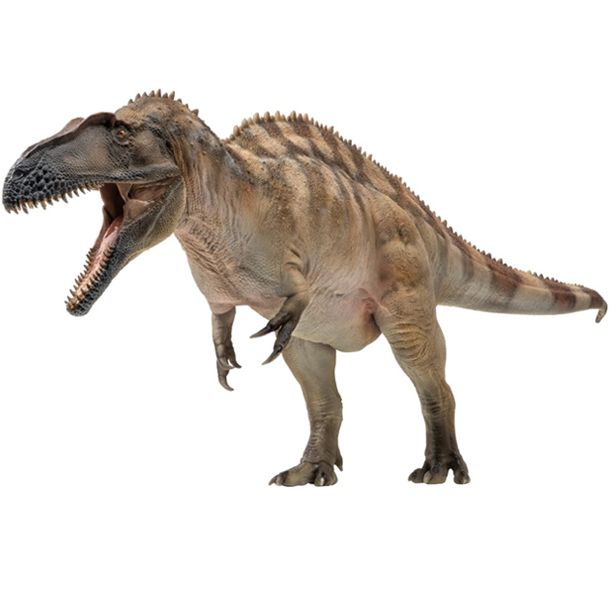
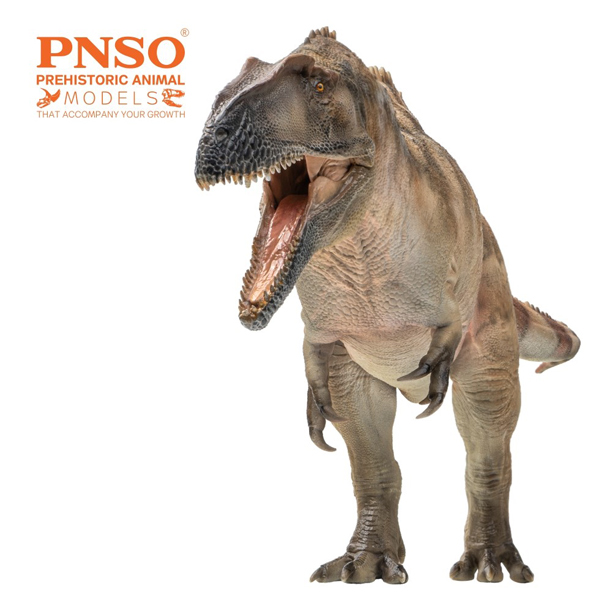
Our thanks to dinosaur fan and model collector William who sent into Everything Dinosaur his detailed review of the recently introduced PNSO Fergus the Acrocanthosaurus dinosaur model.
William starts his review by discussing the head sculpt. He states that the head is “a thing of pure magic, a true Acrocanthosaurus”. When compared to known skull material the life reconstruction from PNSO is praised.
The reviewer goes on to add:
“Thank you both ZHAO Chuang and YANG Yang from us, we are all humbled.”
PNSO Fergus the Acrocanthosaurus has an articulated lower jaw.
No Hint of Shrink Wrapping
The superb skin texturing associated with the head sculpt is mentioned and the reviewer states that the figure shows no signs of shrink wrapping. He comments that the orbits, external ears and the lacrimal crests are perhaps the best around. The model has a fully articulated lower jaw, no lips and the jaw opens smoothly revealing lots of fine detail in the mouth.
William also highlights the placement of the eyes, giving stereoscopic vision.
The Main Body Sculpt
In William’s opinion PNSO have created the most detailed and scientifically accurate Acrocanthosaurus made to date. The cloaca is in the correct position and the neural spines, running from the base of the neck to the pelvic region are praised.
“When viewed from above you can see what makes this figure very rare and special. His massive musculature begins just behind the shoulders and travels down towards the tail. Within the folds of the model’s skin the ribs can be observed and touched these are the anchor points to which the muscles are attached.”
The PNSO Fergus the Acrocanthosaurus dinosaur model.
The forelimbs are described as providing a realistic likeness to the living dinosaur. William also comments upon the hind legs stating that they look robust and powerful, not made for speed but being ideal to help this large carnivore overpower sauropods.
He explains that the tail might look a little shorter when compared to previous examples of the Carcharodontosauridae, but it only seems short due to the presence of the neural spines.
Fergus the Acrocanthosaurus model new from PNSO for 2022.
Similar to a Burmese Python
The reviewer suggests that the model’s colouration is similar to that of a Burmese python. He states that the colour scheme chosen is an inspired choice for an apex predator. The base colour of light ochre contrasts with the darker wash and the Burmese python markings.
William comments that the pink maw of the mouth has a real natural feel and look about it, with the white teeth blending into brown/white at the roots.
He adds:
“The lacrimal crest has a subtle red applied which is very pleasing to one’s eye.”
PNSO Fergus the Acrocanthosaurus in anterior view.
The Size of the PNSO Acrocanthosaurus Model
William suggests that the figure has a scale of 1:37 and provides model measurements:
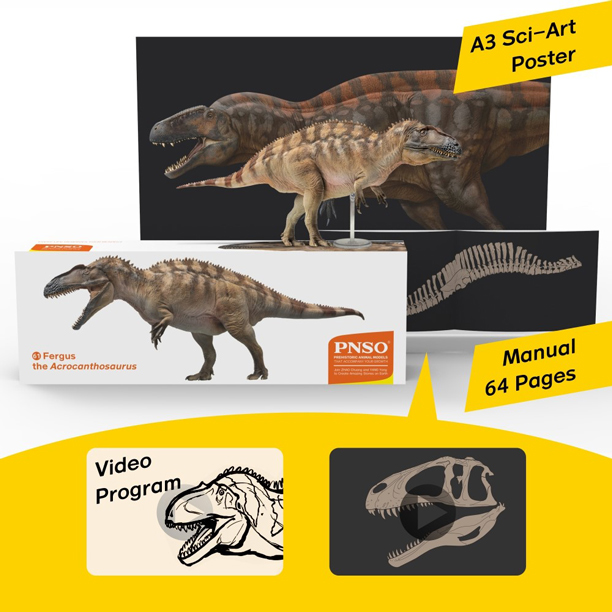
The PNSO Fergus the Acrocanthosaurus model is supplied with a number of accessories.
Clear plastic support stand.
Beautiful, illustrated 64-page booklet.
Stunning A3 colour poster.
QR code to watch a short design video.
The model is supplied with a clear plastic support stand, a 64-page full colour booklet and colour poster. A QR code on the packaging links to a short video that explains how the figure was made.
Acrocanthosaurus Fossils
As is customary with William’s model reviews he concludes by providing information about this Early Cretaceous dinosaur and details of fossil discoveries.
He states that Acrocanthosaurus fossils have been found in four U.S. states (Oklahoma, Texas, Wyoming and Arizona).
As hypercarnivores the Carcharodontosauridae were the ultimate big game hunters, feasting on sauropods. William suggests that these predators were probably pack hunters.
In the information supplied to Everything Dinosaur, William explained how “high spine lizard” was discovered and named and recounted the tale of the discovery of the specimen nicknamed “Fran”.
Whilst the evolution of such high neural spines in members of the Theropoda remains uncertain, William postulates that the spines could have supported a hump or perhaps played a role in visual displays or regulating body temperature.
Theropod and Sauropod Tracks from the Glen Rose Formation
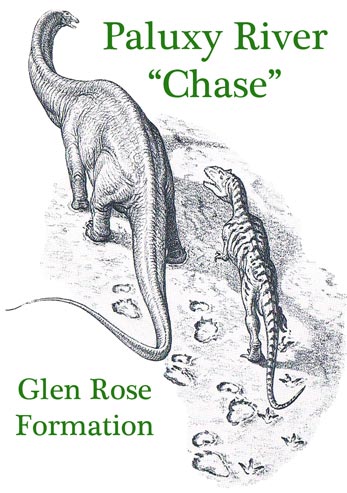
The reviewer also commented upon the famous theropod and sauropod tracks, in what is now known as the Dinosaur Valley State Park (Texas). The tracks may represent a theropod dinosaur stalking a sauropod. These tracks have been attributed to dinosaurs similar to Acrocanthosaurus and Sauroposeidon respectively.
Famous dinosaur tracks – theropod and sauropod tracks. Picture credit: John Sibbick with additional annotation by Everything Dinosaur.
William closes his review by stating that the PNSO Fergus the Acrocanthosaurus figure is:
“PNSO’s greatest theropod”.
Our thanks to William for providing Everything Dinosaur with such a detailed model review.
To view the PNSO Fergus the Acrocanthosaurus and the rest of the PNSO models and figures in stock at Everything Dinosaur: PNSO Age of Dinosaurs Figures.
The new for 2022 CollectA prehistoric animal models are now in stock at Everything Dinosaur. Team members have been busy contacting all those customers that requested that they be informed when the CollectA prehistoric animal model delivery arrived.
The new for 2022 CollectA prehistoric animals have arrived at Everything Dinosaur. Team members have been busy contacting all those customers who requested an email alert. There are seven figures in the photograph, can you name them all?
New Dinosaurs, Pterosaurs, a Prehistoric Mammal, a Nautiloid and ?
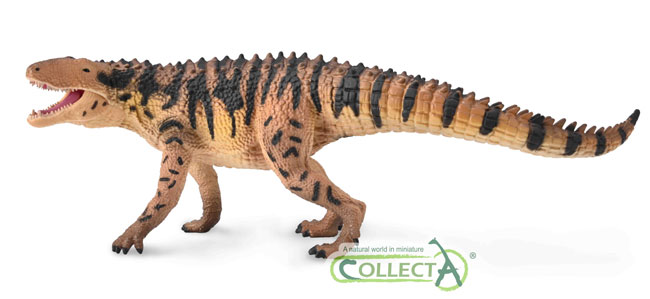
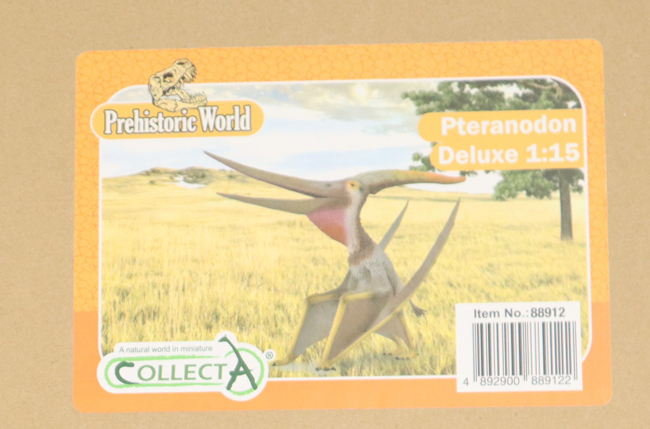
The new figures include dinosaurs, two pterosaurs (the 1:15 scale P. longiceps figure having been held over from 2021), a stunning nautiloid and an updated Paraceratherium replica. In addition, a model of the enigmatic Late Triassic predator Smok (S. wawelski) is also in stock. This Polish carnivore is classified as an archosaur, but its exact taxonomic placement remains ambiguous.
The new for 2022 CollectA Deluxe Smok wawelski replica reflects the view that this large Late Triassic predator was not a theropod dinosaur. Classified as a member of the Archosauria, its exact taxonomy remains unknown. Fossil bones reveal anatomical characteristics associated with the Dinosauria (Theropoda), but also show traits that indicate an affinity to the Pseudosuchia – the crocodile lineage of archosaurs. To further confuse the taxonomy of this carnivore, analysis of the fossil bones also identified features associated with very primitive archosaurs.
A spokesperson from Everything Dinosaur commented:
“We have been looking forward to getting these new CollectA prehistoric animal figures into our warehouse. The shipment contained over a hundred different types of models including fresh stock of the award-winning Doedicurus and the 1:15 scale Pteranodon longiceps figure that we were unable to bring into the UK last year. We know that many collectors have been patiently waiting for these figures, now their wait is over.”
The front of the CollectA Prehistoric Life Deluxe Pteranodon longiceps model. This figure is now in stock at Everything Dinosaur.