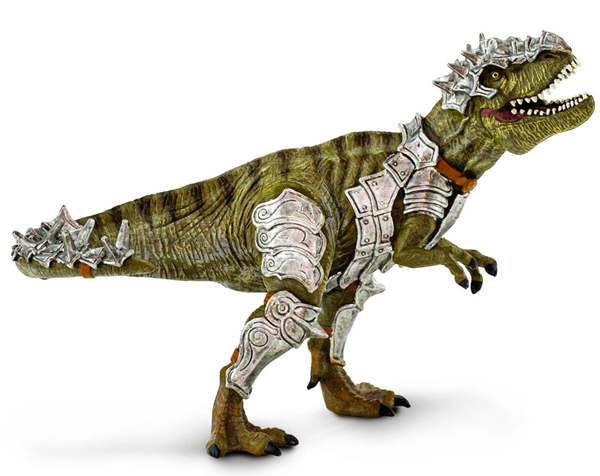
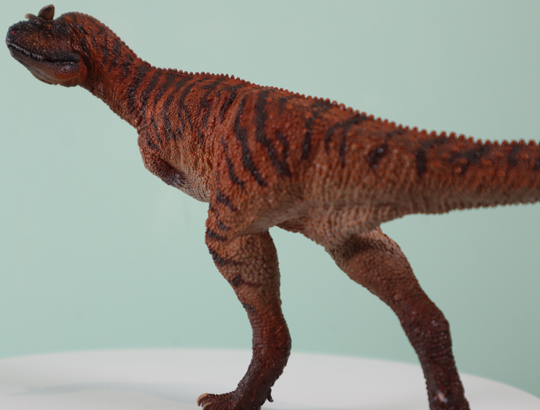
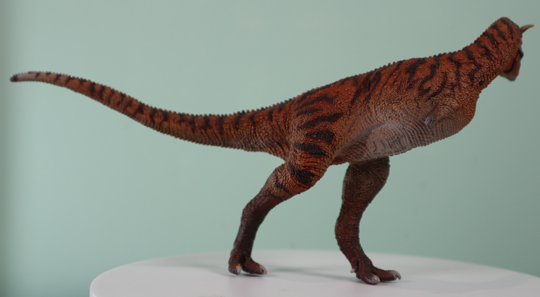
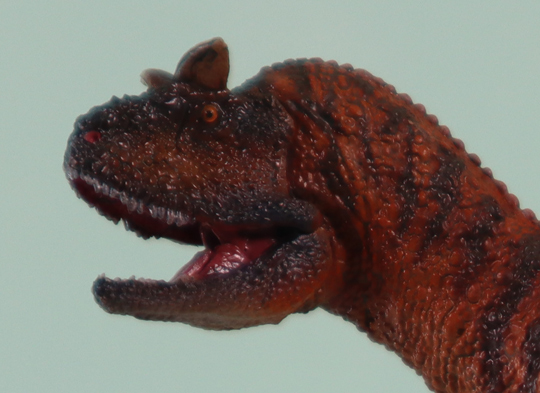
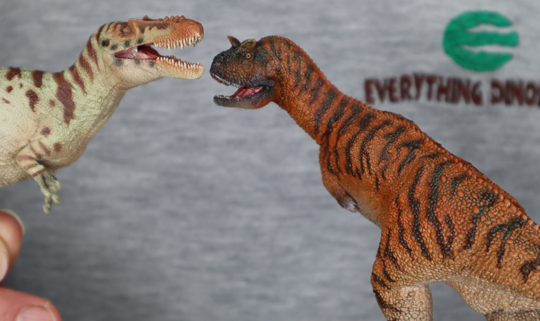
The Safari Ltd Mythical Realms armoured T. rex dinosaur model is now in stock at Everything Dinosaur. This is the third of five new dinosaur models to be introduced by Safari Ltd this year (2021), an armoured Triceratops and a model of the theropod Baryonyx have already arrived at Everything Dinosaur.
Safari Ltd have extended their Mythical Realms line by adding an armoured T. rex dinosaur model to this range. This model has an articulated lower jaw.
An Armoured Carnivorous Dinosaur
This cleverly designed dinosaur has armour on the top of its head. The tyrannosaur sports a breast plate, armour on its shoulders and protecting its ribs. There are three large plates of armour over the thigh and additional protection running down to the foot. The tail has a vicious-looking spiky club. A most impressive weapon one that would make an Ankylosaurus jealous.
Model Measurements
The Safari Ltd Mythical Realms armoured T. rex dinosaur model measures approximately 17 cm in length. In reality the model is bigger than this, as the tail is curved round on itself. That armoured head is around 11 cm off the ground.
Everything Dinosaur team members have been busy over the last few weeks as they help events companies, museums and other attractions prepare for the eagerly awaited easing of lockdown restrictions in the UK.
We have been asked to write a series of display panels for a number of dinosaur and prehistoric animal exhibits that will be opening (hopefully) in the summer. One dinosaur that has featured in this work is the Early Jurassic theropod from the western United States – Dilophosaurus (D. wetherilli).
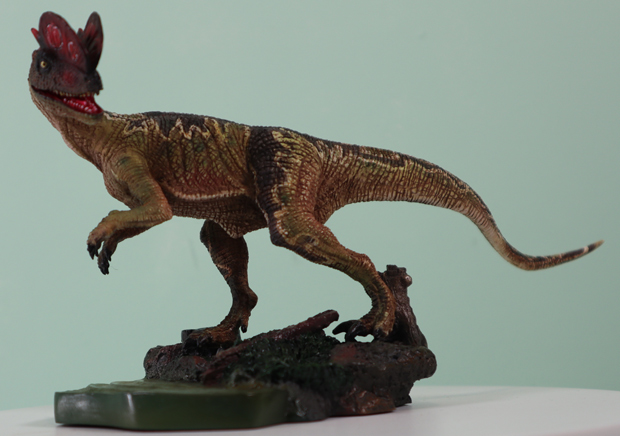
The ITOY Studio Dilophosaurus dinosaur model. Picture credit: Everything Dinosaur.
The picture (above) shows a Dilophosaurus model. To view the models and figures section of the Everything Dinosaur website: Dinosaur Models and Figures.
Double Crested Lizard
With an estimated body length of around 6 metres, Dilophosaurus is one of the largest predators known from the Early Jurassic of North America. Fragmentary fossils of this dinosaur were discovered in 1942 in northern Arizona on Navajo Nation territory by a team of palaeontologists from the University of California who were assisted in their excavations by their Navajo Indian guide. The badly eroded fossil bones were carefully prepared and the first scientific description of this material was published in 1954. It was erroneously thought that the fossils represented a new type of Megalosaurus – a dinosaur known from the Early Jurassic of Europe.
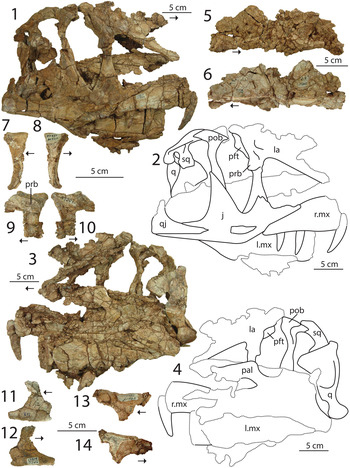
Dilophosaurus wetherilli holotype specimen (UCMP 37302): (1–4) articulated right side of the skull and line drawings. Plus (5, 6) nasolacrimal crest, (7, 8) left postorbital, (9, 10) left lacrimal, (11, 12) left quadratojugal, and (13, 14) left squamosal in (1, 2, 5, 7, 9,11, 13) lateral and (3, 4, 6, 8, 10, 12, 14) medial view.Picture credit: Marsh et al (Journal of Palaeontology).
Fossilised Crests Found in 1964
Expedition team members returned to the site in 1964 and uncovered more fossil bones including a partial skull with unusual bony crests. This dinosaur was subsequently re-described and named Dilophosaurus in 1970.
Dilophosaurus is one of the most extensively studied of all the carnivorous dinosaurs. A recent review, published in 2020, suggested that Dilophosaurus was a much more powerful animal than previously thought. It was probably an apex predator rather than a weak-jawed scavenger. The crests may have been brightly coloured and were probably used for display or played a role in thermoregulation – helping Dilophosaurus to keep cool, functioning in the same way as the casques on the heads of large, flightless birds such as cassowaries.
The new for 2021 CollectA Age of Dinosaurs 1:40 scale Dilophosaurus dinosaur model.
Recently, Everything Dinosaur created a short video for the company’s YouTube channel that provided more information on the 2020 Dilophosaurus scientific paper.
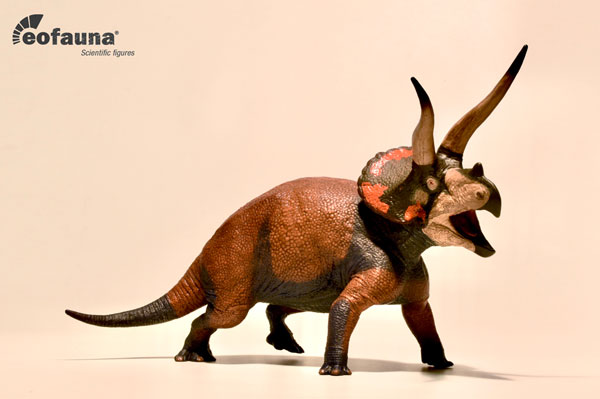
Our thanks to dinosaur fan and model collector William who sent into Everything Dinosaur a review of the latest Eofauna models, the Triceratops dinosaur models “Cryptic” and “Dominant”.
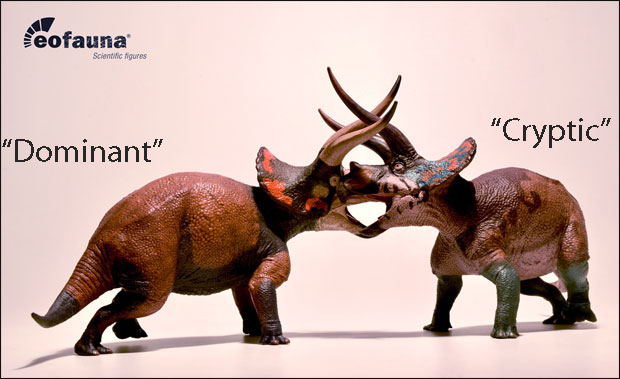
The Eofauna Scientific Research 1:35 scale Triceratops models do battle (Cryptic and Dominant).
Eofauna’s first two releases of 2021 are of the spectacular Triceratops “Yoshi’s Trike” after it’s discoverer Yoshi Katsura. Unearthed in 2010 now housed within the Museum of the Rockies.
Yoshi’s Trike” (MOR 3027), is a very large Triceratops specimen with nearly four foot long horn cores. Yoshi belongs to yet an undescribed Triceratops species “Ugrosaurus olsoni “, older than either Triceratops horridus or Triceratops prorsus but sharing intermediate characteristics of both*.
In life “Yoshi” was 3 metres at the hip and weighed 9.5 tonnes. It’s these little touches that makes Eofauna so beloved of collectors of accurate figures.
Dominant (Brown) and the Variant Cryptic (Blue)
Both come in polybags with horn protectors with Eofauna stats cards with the same beautiful artwork.
Length: 9.1/4 inches.
Height: 3.1/2 inches.
Scale: 1/35.
Both figures stand rock solid, no toppling issues etc.
A superb, compact modern body recreation of an active true life Triceratops. Both figures are sculpted with open mouths with exact detailing such as teeth and the openings to the nasal passages and the tongues are correctly held within the mouth. With the classical ceratopsian beaks.
Both “Yoshi’s” are posed in a sparring stance as though a younger bull is testing the herd’s old bull for any weaknesses. Never will you see such a pair of Trikes adorned with such an impressive a set of horns perfectly sculpted and in life a true terror for all the local tyrannosaurs and to tangle with 4 metres of keratin covered doom would be for the fool hardy or a veteran rex.
The nasal horns are as equally good on the money a shorter back profile with a longer forward facing straight profile. Nostrils are spot on with a double ridge of skin and now on towards the body’s dermal areas.
From the nostrils a ripple of skin processes radiating outwards in a more scaled mosaic pattern from the lower jaw to the tails end and sturdy powerful legs with fully detailed toes with correct toe numbers on each.
A triple fold of skin highlights a beautifully intelligent eye no old time slow moving rhino analogue here.
A more expertly detailed entire body you shall run your hand over from folds of skin on the entire body to variation of the scaling every detail pinpointed on these two figures.
The neck frill has the same texturing of scales with the leading edge enforced with keratin frill bosses.
Looking at the Colour Variations
DOMINANT:
Nasal horn and upper/ lower tips are of a rich dark chocolate.
Main horns, eye folds and side panels of the mouth are of a dark caramel cream with horn tips black.
Neck frill and horn bosses are the same chocolate as the beak.
The inside of the mouth is a rich dark pink with a dark wash and white teeth top/bottom.
Carefully placed is the dark orange pattern placed at the leading edges of the neck frill.
A dark orange eye with a black pupil.
From lower throat downwards of the backs of front limbs and insides of the hind legs and under belly to the lower part of the tail all painted in dark brown broken up at the front with a rich dark ginger.
This same rich ginger covers the majority of upper torso and tail – excellent choice.
All toenails painted in a natural horn colour.
The Eofauna Scientific Research Triceratops dinosaur model – “Dominant”.
CRYPTIC:
Nasal horn and upper/lower tips are of a rich grey.
Main upper head and eye folds and side are of a dark chocolate with a dark yellow nasal panel with a wash over it.
Horns are of a dark grey fading into a caramel beige at the tips.
The neck frill’s base colour is a dark ginger with turquoise blue admixed through out, the frill bosses are dark brown.
The inside of the mouth is a rich dark pink with a dark wash and white teeth top/bottom.
The lower part of the jaw and throat and underbelly and tail are of a beige-cream with some dark chocolate stripes below the eyes and upper part of the lower jaw again a dark wash has been applied.
A vibrant orange eye with a black pupil.
From the shoulders to the middle of the back and then continuing onwards to the very tip of the tail a very rich brown covers this entire dermal area.
The flanks of the side are of a light ginger/tan.
All four legs are of a pale blue with a greyish dark wash applied, very eye catching this is more of an alpha male in all aspects.
All toenails painted in a natural dark horn colour.
The Eofauna Tricertops sp. model (Cryptic).
At this moment I wish to thank Sue and Mike and their entire team at Everything Dinosaur HQ.
We your customers/friends wish to thank you all for being the company we all respect.
Thank you for being our friends and thank you for being EVERYTHING DINOSAUR.
Team members at Everything Dinosaur thanked William for sending in his review. One point to make about the temporal range of this, as yet to be described Triceratops species,* – the fossils associated with this transitional form have been found in strata older than T. prorsus but younger than Triceratops horridus.
Thank you to William for sending into Everything Dinosaur this review.
William added:
“All Eofauna’s figures are available here from our good friends at EVERYTHING DINOSAUR.”
Everything Dinosaur team members have been working on another Papo inspired YouTube video and they hope to have it completed, edited and posted up on the company’s channel in a few days. This latest video is a follow up to a Papo prehistoric animal model video posted up a few weeks ago that examined the strategy behind Papo’s product development. This new video will develop these themes and look at the way in which the French figure manufacture can expand their product range.
Everything Dinosaur’s next YouTube video will discuss the options Papo can consider when extending their prehistoric animal model range. The picture above shows the title screen for the video. Picture credit: Everything Dinosaur.
Papo will introduce two prehistoric animal figures in 2021. The models are a replica of a young Smilodon and a model of the fearsome prehistoric shark Megalodon (C. megalodon). Both models are projected to be available around quarter 4 (2021), but Everything Dinosaur and Papo are working hard to try and bring these two figures into stock a little earlier.
A graph showing the number of new Papo prehistoric animal models introduced each year (new colour variants and brand new models). Picture credit: Everything Dinosaur.
Picture credit: Everything Dinosaur
In Everything Dinosaur’s video, team members will look at the options Papo have to expand their prehistoric animal model offering. The video will also document how the Papo model range has expanded over the years. It will also discuss Papo product development.
The graph above shows the number of new sculpts (new figures) as well as new colour variants that have been introduced by Papo since 2015. This year, (2021) Papo will bring out just two figures, neither of which are dinosaurs.
New Model Suggestions
Everything Dinosaur’s YouTube video will also give viewers the opportunity to suggest new figures that Papo might like to make. The video also challenges fans of dinosaur models to think of other ways in which Papo can expand its “Les Dinosaures” range.
Team members at Everything Dinosaur have commissioned a scale drawing of the Japanese duck-billed dinosaur Kamuysaurus (K. japonicus) as they await the arrival of the first batch of new for 2021 prehistoric animal models from CollectA.
A scale drawing of the hadrosaurid Kamuysaurus (K. japonicus) that was formally named and described in 2019. This Late Cretaceous duck-billed dinosaur is estimated to have measured around 8 metres in length and weighed 4 tonnes. Picture credit: Everything Dinosaur.
Picture credit: Everything Dinosaur
The scale drawing is being prepared to coincide with the arrival of CollectA models.
Kamuysaurus japonicus – A Kamuysaurus Scale Drawing
Described as Japan’s best-known dinosaur by a number of media sources. This dinosaur was officially named and described back in 2019. CollectA have been planning a model of this Japanese dinosaur for some time, they have expressed an interest in expanding their replicas of Japanese dinosaurs since the introduction of Fukuiraptor and Fukuisaurus.
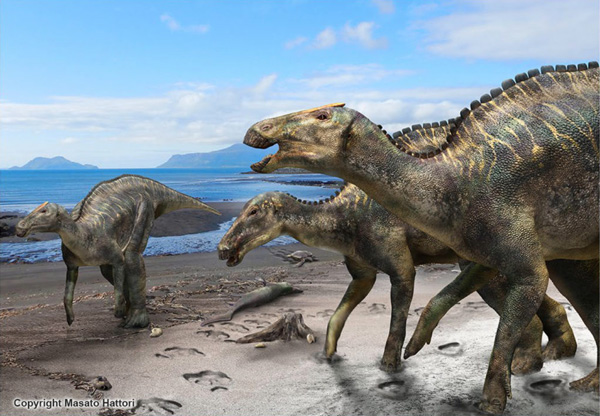
A herd of Kamuysaurus wander along a beach. Picture credit: Masato Hattori. The fossilised remains of a single individual dinosaur were found in marine sediments. These fossils were formally assigned to a new dinosaur species in 2019 (Kamuysaurus japonicus).
How Big was Kamuysaurus?
Although only known from a single specimen, the skeleton represents the most complete dinosaur fossil found in Japan. Scientists were able to assign Kamuysaurus to the Edmontosaurini clade within the hadrosaur subfamily the Saurolophinae.
Kamuysaurus is estimated to have reached a body length of around 8 metres and to have weighed 4 tonnes.
Palaeontologists who have studied the fossil material have suggested that Kamuysaurus is closely related to Kerberosaurus which was unearthed in Russia and Laiyangosaurus which is known from China. Kamuysaurus was named after the indigenous people of the island of Hokkaido, the trivial or species name refers to Japan. It translates as “the deity of Japanese dinosaurs”.
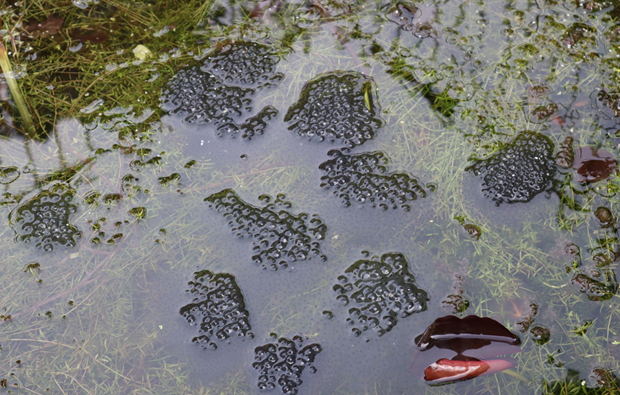
Team members from Everything Dinosaur have spotted frogspawn in the office pond this morning. The overnight gales and heavy rain have not deterred the common frogs (Rana temporaria) and they have spawned.
Frogspawn in Everything Dinosaur’s office pond. Team members estimate that there were more than ten Common frogs (Rana temporaria) in the pond. Picture credit: Everything Dinosaur.
Picture credit: Everything Dinosaur
An Early Spawning
With eggs being laid on the 11th March (2021), this is a little earlier than in recent years. For example, last year (2020), frogspawn was spotted on March 19th. In 2018, frogspawn was spotted on the 17th March, the last time the frogs spawned on the 11th March was 2017.
A spokesperson from the UK-based dinosaur model company stated:
“We keep a close watch on the office pond at this time of year and when the frogs spawn we record the date and then we monitor the progress of the tadpoles when they hatch and become more mobile.”
The frogs in the office pond are Common frogs, sometimes referred to as the European common frog or the grass frog (Rana temporaria).
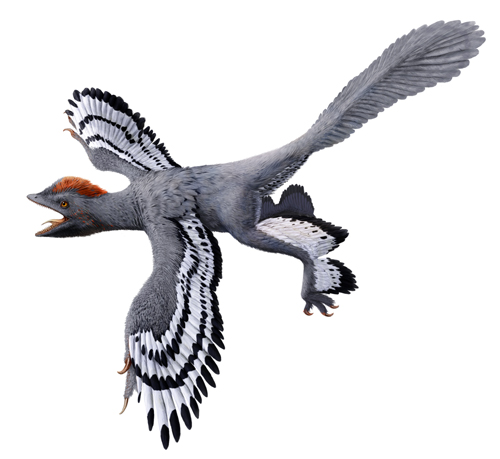
Our thanks to Cooper, a dinosaur fan who commented on one of our blog posts highlighting one of his favourite dinosaurs, the diminutive Anchiornis (A. huxleyi), the scientific name translating as “Huxley’s near bird”.
An illustration of the feathered dinosaur Anchiornis huxleyi. Picture credit: Julius Csotonyi.
Controversial Taxonomy
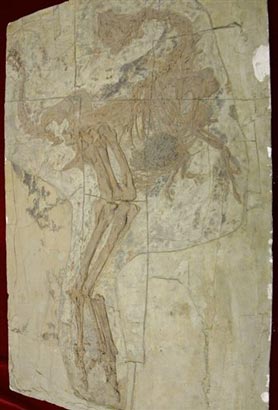
Many palaeontologists believe that this small dinosaur known from Upper Jurassic deposits associated with the Tiaojishan Formation of Liaoning (north-eastern China), is a basal member of the Paraves clade, a part of the Maniraptora that incorporates the dromaeosaurids, the troodontids and the avialans, those dinosaurs that lead directly to the evolution of modern birds. The exact taxonomic position of this dinosaur remains controversial.
Ancient, feathered creature. An Anchiornis fossil from the famous Tiaojishan Formation of Liaoning Province (north-eastern China). Picture credit: CAS.
A Fan of Anchiornis
Cooper produced a near perfect copy of one of Everything Dinosaur’s numerous articles on Anchiornis huxleyi. The many fossil specimens associated with this species has led to several different types of scientific research paper being published about Anchiornis, focusing on ontogeny, phylogeny and behavioural aspects of this little theropod.
Everything Dinosaur has written a number of blog posts (at least fourteen), about Anchiornis with our first article being published in 2009.
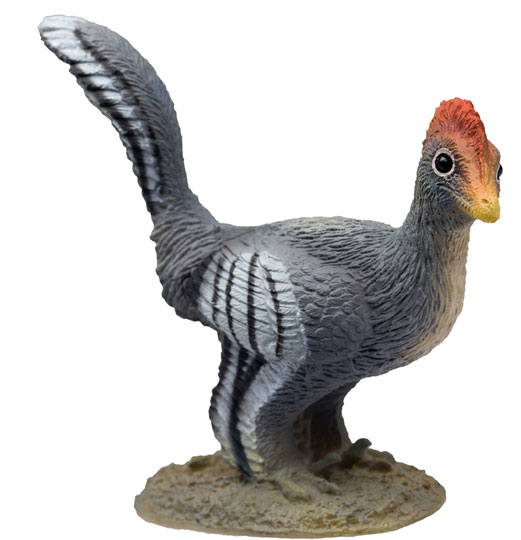
The PNSO “Luffy” the Anchiornis dinosaur model from the “Age of Dinosaurs” model range. PNSO introduced a series of prehistoric animal models, many of which were based on Chinese fossil discoveries.
A spokesperson for the UK-based specialist mail order company stated:
“Our thanks to Cooper for reaching out to us. We deal with hundreds of enquires every week and we do our best to respond to all those that require a reply. We are glad that Cooper found our work on Anchiornis huxleyi so thought-provoking and informative.”
Anchiornis huxleyi
Named and described shortly before Everything Dinosaur published its first blog post about this dinosaur, the species name honours Thomas Henry Huxley, an early champion of Darwin’s theory of evolution.
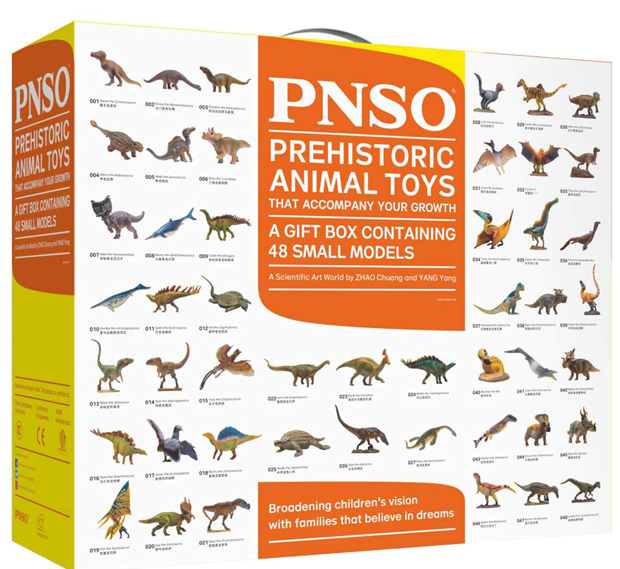
The Chinese company PNSO is one of the few mainstream model makers to have made an Anchiornis figure. “Luffy” the Anchiornis (pictured above), is one of a series of 48 models featured in the “Age of Dinosaurs – Toys that Accompany your Growth” model range. It also features in the huge PNSO Age of Dinosaurs box set.
PNSO special edition gift box features 48 prehistoric animal models including “Luffy” the Anchiornis.
To view the PNSO Anchiornis model and the other prehistoric animal figures available from Everything Dinosaur: PNSO Age of Dinosaurs.
The PNSO Domingo the Carnotaurus dinosaur model has already attracted rave reviews from collectors and fans of dinosaur models. This 5-star rated figure has been described as “a beautiful model, at this moment the most accurate depiction of Carnotaurus” and “an amazing model, both colour and sculpt are stunning” by reviewers on Everything Dinosaur’s website.
The PNSO Carnotaurus model stands perfectly stable without the use of the transparent stand which is supplied with the figure. However, Everything Dinosaur recommends that the support stand is used when the model is put on display. Picture credit: Everything Dinosaur.
Picture credit: Everything Dinosaur
Carnotaurus sastrei
This replica of a Late Cretaceous South American abelisaurid has certainly turned heads. The model is exquisitely detailed and so well made that the figure stands perfectly on a flat, level service without the aid of the transparent support stand that is supplied with this dinosaur model.
A lateral view of the PNSO Domingo the Carnotaurus. This new for 2021 dinosaur model has been highly praised by fans of dinosaurs. Picture credit: Everything Dinosaur.
Picture credit: Everything Dinosaur
An Articulated Lower Jaw
Like a lot of the new theropod figures from PNSO, Domingo the Carnotaurus has an articulated lower jaw. The model designers have been careful to depict those famous horns over the eyes (from which this dinosaur’s name is derived, due to their superficial similarity to the horns of a bull). The colouration chosen shows evidence of countershading and the use of black stripes gives this figure real presence. Although the jaw of Carnotaurus is relatively small and delicate, the designers have taken heed of the fossil evidence and equipped their model with a narrow jaw, located in a disproportionately deep skull.
A close view of the head of the PNSO Carnotaurus model showing the delicate lower jaw, the deep skull and those famous horns over the orbits. Picture credit: Everything Dinosaur.
Picture credit: Everything Dinosaur
A spokesperson from Everything Dinosaur commented:
“Fans of dinosaur models and figure collectors have really been looking forward to the arrival of the PNSO Domingo the Carnotaurus replica. It had a lot of hyperbole to live up with some collectors stating that PNSO was the most improved model manufacturer on the market. With the first reviews for this new for 2021 figure posted up on our website, it seems that collectors have not been disappointed.”
The PNSO Domingo the Carnotaurus dinosaur model has an articulated lower jaw. Picture credit: Everything Dinosaur.
Picture credit: Everything Dinosaur
A Range of New PNSO Dinosaurs
Domingo the Carnotaurus is one of a range of new dinosaur figures which also includes a replica of the theropod from China called Qianzhousaurus.
The PNSO A-Shu the Qianzhousaurus dinosaur model faces off against the PNSO Domingo the Carnotaurus. These two models both have articulated lower jaws and are part of a range of new model introductions from PNSO. Picture credit: Everything Dinosaur.
Picture credit: Everything Dinosaur
To view the PNSO Domingo the Carnotaurus model and the rest of the prehistoric animals in the PNSO range: PNSO Age of Dinosaurs.
Stunning fossil plants preserved within a volcanic ash fall in China have shed light on an evolutionary race 300 million years ago, which was eventually won by the seed-bearing plants that dominate the flora of our planet today.
New research into fossils found at the “Pompeii of prehistoric plants”, in Wuda, Inner Mongolia, reveals that the plants, called Noeggerathiales, were highly-evolved members of the lineage from which came seed plants.
A reconstruction of the crown of Paratingia wuhaia. A newly described prehistoric plant from the Early Permian.
The Importance of Noeggerathiales
Noeggerathiales were important peat-forming plants that lived around 325 to 251 million years ago (Late Carboniferous to the end of the Permian). Understanding their relationships to other plant groups has been limited by poorly preserved examples until now. The beautiful fossils found in China have allowed experts to work out that Noeggerathiales are more closely related to seed plants than to other fern groups.
No Evolutionary Dead-end
No longer considered an evolutionary cul-de-sac, they are now recognised as advanced tree-ferns that evolved complex cone-like structures from modified leaves. Despite their sophistication, Noeggerathiales fell victim to the profound environmental and climate changes of 251 million years ago that destroyed swamp ecosystems globally (End Permian mass extinction event).
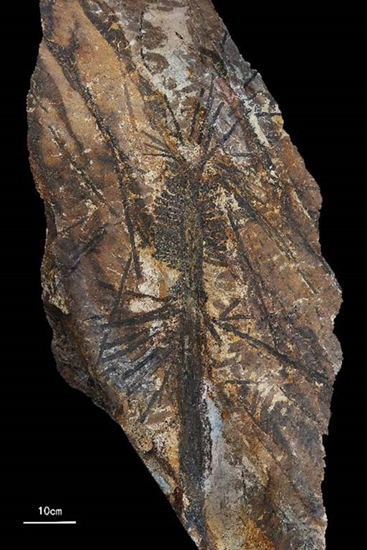
Fossil specimen of the new species (Paratingia wuhaia) preserving the crown of the tree with leaves and its fertile organs attached to the stem.
Co-author of the scientific paper, published this month in the Proceedings of the National Academy of Sciences (PNAS), Dr Jason Hilton, Reader in Palaeobiology at the University of Birmingham’s Institute of Forest Research, commented:
“Noeggerathiales were recognised as early as the 1930s, but scientists have treated them as a ‘taxonomic football’, endlessly kicked around without anyone identifying their place in the story of life. The spectacular fossil plants found in China are becoming renowned as the plant equivalent of Pompeii. Thanks to this slice of life preserved in volcanic ash, we were able to reconstruct a new species of Noeggerathiales that finally settles the group’s affinity and evolutionary importance.”
A Stark Warning for Us
The researchers comment that the fate of advanced Noeggerathiales is a stark reminder of what can occur when a sophisticated and seemingly well-adapted form of life is faced with rapid, dramatic environmental change.
The scientists studied complete Noeggerathiales preserved in a bed of volcanic ash 66 cm thick formed 298 million years ago (Early Permian), smothering all the plants growing in a nearby swamp. The ash stopped the fossils from rotting or being consumed and preserved many complete individuals in microscopic detail.
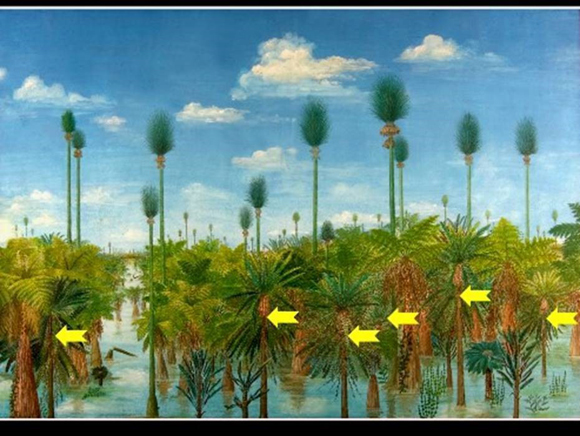
A life reconstruction of the swamp (yellow arrows indicate the newly named plant species (Paratingia wuhaia).
Lead-Author Jun Wang, (Nanjing Institute of Geology and Palaeontology), added:
“Many specimens were identified in excavations in 2006-2007 when a few leaves were visible on the surface of the ash. It looked they might be connected to each other and a stem below – we revealed the crown on site, but then extracted the specimens complete to take them back to the lab. It has taken many years to study these fully and the additional specimens we have found more recently. The complete trees are the most impressive fossil plants I have seen and because of our careful work they are also some of the most important to science.”
An Extensive Ancestral Lineage
The research team postulate that that the ancestral lineage from which seed plants evolved diversified alongside the earliest seed plant radiation during the Devonian, Carboniferous and Permian periods, and did not rapidly die out as previously thought.
Everything Dinosaur acknowledges the assistance of a press release from the University of Birmingham in the compilation of this article.
The scientific paper: “Ancient noeggerathialean reveals the seed plant sister group diversified alongside the primary seed plant radiation” by Jun Wang, Jason Hilton, Hermann W. Pfefferkorn, Shijun Wang, Yi Zhang, Jiri Bek, Josef Pšenička, Leyla J. Seyfullah and David Dilcher published in the Proceedings of the National Academy of Sciences.
An open-access paper has recently been published in the on-line academic journal PLOS One announcing the discovery of a new species of rebbachisaurid sauropod. The newly described dinosaur named Dzharatitanis kingi is the first member of the Rebbachisauridae family to have been found in Asia. Rebbachisaurids are known from Europe, Africa South America and possibly North America. They are related to diplodocids such as Brontosaurus and Apatosaurus and most palaeontologists group them in the Diplodocoidea superfamily along with the Diplodocidae and the rare and enigmatic Dicraeosauridae dinosaurs.
Dzharatitanis kingi the first rebbachisaurid to be described from Asia. Picture credit: Alexander Averianov. The large pterosaurs walking in the same direction as the sauropod probably represent the azhdarchid Azhdarcho, the only pterosaur to have been described to date from fossils found in the Bissekty Formation.
Described from a Single Fossil Bone
Described from a single, well-preserved tail bone from the base of the tail (anterior caudal vertebra), this herbivore is estimated to have been around 15 to 20 metres in size. The fossil bone was found in 1997, by David Ward and one of the authors of the scientific paper, Hans-Dieter Sues, during the Uzbekistan/Russian/British/American/Canadian exhibition to map and document Late Cretaceous Dzharakuduk escarpment outcrops associated with the Bissekty Formation in the Kyzylkum Desert of Uzbekistan.
Dzharatitanis is (as far as Everything Dinosaur team members are aware), the first sauropod to have been formally described from the Bissekty Formation.
The strata associated with the fossil find are believed to be around 90 million years of age (Turonian stage of the Late Cretaceous). D. kingi represents one of the geologically youngest known rebbachisaurids.
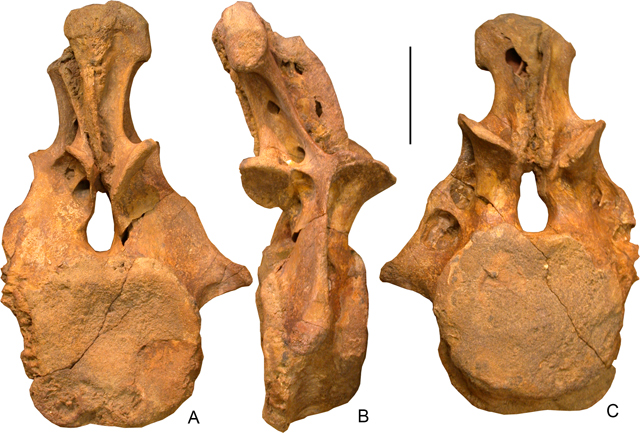
Dzharatitanis kingi, USNM 538133 (holotype), anterior caudal vertebra in posterior (A), right lateral (B), and anterior (C) views. Note scale bar = 10 cm. Picture Credit: Alexander Averianov and Hans-Dieter Sues
“Dzharakuduk titan”
The genus name is derived from the Dzharakuduk escarpment and translates as “Dzharakuduk titan”, whereas the species name honours the late Dr Christopher King who did much to map and document the geology of the Cretaceous-aged strata of central Asia.
Numerous “pencil-shaped” teeth along with isolated bones indicate the presence of sauropods within the Bissekty Formation however, D. kingi is the first member of the Sauropoda to be described. The caudal vertebrae of these types of dinosaur are very diagnostic. Their shape and characteristics help palaeontologists to identity related genera and this single fossil bone, believed to represent the first bone of the tail was sufficient to merit the erection of a new dinosaur species.
The sauropods from the Bissekty Formation now comprise at least two taxa, the rebbachisaurid Dzharatitanis kingi and an indeterminate and as yet unnamed titanosaur.
The scientific paper: “First rebbachisaurid sauropod dinosaur from Asia” by Alexander Averianov and Hans-Dieter Sues published in PLOS One.