All about dinosaurs, fossils and prehistoric animals by Everything Dinosaur team members.
27 07, 2013

Freshwater Pliosaur from Cretaceous Victoria

By |2023-02-21T06:16:11+00:00July 27th, 2013|Categories: Dinosaur and Prehistoric Animal News Stories|0 Comments

Fossil Tooth Provides Evidence of an Australian Freshwater Pliosaur

When amateur palaeontologist Mike Cleeland found a fossilised tooth whilst exploring an area close to San Remo for dinosaur bones, he did not think at the time that his fossil find would lead to new insights into the lifestyles and habits of sea monsters.

Freshwater Pliosaur

Thanks to a joint investigation by scientists from Museum Victoria, Monash University (Australia) and Oxford University (England), palaeontologists have evidence of a giant, freshwater pliosaur.  The discovery suggests that both short-necked and long-necked plesiosaurs lived in freshwater for at least some parts of their lives.  Perhaps, like some species of extant cetaceans such as the river dolphins of the Amazon Basin and the Ganges in India, these reptiles lived their entire lives in freshwater and they had adapted to a life in rivers and estuaries.

The tooth measures approximately 45 millimetres in length and it was found in 1994, in an area around fifty miles from the centre of Melbourne (Victoria).  The strata in which the fossil was found represents a 100-million-year-old river system. During the Cretaceous, this part of Australia was a low-lying plain which was crossed by many meandering, large rivers.

Not a Crocodile Tooth

At first the tooth was thought to belong to a particularly big crocodile, as fossils of Cretaceous crocodilians had been found in the area in the past, but the tooth was not intensively studied until a couple of years ago when Dr Erich Fitzgerald (Senior Curator of Vertebrate Palaeontology a Museum Victoria), decided to take a closer look at the specimen.

Under the microscope, a series of ridges in the preserved enamel could be seen.   The ridges, essentially a series of fine lines, are spaced apart from each other and stop short of the crown apex (the top of the tooth).  This ridge pattern differs from that seen on smaller teeth found in the same locality.  The smaller teeth measure between 10 and 20 millimetres in size and possess ridges that are closer together and continue closer to the apex of the crown (the tip of the tooth).

Dr Fitzgerald suspected that Mike Cleeland’s fossil tooth could be that of a freshwater pliosaur, but he consulted Dr Roger Benson (Oxford University), who was in Melbourne at the time studying dinosaur fossils that had been discovered in the area. Dr Benson had studied a number of pliosaur fossils that had been found in England and he was able to confirm Dr Fitzgerald’s initial view that this large tooth was indeed that of a pliosaur.

The Thumb-sized Tooth of the Freshwater Pliosaur
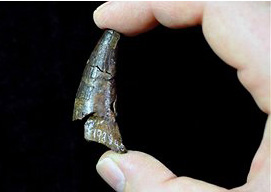
Evidence of a freshwater reptile predator

Evidence of a freshwater reptile predator.

Picture credit: Museum Victoria

Establishing the Evidence

Thus began the long, painstaking process to establish a body of evidence to suggest that this was a freshwater pliosaur tooth.  The matrix from which the tooth was extracted was examined, other fossils found in the location were studied and an examination of the palaeo-environment undertaken.  The research team have concluded that the tooth was from a five-metre-long pliosaur, a predator that used to live in the waterways that once criss-crossed this part of Australia.

Scientists had found evidence of a smaller, plesiosaur, a long-necked plesiosaur living in the same ancient river system. This is the first evidence of a large pliosaur sharing rivers with another member of the Plesiosauria.

An Illustration showing Types of Plesiosaur in a Freshwater Environment
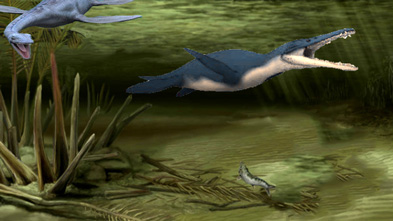
Marine reptiles, now a contradiction!

Marine reptiles, now a contradiction!

Picture credit: Everything Dinosaur/M. Witton/Lyme Regis

Marine Reptiles – A Contradiction

The picture above is a composite made by Everything Dinosaur team members based on an image of a Pliosaur produced by renowned artist Mark Witton and the image of a plesiosaur from Lyme Regis museum.  The picture shows a scene in the freshwater environment of Cretaceous Australia where plesiosaurs and pliosaurs shared the same eco-system.

Commenting upon the differences between short-necked plesiosaurs and long-necked plesiosaurs, Dr Fitzgerald stated:

“The Plesiosauria include all those sea-going reptiles from the age of dinosaurs that have these very long snake-like necks and they’ve often been used as a model for the mythological Loch Ness Monster.  The pliosaur is a shorter-necked, much more robust and crocodile-headed relative of those long-necked plesiosaurs.”

The palaeontologist confirmed that the plesiosaur had much smaller teeth which revealed information about the diet of the now extinct species.

“What we can tell from studying the teeth of these river reptiles is that the smaller species was feeding on relatively small prey.  If you have smaller, finer, needle-like teeth, you’re much more likely to be using your teeth as a fishtrap to catch small fish.”

Feeding on Much Larger Animals

However, the much larger teeth of the pliosaur indicate that it was feeding on much larger animals, perhaps bigger types of fish, the plesiosaurs themselves, crocodiles or even small dinosaurs as they came down to the riverbank to get a drink.

A Close up of the Pliosaur Tooth Showing the Fine Ridges
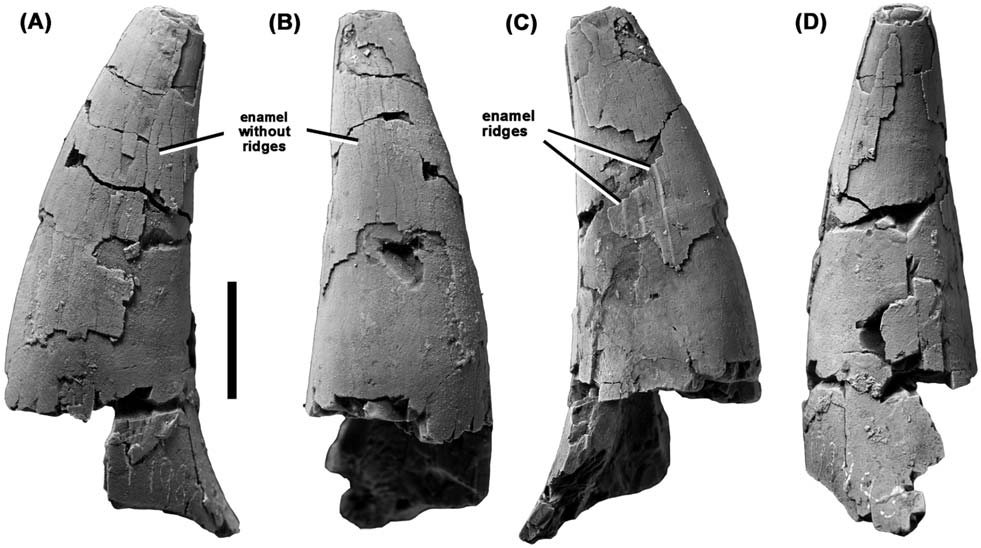
Shown at high magnification and from different angles the fine ridges can be made out.

Shown at high magnification and from different angles the fine ridges can be made out.

Picture credit: Museum Victoria/M. Benson

This is the first evidence to suggest that two Plesiosauria lived inland together at the same time, in the same river system. Recently, a team of scientists studying a Late Cretaceous mosasaur fossil found in Hungary have concluded that mosasaurs too, had members of their group that also lived in freshwater.

To read more about the mosasaur research: Freshwater Mosasaur from a Hungarian Bauxite Mine.

It seems that the term marine reptiles, when applied to the Plesiosauria and even the mosasaurs may not be technically accurate anymore.
26 07, 2013

Ichthyovenator “Fish Hunter” New for 2014 from CollectA

By |2023-02-20T07:38:47+00:00July 26th, 2013|Categories: Dinosaur Fans, Everything Dinosaur News and Updates, Press Releases|8 Comments

Putting Laos on the Palaeontology Map with Ichthyovenator

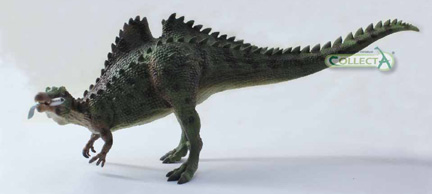
CollectA have announced the third of their new prehistoric animal models for 2014 and fans of the spinosaurs are not going to be disappointed.   The company is committed to producing models of more unusual theropods and the planned introduction of Ichthyovenator (I. laosensis) in 2014 will certainly cement CollectA as  being a pioneering dinosaur model maker as this dinosaur was only formally named and described in 2012.

Ichthyovenator Model

New for 2014 Ichthyovenator Model from CollectA

"Fish Hunter" from Laos

“Fish Hunter” from Laos.

Picture credit: CollectA/Everything Dinosaur

This dinosaur is known from fragmentary remains that were discovered in Laos in 2010.  Fossil bones include vertebrae, a partial rib, plus elements of the hip area.  All the fossil material represents post cranial material, no skull fossils were found.  The striking thing about this basal spinosaurid, currently assigned to the Baryonchidae is that it may have had two sails, running down its spine.  One sail seems to conclude at the first sacral vertebrae (back bones above the hip), the second starting from the second sacral vertebrae.

Due for Release in 2014

CollectA have depicted this feature in their new Ichthyovenator model, due for release in 2014, the skull is modelled on Suchomimus as is the dentition.  The dermal scutes and crocodilian appearance of the tail, the proportions of the limb bones are speculative, once again based on better known members of the spinosaurid group.

Although the fossil material represents less than 15% of the entire skeleton, when the specimen was discovered in 2010 it represented the most complete spinosaur specimen yet to be found in Asia.   The strata from which the fossils were excavated dates from the Aptian faunal stage of the Cretaceous (125 million to 112 million years ago).  The spinosaurids were thus a very widely distributed group with fossil specimens having been found in Europe, South America, Africa and potentially Australia.

To read about the evidence of spinosaurids in Australia: Australia’s First Spinosaur?

Barremian Spinosaurids

Trouble is, we have evidence of Barremian spinosaurids (Baryonyx walkeri) from Europe, then we have Aptian spinosaurid fauna the likes of Suchomimus tenerensis and Ichthyovenator laosensis and then later spinosaurids such as Irritator (I. challengeri) and of course Spinosaurus itself (potentially two species), but nothing representing this group into the Late Cretaceous.  This suggests that the spinosaurid fossil assemblage is extremely fragmentary and the group as a whole is poorly known.

It is very likely that there are many other spectacular spinosaur fossils awaiting discovery.

The Ichthyovenator model measures 22 cm long approximately (measured from the tip of the jaws to the tip of the tail), although in reality the model is a little bigger as the head is slightly curved inwards ) and it stands around 8.5 cm high at its tallest point over the hips.  Palaeontologists are not sure how big Ichthovenator was, the fossil specimen may represent an immature adult or a fully grown individual.  Size estimates range from 7-9.5 metres.

To view CollectA prehistoric animal models and figures: CollectA Prehistoric World Models and Figures.

25 07, 2013

Everything Dinosaur’s Video Review of the CollectA Diabloceratops Dinosaur Model

By |2023-02-20T07:33:30+00:00July 25th, 2013|Categories: Everything Dinosaur Products, Everything Dinosaur videos, Product Reviews|0 Comments

Everything Dinosaur Reviews “Devil Horned Face”

CollectA have rapidly earned themselves a reputation for producing models of more obscure and unusual dinosaurs. Amongst the many replicas of ceratopsians within the company’s range, a model of the horned dinosaur known as Diabloceratops (D.eatoni) has just been added.

CollectA Diabloceratops Dinosaur Model

Everything Dinosaur team members have produced a short (4.49) video review of this dinosaur model.  In the video we review the model, comment on the vivid colouration of the neck shield and remark on the appearance of the jugal processes (flared out bone from the cheeks).

Everything Dinosaur’s Video Review of Diabloceratops

Video credit: Everything Dinosaur

Diabloceratops (Centrosaurinae)

Diabloceratops has been classified as a basal member of the centrosaurine clade of horned dinosaurs.  Its discovery highlights the great diversity of horned dinosaurs that roamed western North America during the Late Cretaceous.  This is a super model of a horned dinosaur and CollectA are to be congratulated for creating replicas of some of the lesser known members of the Dinosauria.

To view the large range of horned dinosaur figure includind centrosaurines and chasmosaurine models in the CollectA Prehistoric Life model range: CollectA Prehistoric Life/CollectA Prehistoric World Models.

24 07, 2013

The Fascinating Tale of a Hadrosaur’s Tail

By |2024-03-17T12:03:25+00:00July 24th, 2013|Categories: Dinosaur and Prehistoric Animal News Stories, Dinosaur Fans|0 Comments

Researchers Uncover the Articulated Caudal Vertebrae of  a Lambeosaurine Hadrosaur

A team of palaeontologists and researchers from the National Autonomous University of Mexico (UNAM) and the National Institute of Anthropology and History (INAH), also of Mexico, have a tale to tell as they have just finished uncovering the tail bones of an enormous, Late Cretaceous duck-billed dinosaur.

Hadrosaur fossils have been found before in Mexico, but what makes this discovery so fascinating is that the fifty or so caudal vertebrae are articulated – positioned in relation to each other as they would have been when the dinosaur roamed.

Hadrosaur Tail

The fossilised tail has been dated to the Maastrichtian faunal stage* of the Late Cretaceous, the strata in the area is approximately 72 million years old and although the genus and species has not yet been determined, the palaeontologists are certain that their dinosaur was a sizeable beast, after all, the tail itself is more than five metres in length.  It is likely that the dinosaur would have measured something in the region of twelve metres in total.  The fossil comes from the Coahuila desert region of Ejido Guadalupe Alamitos municipality of General Cepeda.

* Further analysis led to a revision with the fossil material associated with the upper Campanian.

The duck-billed dinosaur fossil was spotted by José López and Rodolfo Espinoza, in early May 2005.   However, it was only reported to the National Institute of Anthropology and History last month and after a quick, preliminary inspection a field team was despatched to excavate the specimen.  Digging started on July 2nd and the field team thought that they were dealing with just a few vertebrae, but after twenty days, the almost complete tail had been revealed.

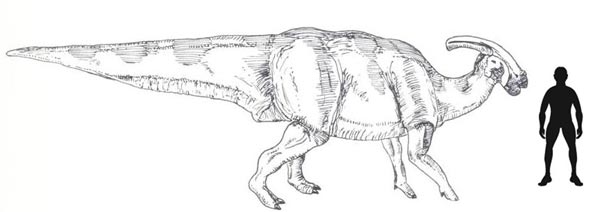
Other elements from the skeleton have also been found including bones from the hip area, these in conjunction with the caudal vertebrae, have led scientists to suggest that this is a fossil of a lambeosaurine hadrosaur.  It is likely that this dinosaur sported a crest on its head, perhaps it was similar to a Parasaurolophus.

An Illustration of the Lambeosaurine Hadrosaur Parasaurolophus walkeri

A crested, duck-billed dinosaur.

Picture credit: Everything Dinosaur

First Fully Articulated Dinosaur Tail Discovered in Mexico

This is the first fully articulated dinosaur tail found in Mexico and is one of the few complete articulated dinosaur tails that have ever been found in the world.  The researchers are optimistic that they will  find the rest of the dinosaur in the rock beneath the site where the tail was found.

Back in 2008, team members at Everything Dinosaur reported on the discovery of Mexico’s first unique dinosaur, another Lambeosaurine Hadrosaur that was named Velafrons coahuilensis.  This specimen was the first example of a significant dinosaur fossil in Mexico that did not reflect other specimens found in the southern United States.

To read about this discovery: Viva Mexico! Lambeosaurine Dinosaur Discovery.

More recently, the discovery of a horned dinosaur was announced.  To read an article about a ceratopsian from Mexico: Giant Horned Dinosaur from Mexico.

A Special Find

A spokesperson from Everything Dinosaur commented:

“This is a really special fossil find.  With the tail bones in such an alignment palaeontologists can understand more about how the tail actually functioned, the specimen is so well-preserved that the space where cartilage was distributed between the actual bones can be identified.  This will help scientists to understand more about the biomechanical properties of the tail.”

Commenting on the field work, palaeontologist Angel Ramirez Velasco, one of the team members on the project stated:

“This finding is important for the biological study of  dinosaurs, we will have a sequence that will reveal the characteristics of the vertebrae.  They will be seen differentiating in size depending on their position in the spine.”

The hefty specimen will be removed from the field location in sections, to avoid as much damage as possible.  The pieces will then be put back together again in a special laboratory.  After further cleaning and study, it is hoped that this amazing fossil will be put on general display so that members of the public can marvel at the tail-end of a Late Cretaceous herbivore, that once roamed Mexico.

For models and replicas of Late Cretaceous lambeosaurines and other dinosaurs: PNSO Age of Dinosaurs Models and Figures.

23 07, 2013

Walking with Cavemen and Swimming with Sharks at the Beacon Museum

By |2023-02-20T07:28:15+00:00July 23rd, 2013|Categories: Press Releases|0 Comments

Everything Dinosaur Prepares to Help Out at Museum Exhibitions

Team members from Everything Dinosaur will be on hand to guide visitors through the Beacon Museum’s two exciting summer exhibitions when they make special guest appearances, the first of which is taking place on the weekend of the 3rd and 4th of August.

The Beacon Museum

Visitors to the Beacon Museum can come face-to-face with life size replicas of giant prehistoric beasts from the Ice Age as well as learn all about amazing creatures from the deep as the Copeland museum hosts “Ice Age – Life after Dinosaurs” and “Shark! Myths and Reality”.

Staff from Everything Dinosaur will explain how the Sabre-Toothed Tiger got its misleading name and what to do if attacked by a Woolly Rhinoceros.  Providing an insightful Ice Age survival guide as well as pointing out just how closely related to Neanderthals some of the residents of Whitehaven might actually be.

Sharks are an ancient group with a fossil record stretching back over 420 million years and Everything Dinosaur team members will explain some of the similarities between sharks and “land-sharks” otherwise known as dinosaurs.

For models and replicas of prehistoric sharks and other ancient creatures: PNSO Age of Dinosaurs Figures.

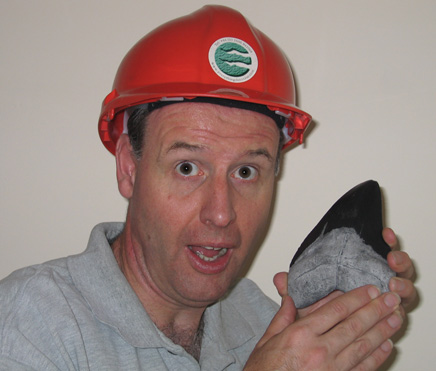
Despite the fearsome reputation of giant shark predators such as the enormous Megalodon, whose jaws were so big it could have swallowed a Great White shark whole, Everything Dinosaur will also be introducing museum visitors to some of the other super-sized predators that once terrorised the seas.

Everything Dinosaur Team Member Mike Walley with a Megalodon Tooth

Something fishy going on at the Beacon Museum

Something fishy going on at the Beacon Museum.

Picture credit: Everything Dinosaur

Everything Dinosaur

Team members from Everything Dinosaur will be special guests at the Beacon Museum over the weekends of 3rd/4th August and October 26th/27th, visitors to the museum will be able to handle fossils, pose questions and participate in various activities as Everything Dinosaur staff explore over 400 million years of Earth’s history.

Contact Everything Dinosaur team members for information about prehistoric animals: Contact Everything Dinosaur.

22 07, 2013

New Prehistoric Times Issue 106 Reviewed

By |2024-01-01T17:27:46+00:00July 22nd, 2013|Categories: Magazine Reviews, Prehistoric Times|1 Comment

A Review of the Summer 2013 Edition of Prehistoric Times Magazine

The first prolonged period of hot, summer weather in the UK for quite a while has been made all the more enjoyable with the arrival of the latest edition of “Prehistoric Times”, the magazine for dinosaur model fans and prehistoric animal enthusiasts.  It is ideal reading material for sitting outside the office and soaking up some sunshine, if only the other Everything Dinosaur team members would let go of the magazine for long enough.

“Prehistoric Times”

This issue (number 106), marks the first copy to be produced after the twentieth anniversary issue and it sets the standard for the next two decades with some excellent articles and features.  The two prehistoric animals given most prominence are Tyrannosaurus rex and the “T. rex” of its day the fearsome Triassic predator Postosuchus.  We expect that Mike Fredericks, the editor would have been swamped with artwork and indeed, lots of reader’s illustrations are featured, especially of T. rex.  There are some wonderful depictions, even feathered versions of T. rex.

How to Draw Dinosaurs

Tracy Lee Ford’s excellent series, “How to Draw Dinosaurs” focuses on this apex predator.  He compares the arm bones of Tyrannosaurus rex with those of other Tyrannosaurids and sets about building up a picture of a powerful predator with exceptionally strong hind legs, a deeper body and a more massive tail.  He concludes that such a dinosaur was not a particularly fast runner, but still an immensely capable and powerful opportunistic hunter.

Amongst all the collector news and model releases, there is a special tribute to Ray Harryhausen, whose stop motion special effects amazed us all in such fantastic films as  “Jason and the Argonauts”, “The Valley of the Gwangi” and “Clash of the Titans”.  Ray sadly passed away on May 7th, William Stout has produced a super article with artwork in tribute to Ray and there is a model diorama of the monster from the 1953 film “The Beast from 20,000 Fathoms”, it looks like lighthouses were not monster proof!

Front Cover Artwork

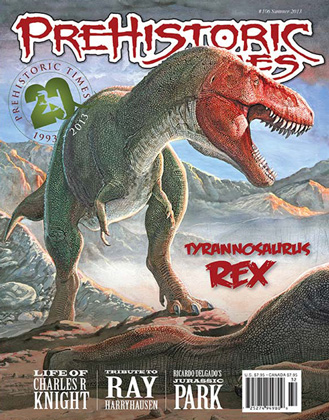
The front cover artwork (featuring T. rex), was created by up and coming Ukrainian artist Sergey Krasovskiy.  Sergey has chosen to depict this fearsome Late Cretaceous carnivore with a conspicuous red head ala theories from Bob Bakker et al.  Sergey also contributes to the feature on Postosuchus with some great drawings of Prestosuchus chiniquensis, Ornithosuchus longidens and Postosuchus kirkpatricki.

The Front Cover of Prehistoric Times – Summer 2013

Marking the 20th anniversary of the magazine.

Marking the 20th anniversary of the magazine.

Picture credit: Prehistoric Times/Everything Dinosaur

Life-size Prehistoric Animal Models

There are also articles on the life-sized prehistoric animal models sculpted by Josef Pallenberg, updates on dinosaur discoveries and a special interview with artist Ricardo Delgado, part of a series the commemorates twenty years since the first Jurassic Park movie.  Team members at Everything Dinosaur even spotted some prehistoric animal drawings that we know very well in this edition and it was particularly interesting to see how clever Steven B. DeMarco “made over” three dinosaur model kits which were manufactured by Pyro many moons ago.

Once again, a great magazine and a great read.

To view the “Prehistoric Times” website: Prehistoric Times.

21 07, 2013

Preparing an “Everything Dinosaur” Signature

By |2023-02-19T07:36:53+00:00July 21st, 2013|Categories: Adobe CS5|0 Comments

Icon Required for Everything Dinosaur Signature Image

Team members at Everything Dinosaur were asked to produce a signature image the other day, something that would be instantly recognisable as to what we do and what we represent.  Fortunately, we are getting a little better at managing Photoshop and we have built up a very large database of images to choose from.

Everything Dinosaur

A number of ideas were put forward, all of them featuring dinosaurs with members of our small team.  From this list, three templates were moved on from the “drawing board” stage and we began to work on them using Photoshop.  Once these three had been prepared as “psd” documents, no mean feat, and a task that took one of our team members a couple of hours to complete, a vote was taken as to which one we should use as a signature.

The Winning Image/Signature

Presenting an image to the world.

Presenting an image to the world.

Picture credit: Everything Dinosaur

Tyrannosaurus rex Image Chosen

The image had to feature a dinosaur and we chose Tyrannosaurus rex.  T. rex has come out as number one every year in our annual poll of the most popular prehistoric animals, so it was quite an easy choice.  Our logo and website had to be included and after this it was simply a case of creating the right sized logo and combining all the elements together.  Once we were happy, the image/signature was converted to jpg format and it could go live.

Then it was simply a question of putting the link code into the signature so that it could direct visitors to the appropriate part of our web presence and that was that.  Not to sure about the toothy grin though [not referring to the T. rex either].

To view the range of prehistoric animal gifts and toys available from Everything Dinosaur: Everything Dinosaur.

20 07, 2013

Everything Dinosaur’s Video Review of CollectA’s Przewalski’s Horse

By |2023-02-19T07:35:16+00:00July 20th, 2013|Categories: Everything Dinosaur videos, Product Reviews|1 Comment

Przewalski’s Horse Model by CollectA Reviewed

With the addition of a model of Przewalski’s horse into the CollectA horse model series, team members at Everything Dinosaur decided to add this replica to the company’s model range.  Przewalski’s horse, otherwise known as the Mongolian wild horse, is the only truly wild horse left on the planet.  As it has remained unchanged since the Pleistocene Epoch and as it would have been known to our European ancestors, it was decided to add this excellent model to our stock.

Przewalski’s Horse

Below is a short, (under five minutes), review of the CollectA model:

Everything Dinosaur Reviews CollectA’s Przewalski’s Horse Model

Video credit: Everything Dinosaur

In this video, we explain a little about the model and how it accurately depicts the live animal.  We also discuss the successful conservation programme that saw this horse brought back from the brink of extinction.

To view Everything Dinosaur’s range of CollectA models: CollectA Prehistoric Life Models.

19 07, 2013

New for 2014 CollectA Dead Stegosaurus Model

By |2023-02-19T07:33:01+00:00July 19th, 2013|Categories: Dinosaur Fans, Everything Dinosaur News and Updates, Everything Dinosaur Products|7 Comments

CollectA Provide Further Information about 2014 Product Releases

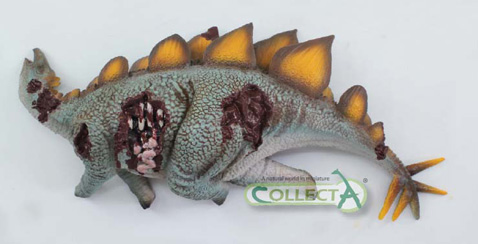
Following on from the news about the Deluxe Carcharodontosaurus figure due to be made by CollectA next year, the manufacturer has announced today details of another new release.  CollectA are going to introduce in 2014 a model of a dead Stegosaurus, it looks like “roof lizard” has ended up as a meal for another dinosaur.

Dead Stegosaurus Model

New for 2014 the CollectA Stegosaurus Corpse

Dinner for an Allosaurus?

Dinner for an Allosaurus?

Picture credit: Everything Dinosaur

In a statement a spokesperson from CollectA added:

“Life was not a bed of roses back then and at least this is what might have happened all those years back.  We have had discussions if we should have another corpse but looking at the success of our first model -the Triceratops corpse- we wanted to give it a try.”

Stegosaurus Corpse

The dead Stegosaurus model depicted is typical of a specimen from the western United States.  This type of stegosaur shared its Late Jurassic environment with a number of predatory dinosaurs, animals such as (in order of size, smallest to largest), Marshosaurus, Ceratosaurus, Allosaurus and Saurophaganax to name but a few.

Team members at Everything Dinosaur could discuss which type of carnivore might have done this damage to the adult Stegosaurus.  The ideal that this is scavenging on a carcase can be discounted due to the bite mark on one of the plates along the back.  A predator would not necessarily bite such a part of a stegosaur’s anatomy with all that meat available elsewhere on the body.  That particular aspect of the pathology shown is indicative of having occurred during a fight, it looks like a bite from above, typical of a large, bipedal theropod.

When asked why a Stegosaurus corpse, the spokesperson from CollectA replied:

“Due to its distinctive tail spikes and plates, Stegosaurus is one of the most recognisable dinosaurs.”

Stegosaur Pathology

One other item of interest when it comes to the pathology (wounds).  Note the wounds in the throat area.  The gashes and bite marks are to the side and not from the underneath of the throat area.  This part of a stegosaur’s body (underside of the throat), was protected by a mass of little bony ossicles, a bit like chain mail found on a suit of armour.

These bony ossicles would have protected this dinosaur as it fed on spiky cycads and other tough vegetation as well as affording a degree of protection from predator attack.  Apparently, this protection combined with this dinosaur’s vicious tail (called a Thagomizer) was not sufficient to help this unfortunate victim.

To read how the Stegosaurus tail was named: The Tale of the Stegosaurus Tail.

This model measures approximately 16.5 cm in length and team members at Everything Dinosaur are already “swishing their Thagomizers in excitement” as they await to hear news of more models to be made by our chums CollectA.

To view Everything Dinosaur’s current range of CollectA prehistoric animal models: CollectA Prehistoric Life Models and Figures.

18 07, 2013

“Large Nose, Horn Face” Nasutoceratops a New Dinosaur is Named

By |2024-04-29T10:54:39+01:00July 18th, 2013|Categories: Dinosaur and Prehistoric Animal News Stories|1 Comment

New Campanian Centrosaurine Dinosaur – Nasutoceratops titusi

A research paper detailing the work on a new type of horned dinosaur discovered in the fossil rich Kaiparowits Formation of the Grand Staircase-Escalante National Monument (southern Utah), has just been published in the academic journal Proceedings of the Royal Society B (Biology).  The fossilised bones of this remarkable looking dinosaur were found back in 2006, the fossils include a nearly complete skull, plus elements from the neck and front limb bones.  Although the scientists cannot be sure that this is a fully mature individual, it is still a sizeable beast, perhaps weighing as much as three tonnes and measuring nearly six metres in length.

Horned Dinosaur

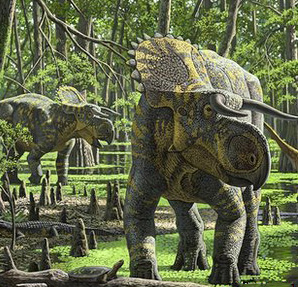
An Illustration of Nasutoceratops titusi

Nasutoceratops - a Centrosaurine dinosaur from Utah

Nasutoceratops – a Centrosaurine dinosaur from Utah.

Picture credit: Raul Martin 

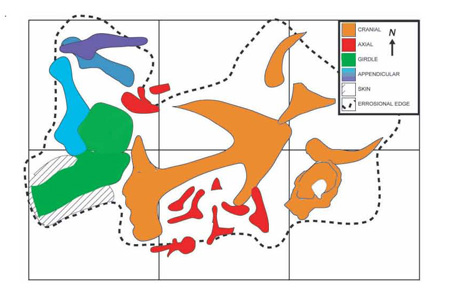
A Grid Diagram Showing the Layout of the Fossil Bones

Nasutoceratops in situ

Nasutoceratops in situ

Picture credit: Eric Lund et al

The picture shows the approximate layout of the fossil material in the ground, each square on the diagram represents one square metre.  The skull material including the large brow horns are coloured orange, axial material (related to the neck) is in red, elements from the shoulder girdle are coloured green and front limbs blue/purple.

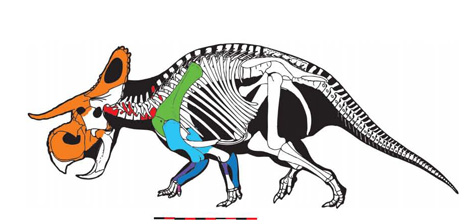
A Reconstruction of the N. titusi Skeleton

Scale bar = 1 metre

Scale bar = 1 metre

Picture Credit: Eric Lund et al

The diagram above shows how the fossil material found would fit into a reconstruction of the complete skeleton of this plant-eating dinosaur.

Nasutuceratops titusi

The dinosaur’s name means “large nosed horned face” after the Latin nasutus (large nosed) and the Latinised/Greek ceratops (horn face).  The species name “titusi” honours Alan Titus, a palaeontologist who is renowned for his work on fossils from the Grand Staircase-Escalante National Monument.

A phylogenetic analysis of the Centrosaurinae group places Nasutoceratops as the sister taxon to Avaceratops lammersi from the Late Campanian of Montana.  Nasutuceratops titusi has been designated as a basal member of the Centrosaurinae and suggests the existence of a previously unknown clade of short-snouted, long-horned centrosaurines in the southern portion of the North American landmass known as Laramidia.

Dr Mark Loewen (University of Utah and the Natural History Museum of Utah), one of the authors of the new paper published this week commented:

“This dinosaur just completely blew us away.  We would never have predicted it would look like this, it is just so outside of the norm for this group of dinosaurs [centrosaurine].

A Member of the Centrosaurinae

Centrosaurines tend to have short brow horns with the largest horn being on the snout, but this description is rapidly becoming redundant.  The discovery of N. titusi with its large, curved brow horns and very broad snout challenges a lot of the assumptions palaeontologists had about the appearance of these horned dinosaurs.

When asked to comment about the large number of horned dinosaur discoveries made recently in the western United States a spokesperson from Everything Dinosaur stated:

“There have been a number of new centrosaurine and chasmosaurine dinosaurs named recently, what is perhaps more remarkable is that many of these horned dinosaur remains have been found in close proximity to the fossilised bones of other types of large, herbivorous dinosaur.  For instance, the fossils of N. titusi were found in close association with hadrosaur as well as ankylosaur material.  This suggests that back in the Late Cretaceous Utah was a very fertile and verdant environment capable of supporting a very diverse range of large plant-eating dinosaurs.”

Campanian Faunal Stage

The fossils have been dated as being between 75.9 and 75.2 million years old (Campanian faunal stage).  A number of other types of horned dinosaur have recently been discovered in strata that make up the Grand Staircase-Escalante National Monument, including two bizarre horned dinosaurs that belong to the Chasmosaurinae.  To read about this discovery: Curious Ceratopsians.

The discovery of Nasutoceratops also provides strong support for the hypothesis of regional dinosaurs in this part of the world during the Late Cretaceous.  It seems that dinosaur populations became isolated in what was to become western North America and a number of independent but related populations subsequently evolved.  Palaeontologists have suggested that there was a high degree of  provinciality in Late Campanian mega faunas.

For articulated models of ceratopsians and other dinosaurs: Beasts of the Mesozoic Models and Figures.

Go to Top