All about dinosaurs, fossils and prehistoric animals by Everything Dinosaur team members.

Everything Dinosaur team members working in schools, helping museums and other educational bodies. Our work with and in schools.

27 04, 2013

Very Creative and Imaginative Use of a Windowsill in a Classroom

By |2023-02-15T21:03:52+00:00April 27th, 2013|Categories: Educational Activities, Everything Dinosaur Products, Teaching|0 Comments

Dinosaur Scene Brightens up Classroom

It is important for teachers to create the right learning environment in a classroom.  The walls and cupboards are adorned with examples of the children’s drawings and posters, relating to the topics covered in the teacher’s scheme of work for the term.  Space is often at a premium and for one enterprising teacher the “dead space” of a windowsill in their classroom provided the perfect opportunity to create an imaginative prehistoric scene to inspire pupils.

Dinosaur Models

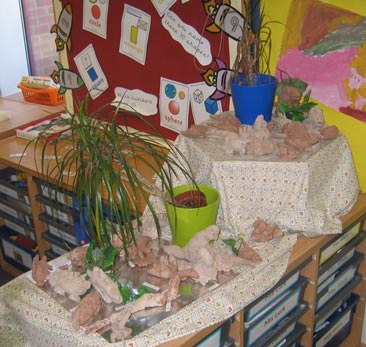
Mr Simon Riggs, took up the challenge of utilising a ledge next to a long window high up on one of the walls of his classroom. Turning the few square feet that was available into an attractive dinosaur diorama featuring the likes of a bellowing Styracosaurus, a meat-eating dinosaur feeding on a dead Triceratops and a pterosaur flying overhead surveying the scene below.

It looks as if the school children have got their own Jurassic Park to help inspire them when it comes to science topics, design and technology (DT) and creative writing.

The Classroom with its Own Jurassic Park!

A very clever and creative use of space in a classroom.

A very clever and creative use of space in a classroom.

The bellowing Styracosaurus can be seen in the foreground, it is looking out onto an array of dinosaur models including a Brachiosaurus, a Plateosaurus and several theropod dinosaurs.  Mr Riggs, skilfully modelled the trees using twigs with mosses and lichens providing the foliage for the herbivorous dinosaurs to feed on.  A pterosaur (flying reptile – Tapejara) is flying overhead, secured to the ceiling by a thin line.

The Pterosaur Flying Over the Dinosaur Diorama
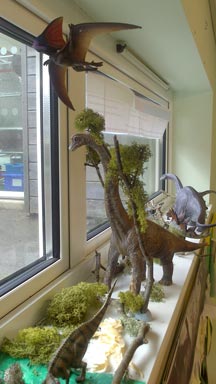
The Pterosaur was attached to the ceiling by a thin line.

The pterosaur was attached to the ceiling by a thin line.

A Wonderful and Imaginative Dinosaur Scene

Mr Riggs, teacher of class 5B has created a wonderful, imaginative dinosaur scene, one that we are sure will inspire his pupils.  He commented:

“Following my purchase from Everything Dinosaur about a month ago, for which I am building a diorama for a ‘dead’ windowsill in my classroom, you asked me to send you some photos.  So here it is. I still need to get some ‘ground’ down on half of it – but with my current distractions – it may not happen for some time!  Cheers for all of your help.”

We do appreciate just how busy teachers and their support staff are at this time of year.  The summer term is a short term and there is so much to do, but we are grateful to Mr Riggs, for taking time out of his busy schedule to send us some pictures of his handiwork.

A Creative use of Limited Space in a Classroom

Inspiring the next generation of scientists and model makers.

Inspiring the next generation of scientists and model makers.

A spokesperson from Everything Dinosaur added:

“What a super way to use a bit of “dead space” in the classroom.  My colleagues and I were all very impressed.  The teacher has created a fascinating model scene, one that I am sure will inspire the pupils, it always amazes me how creative and clever our customers are.”

Our congratulations to Mr Riggs and our thanks to him for sending in some pictures of how prehistoric animal models can be used in such an innovative and enterprising way to brighten up a classroom.

To view the wide range of prehistoric animal models available from Everything Dinosaur: Dinosaur and Prehistoric Animal Models.
18 04, 2013

Coelacanth Gets Its Genome Unravelled

By |2023-02-15T18:16:06+00:00April 18th, 2013|Categories: Animal News Stories, Dinosaur and Prehistoric Animal News Stories, Educational Activities, Teaching|0 Comments

Genome Analysis Shows that the Coelacanth May Not be Too Closely Related to Tetrapods

The genome of one of the most bizarre and enigmatic of all the vertebrates known to science, the coelacanth, has been decoded revealing how this animal may have remained virtually unchanged as a species for millions of years.  The data collected is also helping marine biologists and palaeontologists to understand how closely related the coelacanth group may be to the first land living animals with backbones.

Termed a “living fossil” by many lay people, two extant species are known, one from the waters around Indonesia and a second from the Indian Ocean.  The coelacanth is a member of the actinistian group of fishes, the first of these fleshy-finned fish with their distinctive tails with three lobes probably evolved in the Devonian geological period.  The last of the coelacanths were believed to have become extinct at the end of the Cretaceous period, that is until one was caught by a trawler fishing off the eastern coast of South Africa in 1938.

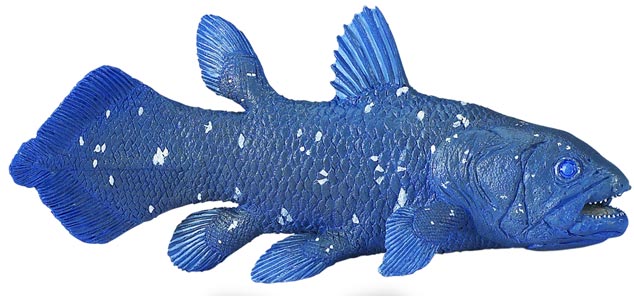
A Coelacanth Model

Ancient fish model – coelacanth.

Occasionally, specimens of these deep-water fish are caught, although marine biologists have expressed concern about the fate of this strange creature as overfishing and the development of industrial port facilities along the fringes of the Indian Ocean threatens their survival.

Coelacanth

With the genome having been sequenced, scientists are able to understand a little more about how this fish relates to other more advanced teleost fish and to also gain an insight into the evolution of land-living vertebrates, a significant moment in evolution of life on Earth as this led ultimately to the evolution of amphibians, reptiles, birds, mammals and of course, our own species.

The international team of researchers including some from the Broad Institute of the MIT (Harvard, USA), from the Uppsala University (Sweden) and Washington University (United States) were able to sequence and analyse the near 3 billion protein letter combinations from the DNA of the coelacanth as well as examining the RNA from both the African and the Indonesian species.  They then compared this data to the genomes of twenty other species of vertebrate as well as with typical representatives of the lungfish family.  The lungfish comparison would hopefully shed light on the evolutionary origins of tetrapods – were they more closely related to actinistians (coelacanths) or dipnoans (lungfishes)?

Published in the Journal “Nature”

This study, published in the academic journal “Nature” suggests that the lungfish has more genes in common with tetrapods than the coelacanth. It can be inferred from these results that the actinistians, assuming extant coelacanths are representative of this group, are not that closely related to the first animals that dragged themselves up onto the land.

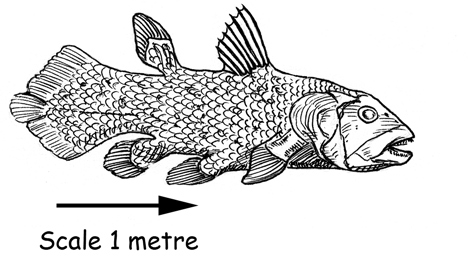
An Illustration of the Coelacanth (Latimeria genus)
Genome of the Coelacanth is Decoded.

Picture credit: Everything Dinosaur

Coelacanth Genome

The genome of the coelacanth is also providing scientists with additional data on how gene sequences may change over time.    The study suggests that some genes may evolve very slowly, this in part would help explain this prehistoric fish’s appearance, it having remained virtually unchanged for millions of years.  Such a stable gene assembly may be attributed to the coelacanth’s habitat and lifestyle.  It lives in relatively deep offshore waters, usually at depths of more than 300 metres.  It may live in sea caves, and it is largely nocturnal moving little during the day and then hunting at night.  The very uniform environment and an absence of other fish species competing for this particular niche in the offshore ecosystem may explain why the coelacanth has had little need to change and evolve over vast periods of time.

The international team of scientists admit there is much more to learn about the transition of vertebrates from water onto the land.  However, the lungfish genome represents more of a challenge than that of the coelacanth.  Although collecting specimens of lungfish is easier, after all, extant lungfish are all freshwater fishes, making them theoretically easier to collect, the lungfish genome is much larger, estimated to exceed 100 billion letters (C G A T), in length.  The more modestly sized genome of the extant coelacanth is permitting scientists to study changes that may have helped the first tetrapods to adapt to a terrestrial habitat.  Comparisons with tetrapods had led the researchers to isolate chains of genes that regulate and control other portions of the sequence, these studied in conjunction with an analysis of what genes are present in the coelacanth but absent in tetrapods has enabled some startling insights to be made.

Identifyin Differences Between the Coelacanth and Tetrapods

A number of immune-related regulatory differences have been identified between coelacanths and land-living animals.  The scientists have postulated that these changes reflect adaptations as a result to new pathogens the first tetrapods encountered as semi-aquatic vertebrates.  Other differences in the genomes provide clues to sensory development, senses such as a lateral line in a fish is not much use to a creature that lives on land.  Genes involved in smell perception and detecting airborne odours have been identified as a result of this research.

Similarities in genetic material have also been found between the marine coelacanth and animals that live entirely on land.  the HoxD strand of genetic material is common between coelacanths and tetrapods.  It is likely that this particular strand of genetic material was a prerequisite to enable the first land animals to develop hands and feet, to assist with locomotion, but as tetrapods evolved and became more specialised, this region of genetic material played a role in the evolution of our own dexterous, tool wielding hands.

Coelacanth Model

Safari Ltd have produced a model of a coelacanth, it forms part of the company’s Wild Safari Dinos & Prehistoric Life model series.  The model measures fifteen centimetres in length approximately and is a fine example of a replica of a lobe-finned fish.  Not only has this model been popular with collectors but it has also proved to be very useful for schools and home educators who have used this model in teaching topics on evolution and life on Earth.

A Useful Teaching Aid – Coelacanth Model
Ancient fish model - Coelacanth

To view the range of prehistoric animal figures: Safari Ltd. Models of Prehistoric Creatures.

One of the more unusual puzzles concerning the move to a terrestrial existence was the way in which waste products from the body were excreted.  Fish excrete ammonia into the water, this gets rid of waste nitrogen.  Land animals evolved a method of converting ammonia into the less toxic urea – the urea cycle, whereby ammonia is converted to the more inert urea, or uric acid.  If ammonia is allowed to build up in cells it will prove toxic to the cell, the researchers found that the most important gene involved in the regulation and control of urea or uric acid production had been modified and was present in tetrapods.

Commenting on the study, Chris Amemiya (Professor at the University of Washington), stated:

“This is just the beginning of many analyses on what the coelacanth can teach us about the emergence of land vertebrates, including humans, and, combined with modern empirical approaches, can lend insights into the mechanisms that have contributed to major evolutionary innovations.”

An International Research Project

This research project brought together a number of institutes and universities, it was a truly international effort, and it is hoped that the publishing of the genome will help to raise the profile of conservation efforts to help ensure the survival of the coelacanth.  A second team of scientists, a joint expedition from the South African Institute for Aquatic Biodiversity and the French National Museum of Natural History set out earlier this month to explore the sea cave home of a population of coelacanths living in the Sodwana Bay area (off the coast of South Africa).  By studying the coelacanth in its natural habitat, the scientists hope to learn more about how these strange creatures use their fleshy fins for locomotion and how they hunt and what prey animals are their preferred food.

To read more about this expedition: Scientists Set Off in Search of the Lair of the Coelacanth.

The scientists responsible for the genome research, acknowledge the importance of their work but also recognise that there is a lot more to learn when it comes to this “living fossil”.  Future studies will help to shed further light on that very significant period in the history of life on Earth when vertebrates first moved onto land.

12 04, 2013

K-W-L Charts Helping Children to Learn About Dinosaurs

By |2023-02-15T08:11:32+00:00April 12th, 2013|Categories: Educational Activities, Teaching|0 Comments

Know – Wonder- Learn How to Kick Start a Dinosaur Teaching Topic

Dinosaurs as a term topic for primary school children is a very appealing idea.  Most children are very familiar with dinosaurs and other prehistoric animals and they have some knowledge of the subject. Indeed, teachers might find themselves with their very own dinosaur expert in the class as some children obsess on dinosaurs and express a surprising amount of knowledge about them.  Here is a simple idea to help kick start a term topic on dinosaurs, create a K-W-L chart which will help shape the subsequent scheme of work, lesson plans that result and provide a stimulus for extension activities.

Everything Dinosaur

K-W-L stands for know, wonder, learn, one of these charts can provide a teaching team with a template for a topic, it works for all kinds of teaching themes but with a subject like dinosaurs, commencing with this activity can help to draw out what the children know, what they think they know and provide a method of checking understanding at the end of the teaching scheme.

Creating a K-W-L chart could not be simpler.  Take a sheet of flip-chart paper and divide it into three columns, write at the top of each column the words “what we know”, “what we wonder” and “what we learned”.  So the flip-chart will have the first column with the title “what we know”, the second column with the title “what we wonder” and the final column entitled “what we learned”.  If you have a smartboard, then of course the free draw facility can be utilised to create an electronic version of a K-W-L chart, but sometimes it is best to use a flip-chart sheet, as this permits the chart to be pinned up on a classroom wall and makes it easy to refer to throughout the teaching topic.

K-W-L Chart

You are then ready to start, get the class together sitting them in a group so that everyone can see the flip-chart paper.  Explain what the term topic or subject for study is going to be.  The very mention of dinosaurs usually causes quite a ripple of excitement amongst the children.  Then explain that the class are going to think about what they know about dinosaurs and this will get written onto the chart that will be produced.  Brainstorm with the children, encouraging them to tell their classmates what knowledge they have of dinosaurs and prehistoric animals.

Make sure that all the children have the chance to contribute, one way of doing this is to have a minute of quiet thinking time before the children are asked to participate in the task.

The K-W-L chart helps school children to recall prior knowledge and it will enable them to state facts about prehistoric animals that they are already aware of.  If the class has a teaching assistant, they can act as the scribe allowing the teacher to concentrate on guiding the children and helping them to sort out their statements as well as ensuring the involvement of all the pupils.

Teaching About Dinosaurs

Teaching about dinosaurs at primary school level provides the teaching team with lots of potential leads into different aspects of the national curriculum’s teaching remit – maths, creative writing, drama and of course science.  However, there is a need to introduce technical subject specific technical vocabulary.  The K-W-L chart technique gives the teaching team the chance to introduce and explore technical vocabulary with the class at the beginning of a term topic.  When creating such a  chart with an exploration of all things dinosaur some of the technical vocabulary encountered can include words such as “extinct”, “fossil”, “prehistoric” and “palaeontologist”.

Some of the statements made by children as the brainstorming session continues can be turned into questions by the teacher.   Statements may be incorrect, “facts” stated by the children can be turned into questions, these go into the second column, the “what we wonder” column.  This column can often provide a rich and diverse range of questions that can be explored during the term topic.  This permits the children to challenge assumptions and existing understanding in a non-threatening way.  The teaching team can also use the “W” column as a stimulus for thinking up creative experiments and activities that will permit their charges to test their understanding.  As the term topic progresses new questions will emerge and these too can be added to the “W” column of the chart.

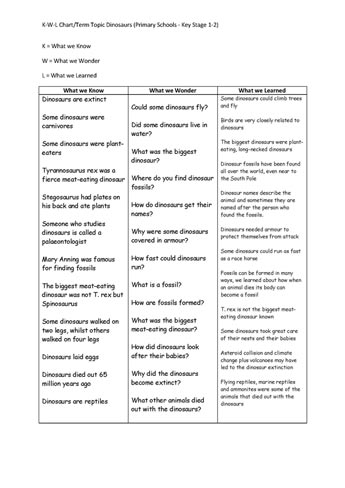
An Example of a K-W-L Chart (Term Topic Dinosaurs)

A chart to help kick-start a teaching topic about dinosaurs.

A chart to help kick-start a teaching topic about dinosaurs.

Picture credit: Everything Dinosaur

Review the K-W-L Chart

At the end of the term topic, time should be allocated by the teaching team to complete the third column of the chart, the “what we learned” section of the K-W-L.  The class can be asked to reflect on the first two columns of their chart and to  help the teacher to fill in the final part.  This permits the teacher to check learning, summarise and check understanding.  The children are demonstrating knowledge and shared learning as they complete the K-W-L flip-chart sheet.

There are of course, a number of ways in which this simple method can be varied and customised to fit a particular set of teaching circumstances.  For example, pupils can be encouraged to create their very own K-W-L chart in their topic books, all the class can be split into groups so that a number of charts can be created with each group taking ownership of their chart and the teaching team working with the entire the class to make sure the breadth and depth of the areas stated are covered in the term topic.

To view the range of toys and gifts with a prehistoric theme available from Everything Dinosaur: Dinosaur Themed Learning Activities and Toys.

K-W-L charts are an ideal way of kicking-off a term topic on the subject of dinosaurs.  Children share knowledge and are contributing to the structure of the teaching topic and scheme of work.  For the teaching team, they can quickly assess existing knowledge and use the chart as a guide for extension ideas and activities.  It also has the helpful benefit of allowing the teacher to be informed about dinosaurs and prehistoric animals, tapping into that reserve of knowledge that children passionate about all things dinosaur tend to have.

12 04, 2013

Pupils Study Dinosaurs and Create Amazing “Jurassic Park”

By |2024-04-29T06:15:23+01:00April 12th, 2013|Categories: Key Stage 1/2|Comments Off on Pupils Study Dinosaurs and Create Amazing “Jurassic Park”

Children Study Dinosaurs at School

Children at a Cheshire primary school have enjoyed studying all things dinosaur during the spring term.  So enthusiastically did the whole school embrace this term topic that the caretaker decided to help the eager, young palaeontologists create their very own dinosaur land.   Given the weather in March, it might have been more appropriate to have studied the Ice Age, but thanks to a visit from one of the experts at Everything Dinosaur, the Year 2 pupils did manage to get their hands on a selection of Woolly Mammoth teeth.

Pupils Study Dinosaurs

Working in co-operation with the teaching team, the caretaker made a number of wooden, prehistoric animal cut-outs.  Then, with the assistance of the children the cut-outs were painted and then positioned in the school’s wildlife garden.

Children Create their Own Dinosaur Display

clay dinosaur models.

Clay dinosaurs.

Picture credit: Everything Dinosaur

The Dinosaur Teaching Topic

The caretaker explained that when he heard about the dinosaur teaching topic, he thought about how he could help and decided to use some spare paint and some scrap wood to build the two-dimensional dinosaur props.  During a break in the dinosaur workshop, our fossil expert was given a tour of the school’s very own “Jurassic Park”.  The brightly coloured dinosaur cut-outs made a wonderful display and the children were keen to demonstrate what they had learned by recalling information on each of the prehistoric animals.

To view the wide range of dinosaur themed toys and gifts available from Everything Dinosaur’s user-friendly website: Dinosaur Toys and Gifts.

8 03, 2013

Celebrating International Women’s Day 2013 (A Special Event)

By |2024-04-29T13:12:20+01:00March 8th, 2013|Categories: Educational Activities, Everything Dinosaur News and Updates, Famous Figures, Teaching|0 Comments

Celebrating The Role of Women in Science

Today, Friday 8th of March is International Women’s Day, a day that is celebrated across the world, celebrating the achievements of women in business, the arts, politics and of course in the sciences. This is the one hundred and second International Women’s Day, in some countries this day is a national holiday.

International Women’s Day

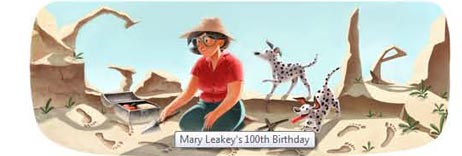
In this brief article, we celebrate the work of women, past and present in the Earth sciences.  It was very gratifying to see that last month, the Google Doodle acknowledged and celebrated the work of Mary Leakey.  Mary was an English palaeoanthropologist who with her husband Louis made significant fossil discoveries helping scientists to understand the evolution of hominids including ultimately, our own species.  Together, this husband and wife team proved that the birth place of human evolution was centred around the eastern part of Africa and that the human branch of the evolutionary family tree was much older than had been previously realised.  The Google Doodle was put on line to mark what would have been her 100th birthday.

The Leakey family are still very much involved with Earth sciences.  For example, Mary’s daughter Dr Meave Leakey, continues to study the origin of our species to this day and she is the co-leader of the world famous Koobi Fora Research Project in Kenya.

The Google Doodle Celebrating the Work of Mary Leakey

Celebrating the role of women in science.

Celebrating the role of women in science.

Picture credit: Everything Dinosaur/Google

Female Palaeontologists

In palaeontology, there are a great many female scientists, far too many to list but we pay our respects to them all and to those who championed the role of women in this particular branch of the sciences.  In 1905, Marie Stopes a palaeobotanist become the first science lecturer at Manchester University, her expertise on fossil plants earned the University a world-wide reputation for being a centre of excellence for the Earth Sciences.  Manchester University is today, the UK’s largest university and the Earth Sciences Department continues to contribute to the advancement of scientific understanding in a number of important areas.

Recently, BBC Radio 4 published a list of the top one hundred most powerful and influential women in the country.  The work of a number of notable scientists was acknowledged.  For instance, Professor Anne Glover, the first Chief Scientific Advisor to the European Commission  was included in this list. Her role is to provide expert advice to the EU policy decision makers on subject areas that include science and technology.

Top 100 Women Power List

In the past, she has also been the Chief Scientific Advisor for Scotland.  The first female Professor in the Engineering Department at the University of Cambridge, Ann Dowling also made the top 100 women of power list.  It is always pleasing to see the work of women in science and engineering recognised in this way.

Closer to home, the first woman Vice Chancellor of the University of Manchester, Professor Dame Nancy Rothwell also made the top 100.  Times have changed since Marie Stopes and her ground breaking role at the University.  A Professor of Physiology, Dame Rothwell has had a very distinguished academic career as well as helping to run a number funding and medical research bodies.

High Profile Female Scientists

Forensic anthropologist Professor Sue Black also made the list. She is the director  of the Centre for Anatomy and Human Identification at the University of Dundee.  Her extensive knowledge has proved vital in the successful prosecution of a number of high profile criminal cases in the United Kingdom.  She has also worked abroad, perhaps most notably in Kosovo where her knowledge of forensic anthropology helped to identify the victims buried in mass graves.  Professor Black and her fellow scientists have helped to promote and encourage other women to take up a career in the scientific field.

Only a few days ago, a new scientific paper was published detailing the research into 360 million year old fossilised sea-lilies (crinoids) that had revealed evidence of organic biomarkers preserved in the fossil record. One of the authors of this research paper was Christina O’ Malley, a PhD student in Earth Sciences currently based at Ohio State University (United States).

To view the article on the research into biomarkers in crinoids: New Research Identifies Organic Biomarkers in 360-million-year-old fossils.

Acknowledging the Contribution

Today we acknowledge the work of women in palaeontology, the study of vertebrates including dinosaurs and in all aspects of scientific endeavour.  It is important that we continue to enthuse and encourage girls to take up a career in the Earth Sciences.  Tomorrow, March 9th marks the 166th anniversary of the death of Mary Anning.  Mary was an amateur fossil collector who lived in Lyme Regis a town in Dorset, England, on what is now called the “Jurassic Coast”.  We will always remember Mary’s contribution to palaeontology and we are happy to talk about her work and her role in the study of long extinct creatures, her story is an inspiration to young women hoping to embark on a career in the sciences.

As team member Sue might say, take a look at Everything Dinosaur’s website: Everything Dinosaur.

7 03, 2013

Wonderful Thank You Letters from School Children

By |2024-04-29T13:10:43+01:00March 7th, 2013|Categories: Educational Activities, Teaching|0 Comments

School Pupils Say Thank you for Dinosaur Teaching Session

The Everything Dinosaur mail bag was even bigger today than normal.  The postman handed us a big envelope which contained thank you letters written to us by school pupils after a recent visit from one of our dinosaur experts to carry out some prehistoric animal themed experiments.

Thank You Letters

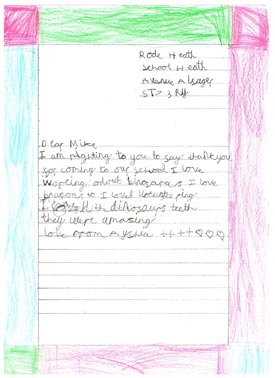
The Year two pupils (aged 6-7 years), at Rode Heath Primary School in Cheshire have been busy studying dinosaurs this term with their teacher Mrs Woollam and Miss Moss, Miss Gater and Mrs Hulse.  The children have been doing all sorts of dinosaur themed activities, we saw some amazing artwork in their classroom and we did our best to answer all the questions from the eager young palaeontologists that we met.

A Thank you Letter from Ayshia

Ayshia shows her appreciation of Everything Dinosaur.

Ayshia shows her appreciation of Everything Dinosaur.

Picture credit: Ayshia/Everything Dinosaur

Encouraging Creative Writing

By working on a thank you letter, the children can be encouraged to write creatively.  Learning and understanding can be checked along with sentence construction and writing ability.  It is always a good idea for a teacher to encourage her charges to write about any school visit and every letter that we receive at Everything Dinosaur is read by our team members.

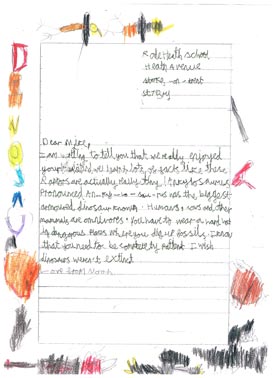
Thank you Noah.

Thank you Noah.

Picture credit: Noah/Everything Dinosaur

As a special treat, the class are going to the Great Orme, a prominent headland situated at Llandudno (North Wales).  The limestone rocks at the top of the Great Orme contain lots of fossils.  The children should be able to find fossils of brachiopods (look like clams but brachiopods are not closely related to shellfish) and fossils of ancient corals.  The fossils are very easy to find, there are lots of small rocks to examine around the man made limestone exposures and scree slopes.

North Wales in the Carboniferous

Around 330 million years ago (Carboniferous geological period), this part of North Wales was at the bottom of a shallow tropical sea.  There were extensive coral reefs and the waters teemed with life, the fossils are the ancient remains of these reefs and they are all at least 100 million years older than the vast majority of dinosaur fossils.

Thomas Thanks Everything Dinosaur for their Visit to his School

Thomas says thanks.

Thomas says thanks.

Picture credit: Thomas/Everything Dinosaur

We are sure that the children will have a great time and it is a lovely way to round off the teaching topic.

Our thanks to the teaching staff and the children at Rode Heath Primary for the lovely letters, examples of which we have reproduced below.

Thank you for your flying reptile drawing – Olivia the Oviraptor.  Good luck finding your own fossil on the school trip Amelie and we appreciate your comment about the dinosaur claws Ashton (A).  Aiden now knows that Spinosaurus was very probably bigger than T. rex and Ellie can draw super fossil bones and Hope can create a spotted dinosaur.  Aki was just brilliant wearing the hard hat and demonstrating some of the equipment that we use and we loved your letter Sam.

Dinosaur Teeth and a Fearsome Sea Monster

Emma drew us some dinosaur teeth and Sam (N) sent us a picture of a fearsome sea monster, whilst Jasmine told us she loved looking at the claws best.  Jonny (H) wrote that he was amazed when the size of the Ankylosaurus was revealed and Lucas sent us a picture of a big smiley face!  Lovely writing Codie and thank you for your red dinosaur it looks really good next to the ammonite picture that Millie kindly included in her letter to us.  James chose to put a bright red, meat-eating dinosaur on the top of his letter to us whilst Lottie sent us a picture of a purple Diplodocus feeding on some leaves.

Colourful Illustrations

We noted that the school now has a pupil called Ashtonosaurus (thanks Ashton), along with a Leilasaurus (thanks Leila).  A very colourful letter was sent in by Poem, the border was illustrated with pink and yellow and the writing was very neat – well done!

Thomas remembered what we said about dinosaurs and their teeth, whilst Noah ended his letter by wishing that dinosaurs were not extinct.  Esmee sent us pictures of three long-necked dinosaurs with her letter and we are pleased to hear that her mummy likes dinosaurs too.  Ayshia just loved learning about dinosaurs especially Dracorex and Albie sent us a bright yellow thank you letter which included a picture of a yellow, stripped dinosaur and a fact about Giganotosaurus.

Esmee says thank you.

Esmee says thank you.

Picture credit: Esmee/Everything Dinosaur

Encouraging school children to write a thank you letter after a school visit makes a great extension activity.  Once again our thanks to the pupils and teachers at Rode Heath Primary.

To view the range of dinosaur themed educational items available from Everything Dinosaur: Visit Everything Dinosaur.

1 03, 2013

Spot the Dinosaur – Wonderful Dinosaur Drawings

By |2024-04-29T10:33:39+01:00March 1st, 2013|Categories: Dinosaur and Prehistoric Animal Drawings, Dinosaur Fans, Educational Activities, Teaching|0 Comments

A Colourful Dinosaur Drawing

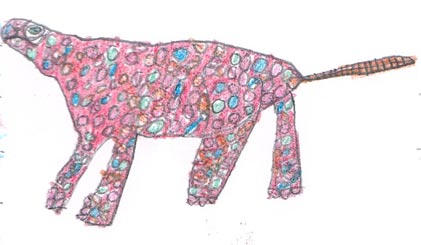
Amongst the many pictures, drawings and letters we receive each week we found a lovely picture of a spotty dinosaur that had been drawn by a Year 2 school girl (aged 6-7).  We read all the letters and emails we receive and we try our best to reply to them all.

“Spot” the Dinosaur

A spotty dinosaur.

A spotty dinosaur.

The green, blue and brown spots look like armour and from the beak and the strange tail we think that this is an interpretation of an armoured dinosaur, perhaps something like an Ankylosaurus from the Late Cretaceous  of North America.

Everything Dinosaur

Our team members love visiting schools and teaching about dinosaurs.  Each lesson plan they prepare contains experiments and activities that dovetail into the national teaching curriculum.

To view the range of dinosaur themed toys and gifts, including colouring books: Everything Dinosaur.

25 02, 2013

Primary School Children Showcase their Amazing Dinosaur Knowledge

By |2024-04-29T10:49:35+01:00February 25th, 2013|Categories: Educational Activities, Teaching|0 Comments

Blackford CE Primary School goes “Walking with Dinosaurs”

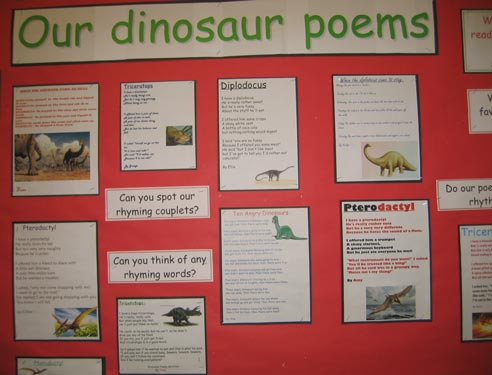
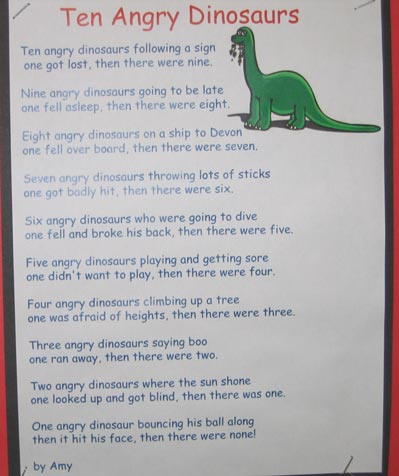
Last Friday, Everything Dinosaur travelled to Cumbria to provide some dinosaur teaching sessions to the eager, young palaeontologists at Blackford CE Primary School.  The morning was spent working with the juniors under the tutelage of Miss Thompson.  The children had been studying dinosaurs as their term topic and they has posted up some super dinosaur themed poems.  These poems made a great display on one of the walls of the classroom.

A Dinosaur Inspired Poetry Corner

Prehistoric Animal Poems.

Prehistoric animal poems.

Picture credit: Everything Dinosaur/Blackford CE Primary School

Dinosaur Teaching Workshop

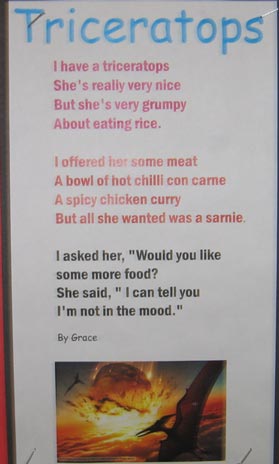
There were lots of different prose writing techniques on display and it was interesting to note the various prehistoric animals that the children had chosen as the subject for their poems.  If we ever need to think up some rhymes for the likes of Triceratops and Diplodocus, Blackford CE Primary School will be our first port of call.

A Poem Entitled Ten Angry Dinosaurs (by Amy)

Ten Angry Dinosaurs Poem

Ten angry dinosaurs poem.

Picture credit: Everything Dinosaur/Blackford CE Primary School

Creative Extension Work

As a teaching topic, dinosaurs does lend itself to all sorts of creative extension work.  The subject area can touch upon design and technology, maths, geography as well as science and history.  With these poems Miss Thompson has encouraged her pupils to consider how poems are constructed as well as encouraging their creative writing skills.

An Ode To Triceratops Written by Grace

"Three horned Face" has a poem written about it.

“Three horned Face” has a poem written about it.

Picture credit: Everything Dinosaur/Blackford CE Primary School

If the likes of Charles Dickens can write about dinosaurs (Bleak House), then it seems that the juniors at Blackford CE Primary are following in some very famous footsteps.

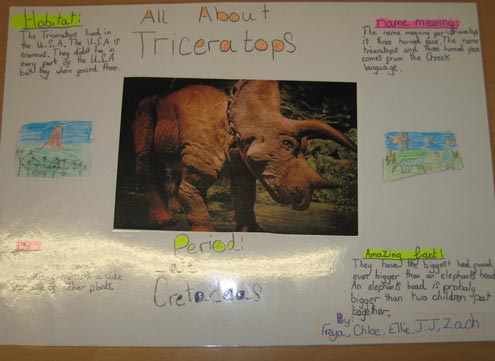
The children’s artistic talents were also encouraged by Miss Thompson, aided by teaching assistant Miss Turner.  Working in small groups the pupils had designed their own colourful dinosaur posters.  Each poster focused on a single genus of prehistoric animal and as well as drawings and pictures the children had researched facts about the animal and reproduced this information on their posters.

A Poster All About Triceratops

A Triceratops Dinosaur poster.

A Triceratops dinosaur poster.

Picture credit: Everything Dinosaur/Blackford CE Primary School

A very informative poster all about a very famous horned dinosaur made by Zach, J.J., Ellie, Chloe and Freya.  We loved the drawing on the left of the picture (as you look) showing a huge, brown volcano.  We talked about Triceratops during the dinosaur teaching session and we set the class a puzzle concerning this particular dinosaur.  The children had to consider the evidence and then come up with a theory to explain what they thought might have happened – interesting stuff!

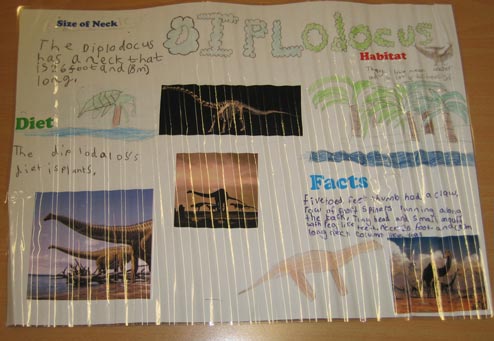
Another group of juniors had created a poster of Diplodocus.  As the poster was being laminated the laminating machine chewed it up a bit creating a rippled effect on the poster. Undaunted,  the pupils decided that the texture was probably like that of the skin of this particular long-necked dinosaur.  We had some casts of dinosaur skin with us on the day, but with all the other activities and experiments including testing to see if your tongue sticks to fossil material (an experiment inspired by budding dinosaur hunter Jack), we did not get round to showing these items.

Diplodocus Takes Centre Stage

A dinosaur poster by children at Blackford CE Primary.

A dinosaur poster by children at Blackford CE Primary.

Picture credit: Everything Dinosaur/Blackford CE Primary School

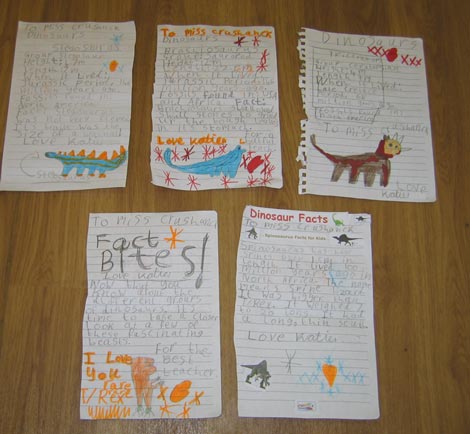
In the afternoon,  it was time to work with the younger children in the school.  Miss Cruickshank’s class were treated to some tactile fossil handling which involved an exploration of the properties of materials interspersed with some physical activities.  There were lots of questions, Nigella wanted to know all about Diplodocus and Elizabeth asked about Tyrannosaurus rex.  One of the pupils (Katie) had even made a set of dinosaur fact cards featuring the likes of Stegosaurus and the fearsome Spinosaurus – nice work Katie!

The Dinosaur Fact Cards Made by Katie

Katie's Dinosaur Fact Cards.

Katie’s dinosaur fact cards.

Picture credit: Everything Dinosaur/Blackford CE Primary School

We loved Katie’s illustrations on her “bite sized” fact cards, but all too soon it was time to pack up and go home.  However,  the pupils at Blackford CE Primary along with their teaching staff are going to have a few more weeks of this teaching topic and with the creative teaching team we are confident that there will be lots of exciting dinosaur themed teaching activities carried out.

To view the range of dinosaur themed toys and gifts available from Everything Dinosaur: Dinosaur Toys and Gifts.

14 02, 2013

Amazing Scientists at Remarkable School Studying Rare Fossils and Wonderful Dinosaurs

By |2024-04-29T13:03:47+01:00February 14th, 2013|Categories: Educational Activities, Photos/Schools, Teaching|0 Comments

Year 2 Demonstrate their Dinosaur Drawing Skills

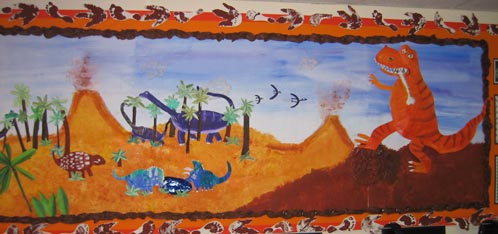
Another day and another school visit for Everything Dinosaur, this time to Rode Heath Primary School in Cheshire.  The year two children under the tutelage of Mrs Woollam the class teacher, have been studying dinosaurs this term.  There was lots of artwork on display including a very colourful wall mural showing, in the foreground, a bright orange Tyrannosaurus rex chomping on a bone.

Rode Heath Primary with their own “Walking with Dinosaurs” Wall Display

A very colourful dinosaur scene.

A very colourful dinosaur scene.

Picture credit: Everything Dinosaur

Tyrannosaurus rex

The T. rex is heading towards a group of herbivorous dinosaurs.  There are horned dinosaurs (Ceratopsians), and an Ankylosaurus whilst amongst the trees two titanosaurs lurk.  It is certainly a very impressive mural.  Forming a border around the picture there are some cut-out tridactyl (three-toed) dinosaur footprints intermingled with footprints made by the school children.

Year two have been busy making exhibits for their very own dinosaur museum.  Teaching Assistant Mrs Hulse was busy taking photographs of the fossils that we brought so that they too could be included in the class museum. Some of the pupils are going to be tour guides for the museum so they will have to “bone up” on lots of dinosaur facts and figures.

Dinosaur Term Topic

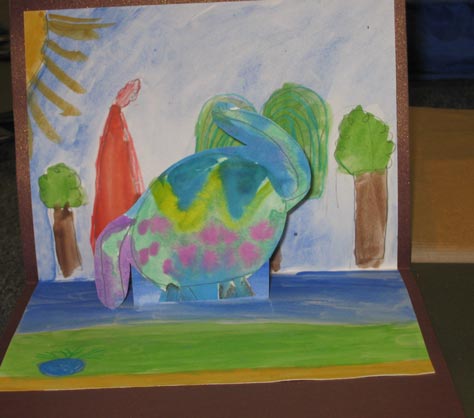
Dinosaurs and fossils make an excellent subject for a term topic.  Lots and lots of extension activities can be employed to help children develop writing and numeracy skills.   For example, Mrs Woollam’s class have been working on their own dinosaur “pop-up” books, showcasing some of the artwork they have produced as well as providing a great platform for creative writing.

Chloe Thompson (aged 7), decided to include a very fierce looking meat-eating dinosaur in her pop-up book.   Team members at Everything Dinosaur were very impressed with the big teeth.

Pink and Blue Meat-eating Dinosaur by Chloe Thompson

A very colourful dinosaur.

A very colourful dinosaur.

Picture credit: Chloe Thompson

If you look carefully you can see that Chloe has added some dinosaur bones in the foreground.  Part of the lesson covered the different types of dinosaur, herbivore, carnivore and even omnivores.

Millie and her Herbivorous Dinosaur

A Sauropod suns himself.

A sauropod suns himself.

Picture credit: Millie

Millie chose to depict a plant-eating dinosaur in her pop-up book.  The sauropod is painted with blues, greens and even a little bit of pink – nice one Millie.

Everything Dinosaur

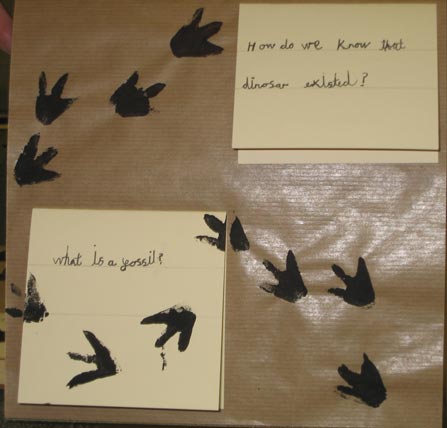
The pupils have had the chance to explore dinosaur footprints, we showed some bones and the children had guess which part of the dinosaur they were.  Jonny (aged 6) depicted a set of dinosaur tracks in his special dinosaur book.

Jonny Illustrates a Set of Dinosaur Footprints

Depicting a Dinosaur Trackway

Depicting a dinosaur trackway.

Picture credit: Jonny (aged 6)

The children had prepared lots of questions, including one about Giganotosaurus.  We did our best to answer them all and to explain about flying reptiles, dinosaurs and other prehistoric animals.  The team members at Everything Dinosaur were most impressed with the creative writing, the artwork and the knowledge demonstrated by the children.

To view the range of educational themed dinosaur toys and products available from Everything Dinosaur: Visit Everything Dinosaur.

1 02, 2013

Pupils Demonstrate their Dinosaur Knowledge

By |2023-02-12T08:55:22+00:00February 1st, 2013|Categories: Educational Activities, Everything Dinosaur News and Updates, Teaching|0 Comments

Young Palaeontologists at Primary School

It is always a pleasure to visit schools meeting eager young dinosaur fans and to spend some time helping out when the term topic is dinosaurs.  Yesterday, for example, one of our team members got the chance to visit a school where the children in years 3 and 4, under the enthusiastic tutelage of their teachers, were learning all about prehistoric animals.

Dinosaur Knowledge

A number of walls in the classrooms were already decorated with some superb examples of dinosaur inspired artwork, along with a series of maps which showed which types of dinosaurs lived on different continents.  A number of children had carried out independent research and written up their findings combining appropriate sentence construction with a surprisingly astute knowledge of palaeontology.

Clearly the teaching staff supported by the teaching assistants had developed a very creative scheme of work for the delivery of this topic, we were happy to play a small part in what will be an exciting and rewarding topic for the pupils at the school.

Brachiosaurus Poster

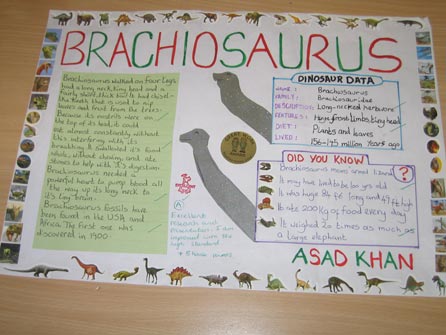
Amongst a number of splendid examples of individual work we noticed a poster created by Asad featuring one of his favourite dinosaurs – Brachiosaurus.  Not only was the poster very carefully designed and laid out, the information that it contained demonstrated that this young palaeontologist had researched his chosen dinosaur in remarkable detail.

Asad’s Excellent Poster on Brachiosaurus

An informative research poster on Brachiosaurus created by Asad.

An informative research poster on Brachiosaurus created by Asad.

Picture credit: Asad Khan

A very colourful poster it is too.  Not only did Asad use the name Brachiosaurus (genus name, often referred to as the generic name), he correctly identified that with the scientific classification of organisms, closely related genera (the plural of genus), are classified into families.    To have a child of around nine years of age using the term Brachiosauridae is very impressive indeed.  The teacher of the class awarded an “A” with five house points and Asad also received a “good work” sticker for his efforts.

Explaining the Poster

Asad demonstrated his dinosaur knowledge by very kindly talking through his poster with the Everything Dinosaur team member as some of the children prepared for lunch.  During our work with this particular class, we were able to update the school children on some of the latest research on members of the brachiosaur family, introducing the idea of the establishment of a new genus of brachiosaurid dinosaur – Giraffatitian (G. brancai) representing brachiosaur specimens excavated from Africa.

Lots of evidence of the year 3/4 pupils carrying out investigations, using drawings to communicate data,  assessing how animals in a habitat are suited to their environment, food chains, making comparisons, using data handling techniques – excellent academic work.

We managed to answer the questions that the children asked and no doubt both the pupils and the teaching team at the school will enjoy their “Working with Dinosaurs” for the rest of the term.

To view the range of dinosaur themed educational items available from Everything Dinosaur: Dinosaur Crafts, Toys and Games.

Go to Top