

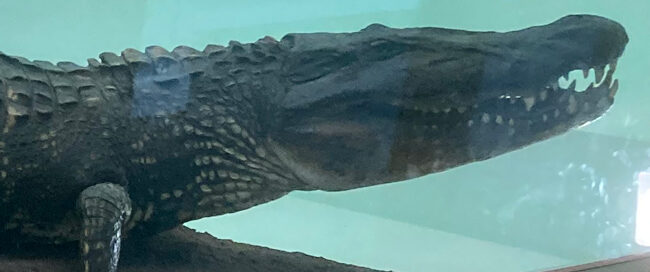
How Warm Climates Helped Crocodiles Survive Dinosaur Extinction
Why did crocodiles survive the extinction event that wiped out the non-avian dinosaurs? New research led by University College London (UCL) suggests that their preference for warm climates played an important role. Throughout their long evolutionary history, crocodiles and their relatives generally followed suitable climatic conditions rather than adapting to new ones. This new study provides important insights into how crocodiles survived dinosaur extinction event conditions approximately 66 million years ago.
The study, published in the journal “Science Advances”, examined more than 7,000 fossils and records representing over 400 living and extinct species. Researchers combined this information with computer reconstructions of Earth’s ancient climates and geography. Their findings suggest that warm regions near the equator provided important refuges following the Chicxulub asteroid impact approximately 66 million years ago.

Keeping to warm climates throughout their 250-million-year history may have helped crocodiles and their relatives survive the asteroid that killed the dinosaurs, finds a new study led by University College London researchers. Picture credit: Davide Bonadonna.
Picture credit: Davide Bonadonna
Crocodiles Followed Warm Climates
The crocodile evolutionary lineage belongs to a group of archosaurs called pseudosuchians. These reptiles first appeared around the same time as the dinosaurs, approximately 250 million years ago. Although modern crocodilians share broadly similar body plans, their prehistoric relatives were remarkably diverse. Some were heavily armoured herbivores, whilst others evolved into formidable terrestrial predators.
For example, Postosuchus was a large, terrestrial predator of the Late Triassic.
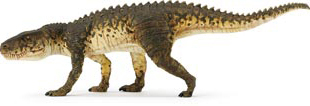
A model of Postosuchus from Safari Ltd.
The picture (above) helps to illustrate the diversity of the pseudosuchians. Two species of Postosuchus have been named, and its fossils have been found in several locations in North America. The picture shows a Postosuchus model introduced by the American company Safari Ltd.
To view the range of Safari Ltd prehistoric animal models: Safari Ltd. Wild Safari Prehistoric World Models.
The company continues to make replicas of pseudosuchians. For example, the latest release is a model of the fearsome, Late Cretaceous Deinosuchus.
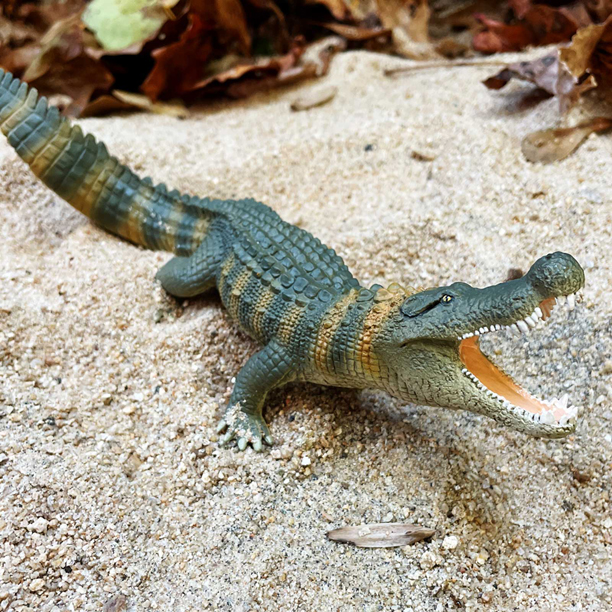
The new Wild Safari Prehistoric World Deinosuchus model.
Despite this extraordinary diversity, the researchers identified a consistent relationship between crocodile-line archosaurs and climate. Rather than evolving to tolerate substantially different climatic conditions, most lineages moved into regions where temperatures remained suitable.
During warmer geological intervals, their geographical ranges expanded. Conversely, cooling climates forced populations to retreat towards tropical regions.
Prehistoric Crocodiles Even Lived in Antarctica
During the early Eocene, approximately fifty million years ago, global temperatures were considerably higher than today. The polar regions were largely ice-free, and warm conditions extended into high latitudes. Consequently, crocodile relatives inhabited regions of North America, Europe and even Antarctica.
However, as global temperatures declined over subsequent millions of years, suitable habitats contracted. Crocodile populations increasingly became restricted to warmer latitudes.
The researchers identified two notable exceptions to this general pattern.
During the Cretaceous Thermal Maximum, approximately ninety-four million years ago, one lineage evolved adaptations permitting it to tolerate exceptionally high temperatures.
Furthermore, an extinct group of Australian crocodiles adapted to increasingly dry conditions around thirty-four million years ago.
Nevertheless, these exceptions emphasise how strongly climate influenced the distribution and evolution of crocodile-line archosaurs.
How Crocodiles Survived Dinosaur Extinction Event
The research team also investigated climatic conditions following the asteroid impact that marked the end of the Cretaceous Period. The impact triggered enormous environmental disruption. Dust and other particles entering the atmosphere reduced incoming sunlight, causing temperatures to fall and disrupting ecosystems. Scientists modelled several scenarios involving reduced sunlight and increased atmospheric carbon dioxide.
Under simulations involving a five or ten per cent reduction in sunlight, tropical and subtropical regions remained climatically suitable for crocodile relatives. Only the most extreme scenario, involving a fifteen per cent reduction, eliminated these suitable climatic refuges. However, the researchers considered this scenario unlikely.
Dr Alfio Alessandro Chiarenza of UCL Earth Sciences commented:
“The asteroid did not make the whole planet equally hostile to every group. Crocodiles’ long-standing preference for warm environments may have placed survivors exactly where suitable climates held up best, like around the equator. These refuges could have sheltered populations that later recovered and radiated out.”
Crocodile relatives already inhabiting warmer regions may have been particularly well positioned to survive the environmental crisis. These populations could subsequently have recovered and expanded into other suitable habitats.
Changing Climate Was Not the Only Factor
Importantly, the researchers stressed that climatic preferences alone cannot explain crocodilian survival. Several additional biological characteristics probably contributed to their resilience.
Their relatively low metabolic requirements meant that crocodiles could survive with less food than similarly sized warm-blooded animals. In addition, flexible diets may have helped them exploit different food resources. Semi-aquatic lifestyles could also have provided advantages during periods of environmental instability.
Furthermore, smaller body size among surviving lineages may have reduced their energy requirements. Together, these characteristics probably increased the likelihood that some crocodile-line archosaurs survived the end-Cretaceous mass extinction.
Important Lessons for Modern Crocodile Conservation
The findings also have significant implications for living crocodilians. Professor Philip Mannion of UCL Earth Sciences highlighted the importance of allowing species to move into suitable habitats as environmental conditions change. Historically, crocodiles could respond to changing climates by shifting their geographical distributions.
Professor Mannion stated:
“These findings have implications for species today. If crocodiles mostly coped with past climate change by moving towards suitable habitats, today’s species will need room to move as the planet warms, and the loss of suitable areas to roads, farms and cities is making that harder.”
As global temperatures rise, protecting suitable habitats and maintaining connections between populations could become increasingly important.
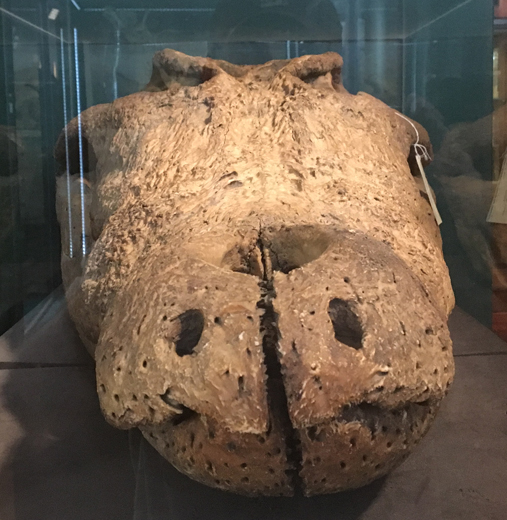
An anterior view of the skull of an estuarine crocodile photographed in the Grant Museum, London. The largest reptile on Earth, the estuarine crocodile (Crocodylus porosus) from south-east Asia is also known as the saltwater crocodile or saltie. Picture credit: Everything Dinosaur.
Picture credit: Everything Dinosaur
The research demonstrates how studying the fossil record can help scientists understand evolutionary responses to environmental change. This new research provides important insights into how crocodiles survived dinosaur extinction event conditions marking the end of the Cretaceous.
It also provides another fascinating example of how palaeontology contributes to modern conservation biology.
Everything Dinosaur acknowledges the assistance of a media release from the UCL in the compilation of this article.
The scientific paper: “Climatic niche conservatism shapes the macroevolution, extinction, and survivorship of crocodile-line archosaurs” by Alfio Alessandro Chiarenza, Alexandra F. C. Howard, Grace L. Varnham, Alex Farnsworth, Paul J. Valdes, and Philip D. Mannion published in Science Advances.
The Everything Dinosaur website: Models of Crocodile and Prehistoric Animals.