

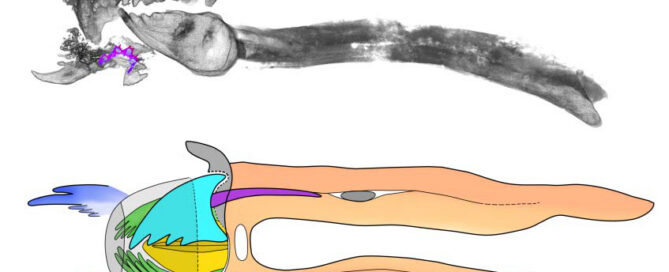
Stunning Rhynie Chert Fossil Rewrites the Evolution of Flying Insects
A tiny fossil discovered in Scotland a hundred years ago has prompted scientists to reconsider the evolution of flying insects. New research led by scientists from the Natural History Museum in London suggests that flying insects may have evolved as much as eighty million years later than previously thought. The findings challenge a long-established interpretation of one of the world’s oldest arthropod fossils and demonstrate how modern scientific techniques can transform our understanding of prehistoric life.
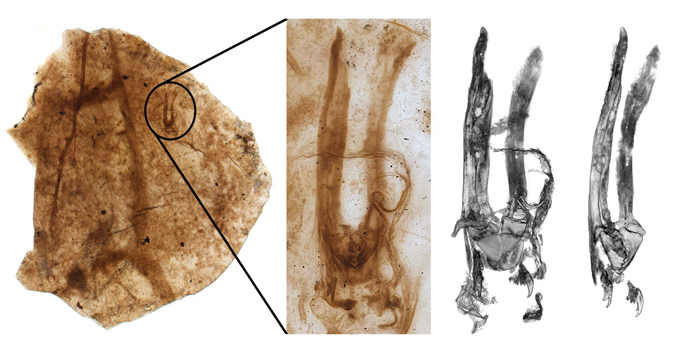
Rhynie Chert fragment with inset Rhyniognatha highlighted and confocal microscopy models. Picture credit: Emma Long.
Picture credit: Emma Long
The fossil, named Rhyniognatha hirsti, was discovered in 1926 in the famous Rhynie Chert deposits of northern Scotland. These remarkable deposits preserve evidence of a Devonian wetland ecosystem dating back approximately 408 million years. The exceptional preservation of fossils from this location has provided palaeontologists with invaluable information about some of the earliest terrestrial ecosystems.
To read an article from earlier this year highlighting the significance of the Rhynie Chert deposits: Fossils Provide a Remarkable Insight into Devonian Ecosystems.
A Tiny Fossil with Enormous Scientific Significance
The fossil of Rhyniognatha hirsti consists of part of the head of a tiny arthropod. Measuring less than one millimetre in length, this extraordinary specimen was largely overlooked for decades as researchers concentrated on other fossils recovered from the Rhynie Chert.
However, a scientific study published in 2004 dramatically changed the importance of this tiny fossil. Researchers identified similarities between its mouthparts and those of modern winged insects. Consequently, Rhyniognatha was interpreted as the oldest known representative of the winged insect lineage.
This identification had profound implications for understanding insect evolution. If Rhyniognatha belonged to the winged insect lineage, the evolutionary origins of flying insects must have extended back to at least the Early Devonian, approximately 400 million years ago.
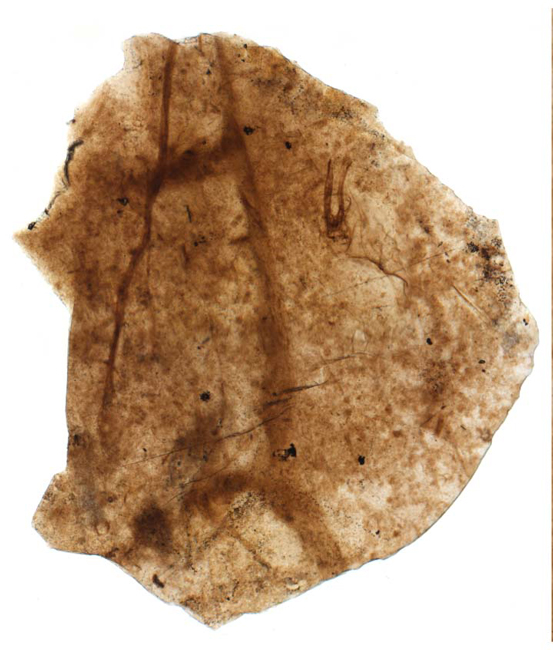
Rhyniognatha fossil chip viewed under light microscope. Picture credit: Emma Long.
Picture credit: Emma Long
The fossil subsequently became an important reference point for researchers attempting to reconstruct the evolutionary relationships of insects, including the ancestors of modern dragonflies, bees and crickets.
Advanced Microscopy Challenges an Established Theory
Despite its scientific significance, questions remained about the true identity of Rhyniognatha hirsti. Some researchers suggested that the fossil might represent an ancient relative of centipedes rather than an insect. To investigate these competing interpretations, scientists led by the Natural History Museum undertook a detailed re-examination of the specimen using advanced confocal microscopy.
This technique uses precisely focused laser light to examine structures within a specimen. It allows scientists to produce detailed digital reconstructions and distinguish anatomical features that can be extremely difficult to interpret using conventional light microscopy.
The research team concentrated on the fossil’s jaws, particularly the arrangement of their joints. These structures are important because differences in mouthpart anatomy can help palaeontologists distinguish between major arthropod groups.
Their investigation revealed that the jaw joints of Rhyniognatha do not correspond precisely with those found in modern flying insects or centipedes.
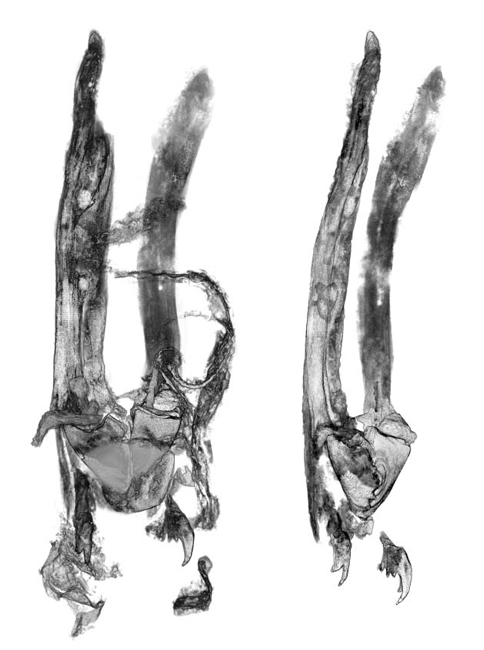
Rhyniognatha confocal microscopy models. Picture credit: Emma Long.
Picture credit: Emma Long
As a result, the researchers concluded that there is insufficient evidence to confidently assign this ancient arthropod to either group.
Rethinking the Evolution of Flying Insects
The implications of this discovery extend far beyond the identification of a single fossil.
For more than two decades, Rhyniognatha hirsti has been used as a calibration point in evolutionary studies. By combining fossil evidence with genetic information from living organisms, scientists can estimate when different groups shared their last common ancestors.
However, these calculations depend upon fossils being correctly identified and placed within the appropriate evolutionary lineages. If Rhyniognatha cannot reliably be classified as an insect, it should no longer be used to establish a minimum age for the evolution of winged insects.
Dr Emma Long, the study’s lead author, explained that the re-examination suggests Rhyniognatha is probably not an insect at all. Removing this fossil from evolutionary calculations could shift estimates for the origins of flying insects forward by as much as eighty million years.
Importantly, this does not establish an exact date for the first appearance of insect flight. Instead, it removes a previously influential piece of evidence supporting a much earlier evolutionary origin.
The findings therefore encourage scientists to reconsider when insects acquired wings and how the development of flight influenced the diversification of terrestrial ecosystems.
Museum Fossils Continue to Reveal New Secrets
This remarkable discovery also highlights the enduring scientific value of museum collections. Although Rhyniognatha hirsti was collected in 1926, modern microscopy has enabled scientists to examine its anatomy in ways that would have been impossible when the fossil was first discovered.
Dr Greg Edgecombe, a co-author of the study and Merit Researcher at the Natural History Museum, emphasised the importance of applying new analytical techniques to historical specimens.
Dr Edgecombe stated:
“Revisiting old fossils with new technology allow us to see them in a new light, and Rhyniognatha is no exception. By using advanced microscopy techniques, we were able to digitally separate the fossil to see its key features in greater detail than ever before.”
Museum collections preserve an enormous wealth of scientific information. As technology advances, fossils collected many decades ago can provide fresh evidence and challenge established interpretations. For instance, this new research has changed our understanding with regards to the evolution of flying insects.
The re-examination of Rhyniognatha demonstrates that even the smallest fossils can have an enormous influence on our understanding of evolutionary history.
For palaeontologists, the research is also an important reminder that scientific interpretations are continually tested and refined as new evidence becomes available.
The multi-award-winning Everything Dinosaur website: Prehistoric Animal Replicas.