

Dinosaurs Dined on Seafood: Remarkable Fossil Teeth Reveal Cretaceous Coastal Diets
Dinosaurs living near the coast may have supplemented their diets with food from the sea. New research suggests that marine resources entered Cretaceous food webs and were consumed by dinosaurs and other vertebrates. Research suggests that some herbivorous dinosaurs ate seaweed.
Scientists examined the chemical composition of fossil teeth and bones. They found evidence that marine-derived nutrients were incorporated into terrestrial food chains. Remarkably, the researchers conclude that some herbivorous dinosaurs may even have eaten seaweed washed ashore. The study provides new insights into the complex ecosystems that existed along the shores of the Western Interior Seaway and the ancient Gulf of Mexico during the Cretaceous.
Dinosaurs and Marine Food Resources
Storms regularly wash seaweed, animals and other organic material onto modern beaches. Terrestrial animals often take advantage of this readily available food. Scientists refer to the movement of nutrients and energy from marine environments into terrestrial ecosystems as marine subsidisation. Indeed, our own species Homo sapiens has a long history of beachcombing. Early modern humans in South Africa for example, are thought to have survived severe climate change by relying on scouring the shoreline to supplement their diet.
Researchers wanted to discover whether the similar behaviours were exhibited by animals that lived during the Mesozoic.
Dr Clayton W. Forster of the University of Arkansas and colleagues studied the stable carbon isotope composition preserved in fossil material. Their research was published in the journal “Frontiers in Ecology and Evolution Paleoecology”.
The scientists concluded that marine resources probably made an important contribution to several coastal Cretaceous ecosystems.
Dr Forster explained:
“We show that coastal terrestrial organisms in the greenhouse climates of the Cretaceous relied on marine resources to supplement their diets in a similar way that modern organisms do.”
Marine-derived resources could move through the entire food chain. Therefore, an animal did not necessarily have to eat seaweed or other marine material directly to acquire its chemical signature.

Theropod tooth from the Mussentuchit Member assemblage on a foam block next to a scale card. Chemical analysis of fossil teeth can provide evidence about the food consumed by animals millions of years ago. Picture credit: North Carolina Museum of Natural Sciences/Clayton Forster.
Picture credit: North Carolina Museum of Natural Sciences/Clayton Forster
Chemical Fingerprints Preserved in Dinosaur Teeth
The researchers focused particularly on different isotopes of carbon. Carbon occurs naturally in several forms, including carbon-12 and carbon-13. The ratio between these isotopes can provide scientists with information about diet. Importantly, this chemical signal can become incorporated into tooth enamel.
Marine plants tend to have higher carbon isotope values than plants growing on land. Consequently, animals consuming marine vegetation, or eating animals that had exploited marine resources, can acquire a distinctive carbon isotope signature. Scientists had previously encountered unexpectedly high carbon isotope values in Cretaceous vertebrate fossils. The new study offers a possible explanation.
The team analysed fossil material from several formations representing ancient coastal environments. These included the Antlers, Woodbine, Dunvegan and Wayan formations, along with the Mussentuchit Member of the Cedar Mountain Formation. These deposits were associated with the margins of the Western Interior Seaway or the ancient Gulf of Mexico.
For comparison, fossils from the predominantly inland Cloverly Formation were also studied.
The Western Interior Seaway
During parts of the Cretaceous, rising sea levels flooded enormous areas of North America. The Western Interior Seaway eventually divided the continent into western and eastern landmasses (Laramidia and Appalachia). Dinosaurs living close to its shores inhabited environments very different from those of dinosaurs living farther inland. The study examined fossil assemblages dating from the Early to early Late Cretaceous. The researchers identified a consistent difference between coastal and inland ecosystems. Fossils from coastal environments generally possessed higher carbon isotope values. This pattern was detected across different animals and locations. It also occurred at sites of different geological ages.
The scientists interpret this as evidence that marine-derived nutrients were entering terrestrial food webs.

A large crocodilian tooth from the Wayan Formation. The Wayan Formation was one of several deposits included in the study of marine-derived nutrients in Cretaceous ecosystems. The specimen is shown next to a centimetre ruler in a specimen box on top of its specimen information card. Picture credit: Idaho Museum of Natural History/Clayton Forster.
Picture credit: Idaho Museum of Natural History/Clayton Forster
Did Dinosaurs Eat Seaweed?
Perhaps the most intriguing question concerns the source of the marine carbon. Dr Forster and his colleagues suggest that marine macroalgae and aquatic plants are strong candidates. The chemical signature occurred in animals occupying different parts of the food web. Therefore, the original source was probably situated relatively low down in the ecosystem.
Seaweed fits this hypothesis extremely well.
Large herbivorous mammals living near coastlines today sometimes eat seaweed. It provides a useful supplementary food source, particularly when terrestrial vegetation becomes scarce.
The researchers propose that coastal herbivorous dinosaurs may have behaved in a similar way.
Dr Forster added:
“Few organisms meet these criteria besides marine macroalgae or macrophytes – seaweeds.”
If herbivorous dinosaurs consumed washed-up seaweed, the marine-derived carbon could subsequently have passed to predatory dinosaurs when they ate these herbivores. Therefore, the research does not necessarily imply that theropod dinosaurs regularly hunted marine animals. Instead, marine nutrients could have moved through a complicated network of ecological relationships.
Not Every Dinosaur Ate Marine-derived Food
Intriguingly, the researchers also discovered evidence of dietary selectivity. Tenontosaurus tilletti was a large herbivorous dinosaur known from several Lower Cretaceous formations of North America. The carbon isotope values associated with the Tenontosaurus material examined were consistent with animals feeding primarily on terrestrial vegetation. The researchers concluded that T. tilletti apparently preferred non-marine food resources, although relatively few specimens were available for analysis.
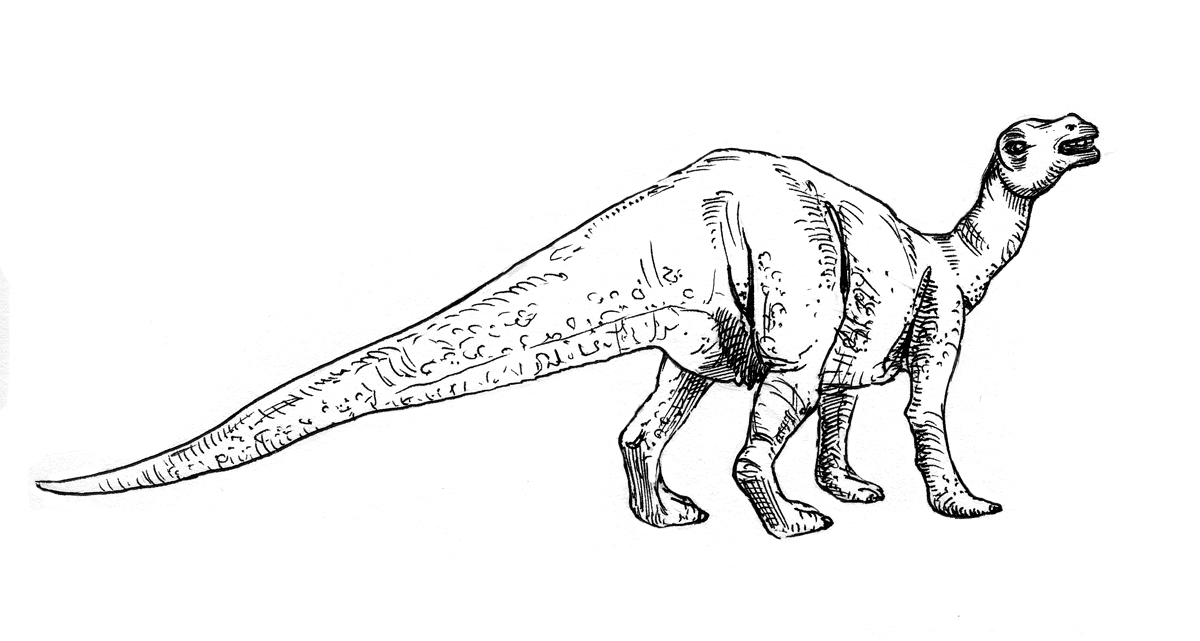
Tenontosaurus tilletti illustration. Picture credit: Everything Dinosaur.
Picture credit: Everything Dinosaur
This is an important observation. It suggests that the unusual chemical signatures were associated with diet rather than simply being the result of geological processes altering the fossils after burial.

A Tenontosaurus tilletti tooth from the Cloverly Formation assemblage in a glass sample vial. This ornithopod appears to have preferred terrestrial vegetation rather than marine-derived food. Picture credit: Sam Noble Oklahoma Museum of Natural History/Clayton Forster.
Picture credit: Sam Noble Oklahoma Museum of Natural History/Clayton Forster
Analysing a Cretaceous Food Web
The Cloverly Formation fossils provided an important comparison with the coastal assemblages. The study included teeth from dinosaurs and crocodilians as well as material from other vertebrates. Some specimens were destructively sampled so that their isotopic composition could be determined.
The results indicate that the predominantly inland Cloverly ecosystem lacked the widespread marine influence identified in the coastal deposits.
However, the picture was not entirely straightforward. One gar specimen from the Cloverly Formation preserved chemical evidence suggesting a connection with a marine or estuarine environment. This hints at just how complex interactions between freshwater, marine and terrestrial ecosystems could have been.

Five fossil teeth specimens from the Cloverly Formation assemblage after destructive sampling for isotopic composition and laser ablation analysis. The specimens from left to right are three specimens of crocodilian teeth, the fourth tooth is a Deinonychus antirrhopus tooth, and, finally, on the far right is a Sauropelta edwardsi tooth. The specimens are mounted on adhesive putty attached to a glass slide with specimen labels below them. Picture credit: Sam Noble Oklahoma Museum of Natural History/Clayton Forster.
Picture credit: Sam Noble Oklahoma Museum of Natural History/Clayton Forster
Reconstructing Ancient Dinosaur Dominated Ecosystems
The research demonstrates that palaeontologists need to consider connections between terrestrial and marine habitats when reconstructing ancient ecosystems. Coastlines are dynamic, ever-changing environments. Nutrients move between land and sea, storms deposit organic material on beaches and animals exploit whatever food resources become available.
The same processes appear to have been operating millions of years ago. Furthermore, marine resources might have become especially important during periods when terrestrial food was scarce. Modern coastal ecosystems demonstrate how marine-derived nutrients can help support terrestrial communities.
The researchers conclude that marine macroalgae and other marine plants may have represented important alternative food resources for coastal dinosaurs. This could also help palaeontologists interpret unusual carbon isotope values identified in other Cretaceous fossils.
The First Study of Marine Subsidisation in Mesozoic Terrestrial Ecosystems
The study represents the first identification of marine subsidisation in prehistoric terrestrial ecosystems. Further research could establish how widespread the phenomenon was at other latitudes and during different intervals of geological time.
Dr Forster summarised the wider significance of the research:
“Our study emphasises the connections between terrestrial and marine ecosystems.”
Dinosaurs are often reconstructed as inhabitants of forests, floodplains and river systems. However, this study provides a reminder that many species also lived close to enormous inland seas. Some of these dinosaurs may have wandered along Cretaceous shorelines exploiting whatever the tides and storms brought onto the beach. Intriguingly, studies of trackways found in Jurassic-aged sediments on the Scottish island of Skye indicate the presence of sauropods in coastal environments. It had been suggested that the relatively open beach environments acted as migration routes for these large herbivores. After all, moving along the coast would have been easier than moving through a dense forest landscape. However, these habitats with their abundant seaweeds being washed up with the tide could have provided plant-eating dinosaurs with a substantial food resource.
To read more about the remarkable sauropod trace fossils on the Isle of Skye: Isle of Skye Sauropods and their Watery World.
For herbivorous dinosaurs at least, that could sometimes have meant adding a little seaweed to the menu.
The scientific paper: “Marine subsidization of dinosaurian ecosystems” by Clayton W. Forster, Celina A. Suarez, Thomas M. Cullen, Lindsay E. Zanno and Ethan G. Hyland published in Frontiers in Ecology and Evolution Paleoecology.
Link: The Scientific Paper.