

Remarkable New Tyrannosaur Highlights an Evolutionary Puzzle
A new species of large tyrannosaur has been named and described from fossils found in Alberta (Canada). The new theropod, Tromerosaurus solumons, lived around 76 million years ago (Campanian faunal stage of the Late Cretaceous). Intriguingly, this predator possessed a mixture of anatomical characteristics associated with two major tyrannosaurid lineages.
The study could change our understanding of tyrannosaur evolution. It suggests that important tyrannosaurid lineages may have diverged later and evolved more rapidly than previously thought. Mark J. Powers of the University of Alberta, lead author of the paper, assisted Everything Dinosaur in the compilation of this article by providing images. The study has been published in the “Journal of Vertebrate Paleontology”.
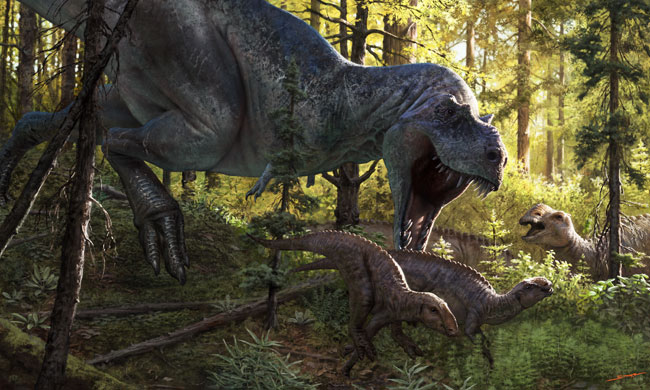
Tromerosaurus attacks a pair of juvenile Brachylophosaurus. Picture credit: Henry Sharpe.
Picture credit: Henry Sharpe
Introducing Tromerosaurus solumons
In 2010, a partial tyrannosaur skeleton was discovered in exposures associated with the upper Oldman Formation of Alberta. The University of Alberta mounted two expeditions (2010 and 2011 field seasons) to recover the skeleton. A substantial part of the skull, vertebrae, both humeri along with hind limb material and parts of the pelvis were recovered. The skull was prepared at the University of Alberta Laboratory for Vertebrate Palaeontology.
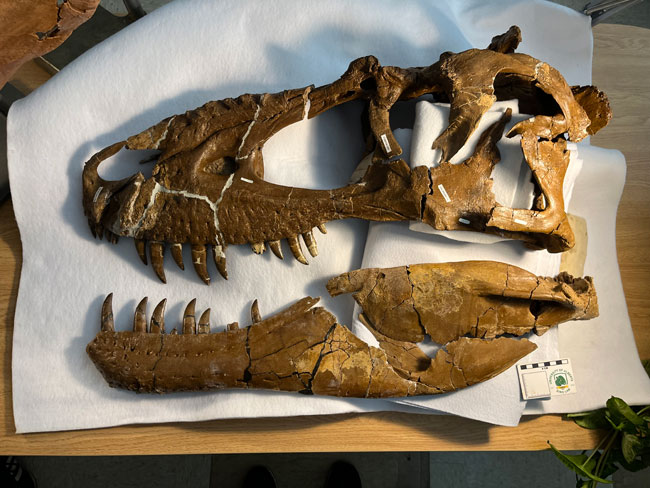
The skull of the holotype specimen (UALVP 52981). Picture credit: Khoi Nguyen.
Picture credit: Khoi Nguyen
A Tyrannosaur with Unique Anatomical Traits
The anatomy of Tromerosaurus proved particularly interesting. Tyrannosaurids are traditionally divided into two important branches: Albertosaurinae and Tyrannosaurinae. Albertosaurines include Albertosaurus and Gorgosaurus. Tyrannosaurines include apex predators such as Daspletosaurus, Tarbosaurus and Tyrannosaurus. However, Tromerosaurus does not fit comfortably into this simple division.
Its anatomy combines characteristics seen in Gorgosaurus with features associated with Daspletosaurus. The research team found particularly important differences in the maxilla, the large tooth-bearing bone forming much of the side of the upper jaw. In addition, morphometric analysis revealed an intermediate morphology. For example, Tromerosaurus has a proportionally longer maxillary fenestra and a narrower pila promaxillaris (the strut of bone that separates the promaxillary fenestra from the maxillary fenestra in the skull), than Gorgosaurus libratus.
This unusual mixture of anatomical features makes the new taxon important for understanding early tyrannosaurid evolution. It also suggests a greater diversity of tyrannosaur species in North America during the Late Cretaceous than previously thought.
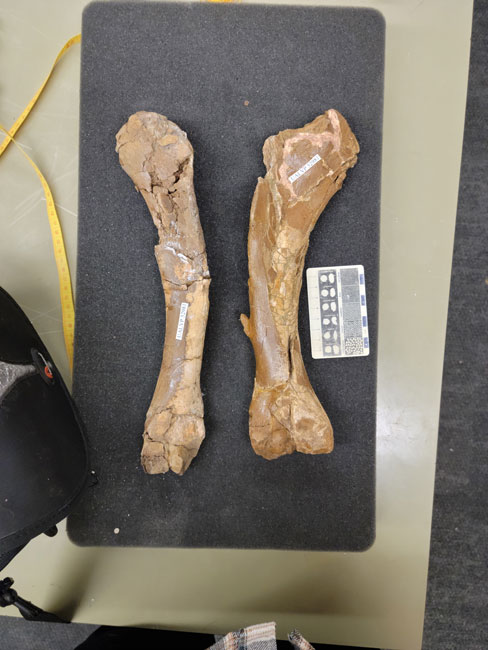
Tromerosaurus solumons humeri (upper arm bones). Picture credit: Mark Powers (University of Alberta).
Picture credit: Mark Powers (University of Alberta)
Fossils Previously Assigned to the Gorgosaurus Genus
The researchers did not restrict their study to the holotype specimen. Instead, they conducted an extensive examination of other tyrannosaur fossils. It was discovered that some specimens previously assigned to the Gorgosaurus genus could instead by referred to T. solumons. Among the reassigned fossils is the substantial specimen TMP 1994.012.0602 and another individual, TMP 1995.005.0001. Additional isolated maxillary material has also been referred to the new tyrannosaur taxon.
Consequently, palaeontologists have fossils representing animals of different sizes and growth stages. This provides considerably more anatomical information than would be available from the holotype alone.
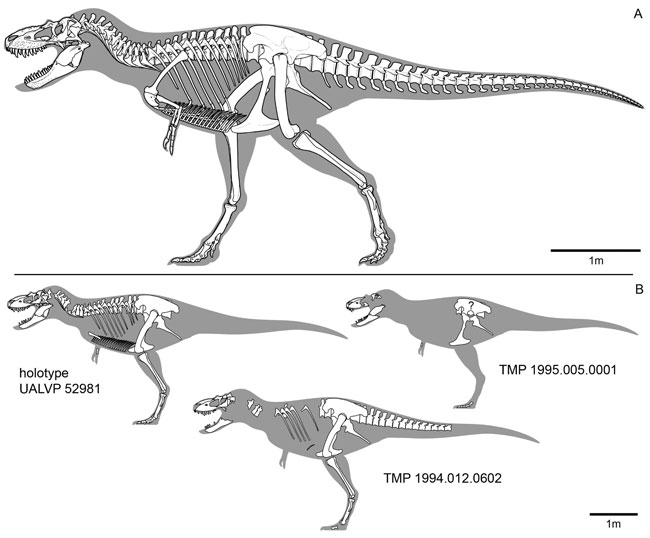
Skeletal reconstruction of Tromerosaurus solumons (A), size estimates vary but when fully grown this dinosaur could have had a body length of between 7 and 9 metres. Referred specimens and the skeletal components (B). Picture credit: Figure 4 in Powers et al 2026..
Picture credit: Figure 4 in Powers et al 2026
Tromerosaurus, Gorgosaurus and the Fossil Record
The stratigraphic distribution of these fossils provides another important piece of evidence. Tromerosaurus and Gorgosaurus appear to have had a restricted period of stratigraphic overlap. This supports the researchers’ interpretation that they represent distinct taxa rather than merely different growth stages or successive forms of the same tyrannosaur lineage. This has wider implications. For example, large tyrannosaurids have sometimes been regarded as comparatively long-lived species with relatively low taxonomic diversity. In contrast, the herbivorous dinosaurs living alongside them appear extremely diverse.
For instance, researchers have identified numerous species of ceratopsian in North America. Many of these species were coeval. High endemism within centrosaurines was demonstrated with the discovery of Lokiceratops (L. rangiformis) from the Judith River Formation of Montana.
To read more about the discovery of Lokiceratops: A New Horned Dinosaur from Montana.
A new lambeosaurine hadrosaur from the Oldman Formation: A Newly Described Lambeosaurine Dinosaur.
The discovery of Tromerosaurus adds evidence suggesting that tyrannosaur diversity may have been underestimated.
The pelvis of the holotype specimen (UALVP 52981). Picture credit: Mark Powers (University of Alberta).
Picture credit: Mark Powers (University of Alberta)
Finding a Place for Tromerosaurus in the Tyrannosaur Family Tree
Perhaps the most fascinating part of the study concerns the dinosaur’s evolutionary relationships. The researchers tested the phylogenetic position of Tromerosaurus using different analytical methods. Remarkably, they obtained different results. A parsimony analysis placed Tromerosaurus as the earliest-diverging member of the Albertosaurinae. However, a Bayesian analysis recovered it within the Tyrannosaurinae sub-family. This discrepancy is scientifically important.
Tromerosaurus possesses a mosaic of characteristics associated with both sub-families. Its anatomy could therefore record a period when the distinctive features of albertosaurines and tyrannosaurines were becoming established. The researchers propose that the divergence of these two major tyrannosaurid lineages could have occurred later than previously thought. Furthermore, anatomical characteristics may have been acquired remarkably rapidly as tyrannosaurids diversified during the Late Cretaceous.
What’s In a Name?
The etymology of this new taxon is fascinating. The genus name combines the Greek “tromeros”, meaning frightening, terrible or alarming, with “sauros”, meaning lizard. The choice also echoes the names Daspletosaurus (“frightful lizard”) and Gorgosaurus (“dreadful/terrible lizard”), reflecting the animal’s intriguing combination of Albertosaurinae and Tyrannosaurinae anatomical characteristics.
The species name combines the Latin terms for “lonely mountain”. It relates to the isolated nature of the lacrimal horn associated with the skull. There is also a deliberate literary connection. The name references the Lonely Mountain, home of the dragon Smaug in J. R. R. Tolkien’s famous book entitled “The Hobbit”.
Tromerosaurus solumons – Leads to a Re-examination of Tyrannosaur Evolution
The scientific description of Tromerosaurus solumons demonstrates how museum specimens can transform our understanding of theropod dinosaur evolution. Some fossils referred to the new taxon had previously been interpreted as belonging to other tyrannosaurids. Detailed anatomical comparisons and improved information about their geological positions allowed researchers to recognise a previously unknown predator. Furthermore, Tromerosaurus suggests tyrannosaur evolution was perhaps more dynamic than traditionally envisaged.
Rather than consisting of a few long-lived species gradually replacing one another, Late Cretaceous tyrannosaurids may have undergone periods of relatively rapid diversification. Their evolutionary history could have been every bit as complex as that of the horned dinosaurs and duck-billed dinosaurs upon which they preyed.
Mike from Everything Dinosaur commented:
“Tromerosaurus solumons is a fascinating addition to the Tyrannosauridae family. It demonstrates how difficult it can be to unravel the evolutionary relationships of these theropods. The mixture of anatomical characteristics associated with different tyrannosaurid lineages makes this new taxon particularly significant. Moreover, the study also highlights the importance of revisiting previously collected fossils. Specimens originally assigned to familiar genera such as Gorgosaurus can provide fresh information when examined in the light of new discoveries.”
A new tyrannosaur from the Foremost Formation of Alberta: Canada’s Oldest Tyrannosaur.
Everything Dinosaur acknowledges the assistance of PhD student Mark Powers and the University of Alberta in the compilation of this article.
The scientific paper: “A new albertosaurine from the Oldman Formation, Alberta, Canada, illuminates ambiguity between albertosaurine and tyrannosaurine characteristics” by Mark J. Power, James G. Napoli, Colton C. Coppock, Henry S. Sharpe, Christiana W. Garros, Alexandre V. Demers-Potvin, Gorm S. Raun, Jordan C. Stock, Tetsuto Miyashita and Philip J. Currie published in the Journal of Vertebrate Paleontology.