All about dinosaurs, fossils and prehistoric animals by Everything Dinosaur team members.

Everything Dinosaur team members working in schools, helping museums and other educational bodies. Our work with and in schools.

2 11, 2013

Dinosaurs Help Inspire Special Anti-bullying Posters for Schools

By |2024-05-01T15:16:10+01:00November 2nd, 2013|Categories: Adobe CS5, Educational Activities, Teaching|0 Comments

Everything Dinosaur Team Members Provide Anti-Bullying Posters for Primary Schools

Week commencing November 18th is the official anti-bullying week in the United Kingdom.  A number of nationwide events and activities are planned to help raise awareness over the issues of bullying and the consequences of having been bullied and Everything Dinosaur team members have been doing their bit to help primary school teachers get the anti-bullying message across.

Anti-Bullying Posters

With all the dinosaur illustrations and other resources available, staff were challenged to create an anti-bullying poster for use in schools.  A number of designs were suggested and three have been prepared and made available as downloads that can be emailed to schools and other organisations to help support their anti-bullying strategy.

One of the Anti-Bullying Posters Created by Everything Dinosaur

Stop the Bullies!

Stop the Bullies!

Picture credit: Everything Dinosaur

Each of the posters can be printed onto an A4 sized (297 mm x 210 mm) piece of paper and the posters can be laminated so that they can become a permanent part of the anti-bullying message within any school.  As children seem fascinated with dinosaurs and other prehistoric animals, it seems sensible to utilise these long extinct creatures to help make bullies extinct too.

Everything Dinosaur

A spokes person from Everything Dinosaur commented:

“It is important to get the message across to school children that bullying is not to be tolerated.  We see the concerted efforts of teachers, teaching assistants and other support staff  with regards to anti-bullying strategies when we visit schools and we wanted to do our bit to help stop the bullies.”

To request an anti-bullying poster for your school, simply email the staff at Everything Dinosaur and they will ensure that a poster is emailed out.

Contact Everything Dinosaur: Email Everything Dinosaur.

2 10, 2013

Dinosaurs and Rare Fossils Visit School

By |2024-05-01T15:02:25+01:00October 2nd, 2013|Categories: Key Stage 1/2|Comments Off on Dinosaurs and Rare Fossils Visit School

Key Stage 1 Pupils Learn All About Fossils

For Key Stage 1 pupils at Bentley High Street Primary, their dinosaur themed term topic was rounded off by a visit from the dinosaur and fossil experts at Everything Dinosaur.  The Year 1 and Year 2 pupils had been studying dinosaurs as the term topic and the children had clearly enjoyed the topic and learned a lot.  The Year one pupils in classes 1G and 1H showed lots of examples of their writing, poster art and data tables that they had produced.  Mrs Gallacher (teacher 1G), had even turned part of her classroom into a dinosaur museum so that the children’s work could be displayed.

Everything Dinosaur

The Dinosaur Museum in Class 1G

Children make a dinosaur themed display.
Dinosaurs made from plates, a wall display featuring Plateosaurus!

Picture Credit: Everything Dinosaur/Bentley High Street Primary

A Dinosaur Term Topic

A dinosaur term topic permits the learning support providers to introduce some basic scientific concepts such as food chains as well as exploring living and extinct creatures and making comparisons between them.

It lends itself to lots of creative writing extension activities as well as helping to enthuse the children about maths and numbers, after all, what six year old can refuse a maths quiz that involves counting and then subtracting plates from a Stegosaurus or the playing of a counting game with our dinosaur experts which involves the teeth from a very large, meat-eating dinosaur.

To learn more about Everything Dinosaur’s work and educational items, simply drop Everything Dinosaur an email: Contact Everything Dinosaur via Email.

Developing Vocabulary

The teachers with the support of the teaching assistants had posted up a number of cards with key words and phrases to do with dinosaurs and fossils.  Our dinosaur expert was happy to assist and advise when it came to this extension activity.  For instance, words such as herbivore, omnivore and carnivore were explained, with the children looking at their own teeth to see their different shapes.  This dovetails into the teaching objectives and aims of the Key Stage 1 science syllabus which involves learning about animals and habitats.

 There were examples of the children’s work, how data can be presented using simple tables and very colourful bar graphs and some applied maths on display all allied to the teaching aims for children in Year 1 (aged from five to six years).

Artwork on Display

There was also a lot of very beautiful artwork on display.  We had suggested using white tissue paper to make a piece of art with the tissue representing the bones of the prehistoric animal.  The tissue paper was rolled into various shapes and stuck onto brown sugar paper.   The skeleton, our “Tissue-oh-saurus” made a lovely display.  Such simple illustrations are a great way to get the children to remember different parts of the body.

A “Tissue-oh-saurus” Created by Key Stage 1 Pupils

Children create a dinosaur skeleton out of tissue paper.
A “Tissue-oh-saurus”

Picture credit: Everything Dinosaur/Bentley High Street Primary

We suggested that the skeleton should be labelled by the children to help reinforce learning about different parts of the body.

Year 2 children were keen to demonstrate their learning and we quizzed them on ideas as to why the dinosaurs became extinct.  One of the walls of the classroom (2S) had a fantastic dinosaur diorama on display.  The mural was very colourful and when we showed the teeth of a Tyrannosaurus rex, the pupils were quick to point out how accurate their wall mural was.

Year 2 Children Produced a Super Dinosaur Themed Display

dinosaur artwork by children.
Colourful prehistoric animals.

Picture credit: Everything Dinosaur/Bentley High Street Primary

The teaching team thanked our team members for their help with the term topic and later on that day, we emailed over some further information and teaching extension ideas, just as we had promised.

To view the range of educational, dinosaur themed items available from Everything Dinosaur: Dinosaur Toys and Gifts.

17 07, 2013

Bright Sparks at Anfield Infants Demonstrate Their Dinosaur Knowledge

By |2023-02-19T07:25:12+00:00July 17th, 2013|Categories: Educational Activities, Teaching|2 Comments

Thank you Letters and Questions About Dinosaurs from the Bright Sparks at Anfield Infants and Early Years School

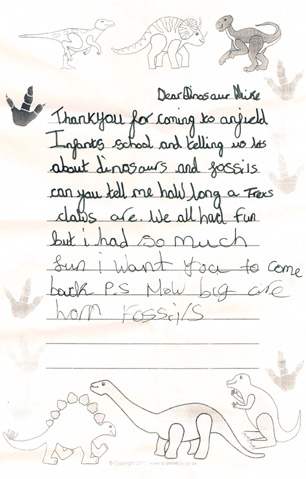
A busy week for team members at Everything Dinosaur, but we always try to make time to respond to any letters we receive from school children after one of our visits to a school.  Children at Anfield Infants and Early Years School (Liverpool, England), were studying dinosaurs this summer term and a member of the Everything Dinosaur staff was invited in to help the budding young palaeontologist with their prehistoric animal studies.

School Visit

Children in the “Bright Sparks” class were asked by the enthusiastic teaching team, Miss Ledgerton, Miss Hardcastle and Mrs Envis to write thank you letters to Everything Dinosaur and sure enough, our bulging mail bag was stuffed fuller than a Triceratop’s tummy.

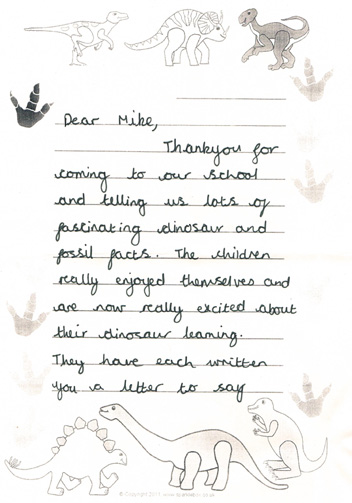
Thank you Note from the Teaching Team

Teachers thank Everything Dinosaur for the school visit.

Teachers thank Everything Dinosaur for the school visit.

Picture credit: Anfield Infants and Early Years School/Everything Dinosaur

Setting an exercise such as this after a visit from one of our dinosaur experts is a great way to help young children practice writing skills and sentence construction.  It also helps reinforce learning and the recall of information.

Thank You Letters

Amongst the many thank you letters we received, Christopher wrote that he liked looking at Ankylosaurus, whilst Jamie, Cameron and Jack were most excited about T. rex.  They wanted to know why Tyrannosaurus rex is known as the “King of the Dinosaurs”?  A very good question, the name T. rex means “Tyrant Lizard King”, when this fearsome dinosaur was formally described back in 1905, no one had ever seen such a frightening looking dinosaur before, the name was chosen as with its huge teeth and jaws, scientists at the time thought that this was the “King”.  Ironically, T. rex was very nearly called Dynamosaurus, but that’s another story.

Joseph wanted to know when the first dinosaur bones were discovered?  This is a tricky question, dinosaur fossils have been known about for a very long time, the legendary Chinese dragons may be based on scholars from China studying dinosaur bones.  The first dinosaur to be scientifically studied and formally named  in the west was Megalosaurus, a meat-eating dinosaur whose fossils have been found in England.

Everything Dinosaur

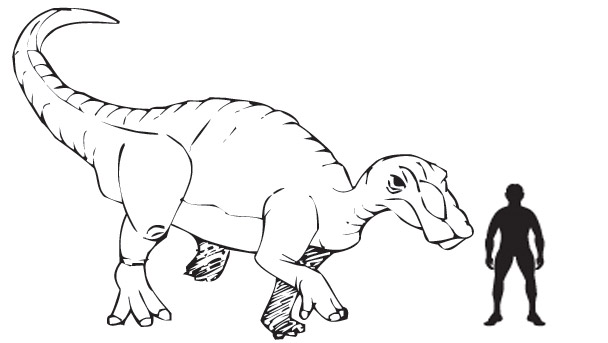
Lots of questions about dinosaurs teeth from the “Bright Sparks” of Anfield Infants and Early Years School, yes, Charlie you are right, some dinosaurs did have sharp teeth, whilst in answer to the question as to which type of dinosaurs had the most teeth we think a good contender would be the very big duck-billed dinosaur known as Edmontosaurus.  This plant-eating dinosaur (herbivore) could grow to be over forty feet long and his mouth was lined with rows and rows of teeth all designed to help this Late Cretaceous dinosaur to grind up his food.

A Scale Drawing of the Very Toothy Edmontosaurus

Edmontosaurus Dinosaur

Edmontosaurus dinosaur drawing.

Picture credit: Everything Dinosaur

A few questions on Brachiosaurus were also received.  Brachiosaurus evolved a long neck so that it could feed on parts of trees that other plant-eating dinosaurs could not reach.  Stephen wanted to know how tall Brachiosaurus was?  Some scientists have suggested that the head of Brachiosaurus was held as much as 43 feet off the ground.  This dinosaur was very heavy, it did weigh much more than an elephant, another super question, but how heavy it actually was is difficult to say, perhaps Stephen is right when he suggests in his thank you letter that some of these long-necked giants could weigh as much as 75 tonnes.

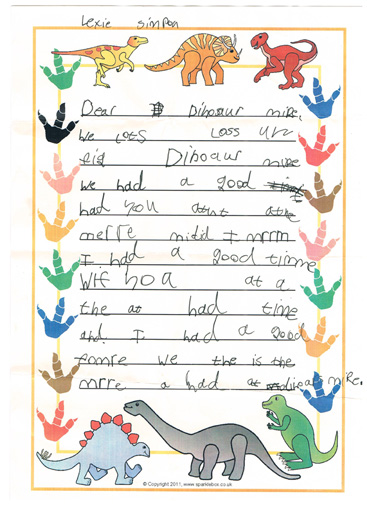
Thank you Letter From Lexie

Lexie wrote to say she had a good time studying dinosaurs.

Lexie wrote to say she had a good time studying dinosaurs.

Picture credit: Anfield Infants and Early Years School/Everything Dinosaur

Lots of Questions

Thank you for your colourful letters, Lexie, Poppy and Tilly.  Indeed, we are grateful to all the children, their teachers and the teaching support staff for writing such lovely letters.  We even had a question about the horns of Triceratops, they are quite big, the horn cores on the skull are only part of the horn.  These would have been covered in a horny sheath that would actually have made them much bigger.  Some of the large Triceratops skulls that we have studied come from dinosaurs that would have sported brow horns more than a metre long!

School Children Send in Thank you Letters to Everything Dinosaur

Pupils say thanks for the dinosaur visit.

Pupils say thanks for the dinosaur visit.

Picture credit: Anfield Infants and Early Years School/Everything Dinosaur

Thanks Caitlyn, we are glad you enjoyed holding the fossils, we give a big dinosaur roar in thanks for all the letters that we received.  Sorry if we have not mentioned everybody but we do read them all and hopefully we have managed to answer the questions you posed.

Have a happy summer holiday.

To view the extensive range of dinosaur themed toys and games available from Everything Dinosaur: Dinosaur Themed Toys and Gifts.

13 07, 2013

School Sets About Creating Their Very Own “Jurassic Park”

By |2023-02-19T06:57:17+00:00July 13th, 2013|Categories: Educational Activities, Everything Dinosaur News and Updates, Teaching|0 Comments

Weston Primary School Studies Dinosaurs

Year 5 and Year 6 pupils at Weston Primary have been busy creating a series of prehistoric animal sculptures as part of their summer term topic on dinosaurs.  All classes have been learning about fossils and prehistoric animals, under the expert tutelage of the teachers and teaching support staff.  A team member at Everything Dinosaur, who visited the school in support of the term’s teaching topic, was given a guided tour of the palaeontology area by Reception/Year 1 children.  A part of their classroom had been set aside so that the children could show the “pieces of dinosaur” that had been excavated from a sand pit, as well as the some of the safety equipment that palaeontologists wear when digging up fossil bones.

School Studies Dinosaurs

In a day of dinosaur themed teaching activities, Year 1/2 pupils learned how to identify fossils, whilst Year 3/4 students discovered that they had all technically eaten dinosaurs, apt as their dinosaur themed workshop concluded shortly before lunch.  During lunchtime, the Everything Dinosaur team member was able to take some pictures of the artwork being created, the lawn area just outside the staff room was beginning to resemble Weston Primary’s own “Jurassic Park”.

Pupils Create Prehistoric Animal Sculptures
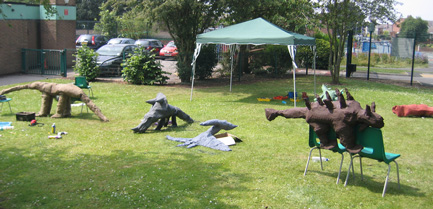
School creates "Jurassic Park"

School creates “Jurassic Park”.

Picture credit: Everything Dinosaur

Prehistoric Animal Themed Artwork

The Year 5/6 pupils under the supervision of Miss Emmison and Mr Kelly had created several pieces of prehistoric animal themed art.  Each sculpture had been carefully created and the children had spent part of the morning painting their Mesozoic monsters.  During their afternoon dinosaur themed teaching workshop, the Everything Dinosaur team member congratulated the pupils on their artistic efforts and although the artwork was not finished, he was able to identify which extinct animal each sculpture represented.

Weston Primary’s Spinosaurus
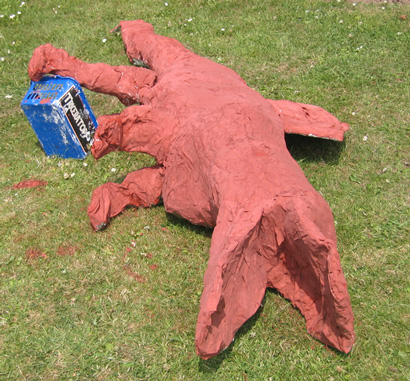
Weston Primary's Spinosaurus

Weston Primary’s Spinosaurus.

Picture credit: Everything Dinosaur

Spinosaurus, with its famous two-metre-high sail lived in North Africa during the Cretaceous.  The arm bones of this huge predator have never been found, yet the pupils have created their replica as a biped (walked on hind legs), most palaeontologists agree, this carnivore probably walked on its two back legs.

Weston Primary’s Armoured Dinosaur
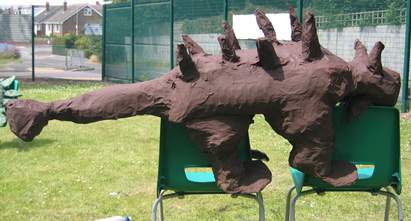
Armoured dinosaur.

Armoured dinosaur.

Picture credit: Everything Dinosaur

Armoured Dinosaurs

The brown coloured, armoured dinosaur has the bony tail club associated with Ankylosaurus, a dinosaur so heavily armoured that even the bone above its eyes was thickened and reinforced.

Weston Primary “Baby Brachiosaurus”
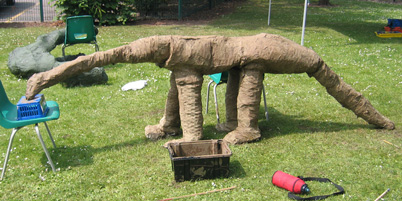
A baby Brachiosaur.

A baby brachiosaur.

Picture credit: Everything Dinosaur

School teacher Miss Emmison explained that a baby Brachiosaurus was created as trying to make a model of an adult, long-necked dinosaur would have probably used up too much newspaper and paint.  The largest dinosaur exhibit in Europe is that of a Brachiosaurus.  The head of the dinosaur skeleton is something like forty-three feet of the ground.

Weston Primary’s Tyrannosaurus rex Sculpture
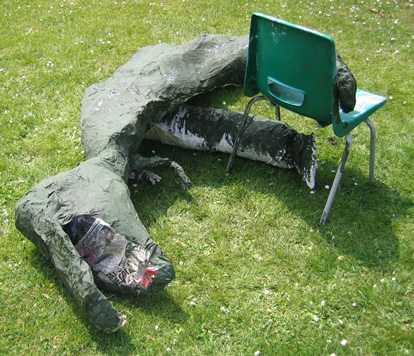
School creates T. rex statue.

School creates T. rex statue.

Picture credit: Everything Dinosaur

No dinosaur theme park would be complete without a sculpture of the most famous dinosaur of all T. rex.  The pupils have opted for a green tyrannosaurus, although the colouration of this dinosaur is not known.  T. rex may even have been covered in feathers.

Weston Primary’s Stegosaurus
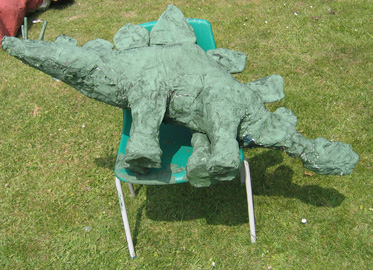
School children create model of "Roof Lizard"

School children create model of “Roof Lizard”.

Picture credit: Everything Dinosaur

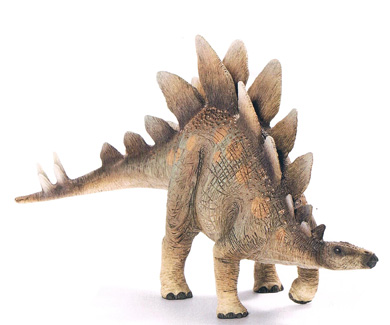
The Stegosaurus model has his plates on his back and spikes on his tail. Stegosaurus was named and described in 1877, the name means “roofed or plated lizard”.

Triceratops Makes an Appearance
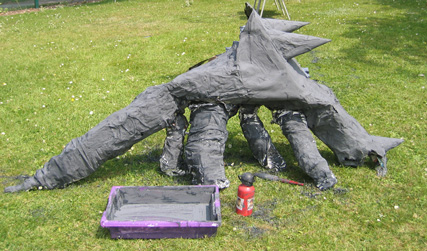
Weston Primary's "Three Horned Face"

Weston Primary’s “Three Horned Face”.

Picture credit: Everything Dinosaur

Triceratops Artwork

In the process of being painted battleship grey, the horned dinosaur model is being prepared by Year 5/6 schoolchildren.  Triceratops was one of the last of the dinosaurs, just four weeks ago, scientists working in the western United States discovered the fossilised remains of three Triceratops, perhaps this is evidence of this type of herbivorous dinosaur living in small, family groups.

To read more about this discovery: More Fossils of Triceratops Discovered.

The schoolchildren at Weston Primary have not just been working on dinosaur sculptures.  The pupils have created a model of a flying reptile, a pterosaur.  Such is the accuracy of the artwork, that the team member at Everything Dinosaur was able to identify the sculpture as being that of a Pteranodon and he had a go at naming the species – Pteranodon longiceps.

Pteranodon Model Under Construction
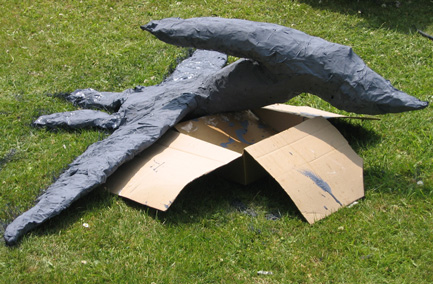
Flying reptile under construction.

Flying reptile under construction.

Picture credit: Everything Dinosaur

The shape of the crest on the back of the head can tell a palaeontologist which species of Pteranodon this is, the long crest indicates P. longiceps.

Once the sculptures have been completed the school will have its very own “Jurassic Park”.

For models and replicas of prehistoric animals including dinosaurs and pterosaurs: Papo Dinosaurs and Prehistoric Animal Figures.

11 07, 2013

Dinosaurs Inspire Unique Three-Dimensional Artwork

By |2024-04-29T14:16:37+01:00July 11th, 2013|Categories: Key Stage 1/2|Comments Off on Dinosaurs Inspire Unique Three-Dimensional Artwork

Year 5 and Year 6 Pupils Make 3-D Models of Dinosaurs

Pupils at Weston Primary have been showing their artistic skills by building a set of prehistoric animal sculptures as part of their summer term topic studying dinosaurs and fossils.  All the classes in Year 5 and Year 6 at the school have been learning about prehistoric animals and fossils, under the tutelage of the teaching team.  A member of Everything Dinosaur, who visited the school as part of a dinosaur workshop, was treated to a guided tour of the exhibits, a sort of work in progress.  Part of a classroom had been set aside to display the artwork, some pieces were over one and a half metres in length.

Models of Dinosaurs

Upper Key Stage 2 Pupils Make Dinosaur Sculptures

A T. rex model in production.

School creates T. rex statue.

Picture credit: Everything Dinosaur

A team member at Everything Dinosaur, who visited the school in support of the term’s teaching topic, was given a guided tour of the prehistoric themed artworks by the Year 1 and Reception children.  A part of the Key Stage 1 area  had been roped off so that the children could show the “pieces of dinosaur” that had been excavated from a sand pit, as well as the some of the safety equipment that palaeontologists wear when digging up ancient bones.  This was an excellent idea as it gave the children an important example of “Health and Safety” at work.

Dinosaur and Fossil Workshops

During the dinosaur and fossil workshops, each of the classes were given activities which dovetail into the national curriculum.  For example, Year 3 students discovered that they had all technically eaten a dinosaur and Year 2 pupils learned how fossils are formed, what rocks contain fossils and what to do if you should be so lucky to find a fossil.

One of the Completed Dinosaur Sculptures

Stegosaurus model.

School children create model of “Roof Lizard”

Picture credit: Everything Dinosaur

During the lunch break, in between answering questions from teaching assistants and discussing extension activities, the Everything Dinosaur team member was able to take some photographs of the exhibition area.  The site was beginning to resemble Weston Primary’s own version of the Crystal Palace dinosaurs.

To view the inspirational range of dinosaur themed crafts, toys and games available from Everything Dinosaur: Dinosaur Crafts, Toys and Games.

4 07, 2013

Young Palaeontologists Reconstruct a Beautiful Stegosaurus Skeleton

By |2024-04-29T14:18:53+01:00July 4th, 2013|Categories: Educational Activities, Teaching|0 Comments

Children at West Walton Community Primary School Learn about Dinosaurs

Children in the reception class at West Walton Community Primary have been learning all about dinosaurs and fossils this term, under the enthusiastic tutelage of the teaching and support staff at the school.

The budding young palaeontologists have been excavating dinosaur bones out in the school yard, creating pictures and writing stories about prehistoric animals, they even got the chance to produce some lovely artwork.  Spotted in pride of place on one of the walls of the reception classroom was this beautifully constructed illustration of the skeleton of the dinosaur known as Stegosaurus.  When asked, the children were eager to share their knowledge of dinosaurs, explaining that Stegosaurus was a plant-eater, with plates on his back, spikes on his tail and this dinosaur had a very small brain – no bigger than a walnut.

Stegosaurus Skeleton Artwork

The Stegosaurus Illustration in the Classroom

Young children study dinosaurs.

Young children study dinosaurs.

Picture credit: West Walton Community Primary School

Mrs Hughes, one of the reception class teachers explained that the children had been very keen to study dinosaurs this term and when it came to creating the class’s own Stegosaurus skeleton the children were determined to make it as accurate as they could.  She told a team member at Everything Dinosaur who visited the school, that one little boy even measured the ribs in order to make sure they were the right size.

Stegosaurus Illustration

It is certainly a very commendable effort and Stegosaurus is one of the most iconic of all the members of the Dinosauria.  As for the small brain size, the walnut metaphor seems to be universally accepted and team members at Everything Dinosaur have come across it on many occasions.  It is true that when the brain to body size ratio for a large number of dinosaurs is considered, then in comparison with their huge bulk, a lot of dinosaurs do seem to have possessed very small brains indeed.  Using a walnut to describe the brain size of a dinosaur, seems to date back more than one hundred years.

One of the earliest examples, of the “walnut phrase” being used comes from a illustrated book “Mighty Animals”, first published in 1912.  The description was applied to the Late Jurassic dinosaur Diplodocus, not Stegosaurus.

There is a reference to the eminent American palaeontologist Edwin Colbert describing the Stegosaurus brain as “being not much bigger than a walnut” back in 1945 and within Everything Dinosaur’s extensive reference library, we have come across one description from shortly after the Second World War that describes the brain of Stegosaurus as being “only as big as a prune”.

A Scale Drawing of Stegosaurus

An illustration of Stegosaurus (S. stenops).

An illustration of Stegosaurus (S. stenops).

Picture credit: Everything Dinosaur

Knowledge of Neuroanatomy

As our knowledge of neuroanatomy has developed so our interpretation of intelligence has changed.  The crude measure of body size to brain size, does not necessarily give an indication of “intelligence”, as different behaviours in animals can be seen as a form of intelligence.  For example, the brain of the grey squirrel is small, these little rodents that leap about in the trees at the back of Everything Dinosaur’s warehouse, still exhibit remarkable feats of memory far superior to our own when it comes to locating nuts that they have buried.

Another method of estimating relative  intelligence is the Encephalisation Quotient (EQ).  This analysis is based on the principle of comparing the brain volume of the animal being studied to the brain volume of a control animal with approximately the same body weight.  Here too, the assumption is that animals with larger brains to body ratios are more intelligent than animals with smaller brains to body size ratios.

Cold-blooded bony fish such as the Pacific Salmon have a brain size just one tenth of that of a similar sized mammal, yet these fish are capable of navigating thousands of miles and making their way upstream, overcoming all sorts of obstacles and obstructions.

Although, the likes of Stegosaurus had very small brains, these animals were clearly well adapted to their environments and we as a species have much more to learn about when it comes to estimating relative intelligence and defining intelligent behaviours in the rest of the Animal Kingdom.  After all, Homo sapiens has been around as a species for over two hundred thousand years, but the Stegosaurs as a group may have existed for more than thirty-five million years.

Stegosaurus – Well Adapted to its Environment

A remarkable dinosaur.

A remarkable dinosaur.

Picture credit: Everything Dinosaur

Perhaps the budding palaeontologists inspired by the teaching staff at West Walton Community Primary will one day carry out some research the helps improve our understanding and interpretation of intelligent behaviours in the Kingdom Animalia.

To view models of stegosaurs and other other armoured dinosaurs take a look at the PNSO model collection: PNSO Prehistoric Animal Models and Figures.

29 06, 2013

Ocker Hill Junior School Pupils Study Rare Dinosaurs for Special Science Week

By |2024-04-29T14:26:08+01:00June 29th, 2013|Categories: Educational Activities, Press Releases, Teaching|0 Comments

 Journey into the Jurassic for Junior School Pupils

Pupils at Ocker Hill Junior School are getting into all things prehistoric as  they embark on a week-long science themed teaching topic with a focus on the dinosaurs.  Based at Tipton, (West Midlands), just a geologist’s stones’ throw from the Wrens Nest Nature Reserve, the UK’s very first national nature reserve for geology, the staff at the school have been working on all sorts of clever and creative activities to help bring the past to life.

Dinosaurs for Science Week

Looking at different types of dinosaurs and classifying them led to the development of a series of Venn diagrams as pupils under the tutelage of their teachers and support staff explored how best to present data relating to the Dinosauria.  Getting school children to understand the concept of deep time can be a little tricky, but teacher Mr Wilde, armed with some stakes and a hammer set out to provide a scale model of the various geological periods using the school grounds.

Each stake representing a period in geological time was carefully marked and hammered into place to give the budding young palaeontologists an idea of how old the Earth is believed to be.  This is an excellent idea, a very practical demonstration of geological time, one that will help the children to grasp what different types of creatures lived and when.

Everything Dinosaur Team Members Visit School

Team members at Everything Dinosaur were invited in to kick start the week by holding a series of workshops with pupils in years three to six.  The chance to explain what fossils can tell scientists and to explain a little about the science of palaeontology.  Sarah Southall, one of the year three teachers was surprised to learn that there is a dinosaur named “Sarahsaurus, whilst Mrs Brookes (year 5 teacher) and some of her charges discovered just how big or (how small), the arms of Tyrannosaurus rex actually were.

Mr Goodwin (year six), had been helping his class to learn more about marine reptiles.  Under the expert guidance of school artist Darrell Wakelam the pupils had created a wonderful reconstruction of the fossilised skeleton of an Ichthyosaurus.

Bringing the Past to Life

Year six pupils constructed their own Ichthyosaurus fossilised skeleton

Year six pupils constructed their own Ichthyosaurus fossilised skeleton

Picture credit: Ocker Hill Junior School

Coprolite on Show

Everything Dinosaur had some coprolite (fossilised poo) from the body cavity of an ichthyosaur skeleton team members had been working on, the children were delighted when Mr Goodwin got to handle the 180 million year old fossil poo and to demonstrate what the creature had been eating by being able to point out the fish scales still preserved within the specimen.

It is certainly going to be an exciting week for the students.  The enthusiastic teaching team have lots and lots of dinosaur themed maths, science and art activities planned all helping to enthuse and motivate the next generation of scientists.

To view the range of sea monster models including ichthyosaurs available from Everything Dinosaur: Models of Sea Monsters and Other Prehistoric Animals.

15 05, 2013

Could Alligators Give us All “Crocodile Smiles”? An Important Breakthrough

By |2024-04-29T13:56:16+01:00May 15th, 2013|Categories: Key Stage 3/4|Comments Off on Could Alligators Give us All “Crocodile Smiles”? An Important Breakthrough

Stem Cell Research Provides Clues to Human Tooth Regeneration

Scientists from the University of California have identified the processes by which an Alligator is able to grow a replacement tooth if it loses one.  A better understanding of this at the cellular level could eventually lead to a radical reform of dentistry, with patients able to grow a replacement tooth should one have to be removed due to decay or trauma.

Stem Cell Research

The Alligators used in the study (Alligator mississippiensis) are one of a number of extant, vertebrate genera that are able to replace teeth that are lost throughout their adult lives.  Reptiles and fish have this ability to regenerate teeth if they are lost and also dinosaurs had teeth replacement too.  Quite helpful if you are a seven tonne Tyrannosaurus rex with arms so tiny that they could not even reach their mouths to clean their teeth, had toothbrushes been around in the Late Cretaceous.

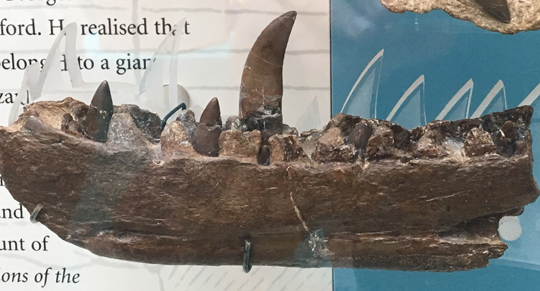
Tooth Replacement Frequently Observed in Fossils Representing Dinosauria

The lower jaw of Megalosaurus.

The partial dentary for teeth associated with Megalosaurus bucklandii. Picture credit: Everything Dinosaur.

Picture credit: Everything Dinosaur

The picture above shows the jaw of the first dinosaur to be scientifically described (Megalosaurus bucklandii), teeth erupting through the jaw bone can be clearly identified.

For models and replicas of Megalosaurus (whilst stocks last) and other meat-eating dinosaurs: CollectA Prehistoric Life Models and Figures.

Identifying Tooth Components

Using powerful microscopes, the Californian research team were able to identify a “family” of tooth components that made up the conical teeth of these predators.  There was the functioning tooth in the jaw, a replacement ready to erupt and a third element, the dental lamina.

A spokesperson from Everything Dinosaur commented:

“This is essentially a conveyor belt operation, as the functioning tooth is lost, then the other family members advance to ensure that the Alligator retains its bite.”

The dental laminae contains stem cells from which the teeth replacement function is initiated.  It is hoped that with a better understanding of this dentition, scientists may be able to isolate the stem cells and genetically combine them with tissue cells from the human jaw.  If this could be done, then it raises the possibility of human beings being able to grow replacement teeth, to give us all a “smile like a crocodile”.

To read more about this research: We Could All Soon Have the Smile of a Crocodile.

10 05, 2013

Colourful Thank You Letters From Year 2

By |2023-02-16T18:52:28+00:00May 10th, 2013|Categories: Educational Activities, Photos/Schools, Press Releases, Teaching|0 Comments

School Children Studying Dinosaurs Say Thank You

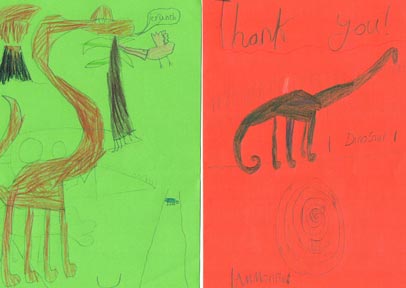
A few days ago Everything Dinosaur received a parcel from a teacher at a primary school we had visited (Great Wood Primary).  The teacher had asked her pupils to compose a thank you letter and to write about some of things they did during our visit to their school.   The parcel contained a set of thank you notes with lots of amazing and very colourful prehistoric animal drawings.  There were many different designs, although long-necked dinosaurs (sauropods), proved a particularly popular subject for the front of the card.

Thank You Letters

Dinosaur Themed Thank You Letters

Drawings of long-necked dinosaurs (Sauropods) proved to be popular.

Drawings of long-necked dinosaurs (sauropods) proved to be popular.

Picture credit: James and Olivia

Ellie drew a flying reptile on the front of her card and she enjoyed learning about Tyrannosaurus rex, whilst Amy chose to illustrate her card with lots of pink dinosaurs and liked learning about Triceratops the best.  Jake drew a very scary looking dinosaur on his thank you card, Lucy illustrated her card with a spiky dinosaur, Matthew (Matthewosaurus) was particularly impressed with the skull of the armoured dinosaur that he saw.

Our mailbag was full of lovely dinosaur cards.

Our mailbag was full of lovely dinosaur cards.

Picture credit: Elliot and Aki

Everything Dinosaur

Leah wrote that she “learned that T. rex had very big teeth“, Josh sent in a card covered with big ticks and asked how did the dinosaurs come alive?  A terrific question Josh, we think that all dinosaurs hatched from eggs, perhaps you can think of animals that are alive today that hatch from eggs, can you and your classmates come up with a list?  We loved the big smiling dinosaur on Toby’s card and Spencer wrote a very long letter, recalling lots of facts about dinosaurs that had come up in our work that day.  Our thanks to Dylan for his wonderful dinosaur drawing, the big bones that were in one of the boxes were part of the leg bones from a Stegosaurus, well spotted Dylan!

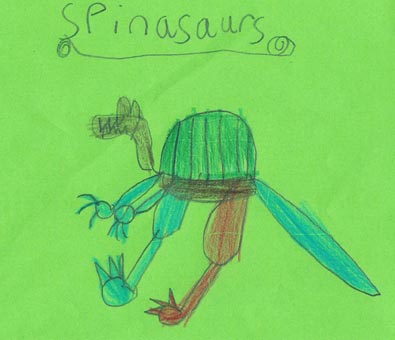
Spinosaurus and Spinosaurs by Max

Max drew a multi-coloured Spinosaurus.

Max drew a multi-coloured Spinosaurus.

Picture credit: Max

Lots of Fun!

Lucy said that she had lots of fun and liked handling the fossils, she even drew some bones on the front of her card, Ruby had a great time as well and she liked learning about teeth. Isobel sent in a lovely picture of a dinosaur with a big smile, must be a very friendly dinosaur.

Our thanks to all the pupils for creating such wonderful cards and to their teacher for taking time out of her busy schedule to send them into us.

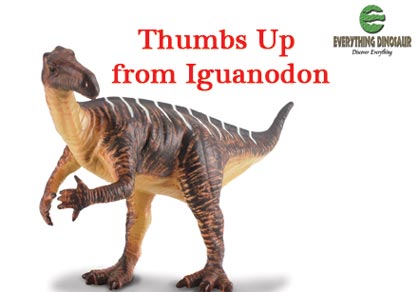
Our Iguanodon gives Great Wood Primary a big “thumbs up”.

Iguanodon Gives the School Children a Big “Thumbs Up”!

Praise from a dinosaur!

Praise from a dinosaur!

Picture credit: Everything Dinosaur

To view Everything Dinosaur’s wide range of toy dinosaurs and games: Everything Dinosaur – Toys and Gifts.

1 05, 2013

School Children Measure a Beautiful Triceratops

By |2024-04-29T14:04:41+01:00May 1st, 2013|Categories: Educational Activities, Teaching|0 Comments

Measuring a Triceratops Footprint at Great Wood School

Children at Great Wood Primary have been busy studying dinosaurs as part of their summer term’s teaching activities.  The teaching team have developed a wide range of activities for their young charges and a team member from Everything Dinosaur visited Year 2 to help reinforce some of this learning and to provide some expertise to assist the budding young palaeontologists with their explorations.

What is Your Favourite Dinosaur?

The children had lots of questions, for example, one question asked was what is your favourite dinosaur?  A tricky question but perhaps Protoceratops would be a strong contender.  Known as the “sheep of the Cretaceous”,  a reference to the size of this dinosaur and to the amount of fossils of this dinosaur found in Mongolia, Protoceratops belonged to the same family group of dinosaurs as Triceratops.   An idea to help the school children learn about how to express data might be for them to produce a tally count recording the favourite prehistoric animals of the class.  This data could then be compiled into a bar chart.  The picture below shows a typical bar chart which has been generated following a tally count exercise by Year 2 children.

A Bar Chart Recording Favourite Dinosaurs

A tally count and then a bar chart to plot the data.

A tally count and then a bar chart to plot the data.

Picture credit: Everything Dinosaur

Dinosaurs as a Term Topic

Dinosaurs as a term topic, does lend itself to all sorts of extension activities.  Dinosaurs seem to have enthused both the pupils and the teachers at Great Wood Primary.

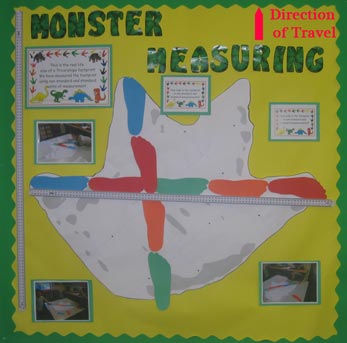
Miss Bolton and her class have been studying dinosaur footprints.  Scientists can learn a lot from the footprints and tracks preserved as trace fossils.  The class have created a colourful poster display of a Triceratops footprint.  Their poster shows the various ways in which the class could measure the size of the footprint of this four-legged, herbivorous dinosaur.

Pupils Measure a Triceratops Footprint

Triceratops Footprint Gets Measured

Triceratops footprint gets measured.

Picture credit: Everything Dinosaur

Dinosaur Footprints

The children compared the size of their feet to the scaled up version of the footprint made by a Triceratops.   Footprints can provide ichnologists (scientists who specialise in studying trackways) with a lot of information.  For example, the shape of the print provides an indication about the sort of animal that left that track.  Long-necked dinosaurs (sauropods) produced rounded or oval shaped prints, whilst meat-eating dinosaurs made three-toed prints (tridactyl) prints in most cases.

The direction of travel of the animal can be worked out.  In the picture above, showing the children’s poster, Everything Dinosaur has put an arrow in the top right-hand corner indicating the direction this Triceratops was moving in.  Just like our own footprints, the marks left by the toes show the direction of travel.

With Triceratops, this isolated print can tell us something more.  Triceratops had five toes on its front legs, but only four toes on its back legs.  By counting the toes, scientists can work out whether this print was made by a front foot, or a back foot.  There is a lot of information that can be obtained from studying fossilised footprints.  Dinosaur tracks have been found all over the world, although they are much rarer than fossilised bones.

Footprints are only preserved when conditions for potential preservation are absolutely right.  The ground must be soft enough to hold an impression of the print, but not too soft as the prints will soon collapse and fill in.  The footprints must be covered quickly by something that protects them such as sediment or sand. In these exceptional circumstances tracks made by a dinosaur or even a whole herd of dinosaurs might be preserved.

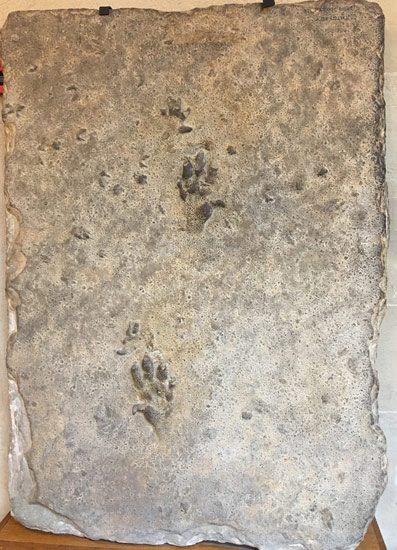
Prehistoric Animal Tracks – A Trace Fossil Preserving Behaviour

A Chirotheriuim trackway.

Chirotherium tracks on display at the Oxford University Museum of Natural History.

Picture credit: Everything Dinosaur.

To view the extensive range of dinosaur themed toys and gifts available from Everything Dinosaur: Dinosaur Toys and Gifts.

Go to Top