All about dinosaurs, fossils and prehistoric animals by Everything Dinosaur team members.

Everything Dinosaur team members working in schools, helping museums and other educational bodies. Our work with and in schools.

21 01, 2014

A Lovely Thank You Letter from Class RJ (Reception)

By |2024-05-02T07:13:52+01:00January 21st, 2014|Categories: Educational Activities, Teaching|3 Comments

Reception Class Sends in Thank You Note To Everything Dinosaur after Dinosaur Workshop

Everything Dinosaur team members are busy visiting schools all over the UK at the moment.  We need to become as fast as a speedy Struthiomimus in order to keep up with all our other duties at this time of year.  However, we do try and respond to every email, letter, drawing sent in and such like, especially from young dinosaur fans and budding palaeontologists.

Everything Dinosaur

After a school visit to work with some children in reception classes (aged 4-5) years, we received a thank you letter from class RJ.

Class RJ Say Thanks for the Dinosaur Workshop

Class RJ's letter

Class RJ’s letter.

Picture credit: Class RJ

Thank You Note

Miss Jones, (the teacher) emailed to say how much the children enjoyed learning about dinosaurs.  She went onto add that the children came up with the letter and helped to write the words.  Always a pleasure to hear from school children and we encourage such imaginative writing in reception classes, they can really help young children with their sentence construction and appreciation of grammar.  Naturally, we took time out of busy schedule to compose a reply and to email it over to the school.

Saying Thank You for the Thank You

Thank you for your kind letter.

Thank you for your kind letter.

Picture credit: Everything Dinosaur

The children under the expert guidance of their teachers and the support staff had prepared lots of questions in time for our visit to the school.  A number of classes had thought about the sort of questions they would like answered and then these were written down with the help of the teacher, we did our best to answer them all.

School Children Prepare Lots of Questions

Lots of questions prepared by school children.

Lots of questions prepared by school children.

Picture credit: Everything Dinosaur

So many questions, the children were very enthusiastic and we were really impressed with their knowledge about prehistoric animals.  We were so pleased that these budding scientists enjoyed looking at the dinosaur bones.

When conducting dinosaur workshops for reception, it is important to consider extension activities that can take place once the visit is over to help reinforce learning and to check understanding.  In this way, Everything Dinosaur team members can further support the work of the teachers in the school.

To view the range of informative, education dinosaur toys and games in stock: Dinosaur Gifts, Models and Toys.

16 01, 2014

Dinosaurs Help Young Children with Phonics (Free Teaching Resources Available)

By |2024-05-02T07:00:30+01:00January 16th, 2014|Categories: Early Years Foundation Reception|Comments Off on Dinosaurs Help Young Children with Phonics (Free Teaching Resources Available)

Dinosaurs Help Children with Phonics

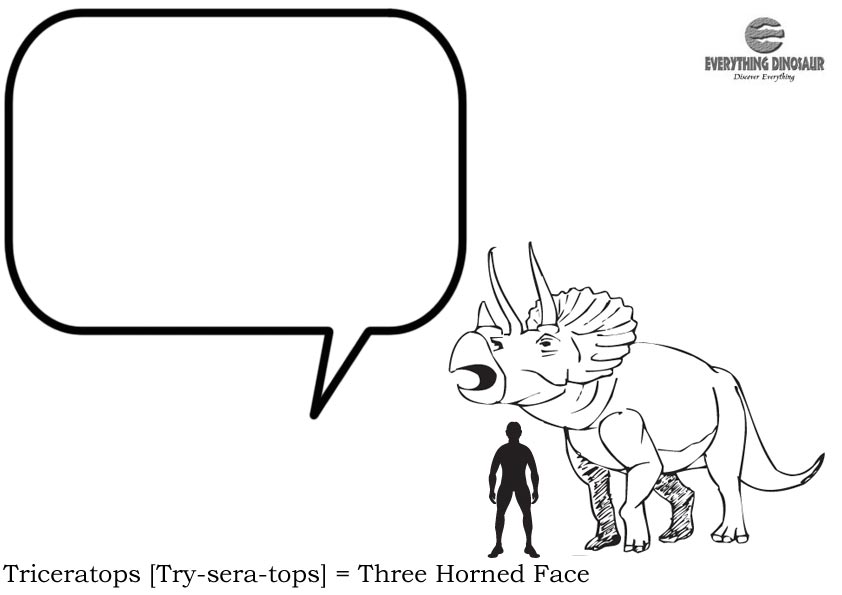
Team members at Everything Dinosaur, the UK-based dinosaur toy and model retailers have developed a number of teaching resources to help teachers and home educators.   Many of these resources are available as free downloads on the company’s dedicated teaching site.  Basic word recognition, word sounds and reading skills can be helped by utilising dinosaurs to demonstrate that learning can be fun.  For instance, a speech bubble situated adjacent to a picture of a dinosaur can help young children to consider what third parties might be thinking or saying.  This can also help when educators are exploring concepts such as empathy and feelings.

Dinosaurs Help Young Children

Dinosaurs Help with Phonics

Triceratops helps with speech development.

Exploring emotions and helping to construct sentences.

Picture credit: Everything Dinosaur

Free Teaching Resources

Many teachers have utilised Everything Dinosaur’s free teaching resources to help children learn using the phonics method.  The long names of dinosaurs can form part of a fun teaching text.  Lots of books about dinosaurs aimed at younger readers, contain helpful pronunciation guides and our team members can always be contacted as they are happy to help out.  The tongue-twisting nature of some dinosaur names can add to the sense of achievement when a name or phrase is said correctly.

With Foundation Stage children, when delivering dinosaur workshops in schools, we are keen to focus on developing an appropriate, diverse vocabulary.  Children like dinosaurs, things to do with the Dinosauria, such as their long names, to a child, can be exciting.  Useful to know when trying to motivate the next generation of readers.

A spokesperson from Everything Dinosaur commented that children seemed to have a fascination for dinosaurs and had no trouble pronouncing their long and often complicated names.

To view the range of dinosaur themed toys and games available from Everything Dinosaur: Dinosaur Gifts and Toys.

16 01, 2014

Dinosaur Names Help Young Children with their Phonics

By |2023-03-02T13:29:24+00:00January 16th, 2014|Categories: Educational Activities, Press Releases, Teaching|0 Comments

Dinosaur Names Just Trip off the Tongue – Especially when you are Three

Why is it that your three year old, thinks nothing of stating the names of several dinosaurs when at times they struggle to come to terms with the correct pronunciation of their own name?  What is it about dinosaurs and their long names that seem to have a universal appeal to children?

Dinosaur Names

That is one of the questions put recently to one of our dinosaur experts who writes lesson plans for children at the Foundation Stage level in primary schools.  This phenomena has been observed and commented on by many parents and grandparents, it seems that “Diplodocus” is not a problem whilst “Da-Da” can be quite a challenge to a budding palaeontologist.

Our dinosaur expert was not aware of any research being undertaken to look at this specific element of children’s phonics and their grasp of speech.  However, it is known, that most  young children up to the age of seven years have an extraordinary ability to pick up speech and expand their vocabulary.  Perhaps the sound of the words themselves have a frisson of excitement about them, the longest genus name we know for a member of the Dinosauria, weighs in at twenty-three letters long – Micropachycephalosaurus (mike-cro-pack-ee-sep-hal-oh-sore-us).  Could dinosaur name pronunciation leave a tingle on the lips?  Certainly, most young children learning about dinosaurs seem to relish and enjoy such tasks.

A Strong Sense of Achievement

Once said, there might be a strong sense of achievement of being able to pronounce such a long word.  The child could be picking up cues from the parent or grandparent present who no doubt, would be expressing a sense of pride of being able to trip Tyrannosaurus rex off the tongue.  We know of a number of parents and home educators who have exploited a child’s fascination with dinosaurs to help them with their reading, writing and sentence construction.  If the young pupil loves Stegosaurus, then using this Late Jurassic herbivorous dinosaur in a fun activity to look at how to pronounce words and to get to grips with writing is a bit like pushing at an open door.

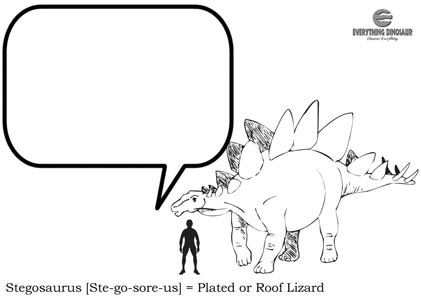
Stegosaurus Bubble Speech Diagram

A typical teaching resource provided by Everything Dinosaur.

A typical teaching resource provided by Everything Dinosaur.

Picture credit: Everything Dinosaur

Developing Teaching Aids

Everything Dinosaur have developed a number of teaching aids to help parents, teachers and home educators to teach basic word recognition and reading skills to their young charges.  For example, a speech bubble placed onto a picture of a dinosaur can help the child to consider what the dinosaur might be saying or thinking.  This can also help the child to consider what third parties might be feeling, thinking or saying.  A number of teachers have helped children learn to read using phonics, with dinosaurs and their long names as part of the teaching text.

Many children’s books about dinosaurs contain a handy pronunciation guide or readers are welcome to contact Everything Dinosaur by leaving a comment on one of our many blog posts and we will do our best to help when it comes to those tongue-twisting dinosaur names.

When delivering dinosaur workshops in schools, especially when working with Foundation Stage children, it seems that dinosaur names are tackled and pronounced with relative ease.  Perhaps like most things to do with the Dinosauria, to a three year old, even the animal’s names are exciting.

To view the exciting range of educational toys and games including models of iconic animals only known from fossils: Fossil Replicas, Dinosaur Games and Toys.

14 01, 2014

Remarkable, Rare Ancient Neanderthal DNA and US

By |2024-05-02T06:59:14+01:00January 14th, 2014|Categories: Key Stage 3/4|Comments Off on Remarkable, Rare Ancient Neanderthal DNA and US

We May have the Neanderthals to Thank for Some Modern Human Diseases

Some of the diseases that plague our own species (Homo sapiens) may be as a result of our ancestors the Neanderthals (H. neanderthalensis).  A new study undertaken by a joint German and U.S. based team which has been published in the academic journal “Nature” suggests that our inherited genetic make-up has made us more susceptible to some types of disease.  In addition, for those of us who smoke, you can blame the Neanderthals for your inability to give up.  Genes passed down to our species from our very close relatives, may be responsible for our poor record when it comes to giving up addictions.

Ancient Neanderthal DNA

The Neanderthal In All of Us

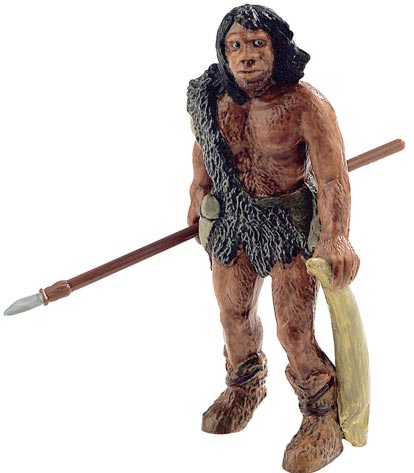
Model of a Neanderthal man.

A model of a Neanderthal man.

The research team, comprising of scientists from the Max Planck Institute of Evolutionary Anthropology (Germany) and the Harvard Medical School (USA) also revealed that other traits such as strong nails, hair colour and the ability to cope better in cold climates might be as a result of our species partial Neanderthal heritage.

For models and figures of ancient hominids: Wild Safari Prehistoric World Models and Figures.

What is Inheritance?

Children inherit their genetic information from their parents (half from the mother, half from the father).  Genetic information is information which is inherited from the parents of organisms by the offspring.  Certain characteristics of all organisms are determined by genetic information and this research team has identified a number of traits that has been passed onto our own species by Homo neanderthalensis or our shared common ancestor.

What Proportion of our Genetic Make Up is Neanderthal?

In those members of the human population who are described as non-African in origin, (particularly non-sub-Saharan African), there is a small amount of Neanderthal DNA present in their genome.  A genome is an organisms complete set of genes, all the information and instructions required to build and maintain that organism.  The level of identifiable and traceable Neanderthal DNA varies from approximately 2% to around 4%, a small amount, but this is not surprising since it is believed that the Neanderthals and our species common ancestor lived around 500,000 years ago.  The amount of DNA we share with Neanderthals is still higher than expected given the estimated length of time since our common ancestor lived.  Two main theories have been proposed:

  • Firstly, the dating of the split from a common ancestor may be earlier than previously thought, around 350,000 years ago for example
  • Or, that cross-breeding between these two very closely related species occurred resulting in the higher level of Neanderthal inherited DNA

To read a more detailed article about this research: Study Suggests That Some Human Diseases Linked to Inherited Neanderthal DNA.

28 11, 2013

A Wonderful Camarasaurus for Cameron

By |2024-05-02T06:25:58+01:00November 28th, 2013|Categories: Educational Activities, Teaching|0 Comments

Cameron’s Camarasaurus (Dinosaur Workshops in School)

Whilst working with a class of school children during one of Everything Dinosaur’s frequent school visits to undertake dinosaur themed workshops we explored how scientists go about naming organisms.  Inevitably, how dinosaurs got their names became the focus of this part of the lesson topic.

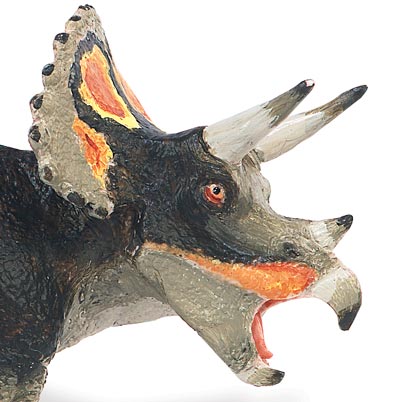
The children were able to demonstrate what they had learned during the term by correctly identifying various prehistoric animals and stating what the name of the animal actually means.  For example, Triceratops means “three horned face” and anyone who has seen a picture of this ceratopsian’s skull can see for themselves the three-horns that adorn it.  The two large, brow horns over the eyes and the smaller nose horn.

Triceratops means “Three Horned Face”

Three-horned face.

Three-horned face.

Picture credit: Everything Dinosaur

The children learned that it is often the job of the person who discovers the dinosaur’s fossil bones to come up with a name for that animal.  Cameron asked, if he had to name a dinosaur could he call it Cameronsaurus?  Our team member explained that there was already a dinosaur that had a very similar name – Camarasaurus (C. supremus).

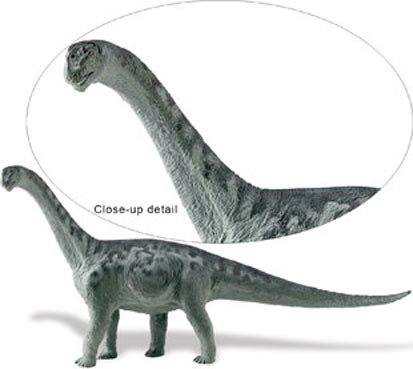
Camarasaurus

Camarasaurus was a long-necked, herbivore, a member of the Sauropoda that lived in the western United States during the Late Jurassic (155-145 million years ago).  It was a large animal, perhaps measuring in excess of twenty metres when fully grown.

An Illustration of the Sauropod Camarasaurus

Camarasaurus

Camarasaurus dinosaur model.

Picture credit: Everything Dinosaur/Safari Ltd

Dinosaur Names

Everything Dinosaur then challenged the class to design their own dinosaur and to come up with a name that describes the prehistoric animal, one that could be used to name their very own dinosaur.

To view models of sauropods, ceratopsids and other herbivorous dinosaurs, take a look at the extensive range of Safari Ltd models in stock at Everything Dinosaur: Wild Safari Prehistoric World Models and Figures.

26 11, 2013

Special “Dinovember” at Barton Moss Community Primary School

By |2024-04-22T14:36:03+01:00November 26th, 2013|Categories: Educational Activities, Teaching|0 Comments

Pupils Learn All About Dinosaurs at Barton Moss Community Primary

Year 3 pupils at Barton Moss Community Primary have been turning this month into “Dinovember” with a whole range of dinosaur and fossil themed activities as the children learn all about prehistoric animals.   Under the tutelage of Mr Sagar and Miss Wardle both classes of Year 3 pupils have been studying dinosaurs and the classrooms have on display some lovely examples of the children’s drawings and creative writing.  A team member from Everything Dinosaur was invited along to show the children some fossils and to illustrate the size and scale of dinosaurs.  The pupils were quick to demonstrate their knowledge and to point out which dinosaurs were carnivores and which were herbivores.

“Dinovember”

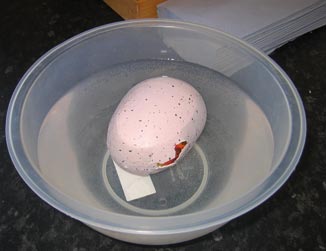
Helped by the enthusiastic Teaching Assistants, Miss Marsh and Miss Thomas, each class have been looking after their very own dinosaur egg and the children are waiting to see what will happen next.

One of the Dinosaur Eggs in the Classroom is Getting Ready to Hatch

Can you see the crack in the egg?

Picture credit: Everything Dinosaur

Dinosaur Eggshell

Some of the pupils got to examine pieces of real dinosaur egg shell and they learned the reasons why dinosaur eggs were not as big as you might imagine.  Lots of questions were asked and our dinosaur expert was able to answer most of them, taking time out to explain using some of the fossils and to check the children’s understanding, we really enjoyed looking at some of the children’s dinosaur drawings including Kamila and her “Kamila-oh-saurus”.

The Second Dinosaur Egg in Mr Sagar’s Class

Could be a T. rex about to hatch?

Picture credit: Everything Dinosaur

Tyler and Tylosaurus

Young Tyler was told all about a huge marine reptile that has a similar name to his (Tylosaurus).  Our dinosaur expert explained that Tylosaurus ate ammonites and other sea creatures and there were some ammonite fossils on hand so that the children learn a little bit more about these sea creatures, which Cain correctly guessed were related to today’s squid.  Caprice even produced a wonderful mime of an ammonite, swimming, bobbing up and down in the water and shooting out its tentacles to catch a fish.

Young Denver, in Mr Sagar’s class learned that he too, shares a name with a prehistoric animal, this time it’s a dinosaur – Denversaurus.  Scale drawings of both the Tylosaurus and the Denversaurus have been sent over to the school so that the children can see how big these extinct animals actually were.  Special thanks to Ethan and his chums for explaining what extinct meant and to Cole for remembering what omnivores ate.

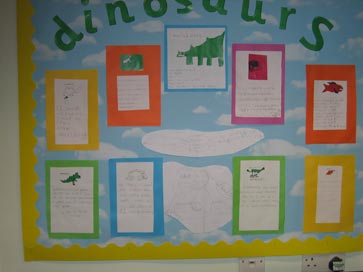
Some of the Examples of the Children’s Artwork 

Creative, inventive dinosaurs.

Picture credit: Everything Dinosaur

Dinosaur Drawings

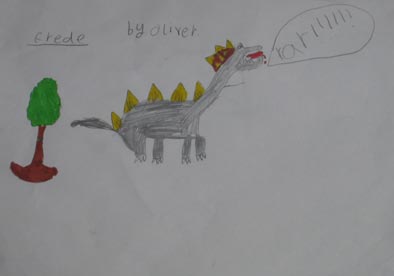
Oliver had produced a most impressive drawing of a dinosaur, he had decided to call his dinosaur Fred.  It’s a dinosaur with spikes on his back and a very loud roar.

Examples of the Children’s Work Posted up on the Classes Working Wall

A spiky dinosaur crated by Oliver.

Picture credit: Everything Dinosaur

With a new dinosaur being named and described on average every two to three weeks, there are a lot of dinosaur discoveries going on around the world at the moment, Michael and Anthony, both from Poland, got to hold a piece of a backbone from a marine reptile that had been recently excavated in the country whilst Jack learned that prehistoric animal bones can be found in this country too.  Our thanks to Courtney-May and Amy for taking notes.  Charlie and his chums correctly identified how closely related to dinosaur’s birds are, whilst Lucy helped with the experiments and Aidan got to help guess the fossil.

For further information about Everything Dinosaur’s huge range of dinosaur themed learning materials, gifts and toys: Dinosaur Themed Gifts and Toys.

Some of the questions posed by the children were very thought provoking and demonstrated a clear understanding of the term topic and there were a number of budding palaeontologists in each class. All in all, a rewarding term topic for both teachers and pupils and as a final challenge the children were asked to compose a thank you letter to Everything Dinosaur, a test of their recall plus an ability to show off their creative writing skills.

18 11, 2013

Dinosaurs Fight the Bullies with New Posters

By |2024-05-02T06:28:08+01:00November 18th, 2013|Categories: Educational Activities, Everything Dinosaur News and Updates, Press Releases, Teaching|1 Comment

Anti-Bullying Week November 18th-22nd 2013

Everything Dinosaur team members have spent a busy few days preparing posters and sending them out to schools  in readiness for anti-bullying week which starts today.  Many of the educational establishments that we visit have got a robust policy towards bullying prevention and awareness.  A school’s anti-bullying strategy is in operation throughout the year and we salute the dedication of those teachers, higher learning teaching assistants, learning support staff and all those other stakeholders in the school community who work so hard to develop and implement an anti-bullying programme.

There are many organisations delivering a creative anti-bullying message throughout this week and Everything Dinosaur is pleased to play a small role in helping to raise awareness of this important issue.

Everything Dinosaur

Team members have designed three anti-bullying posters using dinosaurs as a theme. They have been inspired to do so after seeing all the very colourful and creative anti-bullying posters designed by children during school visits by Everything Dinosaur.

One of the Dinosaur Inspired, Free Anti-Bullying Posters Available

Stop the Bullies!

Picture credit: Everything Dinosaur

Anti-Bullying Posters Feature Dinosaurs

As many children love dinosaurs, we thought it appropriate if we could utilise some of our prehistoric animal drawing materials to create posters with an anti-bullying message.  The dinosaur depicted in the poster above is a fearsome meat-eating dinosaur, we could not think of a better way to get the message across.

Picture credit: Everything Dinosaur

In total three posters were created.  They are designed to be printed off onto A4 sized paper and can be laminated if required.  Hopefully, with a few of these posters pinned up around the school and any bullies will soon get the message.

Dinosaurs Fighting the Bullies

Stop bullies in their tracks!

Picture credit: Everything Dinosaur

Three Posters Designed

These posters have already been circulated to a large number of schools.  Everything Dinosaur has been proactive and through its links with the National Autistic Society (N.A.S) in the UK, these posters have been made available free of charge to the head teachers of all the schools registered with the N.A.S.

If you would like to get one of these posters for yourself, or indeed all three, it could not be more simple.  Just email us (see link below), and one of our team members will email you back with the posters available as downloadable attachments.

Contact us: Email Everything Dinosaur.

A spokes person from Everything Dinosaur commented:

“With our vast library of dinosaur pictures, drawings and images we thought it a good idea if we used some prehistoric animals to help get the anti-bullying message across.  Let’s hope that we can all work together to help make bullying extinct.”

It is important that bullying prevention and awareness is taught throughout the school year, but during this week, Everything Dinosaur is proud to be involved and hopefully helping to make a difference.

To view the range of prehistoric animal themed toys, models and games available from Everything Dinosaur: Visit Everything Dinosaur’s Website.

15 11, 2013

Palaeontology at Painsley Catholic College

By |2023-03-01T09:36:35+00:00November 15th, 2013|Categories: Educational Activities, Teaching|0 Comments

Primary School Children Track Down Dinosaurs at Painsley Catholic College

Year four and five students attending local primary schools in Staffordshire had the opportunity to visit the well-appointed science labs at Painsley Catholic College and to take part in some dinosaur themed studies.  The pupils all from Federation Primary schools which are feeder schools for the College, were invited to join an expert from Everything Dinosaur as part of the College’s outreach programme as teaching staff help to prepare children for the challenges and opportunities of secondary education.

Dinosaur Workshop

The morning’s activities focused around teaching the fundamentals of scientific methodology with the pupils given the opportunity to examine fossils, look at evidence and to come up with their own ideas and theories.  As a warm up exercise, the school children were challenged to come up with an explanation as to why there are so few fossils of Triceratops limb bones available for scientists to study.

Toby from St Mary’s (Leek) suggested that the size of the bones could affect the way that some of them might get turned into fossils, whilst Georgina, who was attending from St. Filumena’s (Caverswall, Stoke), thought that the limbs of Triceratops might have been eaten (you might be onto something, Georgina).

Pupils Puzzle over Fossil Teeth

Children holding fossils.

Getting their Teeth into Science.

Picture credit: Everything Dinosaur

Triceratops horridus

The children learned that the dinosaur that they had just been studying was called Triceratops horridus, the name means “horrible three horned face” and young Max (St Giles Catholic Primary), demonstrated his considerable knowledge about dinosaurs by explaining the reasons for Triceratop’s name.

Next up came a quick comparison of brain sizes with a cast of part of the skull of an ankylosaurid (armoured dinosaur) used to explain a little about the size of dinosaurs and their brains.  Early arrivals, John, Elliot and Holly had looked at the fossilised teeth of a giant marine reptile and they were amazed to learn that if they all laid down head to toe, the length of all three of them would be roughly equivalent to the size of one of this animal’s enormous flippers.

Using such examples can help young scientists understand the sheer scale of some of these prehistoric animals, helping to bring to life what they may have read about dinosaurs or learned at school.

Palaeontology

By way of a quick exploration of ammonite specimens, the school children were provided with a brief guide as to how most fossils are formed and what fossils can tell us about extinct creatures.  Rebecca and Ben were able to work out why palaeontologists think that female ammonites were generally bigger than the males.  A great example of using knowledge to explore a new concept, to relate what they already knew to a fresh challenge.

The Size and Scale of the Dinosauria
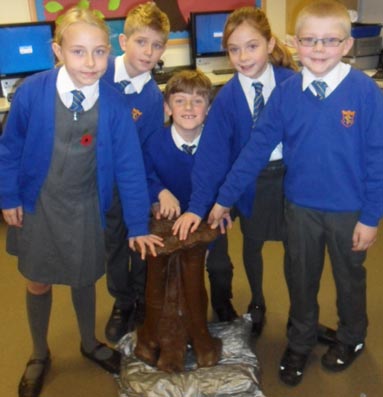
The next generation of scientists!

Picture credit: Painsley Catholic College

Studying Dinosaur Tracks

Next came the opportunity to study a set of dinosaur tracks that date from the Early Jurassic.  Scientists have uncovered a number of fossilised footprints of animals that congregated around a lake that was drying up. The fossils date from around 190 million years ago and the teacher visiting the school from Everything Dinosaur challenged the pupils to look at the evidence and to come up with a theory as to what a section of tracks might show.

Each of the budding young palaeontologists was given a worksheet, could they work out what the strange set of 190-million-year-old tracks might be revealing?  This was a real example of “Walking with Dinosaurs”.

Tasha and Leia (St Josephs Primary School, Uttoxeter) worked out the direction of travel by identifying the marks left by the toes.  Isabel calculated that the animal that made the tracks in the mud by the lake, must have had at least three toes.  Ellie (St Mary’s) came up with a theory the proposed either a three-toed or four-toed animal had walked that way.

The Importance of Scale Bars

When asked to explain why scientists put a scale bar on their drawings, Niall, Edward  and Chris (St. Thomas’ Catholic Primary School), correctly pointed out that scale bars helped scientists to measure the actual size of the prints.

Students Learn About Scale and Scale Bars in Dinosaur Study
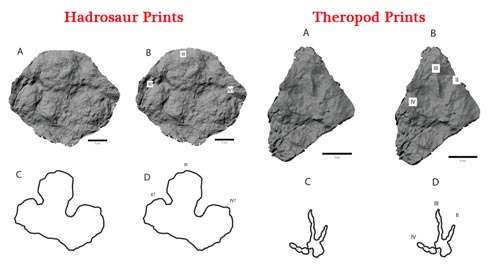
The importance of scale bars.

The black lines next to the photograph help scientists to appreciate the actual size of the prehistoric tracks.

To learn more about Everything Dinosaur’s outreach work in the community: Email Everything Dinosaur.

Examining the Evidence Formulating Theories

Having examined the evidence and worked through the information the children were then challenged to come up with a theory to explain the unusual prints preserved in the Lower Jurassic sediments.  Lots of different ideas were put forward, Joshua and Millie thought that the animal, probably a dinosaur was scratching around in the mud, perhaps it had got stuck and it was trying to free itself.

Peter from St Marys suggested that the tracks might have been made by a wounded dinosaur and perhaps it was limping and staggering – interesting theory Peter.  Harriet and her chums from St Giles Catholic Primary School proposed that this dinosaur must have been quite lazy and the tracks represent the places in the mud where it dragged its feet – another intriguing interpretation.  Having looked long and hard at the evidence, Ben and Roman came up with the theory that these were the tracks of a dinosaur that had gone for a swim.

Fascinating Theories

All in all, some fascinating theories put forward and a great introduction to some of the methods involved in scientific enquiry.  There was even time for Mrs Johnson to organise a set of school photographs of the children holding some of the fossils of prehistoric fish that Everything Dinosaur had brought in.  Not too bad for a morning’s work, exploring Late Cretaceous herbivorous dinosaurs, marine reptiles, prehistoric invertebrates and examining strange tracks made in the mud as a Jurassic lake dried up, with the chance to get up close to the teeth of primeval sharks.

A typical day working with the science teaching team at Painsley Catholic College helping to enthuse and inspire the next generation of scientists with a dinosaur workshop.

Visit Everything Dinosaur’s child-friendly and award-winning website: Everything Dinosaur.

14 11, 2013

Otodus megalodon and Maths (Free Resources for Schools)

By |2024-05-01T15:21:41+01:00November 14th, 2013|Categories: Adobe CS5, Educational Activities, Press Releases, Teaching|0 Comments

Using Shark Fossils to Help Primary School Children with Maths

Another day and another free download for teachers and educationalists.   Everything Dinosaur team members had been approached by a number of primary school teachers and HLTAs (Higher Learning Teaching Assistants), to help key stage 1 pupils get to grips with some of the symbols used in mathematics that they will encounter as they progress to key stage 2.  In particular, we were asked to come up with novel ways of helping young children from five years of age to recognise and remember what certain symbols used in mathematics stand for.

Megalodon Shark Fossils

Much of the emphasis of the mathematics part of the national curriculum in the United Kingdom is based around young learners making connections between numbers, shapes and symbols.  During key stage 1, pupils develop their knowledge and understanding of mathematics through practical activity, exploration and discussion.  Many children are keen on dinosaurs and other prehistoric creatures so if team members at Everything Dinosaur could build in a prehistoric theme, then all the better to help with the learning.  Children at key stage 1 learn to count, read, write and order numbers to 100 and beyond.   They develop a range of mental calculation skills and should be able to use these skills confidently in different settings.

Greater Than and Less Than Symbols

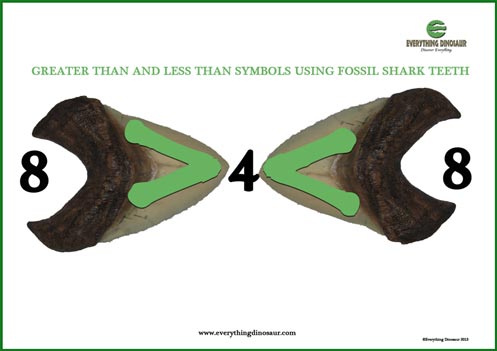
Children learn about shape and space through practical activity which builds on their understanding of their immediate environment.  They begin to grasp mathematical language, using it to talk about their methods and explain their reasoning when solving problems.  It is developing a familiarity with mathematical symbols where Everything Dinosaur comes in, why not use some images of fossilised shark teeth to help children learn about the “greater than” > and the “less than” < signs.

Using Fossils to Help Children Learn About Mathematics

Greater than and less than thanks to C. megalodon.

Picture credit: Everything Dinosaur

Everything Dinosaur Helps Out

Everything Dinosaur team members used pictures of the huge, fossilised teeth of a giant prehistoric shark called Carcharodon megalodon to create the mathematical symbols.  As children move onto key stage 2, they are expected to be able to recognise that the position of a digit gives its value and to use correctly the <> symbols.

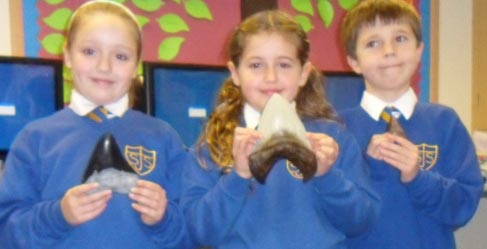
The teeth are part of Everything Dinosaur’s fossil collection.  Some of these fossils are brought into schools to help pupils learn about animals that lived in the past.  The shark teeth are particularly spectacular and these specimens are bigger than the typical hand of an nine year old child.  Such objects always intrigue and fascinate the children and they get a great deal out of the dinosaur workshops in schools that the staff conduct, so why not use some of the fossils to help children with other aspects of their education.

Note

This prehistoric shark has been reclassified and is now referred to as Otodus megalodon.

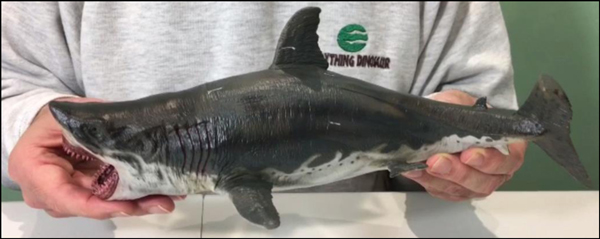
A Replica of the Prehistoirc Shark Known as Megalodon (O. megalodon)

PNSO Megalodon model "Patton".

The PNSO large Megalodon model “Patton” being held by an Everything Dinosaur team member.

Picture credit: Everything Dinosaur

To view the range of PNSO prehistoric animal models and figures including replicas of prehistoric sharks: PNSO Prehistoric Animal Figures (Age of Dinosaurs).

8 11, 2013

Thank You Note After School Visit From Everything Dinosaur

By |2023-03-01T08:41:00+00:00November 8th, 2013|Categories: Educational Activities, Teaching|0 Comments

Dinosaur Toys and Games

Team members at Everything Dinosaur are busy working with lots of schools this term, helping pupils to learn about dinosaurs and fossils.  Over the last few days, staff have been travelling all over the country delivering dinosaur themed workshops in support of national curriculum teaching aims and objectives.

The pace has been quite hectic but all the nice comments from the teachers, LTAs, and children make the hard work really worthwhile.  For example, after working with children from Nessfield Primary, the students sent thank you letters and all of them were greatly appreciated.  This is also a fantastic way to get the children to develop their creative writing skills, use of punctuation and of course, to test their recall.

Everything Dinosaur

Teacher Appreciates the Work of Everything Dinosaur

Thanks from Teacher

Picture Credit: Nessfield Primary

The teacher included this personal note in with the children’s letters, it was addressed to Mike one of our teachers/dinosaur experts who led the dinosaur workshop.  Seems like the visit was a big success with the children still referring to contribution to the topic that the visit from Everything Dinosaur made.

Glad to be of service.

To view the extensive selection of educational dinosaur themed toys and gifts available from Everything Dinosaur’s award-winning website: Educational Dinosaur Themed Toys and Gifts.

Go to Top