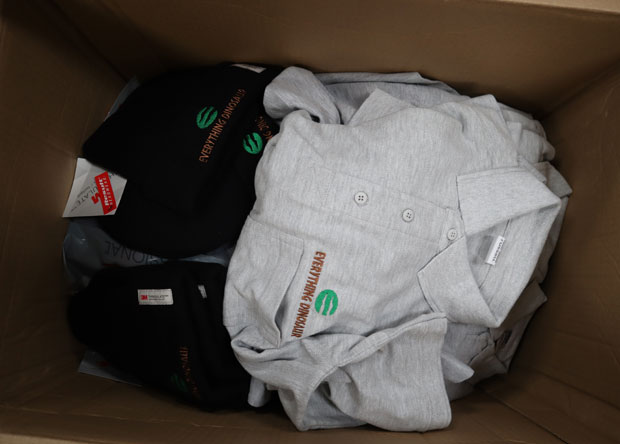
The move into our bespoke offices and warehousing has prompted us to revamp and revise our corporate clothing. Although, very pleasant and cool in the summer, a characteristic of our premises much appreciated by all the couriers and delivery people who visit us, our offices and warehouse are very chilly in winter. When the offices and other facilities were being built in February and March it was noticed that it was very cold. Several layers were required. In the light of this, we have invested in new corporate clothing including beanie hats for team members.
The new Everything Dinosaur beanie hats are proving to be very popular. Picture credit: Everything Dinosaur.
Picture credit: Everything Dinosaur
Incorporating the Everything Dinosaur Logo
The practical workwear includes sweatshirts, polo shirts, shorts and waterproof jackets, all of which will prominently display the Everything Dinosaur logo. We work very long hours and weekends, so we might as well be comfortable and warm especially when picking orders prior to sorting them in the packing room and preparing them for despatch.
Some of the new corporate clothing that arrived at Everything Dinosaur. The range includes polo shirts, shorts, sweatshirts, jackets and beanie hats. Picture credit: Everything Dinosaur.
Picture credit: Everything Dinosaur
Sue from Everything Dinosaur commented that the new clothing was quite smart, practical and sensible and would also prove beneficial when going out fossil hunting. Even the polo shirts had been given pockets – a handy place to store a small fossil if one was spotted whilst walking in a quarry or along a beach.
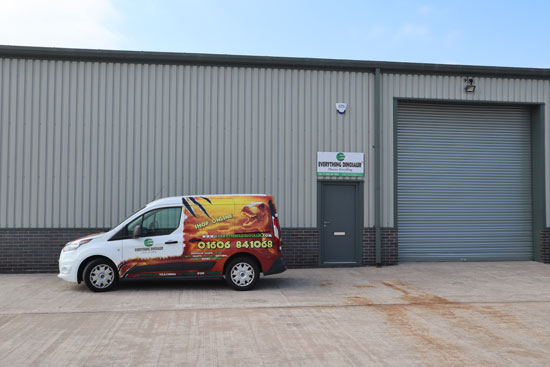
The address details for Everything Dinosaur have been updated in the footer section of the Everything Dinosaur blog. Everything Dinosaur relocated to new, bigger premises in April 2020 and team members have been busy updating all the contact details on their various websites on social media platforms.
The new Everything Dinosaur offices and warehousing. Team members have been busy updating all the contact details on the company’s various social media platforms and websites. Picture credit: Everything Dinosaur.
Picture credit: Everything Dinosaur
Updating the Everything Dinosaur Blog
A spokesperson for the UK-based company commented that they had moved into larger premises and have created purpose-built packing rooms and offices. One of the main reasons for the move into a bigger warehouse was that the company intended to offer even more dinosaur and prehistoric animal models in the future.
One of the last things to do was to ensure that the contact details on the Everything Dinosaur blog were updated.
Whilst looking at a scientific paper published earlier this year which featured the description of two new species of burrowing mammals from the Early Cretaceous of north-eastern China, team members came across a superb illustration of the types of mammals and mammaliamorphs associated with the famous Jehol biota. The artwork had been created by world-renowned palaeoartist Zhao Chuang and it depicts the biota associated with the Lower Cretaceous deposits associated with the Yixian Formation and Jiufotang Formation. What a stunning piece of art.
The Early Cretaceous Jehol biota with emphasis on mammaliamorphs. Picture credit: Zhao Chuang.
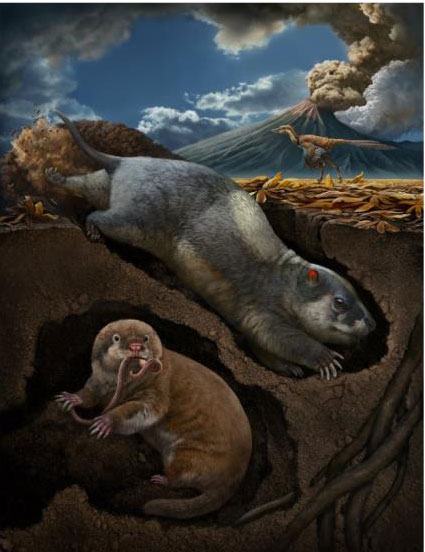
Fossiomanus sinensis and Jueconodon cheni
The two new ancient ancestors of modern mammals were both burrowers, with powerful hands, claws to help with digging, compact bodies and short tails. Although they shared similar anatomical traits, – adaptations to life underground – they were not closely related. The slightly smaller Jueconodon cheni has been classified as a eutriconodontan, a distant cousin of modern placental mammals and marsupials, it was around 20 cm in length. Fossiomanus sinensis is a herbivorous mammal-like animal called a tritylodontid and was around 30 long.
One of the co-authors of the scientific paper, published in the journal “Nature”, Dr Jin Meng from the American Museum of Natural History (New York), commented:
“The Early Cretaceous Jehol Biota has generated many well-preserved fossils that have furnished a great deal of information on the morphology and evolution of early mammals. The two new species expand the diversity of the mammaliamorph assemblage and increase its morphological disparity, as they show unequivocal evidence of convergent adaptation for a fossorial lifestyle.”
Two new species of Early Cretaceous mammals were described from fossils found in north-eastern China. Fossiomanus sinensis (upper right) and Jueconodon cheni in their burrows. Picture credit: Zhao Chuang.
The Diverse Jehol Biota
As well as reading about the diverse nature of the mammaliamorph biota associated with the Early Cretaceous Jehol ecosystem, we have the opportunity to admire the stunning artwork of Zhao Chuang. Fossils from north-eastern China have revealed that during the Early Cretaceous, the forests and lakes were home to a wide variety of different mammaliamorphs. The mammaliamorpha is defined as a clade of cynodonts including mammaliaforms and their close relatives. It is therefore a broader definition of early mammals than the mammaliaformes.
The artist Zhao Chuang is synonymous with the range of PNSO prehistoric animal models. He produces the artwork for the product packaging.
To view the range of PNSO dinosaurs and prehistoric animals: PNSO Dinosaurs.
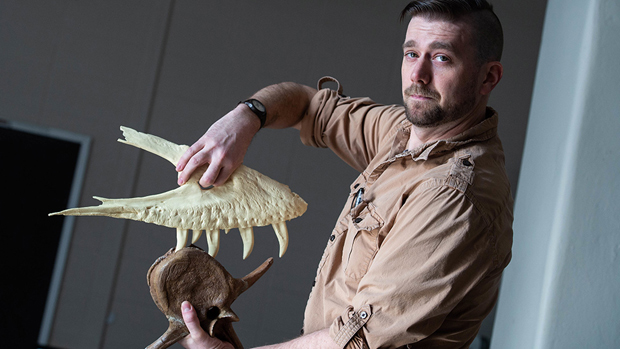
New research published in the on-line academic journal “PeerJ” suggests that the bite of a juvenile T. rex was strong enough to puncture bone.
University of Wisconsin Oshkosh palaeontologist Joseph Peterson in collaboration with Shannon Brink, formerly at Wisconsin but now a student at East Carolina University along with Jack Tseng (University of Berkeley, California), tested the bite force that can be generated on the tip of a tooth from a teenage T. rex. They discovered that even though the tyrannosaur was far from fully grown, it could generate a bite force of up to 5,641 newtons, that’s much higher than an adult male lion (Panthera leo) and more than has been estimated for the giant abelisaurid Carnotaurus (C. sastrei).
In fact, this bite force estimate for a T. rex believed to have been around thirteen years of age is comparable to the calculated bite forces of many adult meat-eating dinosaurs such as Allosaurus fragilis.
University of Wisconsin Oshkosh palaeontologist Joseph Peterson demonstrating the bone penetrating bite of a tyrannosaur. Picture credit: University of Wisconsin Oshkosh.
Where did Juvenile Tyrannosaurs Fit in Late Cretaceous Ecosystems
Whilst there has been quite a lot of research on the bite force potential of adult meat-eating dinosaurs, particularly tyrannosaurs, much less work has been undertaken to assess the bite forces generated by juveniles. By gaining a better understanding of the power of the jaws of these sub-adult predators, then palaeontologists can infer important information about their behaviour such as hunting strategies and preferred prey.
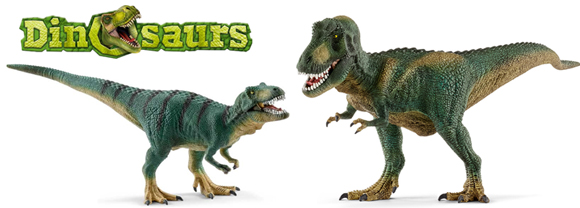
The Schleich juvenile T. rex and the 2017 Schleich T. rex model. Juvenile tyrannosaurs had a bone crunching bite.New research into the bite force generated by juvenile T. rex dinosaurs suggest that they could penetrate bone.
Crunching Cow Bones
In order to test the bite force, a replica of a tooth from a juvenile T. rex was mounted onto a mechanical testing frame used in the University’s engineering and science block. Numerous experiments were then carried out to see if the tooth could penetrate and crack the leg bone of a cow. Based on seventeen successful attempts to match the depth and shape of penetration marks identified in the fossil record, the researchers determined that a thirteen-year-old T. rex could have exerted up to 5,641 newtons of force, that’s somewhere between the bite force exerted by a modern-day hyena and a crocodile.
Impressive as it is, after all, we humans can muster a bite force across our incisors of around 300 newtons, the juvenile T. rex had a much weaker bite than that estimated for an adult. Some scientists have calculated that an adult T. rex could generate a bite force in excess of 35,000 newtons, easily enough pressure to shatter the bones of a hadrosaur or a Triceratops.
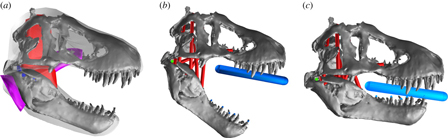
Bite down hard! Assessing the bite force of Tyrannosaurus rex. Picture credit: Biology Letters.
The study reveals that juvenile T. rexes were developing their biting techniques and strengthening their jaw muscles to be able crush bone once their adult teeth came in.
Commenting on the significance of this study, Joseph Peterson stated:
“This actually gives us a little bit of a metric to help us gauge how quickly the bite force is changing from juvenile to adulthood, and something to compare with how the body is changing during that same period of time. Are they already crushing bone? No, but they are puncturing it. It allows us to get a better idea of how they are feeding, what they are eating. It is just adding more to that full picture of how animals like tyrannosaurs lived and grew and the roles that they played in that ecosystem.”
The scientific paper: “Bite force estimates in juvenile Tyrannosaurus rex based on simulated puncture marks” by Joseph E. Peterson, Z. Jack Tseng and Shannon Brink published in PeerJ.
The W-Dragon Giraffatitan is certainly a very impressive figure. Team members at Everything Dinosaur have received a number of enquiries regarding this replica over the last few days and one of the most common questions we get asked is just how big is the Giraffatitan model?
The enormous W-Dragon Giraffatitan dinosaur model. The figure stands a fraction under 44 cm tall.
Always Trying to Help our Customers
We try our best to help our customers and we have responded to all the enquiries that needed a reply. We can confirm that this 1:35 scale dinosaur model measures approximately 38 cm in length and that the superbly detailed head is around 43.5 cm in the air.
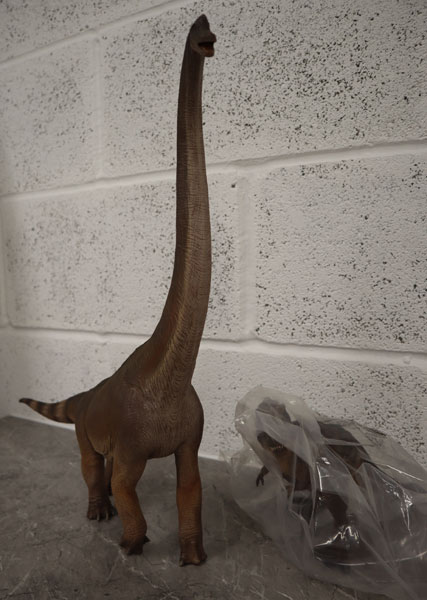
Comparing the W-Dragon Giraffatitan to the Papo standing T. rex dinosaur model. Although the Papo T. rex is a substantial figure in its own right it looks small compared to the enormous W-Dragon Giraffatitan replica. Picture credit: Everything Dinosaur.
Picture credit: Everything Dinosaur
Providing model measurements is sometimes not enough. In order to demonstrate the size of the W-Dragon Giraffatitan we placed it behind a Papo standing T. rex. The Papo T. rex figure is quite a sizeable figure, but it is dwarfed when compared to the enormous Giraffatitan model.
W-Dragon Giraffatitan compared to a Papo standing T. rex dinosaur model. Given the size difference between the largest tyrannosaurs and the largest brachiosaurs, these two figures work quite well together in terms of scale. Picture credit: Everything Dinosaur.
When the size of the largest tyrannosaurs is related to the biggest members of the Brachiosauridae family, the Papo T. rex and the W-Dragon Giraffatitan compare quite well to each other in terms of scale.
Whilst the likes of Giraffatitan (the Brachiosauridae too), had been extinct for millions of years before the super-sized tyrannosaurs evolved, the two models photographed together does give the viewer an insight into the “scale” of the problem the large theropod dinosaurs that co-existed with brachiosaurs had to face if they wanted to bring down one of these leviathans.
The W-Dragon Giraffatitan towers over the Papo standing T. rex dinosaur model. Picture credit: Everything Dinosaur.
Picture credit: Everything Dinosaur
Whilst the lighting in the packing room that we used to set up the shots may not be that great, we were able to send out these images to customers who had asked for more information about the size of the W-Dragon Giraffatitan.
We even include a Giraffatitan fact sheet with says of this colossal figure too.
Long-time fan of dinosaurs and prehistoric animals, Marc, who is also a long-time customer of Everything Dinosaur offered to write a short testimonial about his experiences purchasing from us.
What a kind thought especially in these difficult and challenging times.
Everything Dinosaur Receives Feedback
Marc wrote:
“I’ve been an Everything Dinosaur customer for a number of years, and they’ve never once let me down. They’ve always had an excellent range of models, which has only improved with time with the addition of lines from Creative Beast (Beasts of the Mesozoic) and PNSO, among others. Service has always been personable and friendly but professional, and every package has arrived on time. I also (as a dinosaur nerd) really appreciate the effort they put into the educational side. Overall, ED is a business well worth supporting, and I hope they’re around for a long while yet.”
Signage at Everything Dinosaur’s offices and warehouse. The UK-based mail order company has recently moved into larger premises incorporating more warehouse storage and offices. Picture credit: Everything Dinosaur.
Picture credit: Everything Dinosaur
A spokesperson from Everything Dinosaur thanked Marc for their kind gesture and stated:
“Our thanks to Marc and to every single one of our customers who support our company. These are exceptionally difficult times and we are doing all we can to maintain our high standards of customer service and to offer an even wider range of prehistoric animal models and figures.”
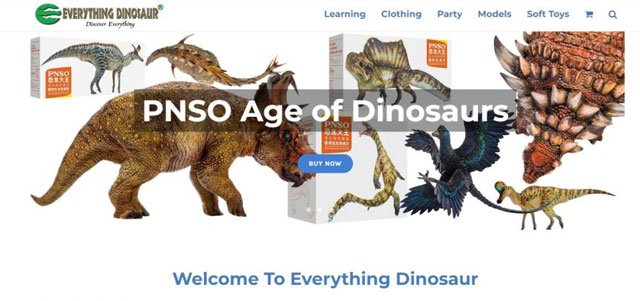
The PNSO Fusion Slider on the Everything Dinosaur website. A typical example showing the huge range of prehistoric animal models and figures available from the UK-based mail order company. Picture credit: Everything Dinosaur.
Picture credit: Everything Dinosaur
The spokesperson from Everything Dinosaur continued:
“We remain committed to bringing into stock even more models of prehistoric animals as we support our customers and fans of dinosaurs and other extinct creatures.”
Once again, our thanks to Marc for writing a testimonial for Everything Dinosaur.
New research published this week shows that smaller amphibians may be more vulnerable to extinction than larger amphibian species.
A study led by Queen’s University Belfast has found that the risk of extinction among amphibians, the most endangered vertebrates on the planet, increases for species of smaller body size as their females produce fewer babies per birth.
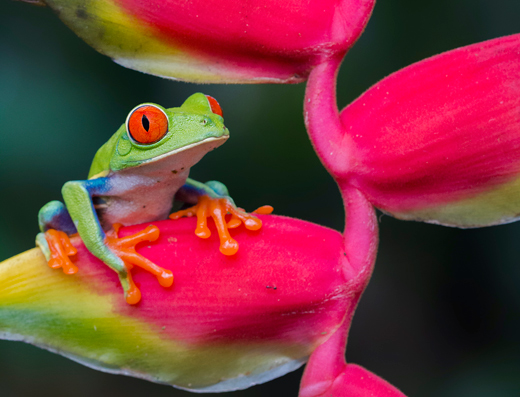
The red-eyed tree frog (scientific name: Agalychnis callidryas). This tropical frog species produces on average about 40 eggs per clutch. Small numbers of offspring can lead to concern over the extinction threat. Picture Credit: Roberto García-Roa.
Scientists had thought that animals of larger body size, be they hypercarnivores, or megaherbivores were more vulnerable to extinction. In popular culture, most people are aware of the threat of extinction to animals such as whales, pandas, big cats and polar bears. These large-bodied animals are certainly in danger. It has been postulated that we are currently experiencing a mass extinction event, brought on mainly due to the behaviour of Homo sapiens.
This newly published research in the journal Global Ecology and Biogeography, which represents a collaboration between Tel Aviv University, the University of Lincoln, Exeter University, Queen’s University (Belfast) and Nottingham Trent University, is the first to suggest amending the theory to focus on reproduction levels of animals rather than on body size when assessing extinction risk.
A Global Challenge
Regarded as one of the most pressing challenges facing our world, scientists are determined to better understand the factors that drive extinction.
Amphibians, such as frogs, toads, newts and salamanders, in particular, have become the iconic example of human-induced extinctions. Amphibian species are dying out faster than any other group of vertebrates on Earth. It has been calculated that something like forty per cent of all known species of amphibians currently face the threat of extinction.
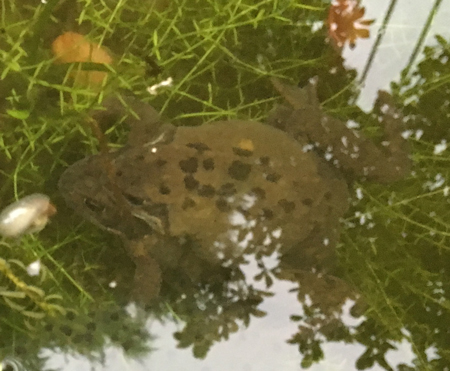
A pair of mating frogs (2017) Rana temporaria (European Common Frog). Picture credit: Everything Dinosaur.
Picture credit: Everything Dinosaur
Not Focusing Just on Mammals
One of the most accepted theories regarding extinction risk is that larger body size significantly increases the extinction threat. This hypothesis has been mainly driven via research into the Mammalia. This research is the first to investigate the causes behind extinction in amphibians based on the theory that it is not body size, but the number of babies a female produces per clutch that determines extinction risk.
Thousands of species from around the world were studied, irrespective of their conservation status. The researchers then mapped their level of endangerment against body size and their number of babies produced per batch of eggs.
The Fewer the Offspring the Greater the Risk
Strong evidence was found indicating that extinction risk increases towards species that produce fewer offspring, such as the “rain frogs” (Eleutherodactylus), whereas extinction risk decreases towards species that produce more, such as different species of American water frogs (Lithobates) or the large-bodied ‘bufonid’ toads.
Lead author, Dr Daniel Pincheira-Donoso (Queen’s University), explained:
“More babies per clutch or birth means more variety among the babies. To some extent, it is like playing the lottery, the more tickets you play the higher your chances to win. In this case, more numerous and diverse babies increase the chances that at least some can survive the stress of environmental alterations, such as progressive climatic changes.”
Focusing on the number of offspring rather than looking solely at body size, may permit a more effective approach to amphibian conservation.
Everything Dinosaur acknowledges the assistance of a media release from Queen’s University Belfast in the compilation of this article.
The scientific paper: “The global macroecology of brood size in amphibians reveals a predisposition of low‐fecundity species to extinction” by Daniel Pincheira‐Donoso, Lilly P. Harvey, Sheena C. Cotter, Gavin Stark, Shai Meiri and Dave J. Hodgson published in Global Ecology and Biogeography.
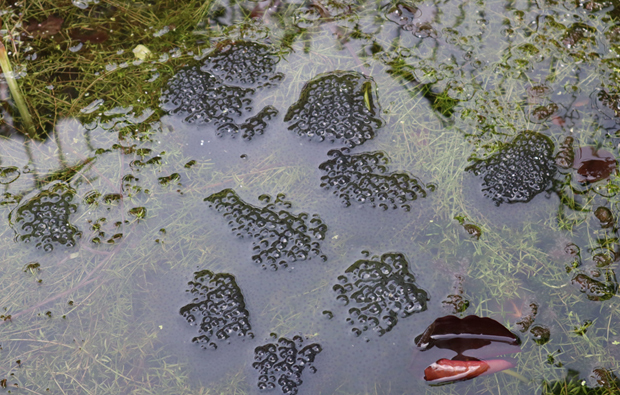
Team members from Everything Dinosaur have spotted frogspawn in the office pond this morning. The overnight gales and heavy rain have not deterred the common frogs (Rana temporaria) and they have spawned.
Frogspawn in Everything Dinosaur’s office pond. Team members estimate that there were more than ten Common frogs (Rana temporaria) in the pond. Picture credit: Everything Dinosaur.
Picture credit: Everything Dinosaur
An Early Spawning
With eggs being laid on the 11th March (2021), this is a little earlier than in recent years. For example, last year (2020), frogspawn was spotted on March 19th. In 2018, frogspawn was spotted on the 17th March, the last time the frogs spawned on the 11th March was 2017.
A spokesperson from the UK-based dinosaur model company stated:
“We keep a close watch on the office pond at this time of year and when the frogs spawn we record the date and then we monitor the progress of the tadpoles when they hatch and become more mobile.”
The frogs in the office pond are Common frogs, sometimes referred to as the European common frog or the grass frog (Rana temporaria).
Today, February 14th is St Valentine’s Day in the UK (and elsewhere in the world too). It is the feast day of St Valentine, a day associated with romance. Romance and the Dinosauria might be an unusual mix, but we are reminded of an article we published nearly five years ago that reported upon some remarkable research into dinosaur trace fossils that possibly shed light on the mating behaviour of “terrible lizards”.
Dinosaurs and St Valentine’s Day
Writing in the academic journal “Scientific Reports”, a team of scientists from Poland, China, South Korea and the USA concluded that a series of trace fossils consisting of pits, scrapes and gouges associated with Upper Cretaceous strata located in western Colorado, preserve evidence of dinosaurs engaging in courtship and mating behaviours similar to modern birds.
Dinosaurs Go a Wooing
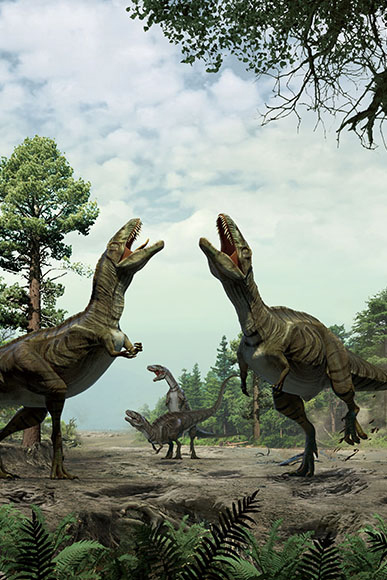
An artist imagines the Cretaceous courtship scene. Gouges and scrapes preserved in sandstone strata that is estimated to be around 100 million years old, preserve evidence of dinosaurs engaging in courtship and mating behaviours similar to extant birds.
Picture credit: Lida Xing and Yujiang Han / University of Colorado, Denver
Dinosaurs and Birds
The connection between dinosaurs and Aves (birds) is well established. However, to what extent can we view the behaviour of modern-day birds and infer behaviours in their long extinct relatives? Thanks to some research published in 2016 in the academic journal “Scientific Reports”, palaeontologists may have gained an insight into the courtship and mating behaviours of theropod dinosaurs.
The scientific paper: “Theropod courtship: large scale physical evidence of display arenas and avian-like scrape ceremony behaviour by Cretaceous dinosaurs” by Martin G. Lockley, Richard T. McCrea, Lisa G. Buckley, Jong Deock Lim, Neffra A. Matthews, Brent H. Breithaupt, Karen J. Houck, Gerard D. Gierliński, Dawid Surmik, Kyung Soo Kim, Lida Xing, Dal Yong Kong, Ken Cart, Jason Martin and Glade Hadden published in the journal Scientific Reports.
Teeth Provide Evidence of H. sapiens and Neanderthal Interbreeding
Teeth estimated to be less than 48,000 years old from a site in Jersey have provided evidence of Homo sapiens and Homo neanderthalensis interbreeding. The collection of thirteen teeth were all found on a ledge behind a hearth at the cave site of La Cotte de St Brelade on the island of Jersey. The teeth which were all collected between 1910 and 1911 were all thought to represent the adult teeth of Neanderthals, however, new research led by the Natural History Museum (London), the University of Wales, the University of Kent, The British Museum, the Max Planck Institute for Evolutionary Anthropology (Leipzig, Germany), Wessex Archaeology and University College London, uncovered features characteristic with modern human teeth (H. sapiens).
Views of One of the Teeth from the La Cotte de St Brelade (Jersey) Site
The teeth demonstrate a mixture of Neanderthal and modern human traits.
Picture credit: Journal of Human Evolution
Traits of Both Neanderthal and Modern Human
One of the original teeth had been lost, another was identified as nonhominin, the remainder represent the teeth from at least two adults. The shape of the area between the crown and the root, the cervix, indicated that the teeth were from a Homo sapiens, whilst the crown and root dimensions along with the shape of the roots are consistent with H. neanderthalensis.
Field Team Members at Work on the La Cotte de St Brelade Site
The site of the discovery La Cotte de St Brelade on the island of Jersey.
Picture credit: Dr Martin Bates (University of Wales)
This combination of Neanderthal and modern human traits led the research team to conclude that the people who had these teeth had a possible shared Neanderthal and H. sapiens ancestry.
Dating the Cave Deposits
The research team were able to utilise advance sediment dating techniques to determine the approximate age of the teeth. The age of the material three to four metres below the horizon from which the teeth came from dates to about 48,000 years ago, a time when modern human populations and Neanderthals were both present in Europe. A fragmentary skull bone (occipital) found in association with the teeth does not exhibit any diagnostic Neanderthal features, however the teeth provide further, intriguing evidence in support of hominin interbreeding.
Dr Martin Bates, (University of Wales), a geologist on the research team stated:
“The work on the teeth show the value of going back to historic collections of material where modern work at a site provides new contexts for this historic material. So, although the teeth were collected back in the early 20th century, modern techniques applied to both the teeth and the site now allow us to really begin to understand what the teeth represent and how old they are.”
Mapping and Excavating the La Cotte de St Brelade Site
La Cotte de St Brelade cave entrance where excavation work continues.
Picture credit: Dr Martin Bates (University of Wales)
Everything Dinosaur acknowledges the assistance of a media release from the University of Wales in the compilation of this article.
The scientific paper: “The morphology of the Late Pleistocene hominin remains from the site of La Cotte de St Brelade, Jersey (Channel Islands)” by Tim Compton, Matthew M. Skinner, Louise Humphrey, Matthew Pope, Martin Bates, Thomas W. Davies, Simon A. Parfitt, William P. Plummer, Beccy Scott, Andrew Shaw and Chris Stringer published in the Journal of Human Evolution.