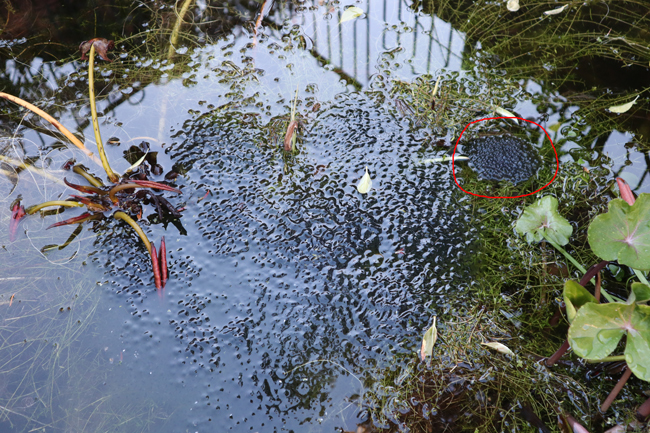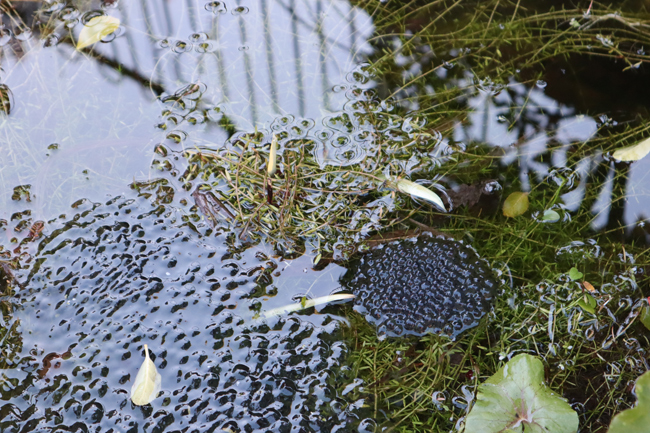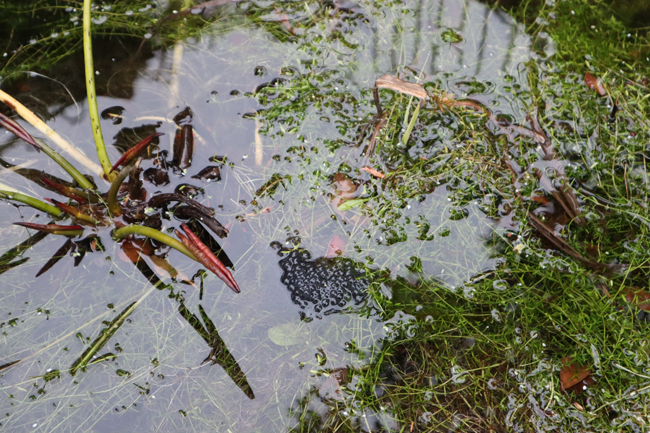
We have frogspawn in the office pond! On the morning of Wednesday March 2nd, a single batch of frogspawn was spotted in the office pond. A frog had been seen in the pond a few days earlier so team members were optimistic that spawning activity was imminent. We suspect that the first batch of spawn was laid in the early morning of the 2nd of March.
The first batch of frogspawn was laid early in the morning of the 2nd March 2022.
Picture credit: Everything Dinosaur
Seven or Eight Batches of Frogspawn
The following morning several more batches of frogspawn were spotted. In total, Everything Dinosaur team members counted seven frogs in the pond. The exact number of batches of frogspawn is difficult to calculate as the batches have been concentrated into a single area of the office pond. However, it has been estimated that there are around seven or eight batches of spawn. All the frogs are Common frogs (Rana temporaria). In 2021, frogs spawned in the office pond around the 11th of March, in 2020, it was later still around the 22nd of March.
Much more frogspawn was laid on the 3rd March. The frogs have spawned a week earlier than in 2021.
Picture credit: Everything Dinosaur
We shall keep watching the office pond to see if any more spawn is laid in the coming days. We look forward to the spawn hatching and observing the progress of the tadpoles.
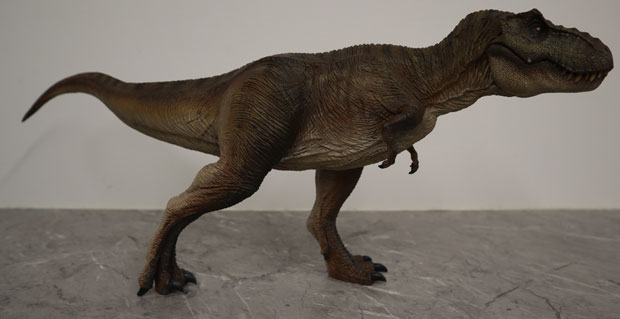
Everything Dinosaur team members were asked by a customer to provide some pictures of the Nanmu Studio T. rex dinosaur model Alpha, the brown colour-variant. The customer was looking for a Tyrannosaurus rex to represent a female “tyrant lizard” for a “Jurassic World” diorama.
Nanmu Studio T. rex dinosaur model (Alpha) in the brown colouration in lateral view. Picture credit: Everything Dinosaur.
We receive emails from customers asking for photographs and more information about the prehistoric animal models and figures that we stock, we are happy to help where we can.
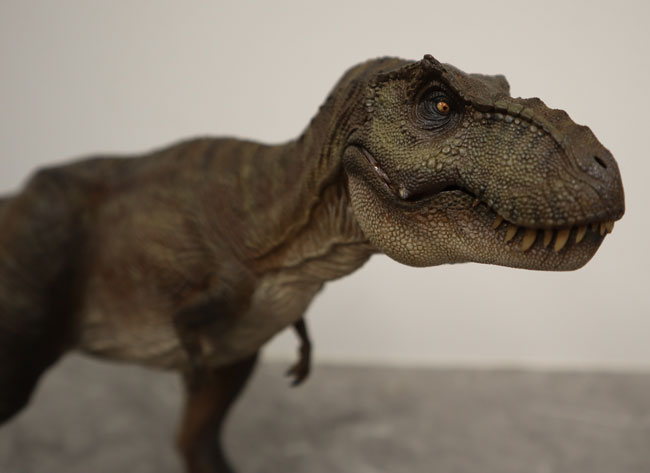
A close-up view of the Nanmu Studio Alpha T. rex in the brown colouration. Picture credit: Everything Dinosaur.
Packing Room Photography
Whilst Everything Dinosaur does have a studio in which to take photographs and to shoot YouTube videos, sometimes it is more convenient to bring a figure from our warehouse and take photographs in one of the order packing areas. The lighting might not be as bright, but at least customers can see images of the prehistoric animal model without the harsh glare of the studio lamps.
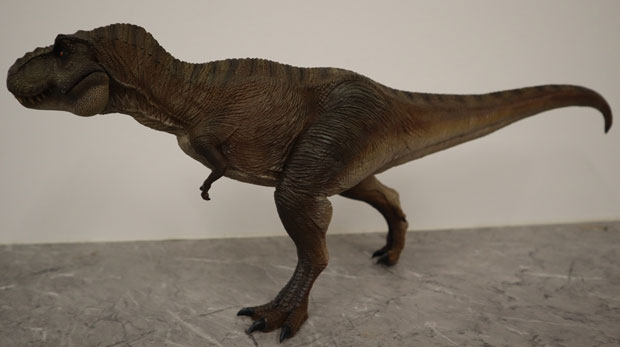
The Nanmu Studio T. rex dinosaur model (Alpha) in the brown colouration (lateral view). Picture credit: Everything Dinosaur.
It is usual for team members to take several pictures, showing the figure at various angles. A spokesperson from Everything Dinosaur commented that by taking lots of photographs, the customer could get an overall impression of the model’s quality and its colouration.
Providing pictures of the Nanmu Studio T. rex dinosaur model. Picture credit: Everything Dinosaur.
Pictures of the Packaging
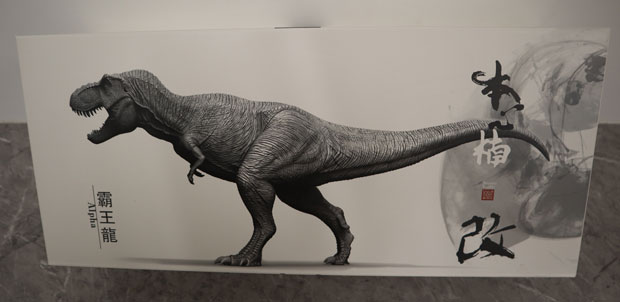
As well as sending photographs of the Nanmu Studio T. rex dinosaur model Alpha, a photograph of the model’s packaging was also emailed to the customer. The box the model is supplied in might not influence the arrangement of a diorama, but at least it proves that the figure is the genuine article and new.
The packaging of the Nanmu Studio Alpha T. rex model (brown colouration). Picture credit: Everything Dinosaur.
When emailing the images, we wrote that if the customer wanted more information or some more photographs, we would be happy to oblige. Everything Dinosaur team members do all they can to help dinosaur fans and model collectors.
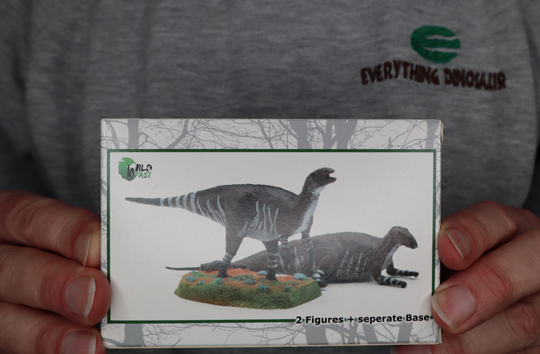
In May of this year (2021), the excellent Wild Past Tethyshadros pair arrived at Everything Dinosaur. This dinosaur figure set featured two models of the dwarf hadrosauroid from north-eastern Italy, which was formally named and described in 2009.
The front of the Wild Past Tethyshadros box. Whilst unpacking the Tethyshadros pair, a cardboard box was found inside one of the cartons. It turned out not to be part of the packing material to help protect the figures, but inside the box Everything Dinosaur team members found a little surprise. Picture credit: Everything Dinosaur.
Picture credit: Everything Dinosaur
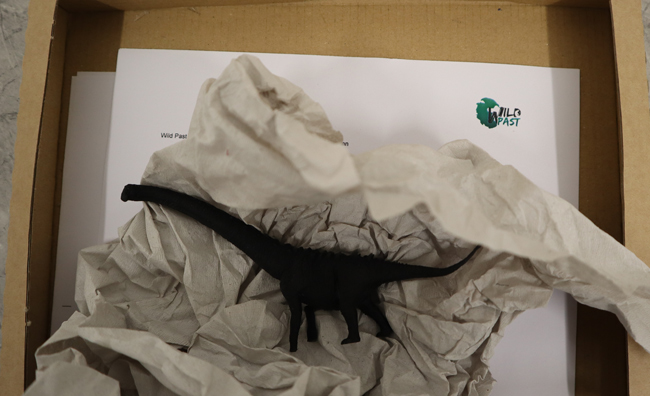
As team members unpacked these models, a small cardboard box was discovered inside one of the cartons. At the time, this was thought to be part of the packing material, the box being thoughtfully added to ensure the boxes containing the 1:35 scale Tethyshadros models were fully protected. It was put to one side in our warehouse and remained unopened.
A team member came across the box this morning, curious as to what it might contain, it was carefully opened and inside a small model of the dwarf titanosaur Magyarosaurus was discovered.
The box containing the Magyarosaurus model was thought to be additional product packaging protection in the Wild Past Tethyshadros pair consignment and the model was not discovered until this morning. Picture credit: Everything Dinosaur.
Picture credit: Everything Dinosaur
A Magyarosaurus Figure
Stefan, the German entrepreneur behind the Wild Past brand had included the little model as a gift, a token of appreciation for the support and assistance provided by Everything Dinosaur.
A note from Stefan accompanying the Magyarosaurus model was also discovered, the note said:
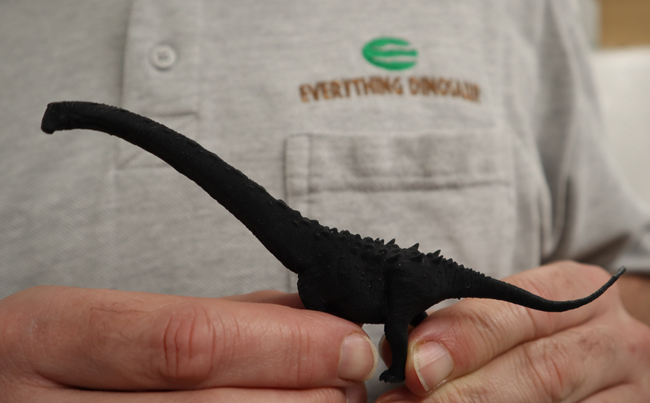
“Additionally, to the delivery I send you a small thank you for your ongoing support. It is our little 1:35 Magyarosaurus resin model. Hope you like it”.
The Wild Past Magyarosaurus dinosaur model, a little token of appreciation sent to Everything Dinosaur. Picture credit: Everything Dinosaur.
Picture credit: Everything Dinosaur
Dwarf Titanosaur from the Hateg Basin
The Magyarosaurus genus has one certain species assigned to it (M. dacus), although slightly larger fossil material has been assigned to a second species – Magyarosaurus hungaricus but these fossils might represent a separate taxon. The beautiful model demonstrates the skill and creativity of Wild Past. The team members at Everything Dinosaur were delighted to receive their gift.
A spokesperson from Everything Dinosaur commented:
“It was very kind of Stefan to include this token of appreciation amongst the Tethyshadros models. We have emailed him and thanked him for his gift and apologised for the tardiness of our response. We did not open the box containing the model and his note until this morning”.
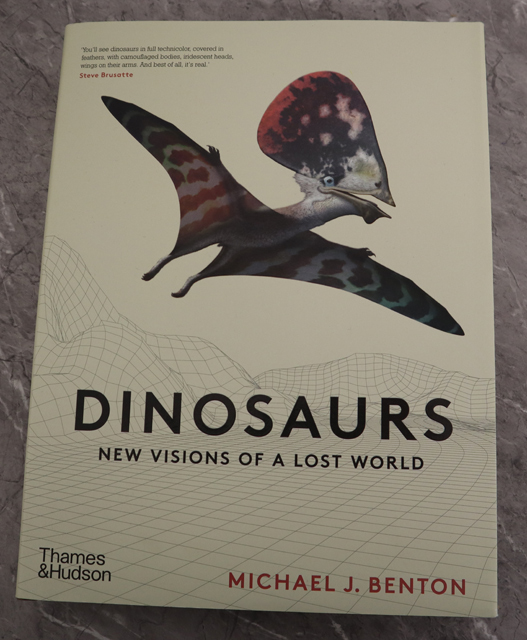
Everything Dinosaur team members were sent a copy of a new dinosaur book that is due to be published this autumn. The book entitled “Dinosaurs – New Visions of a Lost World” is written by Professor Michael Benton of the School of Earth Sciences at the University of Bristol, a highly respected palaeontologist and author of numerous books about prehistoric animals.
There are over 150 full colour illustrations, including beautiful artwork from renowned palaeoartist Bob Nicholls.
Everything Dinosaur has received an inspection copy of a new book written by Professor Michael J. Benton and illustrated by Bob Nicholls.Picture credit: Everything Dinosaur.
Picture credit: Everything Dinosaur
Changing Perceptions About the Dinosauria
This stunning publication aims to change perceptions about the Dinosauria. Each chapter focuses on a different prehistoric animal. The book should perhaps be called “Prehistoric Animals – New Visions of a Lost World”. There are many dinosaurs featured – Sinosauropteryx, Anchiornis, Psittacosaurus, Edmontosaurus, however, the book also features the marine reptile Stenopterygius, the Early Cretaceous mammal Eomaia and the spectacular pterosaur Tupandactylus.
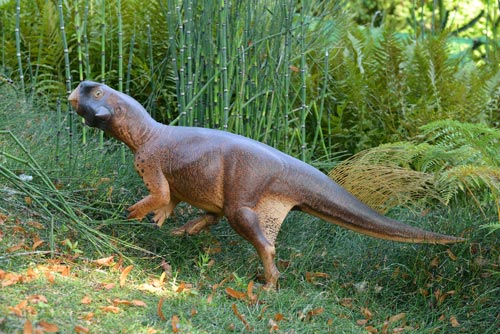
Psittacosaurus photographed in the Bristol Botanic Garden. The model was created by Bob Nicholls who is responsible for the majority of the illustrations in the book “Dinosaurs – New Visions of a Lost World”. Picture credit: Jakob Vinther.
Looking Forward to Reviewing “Dinosaurs – New Visions of a Lost World”
Professor Benton examines some of the technological breakthroughs that have shed new light on the world of the dinosaurs. He demonstrates how rapid advances in technology and astonishing new fossil finds have changed our understanding about the Dinosauria. Team members are looking forward to providing a detailed review of this cleverly conceived publication.
A spokesperson from Everything Dinosaur stated:
“We have been looking forward to getting hold of a copy of this book, each chapter examines one particular genus of prehistoric animal and includes a specially commissioned illustration from Bob Nicholls. Professor Benton’s text and the illustrations by Bob Nicholls are a winning combination.”
Everything Dinosaur team members have been helping fossil collector and dinosaur fan Robert source various prehistoric animal figures and replicas to accompany his fossil collection. As a token of appreciation, he sent a little gift to our offices to say thank you for our work.
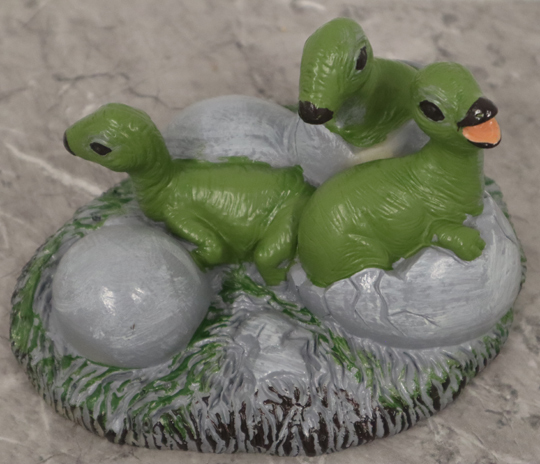
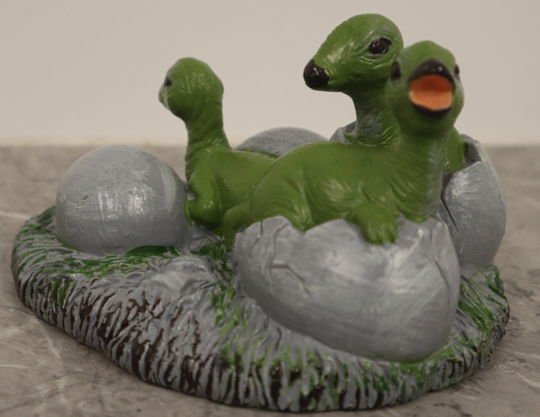
The parcel got mislaid on its way from Scotland to our warehouse but it finally arrived yesterday and when the package was opened we found this model of three hatching dinosaurs inside.
A model of three hatching dinosaurs sent to Everything Dinosaur by a delighted customer.Picture credit: Everything Dinosaur.
Picture credit: Everything Dinosaur
Maiasaura peeblesorum
Recently Robert had telephoned asking us to help him source a model of a Maiasaura with young. A dinosaur model featuring a Maiasaura with a nest was once part of the Carnegie collection of figures, but this range was retired and went out of production back in 2014. We were able to provide Robert with a fact sheet on this herbivorous dinosaur from the Late Cretaceous of Montana.
In gratitude and as a token of appreciation we were sent this little gift of hatching dinosaurs.
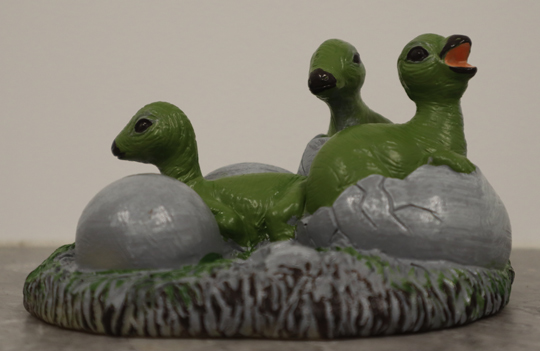
Dinosaur hatchlings. After providing some information on the Late Cretaceous hadrosaurid Maiasaura (M. peeblesorum) to a customer, Everything Dinosaur received this little gift in return– a trio of hatching dinosaurs.Picture credit: Everything Dinosaur.
Picture credit: Everything Dinosaur
A spokesperson from Everything Dinosaur commented:
“We were very touched to receive this little gift. We try our best to help customers and we provide all kinds of advice, information and support. Team members took some photographs of the hatching dinosaurs in our packing room and now we have put this on display in one of our offices.”
A trio of hatching dinosaurs complete with eggs.A little token of appreciation sent to Everything Dinosaur from a grateful customer.Picture credit: Everything Dinosaur.
Picture credit: Everything Dinosaur
Thank you for the Token of Appreciation
When the parcel arrived, we sent an email to Robert, just to let him know that the parcel had got to us safely and to thank him for his very kind gesture.
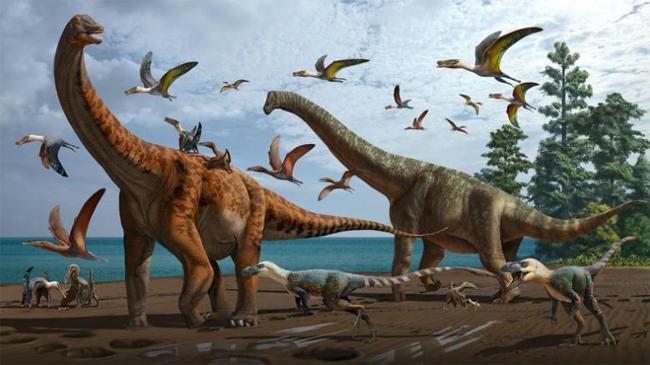
Recently, Everything Dinosaur team members produced a blog article discussing the first dinosaurs to be named and described from the Shengjinkou Formation located in the Xinjiang Uygur Autonomous Region, China. Today, we pay tribute to Zhao Chuang, the scientific illustrator who provided a life restoration of these newly described sauropods and who had earlier illustrated Hamipterus, a pterosaur known from the same strata.
Two sauropods disturb a nesting colony of Hamipterus pterosaurs. Silutitan sinensis (left) and Hamititan xinjiangensis (right), a single theropod tooth found in association with the H. xinjiangensis fossil material indicates the presence of carnivorous dinosaurs. This illustration combines artwork similar to that which accompanied the Hamipterus bonebed scientific paper. A pair of Hamipterus pterosaurs (far left) look after their brood as the newly described sauropods wander past. Picture credit: Zhao Chuang.
Spectacular Artwork
Chinese illustrator and palaeoartist Zhao Chuang created the spectacular artwork that brought to life some of the vertebrate biota associated with the Lower Cretaceous Shengjinkou Formation of north-western China. As an artist at the Peking Natural Science-Art Organisation (PNSO), he has worked on numerous scientific publications and papers helping to illustrate prehistoric animals that are the subject of scientific research. He is also responsible for the stunning artwork associated with PNSO prehistoric animal models and figures.
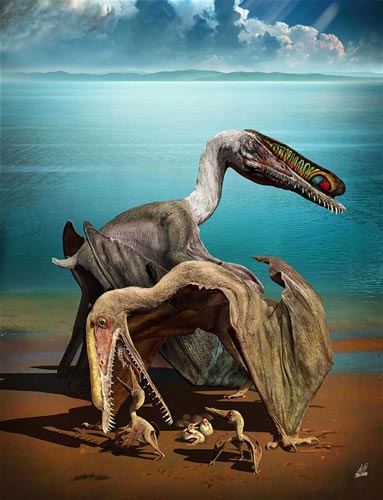
In 2017, Zhao Chuang was commissioned to provide a life reconstruction of the pterosaur nesting colony that was due to be described in a research paper published in the academic journal “Science”.
The male Hamipterus (background) stands guard whilst the female regurgitates food to her offspring (altricial behaviours in pterosaurs). Picture credit: Zhao Chuang.
Sauropod Fossil Discoveries
With the discovery of sauropod fossil bones either in association with Hamipterus pterosaur fossils or in close proximity, Zhao Chuang cleverly combined an image he had painted when describing the Hamipterus bonebed with a new painting showing the two newly described dinosaurs from the same geological formation.
In keeping with the science behind the illustrations, the artist brought together an image of pterosaurs and their offspring with the sauropod illustration. The newly described sauropod species, Silutitan sinensis, Hamititan xinjiangensis and fossils from the hip region of an as yet unnamed species, were all collected from different sites which are 2 to 5 kilometres apart. The horizon where the cervical vertebrae used to describe Silutitan sinensis were found is particularly rich in Hamipterus pterosaur fossils, although all the sauropod sites showed evidence of the presence of Hamipterus remains.
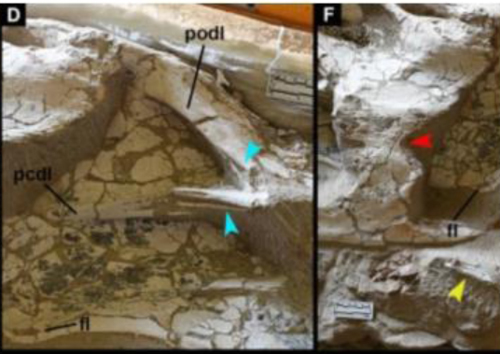
Resting up against one of the large neck bones of Silutitan, the research team discovered a fragment of a lower jaw from a flying reptile. As Hamipterus (H. tianshanensis), is the only pterosaur known from this region and as the bone fragment was similar to more complete Hamipterus specimens, the authors of the scientific paper assigned this bone to the Hamipterus taxon.
An incomplete lower jaw of a pterosaur was recovered associated with the cervical vertebrae assigned to the taxon Silutitan (Figure 3F). Despite its incompleteness, this jaw fragment, highlighted by the yellow arrow, shows the same anatomy of the sole pterosaur collected in this region, Hamipterus tianshanensis and is therefore referred to this species. Picture credit: Wang et al.
Hamipterus and Sauropod Fossil Remains
The association of pterosaur fossils with sauropod remains has not been reported in scientific literature often. However, it is not clear if there were any more specific palaeoecological interactions between these taxa.
The close association of the fossil remains might just be due to taphonomy (the fossilisation process). Although it is intriguing to imagine a colony of nesting Hamipterus being disturbed as two giant sauropods roam through the nesting ground, just as the stunning illustration from Zhao Chuang depicts.
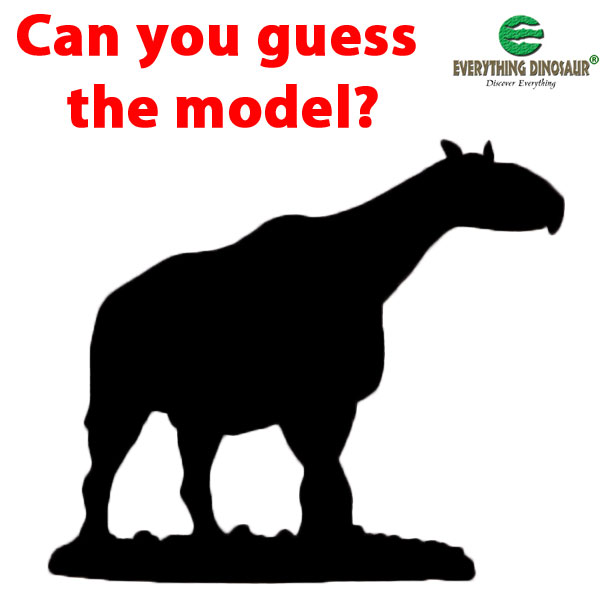
Just for a bit of fun, Everything Dinosaur team members have created a little teaser for their fans and customers, can you identify the model from the image we have posted? There are no prizes, but our knowledgeable customers can be assured that they have our total respect if they can identify the prehistoric animal model from the image below.
Can you guess the prehistoric animal model from the image that Everything Dinosaur has posted? There are no prizes or awards on offer, but are you up to the challenge and can you identify the prehistoric animal model just from its silhouette? Picture credit: Everything Dinosaur.
Picture credit: Everything Dinosaur
Very Well-informed Customers, Fans and Followers of Everything Dinosaur
A spokesperson from Everything Dinosaur commented:
“We are constantly amazed how well-informed and knowledgeable our customers, fans and followers on the Everything Dinosaur social media platforms are. We like to set little quizzes and tests from time to time just to keep them on their mettle, but we have not been able to get the better of our customer base to date.”
There are no prizes or awards on offer, just the satisfaction of having got the better of the Everything Dinosaur team members.
As a clue, we can say that several species have been assigned to this genus. It is a prehistoric mammal and perhaps, one of the largest terrestrial mammals to have ever lived. Can you guess?
We will reveal the answer next week (week commencing 9th August 2021), providing an update on this exciting prehistoric animal replica.
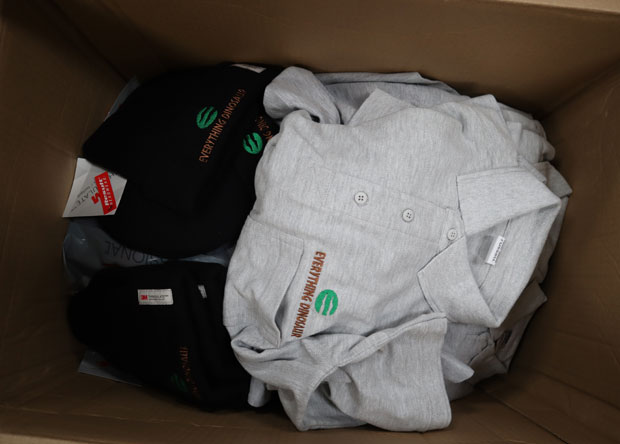
The move into our bespoke offices and warehousing has prompted us to revamp and revise our corporate clothing. Although, very pleasant and cool in the summer, a characteristic of our premises much appreciated by all the couriers and delivery people who visit us, our offices and warehouse are very chilly in winter. When the offices and other facilities were being built in February and March it was noticed that it was very cold. Several layers were required. In the light of this, we have invested in new corporate clothing including beanie hats for team members.
The new Everything Dinosaur beanie hats are proving to be very popular. Picture credit: Everything Dinosaur.
Picture credit: Everything Dinosaur
Incorporating the Everything Dinosaur Logo
The practical workwear includes sweatshirts, polo shirts, shorts and waterproof jackets, all of which will prominently display the Everything Dinosaur logo. We work very long hours and weekends, so we might as well be comfortable and warm especially when picking orders prior to sorting them in the packing room and preparing them for despatch.
Some of the new corporate clothing that arrived at Everything Dinosaur. The range includes polo shirts, shorts, sweatshirts, jackets and beanie hats. Picture credit: Everything Dinosaur.
Picture credit: Everything Dinosaur
Sue from Everything Dinosaur commented that the new clothing was quite smart, practical and sensible and would also prove beneficial when going out fossil hunting. Even the polo shirts had been given pockets – a handy place to store a small fossil if one was spotted whilst walking in a quarry or along a beach.
The address details for Everything Dinosaur have been updated in the footer section of the Everything Dinosaur blog. Everything Dinosaur relocated to new, bigger premises in April 2020 and team members have been busy updating all the contact details on their various websites on social media platforms.
The new Everything Dinosaur offices and warehousing. Team members have been busy updating all the contact details on the company’s various social media platforms and websites. Picture credit: Everything Dinosaur.
Picture credit: Everything Dinosaur
Updating the Everything Dinosaur Blog
A spokesperson for the UK-based company commented that they had moved into larger premises and have created purpose-built packing rooms and offices. One of the main reasons for the move into a bigger warehouse was that the company intended to offer even more dinosaur and prehistoric animal models in the future.
One of the last things to do was to ensure that the contact details on the Everything Dinosaur blog were updated.
Whilst looking at a scientific paper published earlier this year which featured the description of two new species of burrowing mammals from the Early Cretaceous of north-eastern China, team members came across a superb illustration of the types of mammals and mammaliamorphs associated with the famous Jehol biota. The artwork had been created by world-renowned palaeoartist Zhao Chuang and it depicts the biota associated with the Lower Cretaceous deposits associated with the Yixian Formation and Jiufotang Formation. What a stunning piece of art.
The Early Cretaceous Jehol biota with emphasis on mammaliamorphs. Picture credit: Zhao Chuang.
Fossiomanus sinensis and Jueconodon cheni
The two new ancient ancestors of modern mammals were both burrowers, with powerful hands, claws to help with digging, compact bodies and short tails. Although they shared similar anatomical traits, – adaptations to life underground – they were not closely related. The slightly smaller Jueconodon cheni has been classified as a eutriconodontan, a distant cousin of modern placental mammals and marsupials, it was around 20 cm in length. Fossiomanus sinensis is a herbivorous mammal-like animal called a tritylodontid and was around 30 long.
One of the co-authors of the scientific paper, published in the journal “Nature”, Dr Jin Meng from the American Museum of Natural History (New York), commented:
“The Early Cretaceous Jehol Biota has generated many well-preserved fossils that have furnished a great deal of information on the morphology and evolution of early mammals. The two new species expand the diversity of the mammaliamorph assemblage and increase its morphological disparity, as they show unequivocal evidence of convergent adaptation for a fossorial lifestyle.”
Two new species of Early Cretaceous mammals were described from fossils found in north-eastern China. Fossiomanus sinensis (upper right) and Jueconodon cheni in their burrows. Picture credit: Zhao Chuang.
The Diverse Jehol Biota
As well as reading about the diverse nature of the mammaliamorph biota associated with the Early Cretaceous Jehol ecosystem, we have the opportunity to admire the stunning artwork of Zhao Chuang. Fossils from north-eastern China have revealed that during the Early Cretaceous, the forests and lakes were home to a wide variety of different mammaliamorphs. The mammaliamorpha is defined as a clade of cynodonts including mammaliaforms and their close relatives. It is therefore a broader definition of early mammals than the mammaliaformes.
The artist Zhao Chuang is synonymous with the range of PNSO prehistoric animal models. He produces the artwork for the product packaging.
To view the range of PNSO dinosaurs and prehistoric animals: PNSO Dinosaurs.