All about dinosaurs, fossils and prehistoric animals by Everything Dinosaur team members.

Articles, features and information which have slightly more scientific content with an emphasis on palaeontology, such as updates on academic papers, published papers etc.

8 01, 2024

Giant Predatory Worms from the Cambrian of Greenland

By |2024-01-18T13:58:07+00:00January 8th, 2024|Categories: Adobe CS5, Dinosaur and Prehistoric Animal News Stories, Main Page, Palaeontological articles, Photos/Pictures of Fossils|0 Comments

Scientists have named a new, probable apex predator from the Sirius Passet fossil locality in northern Greenland. Measuring in excess of thirty centimetres long, Timorebestia koprii was a giant pelagic predator. These marine worms may be some of the earliest carnivorous animals to have colonised the water column. The fossils are dated to approximately 518 million years ago and reveal a complex, multi-tiered marine ecosystem.

Timorebestia koprii life reconstruction.
A reconstruction of the pelagic ecosystem and the organisms fossilised in Sirius Passet, revealing how Timorebestia was one of the largest predators in the water column more than 518 million years ago. Picture credit: Bob Nicholls.

Picture credit: Bob Nicholls

The image (above) shows a pair of Timorebestia (T. koprii) attacking a shoal of the Cambrian arthropod Isoxys. Several other pelagic (active swimming) animals are featured in the artwork.

Timorebestia koprii

The genus name Timorebestia means “terror beasts” in Latin. These marine worms were some of the largest swimming animals in the Early Cambrian seas. They had fins down the sides of their body, a distinct head with long antennae and large jaw structures. The species has been erected in honour of the Korea Polar Research Institute (KOPRI). It is an acknowledgement of their support of the field expeditions to northern Greenland.

Senior author of the study published in “Science Advances”, Dr Jakob Vinther explained:

“We have previously known that primitive arthropods were the dominant predators during the Cambrian, such as the bizarre-looking anomalocaridids. However, Timorebestia is a distant, but close, relative of living arrow worms, or chaetognaths. These are much smaller ocean predators today that feed on tiny zooplankton.”

Dr Jakob Vinther and a Timorebestia fossil specimen.
Dr Jakob Vinther at the Sirius Passet locality in 2017 showing the largest specimen of Timorebestia koprii after it was found. Picture credit: Dr Jakob Vinther.

Picture credit: Dr Jakob Vinther

The Fossilised Digestive System of Timorebestia

Inside the fossilised digestive system of Timorebestia, the researchers found remains of a common, swimming arthropod called Isoxys.

Co-author, former PhD student at Bristol University, Morten Lunde Nielsen provided more information about Isoxys:

“We can see these arthropods were a food source for many other animals. They are very common at Sirius Passet and had long protective spines, pointing both forwards and backwards. However, they clearly didn’t completely succeed in avoiding that fate, because Timorebestia munched on them in great quantities.”

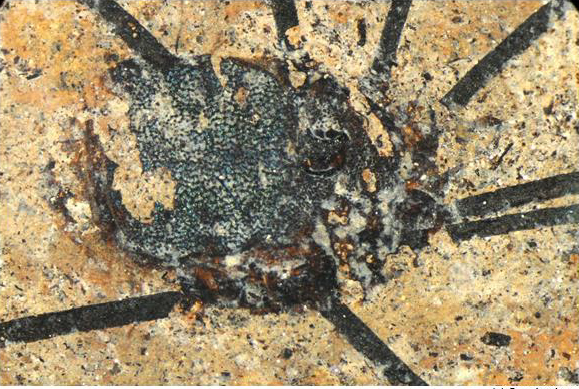
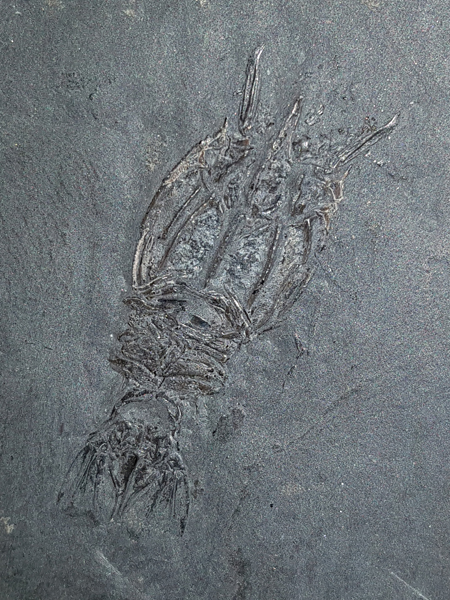
Fossil of Timorebestia koprii and interpretive drawing.
Fossil of Timorebestia koprii and an interpretive drawing. The scientists used a technique called an electron microprobe to map the carbon in the fossil out, which reveals anatomical features with immense clarity including its fin rays and muscle systems. Picture credit: Dr Jakob Vinther.

Picture credit: Dr Jakob Vinther

Arrow Worms

Described as a stem chaetognath (arrow worm), Timorebestia represents a significant discovery. Chaetognaths are one of the oldest animal groups known from the Cambrian. For example, arthropods appear in the fossil record as far back as 529 million years ago, but arrow worms can be traced back to at least 538 million years ago.

Dr Vinther has suggested that both arrow worms and the more primitive Timorebestia were swimming predators. It can be surmised that these marine worms were the dominant pelagic predators before the arthropods.

He stated:

“Perhaps they had a dynasty of about 10-15 million years before they got superseded by other, and more successful, groups.”

Luke Parry from Oxford University, who was part of the research team, added:

“Timorebestia is a really significant find for understanding where these jawed predators came from. Today, arrow worms have menacing bristles on the outside of their heads for catching prey, whereas Timorebestia has jaws inside its head. This is what we see in microscopic jaw worms today, organisms that arrow worms shared an ancestor with over half a billion years ago. Timorebestia and other fossils like it provide links between closely related organisms that today look very different.”

Everything Dinosaur acknowledges the assistance of a media release from the University of Bristol in the compilation of this article.

The scientific paper: “A giant stem-group chaetognath” by Tae-Yoon S. Park, Morten Lunde Nielsen, Luke A. Parry, Martin Vinther Sørensen, Mirinae Lee, Ji-Hoon Kihm, Ji-Hoon Kihm, Changkun Park, Giacinto de Vivo, M. Paul Smith, David A. T. Harper, Arne T. Nielsen and Jakob Vinther published in Science Advances.

The Everything Dinosaur website: Everything Dinosaur.

7 01, 2024

Recommending a Favourite Dinosaur Book for Dinosaur Fans

By |2024-03-09T15:01:01+00:00January 7th, 2024|Categories: Book Reviews, Dinosaur Fans, Everything Dinosaur videos, Famous Figures, Main Page, Palaeontological articles|0 Comments

Whilst preparing a YouTube video on the new for 2024 CollectA Deluxe Polacanthus model, we frequently consulted one of our favourite dinosaur books. “Dinosaurs of the British Isles” by Dr Dean Lomax and Nobumichi Tamura first went into print about ten years ago. It is a comprehensive overview of dinosaurs from Britain. Around a hundred different genera are discussed.

We like this informative book so much that we made a YouTube short about it.

A YouTube short about the book “Dinosaurs of the British Isles” by Dean Lomax and Nobumichi Tamura.

Video credit: Everything Dinosaur

Published by Siri Scientific Press this fantastic dinosaur book is available here: Siri Scientific Press.

When on the Siri Scientific Press website, just search for Dean Lomax and you will find the dinosaur book.

Recommending a Favourite Dinosaur Book

The book contains a foreword by the renowned British palaeontologist Professor Paul Barrett. It then outlines the early history of palaeontology in the UK highlighting the contributions of Mary Anning, the Reverend William Buckland and Richard Owen. Chapters are dedicated to different geological periods during the Mesozoic and the reader is taken from the Early Triassic to end of the age of dinosaurs.

Everything Dinosaur’s review of “Dinosaurs of the British Isles”: “Dinosaurs of the British Isles” Reviewed.

Dinosaur Britain - Dinosaurs of the British Isles.
A comprehensive guide to British dinosaurs over 400 pages.

Visit the website of Dr Dean Lomax: Dean Lomax British Palaeontologist.

“Dinosaurs of the British Isles”

A spokesperson from Everything Dinosaur explained that they were preparing a video on the CollectA Deluxe Polacanthus figure, and the book provided helpful information. “Dinosaurs of the British Isles” provides a unique account of dinosaur discoveries from the UK. The text and photographs of the fossils associated with Polacanthus foxii proved to be extremely helpful when devising the video script.

The new for 2024 CollectA Deluxe 1:20 scale Polacanthus is a remarkable dinosaur model. It challenges perceptions concerning this armoured dinosaur. The model is devoid of pre sacral spines and there are spines on the upper arm of the model. Everything Dinosaur team members set out to understand the science behind this prehistoric animal figure.

CollectA Deluxe Polacanthus.
The new for 2024 CollectA Deluxe 1:20 scale Polacanthus figure.

To view the CollectA Deluxe range of prehistoric animal models: CollectA Deluxe Prehistoric Animals.

A Useful Dinosaur Book

The spokesperson from Everything Dinosaur praised “Dinosaurs of the British Isles” and commented:

“The book is ten years old, but it still provides a detailed overview of the history of British dinosaurs. The beautiful pictures of fossils, particularly those of Polacanthus and other armoured dinosaurs provided invaluable assistance as we prepared our Polacanthus video script.”

The spokesperson went onto add:

“We highly recommend this book, it provides the first, comprehensive account on the dinosaurs of the British Isles.”

Visit the award-winning Everything Dinosaur website: The Website of Everything Dinosaur.

3 01, 2024

Nanotyrannus is a Valid Taxon

By |2024-01-02T21:53:41+00:00January 3rd, 2024|Categories: Adobe CS5, Dinosaur and Prehistoric Animal News Stories, Dinosaur Fans, Main Page, Palaeontological articles, Photos/Pictures of Fossils|2 Comments

Newly published research suggests that the Nanotyrannus genus is valid. Writing in the academic journal “Fossil Studies” researchers conclude that Nanotyrannus lancensis is a distinct species and that fossil specimens do not represent juvenile examples of Tyrannosaurus rex.

Nanotyrannus attacks a juvenile T. rex.
An adult Nanotyrannus lancensis attacks a juvenile T. rex. Newly published research suggests that N. lancensis is a valid taxon. Picture credit: Raul Martin.

Nanotyrannus lancensis and Tyrannosaurus rex

The scientists, Dr Nick Longrich, from the Milner Centre for Evolution at the University of Bath and Dr Evan Saitta, from the University of Chicago propose that Nanotyrannus was probably not closely related to T. rex. Their research indicates that Nanotyrannus was a smaller, longer-armed tyrannosaur with a narrower snout.

The debate as to the validity of Nanotyrannus as a taxon has persisted for decades. The first skull assigned to Nanotyrannus was found in Montana in 1942. Analysis of a skull bone from a previously unrecognised T. rex fossil coupled with a detailed bone histology demonstrates that specimens of N. lancensis do indeed represent adult animals and not juveniles of another, already described species.

The research led Longrich and co-author Evan Saitta to a previous fossil discovery. The skull bone is a frontal, it was at a museum in San Francisco but had not been studied. The researchers were able to conclude that this frontal came from a juvenile T. rex, an animal that would have had a skull about 45 cm long and a body length of 5 metres.

Frontal skull bone from a baby T. rex.
Frontal skull bone from a young T. rex. Picture credit: Longrich and Saitta/University of Bath.

Dr Longrich explained:

“Yes, it’s just one specimen, and just one bone, but it only takes one. T. rex skull bones are very distinctive, nothing else looks like it. Young T. rex exist, they’re just incredibly rare, like juveniles of most dinosaurs.”

Comparing Growth Rates

Measuring the growth rings in Nanotyrannus bones, the researchers demonstrated that they became more closely packed towards the outside of the bone – its growth was slowing. It suggests these animals were nearly full size, not fast-growing juveniles. Modelling the growth of the fossils showed the animals would have reached a maximum of around 900-1500 kilograms and five metres – about 15 per cent of the size of the giant T. rex, which grew to 8,000 kilograms and twelve metres long or more.

Comparing skulls (Nanotyrannus and T. rex)
Holotype Nanotyrannus lancensis skull (left) compared to T. rex skull (right). Significant autapomorphies in both cranial and postcranial fossils were documented. Picture credit: Longrich and Saitta/University of Bath.

Dr Longrich commented:

“When I saw these results, I was pretty blown away. I didn’t expect it to be quite so conclusive.”

He added:

“If they were young T. rex they should be growing like crazy, putting on hundreds of kilograms a year, but we’re not seeing that. We tried modelling the data in a lot of different ways and we kept getting low growth rates. This is looking like the end for the hypothesis that these animals are young T. rex.”

Nanotyrannus and T. rex growth curves.
Fossil evidence suggests that Nanotyrannus grew slowly compared to the rapid growth of a teenage T. rex. Picture credit: Longrich and Saitta/University of Bath.

No Evidence of Fossils with Combined Traits

In addition, the researchers found no evidence of fossils combining features of both the Nanotyrannus and T. rex, which would exist if the one transitioned into the other. Every fossil they examined could be confidently identified as one species or the other. Neither did the patterns of growth in other tyrannosaurs fit with the hypothesis that Nanotyrannus fossils were juvenile T. rex.

PNSO Nanotyrannus dinosaur model.
The new for 2021 PNSO Nanotyrannus dinosaur model.

The picture (above) shows a replica of Nanotyrannus lancensis in the PNSO model range.

To view this range of dinosaur models: PNSO Age of Dinosaurs.

Nanotyrannus lancensis – Strong Evidence in Support of this Genus

Dr Longrich said:

“If you look at juveniles of other tyrannosaurs, they show many of the distinctive features of the adults. A very young Tarbosaurus – a close relative of T. rex – shows distinctive features of the adults. In the same way that kittens look like cats and puppies look like dogs, the juveniles of different tyrannosaurs are distinctive. Nanotyrannus just doesn’t look anything like a T. rex. It could be growing in a way that’s completely unlike any other tyrannosaur, or any other dinosaur- but it’s more likely it’s just not a T. rex.”

The researchers argue these findings are strong evidence that Nanotyrannus is a separate species, one not closely related to Tyrannosaurus. It was more lightly-built and long-limbed than its thick-set relative. It also had larger arms, unlike the famously short-armed T. rex.

Furthermore, the authors suggest that, given how difficult it is to tell dinosaurs apart based on their often-incomplete skeletons, palaeontologists may be underestimating the diversity of dinosaurs, and other fossil species.

Everything Dinosaur acknowledges the assistance of a media release from the University of Bath in the compilation of this article.

The scientific paper: “Taxonomic Status of Nanotyrannus lancensis (Dinosauria: Tyrannosauroidea) — A Distinct Taxon of Small-Bodied Tyrannosaur” by Nicholas R. Longrich and Evan T. Saitta published in Fossil Studies.

Visit the Everything Dinosaur website: Everything Dinosaur.

23 12, 2023

New Giant Titanosaur from Argentina Described

By |2023-12-22T22:00:03+00:00December 23rd, 2023|Categories: Adobe CS5, Dinosaur and Prehistoric Animal News Stories, Dinosaur Fans, Main Page, Palaeontological articles, Photos/Pictures of Fossils|0 Comments

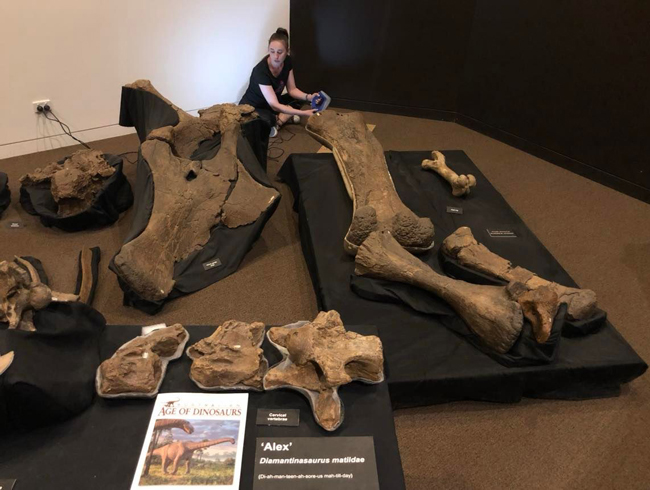
A new species of giant titanosaur has been scientifically described. The dinosaur, known from fossils from Neuquén Province, (Argentina) has been named Bustingorrytitan shiva. This dinosaur may have weighed more than sixty-seven tonnes! Although the body mass estimates are prone to error, it is likely that this huge herbivore weighed at least fifty tonnes.

The fossil material was collected from the base of the Huincul Formation and consists of a relatively complete skeleton and the partial remains of three others. The strata have been dated to the upper Cenomanian (95 mya). The fossils were collected from the surroundings of Villa El Chocón. The genus name was erected to honour Manuel Bustingorry, who permitted the excavation work to take place.

The species name is from the Hindu deity Shiva, which transformed the universe. This alludes to the extensive faunal turnover that occurred in the Cretaceous towards the Cenomanian/Turonian boundary.

Bustingorrytitan fossils.
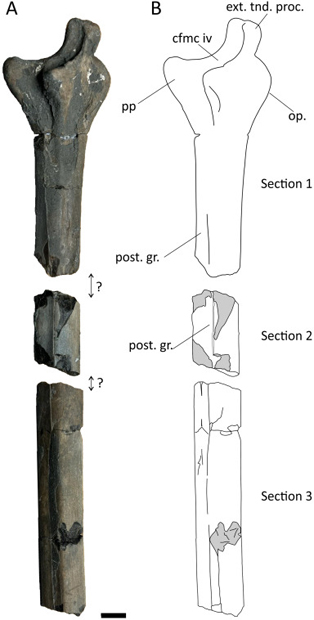
Forelimb bones of the new, giant titanosaurian sauropod dinosaur Bustingorrytitan shiva. Note largest scale bars equal 2 cm. Picture credit: Simón and Salgado (Acta Palaeontologica Polonica).

Calculating the Weight of a Giant Titanosaur

Both cranial and postcranial material was recovered. The fossil material includes right and left humeri and fragmentary thigh bones (femora). From these bones (humerus and the femur) the minimum circumference of these limb bones can be established. A formula (Campione and Evans, 2012) can then be applied to estimate the body mass of the animal. These calculations suggest that B. shiva was heavier than Dreadnoughtus schrani and perhaps comparable to the original body weight calculated for Patagotitan mayorum.

Pelvic and hindlimb elements ascribed to Bustingorrytitan shiva. Note scale bars equal 20 cm. Picture credit: Simón and Salgado (Acta Palaeontologica Polonica).

Intriguingly, the holotype material from which some of the limb bone measurements originate, suggests that the holotype specimen was not fully grown when it died. Bustingorrytitan shiva, may have been much larger.

The scientific paper: “A new gigantic titanosaurian sauropod from the early Late Cretaceous of Patagonia (Neuquén Province, Argentina)” by María Edith Simón and Leonardo Salgado published in Acta Palaeontologica Polonica.

11 12, 2023

The Story of Earth’s Climate in 25 Discoveries

By |2023-12-12T10:13:13+00:00December 11th, 2023|Categories: Book Reviews, Educational Activities, Geology, Main Page, Palaeontological articles|0 Comments

Delegates at COP28 continue their discussions on how to limit and make preparations for future climate change. These discussions, their success or failure will have consequences for all of humanity. Decisions made today will have implications for all future generations too. The publication of a new book that documents the history of our planet’s climate and its connection to life on Earth provides context and delivers a fresh perspective.

“The Story of Earth’s Climate in 25 Discoveries” is written by Donald R. Prothero. He is an incredibly talented American palaeontologist and geologist with a gift for communication. As adjunct professor of geological sciences at California State Polytechnic University (Pomona, California), the author is well qualified to explain the intimate connection between climate and life on Earth. However, unlike many scientists, Donald R. Prothero’s engaging writing style permits the general reader to understand and grasp sometimes difficult concepts.

Climate change book
The story of our planet’s climate in twenty-five discoveries by Donald R. Prothero.

Picture credit: Columbia University Press

Climate Change from a Deep Time Perspective

Our planet has undergone radical climate change throughout its history. Climate has changed dramatically from a “Snowball Earth” that led to a mass extinction event to sweltering jungles that stretched across the globe. Over deep geological time, climate has shaped the evolution of life on our planet. Furthermore, living organisms have shaped the Earth’s climate. We are not the first inhabitants to dramatically influence our planet’s climate. This new book documents these changes. It highlights how our climate has never changed so radically as it is changing now.

“The Story of Earth’s Climate in 25 Discoveries”

“The Story of Earth’s Climate in 25 Discoveries” takes the reader on a journey through Earth’s history. In this highly entertaining book, the author addresses questions such as Why do we have phytoplankton to thank for the air we breathe? What kind of climate was necessary for the rise of the dinosaurs, or the mammals, their successors? When and how have climatic changes caused mass extinctions?

Team members at Everything Dinosaur have enjoyed reading other books written by Donald R. Prothero. For example, we reviewed “The Story of the Dinosaurs in 25 Discoveries”.

Our review can be found here: A Review of “The Story of the Dinosaurs in 25 Discoveries.”

Today’s Climate Crisis

The author concludes this most informative publication with an examination of the Ice Ages and the Holocene Epoch. Our role in climate change is outlined and the perils we now face are explained.

Understanding why the climate has changed in the past, this timely book shows, is essential to grasping the gravity of how radically human activity is altering the climate today.

The Book Details

The Book: “The Story of Earth’s Climate in 25 Discoveries”

Publisher: Columbia University Press

Published February 2024 | Price: £32.00/$38.00 USD (hardback) | Pages: 472

ISBN: 9780231203586

Visit the website of Columbia University Press: Columbia University Press. Search on the website for the author or title to find the book.

10 12, 2023

Helpful Explanation of Lateral Views

By |2024-01-01T11:27:35+00:00December 10th, 2023|Categories: Adobe CS5, Dinosaur Fans, Everything Dinosaur Products, Main Page, Palaeontological articles, Photos of Everything Dinosaur Products, Press Releases|0 Comments

Many prehistoric animal models are photographed in lateral view. Everything Dinosaur explains the differences between right and left lateral views. It can be a little confusing for model collectors when photographs of a new prehistoric animal figure are released. Often the images include lateral views, these are images of the figure seen from the side.

The PNSO Megalosaurus model.
The new for 2023 PNSO Megalosaurus dinosaur model. Picture credit: Everything Dinosaur.

Picture credit: Everything Dinosaur

The image (above) shows a view of the recently introduced PNSO Edward the Megalosaurus dinosaur model. The left side of the model can be seen. This photograph shows the left lateral view of the figure. That is, in a left lateral view the object faces to the left as you look at the image.

To view the extensive range of PNSO prehistoric animal models available from Everything Dinosaur: Prehistoric Animal Models from PNSO.

Lateral Views

Determining whether a prehistoric animal figure is in left lateral or right lateral view is made easier if the whole of the model is shown in the image.

  • Left lateral view – the head of the figure faces to the left as you look at the image.
  • Right lateral view – the head of the figure faces to the right as you look at the image.
Papo Kronosaurus marine reptile model.
The Papo Kronosaurus marine reptile photographed in right lateral view. Picture credit: Everything Dinosaur.

Picture credit: Everything Dinosaur

In the image (above) the recently introduced Papo Kronosaurus model is facing to the right. Therefore, this model is being shown in the right lateral view.

To view the Papo prehistoric animal model range: Papo Prehistoric Animal Figures.

Providing Explanations

A spokesperson from Everything Dinosaur commented:

“Our blog often features details of scientific papers. Some of them can be quite technical and we try to summarise the findings and provide simplified explanations for the general reader. Interpreting scientific drawings can be a challenge. It can also be difficult to understand the details shown on a photograph of a prehistoric animal model if the orientation is not known.”

Explaining lateral views of fossils.
The partial skull of the lizard shown in right lateral view. Picture credit: David Whiteside, Sophie Chambi-Trowell, Mike Benton and the Natural History Museum UK

The photograph (above) shows the skull of the stem lizard Cryptovaranoides microlanius in right lateral view. Computerised tomography (CT) was used to help the researchers to construct the left side of the skull of C. microlanius. This enabled the team to construct a left lateral view of the skull.

To read Everything Dinosaur’s blog post about this fossil discovery: Modern Lizards in the Triassic.

Standardising Anatomical Terms

Although left lateral and right lateral are terms that are not often used in scientific disciplines, it is helpful to have an understanding of their meaning. It is important to have standard anatomical terms and scientific papers have been published that examine the use of such terms when describing fossils.

The next time you see a photograph of a prehistoric animal model, we hope our short explanation will help you to understand whether the view is left or right lateral.

The award-winning Everything Dinosaur website: Everything Dinosaur.

8 12, 2023

Researchers Indentify the Last Meal of a Young Gorgosaurus

By |2024-03-09T15:01:33+00:00December 8th, 2023|Categories: Dinosaur and Prehistoric Animal News Stories, Dinosaur Fans, Main Page, Palaeontological articles, Photos/Pictures of Fossils|0 Comments

A newly published scientific paper has highlighted the diet of juvenile tyrannosaurs. Writing in the academic journal “Science Advances” the research team report that a young Gorgosaurus consumed the hind limbs from a pair of caenagnathid dinosaurs (Citipes elegans). This is the first time that stomach contents have been found in association with a tyrannosaur specimen.

A superb, well-preserved Gorgosaurus libratus specimen was found by Royal Tyrrell Museum of Palaeontology staff in the Dinosaur Provincial Park in 2009. The specimen is a juvenile, thought to be between five and seven years of age. When it died this dinosaur weighed around 335 kilograms, only about 13% of the mass of an adult Gorgosaurus.

Dr François Therrien (Curator of Dinosaur Palaeoecology at the Royal Tyrrell Museum) and Dr Darla Zelenitsky (Assistant Professor at University of Calgary) stand next to the young Gorgosaurus specimen.
Dr François Therrien (Curator of Dinosaur Palaeoecology at the Royal Tyrrell Museum) and Dr Darla Zelenitsky (Assistant Professor at University of Calgary) stand next to the young Gorgosaurus specimen. Picture credit: Royal Tyrrell Museum of Palaeontology.

Stomach Contents Preserved in a Young Gorgosaurus

Whilst being cleaned and prepared at the Royal Tyrrell Museum of Palaeontology (Alberta, Canada), the partial remains of two small theropods were discovered inside the stomach cavity. The research team determined that this juvenile tyrannosaur ate the hind limbs of two caenagnathids. Rather than consuming the whole animal, the young tyrannosaur only ate the hind limbs (the meatiest parts of the body).

The Last Meal of a Gorgosaurus.
The red square highlights where the preserved gut contents found in the Gorgosaurus libratus can be found. Picture credit: Royal Tyrrell Museum of Palaeontology.

Analysis of the Citipes remains demonstrated that they were young animals, perhaps twelve months old. Alongside the Citipes limb bones caudal vertebrae were discovered. This suggests that there was preferential consumption of the Citipes hind quarters.

Gorgosaurus Stomach Contents.
The stomach contents preserved inside Gorgosaurus libratus. The light and dark blue elements show the right and left hindlimbs of one Citipes individual. The light and dark green bones represent the other Citipes specimen consumed. Picture credit: Royal Tyrrell Museum of Palaeontology.

The elements highlighted in green in the illustration (above) are the remains of the first Citipes individual the gorgosaur consumed. The elements highlighted in blue are fossilised bones from the second Citipes individual eaten.

The Same Meal but Consumed at Different Times

As the elements of the two Citipes individuals are at different stages of digestion, the researchers were able to conclude that the gorgosaur’s stomach contents represent two different meals. These two juvenile Citipes could have been ingested hours or days apart. The presence of two dinosaurs of the same species and age in the stomach contents, ingested at different times, suggests that young caenagnathids may have been among the preferred prey of juvenile gorgosaurs.

This specimen is the first to provide direct evidence that young gorgosaurs had different diets than their adult counterparts. When fully grown Gorgosaurus would have been an apex predator. Feeding traces preserved on fossil bones indicate that Gorgosaurus fed on ceratopsians and duck-billed dinosaurs.

This evidence suggests that tyrannosaurs occupied different ecological niches over their lifetime. As young tyrannosaurs grew and matured, they would have transitioned from hunting small and young dinosaurs to preying on large herbivores. This dietary shift likely began around the age of eleven, when their skulls and teeth started becoming more robust.

PNSO Tristan the Gorgosaurus
The recently introduced PNSO Tristan the Gorgosaurus dinosaur model in lateral view. A replica of an adult Gorgosaurus libratus. Picture credit: Everything Dinosaur.

Picture credit: Everything Dinosaur

The picture (above) shows a replica of an adult Gorgosaurus. The skull is much more robust and powerful and the teeth proportionately larger. The model is from the PNSO Age of Dinosaurs range.

To view this range of prehistoric animal figures: PNSO Age of Dinosaurs Models and Figures.

A Way of Reducing Intraspecific Competition

Dietary differences are seen in animals at different ontogenic stages in modern ecosystems. These differences in diet provide a competitive advantage by lessening intraspecific competition for resources. Therefore, such a shift may have allowed juvenile and adult tyrannosaurs to coexist in the same environment with reduced conflict.

Being able to occupy different ecological niches during their lifespan was probably a key to the evolutionary success of the Tyrannosauridae.

A young Gorgosaurus consumes a Citipes elegans.
An illustration of Gorgosaurus libratus eating Citipes elegans. Royal Tyrrell Museum of Palaeontology/Julius Csotonyi.

Everything Dinosaur acknowledges the assistance of a media release from the Royal Tyrrell Museum of Palaeontology in the compilation of this article.

The scientific paper: “Exceptionally preserved stomach contents of a young tyrannosaurid reveal an ontogenetic dietary shift in an iconic extinct predator” by Francois Therrien, Darla K. Zelenitsky, Jared T. Voris, Gregory M. Erickson, Philip J. Currie, Christopher L. Debuhr and Yoshitsugu Kobayashi published in Science Advances.

Visit the award-winning Everything Dinosaur website: Everything Dinosaur.

27 11, 2023

Farlowichnus rapidus – A New Early Cretaceous Theropod

By |2023-11-28T15:11:23+00:00November 27th, 2023|Categories: Adobe CS5, Dinosaur Fans, Main Page, Palaeontological articles|0 Comments

Researchers have erected a new ichnogenus and ichnospecies of theropod dinosaur based on fossil tracks. The dinosaur has been named Farlowichnus rapidus.

The trackways come from the Lower Cretaceous Botucatu Formation of Brazil. The sandstones preserve a variety of trackways including dinosaurs. The tracks were made when animals traversed the extensive dune fields that once existed in this ancient desert. The sandstones of Botucatu Formation originally covered a land area estimated to be at least 1,300,000 km2, an area larger than the Gobi Desert. The ancient sandstones of the Botucatu Formation represent the largest fossil desert known to science.

Farlowichnus rapidus

The three-toed prints that led to the erection of the new dinosaur ichnogenus Farlowichnus were donated to Brazil’s Museum of Earth Sciences (Museu de Ciências da Terra) in 1984. The stride pattern indicates a small biped probably less than a metre tall. This dinosaur was probably carnivorous and fleet-footed, its light body able to traverse the dunes without disturbing the sands too much. This permitted the prints to be preserved.

Farlowichnus rapidus
A new ichnogenus of fleet-footed theropod has been described from fossilised trackways preserved in sandstones located in the Paraná Basin (Brazil).

Picture credit: Cretaceous Research

Unique Characteristics

The tracks differ from other theropod ichnogenera. The footprints have a relatively large and very wide digit III and small, short, pointed, bladelike outer digits. The most significant characteristic is that digit II is longer and more robust than digit IV. As a result of this unusual morphology, the general outline of the footprint reminded the scientists of a water droplet. Although three toes are in contact with the ground (a tridactyl print), most of the weight would have been supported by the oversized digit III, making the foot essentially monodactylous.

A similar foot morphology is seen in living archosaurs today. The ostrich (Struthio camelus) walks on two toes (digits III and IV). Digit III is much more robust and supports most of the bird’s weight.

Close-up view of the foot of an ostrich.
Views of the foot of an ostrich (Struthio camelus). Dorsal (left) and ventral (right). The third digit (III) is greatly enlarged, it is much larger than digit IV. Essentially the foot morphology gives this extant bird an almost monodactylous pes. Picture credit: Everything Dinosaur.

Picture credit: Everything Dinosaur

Ancestors of Noasaurs and Velocisaurs

The ichnogenus name honours the palaeontologist James O. Farlow, for his extensive work on dinosaur trace fossils. The species name “rapidus” reflects the likely habits of this small theropod. It was probably able to run fast, and it was extremely agile.

Writing in the academic journal “Cretaceous Research”, the authors of the scientific paper speculate that Farlowichnus was an ancestor of other theropod clades such as the noasaurs and velocisaurs.

To read about the discovery of the noasaur Vespersaurus paranaensis: First Dinosaur from the Caiuá Group of Brazil.

The scientific paper: “Farlowichnus rapidus new ichnogen., new ichnosp.: A speedy and small theropod in the Early Cretaceous Botucatu paleodesert (Paraná Basin), Brazil” by Giuseppe Leonardi, Marcelo Adorna Fernandes, Ismar de Souza Carvalho, Julia Beatrice Schutzer and Rafael Costa da Silva published in Cretaceous Research.

Visit the award-winning Everything Dinosaur website: Everything Dinosaur.

25 11, 2023

Biggest and Best Ever – TetZooCon 2023

By |2023-11-29T09:58:30+00:00November 25th, 2023|Categories: Adobe CS5, Dinosaur Fans, Educational Activities, Everything Dinosaur News and Updates, Main Page, Palaeontological articles, Press Releases|0 Comments

Less than a week to go now before the start of the TetZooCon 2023 event. Once again, Everything Dinosaur are proud to be involved with this conference and as a sponsor we wish the organisers every success. This is the tenth TetZooCon, the conference is becoming an institution, a must attend event for anyone with an interest in the natural world, the Earth sciences and palaeoart.

Many of Everything Dinosaur’s chums will be attending. Unfortunately, pressures of work have once again prevented us from going, but we will be thinking of everyone next weekend.

The TetZooCon banner for 2023
The TetZooCon banner for 2023 which has been designed by Darren Naish, one of the conference organisers.

Picture credit: Darren Naish

TetZooCon 2023

TetZooCon 2023 will be held at Bush House, King’s College, London, on the weekend of 2nd and 3rd December 2023, with an evening reception on Friday December 1st and a fieldtrip on Monday 4th December. For the first time ever, the TetZooCon will consist of parallel sessions throughout.

Several of the sessions are dedicated to marine reptile research. Attendees will get the chance to meet “Flip” the world’s most scientifically accurate swimming plesiosaur. Dr Dean Lomax will be delivering a presentation covering the latest research into the “Rutland Sea Dragon”. Not to be outdone, Emily Swaby will be discussing Yorkshire’s very own giant marine reptile – Temnodontosaurus crassimanus.

Dr Dean Lomax working on the skull of the Rutland ichthyosaur.
Dr Dean Lomax working on the skull of the Rutland ichthyosaur, the largest and most complete ichthyosaur fossil ever found in the UK. Picture credit: Matthew Power.

Palaeoart in Perspective

The very talented Luis Rey will lead a panel discussion on the Past and Future of Palaeoart. Co-host Darren Naish will provide an insight into the television series “Prehistoric Planet” and expect living archosaurs such as corvids and cassowaries to enter the debate.

On Sunday (December 3rd), Nigel Marven will look back on his adventures filming dinosaurs and other reptiles. In addition, during Sunday lunch time there will be a special screening of the film “The Lost World” from 1925.

A spokesperson from Everything Dinosaur commented:

“We wish we could attend next weekend. Bush House at King’s College, London is going to be buzzing. Our congratulations to Darren Naish and John Conway for all their hard work organising such an exciting event.”

Visit the Everything Dinosaur website: Everything Dinosaur’s website.

11 11, 2023

The Super Senses of Thescelosaurus

By |2023-11-11T06:24:16+00:00November 11th, 2023|Categories: Adobe CS5, Dinosaur and Prehistoric Animal News Stories, Dinosaur Fans, Main Page, Palaeontological articles|0 Comments

A newly published scientific paper, examining the skull of a bird-hipped dinosaur (Thescelosaurus neglectus), suggests that this dinosaur had remarkable senses. CT scans of the skull suggest that this Late Cretaceous herbivore possessed a unique combination of traits and indicate that Thescelosaurus may have spent at least some of the time underground. The study is the first to link a specific suite of sensory abilities with dinosaur behaviour.

If you live alongside Tyrannosaurus rex, then having a burrow or den to hide in might prove to be an effective survival strategy.

Studying the Skull of “Willo”

The skull used in the study comes from “Willo”, which is part of the North Carolina Museum of Natural Sciences vertebrate collection. Thescelosaurus is a member of the Ornithischia. The genus was erected in 1913. It measured around four metres in length and weighed around 340 kilograms. That is about as heavy as a Jersey cow. In an ecosystem which included Triceratops, Edmontosaurus as well as T. rex, Thescelosaurus tends to be overlooked.

Thescelosaurus and super senses.
A newly published scientific paper which undertook a detailed analysis of the skull of a Thescelosaurus suggests that this relatively small, Late Cretaceous dinosaur may have lived underground.

Picture credit: Anthony Hutchings

Thescelosaurus neglectus – “Wonderful, Overlooked Lizard”

The binomial scientific name of this dinosaur translates as “wonderful, overlooked lizard”. However, undeterred by this dinosaur’s lack of sharp teeth, dermal armour, crests or horns – traits associated with some of its contemporaries, Dr David Button (Bristol University) began studying Thescelosaurus.

Dr Button built up a detailed, three-dimensional model of the skull using multiple CT scans. The brain and the inner ear were reconstructed. This allowed the researchers to determine the size of the brain and to build up a picture of the dinosaur’s senses.

Dr Button commented:

“We found that the olfactory bulbs – the regions of the brain that process smell – were very well developed in Thescelosaurus. They were relatively larger than those of any other dinosaur we know of so far, and similar to those of living alligators, which can smell a drop of blood from miles away.”

Dr Button added:

“Thescelosaurus may have used its similarly powerful sense of smell to instead find buried plant foods like roots and tubers. It also had an unusually well-developed sense of balance, helping it to pinpoint its body position in 3D space, another trait often found in burrowing animals.”

There is More to Thescelosaurus

Co-author of the paper, published in Scientific Reports, Dr Lindsay Zanno (North Carolina Museum of Natural Sciences), stated:

“The irony is that palaeontologists generally think of these animals as pretty boring. When we first looked at our results we thought, yeah, this animal is plain as toast. But then we took a big step back and realised there was something unique about the combination of Willo’s sensory strengths and weaknesses.”

A drawing of Thescelosaurus.
A new species of Thescelosaurus (T. assiniboiensis ) was described in 2011. Picture credit: Everything Dinosaur.

Picture credit: Everything Dinosaur

Limited Hearing

The scientists calculated that the hearing range of Thescelosaurus neglectus was extremely limited. It could only hear about 15% of the frequencies humans can detect, and between 4% to 7% of what dogs and cats can hear. In particular, T. neglectus was bad at hearing high-pitched sounds.

Dr Zanno explained:

“We found that Thescelosaurus heard low frequency sounds best, and that the range of frequencies it could hear overlaps with T. rex. This doesn’t tell us they were adapted to hearing T. rex vocalise, but it certainly didn’t hurt them to know when a major predator was tooling about in the area. More interesting to us was the fact that these particular deficiencies are often associated with animals that spend time underground.”

However, the researchers discovered that this dinosaur did have an excellent sense of smell.

T. neglectus may not have been particularly clever, not even for a dinosaur. It may have had limited hearing, but it had powerful arms and legs, a superb sense of balance and spatial awareness coupled with a keen sense of smell. These are all typical characteristics found in extant vertebrates that spend time underground or engage in digging behaviours.

Dr Button summarised the study:

“While we can’t say definitively that these animals lived part of their lives underground, we know that their ancestors did. This fact, together with their unique combination of sensory abilities, strongly suggests T. neglectus engaged in similar behaviours.”

Thescelosaurus neglectus – Not a “Boring” Dinosaur

Dr Zanno concluded:

“We still don’t know the sensory abilities of most dinosaurs. That makes it difficult to link these traits to specific lifestyles with confidence, but it also means there are plenty of cool discoveries to come. The idea that there might have been dinosaurs living under the feet of T. rex and Triceratops is fascinating. No matter what, we now know for certain that T. neglectus isn’t boring.”

Everything Dinosaur acknowledges the assistance of a media release from the University of Bristol in the compilation of this article.

The scientific paper: “Neuroanatomy of the late Cretaceous Thescelosaurus neglectus (Neornithischia: Thescelosauridae) reveals novel ecological specialisations within Dinosauria” by David Button and Lindsay Zanno published in Scientific Reports.

Visit the Everything Dinosaur website: The Everything Dinosaur Website.

Go to Top