All about dinosaurs, fossils and prehistoric animals by Everything Dinosaur team members.

Articles, features and information which have slightly more scientific content with an emphasis on palaeontology, such as updates on academic papers, published papers etc.

7 02, 2024

New Research into Dinosaur Locomotion

By |2024-02-08T08:32:20+00:00February 7th, 2024|Categories: Dinosaur and Prehistoric Animal News Stories, Dinosaur Fans, Main Page, Palaeontological articles|0 Comments

Newly published research examining dinosaur locomotion and comparing it with other archosaurs suggests that the way in which dinosaurs moved could have given them a competitive advantage.

The research was undertaken by a team from the University of Bristol. It has been published today in Royal Society Open Science. The team’s findings indicate that the earliest dinosaurs were simply faster and more dynamic than their competitors. Perhaps the greater locomotor plasticity of dinosaurs gave them a distinctive advantage over other terrestrial animals. This may help to explain why the dinosaur/pterosaur/bird branch of the archosaurs, the Avemetatarsalia eventually outcompeted the archosaur crocodilian lineage (Pseudosuchia).

Studying Dinosaur Locomotion

The researchers compared the limb proportions of an extensive range of archosaurs that lived during the Triassic. In total, the limb proportions of 208 taxa were studied. The research team identified which of these tetrapods was quadrupedal (four-footed) or bipedal (two-footed). The cursoriality index of each animal was also examined. The cursoriality index is essentially a measure of running ability.

The results demonstrated that the earliest dinosaurs and their close relatives were bipedal and cursorial – they had limbs adapted for running. These animals, members of the Avemetatarsalia subgroup of the archosaurs had a much wider range of running styles compared to the other archosaur lineage, the Pseudosuchia.

Dinosaur locomotion study.
Evolutionary tree showing how dinosaur limb adaptation expanded through the Triassic period until it was greater overall than the spread of locomotion types in their competitors, including pseudosuchians, other avemetatarsalians, and other archosaurs. These changes also included many early dinosaurs with strong adaptations to cursoriality (running). Mass extinctions are marked along the time scale: PTME, Permian-Triassic mass extinction; CPE, Carnian pluvial episode; ETME, end-Triassic mass extinction). Picture credit: Amy Shipley.

A Higher Range of Locomotory Modes by the Avemetatarsalia

The Pseudosuchia include the ancestors of extant crocodilians. Some were small, bipedal insectivores, but most were medium-to-large-sized carnivores and herbivores, and they were very successful throughout the Triassic. The research team calculated that the Dinosauria and other members of the Avemetatarsalia, maintained a higher range of locomotory modes throughout this period.

Lead author of the study Amy Shipley commented:

“When the crunch came, 233 million years ago, dinosaurs won out”.

The MSc Palaeobiology student at the University of Bristol added:

“At that time, climates went from wet to dry, and there was severe pressure for food. Somehow the dinosaurs, which had been around in low numbers already for twenty million years, took off and the pseudosuchians did not. It’s likely the early dinosaurs were good at water conservation, as many modern reptiles and birds are today. But our evidence shows that their greater adaptability in walking and running played a key part.”

Dinosaur locomotion and evolution of the femur.
Evolution of the thigh bone (femur) through the Triassic, starting with a very limited array of shapes, and ending with a broad array of shapes for the dinosaur femur (high disparity), indicating a wide range of locomotion modes. Picture credit: Amy Shipley.

The End Triassic Mass Extinction Event (ETME)

Co-author of the paper, Professor Mike Benton explained that at the end of the Triassic there was a mass extinction event. Most of the pseudosuchians died out, except for the ancestors of today’s crocodilians. The surviving dinosaurs expanded their range of locomotion again, taking over many of the empty niches in food webs.

Co-author Dr Armin Elsler added:

“When we looked at evolutionary rates, we found that in fact dinosaurs were not evolving particularly fast. This was a surprise because we expected to see fast evolution in avemetatarsalians and slower evolution in pseudosuchians. What this means is that the locomotion style of dinosaurs was advantageous to them, but it was not an engine of intense evolutionary selection. In other words, when crises happened, they were well placed to take advantage of opportunities after the crisis.”

Dinosaur locomotion a key to their evolutionary sucess.
An illustration of the early dinosaur Eoraptor lunensis from the Upper Triassic Ischigualasto Formation of Argentina. Picture credit: Nobu Tamura.

Could Dinosaur Locomotion be Key to Their Evolutionary Success?

Fellow collaborator Dr Tom Stubbs stated that the word “dinosaur” conjures up in the public’s imagination a slow-moving, large and lumbering animal. The first dinosaurs, animals such as Eoraptor lunensis were very different. The first members of the Dinosauria were small and agile.

Dr Stubbs said:

“The first dinosaurs were only a metre long, up high on their legs, and bipedal. Their leg posture meant they could move fast and catch their prey while escaping larger predators.”

Co-author Dr Suresh Singh concluded:

“And of course, their diversity of posture and focus on fast running meant that dinosaurs could diversify when they had the chance. After the end-Triassic mass extinction, we get truly huge dinosaurs, over ten metres long, some with armour, many quadrupedal, but many still bipedal like their ancestors. The diversity of their posture and gait meant they were immensely adaptable, and this ensured strong success on Earth for so long.”

Everything Dinosaur acknowledges the assistance of a media release from Bristol University in the compilation of this article.

The scientific paper: “Locomotion and the early Mesozoic success of Archosauromorpha” by Amy E. Shipley, Armin Elsler, Suresh A. Singh, Thomas L. Stubbs and Michael J. Benton published in Royal Society Open Science.

The Everything Dinosaur website: Everything Dinosaur.

6 02, 2024

New Species of Jurassic Pterosaur from the Isle of Skye

By |2024-02-06T13:45:11+00:00February 6th, 2024|Categories: Dinosaur and Prehistoric Animal News Stories, Dinosaur Fans, Main Page, Palaeontological articles, Photos/Pictures of Fossils|0 Comments

A new species of Jurassic pterosaur has been described based on fossils found on the Isle of Skye. The new flying reptile has been named Ceoptera evansae (Ki-yo-op-ter-rah evans-say). It lived around 168-166 million years ago (Bathonian faunal stage of the Middle Jurassic). It has been classified as part of the controversial Darwinoptera clade. The discovery of Ceoptera demonstrates that this clade was considerably more diverse than previously thought. The Darwinoptera are now thought to have persisted for more than twenty-five million years and probably had a worldwide distribution.

Ceoptera life reconstruction
The Isle of Skye around 168 million years ago. A flock of Ceoptera take to the skies as turtles look on and a group of sauropods wander towards the treeline. A large pterosaur is seen overhead, we suspect that this is a solitary Dearc sgiathanach. Picture credit: NHM and Mark Witton.

The artist has depicted a single, slender-winged pterosaur soaring high above the Ceoptera flock. We suspect that this is a representation of the recently described rhamphorhynchid Dearc sgiathanach.

To read an article about D. sgiathanach: Fantastic Pterosaur from the Isle of Skye.
The Kilmaluag Formation

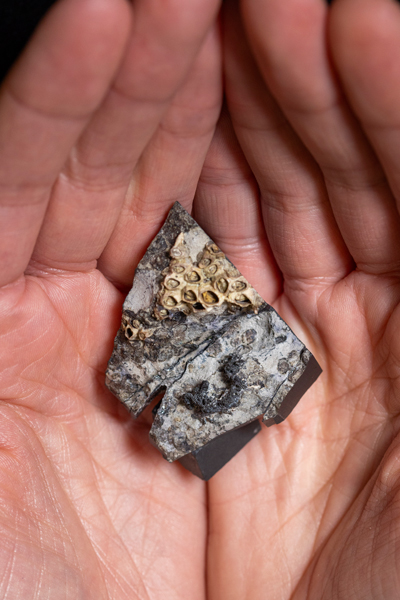
The fossil remains were found partially exposed on a large boulder situated a few metres from the cliffs on the north side of Glen Scaladal at Cladach a’Ghlinne, a small beach that forms part of the coastline of Loch Scavaig, on the Strathaird Peninsula, Isle of Skye. The fossil bearing rocks are associated with the Kilmaluag Formation. The density and hardness of the matrix, coupled with the fragile nature of the fossil bones made the specimen unsuitable for mechanical preparation.

A complex process of acid bath immersion was undertaken to weaken the matrix and to expose the bones. The acid immersion, stabilising via rinsing and oven drying was repeated twenty-nine times in order to get the bones suitably prepared for analysis and CT scanning.

Ceoptera evansae fossils.
The fossilised remains of Ceoptera evansae. The slab (top left) contains the shoulder region, parts of the wing and vertebrae. Picture credit: Trustees of the Natural History Museum London.

Ceoptera evansae

The discovery of Ceoptera underpins a new and more complex model for the early evolution of pterosaurs. Flying reptile fossils from the Middle Jurassic are extremely rare. Those that have been found are relatively incomplete and fragmentary. Whilst no cranial material is associated with Ceoptera evansae, this discovery demonstrates that the major Jurassic pterosaur clades were present before the end of the Early Jurassic.

The fossils also provide important new information concerning the geographic and stratigraphic range of the controversial clade Darwinoptera. It had been thought that this species-poor group were largely restricted to the Upper Jurassic of eastern Asia. With the discovery of Ceoptera it suggests that these pterosaurs were both temporally and geographically widespread.

Many of the bones remain completely embedded in rock and can only be studied using CT-scanning. This pterosaur is one of the first flying reptiles to be digitally assessed using scans and computer modelling.

Senior author of the paper, Professor Paul Barrett (London Natural History Museum), stated:

“Ceoptera helps to narrow down the timing of several major events in the evolution of flying reptiles. Its appearance in the Middle Jurassic of the UK was a complete surprise, as most of its close relatives are from China. It shows that the advanced group of flying reptiles to which it belongs appeared earlier than we thought and quickly gained an almost worldwide distribution.”

3D model of Ceoptera evansae fossil material.
A three-dimensional model showing the layout and configuration of the fossil material. Picture credit: Liz Martin-Silverstone.

Ceoptera evansae – What’s in a Name?

The generic name is derived from the Scottish Gaelic word cheò or ceò (pronounced ‘ki-yo’), meaning mist. This is a reference to the common Gaelic name for the Isle of Skye Eilean a’ Cheò, or Isle of Mist), and the Latin ptera, meaning wing (feminine).

The species name honours Professor Susan E. Evans. It was Professor Evans who first became aware of the Glen Scaladal site’s potential for vertebrate fossils.

Lead author Dr Liz Martin-Silverstone, a palaeobiologist at the University of Bristol explained:

“The time period that Ceoptera is from is one of the most important periods of pterosaur evolution, and is also one in which we have some of the fewest specimens, indicating its significance. To find that there were more bones embedded within the rock, some of which were integral in identifying what kind of pterosaur Ceoptera is, made this an even better find than initially thought. It brings us one step closer to understanding where and when the more advanced pterosaurs evolved.”

Everything Dinosaur acknowledges the assistance of the press team at the University of Bristol and a media release from the London Natural History Museum in the compilation of this article.

The scientific paper: “A new pterosaur from the Middle Jurassic of Skye, Scotland and the early diversification of flying reptiles” by Elizabeth Martin-Silverstone, David M. Unwin, Andrew R. Cuff, Emily E. Brown, Lu Allington-Jones and Paul M. Barrett published in the Journal of Vertebrate Paleontology.

The Everything Dinosaur website: Everything Dinosaur.

5 02, 2024

University Student Discovers New Dinosaur Species

By |2024-02-06T20:09:32+00:00February 5th, 2024|Categories: Adobe CS5, Dinosaur and Prehistoric Animal News Stories, Dinosaur Fans, Main Page, Palaeontological articles, Photos/Pictures of Fossils|0 Comments

To discover a new dinosaur species might mark the high point of a long career in palaeontology for some scientists. However, for one Oklahoma State University (OSU) student they can already put a tick in the “named a new dinosaur box” on their curriculum vitae. Kyle Atkins-Weltman (PhD student in the School of Biomedical Sciences), was studying a selection of foot and leg bone fossils of what was thought to be a juvenile Anzu wyliei. Remarkably, analysis of the fossils indicated that these bones came from a mature animal and as such they represented a new dinosaur species. Based on these findings, Kyle was able to erect a new Hell Creek theropod – Eoneophron infernalis.

Eoneophron infernalis limb bones.
Limb bones of the newly described Hell Creek Formation caenagnathid Eoneophron infernalis. Picture credit: Kyle Atkins-Weldman.

The picture (above) shows limb bones from the newly described caenagnathid. Metatarsals (left) with the right tibia (centre) and a femur (right).

Pharaoh’s Dawn Chicken from Hell

Bone histology revealed the fossils to represent a dinosaur at least six years of age when it died. These were not the bones from a juvenile A. wyliei, but from a smaller but closely related theropod species. The student named the new dinosaur Eoneophron infernalis. It translates as “Pharaoh’s dawn chicken from Hell”. Team members at UK-based Everything Dinosaur pronounce this dinosaur as ee-on-oh-fron in-fur-nal-lis.

The name honours the description of the Anzu taxon as well as the student’s late beloved pet, a Nile monitor lizard named Pharaoh.

Student Kyle Atkins-Weltman.
Oklahoma State University PhD student Kyle Atkins-Weltman. Picture credit: Matt Barnard/OSU Centre for Health Sciences.

Eoneophron infernalis and Implications for Caenagnathid Diversity

Previously, only one caenagnathid (Anzu wyliei) was known from the Hell Creek Formation. It was formally named and described in 2014 (Lamanna et al). Palaeontologists were aware of smaller, fragmentary fossil bones representing caenagnathids from the Hell Creek Formation. It was unclear whether these fossils represented distinct, undescribed taxa or juvenile A. wyliei specimens. Eoneophron infernalis is estimated to have stood around one metre high at the hips and weighed approximately seventy kilograms. In contrast, Anzu wyliei was much larger, with a hip height of about 1.5 metres and weighing three hundred kilograms.

This new taxon is also distinct from other small caenagnathid material previously described from the area. Scientists postulate that there are potentially three distinct caenagnathid genera in the Hell Creek Formation. These results show that caenagnathid diversity in the Hell Creek ecosystem has probably been underestimated.

Caenagnathids of the Hell Creek Formation.
A life reconstruction of Eoneophron infernalis (left), an as yet, undescribed caenagnathid MOR 752 (bottom), and Anzu wyliei (right). Picture credit: Zubin Erik Dutta.

A Feathered Dinosaur

When asked to describe Eoneophron infernalis, Kyle highlighted how closely related to birds these dinosaurs were. He stated:

“It was a very bird-like dinosaur. It had a toothless beak and a relatively short tail. It’s hard to tell its diet because of the toothless beak. It definitely had feathers. It was covered in feathers and had wings.”

Co-author of the scientific paper and Kyle’s faculty advisor Associate Professor Eric Snively commented:

“Kyle is the first student researcher at OSU-CHS to reveal, describe and name a new dinosaur.”

When it looked like the fossils may not belong to an Anzu, Atkins-Weltman turned to caenagnathid researchers Greg Funston, PhD, a palaeontologist with the Royal Ontario Museum in Ontario, Canada, and palaeontology PhD candidate Jade Simons with the University of Toronto for their assistance.

He was also able to involve Associate Professor of Anatomy Dr Holly Woodward Ballard, an expert in bone histology.

A view of the metatarsal bones of Eoneophron infernalis.
A view of the metatarsal bones of Eoneophron infernalis. Picture credit: Kyle Atkins-Weldman.

A Thrilling Discovery

Kyle Atkins-Weltman explained that his project and published findings would not have been possible without his co-authors and those who assisted him.

He added:

“It was really thrilling. Based on the work and research I do, I never thought I would be someone to discover a new dinosaur species.”

Eoneophron infernalis life reconstruction.
Eoneophron infernalis life reconstruction. Picture credit: Zubin Erik Dutta.

Everything Dinosaur acknowledges the assistance of a media release from Oklahoma State University in the compilation of this article.

The scientific paper: “A new oviraptorosaur (Dinosauria: Theropoda) from the end-Maastrichtian Hell Creek Formation of North America” by Kyle L. Atkins-Weltman, D. Jade Simon, Holly N. Woodward, Gregory F. Funston and Eric Snively published in PLOS One.

1 02, 2024

Examining a Sauropod Skin Impression

By |2024-02-14T10:27:24+00:00February 1st, 2024|Categories: Adobe CS5, Dinosaur Fans, Main Page, Palaeontological articles, Photos/Pictures of Fossils|0 Comments

Team members photographed a sauropod skin impression whilst visiting the London Natural History Museum. The specimen is part of the Patagotitan exhibition entitled “Titanosaur – Life as the Biggest Dinosaur”. Although most visitors probably overlook this fossil it is perhaps one of the most important fossil specimens on display in this part of the museum.

A detailed analysis of the skin impression provided new information on the anatomy of sauropods. A study revealed features on the skin that might explain how these dinosaurs were able to grow so big.

Sauropod skin impression.
A sauropod skin impression (NHMUK R1868) on display as part of the London Natural History Museum Patagotitan exhibition. Picture credit: Everything Dinosaur.

Picture credit: Everything Dinosaur

Studying a Sauropod Skin Impression

This is a fossilised imprint of sauropod skin. It is specimen number NHMUK R1868. It was the first skin impression to be described in any non-avian dinosaur. The fossil, discovered in 1852 provided the first evidence that sauropods had scaly skin. The impression was formed when the skin of a carcase was pressed into soft mud. This left an impression of the skin contours imprinted on the sediment. Over millions of years the ground hardened into rock.

The fossil was discovered in Hastings along with a large forelimb. The material comes from the Hasting Beds, which are part of the Wealden Group and represent Lower Cretaceous deposits. The sauropod, possibly a basal titanosaur, has been named Haestasaurus becklesii. The skin impression is thought to have come from the forearm, the presence of smaller scales at one end of the specimen suggests that the skin impression might have come from the elbow area. The smaller scales would have permitted greater flexibility in the joint.

Patagotitan skeleton on display.
Sue from Everything Dinosaur poses in front of the colossal Patagotitan skeleton which is being exhibited at the Natural History Museum (London). Picture credit: Everything Dinosaur.

Picture credit: Everything Dinosaur

Patagotitan dinosaur model.
A Patagotitan dinosaur model. The long neck and tail may have helped with thermoregulation, enabling this super-sized tetrapod to lose heat efficiently.

The image above shows the recently introduced Wild Safari Prehistoric World Patagotitan dinosaur model.

To view this range of prehistoric animal figures: Wild Safari Prehistoric World Models.

A Sauropod Skin Scientific Paper

A paper published in February 2022 (Pittman et al) examined NHMUK R1868 in detail using laser-simulated fluorescence (LSF). This technique reveals much more detail at the microscopic level than exposure to normal light and UV light. The researchers discovered that the skin was covered in tiny bumps (papillae). These convex bumps increased the surface area of the skin, and it was thought that they played a role in thermoregulation.

Large animals, such as sauropods need to find ways to stop their bodies overheating. The extended surface area of their long necks and tails would have helped, but the researchers speculate that these small bumps greatly increased the skin surface area, thus permitting more efficient heat exchange between their bodies and the environment.

A review of other sauropod skin fossils demonstrated that intrascale papillae were unique to and widespread across the Neosauropoda. This suggests that this trait evolved early in the Sauropoda, and it might explain why these types of dinosaurs were able to grow so big and to become giants.

The scientific paper: “Newly detected data from Haestasaurus and review of sauropod skin morphology suggests Early Jurassic origin of skin papillae” by Michael Pittman, Nathan J. Enriquez, Phil R. Bell, Thomas G. Kaye and Paul Upchurch published in Communications Biology.

Visit the Everything Dinosaur website: Everything Dinosaur.

24 01, 2024

New Study into Very Old Vertebrate

By |2024-01-31T12:07:58+00:00January 24th, 2024|Categories: Adobe CS5, Main Page, Palaeontological articles, Photos/Pictures of Fossils|0 Comments

The evolution of a jaw and the transition from passive feeding to predatory behaviour is regarded as one of the most significant events in the evolution of vertebrates. It has been suggested that early vertebrates were passive, suspension feeders. They removed particles of food in the water column by some form of filtration. Over time, a more predatory, active lifestyle evolved. Living jawless vertebrates today such as the Hagfish (Myxinidae family) are scavengers as well as predators. Studying these animals can help to inform palaeontologists about the potential feeding strategies of extinct jawless fish. However, the feeding strategy of these animals and jawed stem-gnathostomes (the phylogenetic intermediates of living jawless and jawed vertebrates) remains unclear.

Heterostrachan and placement within the vertebrates.
The diversity and relationships of jawless and jawed vertebrates, crosses indicate extinct clades. The red star indicates the location of the Heterostraci. Picture credit: Grohganz et al with additional annotation by Everything Dinosaur.

New and Innovative Research into Extinct Jawless Fishes

A new scientific paper, published in the Journal of Vertebrate Paleontology casts doubt on the idea that some jawless vertebrates were filter feeders. Scientists from the University of Bristol used innovative research techniques to examine the dentition of extinct jawless heterostracans. The Heterostraci are an extinct subclass of the Agnatha (jawless fishes).

The research discovered that the forward-facing denticles on the oral plates of heterostracans were not adaptations for filter feeding.

Madleen Grohganz, the lead author of the paper from Bristol University’s Palaeobiology Research Group commented:

“The origin of vertebrates, our very own evolutionary lineage, is widely regarded as one of the most important events in evolutionary history. Early vertebrate evolution is a much-debated topic among biologists and palaeontologists and there are still many unresolved questions.”

Oral plates of Protopteraspis.
Articulated, V-shaped oral plate apparatus of Protopteraspis vogti; B, aboral; C, oral views. Rostral is to the top of the image in B and C. Note scale bar = 2 mm. Picture credit: Grohganz et al.

The Jawless Heterostracans

Heterostracans are among the oldest of all the vertebrates. Their mode of feeding remains controversial. To determine whether they were filter feeders or predators sophisticated modern computational palaeobiological techniques were employed in this study.

Heterostracans possessed a feeding apparatus of rod-like oral plates with rows of forward-facing denticles outside of the mouth. These traits had been thought to represent combs for filter feeding.

The team employed Computational Fluid Dynamics (CFD), a technique from engineering that simulates fluid flows and their interaction with solids to test this hypothesis. Water flow modelled around these structures would indicate whether these oral plates were effective at filtering out particles of food.

All the tested models, independent of denticle orientation, showed similar flow, velocity and vorticity patterns. Based on these analyses the team rejects the hypothesis that denticle orientation is a specific adaption to suspension feeding. The denticles only occur on the lateral sides of the very tip of the oral plates. They may have played a role in preventing oversized food particles, sediment or parasites from lodging between the plates.

Madleen Grohganz stated:

“Our study is one of the first, that actively tests feeding mode hypotheses of early jawless vertebrates instead of making poorly constrained inferences. This is an important step towards better understanding the feeding mode of early jawless vertebrates, testing evolutionary scenarios and ultimately shedding more light on early vertebrate evolution.”

More Research into Stem-gnathostomes Required

The feeding strategies of stem-gnathostomes remains largely unknown. The researchers conclude that other feeding theories such as whether heterostracans were capable of biting still require testing.

The exact nature of heterostracan feeding remains an open question. Other feeding hypotheses, which propose a mechanical function related to active biting or scavenging, still need to be tested. The creation of three-dimensional skull models based on non-destructive CT scans could yield more evidence to help inform palaeontologists. Madleen Grohganz and her colleagues agree that more research is required on these basal vertebrates.

Dr Grohganz explained:

“Previous feeding mode hypotheses of early jawless vertebrates have mainly been based on poorly constrained inferences. But using computational palaeobiological methods, we were able to actually test and reject one of these feeding mode hypotheses.”

Everything Dinosaur acknowledges the assistance of a media release from the University of Bristol in the compilation of this article.

The scientific paper: “Testing hypotheses of pteraspid heterostracan feeding using computational fluid dynamics” by Madleen Grohganz et al published in the Journal of Vertebrate Paleontology.

Visit the Everything Dinosaur website: Everything Dinosaur.

22 01, 2024

Student Discovers Remarkable Late Triassic Flying Reptile in Somerset

By |2024-01-23T09:12:59+00:00January 22nd, 2024|Categories: Adobe CS5, Dinosaur and Prehistoric Animal Drawings, Dinosaur Fans, Main Page, Palaeontological articles, Photos/Pictures of Fossils|0 Comments

A student from the University of Bristol has confirmed the presence of Kuehneosaurs in the Late Triassic of southwestern England. These gliding reptiles were part of a rich reptile dominated fauna that lived on a series of sub-tropical islands, part of an ancient archipelago. The biggest island extended from Frome in the east to Weston-super-Mare in the west. It was around eighteen miles (thirty kilometres long). It is referred to as the Mendip Palaeo-island.

Kuehneosaurus life reconstruction.
An artist’s impression of a gliding reptile Kuehneosaurus. Picture credit: Mike Cawthorne.

Picture credit: Mike Cawthorne

Kuehneosaurs on Sub-tropical Islands

Kuehneosaurs superficially resemble lizards. However, they were more closely related to the ancestors of crocodilians and dinosaurs. They were small animals, which could fit neatly on the palm of a hand, and there were two species present. One species had extensive wing flaps, the second species had much shorter wings. These wings consisted of skin stretched over elongated ribs. Powered flight was beyond them, but they probably were very competent gliders.

Kuehneosaurs probably occupied a niche in the ecosystem similar to the extant flying lizard Draco from southeast Asia. They most likely wandered about on the ground and climbed trees in search of insects and other small invertebrates. To escape from predators, or to make rapid progress through the trees, they could launch themselves into the air and glide for several metres.

The discovery of Kuehneosaurs in the Late Triassic ecosystem was made by University of Bristol Masters student Mike Cawthorne. He had been examining numerous reptile fossils collected from limestone quarries, which represent deposits associated with the Mendip Palaeo-island.

Kuehneosaurus reptile fossils
Image showing partial skeleton of gliding reptile Kuehneosaurus on rock from Emborough. Picture credit: David Whiteside.

Picture credit: David Whiteside

No Dinosaur Fossils Found but They Were Probably Present

The research, published in the “Proceedings of the Geologists’ Association”, also records the presence of reptiles with complex teeth, the trilophosaur Variodens and the aquatic Pachystropheus that probably lived a bit like a modern-day otter likely eating shrimps and small fish. However, no dinosaur bones were found. These animals either fell or their bones were washed into caves and cracks in the limestone. This led to their preservation and the development of a fossil assemblage.

Emborough rock fossils.
A jawbone of unusual Triassic reptile Variodens first named from Emborough. B) Typical Emborough rock with many bones. C, D and E) bones from land-living relatives of crocodiles. Picture credit: David Whiteside.

Picture credit: David Whiteside

Masters student Mike Cawthorne commented:

“All the beasts were small. I had hoped to find some dinosaur bones, or even their isolated teeth, but in fact I found everything else but dinosaurs. The collections I studied had been made in the 1940s and 1950s when the quarries were still active, and palaeontologists were able to visit and see fresh rock faces and speak to the quarrymen.”

A Home for a Diverse Assemblage of Small Reptiles including Kuehneosaurs

Professor Mike Benton from Bristol University’s School of Earth Sciences added:

“It took a lot of work identifying the fossil bones, most of which were separate and not in a skeleton. However, we have a lot of comparative material, and Mike Cawthorne was able to compare the isolated jaws and other bones with more complete specimens from the other sites around Bristol. He has shown that the Mendip Palaeo-island, which extended from Frome in the east to Weston-super-Mare in the west, nearly 30 km long, was home to diverse small reptiles feeding on the plants and insects. He didn’t find any dinosaur bones, but it’s likely that they were there because we have found dinosaur bones in other locations of the same geological age around Bristol.”

Paying Tribute to the Fossil Collectors

Dr David Whiteside (University of Bristol) praised the work of the amateur fossil collectors and academics who found the fossils stating:

“The bones were collected by some great fossil finders in the 1940s and 1950s including Tom Fry, an amateur collector working for Bristol University and who generally cycled to the quarries and returned laden with heavy bags of rocks. The other collectors were the gifted researchers Walter Kühne, a German who was imprisoned in Great Britain in the second world war, and Pamela L. Robinson from University College London. They gave their specimens to the Natural History Museum in London and the Geological collections of the University of Bristol.”

Everything Dinosaur acknowledges the assistance of a media release from the University of Bristol in the compilation of this article.

The scientific paper: “Latest Triassic terrestrial microvertebrate assemblages from caves on the Mendip palaeoisland, S.W. England, at Emborough, Batscombe and Highcroft Quarries” by M. Cawthorne, D. I. Whiteside, and M. J. Benton published in the Proceedings of the Geologists’ Association.

Visit the Everything Dinosaur website: The Everything Dinosaur Website.

11 01, 2024

A New Tyrannosaurus Species is Described

By |2024-01-11T07:17:32+00:00January 11th, 2024|Categories: Adobe CS5, Dinosaur and Prehistoric Animal News Stories, Dinosaur Fans, Main Page, Palaeontological articles, Photos/Pictures of Fossils|1 Comment

Scientists have identified a new species of tyrannosaur from fossils found in western New Mexico. The dinosaur has been named Tyrannosaurus mcraeensis. Although it lived many millions of years before T. rex, it was closely related to it and around the same size.

Tyrannosaurus mcraeensis life reconstruction.
A life reconstruction of Tyrannosaurus mcraeensis with the contemporaneous chasmosaur Sierraceratops in the background. Picture credit: Sergey Krasovskiy.

Tyrannosaurus mcraeensis

The study, published in “Scientific Reports” postulates that the ancestors of T. rex originated in southern Laramidia. Where and when the tyrannosaur lineage that includes T. rex and its closest relatives evolved remains unclear. It had been thought that these theropods originated in Asia, or perhaps at more northerly latitudes of Laramidia. The identification of fossils representing a giant, 12-metre-plus tyrannosaur suggests that large-bodied, apex predators evolved alongside other exceptionally large dinosaurs at lower latitudes.

The researchers examined a partial skull (NMMNH P-3698), that had been excavated from a location in Sierra County, New Mexico. The fossil material consisted of a right postorbital and squamosal, along with a left palatine, a fragmentary maxilla and elements from the lower jaws including the left dentary. The fossils come from Hall Lake Formation (McRae Group). Uranium to lead (U/Pb) isotope analysis of a layer some thirty metres below the tyrannosaur fossil site is dated to 73.2 mya plus or minus 0.7 million years. This indicates that Tyrannosaurus mcraeensis predates T. rex by approximately 6-7 million years.

Skull bones of Tyrannosaurus mcraeensis.
Cranial elements of Tyrannosaurus mcraeensis (NMMNH P-3698). Right postorbital in (A), lateral view; (B), medial view; (C), dorsal view. Right squamosal in (D), lateral view; (E), medial view; (F), ventral view. Note scale bars = 10 cm. Picture credit: Dalman et al.

The skull bones, previously assigned to T. rex are currently on display at the New Mexico Museum of Natural History & Science (NMMNHS).

Views of the Tyrannosaurus mcraeensis mandible
The left dentary of Tyrannosaurus mcraeensis (NMMNH P-3698) in media view (A), lateral view (B) and dorsal view (C). The right spenial in medial view (D) and (E) the right angular in medial view. The right prearticular is shown in medial view (F). Note scale bar = 20 cm. Picture credit: Dalman et al.

Older and More Primitive than Tyrannosaurus rex

While the new discovery predates T. rex, the paper notes that subtle differences in the jaw bones make it unlikely that T. mcraeensis was a direct ancestor. However, it is assigned to the Tyrannosaurini tribe, which is defined by the authors as the last common ancestor of the Asian Tarbosaurus bataar and Tyrannosaurus rex and all its descendants.

Contributing authors on the study include researchers from the University of Bath (UK), NMMNHS, University of Utah, The George Washington University, Harrisburg University, Penn State Lehigh Valley, and the University of Alberta.

Ironically, it was the examination of horned dinosaur fossils from the same palaeoenvironment that led to the discovery of a new Tyrannosaurus species. In 2013, then-student Sebastian Dalman began to re-examine ceratopsian fossils, it led to a broader rethink about the dinosaur fauna associated with the McRae Group.

Dalman commented:

“I started working on this project in 2013 with co-author Steve Jasinski and soon we started to suspect we were on to something new.”

Careful Comparison with T. rex Skull Fossils

Analysis of the skull material revealed subtle, but unique traits relating to their morphology and articulation. Careful comparison with T. rex skull fossils led the research team to conclude that these bones did not represent Tyrannosaurus rex. This was something new.

Comparing skull bones of T. mcraeensis and T. rex.
Comparing skull bones of the newly described Tyrannosaurus mcraeensis and Tyrannosaurus rex. Variation in the postorbitals (A–F), dentaries (G–K) and splenials (M–Q) of Tyrannosaurus mcraeensis (A, G, M) and Tyrannosaurus rex (B–F, H–L, N–Q). Scale bars = 10 cm. Picture credit: Dalman et al.

As T. rex is known from multiple individuals, it is possible to show that T. mcraeensis lies outside of the range of individual variation seen in T. rex.

Co-author of the paper, Dr Anthony Fiorillo, Executive Director of NMMNHS explained:

“New Mexicans have always known our state is special, now we know that New Mexico has been a special place for tens of millions of years. This study delivers on the mission of this museum through the science-based investigation of the history of life on our planet.”

Size estimates for Tyrannosaurus mcraeensis put it in the same bracket as the famous and geologically younger T. rex. It is thought to have measured around twelve metres in length.

Fellow author of the paper, Dr Nick Longrich (Milner Centre for Evolution at the University of Bath) added:

“The differences are subtle, but that’s typically the case in closely related species. Evolution slowly causes mutations to build up over millions of years, causing species to look subtly different over time.”

Tyrannosaurus mcraeensis and the Origins of T. rex

The identification of a new Tyrannosaurus from New Mexico raises the intriguing possibility that there are several more new tyrannosaur discoveries yet to be made.

Co-author Dr Spencer Lucas (Palaeontology Curator at the NMMNHS) stated:

“Once again, the extent and scientific importance of New Mexico’s dinosaur fossils becomes clear. Many new dinosaurs remain to be discovered in the state, both in the rocks and in museum drawers!”

Tyrannosaurus mcraeensis expands our understanding of tyrannosaurs in several ways. Firstly, it suggests that the apex predators lived in what is now the southern United States at least 72 million years ago. Secondly, the Tyrannosaurus genus likely originated in southern North America then later expanded into much of the western portion of the continent.

Phylogenetic analysis supports this hypothesis. The analysis places T. mcraeensis as sister taxon to T. rex and suggests the Tyrannosaurini tribe originated in southern Laramidia.

Tyrannosaurus mcraeensis phylogeny and size comparison with T. rex.
Size, relationships and biogeography of Tyrannosaurus mcraeensis. (A), relative sizes of Tyrannosaurus mcraeensis (NMMNH P-3698) and Tyrannosaurus rex known as “Sue” (FMNH PR 2081) and the type specimen (CM 9380). An evolutionary tree based on Bayesian tip-dated phylogeny and biogeographic analysis. Picture credit: Dalman et al.

Tyrannosaurus mcraeensis Raises More Questions

The skull fossils assigned to T. mcraeensis suggest that larger, more robust and powerful tyrannosaurs evolved in the southern United States compared to the smaller and more primitive tyrannosaurs found further north.

For reasons as yet unknown, dinosaurs may have evolved to larger sizes in lower latitudes in North America. This body condition pattern is not seen in modern mammals. This newly described tyrannosaur was part of an ecosystem dominated by super-sized dinosaurs. For example, the giant chasmosaur Sierraceratops turneri was contemporaneous. In addition, the titanosaur Alamosaurus and an as yet, undescribed giant hadrosaur shared this palaeoenvironment.

Dinosaurs of the Hall Lake Formation.
Dinosaurs of the Campanian-Maastrichtian Hall Lake Formation. Tyrannosaurus mcraeensis (NMMNH P-3698), the horned dinosaur Sierraceratops turneri, a giant but as yet undescribed hadrosaurid and the titanosaur Alamosaurus. Picture credit: Dalman et al.

Giant tyrannosaurs were able to spread north during the Maastrichtian stage of the Late Cretaceous. The reasons for this migration remain unclear. Perhaps the northward spread of giant herbivores such as Triceratops and Torosaurus created a food source that could be exploited by the very biggest tyrannosaurs.

Everything Dinosaur acknowledges the assistance of a media release from the University of Bath in the compilation of this article.

The scientific paper: “A giant tyrannosaur from the Campanian–Maastrichtian of southern North America and the evolution of tyrannosaurid gigantism” by Sebastian G. Dalman, Mark A. Loewen, R. Alexander Pyron, Steven E. Jasinski, D. Edward Malinzak, Spencer G. Lucas, Anthony R. Fiorillo,
Philip J. Currie and Nicholas R. Longrich published in Scientific Reports.

The Everything Dinosaur website: Everything Dinosaur.

9 01, 2024

A Helpful Guide to the Timorebestia Artwork

By |2024-01-22T21:22:46+00:00January 9th, 2024|Categories: Adobe CS5, Dinosaur and Prehistoric Animal Drawings, Dinosaur and Prehistoric Animal News Stories, Main Page, Palaeontological articles|0 Comments

Yesterday, Everything Dinosaur published an article about the newly described Cambrian marine worm Timorebestia (T. koprii).

Thought to be a stem chaetognath (arrow worm), Timorebestia may have been an apex, pelagic (active swimming) marine predator during the Early Cambrian. The authors of the scientific paper proposed that these marine worms may have been top of the food chain for millions of years. The evolution of arthropods, specifically the Radiodonta and predators like Anomalocaris may have led to their decline.

To read Everything Dinosaur’s article about Timorebestia koprii: Giant Predatory Marine Worms from the Cambrian of Greenland.

Examination of what was thought to be the gut of one specimen, revealed the remains of an arthropod (Isoxys). Hence, the theory that Timorebestia was an active predator placed high in the marine food web.

Amazing Artwork Depicting a Scene from the Cambrian

As part of the media release, a fantastic and dramatic artwork showing Timorebestia attacking a shoal of Isoxys was included. This illustration was produced by the very talented palaeoartist Bob Nicholls. A variety of taxa were included in the superb painting. These animals are associated with the fossil site, located in Greenland. The location is known as the Sirius Passet Cambrian Lagerstätte.

Timorebestia koprii life reconstruction.
A reconstruction of the pelagic ecosystem and the organisms fossilised in Sirius Passet, revealing how Timorebestia was one of the largest predators in the water column more than 518 million years ago. Picture credit: Bob Nicholls.

Picture credit: Bob Nicholls

A Key to the Other Marine Fauna in the Timorebestia Artwork

Such is the complexity of the artwork used to highlight a potential hunting strategy of Timorebestia, Everything Dinosaur team members decided to publish a helpful key. Readers and therefore identify the different animals feature in the painting.

The Timorebestia koprii inspired artwork by Bob Nicholls.
The Sirius Passet marine environment. The waters over what was to become Greenland was full of life 518 million years ago. Picture credit: Bob Nicholls.

Identifying the Prehistoric Animals

We have highlighted several of the marine prehistoric animals featured in the Bob Nicholls artwork.

The Key

1 = Timorebestia koprii (a pair of these stem chaetognaths), possibly apex predators in the water column.

2 = Siriocaris a primitive arthropod.

3 = Kiisortoqia a primitive arthropod.

4 = Kerygmachela a gilled lobopodian, probably closely related to the Radiodonta. It was probably a predator, but its mouthparts were very small indicating it probably ate animals much smaller than it.

5 = Kleptothule – an elongated trilobite.

6 = Isoxys – a primitive arthropod with semi-circular, bivalved carapaces. A very common fossil in the Sirius Passet Lagerstätte.

7 = Pauloterminus – an arthropod that resembled a shrimp.

8 = An amplectobeluid – an as yet, undescribed radiodont known from the Sirius Passet Lagerstätte. It was probably a predator and distantly related to Anomalocaris.

9 = Tamisiocaris a large radiodont that was probably a filter feeder.

CollectA Anomalocaris
It has been suggested that the arrow worms such as Timorebestia were gradually replaced as apex predators by the radiodonts such as Anomalocaris. The CollectA Anomalocaris model. A fantastic replica of an early apex predator. The CollectA Anomalocaris (Other Prehistoric Animal Models).

To view the CollectA Prehistoric Life model range: CollectA Prehistoric Life Models and Figures.

A spokesperson from Everything Dinosaur praised the original artwork that accompanied the media release from Bristol University.

View the Everything Dinosaur website: Everything Dinosaur.

8 01, 2024

Giant Predatory Worms from the Cambrian of Greenland

By |2024-01-18T13:58:07+00:00January 8th, 2024|Categories: Adobe CS5, Dinosaur and Prehistoric Animal News Stories, Main Page, Palaeontological articles, Photos/Pictures of Fossils|0 Comments

Scientists have named a new, probable apex predator from the Sirius Passet fossil locality in northern Greenland. Measuring in excess of thirty centimetres long, Timorebestia koprii was a giant pelagic predator. These marine worms may be some of the earliest carnivorous animals to have colonised the water column. The fossils are dated to approximately 518 million years ago and reveal a complex, multi-tiered marine ecosystem.

Timorebestia koprii life reconstruction.
A reconstruction of the pelagic ecosystem and the organisms fossilised in Sirius Passet, revealing how Timorebestia was one of the largest predators in the water column more than 518 million years ago. Picture credit: Bob Nicholls.

Picture credit: Bob Nicholls

The image (above) shows a pair of Timorebestia (T. koprii) attacking a shoal of the Cambrian arthropod Isoxys. Several other pelagic (active swimming) animals are featured in the artwork.

Timorebestia koprii

The genus name Timorebestia means “terror beasts” in Latin. These marine worms were some of the largest swimming animals in the Early Cambrian seas. They had fins down the sides of their body, a distinct head with long antennae and large jaw structures. The species has been erected in honour of the Korea Polar Research Institute (KOPRI). It is an acknowledgement of their support of the field expeditions to northern Greenland.

Senior author of the study published in “Science Advances”, Dr Jakob Vinther explained:

“We have previously known that primitive arthropods were the dominant predators during the Cambrian, such as the bizarre-looking anomalocaridids. However, Timorebestia is a distant, but close, relative of living arrow worms, or chaetognaths. These are much smaller ocean predators today that feed on tiny zooplankton.”

Dr Jakob Vinther and a Timorebestia fossil specimen.
Dr Jakob Vinther at the Sirius Passet locality in 2017 showing the largest specimen of Timorebestia koprii after it was found. Picture credit: Dr Jakob Vinther.

Picture credit: Dr Jakob Vinther

The Fossilised Digestive System of Timorebestia

Inside the fossilised digestive system of Timorebestia, the researchers found remains of a common, swimming arthropod called Isoxys.

Co-author, former PhD student at Bristol University, Morten Lunde Nielsen provided more information about Isoxys:

“We can see these arthropods were a food source for many other animals. They are very common at Sirius Passet and had long protective spines, pointing both forwards and backwards. However, they clearly didn’t completely succeed in avoiding that fate, because Timorebestia munched on them in great quantities.”

Fossil of Timorebestia koprii and interpretive drawing.
Fossil of Timorebestia koprii and an interpretive drawing. The scientists used a technique called an electron microprobe to map the carbon in the fossil out, which reveals anatomical features with immense clarity including its fin rays and muscle systems. Picture credit: Dr Jakob Vinther.

Picture credit: Dr Jakob Vinther

Arrow Worms

Described as a stem chaetognath (arrow worm), Timorebestia represents a significant discovery. Chaetognaths are one of the oldest animal groups known from the Cambrian. For example, arthropods appear in the fossil record as far back as 529 million years ago, but arrow worms can be traced back to at least 538 million years ago.

Dr Vinther has suggested that both arrow worms and the more primitive Timorebestia were swimming predators. It can be surmised that these marine worms were the dominant pelagic predators before the arthropods.

He stated:

“Perhaps they had a dynasty of about 10-15 million years before they got superseded by other, and more successful, groups.”

Luke Parry from Oxford University, who was part of the research team, added:

“Timorebestia is a really significant find for understanding where these jawed predators came from. Today, arrow worms have menacing bristles on the outside of their heads for catching prey, whereas Timorebestia has jaws inside its head. This is what we see in microscopic jaw worms today, organisms that arrow worms shared an ancestor with over half a billion years ago. Timorebestia and other fossils like it provide links between closely related organisms that today look very different.”

Everything Dinosaur acknowledges the assistance of a media release from the University of Bristol in the compilation of this article.

The scientific paper: “A giant stem-group chaetognath” by Tae-Yoon S. Park, Morten Lunde Nielsen, Luke A. Parry, Martin Vinther Sørensen, Mirinae Lee, Ji-Hoon Kihm, Ji-Hoon Kihm, Changkun Park, Giacinto de Vivo, M. Paul Smith, David A. T. Harper, Arne T. Nielsen and Jakob Vinther published in Science Advances.

The Everything Dinosaur website: Everything Dinosaur.

7 01, 2024

Recommending a Favourite Dinosaur Book for Dinosaur Fans

By |2024-03-09T15:01:01+00:00January 7th, 2024|Categories: Book Reviews, Dinosaur Fans, Everything Dinosaur videos, Famous Figures, Main Page, Palaeontological articles|0 Comments

Whilst preparing a YouTube video on the new for 2024 CollectA Deluxe Polacanthus model, we frequently consulted one of our favourite dinosaur books. “Dinosaurs of the British Isles” by Dr Dean Lomax and Nobumichi Tamura first went into print about ten years ago. It is a comprehensive overview of dinosaurs from Britain. Around a hundred different genera are discussed.

We like this informative book so much that we made a YouTube short about it.

A YouTube short about the book “Dinosaurs of the British Isles” by Dean Lomax and Nobumichi Tamura.

Video credit: Everything Dinosaur

Published by Siri Scientific Press this fantastic dinosaur book is available here: Siri Scientific Press.

When on the Siri Scientific Press website, just search for Dean Lomax and you will find the dinosaur book.

Recommending a Favourite Dinosaur Book

The book contains a foreword by the renowned British palaeontologist Professor Paul Barrett. It then outlines the early history of palaeontology in the UK highlighting the contributions of Mary Anning, the Reverend William Buckland and Richard Owen. Chapters are dedicated to different geological periods during the Mesozoic and the reader is taken from the Early Triassic to end of the age of dinosaurs.

Everything Dinosaur’s review of “Dinosaurs of the British Isles”: “Dinosaurs of the British Isles” Reviewed.

Dinosaur Britain - Dinosaurs of the British Isles.
A comprehensive guide to British dinosaurs over 400 pages.

Visit the website of Dr Dean Lomax: Dean Lomax British Palaeontologist.

“Dinosaurs of the British Isles”

A spokesperson from Everything Dinosaur explained that they were preparing a video on the CollectA Deluxe Polacanthus figure, and the book provided helpful information. “Dinosaurs of the British Isles” provides a unique account of dinosaur discoveries from the UK. The text and photographs of the fossils associated with Polacanthus foxii proved to be extremely helpful when devising the video script.

The new for 2024 CollectA Deluxe 1:20 scale Polacanthus is a remarkable dinosaur model. It challenges perceptions concerning this armoured dinosaur. The model is devoid of pre sacral spines and there are spines on the upper arm of the model. Everything Dinosaur team members set out to understand the science behind this prehistoric animal figure.

CollectA Deluxe Polacanthus.
The new for 2024 CollectA Deluxe 1:20 scale Polacanthus figure.

To view the CollectA Deluxe range of prehistoric animal models: CollectA Deluxe Prehistoric Animals.

A Useful Dinosaur Book

The spokesperson from Everything Dinosaur praised “Dinosaurs of the British Isles” and commented:

“The book is ten years old, but it still provides a detailed overview of the history of British dinosaurs. The beautiful pictures of fossils, particularly those of Polacanthus and other armoured dinosaurs provided invaluable assistance as we prepared our Polacanthus video script.”

The spokesperson went onto add:

“We highly recommend this book, it provides the first, comprehensive account on the dinosaurs of the British Isles.”

Visit the award-winning Everything Dinosaur website: The Website of Everything Dinosaur.

Go to Top