All about dinosaurs, fossils and prehistoric animals by Everything Dinosaur team members.

Everything Dinosaur’s product news.

12 02, 2013

Beautiful Papo Woolly Rhino Model Reviewed

By |2024-04-29T06:11:49+01:00February 12th, 2013|Categories: Everything Dinosaur Products, Photos of Everything Dinosaur Products, Product Reviews|2 Comments

A Review of the Papo Woolly Rhinoceros Prehistoric Animal Model

The new Papo Woolly Rhino model is an excellent replica of the shaggy coated Rhinoceros whose fossils have been found in Pleistocene aged deposits across Europe.  A number of Woolly Rhino fossils from the genus known as Coelodonta have been found in France, so it is fitting for a replica of this iconic Ice Age beast to be added to the French manufacturer’s model range.

Papo Woolly Rhino

From the tip of its stubby tail (an adaptation for living in a cold climate), to the front edge of the model’s large anterior, nose horn, the replica measures approximately 17 centimetres long and stands a little over 9 centimetres high at the shoulder.  If we compare this figure to the fossil record for Coelodonta in Europe, the size of this model can be estimated to be around 1:25 scale.

The Papo Woolly Rhino Prehistoric Animal Model
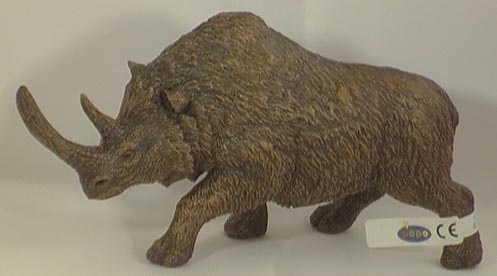
New for 2013 - Papo Woolly Rhino

New for 2013 – Papo Woolly Rhino.

Picture credit: Everything Dinosaur

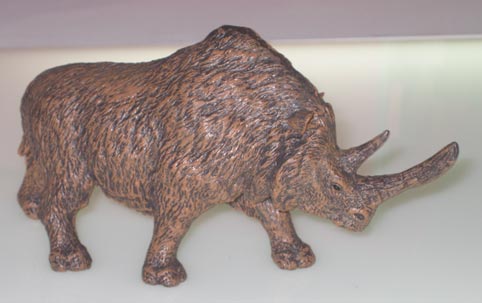
The model is very well painted and the individual strands of long, shaggy hair that make up the coat of this animal can be clearly seen.  The ears are pricked and facing forward, the eyes are relatively small, whilst the nostrils are quite large, suggesting that as with most members of the rhino family, the Woolly Rhino had poor eyesight and relied more heavily on its other senses such as hearing and its sense of smell to detect danger.

A Detailed Replica

This nicely detailed replica represents a grazing mammal that probably originated in Tibet, the descendants of these first Woolly Rhinos quickly spread across a wide geographical area, and fossil remains have been found over much of Europe including the United Kingdom, although there is very little evidence found to date to suggest that these large mammals, some of whom could have weighed up to 2,000 kilogrammes, ever got as far west as Ireland.

The large, anterior horn (the one on the tip of the nose), has been carefully crafted and appears flattened.  Like modern rhinos, the two horns of Coelodonta were made of keratin (compressed, fibrous hair).  However, fossil evidence suggests that the anterior horn was not pointed but had a rather flattened,  keeled appearance.

A Keeled Horn

Scientists believe that the horn of the Woolly Rhino got its strange, keeled shape as the rhino grazed moving its head from side to side wearing the sides of the horn down.  The Woolly Rhino may have also used its horn to clear snow in order to find food.  This prehistoric mammal could have had its own built-in snow plough.

In conclusion, this is an excellent Woolly Rhino model, one that works well with the other prehistoric  mammals and cavemen in the Papo range.

To view the range of prehistoric animal models in the Papo series available from Everything Dinosaur: Papo Prehistoric Animal Models and Figures.

10 02, 2013

A Review of the Papo Carnotaurus Dinosaur Model

By |2023-02-12T09:26:03+00:00February 10th, 2013|Categories: Everything Dinosaur Products, Product Reviews|2 Comments

Papo Carnotaurus Dinosaur Model Reviewed

The newly released Carnotaurus dinosaur model manufactured by Papo is an excellent representation of a very unusual dinosaur .  Indeed, this prehistoric animal was so unlike most other dinosaurs known to science at the time of its discovery, that when it came to scientifically describing the fossils it was immediately placed into its own, new dinosaur family – the abelisaurids.  It is clear from this dinosaur model that the design team at Papo have taken great care to ensure that their Carnotaurus accurately represents the fossil material.

Papo Carnotaurus Dinosaur Model

Named in 1985 after the discovery of an almost complete skeleton in Argentina, Carnotaurus is estimated to have been around seven and a half metres in length when fully grown.  As the Papo figure measures a fraction over 19 cms long, from the tip of its tail to the front of its deep, box-like skull, the model is approximately a 1:40 scale replica.

The Papo Carnotaurus Dinosaur Model

"Meat-eating Bull" from Papo.

“Meat-eating Bull” from Papo.

Picture credit: Papo/Everything Dinosaur

“Meat-eating Bull”

The name Carnotaurus means “meat-eating bull”, a reference to the two horns that stick out sideways from the top of the head, just above the eye sockets.  Papo have made the horns on their dinosaur model quite prominent.  These horns would certainly have intimidated a rival if used for display.  Examination of the actual fossil skull material shows that the top portion of the skull is thickened, perhaps these predatory dinosaurs may have butted heads to settle disputes just as some sheep and goats do today – a form of intra-specific combat.  This model shows the sleek and narrow lower jaw typical of an abelisaurid, the mouth is particularly well painted whilst the individual, slender teeth have been very carefully depicted by the design team.

As with a number of theropod dinosaur models available from the Papo “Les Dinosaures” model range, the lower jaw is articulated so the Carnotaurus can be depicted with the mouth closed, or open.

A Close up of the Articulated Lower Jaw of the Papo Carnotaurus Dinosaur Model

Open Wide!

Open Wide!

Picture credit: Everything Dinosaur

Skin impressions preserved at the Patagonian site where the first Carnotaurus fossils were found indicate that this dinosaur was covered in short scales and had rows of bumps along its flanks  that seem to have got bigger and more distinct moving up from the belly towards the spine of the animal.  This skin texture has been authentically reproduced, once again demonstrating the attention to detail of the dedicated designers at the French company.

A Close up of the Papo Carnotaurus Dinosaur showing the Skin Detail

Very detailed skin on this new dinosaur model.

Very detailed skin on this new dinosaur model.

Picture credit: Everything Dinosaur

All in all this is an excellent model of a Carnotaurus and one that is a welcome addition to the Papo “Les Dinosaures” model range.  It is sure to prove to be a big hit with dinosaur fans and model collectors.

To view the range of Papo prehistoric animal models available from Everything Dinosaur: Papo Prehistoric Animals and Dinosaurs.

30 01, 2013

New Papo Carnotaurus and Papo Woolly Rhino Models now in Stock

By |2023-02-12T06:49:39+00:00January 30th, 2013|Categories: Dinosaur Fans, Everything Dinosaur News and Updates, Everything Dinosaur Products|0 Comments

Just In – Papo Woolly Rhino and the Papo Carnotaurus Models

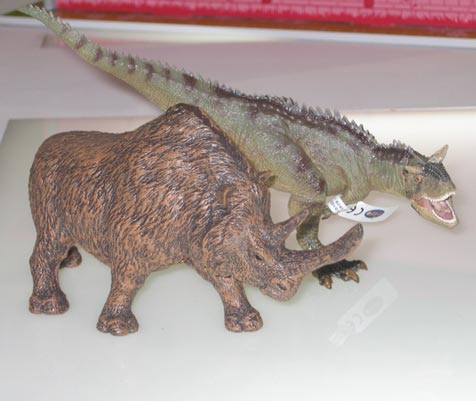
New in stock at Everything Dinosaur the Papo Woolly Rhino and the Papo Carnotaurus dinosaur model.  These are two of the three new releases due out from Papo this year.

Papo Models

To view the models: Papo Prehistoric Animal Models and Figures.

 The New Papo Models (Woolly Rhino and Carnotaurus)

Picture credit: Everything Dinosaur

Naturally, we will review these models shortly and post up some video reviews shortly afterwards.

A spokesperson for the UK-based, award-winning mail order company Everything Dinosaur, commented:

“It is great to see Papo extending their prehistoric animal model range with the addition of a Woolly Rhino model and a replica of the famous South American, Late Cretaceous abelisaurid Carnotaurus.”

30 01, 2013

The Latest CollectA 1:40 Tyrannosaurus rex Dinosaur Model Reviewed

By |2024-04-29T10:30:37+01:00January 30th, 2013|Categories: Dinosaur Fans, Everything Dinosaur Products, Product Reviews|0 Comments

A Review of the CollectA Scale Model of T. rex (1:40 Scale)

No dinosaur fan’s model collection is complete without at least one Tyrannosaurus rex dinosaur model and there are so many to choose from these days.  No self-respecting figure and replica manufacturer can introduce a range of prehistoric animal models without including this most iconic of all the Dinosauria, indeed a number of mainstream model makers have a number of tyrannosaur variants on offer in their product ranges.

Tyrannosaurus rex Dinosaur Model

One interesting example of a Tyrannosaurus rex model is the 1:40 scale model of the “Tyrant Lizard King” made by CollectA.  Firstly, there is the pose.  This T. rex is posed with its head bowed and with its mouth open showing an array of different sized teeth in the jaws.  Most models of this theropod dinosaur portray this animal walking with its head held high, sometimes with the tail dragging on the ground in a bid to balance the model.  The CollectA model attempts to demonstrate behaviour, in our view aggressive behaviour, not necessarily towards another tyrannosaur, where studies of extant animals such as bears and lions suggest that protagonists would try to make themselves as big as possible to deter a rival.  The lowering of the head and the gaping mouth would be at or around the eye-level of a ceratopsian, (horned dinosaur).

The pose of the tyrannosaur model by CollectA may reflect the sort of behaviour adopted by a Tyrannosaurus rex as it attempted to intimidate potential prey.  Of course, this is just speculation, but it demonstrates that considerable thought and care has gone into this particular replica.

The CollectA 1:40 Scale Model T. rex

Interesting pose of this tyrannosaur dinosaur model.

The Size of the Dinosaur Model

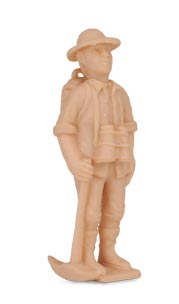
The second impressive element is the size of the model.  It measures nearly thirty centimetres in length, making this figure a relatively large dinosaur model, but one that can still be held comfortably by the hands of a small child.  Each of the CollectA scale models is supplied with a little plastic figure, a model of a palaeontologist.  This figure of a man, complete with pickaxe and binoculars, is known as “Sir Arthur Gauge”.  The addition of the human figure allows the size of Tyrannosaurus rex to be appreciated, it provides a scale for the model.

Say Hello to “Sir Arthur”

A clever way to provide a scale for dinosaur models.

Another plus, is that the model is extremely well painted.  The texture of the dinosaur’s skin is carefully picked out using various greens, mustard yellows and browns.  Even the pupils of the eyes can be made out and the teeth have been painted individually.

To view the range of CollectA scale prehistoric animal models available: CollectA Deluxe Prehistoric Life Dinosaur Models.

This is an excellent Tyrannosaurus rex model, a replica that demonstrates the care and attention of the design team at CollectA and it makes a fine addition to any dinosaur model fan’s prehistoric animal collection.

29 01, 2013

Latest Pictures of the New Schleich Prehistoric Animal Models for 2013

By |2023-02-12T06:44:56+00:00January 29th, 2013|Categories: Dinosaur Fans, Everything Dinosaur News and Updates, Everything Dinosaur Products|0 Comments

On the Hunt for Carnotaurus and Styracosaurus

Two new additions to the Schleich “Prehistoric Animals” model range, what we at Everything Dinosaur refer to as the “World of History range” are due out in May of this year.  The company will introduce a replica of the abelisaurid Carnotaurus as well as a model of Styracosaurus to go with the other horned dinosaur model (Triceratops) which is already in this particular range.

Schleich Prehistoric Animal Models

Schleich had made models of these dinosaurs before, they were marketed under the “Saurus” brand before being retired some years ago.  The two new additions are certainly more colourful than their predecessors.  One of our team members managed to catch up with Schleich recently and took some pictures of these dinosaurs, which are not due to be released until the late spring.

The Colourful Carnotaurus Dinosaur Model (Schleich)

Dinosaur model complete with articulated lower jaw.

Picture credit: Everything Dinosaur

The Schleich Carnotaurus has an articulated lower jaw.  It reminds us very much of the Carnotaurus that featured in the Disney film “Dinosaur” that we think was released in 2000.

The second new model, the Styracosaurus is coloured a vivid blue with a brightly coloured head shield.   The Schleich Styracosaurus measures approximately sixteen centimetres in length and stands around nine centimetres high.  The Carnotaurus is slightly bigger measuring twenty-two centimetres in length with a head height of around twelve centimetres.

Due for Release in May 2013 – Schleich Styracosaurus

Spike Lizard due in Late Spring 2013.

Picture credit: Everything Dinosaur

Interestingly, 2013 marks the 100th anniversary of the naming of the genus Styracosaurus.

To view the range of Schleich dinosaur models in stock at Everything Dinosaur: Schleich World of History Prehistoric Animal Models.

27 01, 2013

An Update on New CollectA 2013

By |2024-04-29T06:13:55+01:00January 27th, 2013|Categories: Dinosaur Fans, Everything Dinosaur News and Updates, Everything Dinosaur Products|2 Comments

CollectA’s Prehistoric Life Collection – An Update

In response to requests from customers we are publishing further information on the size of the new CollectA 2013 prehistoric animal models.  There are going to be a number of new additions to the CollectA “Prehistoric Life” model series this year, both within the company’s deluxe scale model range and within their not to scale figures.

CollectA Models

To see the announcement of the new CollectA models in the “Prehistoric Life” range: New Collecta Models for 2013.

Deluxe Series

Deinotherium (prehistoric elephant) length = 23 cm and height = 11 cm (1:20 scale approx.)

Parasaurolophus (duck-billed dinosaur) length = 34.5 cm and height 10 cm (1:40 scale approx.)

Re-painted Ankylosaurus (length = 25 cm and height 10 cm (1:40 scale approx.)

To view the enormous range of CollectA Deluxe/Supreme scale models of prehistoric animals: CollectA Supreme/Deluxe Scale Dinosaur and Prehistoric Animal Models.

Not to Scale Series

Diabloceratops (horned dinosaur) length = 15 cm and height (horns) 8 cm

Daspletosaurus (tyrannosaurid) length =16.6 cm and height 5.7 cm

Rearing Diplodocus length = 19 cm and height 23.8 cm

Pachycephalosaurus on base length = 12.8 cm and height 5.7 cm

To view the extensive and much admired CollectA Prehistoric Life range of not-to-scale figures and models: CollectA Prehistoric Life Replicas and Figures.

Some of the Team Members Behind the Successful CollectA Range

Ken, Ester, Conny, Anthony (model designs) and Peter

Picture credit: Everything Dinosaur

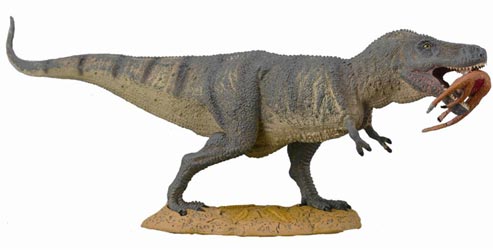
In addition, the Tyrannosaurus with prey (Struthiomimus) model is having a base fitted.  This will make the original T. rex with prey model that was launched last year a rare collectible in years to come.  Those clever people at CollectA have fitted a base to this model that allows it to fit with the bases that can be found on the Williamsonia and the Monathesia and Cycadeoidae tree models.

New for 2013 T. rex with Prey on a Base

Make your own prehistoric scene.

Picture credit: Everything Dinosaur

It looks like 2013 is going to be another exciting year for CollectA.

23 01, 2013

Woolly Rhinos with their Keeled and Oddly Shaped Horns

By |2023-02-12T06:25:07+00:00January 23rd, 2013|Categories: Dinosaur Fans, Everything Dinosaur News and Updates, Everything Dinosaur Products, Photos of Everything Dinosaur Products|1 Comment

Woolly Rhinoceros from Papo Shows Remarkable Detail

One of the most iconic prehistoric animals associated with the periods in geological history known as the Ice Ages is the Woolly Rhinoceros, a large, shaggy coated rhino that lived in Europe from approximately 500,000 years ago to around 10,000 years ago (Pleistocene to the beginning of the Holocene epochs).  Papo, the French model and figure manufacturer, are about to introduce a new model of a Woolly Rhino into their highly acclaimed prehistoric animal model range.  Having had the chance to view the model up close, it is clear that this new interpretation of Coelodonta antiquitatis elevates Woolly Rhino model making to a higher plain (or should that be higher plateau – see below).

Papo Woolly Rhinoceros

There were in fact several species of prehistoric rhinoceros that lived in Europe during the Pleistocene epoch, although the ancestors of the two-horned Woolly Rhino (Coelodonta antiquitatis) are believed to have migrated across the continent from Asia, having originally evolved on the Tibetan plateau.  The fossilised remains of Woolly Rhinos have been found all across Europe, including southern Spain, however, no fossils have been found in Ireland or North America so it seems these grazers did not reach the American continent or indeed the Emerald Isle.

A number of very well-preserved carcases of these prehistoric mammals have been discovered in the higher latitudes of Russia during the spring thaw which leads to flooding in some areas and the subsequent erosion which exposes the animal remains.  So numerous were these animal remains and so strange the preserved horns of these rhinos, that up until the late 19th Century many of the native people thought that the horns were actually the talons of a giant bird.

Coelodonta antiquitatis

The large, anterior horn (the one on the tip of the nose), of C. antiquitatis does not resemble the horn found on extant species of rhinoceros.  The horn is much longer. the largest horns belonged to males and could grow to over two metres in length.  Like modern rhinos, the two horns of Coelodonta were made of keratin (compressed, fibrous hair).  The horns would have been very effective weapons used in self defence against attacks from creatures such as the European Lion (Cave Lion – Panthera genus), however, fossil evidence suggests that the anterior horn was not pointed but had a spatulate or keeled appearance.  Scientists believe that the horn of the Woolly Rhino got its strange, keeled shape as the rhino grazed moving its head from side to side wearing the sides of the horn down.

The Woolly Rhino may have also used this horn to clear snow in order to find food.  This prehistoric mammal, the largest of which could weigh up to two thousand kilogrammes could have had its own built-in snow plough.

The New Papo Woolly Rhino Model

Great care has been taken to depict the anterior horn on the new Papo model.

Picture credit: Everything Dinosaur

A number of cave paintings depict Woolly Rhinos, the long shaggy coat and the short tail can be clearly made out in a number of the better preserved examples of Stone Age artwork.  The very last Woolly Rhinos were to be found in Western Siberia.  The demise of these large herbivores was probably due to the retreat of its glacial habitat and rapid climate change.  As the Woolly Rhino had co-existed with both modern humans and Neanderthals for thousands of years it is unlikely that hunting caused its extinction.

Just as our ancestors depicted Woolly Rhinos with their cave art, so today’s model and figure manufacturers are keen to capture the beauty and power of this Ice Age icon.  A number of models of Woolly Rhinos have been produced but the latest introduction to Papo’s “Les Dinosaures” range of prehistoric animal figures sets new standards.  For example, not only is the French manufacturer’s new model extremely well crafted, the anterior horn on the model shows the spatulate, keeled shape suggesting that the design team have extensively researched the data on Woolly Rhinoceros fossils.

To view the range of Papo prehistoric animal models in stock at Everything Dinosaur: Papo “Les Dinosaures” Prehistoric Animal Figures.

18 01, 2013

Award-winning New Megacerops Reviewed

By |2024-04-29T06:02:32+01:00January 18th, 2013|Categories: Everything Dinosaur Products, Product Reviews|1 Comment

A Review of the CollectA Megacerops (Thunder Beast Reviewed)

One of the more unusual additions to the CollectA range of prehistoric animal models was the introduction in 2012 of the model of the “Thunder Beast” known as Megacerops (M. coloradensis).  Figures of prehistoric mammals only make up a small proportion of most figure and model manufacturer’s model ranges.  Dinosaur models are far more common.  The addition of this extinct, hoofed giant which resembled a rhinoceros, but was actually more closely related to a zebra was most welcome.

The CollectA Megacerops Model

“Thunder Beast” from CollectA.

Picture credit: Everything Dinosaur

CollectA Megacerops Prehistoric Mammal

Megacerops was a member of a group of extinct mammals known as brontotheres (the name means “thunder beasts”).  They first evolved during the Eocene Epoch and were mainly forest dwelling herbivores.  The largest of which was about the size of an Alsation dog, although most species of these perissodactyl mammals (odd number of toes on each foot), were no bigger than a Coyote.  As the world became drier and extensive grasslands began to form on the landmasses that made up the continents of the Northern Hemisphere, so these creatures diversified and radiated.  They spread throughout Asia and North America.

Megacerops was one of the last of the brontotheres to evolve.  Fossils of this creature have been found in the western United States.  The fossils are so abundant that most of the regional museums in the area have Megacerops fossils within their natural history collections.

Model Measurements

The CollectA Megacerops model measures a fraction under twenty centimetres in length.  It is a male, and if this hand painted replica does indeed represent M. coloradensis, then an approximate scale for this model can be calculated.  If the length of large males are estimated to be around 4.5 metres, then a twenty centimetre model would represent a 1:22.5 scale figure.

The painting is excellent on this particular prehistoric animal model, the texture of the coat can be easily seen.  The designers have opted to give their model a darker head with the rear of the animal painted a lighter tan colour.  The ears are facing forward and the animal is depicted as if it were charging, perhaps chasing off some predatory hyaenodonts.  Even the tail with its little tuft of hair at the end has been very finely modelled.  The two “V-shaped” horns that are positioned just above the nostrils have been painted a light grey colour.

Brontotheres

The horns of brontotheres were very probably covered with skin when the animal was alive.  The model has a prominent hump between the shoulders.  Fossils suggest that many species of brontotheres did indeed have such a hump, it was probably a store of fat to help the animals survive  leaner times.

The Award Winning CollectA Megacerops Model

The CollectA Megacerops prehistoric mammal.

The “rear of the year for a brontothere”.

Picture credit: Everything Dinosaur

CollectA Megacerops

It is a very beautiful model, such a treat to have a relatively little-known brontothere added to a mainstream model maker’s range,  However, a warning to mums and dads, this model is anatomically accurate.  The CollectA Megacerops was awarded the accolade of the best, new prehistoric animal model of 2012 as voted for by readers of a popular model collectors magazine.  This Megacerops has redefined the standard of prehistoric mammal models and set the benchmark very high for other manufacturers.  A very desirable and collectible prehistoric animal model.

To view Everything Dinosaur’s range of prehistoric animal models in the CollectA Deluxe/Supreme replica series: CollectA Deluxe Prehistoric Life Models and Figures.

9 01, 2013

Why is the CollectA Irritator Black?

By |2023-02-11T17:09:38+00:00January 9th, 2013|Categories: Dinosaur Fans, Everything Dinosaur Products|0 Comments

A Black Coloured Model of Irritator –  A Possible Explanation

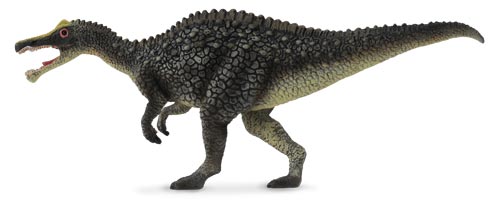
The CollectA Irritator model, part of the company’s not to scale,  prehistoric animal model range is coloured black.  This is an intriguing colour choice for a dinosaur model, most dinosaur models from CollectA have been painted various shades of green or brown but black is not a colour often associated with such items, especially when it is hoped that these replicas would appeal to young dinosaur fans and model collectors.  Could the plumage of an extant bird, found in Africa have influenced the design team?

CollectA Irritator Model

The CollectA Irritator Dinosaur Model

Was the Black Heron the inspiration behind the colour choice?

Picture credit: Everything Dinosaur

Fossils of this dinosaur are associated with the Santana Formation of eastern Brazil, the skull showed a number of anatomical features associated with spinosaurs and so Irritator was described as a member of the Spinosaurids.  It is likely that this dinosaur, that may have reached lengths in excess of eight metres, was primarily a fish eater.  Irritator was formally described in 1996 (Irritator challengeri).

But why did CollectA choose to give their Irritator dinosaur model a predominately black colour?  The explanation put forward could have something to do with this dinosaur feeding mainly on fish.  After all, the fossils ascribed to this genus of theropod dinosaur were found in brackish/marine deposits so it can be inferred that this large predator spent a lot of its time near bodies of water.  This would tie in with the theory that this dinosaur was a hunter of fish.

Examining the Skull Material

When the skull material is examined it can be seen that the position of the nostrils are towards the top of the head and not at the very tip of the snout.  The nostrils are not placed as far back on the skull as the nostrils of Spinosaurus (Spinosaurus aegyptiacus), but their position still suggests that Irritator could hold the tips of its jaws underwater and still breathe.  This evidence along with many conical teeth associated with the Santana sediments suggest that Irritator was indeed a piscivore.

The Black Heron (Egretta ardesiaca), is a member of the heron family, it can be found in Africa, south of the Sudan and it is very common.  It often can be seen feeding in the shallows of lakes, ponds and even in rice fields, where it catches fish and amphibians.  As the name of this bird suggests, its plumage is black and one of its feeding techniques is to pull its wings forward to cast a shadow over the water.  Fish are attracted to this shade and therefore come within reach of the sharp bill and are thus easier for the heron to catch.  This feeding behaviour seen in Black Herons is often referred to as “Canopy Feeding”.

If Irritator had been black, or certainly dark coloured its outline above the water could have been more difficult for fish in the water to spot, especially against the backdrop of a densely vegetated bank.  Perhaps Irritator held its arms out in front of its jaws producing an area of shade that potential prey may have been tempted to swim into.  A black colouration, particularly across the top of the back of the animal would have enabled this creature to absorb heat from the sun very efficiently, little being reflected back off a light coloured more reflective surface.  This may have helped this animal keep warm whilst standing in relatively cool water.

It is interesting to speculate on the choice of colour to the CollectA Irritator dinosaur model.   In truth, there is no evidence to help scientists to establish what colour the dinosaur known as Irritator actually was.

To view the range of spinosaurid models and figures in the CollectA Prehistoric Life range available from Everything Dinosaur: CollectA Prehistoric Life Dinosaur Models.

8 01, 2013

Changes to the CollectA Model Range in 2013

By |2023-02-11T17:06:31+00:00January 8th, 2013|Categories: Dinosaur Fans, Everything Dinosaur Products, Photos of Everything Dinosaur Products|0 Comments

T. rex with Prey Gets a Base

One of the difficulties faced when making accurate models of dinosaurs that walked on just their hind legs (bipedal stance), is to get the replica to balance so that it stands up without support.  As the Dinosauria had a mostly digitigrade (walking on their digits) stance, compared to the plantigrade stance of the likes of bears, mice and humans this is a difficult task, even for the most accomplished model maker.  It is surprising to think, that just like a garden bird, dinosaurs like Tyrannosaurus rex walked on their toes, no other part of the foot playing a role in weight-bearing in conjunction with the ground as this fearsome theropod moved around.

CollectA T. rex with Prey

In the past, when bipedal dinosaurs were often depicted with their tails dragging on the ground behind them, the position and size of the feet of any figure did not matter so much.  The tail could act as an additional support for the model, what is termed a “tripodal” stance.  Ironically, although most palaeontologists agree that the majority of the Dinosauria held their tails clear of the ground, there is some evidence to suggest that some dinosaur could at least use their tails to form a tripodal stance.  The animals concerned are quadrupeds, dinosaurs such as the stegosaurs.  Some of these armoured dinosaurs had more cervical vertebrae (neck bones) than many long-necked sauropods.  It has been suggested that dinosaurs such as Miragaia and Dacentrurus (both European stegosaurs) could have reared up onto their back legs and rested on their tails whilst stretching up into trees to feed on the understorey of leaves.

For dinosaur model enthusiasts the extra security of a base for their model is often welcomed.  To improve the stability of the CollectA T. rex with prey model, the designers at CollectA have added an unobtrusive base to this replica.

Tyrannosaurus rex Gets Grounded

The “prey” is an unfortunate Struthiomimus.

Picture credit: Everything Dinosaur

Grabbed an Ornithomimid

The base permits the animal to be depicted in a much more active pose.  A tyrannosaur that had just grabbed an ornithomimid (Struthiomimus) would probably want to get away from the scene of the attack in order to prevent its meal being stolen by a larger Tyrannosaurus that could “sniff out” the opportunity for a free meal.  Such behaviour is seem amongst members of the Carnivora today.  The addition of a base broadens the range of poses that a model can be put in, helping to depict an anatomically accurate replica of a long extinct carnivore.

To view the range of CollectA Prehistoric Life models available from Everything Dinosaur: CollectA Age of Dinosaurs/Prehistoric Life Models.

Go to Top