
All about dinosaurs, fossils and prehistoric animals by Everything Dinosaur team members.

Everything Dinosaur’s product news.

3 08, 2013

CollectA’s Przewalski’s Horse – A New Written Review

By |2024-04-29T14:48:57+01:00August 3rd, 2013|Categories: Everything Dinosaur Products, Product Reviews|0 Comments

Ancient Horse – Przewalski’s Horse Model (CollectA) Reviewed

It might be seen as a little unusual for a company called Everything Dinosaur to review a model of a horse, after all, we are usually preoccupied with writing reviews of replicas from the CollectA Prehistoric Life Collection, but we are making an exception when it comes to CollectA’s model of Przewalski’s horse as this animal has remained unchanged for thousands of years and it would have been very familiar to Stone Age Europeans and Asians.

Przewalski’s Horse

First lets deal with the pronunciation, as the name is a little difficult to pronounce even for those of us who have to cope with the Dinosauria, this horse is called Pre-zal-ski’s horse, or more commonly and appropriately She-val-ski’s horse.  Of course you could just refer to this animal as the Mongolian wild horse or indeed use the Mongolian name which is the Takhi (tack-ee).

The Model of Przewalski’s Horse by CollectA

Stone Age survivor being slowly re-introduced to the wild.

Stone Age survivor being slowly re-introduced to the wild.

Picture credit: Everything Dinosaur

A Wild Horse

Przewalski’s horse is regarded as the only true wild horse in existence, although it was believed to have died out in the wild, small populations have been re-introduced into Russia, Mongolia and China after a successful zoo based breeding and re-introduction programme.

These horses are stocky, more so than most types of domesticated horses.  They also have shorter legs.  Average height is around 13 hands high, around 130 centimetres tall when measured from the ground just behind the front fore leg up to the withers (the top of the shoulder where the neck joins the body).

To view Everything Dinosaur’s range of CollectA not-to-scale prehistoric animal models: CollectA Prehistoric Life Figures.

Model Measurements

The model measures a little over 16 and a half centimetres in length and the measurement from the ground to the withers is around 7 centimetres, so we estimate that this CollectA horse model is made in approximately 1:20 scale, so it works well with other recently introduced CollectA prehistoric animals such as the Deinotherium , the Megacerops and the Woolly Mammoth.

 CollectA Prehistoric Mammal Models
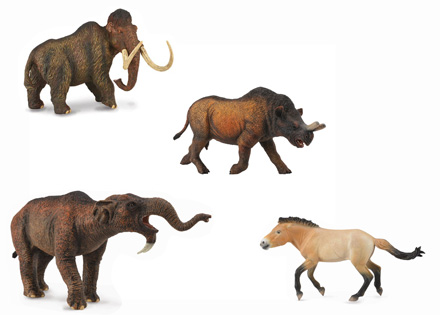
Part of the Collecta range of animal models.

Part of the CollectA range of animal models.

Picture credit: Everything Dinosaur

Designed by Deborah McDermott

This model of Przewalski’s horse is part of the horse model series designed by Californian based sculptor Deborah McDermott and is included  in the CollectA horse model collection.  The coat is a dun colour, with a dark mane that stands proud of the neckline, there is black colouration on the lower legs and a long black tail.  Cave paintings discovered in France and Spain depict drawings of very similar looking horses.  This suggests that these types of animals were a common sight in western Europe during the Upper Palaeolithic.

With this horse believed to be extinct in the wild, an international foundation was set up in 1977 to co-ordinate and manage a zoo-based breeding programme using animals that were descended from wild populations captured in the early 20th Century.  As the population slowly built up, herds were established in several specialised reserves and in 1992 the first Przewalski’s horses were reintroduced into Mongolia.  A number of national parks and preserves have been established and it is estimated that the Przewalski’s horse wild population now numbers several thousand.

This is a well-crafted, hand-painted replica of Przewalski’s horse, a model that works well with the other prehistoric mammals in the CollectA Prehistoric Life model series.
25 07, 2013

Everything Dinosaur’s Video Review of the CollectA Diabloceratops Dinosaur Model

By |2023-02-20T07:33:30+00:00July 25th, 2013|Categories: Everything Dinosaur Products, Everything Dinosaur videos, Product Reviews|0 Comments

Everything Dinosaur Reviews “Devil Horned Face”

CollectA have rapidly earned themselves a reputation for producing models of more obscure and unusual dinosaurs. Amongst the many replicas of ceratopsians within the company’s range, a model of the horned dinosaur known as Diabloceratops (D.eatoni) has just been added.

CollectA Diabloceratops Dinosaur Model

Everything Dinosaur team members have produced a short (4.49) video review of this dinosaur model.  In the video we review the model, comment on the vivid colouration of the neck shield and remark on the appearance of the jugal processes (flared out bone from the cheeks).

Everything Dinosaur’s Video Review of Diabloceratops

Video credit: Everything Dinosaur

Diabloceratops (Centrosaurinae)

Diabloceratops has been classified as a basal member of the centrosaurine clade of horned dinosaurs.  Its discovery highlights the great diversity of horned dinosaurs that roamed western North America during the Late Cretaceous.  This is a super model of a horned dinosaur and CollectA are to be congratulated for creating replicas of some of the lesser known members of the Dinosauria.

To view the large range of horned dinosaur figure includind centrosaurines and chasmosaurine models in the CollectA Prehistoric Life model range: CollectA Prehistoric Life/CollectA Prehistoric World Models.

19 07, 2013

New for 2014 CollectA Dead Stegosaurus Model

By |2023-02-19T07:33:01+00:00July 19th, 2013|Categories: Dinosaur Fans, Everything Dinosaur News and Updates, Everything Dinosaur Products|7 Comments

CollectA Provide Further Information about 2014 Product Releases

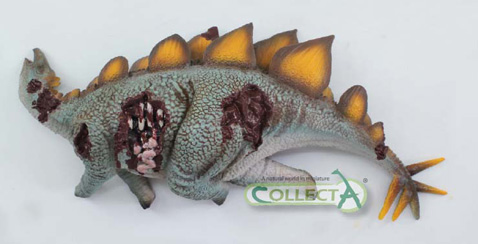
Following on from the news about the Deluxe Carcharodontosaurus figure due to be made by CollectA next year, the manufacturer has announced today details of another new release.  CollectA are going to introduce in 2014 a model of a dead Stegosaurus, it looks like “roof lizard” has ended up as a meal for another dinosaur.

Dead Stegosaurus Model

New for 2014 the CollectA Stegosaurus Corpse

Dinner for an Allosaurus?

Dinner for an Allosaurus?

Picture credit: Everything Dinosaur

In a statement a spokesperson from CollectA added:

“Life was not a bed of roses back then and at least this is what might have happened all those years back.  We have had discussions if we should have another corpse but looking at the success of our first model -the Triceratops corpse- we wanted to give it a try.”

Stegosaurus Corpse

The dead Stegosaurus model depicted is typical of a specimen from the western United States.  This type of stegosaur shared its Late Jurassic environment with a number of predatory dinosaurs, animals such as (in order of size, smallest to largest), Marshosaurus, Ceratosaurus, Allosaurus and Saurophaganax to name but a few.

Team members at Everything Dinosaur could discuss which type of carnivore might have done this damage to the adult Stegosaurus.  The ideal that this is scavenging on a carcase can be discounted due to the bite mark on one of the plates along the back.  A predator would not necessarily bite such a part of a stegosaur’s anatomy with all that meat available elsewhere on the body.  That particular aspect of the pathology shown is indicative of having occurred during a fight, it looks like a bite from above, typical of a large, bipedal theropod.

When asked why a Stegosaurus corpse, the spokesperson from CollectA replied:

“Due to its distinctive tail spikes and plates, Stegosaurus is one of the most recognisable dinosaurs.”

Stegosaur Pathology

One other item of interest when it comes to the pathology (wounds).  Note the wounds in the throat area.  The gashes and bite marks are to the side and not from the underneath of the throat area.  This part of a stegosaur’s body (underside of the throat), was protected by a mass of little bony ossicles, a bit like chain mail found on a suit of armour.

These bony ossicles would have protected this dinosaur as it fed on spiky cycads and other tough vegetation as well as affording a degree of protection from predator attack.  Apparently, this protection combined with this dinosaur’s vicious tail (called a Thagomizer) was not sufficient to help this unfortunate victim.

To read how the Stegosaurus tail was named: The Tale of the Stegosaurus Tail.

This model measures approximately 16.5 cm in length and team members at Everything Dinosaur are already “swishing their Thagomizers in excitement” as they await to hear news of more models to be made by our chums CollectA.

To view Everything Dinosaur’s current range of CollectA prehistoric animal models: CollectA Prehistoric Life Models and Figures.

2 07, 2013

The CollectA Deinotherium Model Reviewed

By |2023-02-18T21:03:17+00:00July 2nd, 2013|Categories: Everything Dinosaur Products, Everything Dinosaur videos, Product Reviews|0 Comments

Everything Dinosaur Reviews the CollectA Deinotherium 1:20 Scale Model

Below is a short review (4:30) of the new CollectA Deinotherium model by Everything Dinosaur.  In this short video, we review the model and point out some of the fine details of this excellent replica.

CollectA Deinotherium

The CollectA Deinotherium Model is Reviewed

Video credit: Everything Dinosaur

This is a great model of a prehistoric elephant and a fine addition to the CollectA Deluxe range of scale prehistoric animal models.

Everything Dinosaur stocks a wide range of prehistoric animal figures including several models of prehistoric elephants and their close relatives.

To view the huge range of mammoths, sabre-toothed cats and other prehistoric mammal models and replicas in stock at Everything Dinosaur, visit the company’s “Prehistoric Mammals” section of their award-winning website: Models of Prehistoric Mammals.

23 06, 2013

CollectA Deluxe Parasaurolophus Video Review

By |2023-02-18T12:06:54+00:00June 23rd, 2013|Categories: Everything Dinosaur News and Updates, Everything Dinosaur Products, Everything Dinosaur videos|2 Comments

Everything Dinosaur Reviews the 1:40 Scale CollectA Deluxe Parasaurolophus

CollectA have introduced a replica of a duck-billed dinosaur into their Deluxe scale model range of prehistoric animals.  This is the first hadrosaur in this scale-model series and an excellent replica it is to.  Team members at Everything Dinosaur have produced a brief (5:22 minutes) video review in which we explain some of the features seen on this model and discuss the fossil evidence regarding Parasaurolophus and hadrosaurs in general.

CollectA Parasaurolophus

Everything Dinosaur’s Review of the CollectA 1:40 Scale Parasaurolophus

Everything Dinosaur reviews the CollectA Deluxe Parasaurolophus model.

Video credit: Everything Dinosaur

In this video we explore how the flamboyant crest may have been used and what purpose it may have served.  We discuss the scale of this model and look at some of the anatomical features that are based on the latest fossil discoveries.

To view the range of CollectA Deluxe prehistoric animal models available: CollectA Deluxe/Supreme Prehistoric Animal Models.

17 06, 2013

Wild Safari Dinos and Prehistoric Life Gastornis Model Reviewed

By |2023-02-18T11:06:21+00:00June 17th, 2013|Categories: Everything Dinosaur Products, Product Reviews|0 Comments

Wild Safari Dinos Gastornis Replica Reviewed

New to the Wild Safari Dinosaurs and Prehistoric Life model series manufactured by Safari Ltd is a replica of Gastornis a giant, flightless bird that roamed the dense forests of Europe and North America during the Late Palaeocene and Eocene epochs before finally becoming extinct a little over forty million years ago.

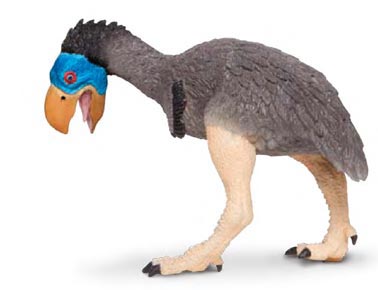
The Gastornis Model from Safari Ltd

Model of a giant, flightless bird from Safari Ltd.

Model of a giant, flightless bird from Safari Ltd.

Picture credit: Everything Dinosaur

“Terror Bird”

Gastornis is often referred to as the original “Terror Bird” due to its reputation as being an apex predator.  A reputation that was considerably enhanced when Gastornis featured in the first episode of the BBC television series “Walking with Beasts”.  In this programme, Gastornis was depicted as one of the largest, terrestrial creatures on the planet, one that hunted and killed the primitive horse Propalaeotherium.  Here was a prehistoric bird that ate horses, however, how the likes of Gastornis is classified with the rest of the birds  is disputed.  Most scientists assign the likes of Gastornis to the anseriformes – which means that Gastornis may be related to today’s ducks and geese.

Diatryma and Gastornis

The first fossils ascribed to the Gastornis genus were discovered in a suburb of Paris.  Although far from complete and lacking any substantial skull material, a French geologist was given the task of formally naming and scientifically describing the fossil material.  He did identify that the specimen represented a giant bird.  The Gastornis genus was erected in 1855 and a number of species have now been recognised.

The American palaeontologist Edward Drinker Cope described a new genus of giant flightless bird based on fossils found in the western United States in 1876.  The genus Diatryma was erected, but subsequent fossil finds have led scientists to conclude that Diatryma was so closely related that fossils from both America and Europe are often referred to as Gastornis, the senior synonym.

Gastornis Model Reviewed

This model from Safari Ltd does reflect the known fossil material well.   The head is large, the model has a deep chest and a broad rump.  The design team have been careful to pick out the small stubby wings, the rear of which have a line of short, black quills, which contrast nicely with the uniform coat of feathers found on the body.

The feet are a little over-sized, but this does not detract from the sculpt.  The large feet help the model to stand and provide stability, this is a common feature of bipedal replicas.  Each of the toes has a short, blunt claw, not a highly recurved talon.  It seems that the model makers at Safari Ltd have taken into account trackway evidence assigned to Gastornis that indicate that this bird did not have big, sharp claws on its feet like a modern raptor.

The head is particularly impressive and the colour scheme which consists of a vivid blue face with a bright yellow beak compliments the muted tones on the body.  The eyes have a red ring painted round them and the design team at Safari have been careful to depict the nostrils.

A Colourful Model

The broad  beak reveals just a hint of a curve at the tip.  Perhaps this is a male Gastornis in its breeding refinery setting out to impress any potential mates.

Despite Gastornis’s gruesome reputation with the BBC, scientists remain unsure as to the diet of this heavy-set creature.   True, it was one of the largest land-living animals around during the Palaeogene period and there were very few large carnivores.  It might have been a predator with tests on that broad beak and reinforced skull indicating that this bird and a bone crushing bite.  However, the lack of any significant top-line curvature on the beak tip and the absence of talons has led some scientists to suggest that Gastornis may have been herbivorous with its beak making  a useful nutcracker.

A Close up of the Gastornis Model

Vivid paintwork on the back of the skull

Vivid paintwork on the back of the skull.

Picture credit: Everything Dinosaur

No fossils of feathers have been assigned to Gastornis, that gave the model makers at Safari Ltd a little problem.  How to define the texture of the feathery coat covering the body.  The team have opted to produce an effect similar to the shaggy, feathery coat seen on the Wild Safari Wildlife Ostrich model.  Opting to do this rather than depict  Gastornis with longer more strand-like feathers seen on flightless birds today such as the emu.

To view the range of Wild Safari Prehistoric World figures in stock on Everything Dinosaur’s user-friendly website: Wild Safari Prehistoric World Models and Figures.

15 06, 2013

Warning! Copies of CollectA Models on Sale (Disreputable Companies)

By |2023-02-18T10:59:10+00:00June 15th, 2013|Categories: Everything Dinosaur News and Updates, Everything Dinosaur Products, Press Releases|5 Comments

Beware of Imitations of CollectA Models

CollectA International Limited has been in business for a number of years now.  Their dedicated team have produced some amazing models of prehistoric fauna and flora in the replica range entitled “Prehistoric Life”, we at Everything Dinosaur have been selling CollectA models since the company started and our team members are proud of our strong working relationship  with this hard working company.

It is sad to receive news that a company has started to manufacture poor quality copies of a number of CollectA prehistoric animal models.  Not only are the models being made and sold, but the firm concerned has used CollectA’s logo and even a picture of dear Anthony Beeson to help promote this range.  To all fans of CollectA, please, please, please be careful where you buy CollectA models from.

CollectA Models

All the models made by CollectA are individually hand-crafted and are manufactured from the best quality materials.  CollectA are constantly striving to improve their product range, investing and working very hard so that they can bring you the best possible model range.

Examples of the Copied CollectA Models

Avoid these models, inferior quality and not from Collecta.

Avoid these models, inferior quality and not from CollectA. Everything Dinosaur urgest dinosaur fans and model collectors not to buy copied figures.

Poor Quality Copies

Having their replicas copied like this is a form of flattery, we at Everything Dinosaur have come across instances where some of our own photography has been used by unscrupulous people for personal gain.  We too, have had our imitators, even those who have claimed our Everything Dinosaur logo as their own.  For CollectA, they have taken the precaution of informing company lawyers, since the imitations are being made in China, it may not be possible to prevent such copies being manufactured.

Peter Leung, the General Manager at CollectA commented to Everything Dinosaur:

“This is extremely annoying and it would be gratefully appreciated if you [Everything Dinosaur] could give a warning to collectors”.

Collectors Urged to Take Care

We are happy to do this for you Peter, we would urge all model collectors to take great care and to ensure that they are sourcing CollectA products from a reputable source, such as Everything Dinosaur, we go to a great deal of trouble to support the work of the enthusiastic staff at CollectA, a spokesperson from Everything Dinosaur added:

“We do see instances such as this from time to time and we would urge all fans of CollectA to take care when sourcing models.  We cannot be certain as to the type of plastic these replicas are made from, we don’t know what sort of paints have been used.  Many of these models may be being given to children and this concerns me greatly”.

Comparisons between the CollectA Made Models and the Imposters

Beware of poor quality, inferior imitations.

Beware of poor quality, inferior imitations.

Picture credit: Everything Dinosaur

Identifying Authentic Models

The above picture shows three authentic CollectA models (top) compared against their imitations (bottom).  The dinosaurs depicted (from left to right) are Styracosaurus, Iguanodon and the North African sauropod Rebbachisaurus.

Everything Dinosaur remains strongly committed to support CollectA.  The company stocks a huge number of models and every named prehistoric animal model supplied by Everything Dinosaur is sent out with its own fact sheet that has been researched and written by team members.  Recently, Everything Dinosaur added Daspletosaurus, Diabloceratops and Prezwalski’s Horse fact sheets to its portfolio, as a result of taking in stocks of the new 2013 model releases from CollectA.

To view the not-to-scale CollectA Prehistoric Life/Prehistoric World model range: CollectA Prehistoric Life/World Models and Figures.

To view the range of scale CollectA prehistoric animal models in stock at Everything Dinosaur: CollectA Deluxe/Supreme Prehistoric World Models.

The message is simple, please take care and beware of imitations!

13 06, 2013

The New CollectA Deinotherium Model Reviewed

By |2024-04-18T07:33:21+01:00June 13th, 2013|Categories: Everything Dinosaur Products, Product Reviews|1 Comment

Everything Dinosaur Reviews the 1:20 Scale Model of Deinotherium by CollectA

CollectA introduced an award winning model of the brontothere known as Megacerops a couple of years ago, now they have added to their growing reputation as makers of superb prehistoric mammal models by bringing out a replica of the prehistoric elephant known as Deinotherium.

CollectA Deinotherium Model

Deinotherium was a member of the elephant family, but it is not closely related to modern elephants or mammoths.  It is likely that the ancestors of Deinotherium diverged from other forms of primitive elephant very early in the evolutionary history of the group.  It had relatively long legs and a long, low skull, rather than the domed skull of more modern elephants such as the extant species seen today.  The front part of the lower jaw was turned downwards and deinotheres possessed two over-sized, tusk-like incisors that curved downwards in a hook-like configuration.

Depicting the Trunk

These are very well depicted in the CollectA replica.  Palaeontologists have postulated that the trunk was shorter than those of living elephants, this too is beautifully recreated in this new CollectA model.  It is likely that these prehistoric elephants first evolved in Africa and a number of species of Deinotherium are known, the largest of which lived in Europe, at Everything Dinosaur we have tended to describe this figure as a replica of Deinotherium giganteum, one of the largest species described to date.

The CollectA Deinotherium Prehistoric Elephant Model

Super model of a prehistoric elephant.

Super model of a prehistoric elephant.

Picture credit: Everything Dinosaur

To view a wide selection of prehistoric mammal available from Everything Dinosaur: Models of Prehistoric Mammals.

The model represents a male of the species and it measures a total of twenty-four centimetres from the tip of the tail to the upper portion of the trunk.  CollectA state that this a 1:20 scale model and this fits the parameters known for this genera, although based on our calculations, using specimens from Europe, a scale of nearer 1:30 might be closer to the mark.

Beautiful Fine Details

The model shows the fine detailing as seen in the earlier Megacerops figure.  For example, look into the top of the mouth and you can see that the teeth of this prehistoric elephant have been included.  The skin texture is brilliantly done with subtle creases, skin folds and the impression of a hairy coat.  The individual toes of this giant prehistoric animal have been carefully picked out and the small ears and the animal’s bright eyes are wonderful.  CollectA have created a very expressively replica indeed.

To view the range of CollectA scale models of prehistoric animals: CollectA Deluxe/Supreme Prehistoric World Models.

The Deinotherium model can be posed with the CollectA Neanderthal figures and it does not look out of place, it is a fine example of the model makers art.

9 06, 2013

The New CollectA 1:40 Scale Model of Parasaurolophus Reviewed

By |2024-04-18T07:34:36+01:00June 9th, 2013|Categories: Everything Dinosaur Products, Product Reviews|5 Comments

Everything Dinosaur’s Review of the CollectA Scale Parasaurolophus

Easily recognised due to its distinctive crest, Parasaurolophus is one of the better known of the duck-billed dinosaurs when it comes to public perception.  However, it may be one of the more recognisable members of the lambeosaurine hadrosaurs but fossils of the species that make up this genera are less common than those from a number of other hadrosaurine genera.

The Scale Model of Parasaurolophus from CollectA

Colourful and well made dinosaur model.

Colourful and well made dinosaur model.

Picture credit: Everything Dinosaur

Parasaurolophus

Known from North America, New Mexico in the USA to Alberta in Canada, this Late Cretaceous herbivore may have reached lengths in excess of ten metres.  The backward, sweeping head crest in some of the larger specimens found to date measures nearly two metres in length.  For CollectA, a Parasaurolophus dinosaur model has been a part of their not-to-scale model series for many years, but they have posed this dinosaur on its hind legs.

The new scale model of Parasaurolophus is posed on all fours (quadrupedal stance).  The pose probably helps to stabilise this large model, but it also demonstrates nicely that adults probably spent most of their time on four legs, demonstrating their facultative bipedal behaviour only when they really needed to.

CollectA Parasaurolophus Scale Model

The model is indeed quite hefty, recent hadrosaurine finds from the western United States have suggested that these duck-billed dinosaurs had very powerful back legs and deep, broad tails, traits which are well picked out by this new CollectA replica.  The dappled skin texture on the model also reflects evidence from the fossil record.  Measuring in at thirty centimetres, we estimate the scale to be around 1:33 rather than the stated 1:40 by CollectA.  However, since fragments of very large specimens are known and that it is possible for Parasaurolophus to have grown larger than ten metres, the scale stated by CollectA is fine by us.

To view the range of scale model prehistoric animals (CollectA Deluxe/Supreme models) available from Everything Dinosaur: CollectA Deluxe/Supreme Prehistoric Animal Models.

Like all the CollectA models, it is well painted and shows lots of detail.  There is a small flap of skin attached to the crest from the neck (painted blue) and the crest itself is coloured a vivid red and blue with nicely defined white eye patches around the face.  The stripes along the body would make excellent camouflage in this dinosaur’s woodland home and the colourful crest with its red, white and blue markings would have been clearly visible to any other Parasaurolophus that might have challenged it.

A Close up of the Head of the CollectA Parasaurolophus Scale Model

A red, white and blue crest, perhaps a patriotic "British" Hadrosaur.

A red, white and blue crest, perhaps a patriotic “British” hadrosaur.

Picture credit: Everything Dinosaur

In summary, an excellent model, an excellent addition to an excellent range.

25 05, 2013

Safari Ltd – The Remarkable Carnegie Collectibles Spinosaurus Reviewed

By |2024-04-29T06:56:26+01:00May 25th, 2013|Categories: Dinosaur Fans, Everything Dinosaur Products, Product Reviews|0 Comments

Spinosaurus Model (Carnegie Collectibles) Reviewed

A few weeks ago team members at Everything Dinosaur asked which of the vast array of dinosaur and prehistoric animal models, would our customers and blog readers like us to produce a video review of.  Our thanks to everyone who sent in suggestions, one of the most popular requests was for a review of the Carnegie Collectibles Spinosaurus dinosaur model made by Safari Ltd.

Carnegie Collectibles Spinosaurus

We obliged and produced a short (5.25 minutes), video review, which can be found on our blog here: Spinosaurus Model Video Review by Everything Dinosaur.

Ever since Spinosaurus appeared in the third of the Jurassic Park films it has become a firm favourite amongst dinosaur fans and a number of manufacturers of dinosaur figures and models have made replicas of this large theropod.  Fossils of this particularly large, sail-backed, dinosaur are extremely rare and the  first fossils to be discovered, those used to scientifically describe Spinosaurus over 100 years ago, have been lost, many scientists consider Spinosaurus as the largest carnivorous, land-living animal known.

An African Theropod Dinosaur

With fossils having been found in Morocco and Egypt, palaeontologists are fairly certain that Spinosaurus lived in a sub-tropical habitat which was dominated by many rivers and large bodies of water.   The skull of the largest specimen known has been estimated to have measured nearly two metres in length, longer than any Tyrannosaurus rex  skull material found.  The narrow, slender  dentary, lined with conical teeth help support the theory advanced by a number of palaeontologists that this dinosaur was a piscivore (fish-eater).  Although, in all likelihood this predator would have happily scavenged carcases and eaten any smaller dinosaurs that it could catch.

The Spinosaurus Dinosaur Model (Carnegie Collectibles)

Fearsome, sail-backed reptile.

Fearsome, sail-backed reptile.

This model (seen in the picture above), shows lots of amazing detail.  For instance, the prominent crest on the top of the skull which is painted a vivid, bright red colour and the subtle skin texture which has been created by the Safari Ltd design team along the flanks of the figure.  More than a third of the model’s length is made up of the tail.  Consequently, this replica has a more slender, lighter appearance than other more robust-looking Spinosaurus models that are available.  There is much debate as to the body proportions and the bulkiness of this dinosaur.

This Carnegie Collectibles replica depicts this dinosaur as a lighter, more agile hunter.  Estimates of the weight of this dinosaur vary considerably from around four tonnes to perhaps as much as twenty tonnes so it is not surprising that there is so much variation in  Spinosaurus figures that are available.

Spinosaurus Models

To help create a more complete picture of Spinosaurus, especially S. aegyptiacus, palaeontologists have based their work on comparisons made against more substantial and complete fossil material from related members of the Spinosauridae.  An example of this is, although no fossils of the arm bones have been found to date, most scientists believe that this dinosaur had strong, powerful arms, much longer than an equivalent sized carcharodontosaurid theropod.  In the model of Spinosaurus manufactured by Safari Ltd, the arms are indeed quite long.

A Number of Different Spinosaurus Replicas

Different interpretations of fossil material.

Different interpretations of fossil material.

Picture credit: Everything Dinosaur

The Carnegie Collectibles Spinosaurus dinosaur model measures approximately thirty-five centimetres long.  The hip height is about twelve centimetres and the height of the head approximately thirteen centimetres.  Safari Ltd state that this is a 1:40 scale replica, however, since the size estimates of Spinosaurus vary considerably it is difficult to give a precise scale to most models of this dinosaur.

To view Everything Dinosaur’s range of Safari Ltd models: Wild Safari Prehistoric World Figures and Models.

As with all Safari Ltd models, the Carnegie Collectibles Spinosaurus  is very well painted.  On our stock, the famous sail, has a dark brown fringe with regular orange coloured , triangular markings running down  the sides .  This artwork suggests that the design team at Safari Ltd have opted to depict this sail-like structure as a striking communication  device perhaps used to deter rivals in confrontations over feeding territories.

All in all, an attractive dinosaur model, one that is proving very popular with collectors and dinosaur fans.

Go to Top