All about dinosaurs, fossils and prehistoric animals by Everything Dinosaur team members.

Everything Dinosaur’s product news.

15 09, 2013

The Wonderful Wild Safari Dinos Gryposaurus Dinosaur Model Reviewed

By |2024-05-01T14:51:57+01:00September 15th, 2013|Categories: Everything Dinosaur Products, Product Reviews|0 Comments

Everything Dinosaur Reviews Gryposaurus (Safari Ltd)

Included within the excellent Wild Safari Dinos and Prehistoric Life range is  this fascinating model of the hadrosaur known as Gryposaurus.  This dinosaur may have lacked the ostentatious head-gear of other duck billed dinosaurs, but a lot of fossil material has been ascribed to this genus and as such it represents an important member of the Late Cretaceous mega fauna of North America.

Gryposaurus

Gryposaurus is  known from numerous skulls, articulated specimens and even fossilised skin impressions.  In comparison to other duck-billed dinosaurs, such as the crested lambeosaurines, Gryposaurus had relatively longer and slimmer front legs.  The design team at Safari Ltd have been careful  to depict the slim forelimbs on their model.  This dinosaur very probably lived in herds and spent most of its time walking on all fours, adopting a bipedal stance only rarely, perhaps to flee from a marauding tyrannosaur.

Wild Safari Dinos Gryposaurus

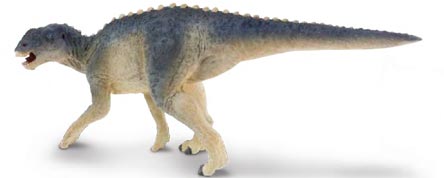
The model is painted a beautiful, dusky blue, with a light tan underside and a beige coloured row of prominent scales running from behind the skull almost to the tip of the animal’s stiffened tail.  This dinosaur is posed in a quadrupedal stance with the tail, which makes up approximately half this animal’s length,  held out straight behind it.  The presence of ossified tendons in the fossil record supports the idea that the tails of these duck-billed dinosaurs were stiff and held off the ground.

The Gryposaurus genus was established in 1914 by the famous Canadian palaeontologist Lawrence Lambe after studying fossils found in Alberta, Canada.  A number of species of Gryposaurus are now recognised by palaeontologists, making this type of duck-billed dinosaur one of the most geographically widespread of all the Hadrosaurs known to science.

 The Gryposaurus Dinosaur Model (Safari Ltd)
New Duck-billed Dinosaur for 2013

New Duck-billed dinosaur for 2013.

Picture credit: Safari Ltd

A “Roman Nose”

The most prominent feature of the skull, is the famous “Roman nose” that gives this dinosaur its name.  Gryposaurus means “hook-nosed lizard”.  This feature is formed by the highly arched nasal bones.  In some fossil specimens that team members at Everything Dinosaur have seen, the top part of the crest is roughened.  It has been speculated that soft tissues were connected to  these nasal bones, skin and cartilage forming a bulbous area that could be inflated as the animal breathed.  Once again, Safari Ltd are to be congratulated for the way in which this feature has been depicted on their replica.  We like the piercing blue eyes as well, an eye colouration not usually associated with dinosaur models.

 Dinosaur with Blue Eyes – Wild Safari Dinos Gryposaurus

A Blue-eyed dinosaur.

A blue-eyed dinosaur.

Picture credit: Safari Ltd

What purpose this bulbous soft tissue served is unknown.  It could have  amplified the animal’s calls so perhaps it was used for auditory as well as visual communication amongst members of the herd.  The enlarged nasal passages could have been very well supplied with blood vessels so this “Roman nose” could have helped this dinosaur keep cool and otherwise regulate its body temperature.

Skin Impressions

Fossils of skin impressions of Gryposaurus have been found.  These show that this dinosaur was covered in many different types of scale  The model makers at Safari Ltd have obviously paid a lot of attention to the fossil material as they have ensured that their Gryposaurus replica reflects what is known about this dinosaur’s skin texture.

This well-made model measures approximately 22 centimetres in length, from its clearly defined beak to the tip of its blue painted tail.  Size estimates for this dinosaur do vary, but based on what is presumed to be fully grown adult specimens of Gryposaurus notabilis this replica is in 1:36 scale so it fits in well with other models in the Wild Safari Dinos and the Carnegie Collectibles model ranges.  This Gryposaurus dinosaur  model is an excellent addition to the Wild Safari Dinos range.  It is always a pleasure to see duck-billed dinosaurs included in a range of quality replicas.

We at Everything Dinosaur even provide a  fact sheet so that collectors can read all about this Late Cretaceous herbivore, where its fossils have been found, how big these dinosaurs were, their taxonomic affinities to other hadrosaurs and other fascinating facts.

To view the Wild Safari Prehistoric World range in stock at Everything Dinosaur: Wild Safari Prehistoric World Models and Figures.
13 09, 2013

Squiggle Dinosaurs (New Dinosaur Drawing Game) Reviewed

By |2024-05-01T14:52:45+01:00September 13th, 2013|Categories: Educational Activities, Everything Dinosaur Products, Product Reviews|0 Comments

A Review of Squiggle Dinosaurs

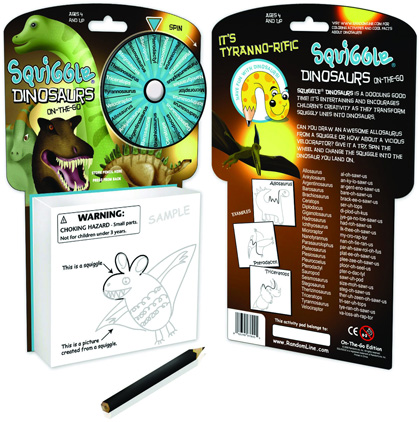
Squiggle dinosaurs is a dinosaur drawing game aimed at young dinosaur fans.  This drawing game has been specially devised to help young children develop their imagination and creativity.  Spin the spinner and select one of twelve dinosaurs listed on the spinning device, then using the squiggle pad with its wavy squiggle, the illustrator has to create a sketch of the named dinosaur.  Lots of favourite dinosaurs to draw such as Triceratops and Tyrannosaurus rex.

 Squiggle Dinosaurs (Dinosaur Drawing Game)

Doodle a dinosaur.

Doodle a dinosaur.

Picture credit: Everything Dinosaur

Dinosaur Drawing Game

Squiggle dinosaurs is a dinosaur game aimed at inspiring your child’s creativity.  It has proved popular with our review team.  Can you draw an awesome Allosaurus from a squiggle?  How about a vicious Velociraptor?  Give it a try, simply spin the wheel and change the squiggle into the dinosaur that you land on.

There are one hundred unique squiggles and the pack is even supplied with a special doodling pencil.  On the back of the game there is a handy pronunciation guide to help grown ups and little ones remember and pronounce the name of the prehistoric animal selected.

Squiggle dinosaurs is recommended for children aged four years and upwards, and it was awarded the Preferred Choice Award (Creative Toy Awards) by Creative Child Magazine.

To view the dinosaur drawing game, squiggle dinosaurs and Everything Dinosaur’s other educational games: Educational Dinosaur Themed Toys and Games.

8 09, 2013

Promoting Fossil Finds – Pocket Sized and Exciting Dinosaur Dig Sets

By |2024-05-01T14:54:15+01:00September 8th, 2013|Categories: Adobe CS5, Educational Activities, Everything Dinosaur Products|0 Comments

Fossil Finds Ever Popular and Great for Schools

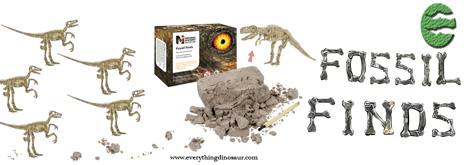
Team members at Everything Dinosaur have been busy fulfilling orders for schools and other educational institutions as the autumn term gets under way.  A popular item with teachers and young dinosaur fans is the Fossil Find dig kit.  Young palaeontologists can excavate a prehistoric animal skeleton out of a gypsum block using the digging tools provided in the kit.  These tools, consisting of a small brush and a wooden pick are identical to the tools used by real palaeontologists when they are excavating material that surrounds fossil bone.  Once the pieces of skeleton have been excavated then they can be assembled to form a skeleton of a dinosaur.

Fossil Find Kits

Photoshop is Used to Build to Build a Fossil Finds Banner

Everything Dinosaur creates a banner to promote Fossil Finds.

Everything Dinosaur creates a banner to promote Fossil Finds.

 Picture credit: Everything Dinosaur

In the picture above, a flock of Velociraptor skeletons are confronting a T. rex skeleton, with the T. rex taking shelter behind a pile of rubble that has been excavated.

Everything Dinosaur

There are several different dinosaurs to collect in this series, hours of fun for any budding palaeontologist.  Assemble the pieces and construct your own dinosaur skeleton model you can even build your own mini dinosaur museum.

To view the range of Fossil Find kits and other craft ideas including prehistoric animal themed toys and gifts available from Everything Dinosaur: Everything Dinosaur Toys and Gifts.

3 09, 2013

Safari Ltd Announce New Prehistoric Animal Models for 2014

By |2023-02-22T13:03:09+00:00September 3rd, 2013|Categories: Dinosaur Fans, Everything Dinosaur News and Updates, Everything Dinosaur Products|11 Comments

Four New Additions to the Wild Safari Dinosaurs and Prehistoric Life Range for 2014

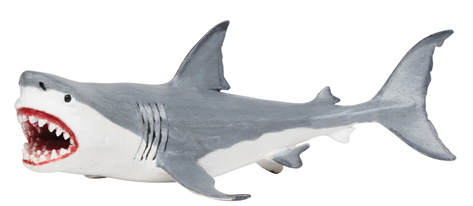
The first images of the four new models to be included in the Wild Safari Dinosaurs and Prehistoric Life Range (Safari Ltd) have been received by Everything Dinosaur and our team members are very excited about these new additions.  Three of the 2014 releases are dinosaurs Suchomimus, Monolophosaurus and Pachyrhinosaurus respectively.  The fourth model will get fans of the Elasmobranchii twitching their forked tails in anticipation as it is a replica of a Carcharodon megalodon, a giant, predatory shark that probably fed on whales.

Prehistoric Animal Models

New for 2014 – Pachyrhinosaurus

Horned dinosaur from Safari Ltd new for 2014.

Horned dinosaur from Safari Ltd new for 2014.

Picture credit: Safari Ltd

Wild Safari Dinosaurs and Prehistoric Life Range

Safari Ltd have added a new ceratopsian model to their Wild Safari Dinosaurs and Prehistoric Life range each year for the last few  years.  Vagaceratops was added in 2012, this year we had the excellent Diabloceratops replica and in 2014 a Pachyrhinosaurus is being added to this model series.  Having seen the model, we at Everything Dinosaur think that his is a replica of Pachyrhinosaurus canadensis.

This model is bound to prove popular as a pachyrhinosaur (P. canadensis) is the star of the forthcoming “Walking with Dinosaurs in 3-D” movie, due for release in December.  The Pachyrhinosaurus model measures just over 17 centimetres in length.

Theropod Models

The other two new dinosaurs are both theropods, but from very different parts of the Theropoda family tree.  Firstly, there is Monolophosaurus, a five-metre-long carnivorous dinosaur named and described just twenty years ago.  This dinosaur dates from the Middle Jurassic of China (north-western China).  The name means “single crested lizard” and the picture of the model below shows why.

Wild Safari Dinos Monolophosaurus Model New for 2014

Middle Jurassic Theropod Dinosaur

Middle Jurassic theropod dinosaur.

Picture credit: Safari Ltd

Monolophosaurus Model

Monolophosaurus sported a strange crest that ran from just above its eye socket down to the tip of its nose.   A lot of palaeontologists have speculated what this crest might have been used for.  It could have had a role in visual communication, this perhaps explains why the model’s crest has been painted a vivid red colour.  Monolophosaurus is regarded as a basal member of the Tetanuran clade of theropods (stiff tails), however, it remains uncertain as to where this dinosaur actually fits in terms of taxonomy.

However, Monolophosaurus should feel right at home in the Wild Safari Dinos range as it already includes another meat-eating dinosaur whose fossils have been found in in the same part of China – Guanlong.  In fact it has been speculated that the tyrannosaurid known as Guanlong (G. wucaii), is actually a juvenile Monolophosaurus.

The Monolophosaurus model measures just over 19 centimetres in length.

In contrast, the taxonomy of the third dinosaur model to be introduced next year by Safari Ltd into this range is much better understood.  This is Suchomimus (S. tenerensis), a spinosaur and a big one too, measuring nearly ten metres in length.  This predatory dinosaur lived at least fifty million years after Monolophosaurus.

New Spinosaurid on the Block – Suchomimus

Updating an earlier model.

Updating an earlier model.

Picture credit: Safari Ltd

Suchomimus Replica

Known from a partial skull and several other fossils representing post cranial material, this dinosaur lived during the Cretaceous and it is known from the Upper Elrhaz Formation of Niger (Africa).  The replica measures just under 20 centimetres in length and its tail tip is about 10 centimetres off the ground.  This model updates an earlier interpretation of Suchomimus, the very crocodile-like replica of “crocodile mimic” that was introduced into the Wild Safari Dinos range a few years ago.

Megalodon Figure

The fourth model to be added to the Wild Safari Dinosaurs and Prehistoric Animal Life range is a replica of Carcharodon megalodon, more commonly (although technically incorrectly), referred to as Megalodon.  Measuring perhaps as much as sixteen metres in length, this member of the shark family was a formidable hunter, the largest shark apex predator known to science.  Although the model itself measures a more modest 18 centimetres in length.

New for 2014 – A Megalodon Model

C. megalodon replica available in 2014.

C. megalodon replica available in 2014.

Picture credit: Safari Ltd

A spokesperson from Everything Dinosaur stated:

“These hand-painted models represent exciting additions to this particular model range and Everything Dinosaur has already verbally committed to stocking these models in 2014”.

Note

Following a taxonomic revision the shark referred to as Megalodon has been given the scientific name Otodus megalodon.

To view the range of Wild Safari Prehistoric World figures and models in stock at Everything Dinosaur: Prehistoric World Figures and Models.

25 08, 2013

New Papo Dimetrodon Prehistoric Animal Model Reviewed

By |2024-05-01T14:42:23+01:00August 25th, 2013|Categories: Everything Dinosaur Products, Product Reviews|0 Comments

A Review of the Papo Dimetrodon (Pelycosaur) Model

The last of Papo’s 2013 releases in the company’s prehistoric animal model range is Dimetrodon, Papo’s first model of a animal that lived before the dinosaurs existed.   Dimetrodon is not even closely related to the Dinosauria, it is a synapsid, a member of the pelycosaur group of reptiles.  Models of this sail-backed reptile have appeared very frequently in dinosaur model ranges and this is Everything Dinosaur’s review of the Papo Dimetrodon replica.

Dimetrodon Prehistoric Animal Model

Why Dimetrodon should be so strongly associated with the Dinosauria alludes us, but a few years ago team members at Everything Dinosaur wrote a short article about this: Why is Dimetrodon regarded as a Dinosaur?

The Papo Dimetrodon Model

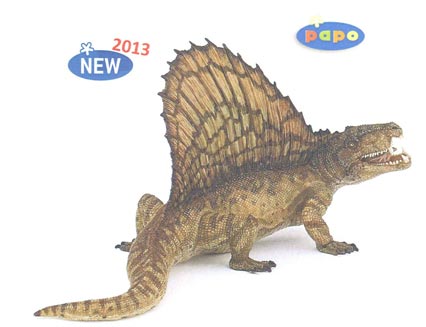
Fearsome sail-backed reptile, with exquisite detail.

Fearsome sail-backed reptile, with exquisite detail.

Picture credit: Everything Dinosaur/Papo

A Large Predator

Dimetrodon was a large predator of the Permian geological period, a number of species are known, one of the largest of which, Dimetrodon grandis measured over 3.5 metres in length and would have weighed up to 200 kilogrammes when fully grown.  The genus Dimetrodon was named by the American Edward Drinker Cope, it is one of over 1,000 prehistoric animals that this famous palaeontologists named in his lifetime.

The most prominent feature of Dimetrodon is its enormous sail which stretched across the animal’s back.  This sail was supported by spines and the sail was actually quite thin.  Papo have taken care to depict the spines and thin sail very carefully on their replica.  This structure was most likely used to help regulate body temperature, although it may also have a played a role in courtship displays or other forms of visual communication between individuals, this perhaps helps to explain the patterning that the Papo design team have given the sail on their model.

Fantastic Detail on the Skin

The detailing on the skin is exquisite with individual scales clearly picked out.  The presence of skin folds and the detailed scaling gives this model a very lizard-like appearance.  The Papo Dimetrodon has a relatively long tail, early reconstructions of Dimetrodon showed this reptile with a short, stubby tail, but palaeontologists now know that this pelycosaur did indeed have a long tail.

The lower jaw is articulated and Papo have been careful to depict the different sized teeth in the jaws with a reasonable degree of accuracy, the prominent notch in the upper jaw is present, providing a space for the oversized teeth in the lower jaw to fit into when the mouth is closed.  Like the rest of the model, the head is very well painted and there is lots of detail to admire.

Model Measurements

This new Dimetrodon model measures  approximately 16.5 centimetres in length.  If we assume that this is a model of Dimetrodon grandis, then we can conclude that this replica is in approximately 1:21 scale.  Although, we are not aware of any scaling actually being stated by the manufacturer, this model would work well with any other replicas produced in a 1:20 scale format.

To view Papo models available at Everything Dinosaur: Papo Dinosaurs and Prehistoric Animal Figures.

Intriguingly, Papo have chosen to give their Dimetrodon model only four toes on the hind feet.  We think that this reptile had five toes on its feet, the front limbs of the model do have five digits which is correct.  Trackways, trace fossils assigned to the Dimetrodon genus, showing a large animal with five digits on each foot have been discovered in North America.

All in all, this is an excellent Dimetrodon model and one that is a welcome addition to the Papo range of replicas.  Perhaps, Papo will be encouraged to introduce other non-dinosaurian models into their prehistoric animal model series.

24 08, 2013

Beautiful CollectA Pachycephalosaurus Dinosaur Model Reviewed

By |2024-05-01T14:42:50+01:00August 24th, 2013|Categories: Everything Dinosaur Products, Product Reviews|0 Comments

A Review of the Pachycephalosaurus Model from CollectA

The pachycephalosaurs, often referred to as the “bone-headed dinosaurs” due to their greatly thickened skulls are a group of ornithischian dinosaurs known almost exclusively from Upper Cretaceous deposits of North America and northern Asia.  Although the majority of this group are only known from fragmentary fossil remains, most notably frontal and parietal bones of the skull,  a number of pachycephalosaur models have been made and this is a review of the Pachycephalosaurus dinosaur model manufactured by CollectA.

Pachycephalosaurus Dinosaur Model

No complete skeleton of Pachycephalosaurus has been found, so interpretations of this dinosaur, the largest of the “bone-headed dinosaurs” discovered to date, are usually based on a scaled up version of the pachycephalosaur known as Stegoceras.  CollectA have depicted their Pachycephalosaurus in a bipedal pose with strong hind legs, five fingered hands and with a tail a fraction longer than the length of the shoulder girdle to the pelvis, although the actual body proportions are unknown.

The CollectA 2013 Pachycephalosaurus Dinosaur Model

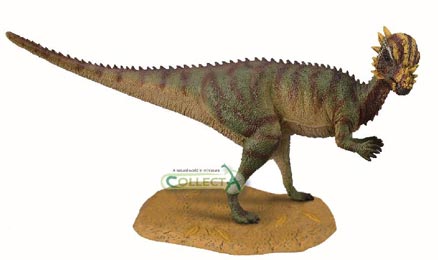
A lithe Pachycephalosaurus dinosaur model.

A lithe Pachycephalosaurus dinosaur model.

Skull Fossil Fragments

Skull fossil fragments ascribed to Pachycephalosaurus are known from Canada and the western United States, mainly from the Province of Alberta and the states of Wyoming and Montana. The thickened skull dome is over 25 cm thick on larger specimens, exceptional protection for what was a relatively small brain inside the skull.   The model makers at CollectA have elected to give their Pachycephalosaurus a more rounded skull, rather than the very domed shape seen in some reconstructions.

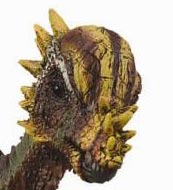
The skull dome was edged with a number of bony protrusions and spikes, these were most prominent towards the back of the skull.  The muzzle was relatively short and it ended in short beak,  in the CollectA replica, the beak is ever so slightly pointed and can be clearly made out on the model.  The spikes and bony projections have been painted a bright yellow colour which contrasts nicely with the muted, camouflaged tones of the body.

 The CollectA Pachycephalosaurus Viewed Close Up

A close up of the lovely detail on the head.

A close up of the lovely detail on the head.

Picture credit: Everything Dinosaur

Model Measurements

The model measures a little over ten centimetres long, although the size of this dinosaur is not certain from the fossil evidence, based on a 4.6-metre-long adult animal we estimate that this Pachycephalosaurus is in approximately 1:46 scale.

The replica has a row of prominent, triangular spikes running from the base of the skull to the almost the very tip of the tail, a single line of spikes is also depicted on the neck, presumably providing some protection from attack and to protect the soft tissue of the neck when browsing on thorny plant material.

The neck looks quite long and stiff. The total number of vertebrae is unknown for any member of the pachycephalosaur family, indeed how the neck bones articulated with the skull of Pachycephalosaurus is open to speculation.  It had been thought that the thickened skulls and stiffened dorsal vertebrae of this type of dinosaur were adaptations for head-butting contests between individuals, although recent studies and biomechanical analysis of the skull domes have led to this form of intra-specific conflict being disputed.

To read more about the disputed theory regarding head-butting Pachycephalosaurs:

Evidence for head-butting dinosaurs: Head-Butting Dinosaurs After All.

Contrasting evidence, pachycephalosaurs may have used their reinforced skulls in different ways: Bone-headed Dinosaurs “bashed” in Different Ways.

This model is supplied on a base, this prevents the feet from having to be oversized and the effect is to depict Pachycephalosaurus as an agile, strong-running dinosaur.  The number of fragments of skull bone found in locations such as the Dinosaur Provincial Park Formation of Alberta suggest that pachycephalosaurs were the most common, small-bodied dinosaurian herbivores in those ecosystems where their fossils have been found.

This is a fascinating re-creation of Pachycephalosaurus and an excellent addition to the CollectA range of prehistoric animal models.  The Pachycephalosaurus replica and the rest of the CollectA prehistoric life range is available from Everything Dinosaur, the UK based retailer of dinosaur models, toys and games that is staffed by parents, teachers and real dinosaur experts.

To view Everything Dinosaur’s range of CollectA models: CollectA Prehistoric World/Prehistoric Life.

20 08, 2013

Papo Dimetrodon – A Video Review

By |2023-02-22T07:38:45+00:00August 20th, 2013|Categories: Everything Dinosaur Products, Everything Dinosaur videos, Product Reviews|3 Comments

Everything Dinosaur Reviews the Papo Dimetrodon Model

The last of the 2013 model releases in Papo’s prehistoric animal range of replicas is the Dimetrodon.  It has been worth the wait, as this is a wonderful model of this Permian predator.  Dimetrodon may have existed long before the Dinosauria evolved, but for some reason this sail-backed reptile is synonymous with dinosaur model collections.

Papo Dimetrodon Model

Papo, as a French company refer to their range of prehistoric animal replicas as “Les Dinosaures”, this can be a little confusing as it now includes a mammal-like reptile, one that is only very distantly related to that part of the reptile family tree that gave rise to the dinosaurs.

Team members at Everything Dinosaur have made a short video review of the model.  In this video, it lasts around 5 minutes, we look at the model in detail, highlight some features and discuss fossil evidence that relates to the Dimetrodon genera.

Everything Dinosaur’s Video Review of the Papo Dimetrodon Model

Video credit: Everything Dinosaur

Papo Prehistoric Animal Figures

Earlier in the year, Papo added a Carnotaurus and a Woolly Rhino model replica to their prehistoric animal model range.  Only one of the models introduced this year is actually a dinosaur.  It is good to see the design team at Papo working on a variety of prehistoric creatures.  We know that plans are progressing well with regards to new model introductions for 2014, from the reviews we have received so far for the 2013 models, Papo will have to work hard to maintain their high standards.

Papo models available at Everything Dinosaur: Papo Models and Figures.

11 08, 2013

A Review of the CollectA Diabloceratops Horned Dinosaur Model

By |2023-02-21T16:35:29+00:00August 11th, 2013|Categories: Dinosaur Fans, Everything Dinosaur Products, Product Reviews|0 Comments

A Review of the CollectA Diabloceratops Dinosaur Model by Everything Dinosaur

Over the last few years there have been a number of remarkable horned dinosaur discoveries particularly in the United States and Canada.  Slowly but surely these new ceratopsians are being included in model collections and this is Everything Dinosaur’s review of the CollectA Diabloceratops dinosaur model.

Diabloceratops Dinosaur Model

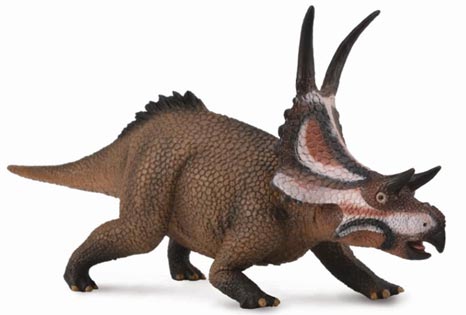
Known from just two partial skulls, the first of which was found in southern Utah in 2002, Diabloceratops is believed to be a primitive member of the centrosaurine sub-family of horned dinosaurs, although the skull fossils do share some anatomical characteristics with chasmosaurines as well.  It was formerly named in 2010, Diabloceratops means “devil horned face”, after the Spanish word for devil “Diablo” in reference to the pair of long, horn-like spines that sweep back from the top of this dinosaur’s frill.

The CollectA Diabloceratops Dinosaur Model

"Devil Horned Face"

“Devil Horned Face”

Picture credit: Everything Dinosaur

CollectA Diabloceratops

The design team at CollectA have used vivid colouration to depict the bizarre horns and neck frill of Diabloceratops, the colour combinations of brown and black with flashes of white give this dinosaur model a very striking appearance.  The model makers have obviously studied the actual fossil material as they have worked hard to ensure that the broad, deep snout is depicted accurately.

If you look carefully, the design team have given their Diabloceratops a prominent bony projection which juts out along the side of the neck. This is called the  jugal and it may have been capped by  a small  horn referred to as an epijugal ossification.  Such features are seen in many primitive ceratopsians, such as the psittacosaurs which had large uncapped jugals, the tongue of Diabloceratops can also be seen in the mouth of this particular dinosaur model.

The Skull of a Typical Psittacosaur

A characteristic of basal Ceratopsians?

A characteristic of basal ceratopsians?

Picture credit: Everything Dinosaur

Model Measurements

The model measures approximately sixteen centimetres long and the skin texture along the flanks and on the belly is beautifully marked out.  Although this is not technically a scale model, based on an adult Diabloceratops measuring a little over five metres, we estimate that this replica is in approximately 1:32 scale.   Over the rump the model makers have added a small crest of bristles.  Recent research has suggested that some of these horned dinosaurs had bristles running down their backs, a characteristic also seen in more primitive, basal forms of this dinosaur clade – once again, the psittacosaurs for example.

To view Everything Dinosaur’s range of CollectA dinosaur models, including Diabloceratops and the primitive ceratopsian Psittacosaurus: CollectA Prehistoric Life Models and Figures.

The tail is relatively stumpy and the short hind legs in combination with the front legs that are not fully straightened give this dinosaur a rather squat, stocky appearance.  The posture and body proportions of this dinosaur are not known, as far as we can tell no post cranial fossil material has been found to date.  It is likely that the model makers have used reconstructions of the better known Zuniceratops, which has more fossil material ascribed to it, to create their representation of Diabloceratops.

An Illustration of the Horned Dinosaur Zuniceratops

Reconstruction based on the likes of Zuniceratops.

Reconstruction based on the likes of Zuniceratops.

Picture credit: Everything Dinosaur

This is a skilfully created model of a lesser known, but spectacular looking horned dinosaur.  Congratulations to  CollectA for wanting to add models of more obscure ceratopsians to their rapidly growing prehistoric life model series.

9 08, 2013

Everything Dinosaur Reviews the Amazing CollectA Pachycephalosaurus Dinosaur Model

By |2024-04-29T14:55:26+01:00August 9th, 2013|Categories: Everything Dinosaur Products, Everything Dinosaur videos, Product Reviews|0 Comments

CollectA Pachycephalosaurus Dinosaur Model Reviewed

Team members at Everything Dinosaur, feel that sometimes the pachycephalosaurs do not get the credit they deserve. Although known only from fossil fragments (most species, the exceptions are the likes of Stegoceras validum and Dracorex hogwartsia although this may prove to be a juvenile Pachycephalosaurus wyomingensis), these ornithischian dinosaurs may represent one of the most diverse and abundant clades of the Dinosauria in the very Late Cretaceous.

Pachycephalosaurus Dinosaur Model

These “bone-headed” dinosaurs have featured in a number of films and television programmes, albeit mostly as very minor supporting characters to the “A-lister” dinosaurs such as the tyrannosaurs and dromaeosaurs.  When CollectA introduced a model of Pachycephalosaurus into their not-to-scale prehistoric life model series, we decided to create a short five minute video review of this replica.

The CollectA Pachycephalosaurus Dinosaur Model Video Review

Video credit: Everything Dinosaur

CollectA Video Review

In this brief video, (5:24) we review this dinosaur replica and comment on the way it reflects current thinking regarding the anatomy of these Late Cretaceous dinosaurs.  Palaeontology may not be known for its wild speculation, but given the paucity of the current fossil record which contrasts with the likely relative abundance of Pachycephalosaurs living in northern latitudes during the Late Cretaceous, there are probably some amazing insights and discoveries concerning this particular group of dinosaurs just waiting to be made.

To view Everything Dinosaur’s range of CollectA prehistoric animal models: CollectA Prehistoric World Models.

7 08, 2013

Back to School with Everything Dinosaur

By |2023-02-21T15:18:15+00:00August 7th, 2013|Categories: Educational Activities, Everything Dinosaur News and Updates, Everything Dinosaur Products, Press Releases|0 Comments

A Month to the Start of the Autumn Term

The countdown has begun to the start of the new school year in the UK,  in just over a month the summer holidays will be over and many school children will have already settled in as the autumn term commences.  It was only a few short weeks ago that team members at Everything Dinosaur were packing away their dinosaur themed teaching resources after finishing their last teaching assignment of the summer term.  Now we can all look forward to the challenges ahead.

Back to School

For grown ups looking to inspire the next generation of palaeontologists, or for those wondering how to motivate and enthuse youngsters when it comes to going back to school, a good place to start is with Everything Dinosaur’s range of prehistoric animal themed school kits, pens, pencils and stationery.

Everything Dinosaur stocks a wide range of back to school items.  Send your young palaeontologists off to school with this fantastic range of dinosaur themed school stationery, pens, pencils and school items.  Take a dinosaur to school or out on your own prehistoric adventures with Everything Dinosaur’s inexpensive range of back to school supplies and back to school stationery.

Everything Dinosaur

Getting Ready for School with Everything Dinosaur

pens, pencils, lunchboxes, pencil cases, school kits all with a dinosaur theme.

Pens, pencils, lunchboxes, pencil cases, school kits all with a dinosaur theme.

Picture credit: Everything Dinosaur

Staff are already working on a number of new palaeontology themed teaching assignments, including creating suitable lesson plans for key stage activities that will relate to teaching about evolution in the new UK curriculum.

In the meantime, check out Everything Dinosaur’s comprehensive range of back to school items by clicking on the “Back 2 School” image above, or simply visit our website: Visit Everything Dinosaur.

Go to Top