All about dinosaurs, fossils and prehistoric animals by Everything Dinosaur team members.

Everything Dinosaur’s work with schools and other educational bodies. Articles, features and stories about dinosaurs and their role in education and educating young people.

23 02, 2010

Unique Dwarf Dinosaurs on Dinosaur Island

By |2024-04-19T07:19:49+01:00February 23rd, 2010|Categories: Dinosaur and Prehistoric Animal News Stories, Dinosaur Fans, Educational Activities, Main Page|0 Comments

Evidence of Dwarfism in Late Cretaceous Dinosaurs that lived on an Island

Fossils of dwarf dinosaurs found in deposits associated with the Hateg Formation suggest that on an ancient Cretaceous archipelago, diminutive dinosaurs roamed.

The Hungarian scientist Franz Nopcsa, proposed a theory that if animals are marooned on an island, the limited resources would have a fundamental effect on the animal population over generations.  Large animals would have a tendency to become smaller over time, eventually evolving into distinct species from their mainland ancestors.  This rule, seen in many extant island species today, also rings true for those creatures known only from the fossil record.  In a new paper, published by a team of scientists, it seems that dinosaurs trapped on islands with limited resources also evolved into dwarf forms.

“Insular Theory”

Nopsca called his theory the “insular theory”, it is perhaps more commonly known as the “island rule”.  Animals having to cope with environments where resources are limited either adapt or become extinct.  One of the ways in which animals adapt is to become smaller and smaller over subsequent generations.  Many thousands of years ago, dwarf species of elephant lived on some of the islands of the Mediterranean.  These animals had been cut off from their African homeland as sea levels rose.  Many of these types of elephants evolved into dwarf forms as a result of their isolation.

The finding of the fossilised skulls of these long dead elephants by human settlers gave rise to the cyclops myth.  The nasal area of the skull rots away leaving a hole in the centre of the forehead.  This was mistaken by Greek settlers to those Mediterranean islands where elephant populations had existed, as being a single eye socket.  Hence the myth of the one-eyed, giant cyclops arose.

Is This How the Cyclops Legend Arose?
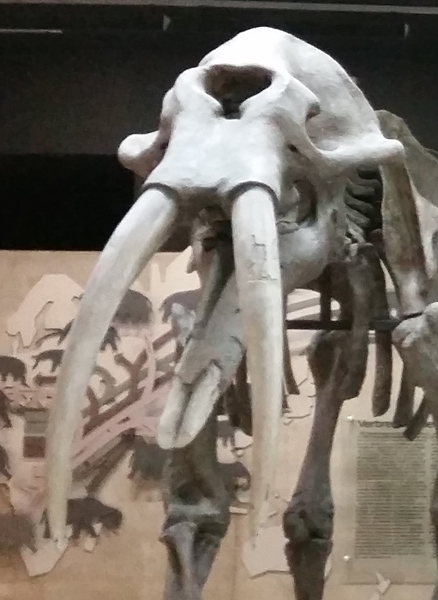
Proboscidian skull.

When viewed from the front the idea of a one-eyed man (cyclops) can be postulated. Picture credit: Everything Dinosaur.

Picture credit: Everything Dinosaur

Ironically, Franz Nopcsa’s family owned estates in part of Romania and it is from the study of the ancient Cretaceous fauna from this part of Romania known as Hateg Island that indicates that Nopcsa’s “island rule” applies also to Dinosauria.  The concept of diminutive dinosaurs on Hateg Island was put forward by Nopcsa and this new research into the fossils found in that region shows that he may well have been right.

Professor Mike Benton (University of Bristol) and six other researchers from Romania, Germany and the United States have published a paper on-line detailing their studies of the fossil bones found in the Upper Cretaceous strata of the region.  Thanks to earlier work, the dinosaurs of this part of eastern Europe are very well documented and a number of species and genera are known.  What is surprising is how small many of these animals seemed to be.

For example, the titanosaur, Magyarosaurus one of the largest animals known from this region measured only six metres long, making it one of the smallest titanosaurs in the fossil record.  Many dinosaur remains indicate that in the Hateg area dinosaurs were in many cases less than half the size of their close relatives found in slightly older strata in northern Europe.

The team of scientists examined the fossilised bones of a number of types of dinosaur from the Hateg Island region, theropods, ornithopods and of course titanosaurs.  They have concluded that the Hateg Island dinosaurs were indeed dwarfs and not just young dinosaurs whose remains have been preserved with no adult animal material present.

The “Island Rule”

It seems that based on this study, the “island rule” also appears to apply to dinosaurs.  The Hateg Island area is assumed to have been a series of small islands that were formed as sea levels rose at the end of the Cretaceous.  Although, some geologists question the evidence for this part of the world being a series of small islands, a sort of archipelago island chain, at the end of the Cretaceous, island habitats with their limited resources would provide some explanation for the dwarfism seen in the dinosaur fossils.

A close study of the fossils confirmed that the dinosaurs had reached adulthood so they were not just underdeveloped youngsters who had died young and been preserved as fossils.

Detailed studies by Martin Sander in Bonn and his students also show that the bone histology (the microscopic structure) is adult, meaning that at six metres long; that was about as big as a Magyarosaurus could expect to grow to, whilst other types of titanosaur could grow to lengths in excess of 20 metres.

These well-studied examples suggest dwarfing can happen quite quickly, the team believes.

Professor Benton, said:

”The general idea is that larger animals that find themselves isolated on an island either become extinct because there is not enough space for a reasonably-sized population to survive, or they adapt.  One way to adapt is to become smaller, generation by generation.”

The Hateg dinosaurs date from close to the end of the Cretaceous period, some 65-70 million years ago, when much of Europe was flooded by rising sea levels.  The largest island is this ancient island group, may have been just a few thousand kilometres square, providing the environmental driving force to induce dwarfism in the larger types of animals on the islands.   It is not known whether the dinosaurs and the other fauna was marooned as sea levels rose, or whether they swam or drifted to the islands by chance later on.

As Professor Benton added:

”Either way, this research demonstrates that once they arrived they evolved to become dwarfs.”

The island of Isla Sorna, the small, second island used by the creators of the Jurassic Park dinosaur land in the movie of the same name, may have been a work of fiction, but this new paper indicates that small islands in the past did support populations of dinosaurs albeit dwarf species compared to their mainland cousins.

Everything Dinosaur stocks models of various prehistoric animals, fossils of which are associated with the Hateg Formation: Dinosaur and Prehistoric Animal Models.

Not all animals from the Hateg islands were small, recently evidence has been found of a gigantic pterosaur, large enough to rival the biggest of the azhdarchids in strata from this area.  The genus has been named Hatzegopteryx and although the description is based on fragmentary fossil evidence, some scientists have claimed this pterosaur would have had a wingspan in excess of 12 metres.
16 02, 2010

Fossil Fun for all the Family with the BGS and Rockwatch

By |2023-03-04T22:27:50+00:00February 16th, 2010|Categories: Dinosaur Fans, Educational Activities, Geology, Main Page|0 Comments

British Geological Survey and Rockwatch Fossil Fun Event

With the annual National Science week rapidly approaching (from 12th to 21st March), team members at Everything Dinosaur are busy preparing for all the activities they have planned.  This years theme is “Earth” and ties into the International Year of Biodiversity and there are lots of events planned around the country.

Fossil Fun Day

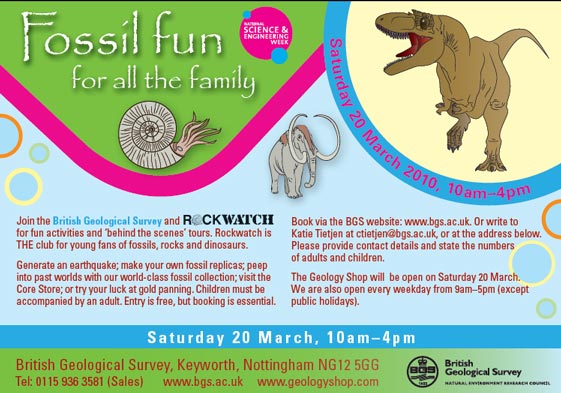
For example, the British Geological Survey (BGS) and Rockwatch (the club for young fossil fans and junior geologists) is holding a special family fossil fun day on Saturday March 20th.

The BGS and Rockwatch Family Fossil Day

Picture credit: BGS

Numbers are limited for this fun day out, so best to book early to avoid disappointment.  The event is taking place at the BGS premises at Keyworth, Nottingham on Saturday 20th and the event opens at 10am.

To book visit write to Katie Tietjen at the address at the bottom of the advert.

Here is your chance to peep into prehistory with the BGS fossil collection, see how earthquakes happen and to pan for gold.  Entry is free and young children must be accompanied by an adult (after all, why should the kids have all the fun), best to book early to avoid missing out.

Everything Dinosaur

Team members at Everything Dinosaur wish the event organisers every success.

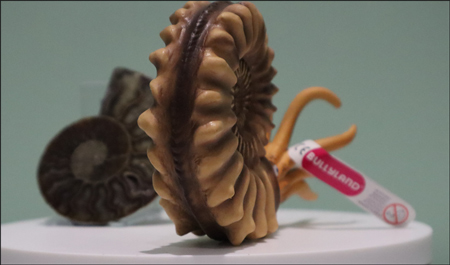
Ammonites and Ammonite Fossils at the Fossil Fun Day

Ammonite model next to a fossil specimen.

The strongly ribbed shell and the obvious keel of the ammonite replica.  Look out for lots of ammonite activities at the fossil fun day.  Picture credit: Everything Dinosaur.

Picture credit: Everything Dinosaur

Everything Dinosaur supplies replicas of iconic animals from the fossil record including ammonites, to see the range: Replicas of Important Fossil Animals.

9 02, 2010

The Famous Lizard from Edmonton – Edmontosaurus

By |2024-04-19T09:33:03+01:00February 9th, 2010|Categories: Dinosaur Fans, Educational Activities, Main Page|0 Comments

The Lizard from Edmonton – Edmontosaurus

A few days ago, team members at Everything Dinosaur received an email from a young dinosaur fan, asking how Edmontosaurus got its name.  This ornithopod, a member of the Hadrosauridae family, (duck-billed dinosaur), was named and described by the Canadian palaeontologist Lawrence Lambe in 1917.  Lambe was responsible for the study of a number of North American dinosaurs that were discovered in the early years of the 20th century.  Fossils of this particular dinosaur genus have been found in Alberta (Canada) and the United States (Montana and Wyoming).

The Lizard from Edmonton

Edmontosaurus was one of the last of the duck-billed dinosaurs, living at the very end of the Cretaceous (70 – 66 million years ago) – Maastrichtian faunal stage.

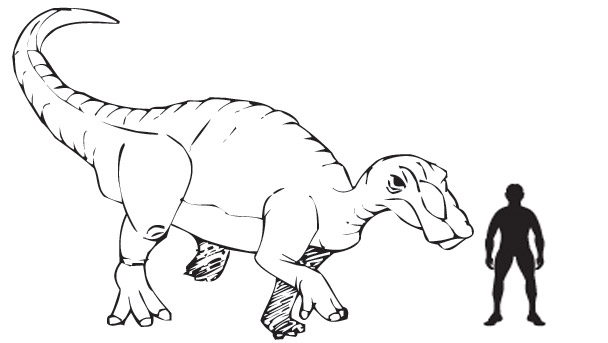
An Illustration of Edmontosaurus (Edmontosaurus regalis)

Picture credit: Everything Dinosaur

Edmontosaurus is known from many fossilised skeletons.  It must have been one of the most abundant of the large, herbivorous dinosaurs at the end of the Cretaceous and a number of species have been ascribed to this genus.  These large animals that could grow to lengths of 13 metres and weigh as much as 4 tonnes, were the prey of the large tyrannosaurs.  A number of fossilised skeletons show signs of attacks from predators, including one specimen with a chunk bitten out of its tail.  This flat-headed hadrosaur was not named after the Canadian city of Edmonton, although fossils assoiciated with this genus are known from Edmonton and its suburbs.

Edmontosaurus was named after the “Edmonton” Formation, the rock unit in which it was first found.  The “Edmonton” Formation has subsequently been elevated to “Group” status by geologists and consists of four geological formations namely, (oldest first) Horseshoe Canyon, Whitemud, Battle and the Scollard Formation which contains evidence to make the Cretaceous-Palaeogene boundary.  Edmontosaurus fossils (E. regalis) are associated with the Horseshoe Canyon Formation.

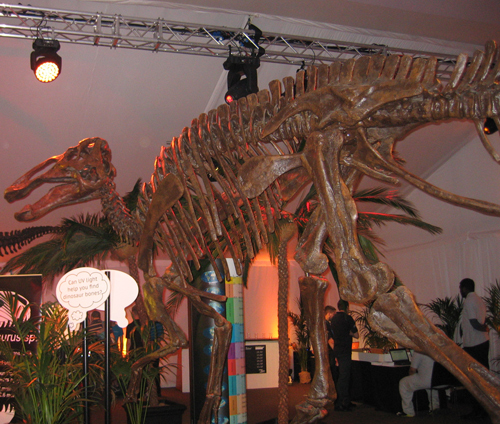
An Edmontosaurus Skeleton on Display

Edmontosaurus skeleton.

Duck-billed dinosaur on display. Picture credit: Everything Dinosaur.

Edmontosaurus

To view models of Edmontosaurus and other duck-billed dinosaurs, we suggest you take a look at the scale models in the CollectA Deluxe range: CollectA Deluxe Prehistoric Life Models.

3 02, 2010

Happy Birthday to Gideon Mantell

By |2023-03-04T15:08:24+00:00February 3rd, 2010|Categories: Dinosaur and Prehistoric Animal News Stories, Dinosaur Fans, Educational Activities, Famous Figures, Main Page|0 Comments

Happy Birthday Dr Gideon Mantell

Today, marks the birthday of Gideon Algernon Mantell, a English doctor, avid fossil collector and amateur geologist who made a considerable contribution to the early science of palaeontology.  Gideon Mantell was born on the 3rd of February in 1790, he was responsible for naming and describing two of the three dinosaurs that made up the Order Dinosauria as proposed by Sir Richard Owen.  These dinosaurs were Iguanodon and Hylaeosaurus.

The naming of Iguanodon (Iguana Tooth) has a stroke of luck about it.  Having studied the very worn, teeth, of a large, herbivorous reptile, as described by the French scientist Cuvier, Mantell was fortunate to see a freshly prepared skeleton of an Iguana  from the Caribbean.  He visited the Museum of the Royal College of Surgeons and was shown the newly prepared Iguana skeleton.  Noticing that the teeth of this lizard resembled the fossilised teeth of his as yet unnamed prehistoric reptile, he began to speculate on a formal scientific name for his extinct reptile.  The actual name of Iguanodon was suggested to Mantell by the Reverend William Conybeare.

Gideon Mantell

Hence the genus Iguanodon came about, the second dinosaur to be formerly named and described.

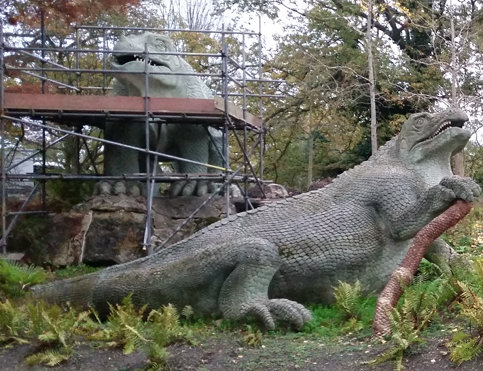
Iguanodon Figures at Crystal Palace Park

Iguanodons at Crystal Palace.

A pair of Iguanodons study the Crystal Palace landscape, these were the first, large dinosaur figures to be made. Picture credit: Everything Dinosaur.

Picture credit: Everything Dinosaur

To view models of iguanodontids and other ornithischian dinosaurs: Dinosaur Models and Figures.

30 01, 2010

Say Hello to “Meg” the Amazing Megalosaurus

By |2024-04-19T07:12:14+01:00January 30th, 2010|Categories: Educational Activities, Everything Dinosaur News and Updates, Main Page|0 Comments

Meet “Meg” the Megalosaurus

It is always a pleasure to come across a company that cares passionately about what they do and how they create their products.  One such company is Dice Maestro the developers of the dinosaur themed card and dice combat game – Jurassic Wars.  We had the chance to meet up with the designers behind this award winning game the other day and we were introduced to “Meg” one of the meat-eating dinosaurs featured amongst the ten theropod dinosaurs in Jurassic Wars.  “Meg” as she is called, is actually a Megalosaurus (Megalosaurus bucklandii), a swift hunter from the Middle Jurassic.

Say Hello to “Meg” the Megalosaurus

Picture credit: Everything Dinosaur

It is very appropriate to have a Megalosaurus to promote this British manufactured game, after all Megalosaurus was the first dinosaur to be scientifically studied and formerly described and one of original founder members of the Order Dinosauria as stated by that famous English anatomist, Sir Richard Owen.

Megalosaurus

To view the wide range of prehistoric animal and dinosaur themed toys and gifts available from the award-winning Everything Dinosaur website including Megalosaurus models: Everything Dinosaur.

A great picture, an example of the lovely artwork that can be seen on all twenty dinosaur cards included in the Jurassic Wars game.  The running pose reminds of the the three-toed, dinosaur trackway in Oxfordshire that has recently been granted SSSI (site of special scientific interest) status.

To read more about this important dinosaur trackway: Dinosaur Footprints Get Special Protection.

Although, ichnologists (scientist who specialise in studying tracks and footprints), cannot be sure what sort of meat-eating dinosaur made those prints, it could have been a Megalosaurus like “Meg”.  The illustration shows this beautifully balanced dinosaur in mid stride with its jaws opening perhaps depicting the last moments of a chase as this hunter prepares to attack its victim.

A delight to encounter “Meg” and a lovely illustration of this Jurassic carnivore.

29 01, 2010

Lapal Primary School and the Beautiful Diplodocus

By |2024-04-19T07:11:24+01:00January 29th, 2010|Categories: Dinosaur Fans, Educational Activities, Everything Dinosaur News and Updates, Main Page, Teaching|0 Comments

Lapal Primary School and the Diplodocus

Pupils at Lapal Primary school in Halesowen (England) have been travelling back in time to visit the age of Dinosaurs with a range of teaching activities organised for years 1 and 2.

Students have been getting to grips with fearsome creatures such as Tyrannosaurus rex and Velociraptors as well as marvelling at peaceful plant eating giants such as the armoured Stegosaurus and the huge Diplodocus.

For these young palaeontologists and their teachers, dinosaur themed activities have included creating their own prehistoric animal models and helping to paint gigantic posters featuring well-known dinosaurs.  The posters have been used to decorate the classrooms and the corridors.

For Miss Loughton’s class (2L) the front of the classroom is now adorned with an enormous Diplodocus grazing on a tree fern.  This artwork has been lovingly created by the children aided by Miss Loughton and the class teaching assistant Mrs Holden.

Lapal Primary School and their Diplodocus (class 2L)

Picture credit: Everything Dinosaur

The picture shows the Diplodocus mural (Diplodocus longus), we loved the spotted decorations and the addition of a tree fern so that this herbivorous dinosaur could be depicted chomping on plants.  After all, with a twenty tonne body to sustain, scientists believe that animals such as Diplodocus probably spent most of the time eating.

The Head of the Diplodocus

Diplodocus close-up view.

Picture credit: Everything Dinosaur

The picture (above) shows a close view of Lapal Primary school’s Diplodocus about to take a bite out of a tree fern.

Dinosaurs make a great topic for primary school children, helping them to express their creativity with story writing, imaginative play and aiding numeracy and reading development.

It was a real pleasure visiting the school and working with years 1 and 2, helping with the dinosaur experiments and showing some of our fossils.  Our thanks to all the students, teaching assistants and teachers who helped make the day so special.

To view the extensive range of prehistoric animal and dinosaur themed toys and gifts available from the award-winning Everything Dinosaur website: Visit Everything Dinosaur.

25 01, 2010

New Dinosaurs Unleashed Exhibition Opens this Week

By |2024-04-19T07:15:03+01:00January 25th, 2010|Categories: Dinosaur and Prehistoric Animal News Stories, Dinosaur Fans, Educational Activities, Everything Dinosaur News and Updates, Main Page, Press Releases|0 Comments

Dinosaurs Unleashed Exhibition Opens on January 28th

Dinosaurs Unleashed opens in London’s West End this week.  The largest animatronic dinosaur ever to be seen in the United Kingdom will be just one of the many exciting features of the Dinosaurs Unleashed exhibition at Parklife, Oxford Street (London).  Joining the 30 metre long Diplodocus will be a range of 23 life size dinosaur models featuring the likes of the fearsome Tyrannosaurus rex, Triceratops and the armoured dinosaur Stegosaurus.

Dinosaurs  Unleashed

Dinosaurs Unleashed opens its doors on Thursday, January 28th and runs until the end of April.  The exhibition offers visitors the chance to see prehistoric animals in a unique Mesozoic forest setting, as the exhibition also includes a range of prehistoric plants that were around at the time of the Dinosaurs.

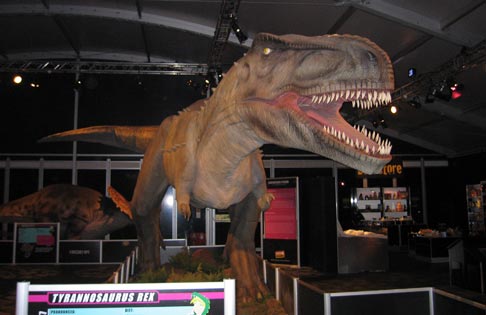
A Ferocious T. rex on Display

T. rex on display.

Ferocious T. rex!  The exhibition will include Tyrannosaurus rex.  Picture credit: Everything Dinosaur.

Picture credit: Everything Dinosaur

This particular dinosaur encounter is designed to be educational, informative and lots of fun for all the family.

To visit an educational, informative and family-friendly website, visit Everything Dinosaur’s website: Everything Dinosaur.

Everything Dinosaur staff have been involved in this event helping to set up the retailing.  For a fun-packed experience with an amazing array of prehistoric animals visit Everything Dinosaur’s social media sites for updates.

Keep up to date by reading the Everything Dinosaur blog.

17 01, 2010

Unique Stonehenge “Threatened”

By |2024-04-18T18:55:22+01:00January 17th, 2010|Categories: Dinosaur and Prehistoric Animal News Stories, Educational Activities, Main Page|0 Comments

Ancient Monument Stonehenge Given “Threatened” Status due to Road Traffic

One of the world’s most famous monuments, Stonehenge in Wiltshire (England), has been listed by a travel magazine in their annual survey detailing important human monuments and attractions that are under threat.

Stonehenge

Wanderlust magazine, the UK based travel publication has cited Stonehenge as one of the most threatened visitor attractions, in their second annual survey.

The site of Stonehenge is in an area of southern England which has many henges, burial mounds and other ancient monuments.  This location was first built on approximately 5,000 years ago, a time in human history (Neolithic) when people were adopting a more sedentary lifestyle, moving away from the hunter/gatherer way of life.  Powerful tribe leaders and influential people developed the site making it a focal point for Neolithic culture, the actual purpose of the site remains unclear.

Commenting on the inclusion of Stonehenge in the magazine’s most threatened list, editor in chief; Lyn Hughes stated that Stonehenge was: “brutally divorced from its context.”

This ancient monument is located at the junction of two major roads, the A303 and the A344, the site is badly affected by road traffic and road traffic noise.  Plans to build tunnels to direct traffic underground and to establish a new visitor centre have been abandoned due to the high costs involved.  The A303 is particularly busy.  It is the main trunk road linking Devon and Cornwall and during the Summer months it is an exceptionally busy tourist route.

Lyn Hughes went on to add:

“Seeing it without its surrounding landscape is to experience only a fraction of this historical wonder.  The fact that the government and various planning bodies cannot agree on implementing a radical solution to this problem is a national disgrace.”

English Heritage

Stonehenge is managed by English Heritage, with much of the land surrounding the site owned by the National Trust.  The poor traffic management and lack of tourist facilities has been commented upon before, in 1989 a Parliamentary public accounts committee heavily criticised the poor tourist infrastructure, labelling Stonehenge “a national disgrace.”

It is hoped that a new, (although slightly smaller than originally planned), tourist centre located just over one mile away from the stones will be opened in time for Summer 2012.  Hopefully this new visitor centre will be ready in time to welcome the influx of tourists expected for the London Olympic games.

15 01, 2010

Clever Mums and Cup Cakes

By |2023-01-02T07:34:37+00:00January 15th, 2010|Categories: Dinosaur Fans, Educational Activities, Everything Dinosaur News and Updates, Main Page|0 Comments

Clever Mums and Cup Cakes – Adding a Dinosaur Theme

At Everything Dinosaur, we receive lots and lots of emails, letters, photos and drawings from dinosaur fans.  In the warehouse, we have a big, cork-board, display board that is supposed to have things like delivery schedules and shipping logs pinned to it, but over the years the use of this board has changed.  More and more pictures, drawings, comments and such like have been put up.  You could say that our message board has “evolved”, it now shows off a huge montage of items sent into us by our customers.  It makes a very colourful display.

Occasionally, we come across correspondence that deserves a special mention.  We are constantly amazed at how resourceful and clever our customers can be.  For example, a lady called Anna wanted to have a special dinosaur themed birthday party for her young son Ben.  Ben, who has just turned three, is an avid dinosaur fan.  Now we all know, how stressful organising a birthday party can be, but to make it a birthday party with a dinosaur theme, one that will meet with the approval of young palaeontologists, that can be a daunting task.  For Anna and her family, this Brachiosaurus sized problem was soon brought down to size with some clever and innovative use of some of Everything Dinosaur’s products.

For example, we stock a little party favour called Dinosaur Rings, a set of five prehistoric animal themed rings for children.  They proved popular with our product testers, the set consisting of a T. rex, Triceratops, a flying reptile (Pteranodon) and two Ice Age animals, a Sabre-toothed cat and a Woolly Mammoth.  Anna very cleverly used the rings as cup cake decorations, turning party cakes into dinosaur themed delicacies that went down a treat with her young guests.

What a Clever use of a Dinosaur Party Favour

Picture credit: Anna

We were all very impressed, and we love the green icing!  What a super idea, we know that to purchase birthday cakes can be very expensive, but with a bit of thought and imagination Mums and Dads can create their very own prehistoric themed party bites.

Up Close to the Cup Cakes

Great Dinosaur Themed Birthday Party Food

Picture credit: Anna

We do hear about lots of interesting and innovative ways in which our products are used, but we have not come across this before, the rings make wonderful cake toppers, they are just the right size.  A super idea, once the cake has been devoured your little monsters have a souvenir of the party to take home with them.

To view the extensive range of prehistoric animal and dinosaur themed toys and gifts available from the award-winning Everything Dinosaur website: Visit Everything Dinosaur.

Happy Birthday to you Ben, and thank you for modelling one of our dinosaur T-shirts (blue T. rex),  you are a very lucky boy to have such delightful party food.

From the pictures we received, it seems like everyone had a good time, great to see our dinosaur party masks were a big success.  Our blog is read by all kinds of people from all over the world, scientists, teachers, model makers, dinosaur fans and we love receiving and reading correspondence from all the enthusiastic people that take the time to contact us.

Thanks once again to Anna and Ben for the pictures.

11 01, 2010

From the Water onto the Land only 35 million Years Earlier – An Important Update

By |2024-04-18T18:55:59+01:00January 11th, 2010|Categories: Educational Activities, Everything Dinosaur News and Updates, Main Page, Palaeontological articles|0 Comments

Tetrapods – Why bother coming onto the Land?

Following our publication of an article providing information on the recent discovery of tetrapod trace fossils in a Polish quarry, we have had the question posed to us – why evolve into cumbersome land dwelling tetrapods when as fish you are extremely well adapted to a life in water?  Good question and one that continues to puzzle scientists.

To read the report on the trace fossils: From the Water onto the Land 35 million years Earlier.

The Devonian Period

The Devonian Period is often referred to as the “Age of Fishes”, there certainly was evolutionary radiation in some of the fish clades that existed during this geological period.  The actinopterygians or the ray-finned fish diversified extensively, indeed this group is still represented today by something like 25,000 species.  However, clades declined and many important fish groups that had evolved during the early Devonian did not survive to see the Carboniferous.

Jawless fishes, once common in the Late Silurian and up until the Middle Devonian, went into steep decline, clades such as the osteostracans and the Heterostracans were all but extinct some 370 million years ago.  Just a few families of jawless fish represented these once diverse and abundant groups as the Devonian drew to a close – sort of “dead clades walking”.

Invasion of the Land

On the subject of walking, the Devonian saw the invasion of the land by the first four-legged vertebrates – the tetrapods had arrived.  In the light of the article published regarding the discovery of tetrapod trace fossils in Poland we received some information from Dr Zerina Johanson, from the Natural History Museum in London.

Dr Johanson, has published a number of papers on Devonian vertebrates, here are her comments:

The article on the Polish trackways is very important because of its age – Middle Devonian (Eifelian) based on conodonts (extinct, jawless marine creatures whose fossils are used to help date rock strata – biostratification), found 20 metres above the trackways.

As the authors note, this is 18 million years older than the previously known tetrapods, and also older than their nearest fish ancestors, the elpisostegalids.  This has the effect of pushing the fish to tetrapod split (evolution of tetrapods from fish ancestors) from the Late Devonian (based on body fossils) to the Middle Devonian.  Also as the authors note, this period of time is characterised by more typical sarcopterygian fish, rather than those that are currently recognised as the nearest ancestors to tetrapods. These include the very famous Tiktaalik, which has a flattened skull and eyes rotated to the top of the skull. This morphology does not characterise Middle Devonian sarcopterygian fish.

The Polish Trackway

Also important is that the Polish trackway locality is interpreted as an “extremely shallow marine tidal, perhaps lagoonal, environment”, and the authors suggest that some of the track makers were swimming.  So, these earliest tetrapods did not necessarily move onto land.  Other Devonian tetrapods, such as Acanthostega from East Greenland, clearly lived in a river environment while possessing hands and feet.

So, your reader’s question about why tetrapods evolved limbs and moved onto land, is a good one, and perhaps one that we can’t answer at the moment, because limbs seem to have evolved in the water. Sometimes it’s difficult to say exactly why a feature evolved – in this case we could say that the evolution of hands and feet was a preadaptation for life on land.  As to why tetrapods moved onto land, the authors of the Polish study noted that:

“The intertidal environment provides a ready food source of stranded marine animals on a twice-daily basis, in the immediate vicinity of the sea, and would thus have allowed marine ancestors of tetrapods gradually to acquire terrestrial competence while accessing a new and essentially untouched resource.”

Accessing New Food Resources

In the Polish researcher’s scenario, tetrapods were moving from a shallow marine environment onto land to access new food resources, although presumably they lived primarily in the water.  Fully terrestrial Tetrapods don’t appear until the Carboniferous.

Our thanks to Dr Johanson for helping to explain the importance of the new research from Poland.  It does make you think, after all, as we put together this blog, in essence we are nothing more than highly evolved fish.

For models of Palaeozoic creatures, visit the figures section of Everything Dinosaur’s award-winning website: Prehistoric Animal Models.

Go to Top