All about dinosaurs, fossils and prehistoric animals by Everything Dinosaur team members.

Everything Dinosaur’s work with schools and other educational bodies. Articles, features and stories about dinosaurs and their role in education and educating young people.

21 04, 2010

Rare Giant Sea Scorpion Tracks Discovered in Scotland

By |2024-04-18T21:44:07+01:00April 21st, 2010|Categories: Educational Activities, Everything Dinosaur News and Updates, Main Page|0 Comments

Ancient Eurypterid Trackway Discovered in Fife

330 million-year-old tracks made by a giant arthropod which was longer than a man have been discovered in Fife (south-eastern Scotland).  The trackway which consists of three parallel lines representing the feet and in between a “scooped” out shape indicating that the tail was dragged; have been preserved in sandstone and were discovered by chance when Dr Martin Whyte from the University of Sheffield was out walking. The trace fossils have been described as giant sea scorpion tracks.

The tracks have been ascribed to a sea scorpion called Hibbertopterus, fossils of which have been found in the area.  Sea scorpions, or to be more precise eurypterids (pronounced You-ree-ip-ter-ids) were Chelicerate arthropods that evolved around 480 million years ago and flourished worldwide in marine and freshwater environments until their demise towards the end of the Permian.

Fossils of eurypterids are relatively common in ancient marine strata, particularly, as like trilobites, they had to shed their body armour (exoskeleton) when they grew and the cast shells had a high preservation potential.  Most eurypterid fossils are not the fossilised carcase of a dead animal but instead the fossilised remains of a cast shell from a moult.

Some types of eurypterids grew to enormous sizes and until the rise of vertebrates such as fish, they were some of the top predators of the Palaeozoic.  To read an article about the discovery of an enormous three-metre-long sea scorpion: Claws! Giant Sea Scorpion of the Devonian.

This Scottish discovery is the largest known walking trackway of an arthropod, or indeed any invertebrate discovered to date.

Giant Sea Scorpion Tracks

The tracks were probably made as this huge animal hauled itself out of the water.  Eurypterids with their simple gills were adapted to absorb oxygen from both water and the atmosphere.  It is likely these animals moved into the shallow margins in order to breed, just like a relative of these creatures, the Horseshoe Crab does today.

The tracks are already quite badly eroded but removing the sandstone rock in which they are preserved may be too difficult.  Instead, Scottish Natural Heritage, is funding a project to create silicone copies of the trackway which will enable these ancient “footprints” to be studied in detail.  A spokesperson for Scottish Natural Heritage, described this discovery as “unique and internationally important because the creature was gigantic.”

Richard Batchelor from Geoheritage Fife, commented:

“The trackway is in a precarious situation, having been exposed for years to weathering.  The rock in which it occurs is in danger of falling off altogether.  Removing it and housing it in a museum would be prohibitively costly but moulding it in silicone rubber and making copies for educational and research purposes means that we can still see and research this huge creature’s tracks in years to come.”

The person stood next to the trackway in the photographs is pointing to the impression (groove as the fossil has been made by infilling sediment), made by the tail dragging over the sand, the scale of trackways can clearly be seen when compared in size to the person stood adjacent to them.  The trackways suggest that they were made by an animal at least 1 metre wide.  The three rows of crescent shaped footprints on each side of a central groove made by the tail can be clearly made out.  The length of the entire trackway is approximately 6 metres.

A geologist for Scottish Natural Heritage, Colin MacFadyen stated:

“Helping to conserve this important find is vital for our understanding of this period in evolution.  Such finds as this highlight that all over Scotland there are no doubt other geological treasures awaiting discovery.”

The sandstone has been dated to approximately 330 million years ago (mid Carboniferous).  This area of eastern Scotland is world famous for its Carboniferous fossil sites.  For example, at East Kirton a number of important fossil rich Mississippian (Lower Carboniferous) strata are known.  It seems that around 330 million years ago, this area of Scotland was low lying with many freshwater lakes.  Many early tetrapod fossils as well as numerous invertebrate fossils and plants are known from this region.

For models of Palaeozoic creatures: Prehistoric Animal Models.
12 04, 2010

Remembering Edward Drinker Cope (1840 – 1897) a Famous American Scientist

By |2024-04-18T21:48:06+01:00April 12th, 2010|Categories: Dinosaur and Prehistoric Animal News Stories, Dinosaur Fans, Educational Activities, Famous Figures, Main Page|0 Comments

Edward Drinker Cope – Eminent American Palaeontologist

Today, April 12th marks the anniversary of the death of Edward Drinker Cope, who along with his rival Charles Othniel Marsh did so much to explore and study vertebrate fossils of the United States.  Although the techniques employed by both parties in the “bone wars” of the late 19th century would certainly raise eyebrows today, there is no denying Cope’s dedication to the science of palaeontology.

As professor of comparative zoology and botany at Haverford College, Pennsylvania (USA), Cope led a number of expeditions to explore the fossil rich strata of the western United States.  It has been estimated that he and his team, discovered more than 1,000 species of extinct vertebrates – including dinosaurs.  Responsible for naming and describing iconic dinosaurs such as the sauropod Camarasaurus and the Triassic theropod Coelophysis, Cope has been honoured by having a dinosaur genus named after him.  Drinker nisti, a small ornithopod dinosaur whose fossils have been found in Wyoming (USA) was a 2 metre long, herbivorous dinosaur of the Late Jurassic  However, it seems that even naming dinosaurs after Cope brings him into direct conflict with his great rival Othniel Charles Marsh.  Drinker is known from a number of fragmentary remains and the partial skeletons of one adult and a juvenile.  It is very closely related to Othnielia (Othnielia rex), named in honour of Marsh.  In fact the differences between these two dinosaurs are so slight that it has been argued that Drinker is not a separate genus, but in fact a species of Othnielia.

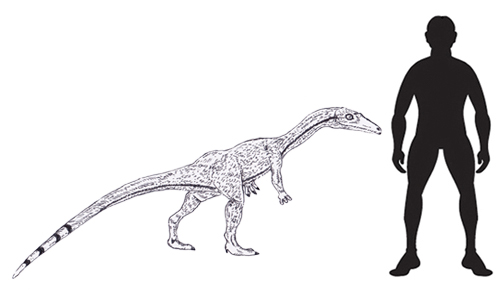
A Scale Drawing of Coelophysis

Coelophysis illustrated. Remembering Edward Drinker Cope.

A scale drawing of the Triassic dinosaur Coelophysis. Remembering Edward Drinker Cope.  Picture credit: Everything Dinosaur.

Picture credit: Everything Dinosaur

For models of Coelophysis (whilst stocks last) take a look here: Wild Safari Prehistoric World Replicas.

Looks like the rivalry between Marsh and Cope will rumble on.  However, Cope’s contribution to science cannot be doubted.  He published more than 1,200 books and papers during his lifetime and contributed greatly to the understanding of vertebrate evolution.

7 04, 2010

If you go down to the woods today – discover a new species of Monitor Lizard

By |2023-03-05T14:22:17+00:00April 7th, 2010|Categories: Animal News Stories, Educational Activities, Main Page|0 Comments

Beware of a new Dragon in the Woods – Varanus bitatawa  a New Species

Finding a new species of vertebrate is a rare event.  Finding a new, large species, an animal that would be described as a member of the “mega fauna” is exceptional, but a new 2-metre-long species of Monitor Lizard (genus Varanus) has just been brought to the attention of western scientists.

The giant lizard resides in the Philippines, in the northern forests of Luzon island.  Luzon island is the largest island that makes up the Philippines and despite having parts of it densely populated (it is one of the most populated islands on Earth), it still has plenty of natural wonders awaiting discovery.

Monitor Lizard

The genus Varanus (Monitor Lizards) contains nearly 30 species, all of which live in the Old World, with species found in Africa, southern Asia, the Philippines and Australia.  The largest lizard in the world today is a Monitor Lizard – the Komodo dragon (V. komodoensis), it too has revealed some surprising discoveries recently, with confirmed evidence that this lizard that can grow up to 3 metres long and weigh 90 kilogrammes has a venomous bite.

Recently, a scientific paper was published suggesting that a genus of dinosaur called Sinornithosaurus may also have been venomous.

To read more about this: Sinornithosaurus – A Dinosaur with Venom.

This new species of monitor, although longer than a man, is actually very lightly built with the largest specimens so far weighing a little more than 10 kilogrammes.  Half the body length of this new species, named Varanus bitatawa is made up of tail.

The animal poses no threat to humans as it appears to be entirely herbivorous.  It has remained undescribed for so long as it is extremely secretive and spends a great deal of time living in trees, where it finds fruit to eat.  This new Monitor Lizard, described by the scientists who found it as “spectacular”, is a very striking animal indeed with bright yellow, blue and green skin.

A Model of the Largest Living Lizard – the Komodo Dragon

Rebor Komodo dragon 1:6 scale replica. A species of monitor lizard.

Rebor GrabNGo Komodo dragon model. Picture credit: Everything Dinosaur.

Picture credit: Everything Dinosaur

The model (above) is the Rebor Komodo dragon replica, to view this figure (whilst stocks last): Rebor Replicas and Prehistoric Animal Figures.

This lizard may be completely new to western science, but to the local tribes people of the forests of northern Luzon, the animal is very well known.  For centuries the locals have hunted it for food, it is reputed to taste extremely pleasant and such animals provide a valuable source of protein for the indigenous people.  We suppose it would be kind of like a version of “corn fed chicken”.  The secretive nature of this lizard may well be a result of hunting pressure with only the most reclusive and shy animals avoiding the attention of the local hunters.  At the same time, this Monitor remained unknown to scientists in the west.

International Research Team

The American, Dutch and Philippines based research team had found plenty of evidence of a large, arboreal lizard.  Many trees had claw marks on the trunk and the native people had talked about a lizard that was good to eat, but until now no documentary proof of this lizard’s existence had been collected.

One of the authors of the paper on this new species, Dr Rafe Brown stated:

“It is an incredible animal”.

The paper has been published in the scientific journal “Biology Letters”.  In the journal, the researchers describe how rare it is to find such a large terrestrial animal new to science.

The new species, which is called Varanus bitatawa, is thought to live almost entirely on fruit, making it one of just three species of fruit-eating Monitor Lizards in the world.  Living as it does in the tree canopy, this large lizard has remained undetected to the eyes of western scientists, despite a number of scientific expeditions to this part of the Philippines to map the diversity of the fauna and flora.

The new species of monitor lives at least 150km away from its nearest relative, another lizard called V. olivaceus, which also lives in trees and eats fruit.

3 04, 2010

Sir David Attenborough Provides Helpful Comments on the Restrictions placed on Children to Learn about Nature

By |2024-04-19T10:28:15+01:00April 3rd, 2010|Categories: Animal News Stories, Dinosaur and Prehistoric Animal News Stories, Educational Activities, Main Page|0 Comments

Sir David Attenborough wants Children to Gain a “Foundation Stone” of Science

The natural curiosity of children with their desire to collect and understand the world around them is being suppressed as the are too many restrictions and laws today.  That is the view expressed by veteran natural history broadcaster and naturalist Sir David Attenborough, who believes that young people are being denied the chance to learn about the world around them because of restrictions on collecting items from the countryside.

Sir David Attenborough

Sir David spoke about his concerns at the launch of a new organisation aiming to promote the teaching of biological sciences – The Society of Biology.  He considers that much of the legislation brought into the UK to protect threatened species and environments has resulted in declining opportunities for young people to collect other non-protected species and so learn about the natural world around them.  Sir David commented on the many restrictions imposed on fossil collectors, those locations where people can freely collect fossils in the UK are becoming fewer and fewer.  The lack of access was stifling the enquiring minds of the next generation of scientists he claimed.

Sir David’s comments are particularly pertinent, what with the granting of the first two injunctions against professional fossil collectors extracting fossils from Dorset cliffs.

To read more about these injunctions: Rogue Fossil Collectors on England’s Jurassic Coast Face Ban.

He stated:

“Children become interested in natural history because they are natural collectors.  It is a pity that it is not possible to allow them to go out and collect any more.  Not to be able to collect a wild flower or fossils is sad.”

Whilst we at Everything Dinosaur accept that the loss of many fossil hunting sites is a great shame, we are also aware of the great damage done to many locations by professional fossil collectors who literally smash up locations in their search for specimens that they can sell.

The Joy and Excitement of Finding that Special Fossil

Finding that special fossil.

The joy and excitement of finding that special fossil. Picture credit: Everything Dinosaur.

When asked about the decline in the public’s ability to identify species of animals in the world around them, Sir David stated that:

“Taxonomy is the foundation stone of the biological sciences.”

He went onto bemoan the lack of opportunities children have to collect and classify insects, animals and other objects saying that:

“It is a great loss to our children that they are prevented legally from collecting animals.”

Helping Children Explore Nature

By allowing children to collect and classify insects, animals and other objects they found around them helped them to learn the skills needed for taxonomy, the science of classifying species.  It is certainly true, that many great scientists such as Napier and Darwin were fascinated from an early age with the natural world and in Victorian England there was a huge fashion for collecting, whether it was ferns and plants or even butterflies and birds eggs.  Putting together vast collections was seen as an appropriate hobby for Victorian gentle folk to indulge in.  Sadly, legislation became increasingly necessary as these natural resources were rapidly exploited and species became endangered.

Today there are a number of laws and voluntary codes in place.  These are designed to protect our natural world, although these restrictions do inhibit the opportunities children may have to learn more about subjects such as botany and biology.

Commenting on the current legislation, Sir David Attenborough said:

“I hope we might be able to shift legislation in a more intelligent and generalised way that will not be so specific.”

We remember the joys of pond dipping, collecting frogspawn and observing the tadpoles metamorphosize into frogs, catching butterflies and watching caterpillars pupate.  Teachers and teaching assistants have a role to play in helping to fire the imaginations of children.  The National Curriculum does empower teachers to develop creative and thoughtful ways of meeting the requirements of the syllabus.  Indeed, teachers and teaching staff along with parents can have a huge influence on the development of an interest in the sciences amongst children.

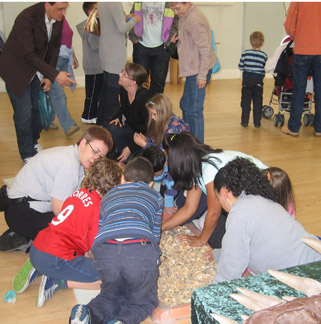
Sadly, when it comes to fossil collecting there are fewer and fewer opportunities to take groups out these days.  We have helped to overcome this problem to some extent by building trays that we fill with sand, gravel and fossils – bringing the joy of fossil hunting to children in those areas where they may not be able to go and experience it for real.

One of the Everything Dinosaur Portable Fossil Beaches in Action

Picture credit: Everything Dinosaur

For educational games and toys visit Everything Dinosaur’s website: Dinosaur Toys and Games.

A spokesperson for Defra (The Department for the Environment, Food and Rural Affairs) said that the legislation was not intended to stop children from exploring or learning about the natural world.

She stated:

 “It is important to protect plants, birds and animals from damage and disruption and to help preserve an important part of our heritage so that we can enjoy the benefits for years to come.  The legislation does not prevent children and adults from exploring and learning about the natural world and we encourage them to enjoy the beauty of the countryside.”

20 03, 2010

Ancient Crocodile Poop Provides Unique Evidence of Deinosuchus Diet

By |2024-04-18T19:00:01+01:00March 20th, 2010|Categories: Animal News Stories, Dinosaur and Prehistoric Animal News Stories, Educational Activities, Main Page|1 Comment

New Study into Fossilised Crocodile Poop Provides Evidence of Deinosuchus Diet

It was not just the tyrannosaurs and raptors that the unwary dinosaur herbivore had to look out for in the Late Cretaceous habitats of the southern and southwestern United States seventy million years ago.  In estuarine environments (where rivers meet the sea), there lurked a monster crocodile called Deinosuchus that would have quite happily tackled a duck-billed dinosaur or pachycephalosaur had one ventured too near.

Deinosuchus

That is the conclusion drawn by a team of U.S. based scientists following a study of ancient crocodile coprolite (fossilised poop).  The coprolite, some of which measures more than 13 cm long, has been assigned to the fearsome Late Cretaceous predator Deinosuchus and evidence from the study of such objects has helped scientists determine the diet of this huge reptile and where it lived.

Deinosuchus (Deinosuchus hatcheri) was a huge, crocodilian that lived in what was North America during the later stages of the Cretaceous period.  Although, no complete skeleton has been found, a number of fragmentary fossils and a nearly complete skull have been discovered.  Scientifically named in 1909, this huge reptile has been estimated to have reached lengths in excess of 10 metres and would have weighed perhaps as much as 2 tonnes.  A recent study has indicated that Deinosuchus (the name means “terrible crocodile”) may actually be  more closely related to modern alligators than crocodiles.

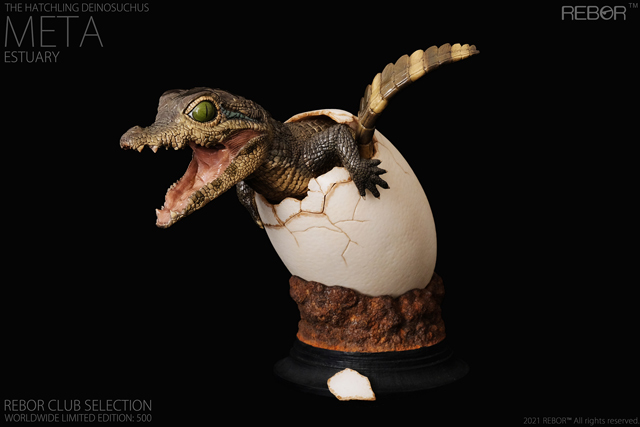
A Replica of a Hatching Deinosuchus

Rebor Meta the hatchling Deinosuchus model (Estuary Variant0

The Rebor Club Selection: Meta the hatchling Deinosuchus is about to leave its egg! It’s very keen to get to the safety of the water.

Picture credit: Everything Dinosaur

The picture (above) shows the Rebor limited-edition hatching Deinosuchus (Esturary variant).

To view the range of Rebor figures and models: Rebor Prehistoric Animal Figures.

Estimating the Size of Deinosuchus

It is difficult to provide an accurate estimate of the size of this particular ancient crocodile in the absence of more complete skeletal material.  Using ratio measurements of skull length compared to body size of modern crocodiles as a guide, an estimated size of between 10-12 metres can be obtained.

Professor David Schwimmer of Columbus State University and one of his students of palaeontology, Samantha Harrell; carried out a detailed analysis of the fossilised crocodile dung and bones that showed bite marks from crocodilians.  They have concluded that this fearsome beast preferred to live in shallow, estuarine environments and preyed mainly on sea turtles but would have also been capable of taking down a dinosaur or two.

Palaeontologist Professor Schwimmer (no relation to the actor who played Ross the palaeontologist in “Friends”) stated:

“We’re sure [Deinosuchus] ate a lot of sea turtles, but it’s evident it liked to prey on dinosaurs too.”

Professor Schwimmer and Harrell gave a combined presentation on the bite marks and the coprolites, at the March 13-16 Geological Society of America Northeastern/South-eastern annual meeting in Baltimore.  Additionally, the coprolite study is being published as “Coprolites of Deinosuchus and other Crocodylians from the Upper Cretaceous of Western Georgia, USA” in a special symposium volume of the New Mexico Museum of Natural History and Science Bulletin.

Bite Marks on Dinosaur Bones

The studies detail how bite marks on dinosaur bones discovered in various locations around the United States, and large fossilised dung droppings discovered near Columbus, Georgia (southern USA), have been linked to Deinosuchus.

The dung fossils are the first such documented samples from the Deinosuchus and help confirm that this giant, prehistoric crocodile preferred living in the marine shallows. Meanwhile, the separate bite mark findings reveal aspects of the creature’s eating habits.

In the spring of 2009, Professor Schwimmer asked Harrell to take command of a project as an independent study course to gather and analyse fossilised dung he had started to recover from a fossil hot spot along the banks of the Hannahatchee Creek in Stewart County, a major tributary of the Chattahoochee River, south of where the Piedmont meets the Coastal Plain.

Harrell explained coprolites are studied in order to convey information about the lifestyles of the dead and buried.  She discovered sand and lots of shell fragments, signifying that these crocodiles lived in a shallow, brackish, warm-water environment — likely near the mouth of a river where it opened to a sea with a sandy shoreline and an abundance of sea turtles for its diet.

Although it is difficult to be absolutely precise when assigning fossilised dung to a particular genus, in this case the size, shape and nature of the dung studied  does indicate a large crocodile and Deinosuchus is the only known genus of crocodile from this strata.

To view models of prehistoric crocodiles: Wild Safari Prehistoric World Models and Figures.

18 03, 2010

Worm Wiggles its Way to Pre-eminence

By |2023-01-03T09:17:09+00:00March 18th, 2010|Categories: Animal News Stories, Dinosaur and Prehistoric Animal News Stories, Educational Activities, Main Page|0 Comments

Canadian Worm Wiggles its Way to Pre-eminence

In the warm waters surrounding the Cambrian continent of Laurentia lived an array of bizarre creatures, early arthropods, brachiopods and our ancient vertebrate ancestors.  The Annelida (worms) were very well represented with a number of different families of segmented worms.  These survivors from the Precambrian continued to diversify and flourish and if you want to find the fossilised remains of a prehistoric worm, look no further than your average Canadian construction site.  That is exactly what one Canadian amateur fossil collector called “James” did, and he inadvertently helped the Royal Ottawa Museum (ROM) discover a fossil of a 480 million-year-old armoured worm.

The extremely rare fossil of an armoured worm, a fossil that predates the emergence of the dinosaurs by some 250 million years was found when a local fossil collector examined the spoil coming from the excavation of an underground car park for the World Exchange Plaza, a set of buildings that can be found in downtown Ottawa (Ontario State, Canada).  However, it was not until a similar find was made in Morocco that scientists from the ROM realised the significance of the fossil found on the construction site ten years earlier.

Armoured Worm

Lead author Jakob Vinther and colleague David Rudkin have published a detailed description of this fossil in January’s edition of the scientific journal “Palaeontology”.  This tiny fossil, (measuring 16 mm long), about the size of an adult man’s little finger nail represents the organism Plumulites canadensis, a member of the Machaeridian family.  The significance of the Canadian fossil was not recognised until similar material was recovered from ancient marine deposits found in North Africa.

In 1998, the local fossil fan, known as “James” approached the ROM and handed the bizarre fossil to museum staff.  It was not until the Moroccan material was discovered that researchers realised the importance of this ancient object.  Unfortunately, the original donor of the fossil cannot be traced.

This fossil and other recently discovered material helps to cement the evolutionary link between the ancient Machaeridia and Annelid worms.

Commenting on how rare this example was, Vinther stated:

“They are really hard to find complete, fewer than ten of these fossils are known to exist.  We just had these skeletons and we didn’t know what kind of animal was underneath these plates.  We didn’t even know that they were worms, actually.”

Pictures show the bizarre fossil found in the spoil of a Canadian construction site.  It superficially resembles the much larger Vendian organism Dickinsonia and seems to have a segmented body that has a mid-line of symmetry.  This creature probably lived on or in the sea floor.  It would have been a member of the epifauna.  Essentially vagrant it would have roamed around the soft sea bed on thin, spindly legs that emerged in parallel out of key body segments.  The strange carapace of bony plates that protected this creature was made from calcite.  It would have provided some protection against marauding cephalopods or arthropods.

The emergence of hard body parts, items such as shells and an exoskeleton is evidence of the “Cambrian Explosion” a period when life in the sea diversified rapidly and the first complex predator/prey relationships were established.

Body Armour

Commenting on the body armour of this creature, Yale University graduate, Vinther added:

“A number of animals started evolving a higher level of protection in this period of time.  These annelid worms, they did the same thing … that seems to correlate well with the appearance of cephalopods.”

The Machaeridia persisted for some 200 million years, finally going extinct towards the end of the Palaeozoic, but their ancestors are very much with us today and perform a number of essential roles in both marine and terrestrial eco-systems.

Strange Cambrian Fauna

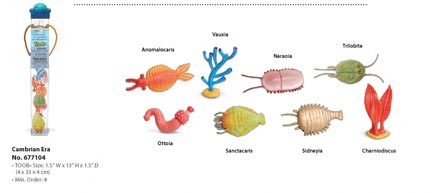
Cambrian Toob by Safari Ltd

Say hello to Cambrian wildlife.  Strange Cambrian fauna.

The picture (above) shows the Cambrian Toob by Safari Ltd a model set that highights the bizarre nature of Cambrian fauna.

Allan Donaldson, a retired Carleton University Professor of Geology, participated in an authorised dig at the construction site of the World Exchange Plaza.  He said he found the routine trilobites and shelled orthocones, but nothing spectacular like the Machaeridia this amateur found in the material removed from the spot.

“Good for him” Donaldson acknowledged.

It is hoped that all the publicity over this worm fossil will reach the ears of the local man who actually found this ancient relic of Late Cambrian marine life and he can come forward to take some of the credit for the discovery of the worm from pre-history.

5 03, 2010

The Red Headed League Research into the Colour of Dinosaurs

By |2024-04-19T09:48:59+01:00March 5th, 2010|Categories: Dinosaur Fans, Educational Activities, Everything Dinosaur News and Updates, Main Page|0 Comments

Red Colouration in Predatory Dinosaurs

Team members at Everything Dinosaur explore the idea that there was red colouration in predatory dinosaurs.

Evidence suggests that dinosaurs had good colour vision, studies of brain cases can provide an indication of the volume of the brain and analysis of the preserved holes in the skull that carried the nerves back and forth can suggest which senses were important.  For example, with Tyrannosaurus rex the orbits in the skull (eye sockets) were large compared proportionately with other reptiles, birds and mammals.  Some scientists have postulated that the big tyrannosaurs had the largest eyes of any land animal.  The optic nerve of T. rex has been estimated to be more than 2 cm in diameter, indicating that a lot of information was being passed from the eyes to the brain.

Red Colouration

Crocodiles and birds have colour vision, indeed some birds, most notably the raptors have exceptional eyesight – hence the phrase “eyes like a hawk”.  Recent discoveries have shown that many dinosaurs may have been brightly coloured, so colours of plumage and scales may have been very important to the Dinosauria.  A recent paper, published on behalf of a group of British and Chinese scientists even suggested that some small, theropod dinosaurs were ginger coloured.

To read more about “ginger” dinosaurs: Melanosomes Provide Further Proof of Feathered Dinosaurs.

With the theory that dinosaurs had good colour vision; model makers and manufacturers can go to town with the colours and patterns they put onto their various dinosaur replicas and toys.  Just like animals today, many dinosaurs would have been camouflaged or patterned in a particular way, natural selection favouring those creatures that were best adapted to their environments.  Other dinosaurs may have used colour to communicate with other members of their species or to threaten or intimidate predators and prey.

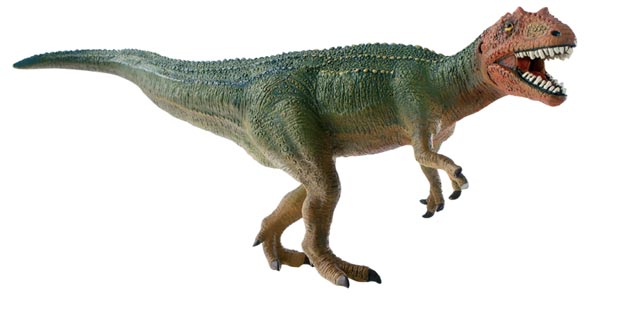
An example, of a novel use of colour can be seen in the new scale model of the fearsome meat-eater Giganotosaurus by Bullyland of Germany.  This hand-painted 1:30 scale model is painted a mixture of dark green and mustard on the tail, the back and the flanks, but the head and the throat has been depicted in a contrasting, bright red pigment.

The Giganotosaurus Model from Bullyland of Germany

Picture credit: Everything Dinosaur

To view the Bullyland range of prehistoric animal figures: Bullyland Dinosaur and Prehistoric Animal Models.

Bullyland Giganotosaurus

This is a large model, of a large carnivorous dinosaur.  Indeed, based on the fossil evidence, Giganotosaurus may be one of the largest meat-eating dinosaurs of all time.  Fossils excavated from Patagonia in Argentina (remarkably 70% of an adult skeleton is known), indicate that these animals may have reached lengths in excess of 50 feet.  The bright red head is very striking when compared to the rest of the body and at first glance this looks like an unusual choice of colouration for a model of an apex predator, especially when considered in context with other data known about Giganotosaurus.

Studies have shown that the ratio of the thigh bone to the lower leg bones indicate that this dinosaur was not a particularly fast runner.  It probably specialised in hunting the large long-necked, slow moving titanosaurs.

But why the red head?  There has been a lot of controversy over whether large theropod dinosaurs were hunters or mainly scavengers.  The American palaeontologist John “Jack” Horner has championed the hypothesis that these large creatures were primarily scavengers.  The hunter versus scavenger debate continues today, with advocates citing evidence from both extinct and extant creatures to support their point of view.  In all likelihood, a large carnivore such as T. rex or Giganotosaurus would not turn down the opportunity of a free meal if it came across a carcase.  So it is quite likely that these animals were opportunist scavengers to some extent.

Those predators that could chase off other carnivores and steal their kills would have a distinct advantage.  This behaviour is seen in Africa today, with, for example hyenas chasing off lions and robbing them of their hunting spoils.  A big theropod, with a strikingly marked head appearing on the scene could intimidate other predators and scare them away from their meal.

Hence the reason for the bright markings on the head of the Giganotosaurus model.  Smaller allosaurs confronted with a large 40 foot plus predator roaring, and flashing its large teeth in its huge jaws with some vigorous head bobbing would have probably been enough to see off even the most determined and hungry dinosaur.

23 02, 2010

Unique Dwarf Dinosaurs on Dinosaur Island

By |2024-04-19T07:19:49+01:00February 23rd, 2010|Categories: Dinosaur and Prehistoric Animal News Stories, Dinosaur Fans, Educational Activities, Main Page|0 Comments

Evidence of Dwarfism in Late Cretaceous Dinosaurs that lived on an Island

Fossils of dwarf dinosaurs found in deposits associated with the Hateg Formation suggest that on an ancient Cretaceous archipelago, diminutive dinosaurs roamed.

The Hungarian scientist Franz Nopcsa, proposed a theory that if animals are marooned on an island, the limited resources would have a fundamental effect on the animal population over generations.  Large animals would have a tendency to become smaller over time, eventually evolving into distinct species from their mainland ancestors.  This rule, seen in many extant island species today, also rings true for those creatures known only from the fossil record.  In a new paper, published by a team of scientists, it seems that dinosaurs trapped on islands with limited resources also evolved into dwarf forms.

“Insular Theory”

Nopsca called his theory the “insular theory”, it is perhaps more commonly known as the “island rule”.  Animals having to cope with environments where resources are limited either adapt or become extinct.  One of the ways in which animals adapt is to become smaller and smaller over subsequent generations.  Many thousands of years ago, dwarf species of elephant lived on some of the islands of the Mediterranean.  These animals had been cut off from their African homeland as sea levels rose.  Many of these types of elephants evolved into dwarf forms as a result of their isolation.

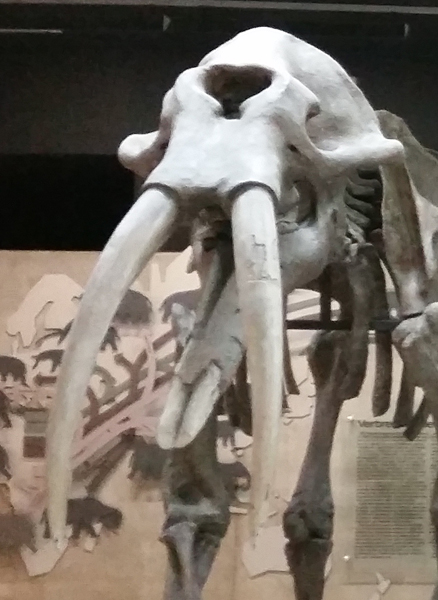
The finding of the fossilised skulls of these long dead elephants by human settlers gave rise to the cyclops myth.  The nasal area of the skull rots away leaving a hole in the centre of the forehead.  This was mistaken by Greek settlers to those Mediterranean islands where elephant populations had existed, as being a single eye socket.  Hence the myth of the one-eyed, giant cyclops arose.

Is This How the Cyclops Legend Arose?

Proboscidian skull.

When viewed from the front the idea of a one-eyed man (cyclops) can be postulated. Picture credit: Everything Dinosaur.

Picture credit: Everything Dinosaur

Ironically, Franz Nopcsa’s family owned estates in part of Romania and it is from the study of the ancient Cretaceous fauna from this part of Romania known as Hateg Island that indicates that Nopcsa’s “island rule” applies also to Dinosauria.  The concept of diminutive dinosaurs on Hateg Island was put forward by Nopcsa and this new research into the fossils found in that region shows that he may well have been right.

Professor Mike Benton (University of Bristol) and six other researchers from Romania, Germany and the United States have published a paper on-line detailing their studies of the fossil bones found in the Upper Cretaceous strata of the region.  Thanks to earlier work, the dinosaurs of this part of eastern Europe are very well documented and a number of species and genera are known.  What is surprising is how small many of these animals seemed to be.

For example, the titanosaur, Magyarosaurus one of the largest animals known from this region measured only six metres long, making it one of the smallest titanosaurs in the fossil record.  Many dinosaur remains indicate that in the Hateg area dinosaurs were in many cases less than half the size of their close relatives found in slightly older strata in northern Europe.

The team of scientists examined the fossilised bones of a number of types of dinosaur from the Hateg Island region, theropods, ornithopods and of course titanosaurs.  They have concluded that the Hateg Island dinosaurs were indeed dwarfs and not just young dinosaurs whose remains have been preserved with no adult animal material present.

The “Island Rule”

It seems that based on this study, the “island rule” also appears to apply to dinosaurs.  The Hateg Island area is assumed to have been a series of small islands that were formed as sea levels rose at the end of the Cretaceous.  Although, some geologists question the evidence for this part of the world being a series of small islands, a sort of archipelago island chain, at the end of the Cretaceous, island habitats with their limited resources would provide some explanation for the dwarfism seen in the dinosaur fossils.

A close study of the fossils confirmed that the dinosaurs had reached adulthood so they were not just underdeveloped youngsters who had died young and been preserved as fossils.

Detailed studies by Martin Sander in Bonn and his students also show that the bone histology (the microscopic structure) is adult, meaning that at six metres long; that was about as big as a Magyarosaurus could expect to grow to, whilst other types of titanosaur could grow to lengths in excess of 20 metres.

These well-studied examples suggest dwarfing can happen quite quickly, the team believes.

Professor Benton, said:

”The general idea is that larger animals that find themselves isolated on an island either become extinct because there is not enough space for a reasonably-sized population to survive, or they adapt.  One way to adapt is to become smaller, generation by generation.”

The Hateg dinosaurs date from close to the end of the Cretaceous period, some 65-70 million years ago, when much of Europe was flooded by rising sea levels.  The largest island is this ancient island group, may have been just a few thousand kilometres square, providing the environmental driving force to induce dwarfism in the larger types of animals on the islands.   It is not known whether the dinosaurs and the other fauna was marooned as sea levels rose, or whether they swam or drifted to the islands by chance later on.

As Professor Benton added:

”Either way, this research demonstrates that once they arrived they evolved to become dwarfs.”

The island of Isla Sorna, the small, second island used by the creators of the Jurassic Park dinosaur land in the movie of the same name, may have been a work of fiction, but this new paper indicates that small islands in the past did support populations of dinosaurs albeit dwarf species compared to their mainland cousins.

Everything Dinosaur stocks models of various prehistoric animals, fossils of which are associated with the Hateg Formation: Dinosaur and Prehistoric Animal Models.

Not all animals from the Hateg islands were small, recently evidence has been found of a gigantic pterosaur, large enough to rival the biggest of the azhdarchids in strata from this area.  The genus has been named Hatzegopteryx and although the description is based on fragmentary fossil evidence, some scientists have claimed this pterosaur would have had a wingspan in excess of 12 metres.

16 02, 2010

Fossil Fun for all the Family with the BGS and Rockwatch

By |2023-03-04T22:27:50+00:00February 16th, 2010|Categories: Dinosaur Fans, Educational Activities, Geology, Main Page|0 Comments

British Geological Survey and Rockwatch Fossil Fun Event

With the annual National Science week rapidly approaching (from 12th to 21st March), team members at Everything Dinosaur are busy preparing for all the activities they have planned.  This years theme is “Earth” and ties into the International Year of Biodiversity and there are lots of events planned around the country.

Fossil Fun Day

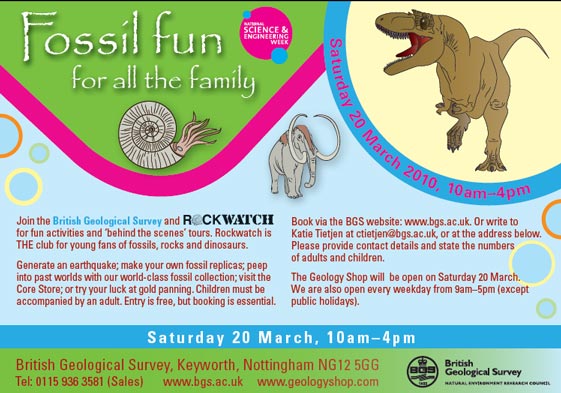
For example, the British Geological Survey (BGS) and Rockwatch (the club for young fossil fans and junior geologists) is holding a special family fossil fun day on Saturday March 20th.

The BGS and Rockwatch Family Fossil Day

Picture credit: BGS

Numbers are limited for this fun day out, so best to book early to avoid disappointment.  The event is taking place at the BGS premises at Keyworth, Nottingham on Saturday 20th and the event opens at 10am.

To book visit write to Katie Tietjen at the address at the bottom of the advert.

Here is your chance to peep into prehistory with the BGS fossil collection, see how earthquakes happen and to pan for gold.  Entry is free and young children must be accompanied by an adult (after all, why should the kids have all the fun), best to book early to avoid missing out.

Everything Dinosaur

Team members at Everything Dinosaur wish the event organisers every success.

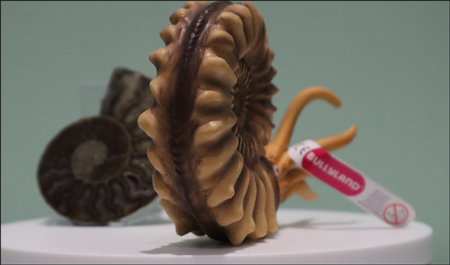
Ammonites and Ammonite Fossils at the Fossil Fun Day

Ammonite model next to a fossil specimen.

The strongly ribbed shell and the obvious keel of the ammonite replica.  Look out for lots of ammonite activities at the fossil fun day.  Picture credit: Everything Dinosaur.

Picture credit: Everything Dinosaur

Everything Dinosaur supplies replicas of iconic animals from the fossil record including ammonites, to see the range: Replicas of Important Fossil Animals.

9 02, 2010

The Famous Lizard from Edmonton – Edmontosaurus

By |2024-04-19T09:33:03+01:00February 9th, 2010|Categories: Dinosaur Fans, Educational Activities, Main Page|0 Comments

The Lizard from Edmonton – Edmontosaurus

A few days ago, team members at Everything Dinosaur received an email from a young dinosaur fan, asking how Edmontosaurus got its name.  This ornithopod, a member of the Hadrosauridae family, (duck-billed dinosaur), was named and described by the Canadian palaeontologist Lawrence Lambe in 1917.  Lambe was responsible for the study of a number of North American dinosaurs that were discovered in the early years of the 20th century.  Fossils of this particular dinosaur genus have been found in Alberta (Canada) and the United States (Montana and Wyoming).

The Lizard from Edmonton

Edmontosaurus was one of the last of the duck-billed dinosaurs, living at the very end of the Cretaceous (70 – 66 million years ago) – Maastrichtian faunal stage.

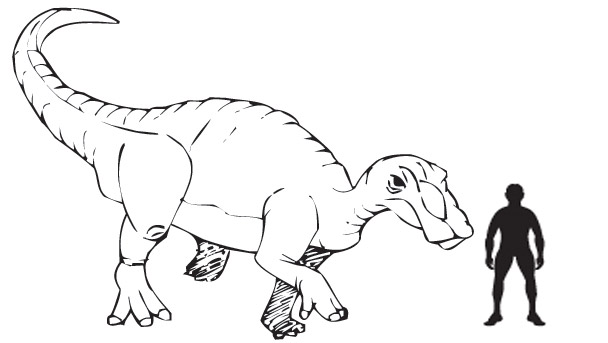
An Illustration of Edmontosaurus (Edmontosaurus regalis)

Picture credit: Everything Dinosaur

Edmontosaurus is known from many fossilised skeletons.  It must have been one of the most abundant of the large, herbivorous dinosaurs at the end of the Cretaceous and a number of species have been ascribed to this genus.  These large animals that could grow to lengths of 13 metres and weigh as much as 4 tonnes, were the prey of the large tyrannosaurs.  A number of fossilised skeletons show signs of attacks from predators, including one specimen with a chunk bitten out of its tail.  This flat-headed hadrosaur was not named after the Canadian city of Edmonton, although fossils assoiciated with this genus are known from Edmonton and its suburbs.

Edmontosaurus was named after the “Edmonton” Formation, the rock unit in which it was first found.  The “Edmonton” Formation has subsequently been elevated to “Group” status by geologists and consists of four geological formations namely, (oldest first) Horseshoe Canyon, Whitemud, Battle and the Scollard Formation which contains evidence to make the Cretaceous-Palaeogene boundary.  Edmontosaurus fossils (E. regalis) are associated with the Horseshoe Canyon Formation.

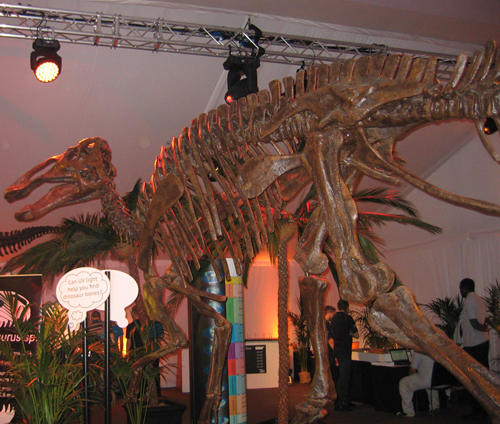
An Edmontosaurus Skeleton on Display

Edmontosaurus skeleton.

Duck-billed dinosaur on display. Picture credit: Everything Dinosaur.

Edmontosaurus

To view models of Edmontosaurus and other duck-billed dinosaurs, we suggest you take a look at the scale models in the CollectA Deluxe range: CollectA Deluxe Prehistoric Life Models.

Go to Top