All about dinosaurs, fossils and prehistoric animals by Everything Dinosaur team members.

Everything Dinosaur’s work with schools and other educational bodies. Articles, features and stories about dinosaurs and their role in education and educating young people.

5 06, 2010

Lack of Burps from Megafauna Helped Cause Global Cooling

By |2023-03-06T07:12:49+00:00June 5th, 2010|Categories: Dinosaur and Prehistoric Animal News Stories, Educational Activities, Geology, Main Page|0 Comments

Calls for the Start of the Holocene to be put Back 2,000 Years due to Lack of Mammoth Belches

American Scientists have linked the extinction of mammalian megafauna by humans to the loss of methane from the atmosphere which in turn led to a global cooling event.  In a paper published in the scientific journal “Nature Geoscience” a team of scientists from the University of New Mexico have put forward a theory that the killing off of a number of large mammal species by humans led to the removal of a substantial amount of methane from the atmosphere.  This brought on a period of substantial cooling that severely affected temperatures in the Northern Hemisphere.

This cooling period is known as the Younger Dryas and scientists claim that this event was brought on when the extinction of the mega fauna led to the loss of their planet warming burps.

Mammalian Megafauna

Studies of ice cores indicate that the Younger Dryas event began about a thousand years after mass human migrations into the Americas from across the Bering Strait land bridge that linked Siberia to Alaska.  With mass human migrations into the Americas this put pressure on the populations of giant herbivores such as Mammoths, Mastodons and ancient camels as these animals were hunted by the human migrants.  With the extinction of these animals, the atmosphere would have lost the methane they contribute caused by the process of digestion of tough plant material.

The scientists postulate that the loss of these methane producing animals contributed to the cooling event known as the Younger Dryas which saw temperature drops in parts of the Northern Hemisphere ranging from 4 degrees to 8 degrees Celsius.

According to ice core studies, the Younger Dryas event began about a thousand years after mass human migrations into the Americas 13,400 years ago, near the end of the last ice age.  Within a thousand years of the human migrations more than 114 species of large plant-eaters became extinct and the study links the loss of the methane these animals would have produced with the cooling event.  Methane is a powerful greenhouse gas, twenty times more effective than carbon dioxide when it comes to trapping heat in the Earth’s atmosphere and contributing to global warming.

As they digest plant material, large herbivores give off the gas, which, contrary to popular belief, escapes via the head in the form of burps and belches.

Could the Extinction of Mega Fauna Helped Cause Global Cooling?
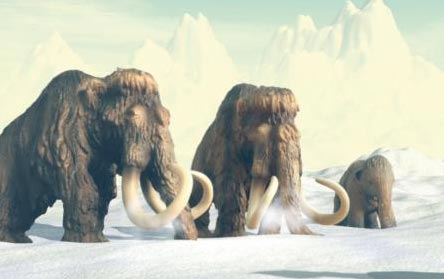
Woolly Mammoths. An Ice Age scene. What caused the extinction of the mammalian megafauna?

Extinction of the mammalian megafauna.

Picture credit: Schleich of Germany

Could the extinction of mega fauna such as the Woolly Mammoth (M. primigenius) have led to a change in the Earth’s climate?

To view a range of prehistoric mammal soft toys and dinosaur stuffed animals: Prehistoric Animal Soft Toys.

Study leader Felisa Smith of the University of New Mexico, stated that the methane was not released as these animals broke wind:

“Eighty to ninety percent of methane produced is in the form of a burp.”

At the onset of the Younger Dryas cooling event, atmospheric methane concentrations dropped two to four times faster than at any other period in our planet’s history according to the ice core studies.  The fall was caused by all those missing methane burps that would have been produced by the herbivores.

Felisa Smith added:

“We estimate that just under ten teragrams [about ten million tons] of methane would have gone missing when these animals went extinct.”

Ice Age Atmospheric Conditions

As Ice Age atmospheric methane concentrations were about one third of what they are now, the missing emissions would have had a magnified impact, accounting for at least 12 to 15 percent of the methane reduction the researchers claim.

Traditionally geologists have said humans are now living in the Holocene epoch, which began 11,500 years ago.  Smith and her team are among scientists who argue that Earth has entered a new age, characterised by widespread, human-wrought change, the Anthropocene.  Other scientists have claimed the onset of the industrial revolution in the 18th Century should mark the dawn of a new geological age, highlighting the profound effect mankind has had on the Earth’s climate.  However, if it is assumed that humans were responsible for the Ice Age die-offs, the advent of the Anthropocene should be pushed back to 13,400 years ago, into the Ice Age, the study authors say.

Felisa Smith commented:

“Any way you spin it, humans had a discernible effect on the environment prior to the beginning of the Holocene.”
2 06, 2010

Rare South African “Cradle Hominid” Fossil Given a Name

By |2024-04-19T10:21:29+01:00June 2nd, 2010|Categories: Dinosaur and Prehistoric Animal News Stories, Educational Activities, Main Page|0 Comments

Australopithecus sediba – Ancient Hominid Fossil Named by South African Student

A name suggested by a seventeen-year old student at St Mary’s school in Waverley, Johannesburg (South Africa), has been chosen by a team of scientists as the official “nick-name” of a 1.95-million-year-old hominid fossil.  Many palaeontologists give names to the specimens that they are working on, whether it be a prehistoric animal, a dinosaur or even a fossil of an ancient hominid.

There is no precedence for doing this as far as we at Everything Dinosaur understand, however, having worked long hours on an individual specimen we can recognise the feeling of attachment that this brings.  Also, when referring to the specimen, it is all very well to use the official specimen nomenclature in literature, but nick-names are so much easier to comprehend when having a conversation.

For example, the Tyrannosaurus rex museum specimen TMP 81.6.1was nick-named “Black Beauty” due to the jet-black colour of the bones, a result of manganese deposited by the surrounding groundwater.

The recently discovered hominid skeleton, representing a new species of Australopithecine (Australopithecus sediba) was given the name “Karabo” in an announcement made yesterday (June 1st), during the seventh annual Standard Bank Past (Palaeontological Science Trust) key lecture by Professor Lee Berger.

Hominid Fossil

It was Professor Berger’s young son, Matthew who made the discovery of this important fossil, appropriate as Matthew was nine at the time and the fossil remains have been identified as being from a 9-13 year-old male.  The fossils were found at a site in Gauteng Province (South Africa), known as the “Cradle of Humankind”.  The site has twelve or so limestone caves that have preserved the remains of ancient animals, plants and perhaps, most importantly of all – ancient hominids.

The name “Karabo”, which means “answer” in a native South African dialect was submitted by 17-year old St Mary’s pupil, Omphemetse Keepile.  It beat more than 15,000 other entries, submitted by students and pupils from schools, colleges and universities from all over South Africa.

A second partial skeleton of Australopithecus sediba has been found, this time scientists believe the bones are from an adult female.

Visit Everything Dinosaur’s award-winning website for models and replicas of ancient hominids: Everything Dinosaur.

26 05, 2010

Ichthyosaur Turns up in School Vegetable Patch

By |2023-01-07T10:24:01+00:00May 26th, 2010|Categories: Dinosaur and Prehistoric Animal News Stories, Educational Activities, Main Page|0 Comments

Ichthyosaur Fossils Found in School Vegetable Patch

Many schools have set aside a small area of their grounds to act as a vegetable garden so that the pupils can have a go at growing their own fruit and vegetables.  Such a plot of land can permit teachers and teaching assistants to carry out all sorts of lesson extensions and these activities could inspire and encourage the next generation of gardeners.  However, for one school in Queensland (Australia), the digging of some post holes in their vegetable patch revealed the bones of an ancient marine reptile, not the sort of thing that schools encounter everyday.

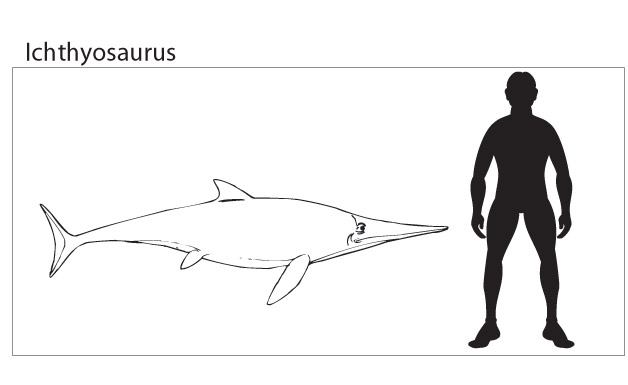
Ichthyosaurus

Year 10 student Raymond Hodgson and groundsman Ben Smith were digging corner posts for a vegetable garden at the Richmond State School, in western Queensland, when they made the find.  This part of Queensland is known as the “dinosaur trail” as a number of important dinosaur and marine reptile fossil discoveries have been found in this area in recent years.  During the middle part of the Cretaceous, this part of what was to become Australia was covered by a warm, tropical sea that teemed with life including giant marine reptiles such as ichthyosaurs (fish lizards) and pliosaurs such as the giant predator Kronosaurus.

At first the student and the groundsman thought the hard lumps in the dirt were rocks but luckily Ben recognised them as bits of fossilised bone.

Paul Stumkat, the curator of local fossil museum Kronosaurus Korner, named after the huge pliosaur whose fossils have been found in this part of Queensland, commented that the vegetable plot diggers had unearthed the fossilised vertebrae from an ichthyosaur, a marine reptile that looked like a cross between a dolphin and a shark.

A Scale Drawing of the Marine Reptile Ichthyosaurus

Ichthyosaurus

A typical “dolphin-like” Ichthyosaur.

Picture credit: Everything Dinosaur

To view more details of a model Ichthyosaurus and dinosaur toys: CollectA Age of Dinosaurs Prehistoric Life Models.

Mr Stumkat said both men were pretty excited about the discovery.  He added:

“You never think about finding something like that when you’re digging your vegie garden do you?”

Mr Stumkat said the giant reptiles once ruled the inland sea that covered Richmond and were present in such prolific numbers they could be compared to the bison which dotted the grass plains of North America.

“They were just everywhere.  They were an incredibly successful group of marine reptiles that existed from the end of the Jurassic through to the Early Cretaceous.”

The vertebrae of ichthyosaurs are the backbones and tail bones of this marine reptile.  Ichthyosaur vertebrae are typically circular and dished in the centre (on both sides).

Mr Stumkat said ichthyosaurs ate other sea creatures such as squid and fish.  He commented:

“We have amazing fossils up here that show teeth marks probably from ichthyosaurs as well.  We’ve got a lovely fish head here on display that has a big bite mark on the side of its head which seems to line up with something like the teeth of an ichthyosaur.”

Situated in what was the Cretaceous Inland Sea, the outback town is now the site of many significant fossil finds, including dinosaurs and giant marine reptiles.

The latest specimen is currently being prepared by Mr Stumkat and will eventually go on display at the school.  However, Mr Stumkat says the find has not stopped work on the school’s new vegetable garden, although the school children and staff have altered the way in which they work on the plot.

“They’re digging much more carefully now just in case they hit any more interesting rocks,” added Paul.

25 05, 2010

“Clumped Isotopes” May Answer Important Question of Whether or Not Dinosaurs were Endothermic

By |2024-04-19T10:14:09+01:00May 25th, 2010|Categories: Dinosaur and Prehistoric Animal News Stories, Educational Activities, Main Page, Palaeontological articles|0 Comments

Warm-blooded or Cold-Blooded Dinosaurs – “Clumped Isotopes” May Reveal the Answer

One of the key questions regarding Dinosauria and other extinct reptiles of the Mesozoic puzzled over by scientists almost since the first dinosaur fossils were scientifically studied; is whether or not these ancient creatures were warm-blooded (endothermic).  A team of U.S. based researchers have come up with a new technique that could help scientists answer this question once and for all.  The researchers have introduced the first scientific procedure to directly measure the body temperatures of extinct vertebrates and help establish the temperatures of prehistoric environments.

Clumped Isotopes

The study, a combined effort by researchers from five institutions including the University of Florida, has been published in the online scientific journal “The Proceedings of the National Academy of Sciences”.

The published report explains how the team have developed a method of using carbon and oxygen isotopes from fossils to more accurately determine whether extinct animals were endothermic (warm-blooded) or ectothermic (cold-blooded).  This new procedure will also help researchers to better estimate the temperature ranges in the environment when these animals lived.

Co-study author Richard Hulbert, a vertebrate palaeontologist at the Florida Museum of Natural History on the University of Florida campus explained:

“Without a time machine, it has previously been impossible to directly take the temperature of extinct animals such as dinosaurs and megalodon sharks.  The method described in the study has been shown to work with 12-million-year-old fossils from Florida and the next step is to look at even older fossils.  For example, we have no teeth of Titanoboa, the largest snake ever discovered, but we could use 60-million-year-old crocodylian teeth from the same deposit to find out more about the snake’s environment.”

Titanoboa is the largest known snake in the fossil record.  With an estimated length in excess of 15 metres this constrictor type snake of the Palaeocene would have been at least 1.5 times the size of the largest extant species known today.

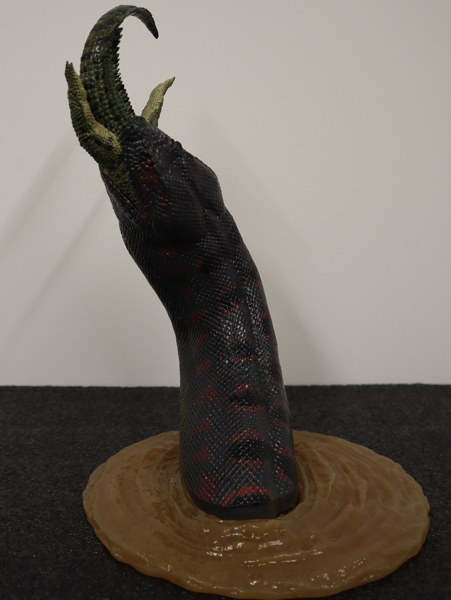
A Museum Quality Replica of Titanoboa Swallowing a Crocodilian

Rebor Titanoboa Museum Class Maquette Brian Diccus prehistoric animal model.

The assembled Rebor Titanoboa Museum Class Maquette Brian Diccus prehistoric animal model.

Picture credit: Everything Dinosaur

Rebor has created a range of scale model figures including wonderful, museum-quality replicas of the giant prehistoric snake Titanoboa.

To view the Rebor range: Rebor Prehistoric Animal Scale Models.

The fossils of this colossal snake were found in an open cast mine in north eastern Columbia.  To read more about the discovery of Titanoboa fossils: Titanoboa – Giant Snake of the Palaeocene.

The new “clumped-isotope” paleothermometer method used in the study analyses two rare heavy isotopes, carbon-13 and oxygen-18, found in tooth enamel, bones and eggshells.  Lead author and California Institute of Technology postdoctoral scholar Robert Eagle, commented:

“Clumping is temperature dependent, so at low temperatures you get more clumping together in a mineral while high temperatures mean less clumping.  If you can measure the clumping accurately enough, you can work out the temperature at which a mineral formed.  In the case of teeth and bone, this will be the body temperature of the organism.”

The use of oxygen isotopes (or at least the ratio of isotopes present) to establish ancient climatic conditions is not new.  The measurement of oxygen-16 isotope and its relationship to the heavier oxygen-18 isotope has been used by researchers to calculate temperature differences between glacial and interglacial periods.  However, this is the first time such a methodology has been used to calculate temperatures of long extinct animals such as dinosaurs.

An isotope is an atom of an element whose nucleus contains the same number of positively charged particles (called protons) as the “parent” element, but a different number of neutral particles (called neutrons).  Oxygen is present in water molecules as two isotopes – oxygen-16 and oxygen-18.  Oxygen-16 is the lighter of these two isotopes and evaporates more quickly.  During an Ice Age or glacial period, oxygen-16 enriched water vapour falls as ice and snow, depleting the ocean of this isotope and enriching it with a higher concentration of oxygen-18.

Studying Foraminiferans

Some marine organisms such as microscopic, single-celled, commonly occurring organisms called foraminiferans secrete calcium carbonate exoskeletons derived from sea water.  The oxygen content of these shells reflects the ratio of oxygen-16 to oxygen-18 isotopes in the water at the time the shell was constructed.  This ratio can also provide scientists with an indication of the sea temperature at the time.  Once a scientist has calculated the ratio of the two oxygen isotopes found in a fossilised foraminiferans, he (or she), will be able to estimate the oxygen composition of the sea water and deduce the likely climatic conditions at the time the shell was formed.

The researchers first tested the method on modern species: the white rhinoceros, Indian elephant, Nile crocodile, American alligator and sand tiger shark.  The study confirmed the rhinoceros and elephant, like all mammals, are warm-blooded, and their tooth enamel forms at about 37 degrees Celsius.  Researchers confirmed the accuracy within 2 degrees Celsius by measuring teeth of modern sharks from temperature-controlled aquariums.

In the next stage of the study, researchers tested fossils of mammoths and older extinct Florida alligator and rhinoceros species.

Robert Eagle added:“The method we present is a big advance because it allows a direct measurement of the body temperature of extinct species, free from the assumptions required with other approaches.”

Eagle said further testing of different-sized dinosaurs and other extinct vertebrates will provide more evidence about whether they were warm or cold-blooded.

22 05, 2010

A Terrific Alphabetical Dinosaur Puzzle

By |2024-04-19T10:03:53+01:00May 22nd, 2010|Categories: Dinosaur Fans, Educational Activities, Main Page|0 Comments

Difficult Question related to the Alphabetical Order of Dinosaur Genera

Sometimes, team members at Everything Dinosaur get asked really unusual and challenging questions by school children.  For instance, on one of our many visits to schools to teach science using dinosaurs as theme, we were asked this question by a young learner.

“If you were to list all the names of dinosaurs in alphabetical order what would be the name at the bottom of your list?”

An Alphabetical Dinosaur Puzzle

With the relative explosion of dinosaur names from discoveries made by Chinese scientists there are a number of genera that we are aware of that begin with the letter “Z”.  However, if we were to write down a list in alphabetical order, a substantial task in itself given the number of dinosaur genera known, we think that it would not be a Chinese dinosaur on the bottom.  That honour (we think), would go to Zupaysaurus a genus of theropod dinosaur known from skull material, partial vertebrae and some limb bones.

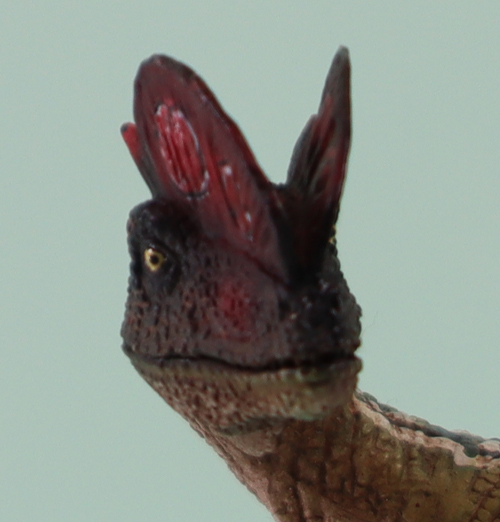
This dinosaur lived in what was to become Argentina towards the end of the Triassic.  It was named and described in 2003 and resembles in appearance a dinosaur such as Dilophosaurus.

An Illustration of the Skull of Zupaysaurus

Staring at you! The ITOY Studio Dilophosaurus dinosaur model.

Here’s looking at you! A stare from the ITOY Studio Dilophosaurus dinosaur model.  Zupaysaurus is thought to have looked very similar to Dilophosaurus.  Picture credit: Everything Dinosaur.

Picture credit: Everything Dinosaur

Everything Dinosaur

To view a model of a Dilophosaur (resembling Zupaysaurus) and other dinosaur toys, take a look at the extensive Wild Safari Prehistoric World range of prehistoric animal models: Safari Ltd. Wild Safari Prehistoric World.

7 05, 2010

Shedding Light on our Closest Relative – The Amazing Neanderthal In All of Us

By |2024-04-19T10:19:19+01:00May 7th, 2010|Categories: Dinosaur and Prehistoric Animal News Stories, Educational Activities, Main Page|0 Comments

The Neanderthal Genome Shedding Light on Human Evolution

A ten year project led by an international team of anthropologists and geneticists is shedding light on the H. sapiens and H. neanderthalensis relationship as more information about the Neanderthal genome, the genetic make up of this extinct species of human is revealed.

Scientists involved in the project say the findings, published today in the journal “Science”, provide important information on the origin of our own species and the inter-relationships with the other hominid species with whom modern humans shared the world up to around 28,000 years ago – the Neanderthal.

Although earlier studies had cast doubt over whether modern humans interbred with Neanderthals, this study indicates that modern humans migrating out of Africa did interbreed with Neanderthals.  This interbreeding could be one of the reasons why the Neanderthal is no longer with us (unless we count this DNA evidence that is), the Neanderthal could simply have been absorbed into the modern human genome.

The lead researcher, Svante Paabo of the Max Planck Institute for Evolutionary Anthropology, in Leipzig, Germany commentated:

“Having a first version of the Neanderthal genome fulfils a long-standing dream.  For the first time we can now identify genetic features that set us apart from all other organisms, including our closest evolutionary relative.”

Neanderthal

The findings are based on bone samples of three female Neanderthals excavated from Croatia’s Vindija Cave, a site famous for its well preserved Neanderthal remains and artefacts.  The fossilised bones of the individuals have been estimated by scientists to be approximately 38,000 years old.  It is at around this time that Neanderthal remains and artefacts start to disappear from the fossil and archaeological record of Europe, with evidence of modern humans becoming far more common.

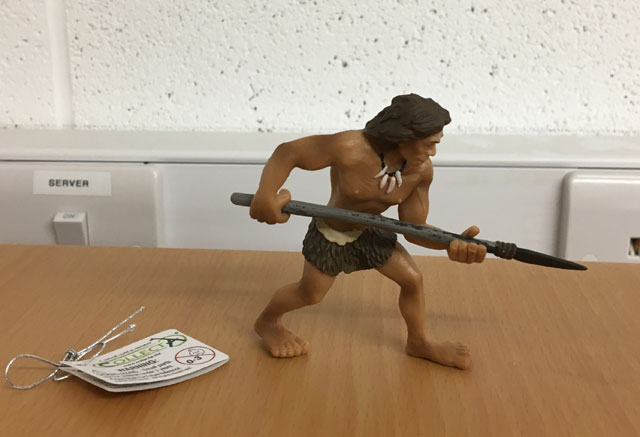
A Model of a Neanderthal Man

CollectA Neanderthal man model

A CollectA Neanderthal man figure.

Picture credit: Everything Dinosaur

The picture shows a model of a Neanderthal man, to see this model range: CollectA Age of Dinosaurs Popular Range.

The scientists state that they have mapped sixty percent of the genome so far.  They will continue their efforts to complete the sequence, to map the entire genetic code of the Neanderthal species, a project that they anticipate will take years.

The researchers compared the Neanderthal genetic material, with the genomes of five present-day humans from different regions of the world: China, France, Papua New Guinea and southern and western Africa.

Human Migration

The findings suggest that modern humans, after migrating out of Africa 80,000 to 45,000 years ago, bred with Neanderthals then in the Middle East before spreading further into Asia.  In the scientific paper, the team conclude that between 1 to 4 percent of the modern human genetic make up of non-Africans can be traced back to a Neanderthal ancestor.

Over recent years, our understanding of Neanderthal stone tool technology and Neanderthal culture has changed and the slow witted, ape man image associated with Neanderthals in the past has been fully refuted.

To read an article about Anglo/American research into Neanderthal tool technology: Neanderthals not as Stupid as We Thought.

David Reich, a geneticist and associate professor at the Harvard Medical School Department of Genetics, commented on the paper stating:

“The main finding is that there was gene flow from Neanderthals into the ancestors of modern non-Africans.”

Neanderthals first appeared in the European fossil record about 400,000 years ago.  The species persisted until approximately 28,000 years ago when the last Neanderthal enclaves (in the Iberian peninsula) died out.

Extracting DNA from the ancient bone samples was a daunting feat.  Using a delicate dental drill, researchers collected tiny fragments of bone powder (500 milligrammes), roughly the size of a small asprin, from which to analyse and isolate Neanderthal DNA.

Svante Paabo stated:

“Six or seven years ago, I thought it would be impossible, at least my lifetime, to sequence the entire nuclear genome of Neanderthals.”

The bone samples contained very little preserved Neanderthal DNA.  According to researchers, 95 to 97 percent of the DNA extracted was bacterial or from other organisms that had colonised the bone.  The DNA fragments that were recovered were extremely small and contained chemical modifications that could have yielded false data.

Researchers also had to take special measures to extract the Neanderthal DNA without contaminating it with their own human DNA.  Employing new computer technologies and software the team were able to map out the majority of the 4 billion-nucleotide Neanderthal genome.

Scientists are hoping that over the next few years more of the Neanderthal genome will be plotted.

To view the extensive range of prehistoric animal themed gifts and toys available from the award-winning Everything Dinosaur website: Visit Everything Dinosaur.

4 05, 2010

What is a Fossil? That is an Excellent Question

By |2024-04-19T10:24:00+01:00May 4th, 2010|Categories: Educational Activities, Geology, Main Page|1 Comment

Fossils – A Definition

One question that Everything Dinosaur team members get asked when they visit schools is what are fossils?  This seemingly innocuous question is actually quite difficult to answer when the different types of fossil are considered. What is a fossil?

Essentially if we were to say that a fossil is the preserved remains of a once-living organism that has been buried in sediment that has over time become rock, this would not be entirely correct.  This particular definition fails to encompass the many and varied different types of fossil that can be found.

What is a Fossil?

A more fundamental definition is required, for example, it would be true to say that a fossil is simply any evidence of ancient organisms, naturally preserved within the materials that make up the Earth.  Usually, such evidence is found within sedimentary rock, the muds, silts and sands that are deposited in layers and over time form rock, but not all fossils are formed in this way small creatures, fungi and plant material can be preserved in tree resin that hardens into amber, Pleistocene animals and plants can be preserved frozen; such as Mammoths in the Arctic wastes of the Siberian Tundra.  Occasionally, organisms may be trapped in fine volcanic ash and preserved in amazing detail and at Starunia in Poland, a complete rhinoceros was discovered pickled in a mixture of brine and tar.  This specimen was over 100,000 years old, but it was so well preserved that its stomach contents could be studied.

The word “fossil” is derived from the Latin word “fossa” meaning “dug up”.  In the 17th Century academics thought fossils consisted of both organic and inorganic matter, but by 1800 most agreed that fossils were purely of organic origin.  However, how fossils came to exist was still hotly debated (indeed, the debate continues today).

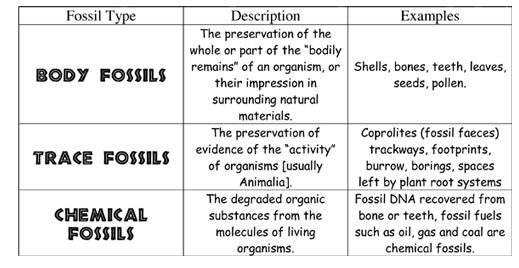
Broadly there are three types of fossil; body, trace and chemical fossils the table below provides a brief description and some examples.

Different Types of Fossil

Table credit: Everything Dinosaur

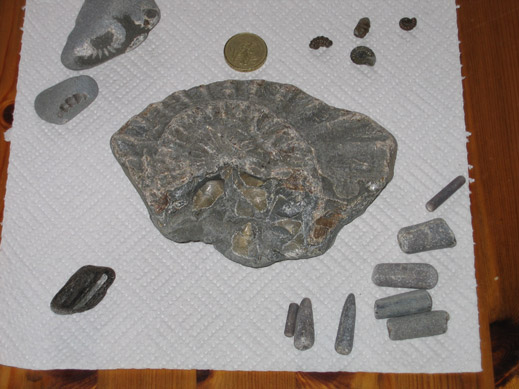
Finding Fossils at Lyme Regis

Team members at Everything Dinosaur enjoy hunting for fossils.  They try to visit Lyme Regis once or twice a year to hunt for fossils.

Fossils Found at Lyme Regis

Fossils found at Lyme Regis (Dorset). What is a fossil?

Lyme Regis full of fossils.

Picture credit: Everything Dinosaur

For replicas of iconic animals from the fossil record: Fossil Replicas and Educational Toys.

2 05, 2010

Rare Mediterranean Fossils may help Scientists find Proof of Life on Mars

By |2024-04-19T10:24:45+01:00May 2nd, 2010|Categories: Dinosaur and Prehistoric Animal News Stories, Educational Activities, Geology, Main Page|0 Comments

Fossils in Ancient Seabed may Shape the Search for Life on Mars

Microscopic fossils of primitive lifeforms found in what was a dried up part of the Mediterranean could help NASA scientists to determine where to look for fossils of primitive life on Mars.  Mediterranean fossils could help NASA researchers find proof of life on Mars.

The question whether there is or has been life on Mars has been hotly debated.  Certainly, there is evidence to indicate that in pre-history Mars was seismically active and perhaps it had a thicker atmosphere than it has today.  There is also plenty of evidence of water on the red planet and indeed despite the fact that what water on the planet is frozen solid, pictures taken from the Martian surface indicates geological features that may have been caused by rivers and flowing water.

The NASA Martian rover, known as Opportunity is currently traversing a relatively flat area of the planet called Meridiani Planum and this particular region of Mars is littered with rocks made from calcium sulphate (gypsum) the same rocky material in which scientists have found fossils of primitive life here on planet Earth.

Mediterranean Fossils

The scientists said they are impressed by the unexpected discovery of 6-million-year-old fossils in rocks from a time when the Mediterranean Sea was known to have dried up completely.  The fossil life forms include organisms very much like those found at the bottom of Ocean food chains today, phytoplankton, diatoms and cyanobacteria.

Cyanobacteria (sometimes referred to as blue-green algae), evolved on Earth sometime during either the Archean Eon or the Proterozoic Eon, a period of time that covers the Earth from around 4 billion years ago to the beginning of the Cambrian Period.  Evidence of ancient microscopic life is extremely rare, especially in the earliest part of the Proterozoic Eon, (known as the Palaeoproterozoic), but some scientists have put forward fossil evidence to indicate that photosynthesising single-celled, micro-organisms without nucleii – prokaryotes evolved around 2.4 billion years ago.  It was the action of micro-organisms that radically changed the Earth’s atmosphere as they converted sunlight into food with oxygen as a bi-product.

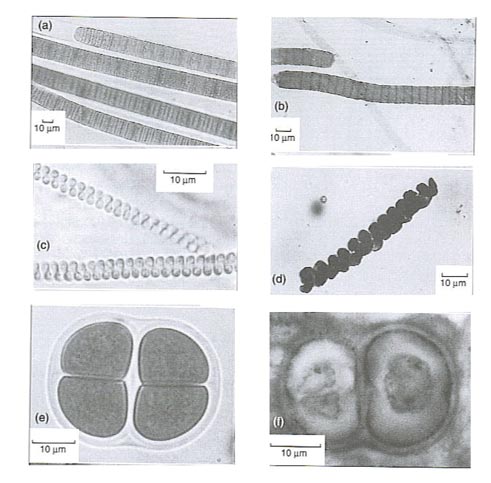
A Comparison of Living and Fossil Bacteria

Picture credit: Open University

The picture above shows six electron microscope studies of cyanobacteria, each with a scale in microns.  The pictures labelled (a), (c) and (e) are from cyanobacteria colonies found today in Mexico (stromatolites).  Pictures labelled (b), (d) and (f) are from rocks in the former Soviet Union, showing micro fossils of bacteria.  Picture (b) is approximately 950 million years old (Neoproterozoic), picture (d) has been dated to approximately 850 million years ago (Neoproterozoic) and picture (f) is the oldest specimen dating from the middle of the Proterozoic (Mesoproterozoic), approximately 1550 millon years ago.  The fossil bacteria resembles very closely the modern forms, indicating how little change has occurred in these organisms since they first evolved.  These relatively unchanging lifeforms that evolved in the in the Cryptozoic (the immense amount of time from the Earth’s formation to the first fossils of complex life forms), give credence to that often used phrase by palaeontologists that life on Earth was “on a long fuse to the Cambrian explosion”.

NASA Briefing

During a NASA phone briefing Wednesday, J. William Schopf, director of the Centre for the Study of Evolution and the Origin of Life at UCLA, said the fossil life forms found in the calcium sulphate rocks on Earth, present the intriguing possibility of the Martian rover finding similar fossil on the calcium sulphate rocks that are scattered across the part of Mars the rover is currently exploring.

Commenting on the discovery of micro-fossils in the gypsum rocks, Schopf stated that the scientists never expected to find signs of life.

“We all assumed there wouldn’t be anything like life there, and we were wrong.”

Gypsum is made of calcium sulfate, and Steven Squyres, chief scientist of the Mars Rover mission, noted that Opportunity’s six wheels are now carrying it across portions

Steven Squyres the chief scientist on the NASA Mars rover mission said that the rocks that Opportunity was now passing by would be “a fine target for intense investigation”.

Squyres is a member of a National Research Council task force weighing up future concepts for space missions that would seek evidence of life – past or present – on planets or other bodies in the solar system like the larger asteroids that orbit the sun between Mars and Jupiter.

After all, it is not just the planets such as Mars or a moon such as Europa that may harbour life, a recent study of a large asteroid in the main debris belt between Mars and Jupiter (24 Themis) has shown that asteroids too, may also contain water and have organic compounds.

To read more about the research on this asteroid: Scientist find Evidence of Water on an Asteroid.

There are a number of missions currently being considered, each one with the aim of helping to prove that Earth is not alone in the solar system in terms of life, that once there was life, albeit primitive life, in other parts of our solar system.

Collecting Samples

One of particularly strong scientific interest would revive a 20-year-old plan to collect samples of Martian soil and return them to Earth for scientists to analyse in the best laboratories in the world.

Explaining how this mission would be carried out, Squyres stated that this mission would involve three spacecraft launched over six years.

The first would be a rover that would trundle across a selected Martian site, collect a variety of soil samples, and then “park in a nice, safe spot” to await a second spacecraft from Earth that would pick up the samples, blast off from the planet’s surface, and remain in Mars orbit until a third ship from Earth arrived to carry the priceless cargo back home.

The entire project, which Squyres described as “complex and hellishly difficult to complete,” has no price tag yet, but NASA planners say the concept is being studied as a potential joint venture by teams at the European Space Agency’s headquarters in Paris.

For prehistoric animal toys and games at down to Earth prices: Everything Dinosaur.

28 04, 2010

Scientists Find Evidence of Water on Asteroid

By |2023-03-05T14:05:52+00:00April 28th, 2010|Categories: Educational Activities, Geology, Main Page|0 Comments

Scientists find Evidence of Ice on Large Asteroid

Could life on Earth have been kick started thanks to the impact of asteroids and other celestial bodies that brought raw materials to encourage the right conditions for organisms to flourish?

This is the fascinating question that is being posed by scientists in a study published in the scientific journal “Nature”.  Ice has been detected on a large 200-kilometre-wide asteroid in an area of our solar system.  The asteroid lies between Mars and the gas giant Jupiter.

Asteroids

Analysis of the asteroid, known as 24 Themis shows evidence of organic matter as well as ice crystals.  Impacts from extra-terrestrial bodies such as asteroids and comets could have led to the deposit on Earth of the chemical ingredients required to start or even speed up the development of life forms on planet Earth.  The discovery of ice and carbon elements on this asteroid adds weight to the theory put forward by many astronomers that Earth was relatively arid in its early history and water and other organic compounds were seeded on the planet due to the impact of asteroids and other space debris.

Water from asteroids could have helped to create the right conditions for life on Earth to flourish.

Seeding the Planet

Planetary scientist Dr Josh Emery, of the University of Tennessee, (United States), one of the authors of the astronomical study commented:

“The organics we detected appear to be complex, long-chained molecules.  Raining down on a barren Earth in meteorites, these could have given a big kick-start to the development of life.”

To see models of prehistoric and long-extinct creatures available from Everything Dinosaur: Prehistoric Animal Models and Figures.

The scientists hope to continue their research.  They aim to find more asteroids with evidence of ice.

27 04, 2010

Archives Reveal British Authorities Believed in the Loch Ness Monster

By |2023-03-05T14:07:33+00:00April 27th, 2010|Categories: Dinosaur and Prehistoric Animal News Stories, Educational Activities, Main Page|0 Comments

Senior Police Officers Believed in “Nessie” in the 1930s

Loch Ness, the largest expanse of freshwater in the British Isles is a very beautiful and tranquil place, however, this part of the Scottish Highlands is perhaps best known as the lair of a strange beast – “Nessie”.  Many sightings, pictures and even sonar and video images have been taken of the “wee beastie” that is supposed to lurk in the peaty waters of the Loch, indeed, many other Lochs in Scotland have their own stories of strange creatures in the water.

This phenomenon is not just restricted to Scotland, many locations in the Northern Hemisphere have their own stories and myths of strange lake monsters.  There is “Champ” in Lake Champlain and a myriad of similar strange animals reported from Lakes as far apart as Norway, Sweden, the United States, Ireland and Turkey.

However, perhaps the most famous (or should that be infamous) lake monster of them all is Nessie and papers from senior figures in authority dating from the 1930s, put on display for the first time; reveal that for many people at the time the Loch Ness Monster was very real.

With the upgrading of the A82 that skirts around the northern shore of the twenty-five mile long loch, there were more vehicles and travellers passing by the deep, dark waters and there were a spate of monster sightings, even one from a couple who claimed that Nessie left her watery home and hauled herself passed their car, perhaps the creature was going ashore to sample the night life of Fort William.

In a time, when movies like King Kong were causing a sensation and monsters (even dinosaurs) were big news, even bigger than they are today, it was one particular photograph, taken in 1934 that really set the world’s attention on the Loch Ness area and sent every would-be monster hunter to this part of the Highlands in a bid to “bag the beastie”.

In April 1934, a sensational photograph purportedly taken by a respectable London surgeon was published in many newspapers around the world.  It seemed to show the head and neck of a strange creature breaking the surface of the waters of the Loch.

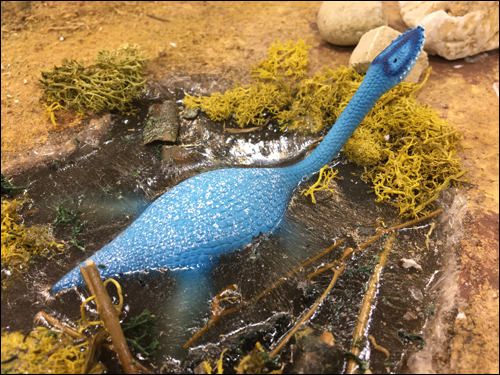
A Replica of the Schleich Plesiosaurus Model

Schleich Plesiosaurus model.  Is this the Loch Ness Monster?

The Schleich Plesiosaurus model on display.  Is this a replica of the Loch Ness Monster?

Picture credit: Everything Dinosaur

To view the range of Schleich prehistoric animals: Schleich Prehistoric Animal Figures and Replicas.

Colonel Robert Wilson’s photograph seemed to confirm the sightings and reports, that there was a strange animal unknown to science lurking in the waters of Loch Ness.  It was not until 1994 that the photograph was revealed to be a hoax, the picture shows a model of the “monster” taken just a few feet from the shore and not the head and neck of a large plesiosaur (extinct marine reptile).

However, this photograph and the spate of sightings and reports seemed to convince a number of senior figures in authority as to the creature’s existence.  In papers and letters put on display at the National Archives of Scotland in Edinburgh, the then Chief Constable of Police in Inverness-shire, William Fraser, was even making plans to try to protect the monster from big game hunters.

Sightings of the Monster

As the new Chief Constable for the region, Mr Fraser wrote in August 1938 to the Under Secretary of State in the Scottish Office, urging the Government to do all it could to “protect the monster”.  Mr Fraser expressed his concern over the steady stream of trophy hunters and sportsmen who visited the Loch with the intention of capturing Nessie, the letter, one of a series of documents put on display, part of the “Secret Nessie Files”, reveals that Mr Fraser believed that the monster was real.

This letter along with other documents on display demonstrates the extent to which the belief in Nessie was established amongst senior authority figures and their determination to protect it.

Mr Fraser, who led the force until 1951, described a London couple, Peter Kent and Marion Stirling, who were “determined to catch the monster dead or alive”.  They planned to have a “special harpoon gun” made and intended to return with “twenty experienced men” the following week “for the purpose of hunting the monster down”.

It could be argued that Mr Fraser was thinking in terms of public safety when he wrote those comments but he goes onto add:

“That there is some strange fish creature in Loch Ness seems now beyond doubt, but that the police have any power to protect it is very doubtful.  I have, however, caused Mr Peter Kent to be warned of the desirability of having the creature left alone, but whether my warning will have the desired effect or not remains to be seen.”

It appears that the Chief Constable had a case of “monster fever”, perhaps he was an early cryptozoologist (a person who believes in the existence of strange and bizarre creatures, as yet unknown to science).

From time to time, remarkable discoveries of animals not known in the western world are made.  For example, recently a new species of giant monitor lizard was discovered in the Philippines.

To read more about this recent discovery: If You go Down to the Woods Today – Discover a new species of Monitor Lizard.

A spokesperson for the archives stated that other authority figures were less convinced:

“It’s certainly remarkable that a senior police officer was prepared to accept the existence of a “strange fish” or rather “creature” in the Loch”.

The files put on public display for the first time, also reveal that other officials were more sceptical and certainly less inclined to express strong views in favour of the existence of a monster.

For Adrian Shine, a naturalist who founded the Loch Ness and Morar Project (Loch Morar is deeper than Loch Ness and has its own monster legend), believes that Mr Fraser was not alone in believing in Nessie.

He said:

“When the first stories began to burgeon from Loch Ness in the summer of 1933, people in fairly high and respectable positions were quite properly and respectably interested to see what was happening and wanted to investigate and protect whatever was there if necessary.”

Spotting Nessie

Mr Shine commented that it was possible that Nessie was a species of migratory sturgeon.  Another theory behind the more than 1,000 sightings is that the unique environment of Loch Ness creates optical illusions, or perhaps there really is a marine reptile, a plesiosaur swimming around the Loch.  Unlikely, but you never know, however, we at Everything Dinosaur don’t believe in the possibility of a Mesozoic relic such as a plesiosaur being alive today, certainly not a population of them living in Loch Ness, a feature that was only formed a few thousand years ago.

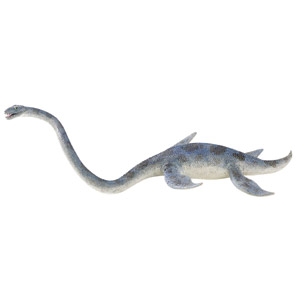
A Model of a Plesiosaur (Elasmosaurus) – Could this be Nessie?

Bullyland Elasmosaurus from Everything Dinosaur

Picture credit: Everything Dinosaur

To view marine reptile models and other prehistoric animal figues in the popular Bullyland prehistoric animal model range: Bullyland Dinosaurs and Prehistoric Animal Models.

Strange things do turn up from time to time.  Not long after Mr Fraser wrote his letter in the Summer of 1938, the first live Coelacanth was discovered off the African coast.  Coelacanths belong to an ancient group of fish that were once thought to be the ancestors of land animals.  They are found in the fossil record in strata from the Devonian Period through to the Cretaceous.  Scientists believed them to be extinct, until by chance, one came to the notice of western science shortly before Christmas1938.

To read more about Coelacanth catches: Coelacanth caught off the island of Zanzibar.

The Loch Ness Monster

Periodically, there are more pictures published of the Loch Ness Monster and people still travel to the area in the hope of catching a glimpse of the beast.  Quite a large tourist industry has sprung up in the area, fuelled by the myth of the monster.

As Adrian Shine says:

“People still come and they still see.  We have to accept that we don’t have all the answers.”

Go to Top