All about dinosaurs, fossils and prehistoric animals by Everything Dinosaur team members.

Everything Dinosaur’s work with schools and other educational bodies. Articles, features and stories about dinosaurs and their role in education and educating young people.

30 12, 2009

What sort of Dinosaur was Thyreophora? A Great Question!

By |2024-04-19T07:10:42+01:00December 30th, 2009|Categories: Dinosaur Fans, Educational Activities, Main Page|0 Comments

Thyreophora not a Dinosaur Genus but a Suborder of the Dinosauria

As team members of Everything Dinosaur visit schools and meet pupils we get asked lots of questions from enthusiastic dinosaur fans.  One of our staff was asked the other day by one particular dinosaur fan, what sort of dinosaur was a Thyreophora?  She had come across the word on line but she had not been able to find it in any of her dinosaur books.

Thyreophora

The word Thyreophora or thyreophorans does not relate to just one particular genus of dinosaur but describes a Suborder of the Dinosauria.  The word means “shield bearers” and refers to a group of ornithischian dinosaurs characterised by the presence of armour plates arranged along their sides and the top of their bodies.  The Suborder Thyreophora contains the familiar dinosaur families of the Stegosauridae and the Ankylosauridae.

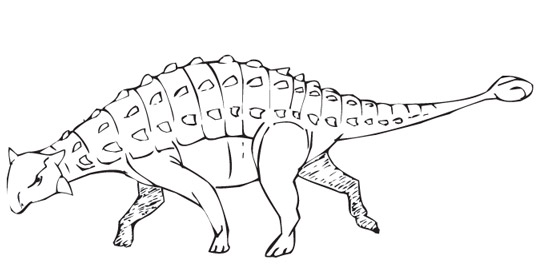
An Illustration of a Typical Thyreophoran Dinosaur (Ankylosaurus)
Picture credit: Everything Dinosaur

The diagram above is of a Late Cretaceous thyreophoran dinosaur – Ankylosaurus, a heavily armoured, 10-metre-long herbivore from North America.

To view a model of Ankylosaurus and other dinosaur models which represents members of the Thyreophora: Dinosaur and Prehistoric Animal Models.

As well as the presence of dermal armour, these members of the bird-hipped group of dinosaurs are also distinguished by anatomical differences between themselves and other dinosaurs.  These types of dinosaurs have unusual hip-bones, they lack the oburator process on the ischium.  The oburator process is a blade-like process that projects out from the ischium, a bone in direct contact with the pubis bone in Ornithischia.

One of the earliest members of the Thyreophora was Scutellosaurus.  It was a small (one metre long), fast running primitive member of this Suborder.  Scutellosaurus had parallel rows of bony studs running down its neck and back and a long, thin tail.  Its hindlimbs were longer than its forelimbs and it was probably a facultative biped.  In biology, the term facultative describes the ability to undertake an activity by desire rather than obligation.

Facultative bipeds were quadrupeds that when required, were capable of rising up on their hind limbs and walking or running.  As thyreophorans became larger and more heavily armoured they lost this ability to adopt a bipedal posture.

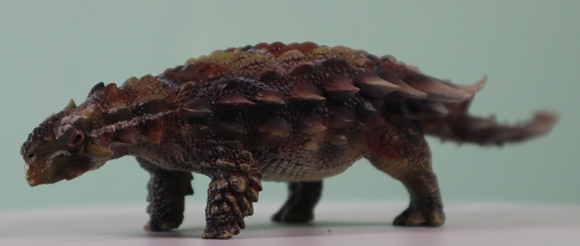
A Photograph of a Pinacosaurus Dinosaur Model (Thyreophora)
PNSO Bart the Pinacosaurus (left lateral)

The PNSO Pinacosaurus in lateral view. A member of the Thyreophora. Picture credit: Everything Dinosaur.

Picture credit: Everything Dinosaur

To view the PNSO model range: PNSO Age of Dinosaurs Replicas.

Fossil evidence of the earliest known thyreophorans date from the Lower Jurassic, a number of fossils have been found in the Western United States and England.  Scientists have postulated that the origins of this particular group of dinosaurs are in the Triassic, but as far as we know there have been no thyreophoran fossils found to date in strata dating from the Triassic.

17 11, 2009

What is a “Living Fossil”? A Favourite Question

By |2024-04-18T07:28:06+01:00November 17th, 2009|Categories: Dinosaur Fans, Educational Activities, Main Page|0 Comments

What is a “Living Fossil”?

A number of extant species, that is a species that exists today rather than an extinct one, are referred to as “living fossils”.  An example might be the remarkable  Tuatara, that has just been introduced to the mainland of New Zealand.  The Tuatara (Sphenodon punctatus) is the only surviving member of an otherwise extinct reptilian order the Rhynchocephalia.

The Rhynchocephalia

Fossils of Rhynchocephalians have been found in rock strata dating back to the Lower Triassic and from the fossil site locations, virtually every continent except North America, it is likely that this particular type of reptile was very common in the early Mesozoic.  The Tuatara has been protected by the New Zealand Government for many years and recently, in an extension of the ongoing conservation programme a new mainland reserve for this little reptile was established.

Living Fossil

The males have conspicuous triangular folds of skin that form a crest that runs down the back and tail of the males.  The Maori word Tuatara means “peaks on the back”, a reference to the crests found along the backs of the males.

To read an article on the Tuatara re-introduction programme: Living Fossil to be Reintroduced to New Zealand Mainland.

There are many other examples of living fossils, Charles Darwin, in his ground breaking work on natural selection “The Origin of Species” uses the phrase “living fossil”.  In chapter 4 of our copy of the third edition (kept in the office), we first encounter the phrase “living fossil”.  In this chapter, Darwin begins to outline his theory of natural selection, presenting evidence for the competition for organisms in the natural world.

Darwin comments that in general, the larger the land mass or area within which an ecosystem exists the greater the competition between organisms and hence the greater the drive to create new species.  He contrasts the paucity of species to be found on remote islands to those found on the continents and he states that those native organisms of the isolated country of Australia are easily out competed and threatened by European and Asian species once they are introduced.  Darwin introduces the idea that there are circumstances in the natural world favourable to natural selection and circumstances which are not favourable to the process of natural selection.

Natural Selection

In developing this point about circumstances favourable or unfavourable to natural selection; Darwin states that the world contains far more salt water than fresh water.  Compared to the great oceans and seas of the world, freshwater lakes, ponds and rivers are very small.  Consequently, he argues that the competition between organisms living in freshwater will be much less severe than the competition between organisms living in salt water.  As a result new species of freshwater animals will take longer to develop when compared to salt water species.  New forms take longer to develop and older forms persist for longer.

Darwin comments that in freshwater; seven genera of ganoid fishes can be found, the likes of the Gar fish for example.  These are the remnants of a much more common type of fish that dominated both freshwater and marine environments by the number of fossils found.  It is also in freshwater, he notes, that the last of the lepidosiren (lung-fishes) can be found.  These remaining few species of once great families of fish are now widely separated in the natural scale and Darwin refers to these type of creatures as being:

“anomalous forms” that “may almost be called living fossils, they have endured to the present day, from having inhabited a confined area, and from having thus been exposed to less severe competition.”

If this is Darwin’s definition of a living fossil, then it is certainly good enough for us.

For replicas of extinct animals visit Everything Dinosaur’s website: Everything Dinosaur.

10 11, 2009

Remembering the Great Gideon Mantell 03.02.1790 – 10.11.1852

By |2024-04-18T07:32:12+01:00November 10th, 2009|Categories: Dinosaur and Prehistoric Animal News Stories, Dinosaur Fans, Educational Activities, Everything Dinosaur News and Updates, Famous Figures, Main Page|0 Comments

Gideon Mantell – Died this day in 1852

The son of a shoe maker, Gideon Mantell rose from humble origins to become one of the most influential and respected scientists in the early years of palaeontology. Despised by the likes of Sir Richard Owen, who did much to destroy Mantell and his reputation, the passing of time has shown that this physician had a far greater insight into the Dinosauria than many of his contemporaries, including Owen himself.

Gideon Algernon Mantell

Gideon Algernon Mantell, was born in 1790 and died this day in 1852.  He is perhaps best remembered as the discoverer and describer of the first ornithischian dinosaur to be scientifically named and described – Iguanodon.  This was only the second dinosaur to be formerly studied and along with Megalosaurus (the first) and Hylaeosaurus it was included in the Order Dinosauria by Richard Owen.

The story of how Mantell came to name and describe Iguanodon, is shrouded in mystery.  His wife Mary Ann, often accompanied Mantell on visits to patients.  The possibly apocryphal story suggests that it was Mary Ann who found a strange tooth in a pile of stones placed on the road by workmen, as she waited for her husband.  This is believed to have taken place sometime in 1822.  A number of researchers have claimed that this story is nothing more than Georgian romantic make believe, but others have claimed that this version of the events may well turn out to be accurate.  Either way, Mantell went on to describe this tooth and others as well as a number of fossil bones found in the Tilgate Forest strata of the Weald of Sussex.

Remembering Gideon Mantell

Mantell was highly influential in the early years of the study of dinosaurs and other prehistoric animals, writing several books on geology and palaeontology.  Although, despised by the vindictive Owen, Mantell is remembered by scientists and a number of Lower Cretaceous fossil species are named after him.  He even has a species of Iguanodon named in his honour Iguanodon mantelli.  Recently, an iguanodontid from the Isle of Wight, formerly named I. atherfieldensis, a lightly built, Early Cretaceous member of the Iguanodontid family, was re-named by some scientists in Mantell’s honour.  This new dinosaur name is Mantellisaurus.

A Model of a Mantellisaurus Dinosaur

CollectA Mantellisaurus dinosaur model.

CollectA Mantellisaurus drinking.

To view a model of an Iguanodon. a Mantellisaurus and other ornithischian dinosaurs, take a look at the CollectA Age of Dinosaurs model range: CollectA Age of Dinosaurs Prehistoric Life Models.

8 11, 2009

Therizinosaurus cheloniformis – What’s in a Name?

By |2023-09-02T06:49:58+01:00November 8th, 2009|Categories: Dinosaur Fans, Educational Activities, Everything Dinosaur News and Updates, Main Page|0 Comments

How did Therizinosaurus cheloniformis get its Name?

One of our team members was asked the other day, why was Therizinosaurus cheloniformis so called, as they thought the Latin word chelonia was to do with turtles and tortoises.

Therizinosaurus cheloniformis

Well, they are quite right chelonia or chelonians refers to the turtles, tortoises and their relatives.  They are a very ancient group of reptiles that are not that closely related to the Dinosauria.  The difficulties arose when the first fossils of this, until then, unknown and very unusual dinosaur were discovered and studied in 1948.  These first fossils consisted of some flattened ribs and parts of the large forelimbs with their huge flat and not that curved claws.  The scientists mistakenly ascribed these fossils to a huge turtle-like creature, and this is how a species name for Therizinosaurus came about.

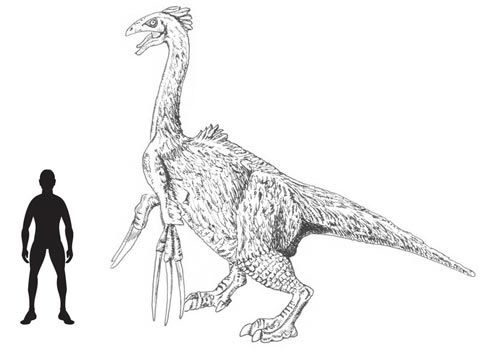
An Illustration of the Bizarre Theropod Therizinosaurus

Puzzling therizinosaurs - a scale drawing of Therizinosaurus.
Huge “scythe lizard” Picture credit: Everything Dinosaur.

Picture credit: Everything Dinosaur

To view a model of Therizinosaurus and other dinosaurs including feathered ones: Dinosaur and Prehistoric Animal Models.

It is difficult to believe that this strange herbivore belonged to the same sub-order as Tyrannosaurus rex and Velociraptor (Theropoda), but this is the case.

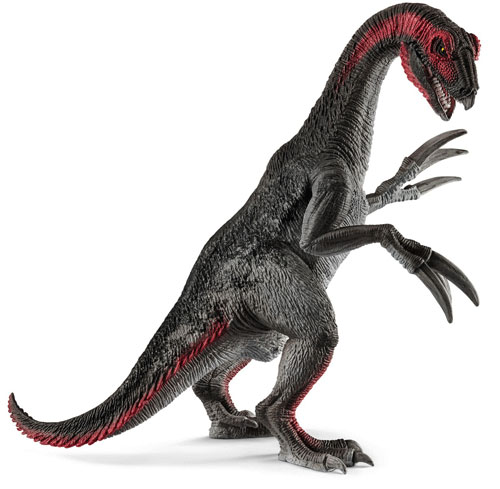
A Replica of Therizinosaurus cheloniformis

Schleich Therizinosaurus dinosaur model.
Schleich new Therizinosaurus model.

For Schleich dinosaur and prehistoric animal figures: Schleich Dinosaur Toys and Figures.

Therizinosaurus cheloniformis was formerly named and described by the famous Russian scientist Evgeny Aleksandrovich Maleev in 1954.  Although it had been realised by then that the palaeontologists were dealing with the fossilised remains of a dinosaur the specific name related to turtles was retained.

Visit the Everything Dinosaur website: Visit Everything Dinosaur.

2 11, 2009

Staring Open Mouthed at Models

By |2022-12-31T12:08:02+00:00November 2nd, 2009|Categories: Dinosaur Fans, Educational Activities, Everything Dinosaur News and Updates, Main Page|0 Comments

Dinosaur Models – Why are most of them shown with their Mouths Open?

Why do most dinosaur models have their mouths wide open? Animals around today do not walk around with their mouths agape.

When it comes to designing dinosaur and other prehistoric animal models, the artists and sculptors take great care, trying to ensure that their particular model reflects the latest scientific thinking.  Staff at Everything Dinosaur get involved in this process and we have been consulted on a number of aspects related to prehistoric animal models; from suggestions as to which models should be made, to advising on anatomical features and colouration.  Interestingly, sometimes life can imitate art, for many years we were most insistent that models depicting members of the Pteranodontidae were toothless, now toothed forms of Late Cretaceous pterosaurs have been named and described, muddying the water somewhat.

Dinosaur Models

However, most model makers attempt to depict the animals as accurately as possible, although liberties are taken with a number of bipedal models.  For example, to make a dinosaur model that stands on its two hind legs stable; the feet may have to be made slightly over-sized, or the tail position adjusted to give a tripod effect, helping the model stay upright.  This is most noticeable in models of dromaeosaurs and maniraptorans.  These type of dinosaurs walked on two toes, not the normal theropod three, so feet have to be adjusted accordingly to help the model remain stable.

A Typical Dromaeosaur Model (Big Feet)

Walking on just two toes.

Picture credit: Everything Dinosaur

To view this Velociraptor model and other theropod dinosaur models: CollectA Prehistoric Life Age of Dinosaurs Models.

Models do get makeovers from time to time, with new colour variants being added.  This is a cheap way of refreshing a range without the need to introduce new sculpts.  There is nothing wrong with this, as afterall, since pigment rarely fossilises the colour of a prehistoric animal such as a dinosaur is largely speculative.

Dinosaur Replicas

One of the interesting points that we often make to designers is that they are preoccupied with showing the animal with its mouth open.  Whether it is a meat-eater such as Tyrannosaurus rex, Allosaurus or even a Sabre-toothed cat, or indeed a herbivore such as Stegosaurus or Triceratops, mouth open models seem the order of the day.

Anyone observing how animals move around, a study of your pet dog or cat, perhaps watching a pride of lions on a television programme and you will see that most animals keep their traps shut for most of the time.  Teeth and open jaws are more exciting for model makers, but the reality is most animals keep their mouths closed, in essence only opening their mouths to communicate, make threat gestures, attack or to eat.  We do point this out when advising sculptors and the like, but we suspect that there are going to be lots more open mouthed dinosaurs made.

The London Natural History Museum’s Large T. rex Model

T. rex model.

Picture credit: Everything Dinosaur

The Tyrannosaurus rex dinosaur model (above), is from the London Natural History Museum model series.  To view this exciting range of prehistoric animal models: Natural HistoryMuseum Dinosaur Models.

Whilst the gape is impressive and the paint job on the teeth is very good, T. rex would not have walked around all day with his mouth wide open.  However, a closed mouth T. rex is perhaps not as appealing and so the open mouthed Tyrannosaurus model seems here to stay.

31 10, 2009

A Unique Everything Dinosaur 2010 Dinosaur Calendar

By |2024-04-18T07:16:52+01:00October 31st, 2009|Categories: Dinosaur Fans, Educational Activities, Everything Dinosaur News and Updates, Main Page, Press Releases|0 Comments

Everything Dinosaur 2010 Dinosaur Calendar

Everything Dinosaur team members have created a special dinosaur and prehistoric animal themed calendar which is available from the company’s website.

Scientists don’t really know what colour dinosaurs were, as only very rarely does any form of pigmentation fossilise.  Illustrations of dinosaurs and various CGI reconstructions are based on scientific assumption.  One of the coolest things about dinosaurs is that when you colour in a picture of a Stegosaurus and make it bright blue, nobody can actually say that your interpretation is inaccurate.  Your guess is as good as any highly respected palaeontologist, we simply don’t know what colour stegosaurs were.

A Dinosaur Calendar

Now is the  chance to put your creative minds to the test with the 2010 Everything Dinosaur calendar.  Each month features an illustration of a different prehistoric animal and you have the chance to colour it in and show the world what colour you thought dinosaurs were.  The 2010 calendar, which is available now, features Chasmosaurus, Tarbosaurus, Nigersaurus, Triceratops and of course Tyrannosaurus rex, plus lots of other prehistoric animals.

The Everything Dinosaur 2010 Dinosaur Calendar

Picture credit: Everything Dinosaur

To view the extensive selection of dinosaur and prehistoric animal themed toys and gifts, take a look at Everything Dinosaur’s award-winning website: Visit Everything Dinosaur.

With a pair of bellowing pachyrhinosaurs on the front, the calendar is jam packed full of dinosaurs and dinosaur information.

Muttaburrasaurus for February

Muttaburrasaurus is featured in February.

Picture credit: Everything Dinosaur

Everything Dinosaur

We even have included a dinosaur friendly word search game, with the answers available as a download or from this web log.

12 08, 2009

Time for the Perseids – Annual Meteor Shower

By |2023-03-03T09:57:05+00:00August 12th, 2009|Categories: Educational Activities, Everything Dinosaur News and Updates, Main Page|0 Comments

The Perseids Annual Meteor Shower

One of the most spectacular displays of shooting stars should be reaching its peak tonight.  Astronomers are getting ready to observe the annual Perseid meteor shower which fills the night sky with streaks of white light as small rock fragments burn up in the Earth’s atmosphere.

Perseid Meteor Shower

This annual event takes place throughout July and August but the rate of meteors or shooting stars is likely to peak either Tuesday night or this evening.  Since much of northern England was covered with cloud, last night but the forecast for Wednesday is for a more broken sky, tonight is probably the best chance to observe this phenomenon for most people in northern England.

The Perseid meteor shower is caused by the Earth passing through a stream of debris from the comet Swift-Tuttle.  The name Perseid refers to the star constellation of Perseus, as when viewed it seems that the meteors originate from this part of the night sky, although star system of Perseus is not responsible in any for this free light show in the sky.

At the peak of the shower, observers can expect to see around 80-100 streaks of meteor light per hour.  Astronomers record how many shooting stars occur over a fixed period of time, this is expressed as a Zenithal Hourly Rate (ZHR).  The National Trust has published a list of the best places to view the meteor shower, places such as Stonehenge and Wicken Fen.  Any one can view this annual event, but light pollution from cities and towns is a problem, so a trip to the countryside with its generally darker skies may be required.

Here’s hoping the sky tonight is at least partially clear and that we can see something.

For more down to Earth bargains, visit Everything Dinosaur’s award-winning website: Everything Dinosaur.

7 08, 2009

New Research into Bird Brains – Feathered Friends Capable of Complex Problem Solving

By |2024-04-17T11:16:37+01:00August 7th, 2009|Categories: Animal News Stories, Educational Activities, Main Page|0 Comments

Bird Brains – Corvidae proves Aesop Fable could be True

The term “Bird Brain” is often meant as an insult, but in reality some members of the Order Aves (the birds) are known to be remarkably intelligent and able to demonstrate the ability to solve complex problems.  For example, members of the crow family (Corvidae) are regarded by scientists as being remarkable adaptable and have been used in a number of studies providing an insight into how the cerebrum (the problem solving part of the brain) functions.

Bird Brains

Clever crows and rooks are not new to science but a new study by a team of British researchers has demonstrated the problem solving abilities of these birds and perhaps, proved that one of Aesop’s ancient fables may be based on truth.

In one of Aesop’s fables (morality tales from ancient Greece attributed to writer Aesop who lived some 600 years before the birth of Christ), a thirsty crow finds a pitcher of water.  Unfortunately, for the crow, the neck of the pitcher is quite narrow and the water cannot be reached, as the pitcher is not filled up to the top.  The crow solves this problem by dropping stones into the water, thus raising the water level via displacement.  As more stones are dropped in, so the water rises, until the crow is rewarded with a drink.

The moral of this particular story might be necessity is the mother of invention, but now a team of scientists from Cambridge University have demonstrated that there may be some truth behind this story.

Several rooks, at the University’s aviary have quickly mastered the technique of stone dropping to enable them to raise the level of water within a plastic tube so that they can catch a worm floating on the surface.  This “brains trust” amongst “bird brains” consists of four rooks, named Cook, Fry, Monroe and Connelly.  The scientists have observed the birds carefully examining the problem before dropping in the right number of stones needed to allow them to bring the tasty worm within reach.  Although, is is very difficult to attempt to assess the level of cognitive reasoning involved the birds did seem to wait until the water level was high enough to be reached before attempting to grab the worm with their beaks.

In addition, the birds did not add any more stones after eating the worms, suggesting the pebble dropping was a means to the end and not just a form of play.

Our Feathered Friends

The ingenuity of the feathered friends was shown when they were presented with a pile of stones of varying sizes. The rooks quickly learnt that picking the bigger ones would speed up the task, allowing them to snack more quickly and showing an efficiency of effort.  When given a choice of a worm floating in a tube part-filled with water and one half-packed with sawdust, they grasped that adding stones to the part filled tube with sawdust would not bring the treat within reach.

The study was led by the appropriately named Christopher Bird, a PhD student studying zoology, it has been published in the latest edition of the scientific journal “Current Biology”.

Commenting on his study, Christopher stated:

“Corvids are remarkably intelligent, and in many ways rival the great apes in their physical intelligence and ability to solve problems. “This is remarkable considering their brain is so different to the great apes”.

Such behaviour has not been observed in the wild, but the crow family with their relatively small brains (encephalisation quotient not withstanding), have gained a reputation in many societies for being clever.  For example, in Finland we were told stories by fisherman that when they went ice fishing and left their lines in the water overnight, ravens soon learnt to examine the holes early in the morning before the men returned and to pull up the lines that had a fish hooked on them.  The encephalisation quotient is a simplistic measurement of an animal’s intelligence and allows comparisons across genera.  It examines the ratio between body weight and brain size.

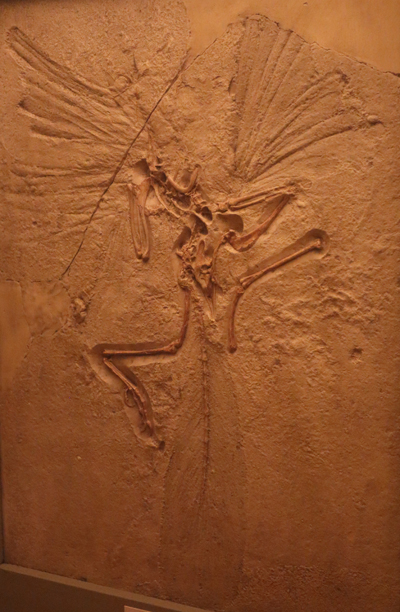
A Fossil Cast of the Early Bird Archaeopteryx

Archaeopteryx fossil cast

Archaeopteryx fossil cast an early bird. Picture credit: Everything Dinosaur.

Picture credit: Everything Dinosaur

This study could help palaeontologists to assess the relative intelligence of theropod dinosaurs, the closest relatives to birds in the animal kingdom fossil record.

Everything Dinosaur stocks a huge range of theropod dinosaur models and figures, some primitive members of the Aves too.  For example, take a look at the scale model range here: CollectA Deluxe Prehistoric Life Models.

18 07, 2009

Update on the Isle of Man Archaeological Excavations

By |2023-03-03T16:32:51+00:00July 18th, 2009|Categories: Dinosaur and Prehistoric Animal News Stories, Educational Activities, Main Page|0 Comments

Ronaldsway Site Yields Exciting Prehistoric Artifacts

The excavation on the site of the new taxiway at Ronaldsway airport on the Isle of Man is nearing completion, as the archaeologists strive to ensure that all the work is completed on schedule before the builders move in and recover as many prehistoric artifacts as they can.  The highlight of the dig has been the discovery of remains of a large Mesolithic dwelling, dated to approximately 8,000 years ago.  This is the oldest building of this nature ever found on the island and dates from the time shortly after the last Ice Age when the Isle of Man was settled.

Interestingly, until evidence of this structure was found, archaeologists had assumed that the first settlers on the island were mainly nomadic, but this substantial structure indicates that at least for part of the time the people were sedentary.

Prehistoric Artifacts

The team of archaeologists unearthed the remains of this wooden shelter, which would have measured something like 7 metres across and by studying the post holes it would have been a substantial, imposing building.

The excavation is being carried out by a team of scientists from Oxford Archaeology North.  To date the archaeologists have discovered 15,000 pieces of worked flint plus evidence of the diet of these settlers and other artifacts dating from 3,000 years before Stonehenge was built.

We first reported on this particular archaeological dig back in June 2008, when the first evidence of Mesolithic remains were found.  To read the first article in full:

Runway Extension reveals signs of Stone Age people on the Isle of Man.

It is hoped that the work will be completed in time to let the contractors back onto the site to start building the new runway extension in the next few weeks.

The picture shows archaeologists working on the large dwelling, the post holes can be seen.  Commenting on the excavation, Gemma Jones of Oxford Archaeology North stated:

“We have uncovered deposits to a depth of 30-40 centimetres.  These will now be returned to our Cambridge office for further study”.

The groundworks for the new runway extension has been continuing whilst the scientists worked, the contractors involved with the project have co-operated fully with the archaeologists, allowing this unique insight into the ancient inhabitants of the Isle of Man.

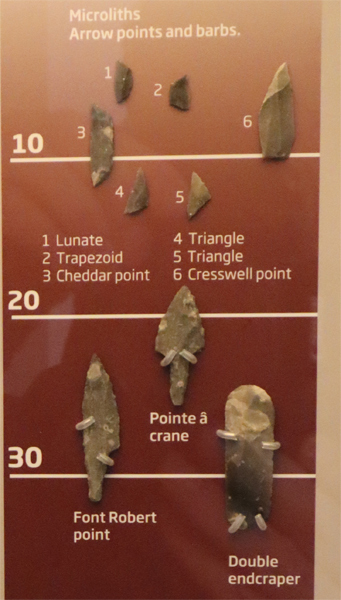
Typical Stone Tools (Museum Exhibit)

Stone Age Tools

A collection of typical Stone Age Tools. Picture credit: Everything Dinosaur.

Picture credit: Everything Dinosaur

Visit Everything Dinosaur’s award-winning website: Everything Dinosaur.

12 07, 2009

Themed Dinosaur Party Food is Easy to Make

By |2024-04-17T11:02:22+01:00July 12th, 2009|Categories: Educational Activities, Everything Dinosaur News and Updates, Main Page|0 Comments

Food for Dinosaur Parties

When it comes to organising that dinosaur themed birthday party for a dinosaur obsessed youngster one of the many questions we get asked is how to customise food so that it fits in with the party theme?  It is not easy to find dinosaur shaped sandwiches and tit-bits in your local supermarket, but you needn’t spend a fortune to ensure that your party buffet cuts the Mesozoic mustard

Dinosaur Themed Party Food

For example, dinosaur shaped cookie cutters are inexpensive to purchase and can be used to create biscuits shaped like prehistoric animals.  We supply a range on our website along with free to download recipes and instructions.  However, don’t be limited just to the sweet elements of your menu when it comes to using the cookie cutters.  We have used both our plastic and metal cutters to create dinosaur shaped sandwiches for hungry dinosaur fans.

To view the Everything Dinosaur range: Visit Everything Dinosaur.

Using soft bread, we find that white or wholemeal sliced loaves work best; and a series of simple fillings such as spreads, (peanut butter, chicken paste, jam, honey), dinosaur shaped sandwiches and light bites can be created simply by using the cookie cutters to cut out the sandwich once the slices have been prepared.

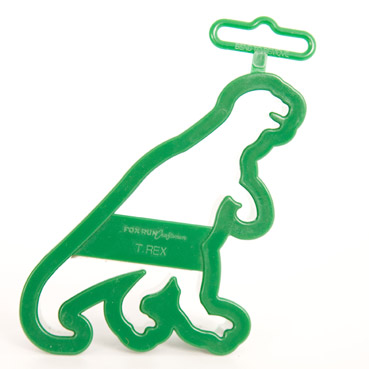
A Tyrannosaurus rex Themed Cookie Cutter – Ideal for Dino Shaped Sandwiches

Picture credit: Everything Dinosaur

The biscuit cutter is dishwasher prove and makes lovely shaped biscuits and sandwiches shaped like Tyrannosaurus rex.  They prove very popular at dinosaur themed birthday parties and the cutter is very easy to use and clean afterwards.

Taking a cocktail stick, and a coloured piece of paper prepare a label for the sandwich platter using simple dinosaur vocabulary (a quick look in your child’s dinosaur book should give you plenty of inspiration).  The cocktail stick can be used to stick securely the label to the plate, like a little flag.  Make sure you blunt the end of the cocktail stick still sticking up after you have secured the label to it, you don’t want anyone pricking their finger.

Summer Dinosaur Parties

With Summer dinosaur parties, the barbecue can often come out into its own.  Naturally, with us Mums and Dads supervising the cooking.  Ordinary burgers can become dinosaur inspired “Brachiosaurus burgers” with Tyrannosaurus rex red relish (tomato ketchup to you and me).  Please don’t be tempted to call your burgers “Brontosaurus burgers”, unless you want to incur the wrath of any of the more erudite of your young guests.  The name Brontosaurus is no longer accepted or used in scientific circles, although a genus of Late Jurassic diplodocid dinosaur was recently named Eobrontosaurus.  Brontosaurus had to undergo a name change in the 1970s, the reason for this is laid out below:

The eminent American palaeontologist Othniel Charles Marsh described and named Apatosaurus in 1877 from fossils found near the town of Morrison in Colorado, USA. Two years later, bones of what was thought to be another dinosaur were found at a quarry at Como Bluff, Wyoming. This animal was described and named as Brontosaurus “Thunder Lizard” by Marsh. As more skeletons were found, scientists realised that these two dinosaurs were actually the same genus, and since Apatosaurus was described first, the name Brontosaurus had to be disregarded.

In 1905 when the world’s first long-necked dinosaur skeleton went on display at the American Museum of Natural History it was wrongly labelled as Brontosaurus. Thanks to this and many Hollywood films, the name Brontosaurus seems to have stuck in people’s imaginations and for many years “thunder lizard” was one of the best-known dinosaurs.

So be warned, if your young dinosaur fans know their dino-data they will point out to you your mistake if you name anything Brontosaurus.

Herbivorous dinosaurs were some of the first large land animals to exploit the new food source of fruit in the mid to Late Cretaceous.  Don’t forget to add some fruit salad to your Mesozoic menu.  You can always label it up as “Fruit Salad Swamp” or “Fruit-o-saurus”.  By doing this you can ensure a healthy and nutritious balance to your “Styracosaurus Snacks”.

Finding Recipes

For recipes, more instructions and of course more information about dinosaur themed party food, simply log onto our website: Everything Dinosaur you will find a whole section of the site dedicated to this subject with free downloads, ingredient check lists and all sorts of helpful stuff.  There is even the recipe, instructions and templates to create your own dinosaur shaped birthday cake.  Best of all these information is available free as a download.

Every item put into our dinosaur shop is tested by ourselves and our pet parents and dinosaur fans.  We even tested out the biscuits and cake recipes.  Each member of staff was given job of trying to come up with recipes suitable for dinosaur themed events.  Then using our cookie cutters and such like we all had to make some.

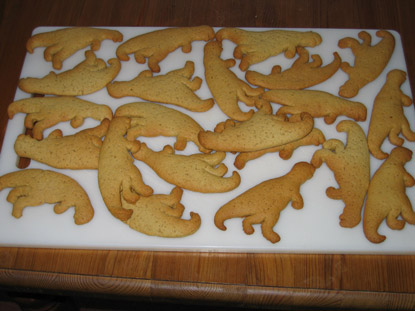
My Tyrannosaurus rex Gingerbread

Picture credit: Everything Dinosaur

My gingerbread dinosaurs, just out of the oven and cooling down ready for icing.  Not a bad effort for someone like me, who generally struggles to remember the recipe for toast.

Update

Following an extensive revision of diplodocid fossils, Brontosaurus is once again accepted as a valid genus.

Go to Top