All about dinosaurs, fossils and prehistoric animals by Everything Dinosaur team members.

Everything Dinosaur’s work with schools and other educational bodies. Articles, features and stories about dinosaurs and their role in education and educating young people.

5 07, 2009

Little Frogs Starting to Leave the Pond

By |2022-12-25T17:40:16+00:00July 5th, 2009|Categories: Animal News Stories, Educational Activities, Everything Dinosaur News and Updates, Main Page|0 Comments

Little Frogs Starting to Leave the Office Pond

Over the last couple of days we have been keeping a look out for signs of the first of the little frogs from this year’s frogspawn leaving the pond.  We had spotted one tiny froglet, still with a tail earlier this week (Friday), but up until now we had not found any evidence of frogs leaving the pond as fully formed, but tiny frogs ready to begin their amphibious lifestyles.

Little Frogs

To read the article about the froglet spotted last Friday: First Signs of Frogs about to Leave the Pond.

We had started to become a little concerned, as although we knew a number of the tadpoles had nearly completed their metamorphosis into tiny frogs, we had spotted several just a few days ago at an earlier stage of development. Their jaws had not started to form and as a result the head was still quite rounded.  For the last couple of days or so we had seen no sign of any tadpoles.  However, this evening one of the Everything Dinosaur team members spotted three tiny frogs, obviously this years hatchlings, whilst examining a container planted up with some French beans.

Little Frogs Spotted

It seems that some of the tadpoles have made it so far.  Hopefully, they will disperse in the back yard area behind the office and feed well enough over the remaining Summer months to be able to survive the winter.  With a bit of luck some of these tiny frogs will survive long enough to be able to return to our pond in a few years to breed.

30 06, 2009

Coping with the Heat – How Some Dinosaurs Did It

By |2023-02-28T18:31:41+00:00June 30th, 2009|Categories: Dinosaur and Prehistoric Animal News Stories, Educational Activities, Everything Dinosaur News and Updates, Main Page|0 Comments

Coping with Heat – How Some Dinosaurs Stayed Cool

How did dinosaurs cope with heat stress, Everything Dinosaur looks at some of the ways that large dinosaurs could have kep themselves cool.

As temperatures soar in the United Kingdom and the southern part of the country endures temperatures in excess of 30 degrees Celsius, lots of media space is dedicated to the subject of how to keep cool in what looks like to be the hottest days of our all to brief British Summer.  Although, the weather has certainly been hot in places like central London, when the temperatures recorded at midday in Britain are compared with other places in the world where we have been, (Kenya, Canada, USA), for example, the hot UK weather is put more into context.

Heat Stress

For some dinosaurs, keeping cool may have presented them with some serious difficulties to overcome.  Whilst horses in a field will often seek out the shade and shelter of a tree during the hottest part of the day, a Brachiosaurus for example, may not be fortunate enough to find a tree canopy big enough, or indeed tall enough to stand under.

A typical brachiosaurid, such as Sauroposeidon, Brachiosaurus or Camarasaurus would have held their heads many metres above the ground.  In the case of Sauroposeidon, from the fossil evidence gathered to date, it has been estimated that this creature could have raised its head to over 20 metres above the ground.  Wandering around in the mid-day Early Cretaceous sun, it is surprising that the brains of these animals did not cook inside the skulls.  These dinosaurs and indeed many other families of dinosaurs must have had ways in which they could modify and maintain a constant body temperature.

An Illustration of a Typical Brachiosaur
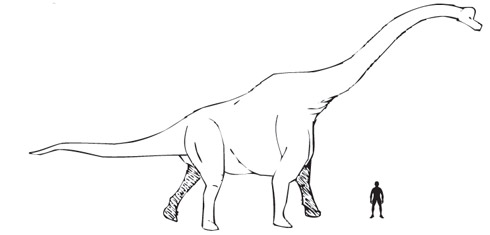
Picture credit: Everything Dinosaur

Trying to Maintain a Stable Body Temperature

Having a stable, almost constant body temperature is important in vertebrates, whether they are endothermic or ectothermic (warm-blooded or cold-blooded).  A stable internal body temperature will allow the animal’s chemical processes to work efficiently and constantly.  Chemical reactions in the body are controlled by enzymes and these are very temperature sensitive.  Birds and mammals maintain stable internal temperatures and it is believed that dinosaurs did too.

The trouble for a huge herbivore like a brachiosaurid is that it would have generated a lot of heat irrespective of the weather.  For starters, these animals had huge guts, basically a series of fermentation chambers.  The fermentation of digested and digesting remains of plants would have produced a lot of heat.  Secondly, just moving around, an animal as big as a brachiosaur would have generated a lot of heat in its huge leg muscles and this would have to be dissipated somehow.

With such a large surface area to volume, a brachiosaur may have struggled to cool down, but just like many large animals that live in hot climates today, these dinosaurs had survival strategies for coping with heat.  Some of these strategies would involve anatomical changes in their bodies to help regulate body heat, other strategies would be related to the way these animals behaved.

African elephants for example, have evolved large ears, these act as radiators, permitting blood to be circulated close to the surface of the skin and subsequently cooled.  Some scientists have speculated that the long, cylindrical neck and tail of a brachiosaurid would have made effective radiating surfaces, particularly if blood could be selectively channelled under the skin, as it can be in some extant reptiles.  This could be an example of an anatomical adaptation with regards to thermal regulation.

Seeking Relief

Brachiosaurs may have sought relief from the harshest part of the dry season by migrating to cooler, higher regions perhaps.  They may have wadded in lakes in order to cool down, an adult Brachiosaurus would certainly have nothing to fear from the crocodiles and other lake predators.

To keep the head cool, after all, it was perched high up in the full glare of the sun, brachiosaurids may have had another trick up their sleeve, or to be more precise up their noses.  Brachiosaurids are classified as Macronaria (big noses), they have a distinctive, box-like head shape with the holes in the skull representing the nostrils far bigger than the holes in the head for the eyes (orbits).  Could a brachiosaur keep a cool head by allowing blood to circulate in special channels close to the skin in these large, moist nostrils?

These big, moist, nasal cavities would have cooled the air that the animal breathed in and if blood was channelled into special tissues close to the internal surface of the nostril, this may have proved to be an effective cooling device.

The process would be similar to the ears of an elephant, which can act as a radiator to cool the blood.  By flapping its ears an elephant creates airflow which can accelerate this process.  Perhaps a brachiosaur could have cooled its small brain simply by breathing in and out in a regimented manner, permitting a greater airflow over the moist membranes and thus increasing the speed of the cooling.  A head at 20 metres off the ground is generally moving through cooler air than the body, this difference in temperature between the head and the top of the neck compared to the bulky body, may also have had a role to play in helping to regulate temperature.

Everything Dinosaur stocks a wide range of sauropod models, such as the Schleich dinosaur model range.

When a hot period of weather breaks, there is often a thunderstorm.  If you are 20 metres tall you could have been the highest thing around on the Late Jurassic or Early Cretaceous plains.  This could be dangerous especially if there was any forked lightning around.  Perhaps big brachiosaurids were occasionally struck by lightning.

To read about a newly discovered genus of early sauropod that may have had a trouble keeping warm, as it lived in Antarctica (Glacialisaurus): A long-necked dinosaur from the Antarctic.


21 06, 2009

Everything Dinosaur Team Members Prepare for a Busy Summer

By |2022-12-25T11:31:55+00:00June 21st, 2009|Categories: Educational Activities, Press Releases|0 Comments

Everything Dinosaur Reveals Plans for Summer 2009

The summer school term may nearly be over in the UK, but once Everything Dinosaur’s teaching commitments have been completed it will be time to focus on the events and other activities the company has planned for the rest of the summer.   The forthcoming school holidays will permit staff to review lesson plans and schemes of work that have been delivered as part of the company’s dinosaur workshops programme.  In addition, there has been time set aside to add new dinosaur themed teaching programmes aimed especially at Foundation Stage classes, Reception and Key Stage one.  This will help to strengthen the firm’s portfolio of dinosaur themed visits to schools.

A Busy Summer

Everything Dinosaur team members will also be working on a number of outreach programmes involving dinosaur talks, fossil digs and other activities helping to support museums and other educational bodies.

It is certainly going to be a busy summer for Everything Dinosaur.

Everything Dinosaur

A spokesperson for the UK-based dinosaur toy company commented:

“We have plans to expand our lesson plans for use when working with children in age groups from four to six.  Our team members have lots of ideas about how to undertake  teaching about dinosaurs in schools and we can’t wait for the start of next term.”

Visit Everything Dinosaur’s user-friendly and award-winning website: Everything Dinosaur.

20 06, 2009

New Radiocarbon Dating Information Changes Mammoth Extinction

By |2022-12-25T11:29:29+00:00June 20th, 2009|Categories: Dinosaur and Prehistoric Animal News Stories, Educational Activities, Main Page|0 Comments

Mammoths around in Great Britain much Longer than Previously Thought

Radiocarbon dating information changes the date of the extinction of Woolly Mammoths from the British Isles.

A trip to the beautiful county of Shropshire 14,000 years ago may well have resembled a visit to a safari park as amongst the exotic wildlife around at the time, herds of Woolly Mammoths could still be seen.  This is the conclusion of a group of scientists that have recalculated the age of several Mammoth fossils found in the Shropshire.  It seems that herds of these iconic Ice Age mammals were wandering around the English countryside, thousands of years after they were thought to have gone extinct.

In research published in the scientific publication “Geological Journal”, researchers from the Natural History Museum in London have re-examined data on five Woolly Mammoth fossils found at Condover, Shropshire in 1986.  Improvements in the technology of radiocarbon dating has enabled the scientists to reassess the age of these fossils and their work indicates that these animals died 14,000 years ago, 7,000 years later than previously thought.

Condover, is a small village in the centre of Shropshire, the area is well-known to geologists as there are a number of small fault lines in the region and earthquakes in the vicinity are not unknown.  The last substantial quake occurred in 1990.  There are a number of sandstone and gravel quarries around the village and it was in one of these gravel pits that the remains of one adult and four juvenile mammoths were discovered in 1986.  The skeletons were well preserved and articulated and the site remains one of the best locations known for fossil Mammoths in the UK.  There is a model of the Condover Woolly Mammoth on display at the Shropshire Hills Discovery Centre in the nearby town of Craven Arms.  Members of Everything Dinosaur have been to Shropshire on many occasions, normally to visit sites such as Ludlow and the Mortimer forest to explore the excellent Silurian aged rock formations and hunt for trilobite fossils.

Radiocarbon Dating Information

However, developments in dating techniques has enabled a team of scientists from the Natural History Museum to reassess the age of the Mammoth remains.  The new dates point to climate change as the reason for this elephant’s decline rather than hunting by early humans and Neanderthals.

Commenting on the new data, Professor Adrian Lister (Natural History Museum) stated:

“Mammoths are conventionally believed to have become extinct in north-western Europe about 21,000 years ago during the main ice advance, known as the Last Glacial Maximum”.

However, more sophisticated radiocarbon dating techniques used on bones, plus a new study of the micro fossils, plant and insect fossils found at the site indicate that these large herbivores persisted longer in the United Kingdom than previously thought.

Professor Lister went on to add:

“Our new radiocarbon dating of the Condover mammoths changes that, by showing that Mammoths returned to Britain and survived until around 14,000 years ago”.

The Condover Mammoth Fossils

The Condover Mammoth fossils are the last known record of Mammoths living in the north-west of Europe, their demise seems linked with climate change rather than the pressure of hunting from human settlers.  The advance of the ice sheets from the north, led to a change in the habitat, the open grassy plains, (known as Mammoth steppe, due to these large creature’s influence on the ecosystem), gave way to much more conifer forest and scrub.  This habitat was not suitable for a large herbivore that grazed on grasses and sedges.

Professor Lister added:

“The new dates of the Mammoths’ last appearance correlate very closely in time to climate changes when the open grassy habitat of the Ice Age was taken over by advancing forests, which provides a likely explanation for their disappearance.

 There were humans around during the time of the Condover mammoths, but no evidence of significant mammoth hunting”.

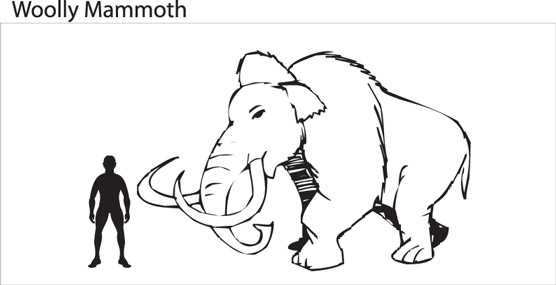
Although Woolly Mammoths are seen as “classical” animals of the Ice Age and they were well adapted to cold climates, they were not limited to cold environments.  Types of Mammoths lived throughout the northern hemisphere during the Pleistocene.  Contrary to popular belief, Mammoths did not live in habitats dominated by ice and snow but rather on the cold grasslands (steppe) beyond the reach of the ice sheets.  Mammoths were well adapted to cold conditions, with small ears (to reduce heat loss), thick set bodies, and two types of body hair to help keep them warm.  The outer layer of hair, was thick with long guard hairs, over a metre in length in some cases.  This hair was coarse and up to six times thicker than human hair.  The under-layer of hair was dense, softer and shorter with individual hairs much thinner than the outer hair covering.  This helped trap air which added to the insulation properties of this inner layer of body hair.

Many types of Mammoth had thick skin and a layer of body fat up to 10 cm thick, again providing excellent protection from the cold.

An Illustration of a Woolly Mammoth

Picture credit: Everything Dinosaur

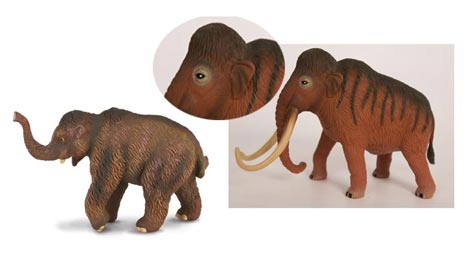
Evidence from frozen Mammoth corpses from Siberia indicate that the hair colouring of Mammoths varied from reddish orange to a dark brown.  The Natural History Museum Woolly Mammoth model is depicted as a reddish brown coloured animal whereas other Mammoth models such as the new baby Mammoth model from Procon/CollectA is depicted with the more “traditional” dark brown colouration.

Woolly Mammoth Model Comparisons

Comparing Mammoths.

Picture credit: Everything Dinosaur

The picture shows the adult Woolly Mammoth model as created by the Natural History Museum in London, the colouration is distinctly reddish with darker hair on the crown of the head and along the back and part way down the flank (inset).  The model of the baby Mammoth from the Procon/CollectA prehistoric animal model series, is depicted with a dark brown colouration all over.  Note also the different interpretations of nail colour between the two replicas.

To view the range of Woolly Mammoths and other prehistoric mammals available from Everything Dinosaur: Prehistoric Mammal Models and Dinosaurs.

16 06, 2009

Welcome to our New Office – We Wish

By |2024-04-17T10:31:42+01:00June 16th, 2009|Categories: Educational Activities, Everything Dinosaur News and Updates, Main Page|0 Comments

Welcome to our Office – We Wish

Lots of science weeks and school exercises at the moment for Everything Dinosaur team members, they are always fun (but hard work too).  We were invited to attend a “Dinosaur Day” at a school in the wonderful county of Cumbria yesterday.  Happy to meet all the young, enthusiastic and knowledgeable dinosaur fans, trouble was we had to get up at 4.30am to arrive in time to start the first session.

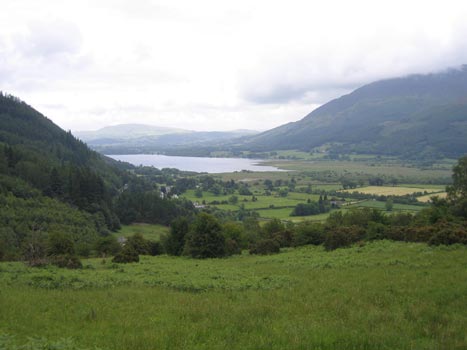
Long days and early starts are not too bad, especially this time of year with the light mornings.  We spent the day at the school, carrying out a range of activities for children aged 5 years to 11 years (KS1 and KS2).  By the end of the day we had covered a round trip of 298 miles, so we were very tired but some of the views of the Lake District that we had on our way to the school were awesome.

Not a Bad Place to Work – A View of the Lakes

Picture credit: Everything Dinosaur

Everything Dinosaur

These early starts certainly have some compensations.  We stopped for a flask of coffee and sandwich and just relaxed for a while and enjoyed the view.  As well as being very beautiful and a favourite destination for walkers and bikers there is some amazing geology to see (and lots of fossils to collect), but that will be for another day, but we could not help ourselves when we saw a very inviting scree slope that we were very tempted to clamber up.

One thing for certain, we get the chance to visit some amazing places on behalf of our work for Everything Dinosaur.

If you want to visit an amazing place, take a look at Everything Dinosaur’s award-winning website: Everything Dinosaur.

8 06, 2009

Life Begins at 40 for the Open University

By |2023-03-02T14:39:05+00:00June 8th, 2009|Categories: Dinosaur and Prehistoric Animal News Stories, Educational Activities, Main Page|0 Comments

Open University Celebrates Forty Years

The Open University is marking four decades of educating people far and wide, young and old with a series of events being held throughout the country over the Summer.  The Open University is the only British University dedicated to providing educational courses to students via distance learning.  The concept of the University is that you can study the courses, whether degree, post graduate or other on a part-time basis, perhaps whilst working or taking a career break.

The Open University

Founded in the late 1960s, the Open University was the world’s first successful distance teaching university and part of a vision by the UK Government to provide “Open Doors” to all members of the community in terms of education provision.  It now provides distance learning courses to many thousands of people, many of them overseas.

Established in the ‘White Heat of Technology’ era, the Open University was founded on the belief that communications technology could bring high quality degree-level learning to people who had not had the opportunity to attend campus universities.

A number of our staff and team members have studied with the Open University, everything from business qualifications to brushing up on geology.  The courses are very well written, up to date and extremely enjoyable.  We would recommend the Open University to anyone considering doing some part-time study.

A section dedicated to the educational sector.

The Open University has become a “Hot Spot” for education.  Picture credit: Everything Dinosaur.

Picture credit: Everything Dinosaur

Many thousands of people now study on a huge range of courses offered by the University.  In our experience as teachers, the courses offered are second to none but it is interesting to recall the opposition to a “University of the Air”, as the OU was called when it was first launched.

Celebrating Forty Years

The Open University was the first institution to break the insidious link between exclusivity and excellence.  It is a University founded on an ideal and, like all revolutionary ideas, attracted hostility and criticism.

In 1969, when the idea of The Open University was announced, it was described as “blithering nonsense” by Iain Macleod MP.  More than three decades on, The Open University has managed to convince sceptics that academic excellence need not be compromised by openness, indeed some of the degrees and courses offered are extremely well regarded in the academic world.

To learn more about the Open University and the courses that it offers: The Open University.

Happy 40th Birthday to the Open University.

26 05, 2009

Reflections on Lyme Regis – Rockwatch – The Unique Club for Young Geologists

By |2024-04-17T10:27:03+01:00May 26th, 2009|Categories: Dinosaur and Prehistoric Animal News Stories, Educational Activities, Geology, Main Page|0 Comments

Lyme Regis Reflections – Rockwatch the Greatest Club on Earth!

After a pleasant couple of days digging for fossils at Church Cliffs between Lyme Regis and Charmouth on the Dorset coast and participating in the Fossil Festival we get the chance to reflect on our bus-man’s holiday.

One of the great pleasures of the Lyme Regis Fossil Festival is that we get the chance to meet up with all kinds of people involved with geology, palaeontology and general science.  The festival has become a magnet for science enthusiasts from all sorts of organisations representing a myriad of scientific disciplines.

Lyme Regis

For example, whilst enjoying an evening walk back from the famous harbour with its Cobb, as featured in the film of the John Fowles novel “The French Lieutenant’s Woman”; we bumped into Sue Brown, the Chairperson of Rockwatch.

Rockwatch, is a nationwide club for junior geologists, or indeed young persons with an interest in Earth sciences.  Part of the Geologists Association, Rockwatch is a club for anyone fascinated with rocks, fossils, landscapes and minerals, giving young people the chance learn more about geology and to be a part of the world renowned Geologist Association, one of the oldest scientific institutes dedicated to geology in the world.

Based in London, Rockwatch sends out a special magazine three times a year to members, it features loads of information, stories, quizzes, puzzles… lots and lots of super stuff is crammed into each edition.  It takes really complicated science and makes it easy to understand.  For instance, if you ever want to know about Earthquakes or meteorites there is an article somewhere in the Rockwatch magazine archives which you can refer to.

Best of all, members of Rockwatch get exclusive invitations to special Rockwatch Club events taking place round the country.  If you have ever wanted to meet a real geologist or to go out fossil hunting with a professional, then Rockwatch is the club for you.

If you want to be a “Rock Star” (pardon the pun), then we would heartily recommend Rockwatch, their magazine even features the latest news on dinosaur discoveries.

For fans of prehistoric animals, Everything Dinosaur offers a wide range of models of dinosaurs as well as replicas of typical animals such as ichthyosaurs and ammonites that once swam in the shallow tropical sea that is now southern England.

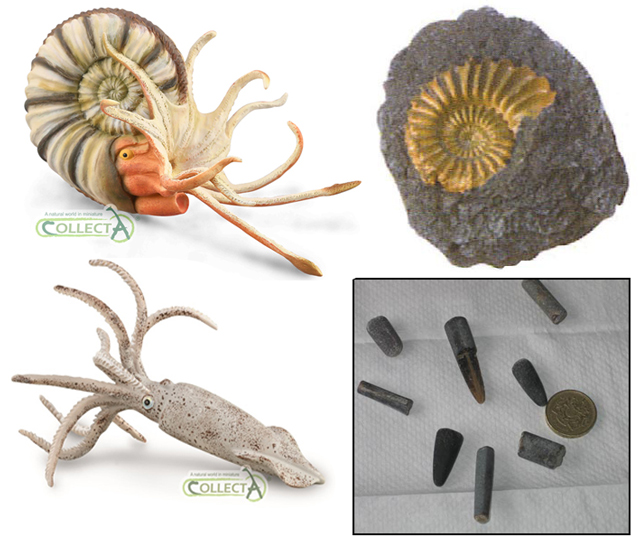
To view the extensive range of prehistoric animal models and figures including the CollectA Prehistoric Life ammonite and belemnite models, visit the CollectA section of Everything Dinosaur’s award-winning website: CollectA Age of Dinosaurs Models and Figures.

Examples of Prehistoric Animal Models that Reflect Lyme Regis Fossils

CollectA ammonite and belemnite.

The CollectA ammonite and belemnite models next to examples of fossils found at Lyme Regis.

To learn more about the Geologists Association: The Geologists Association.

Sue and her enthusiastic team had been making Jurassic landscapes, as part of the Fossil Festival, reflecting on the age of the rock strata all around them, we think that this was a very appropriate activity to set in Lyme Regis.  I am sure Mary Anning herself, would have approved.

21 05, 2009

The Wonderful Jurassic Park Finger Puppet Theatre Company

By |2024-04-17T10:14:01+01:00May 21st, 2009|Categories: Dinosaur Fans, Educational Activities, Everything Dinosaur News and Updates, Main Page|0 Comments

Dinosaurs as Thespians – Walking on Stage with Dinosaurs

Over the years we have supplied all sorts of dinosaur themed items to theatres, television studios and performing arts societies.  Dinosaur models for use in a stage play, to advice on dinosaur footprints to cover the stage, even drawings to be blown up and used as back drops for various avant-garde theatre productions.

Now young dinosaur fans can have a go at forming their very own theatrical company with these bright and colourful dinosaur finger puppets.   An ideal and inexpensive party favour bag item, a plastic, dinosaur finger puppet, or to be more precise a prehistoric animal finger puppet as a pterosaur (Pteranodon longiceps) is included.

The Dinosaur Finger Puppets

Picture credit: Everything Dinosaur

Jurassic Park Finger Puppet

Also featured are finger puppet interpretations of theropods, hadrosaurs, pachycephalosaurs and sauropods – quite a few different designs, more than enough to help form your very own Jurassic theatre troupe, a great idea for schools.  Suitable for children from aged 3 years and upwards, they are durable and fun, just the thing to get children’s imaginations going.

To view the extensive range of prehistoric animal themed toys and games available from Everything Dinosaur’s award-winning website: Visit Everything Dinosaur.

All the favourites are there with puppets representing T. rex, Parasaurolophus, Triceratops and so on.  Now all we need to do is think of some dinosaur or palaeontology themed plays.

How about  – “The Mouse Lizard (Mussasaurus) Trap” or “A Winter’s Tail” featuring an Ankylosaurus, I’m sure William Shakespeare would not have minded a little bit of poetic licence on our part.  Indeed to follow the Shakespearean theme a little longer how about “Much ado about Nothronychus”.

These plastic dinosaur finger puppets are sure to steal the scene.

24 04, 2009

Teaching, Teaching, Teaching (Hopefully Some Helpful Learning)

By |2024-04-15T14:40:51+01:00April 24th, 2009|Categories: Educational Activities, Everything Dinosaur News and Updates, Main Page|0 Comments

Teaching, Teaching, Teaching Advising Teachers How to Teach About Dinosaurs in Schools

Everything Dinosaur team members discuss their teaching work.

Everything is in full swing on the teaching front, we have got some work to complete for one of the UK universities over the next few weeks and then it seems to be full steam ahead as a number of regional primary schools are having science weeks over the next month or so.  Our diaries are always quite full, but what with the 200th anniversary of the birth of Charles Darwin, the 150th anniversary of the publication of his ground breaking book “The Origin of Species” we seem to be busier than ever with our dinosaur workshops in schools and our dinosaur themed teaching activities.  To be fair to Charles Darwin for a moment; we should acknowledge the full title of his 1859 book “On the Origin of Species by means of Natural Selection or the Preservation of Favoured Races in the Struggle for Life” – catchy title isn’t it.

It’s All Hands on Deck for an Everything Dinosaur Teaching Activity

Everything Dinosaur conducting a dinosaur workshop.

Dinosaur hands being examined as part of an Everything Dinosaur teaching activity.

Picture credit: Everything Dinosaur

Everything Dinosaur

Hopefuly, we will get some time to visit the Lyme Regis Fossil Festival that is scheduled to take place at the end of the month, I know one of us has to go to Dorset as they want to view some ichthyosaur remains that are currently being prepared.

Charles Darwin describes in great detail his argument to support his theory of Natural Selection.  He described the first edition of his book as “brief” when it was first published, for the record; our office copy has over 470 pages (including glossary).  If you want to understand the theory, the book is a great place to start and the published notes on Darwin’s Beagle voyage are well worth a read too.  Although once again it is no “rough guide to South America”, Darwin describes in fine detail his trips on land whilst on the Beagle expedition.  It is a little known fact that whilst on the Beagle expedition Darwin spent a great deal of his time away from the ship exploring the mainland and islands of South America.  If you want to understand a little of the background to the theory of evolution put forward by Darwin, then reading his descriptions and notes regarding his voyage is a good place to start.

Trouble is, we never seem to get a spare minute just to sit down and read a good book!

To visit Everything Dinosaur’s award-winning website: Everything Dinosaur.

13 04, 2009

Count Down to the Bollington Festival

By |2023-03-02T07:29:18+00:00April 13th, 2009|Categories: Dinosaur and Prehistoric Animal News Stories, Educational Activities, Main Page|0 Comments

Bollington Festival Starts next Month

The annual Bollington Festival starts on Friday 8th of May and runs until the late May Bank Holiday (Monday May 25th).  The organisers are hoping for an even greater attendance for the events, shows, presentations and activities this year, beating the experience of 2008 when over 10,000 event tickets were sold and many thousands more attended the free, open air activities.  The Festival is going to have for the first time, a series of science themed presentations, adding to the broad appeal of the Festival.  There will be something for everyone, from toddlers right up to the young at heart.

As well as covering literature, the arts, sport and photography a number of science themed events and presentations will be held over the three weeks that the Festival runs.

For example, on Saturday 16th May from 1pm to 4pm a series of science themed workshops will be held, promising explosions, experiments and excitement.  The event is open to all and free to attend, just pop along to the Bollington Methodist Church and be prepared to be entertained and perhaps even educated in one or two scientific concepts.

To learn more about the events on offer visit the official website of the Bollington Festival, a link to it is here: Bollington Festival.

The Cheshire town of Bollington is just a few miles north of Macclesfield and it has become quite famous for its Festival.  This year, for the first time, a number of science based presentations and events are going to be held.  The Festival has a dedicated science group and a total of 8 fantastic science themed events will take place over the duration of the Festival.

The Bollington Festival

The scientific presentations are varied and cover a diverse range of subjects, for example, Dr. Graeme Jones from the School of Physical and Geographical Sciences at Keele University will be presenting the definitive scientific guide to a good night out – “Saturday Night Science”.

In recognition of 2009 being the international year of astronomy, Dr Jamie Gilmour from the School of Earth, Atmospheric and Environmental Sciences at the University of Manchester will be providing visitors to the Festival with a guide to meteorites, and how our little part of the Milky Way was formed.  His presentation is entitled “Meteorites, Stardust and the Solar System”.

Our good friend Dr Phil Manning from the University of Manchester will be giving a talk on his latest palaeontological adventures and updating everyone on some of the new developments in palaeontology.  He promises to cover everything from dinosaur mummies, to fossil blasting and how to carry out a dinosaur autopsy – sounds fascinating.  Dr Manning will be talking on the evening of Tuesday 12th May at the Bollington Arts Centre.

Promotional Poster for Presentation on Dinosaurs (Dr Phil Manning)

Picture credit: Annette Hurst (Bollington Festival)

Visit the Bollington Festival website: Bollington Festival Website.

Go to Top