All about dinosaurs, fossils and prehistoric animals by Everything Dinosaur team members.

Everything Dinosaur’s work with schools and other educational bodies. Articles, features and stories about dinosaurs and their role in education and educating young people.

11 04, 2009

Woolly Rhino – An Odd Shaped Rhino Horn

By |2023-03-02T07:31:17+00:00April 11th, 2009|Categories: Animal News Stories, Educational Activities, Main Page|0 Comments

Woolly Rhino (Coelodonta antiquitatis) – Odd Shaped Horns

Whilst one of our team members was doing some dinosaur themed teaching activities with school children before the half-term holiday, they were asked by a student why did Woolly Rhinos had such large horns?

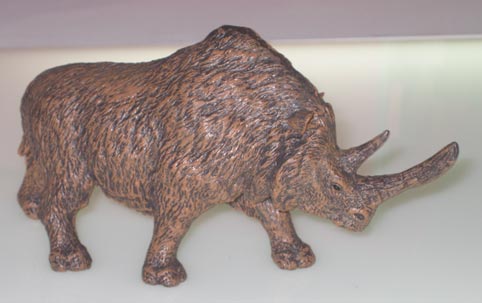
A Replica of a Woolly Rhino
Woolly  Rhino

Great care has been taken to depict the anterior horn on the new Papo model. Picture credit: Everything Dinosaur.

Picture credit: Everything Dinosaur

The picture (above) shows the Papo Woolly Rhino model, to view the Papo range of prehistoric animal models and figures: Papo Prehistoric Animal Models.

The question was asked when the Mammoth tooth was being handed round and it did get us thinking as to why ancient Rhinos had large horns.  In truth, we had to do a little bit of research before we could provide a complete explanation.  We were able to send an email to the teacher, outlining some of the reasons for the large horn on the Woolly Rhino.

Woolly Rhino

It turns out that the particular pupil concerned had seen a model of a Woolly Rhino and it did have a very large nose horn when she compared it to her models of modern Rhinos in her zoo play set.  Rhinocerotidae (the family to which Rhinoceroses belong), is actually quite an ancient mammal group, with their fossil record dating back to the Oligocene, approximately 35 million years ago.  There were a number of Rhino species around during the Ice Ages of the Pleistocene Epoch, fossils of such animals have been found all over Asia and Europe, these ancient animals were much more widespread in the past than modern species.  It is believed that the first Woolly Rhinos originated in China and there were a number of different types or species.

Coelodonta antiquitatis was named and described in 1807 by the German anthropologist and naturalist Johann Friedrich Blumenbach, long before the term Dinosauria had been thought of.  Indeed, Regency museums had many exhibitions of prehistoric mammal fossils long before dinosaur fossils began to take centre stage.

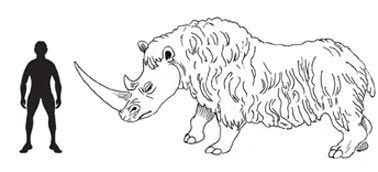
An Illustration of a Woolly Rhinoceros
Picture credit: Everything Dinosaur

To see a model of a Woolly Rhino and other prehistoric mammals associated with the Ice Age and the Pleistocene Epoch: Dinosaur and Prehistoric Animal Models.

Coelodonta antiquitatis

Coelodonta antiquitatis had two horns on its snout, the front horn being larger than the second horn located between the eyes. Woolly Rhinos were stocky, covered in long, shaggy hair with short legs, small ears and a dumpy tail – all adaptations for living in cold climates.  The horns of rhinos are made of keratin (fibrous hair that it compressed), the front horn (known as the anterior horn), could grow up to about 2 metres in length.  It is believed that the males had larger horns than females.

Scientists believe that the front horn of the Woolly Rhino was keeled, it was constantly worn down as the animals grazed moving their heads from side to side.  Woolly Rhinos may have used their large horns to clear snow in order to find food, this may explain how these animals had peculiar shaped horns.  Animals with large horns may have been more successful engaging in ritual combat and winning more mates as well as finding food.  The genetic trait for large horns may then have been passed from generation to generation.  This might explain why over many generations Woolly Rhinos had larger horns.

9 04, 2009

Free Swimming Tadpoles

By |2022-12-21T21:21:14+00:00April 9th, 2009|Categories: Animal News Stories, Educational Activities, Everything Dinosaur News and Updates, Main Page|0 Comments

Tadpoles begin to Disperse in Office Pond

Those tadpoles that hatched successfully have now begun to disperse across the office pond.  The heads of these little creatures, are now clearly discernable but no eyes or mouth can be distinguished as yet, in animals little more than one centimetre long.  The broad tails are permitting these tiny creatures to make short journeys as they spread out from the mass of spawn to take up residence in the rest of the pond.  We have observed a number of indviduals have made it to the far side of the pond and they are hanging onto large stones and debris in the shallows.  The majority of the tadpoles are to be found within the remains of the spawn, but we suspect that once they have exhausted their yolk sacs they will seek food and refuge elsewhere.  There is a lack of cover for the tadpoles (we cleaned the pond out in the autumn).  Hopefully, there will still be enough cover for the tadpoles to hide in although we accept that nearly all of them will perish over the next few weeks.  Most will fall prey to the other animals that inhabit the pond with them, the dragon and damsel fly nymphs are particularly voracious, but even blackbirds and robins can pose a threat to the tadpoles.

6 04, 2009

Dinosaur Easter Egg Activity – Make your own Dinosaur Nests

By |2022-12-21T09:21:25+00:00April 6th, 2009|Categories: Educational Activities, Everything Dinosaur News and Updates, Main Page|2 Comments

Dinosaur Easter Activity – Make your own Dinosaur Nests

Looking for something to do with your young dinosaur fans over the school holidays, make a chocolate nest full of tasty dinosaur eggs.  Here is a simple and fun recipe for dinosaur chocolate nests, an ideal activity for Easter time.

Dinosaur Chocolate Nests

Ingredients – (makes a batch of about 8 nests)

Plain or Milk cooking Chocolate 225 grammes (8oz)

Packet of Breakfast Cereal Cornflakes or Shredded Wheat variety

Packet of Sugar Coated Mini-chocolate Eggs

Pack of Small Cake Cases

Dinosaur Nests – a Great Easter Holiday Baking Activity

Picture credit: Everything Dinosaur

Method

1.  Break the cooking chocolate into pieces and place in a heat-proof bowl.  Melt the chocolate over a pan of simmering water.

2.  Once the chocolate has melted remove it from the heat and give it a good stir in the bowl.

3.  Add some of the breakfast cereal until the mixture takes on a a brown twiggy look.

4.  Carefully spoon enough of the mix into each paper case so that a little nest is formed.  Make sure you push it down in the middle so that each nest has a hollow in the centre

5.  Place two chocolate mini-eggs in the centre of each chocolate nest, the eggs will stick when the chocolate sets. Two eggs is all you need for each nest (we know that some dinosaurs laid eggs in pairs so your chocolate nests would please a palaeontologist).

6.  Then leave the nests to set.

There you are a set of lovely dinosaur themed nests, an ideal activity for young palaeontologists over the Easter holiday break.

For other baking ideas, recipes and for fun party items as well as dinosaur toys and gifts visit the award-winning Everything Dinosaur website: Visit Everything Dinosaur.

Dinosaur Eggs

Dinosaurs and their Nests (a little bit of science for you)

Many nests of dinosaurs have been discovered, particularly over the last fifteen years or so with the discovery of sauropod nesting sites in Argentina and Europe plus more evidence having been gathered from places such as the famous Flaming Cliffs area of Mongolia.

Dinosaur Eggs Fossil Discovery

The first dinosaur eggs were discovered in 1859 (France). The first recognised dinosaur nests were uncovered by an American team of palaeontologists led by Roy Chapman Andrews during expeditions to Mongolia in the 1920s.  Over the last few years, scientists have been able to build up their knowledge about dinosaur reproduction and egg laying as egg-shell fragments, nests, and even fossils of unhatched baby dinosaurs inside eggs have been discovered.

3 04, 2009

The Frogspawn is Hatching – an Exciting Development

By |2024-04-15T14:43:04+01:00April 3rd, 2009|Categories: Animal News Stories, Educational Activities, Everything Dinosaur News and Updates, Main Page|0 Comments

Office Pond Frogspawn Shows signs of Life

On Saturday 14th of March we reported that once again we had frogspawn in our office pond.  This is the second year in a row that frogs have spawned in our pond.  Based on our estimates we think that just like last year, the eggs we have in the pond have come from just the one female.  We are not sure whether it is the same female as last year, but it might be as we believe that the Common Frog (Rana temporaria) tends to return to the same pond each year to spawn.

To read the article about the frogspawn: We have frogspawn in the office pond.

We have kept a close watch on the frogspawn, and over the last few days or so we have observed that it is beginning to hatch.  The first tadpoles began to hatch on Wednesday 1st April, approximately 17 days after the spawn was laid.  The spawn last year began to hatch a little earlier but it was laid in a shallower part of the pond in direct sunlight and this may account for the slightly slower hatching this year.  We expect to see the majority of the tadpoles hatching over the weekend, although we note that the spawn is not as clear and healthy looking as it was last year.  Perhaps it is because the spawn has ended up in a deeper part of the pond, sitting on the silty bottom.  Those tadpoles that have hatched already, have a distinctive head end, but their tails are not able to propel them very far at the moment.

In the autumn, we all got together and had a lovely afternoon clearing out the blanket weed and generally cleaning the pond.  This has left the pond with little weed cover.  Hopefully, the tadpoles will be able to find plenty of cover to help them avoid predators.  The absence of cover may permit us to observe the tadpoles in more detail this year.

To view the article about 2008 hatching frogspawn: Frogspawn beginning to hatch (2008).

The pond seems quite healthy, we have noticed a lot of snails eggs and the water boatmen have been very active.  We also observed our first pond skater of the season.  Hopefully, our pond clearing has helped maintain a healthy, balanced ecosystem.

29 03, 2009

Science Events at the Bollington Festival

By |2022-12-21T08:58:07+00:00March 29th, 2009|Categories: Educational Activities, Everything Dinosaur News and Updates, Main Page|0 Comments

Science Events at the Bollington Festival – Hunting Dinosaurs

The Bollington Festival in Cheshire keeps growing and each year it gets bigger and better.    The Cheshire town of Bollington is just a few miles north of Macclesfield and it has become quite famous for its Festival.  This year, for the first time, there will be a series of events and presentations with a science theme.  The Festival has a dedicated science group and a total of 8 fantastic science themed events will be held over the duration of the Festival, which itself runs from the 8th to the 25th of May this year.

Bollington Festival

In keeping with the rest of the Festival, the scientific presentations are varied and cover a diverse range of subjects, for example Dr Graeme Jones from the School of Physical and Geographical Sciences at Keele University will be presenting the definitive scientific guide to a good night out – “Saturday Night Science”.  In recognition of 2009 being the international year of astronomy, Dr Jamie Gilmour from the School of Earth, Atmospheric and Environmental Sciences at the University of Manchester will be providing visitors to the Festival with a guide to meteorites, and how our little part of the Milky Way was formed.  His presentation is entitled “Meteorites, Stardust and the Solar System”.

Of course palaeontology will be represented…

Dr Phil Manning

Dr Phil Manning from the University of Manchester, will be giving a talk on “Hunting Dinosaurs in the 21st Century” on the evening of the 12th May.  Knowing Phil, this will be a super presentation and extremely enjoyable as Dr Manning will no doubt, enthusiastically guide us through the latest research on the mummified hadrosaurine (duck-billed dinosaur), discovered in Dakota.  Perhaps he will combine this with further information on several other projects, including the use of computer modelling techniques to estimate dinosaur velocity, a specific software programme developed by the University of Manchester, to calculate just how first some bipedal dinosaurs could run.

The first dinosaurs walked the earth over 220 million years ago, yet people are still captivated by these amazing creatures.  With the celebrations of the 200th anniversary of the birth of Charles Darwin and the 150th anniversary of the publication of “On the Origin of Species” dinosaurs are one of the oldest evolutionary links to one of the worlds most diverse species of modern vertebrate, birds. Indeed, there are still more species of birds on this planet than mammals – perhaps a testament to their adaptability.  This talk will take the audience on a journey from the Badlands of North Dakota, supercomputers in Manchester and particle accelerators with dinosaurs as targets in California!

The Promotional Poster for the Dinosaur Presentation

Picture credit: Annette Hurst (Bollington Festival)

Pleasing to see a picture of an ornithopod (iguanodontid) promoting Dr Phil’s presentation, which will focus on a superbly preserved hadrosaur fossil discovered in America.

For more information about the Bollington Festival, including how to book for events and presentations visit the Festival website: Bollington Festival.

28 03, 2009

How did Liopleurodon get its Name?

By |2023-02-28T15:23:29+00:00March 28th, 2009|Categories: Educational Activities, Everything Dinosaur News and Updates, Main Page|0 Comments

The Naming and Describing of Liopleurodon

One of the Everything Dinosaur team members was asked the other day what the name of the large Jurassic, pliosaur Liopleurodon means and how this fierce carnivore got to be named.  We tend to get asked a lot of questions about this particular prehistoric animal, it remains extremely popular after it was “tagged” with the title of the biggest carnivore of all time.  Liopleurodon was featured in one of the BBC’s “Walking with Dinosaurs” episodes (episode 3 – The Cruel Sea), the documentary claimed that this marine reptile was up to 25 metres long and would have weighed as much as 150 tonnes.  These statistics, although impressive, are difficult to confirm using the existing fossil record, but for young fans of the TV series, Liopleurodon remains a real star.

Liopleurodon

Liopleurodon was a fierce meat-eating, aquatic reptile of the Jurassic period.  A number of species of Liopleurodon are now known, but the fossils of this animal are extremely rare and many of the examples scientists have are poorly preserved. It was very probably the apex predator in its environment and as a consequence; there would have been fewer individuals in any one area compared to other animals in the food chain.  As a result, the fossils of such creatures are extremely rare.  The best-known species  (Liopleurodon ferox); was first named and described by the French palaeontologist H. E. Sauvage in 1873.  The holotype of this animal, the specimen on which the original description of Liopleurodon ferox is based is actually a single tooth.  The smooth sides of this tooth gave Liopleurodon its name.  The name Liopleurodon means “smooth-sided tooth”

An Illustration of Liopleurodon

Picture credit: Everything Dinosaur

The drawing above shows a Liopleurodon to scale with a human being, had this animal reached the lengths claimed by the BBC production team.

Colouration of the Model

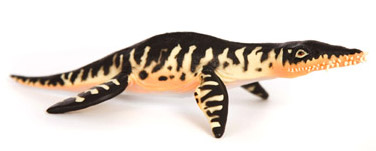
The colouration on the model of Liopleurodon we stock is very striking.  We have advised a lot of people on the way in which this large predator may have looked but the colours depicted are pure speculation.  We do try to base our work on some scientific principles and evidence seen in extant creatures today.  For example, study of Liopleurodon and other pliosaur skull material indicates that the eyes were positioned towards the top of the skull.  This would have helped Liopleurodon ambush its prey by attacking them from below, in much the same way as Great White sharks attack seals today.  We presume that this large animal, hid in the depths and then propelled itself upwards at a target animal such as an ichthyosaur.  The four powerful flippers provided fast acceleration and the strong jaws equipped with large teeth (some up to 18 inches long), were capable of delivering a very powerful bite.

A Liopleurodon Model (Everything Dinosaur)

Picture credit: Everything Dinosaur

To view a model of Liopleurodon, other marine reptiles and dinosaurs: Dinosaur and Prehistoric Animal Models.

The dark markings on the top of the animal would help camouflage this large creature and break up its shape when viewed from above.  The white underbelly would have been almost invisible against the sun dappled surface waters, if viewed from below.

25 03, 2009

Humans and Dinosaurs a “Handy” way to tell the Difference

By |2023-02-28T15:27:45+00:00March 25th, 2009|Categories: Educational Activities, Everything Dinosaur News and Updates, Main Page, Teaching|0 Comments

Latest Palaeontological Research helps with Classroom Exercise

A few weeks ago, team members at Everything Dinosaur reported on the research published by a team of American scientists who had studied the best preserved hand prints of a theropod dinosaur.  Theropod dinosaurs such as Megalosaurus, Allosaurus and Dilong were bipedal.  This means that they walked upright on their hind legs.  Scientists had speculated how these animals would have used their hands and what movement they would have had with their forelimbs.  A lot can be determined by studying the fossilised arm and hand bones of these particular dinosaurs, but no decent, well-preserved “hand prints” of such animals had ever been found.

Dinosaur “Hand Prints”

The study of a dinosaur trackway, left in mudstone has revealed that dinosaurs had hands that were not suitable for walking upon very early in their evolution.  In a report published in the online palaeontological journal PLos ONE, a U.S. based team have concluded that the fossil hand-prints, perhaps the best theropod hand-prints discovered to date, indicate that these dinosaurs abandoned the use of their forelimbs as legs early in their evolutionary development.

The lead author, Andrew R. C. Milner of the St George Dinosaur Discovery Site at Johnson Farm in Utah, stated that due to the disproportionately small forelimbs of most theropods, trace fossils of them as they rested on the ground are extremely rare.  Only a few other examples of theropod hand-prints are known, but the discovery of a wonderfully well-preserved set of impressions in 2004, have enabled scientists to shed more light on the range of movement of dinosaur hands and arms.

Dinosaur Trace Fossils

Vertebrate palaeontologist Milner and his colleagues describe in the paper, a clear set of 5 cm deep impressions preserved amongst hundreds of other trace fossils in the sediment that has been dated to the Early Jurassic (Sinemurian faunal stage), approximately 198 million years ago.  The rock preserves trace fossils of worm borings, tracks made by crabs as well as body fossils of fish.  The sediment represents a part of a shoreline adjacent to an ancient lake (known as Lake Dixie).  The water level seems to have altered and as a result the sediment shows signs that the water levels fell and the muddy sand cracked and dried in the sun.

A theropod dinosaur left a remarkable trackway, on this shoreline, it stopped and sat down, perhaps to rest for a while.  As it rested it put its hand’s on the ground and these left impressions (left manus and right manus).  There is even the marks in the fossilised trackway that show where the base of the tail was rested on the ground.

To read the article in full: Dinosaur Hand-print Reveals Link to Birds.

An Artist’s Impression of the Theropod Resting and Trackway Picture

Picture credit: H. K. Luterman of Cedar City, Utah

Everything Dinosaur, is always keen to build in new ideas and scientific developments into its teaching programmes so we combined the research work carried out on these remarkable trackways with an experiment with school children to see if dinosaurs and people has the same range of movement in their hands and arms.  We term this teaching exercise, part of our range of classroom activities “the palms down activity”, but many of my colleagues prefer the more intriguing title – can dinosaurs juggle?

Dinosaur Hands

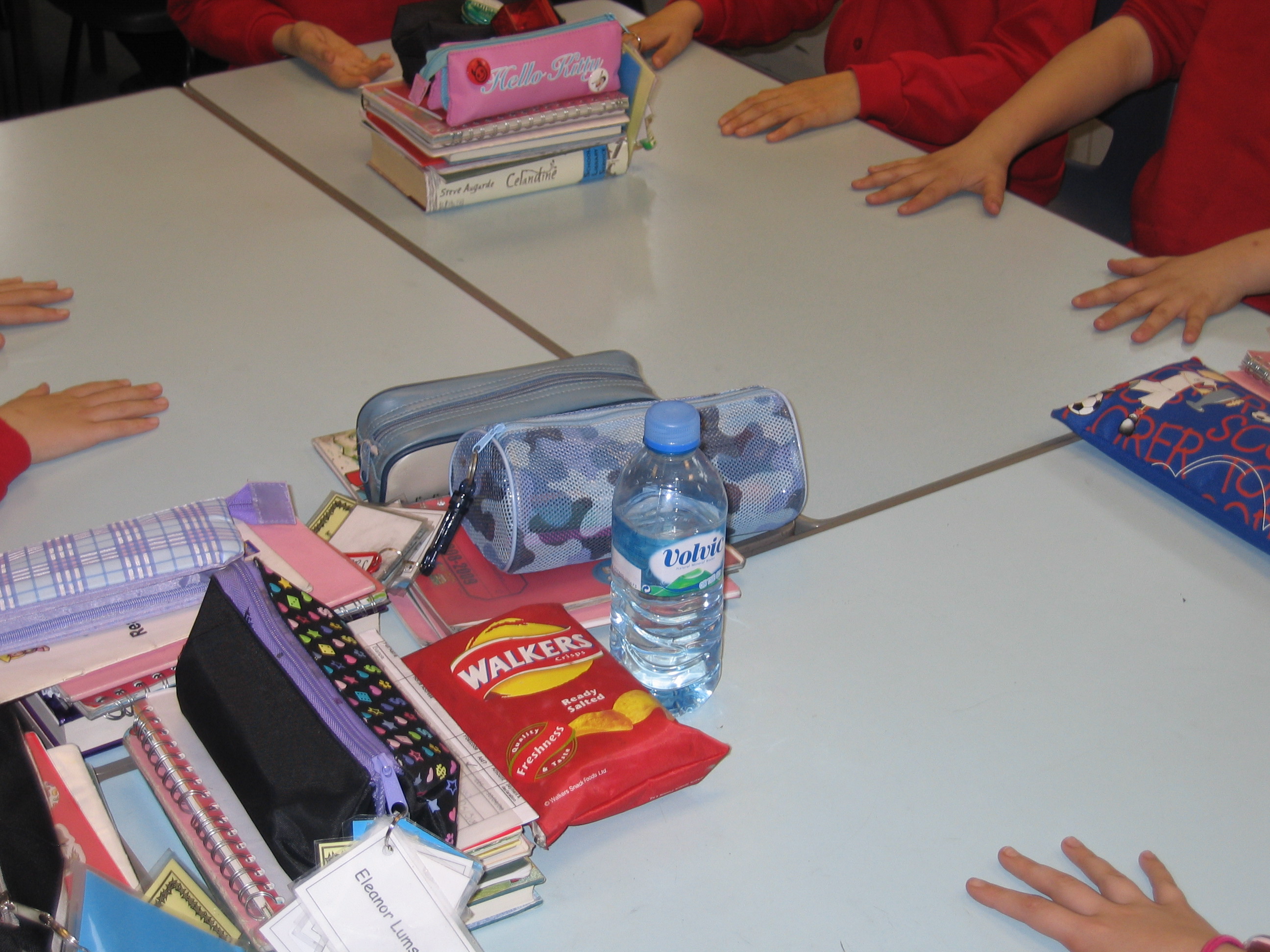
As well as showing various fossils with the class, we run an exercise to test how we place our hands when we are resting.  By splitting the class into groups and appointing a student to supervise the exercise for each group we can get the entire class to repose with their hands in a relaxed, comfortable position.  By studying how we; H. sapiens rest and comparing our resting position with that of a theropod dinosaur we can see differences in how we use our arms and hands compared to a dinosaur.

We carried out this experiment with Year 6 students at Barnfields Primary School in Stafford (England).  The results, were as we predicted with most of these 10-11 years old pupils resting with their hands on the table palms down.  This is a comfortable position for our hands, a very different pose to that of a theropod dinosaur.  If the fossil trackway evidence from Utah proves to be conclusive, theropod dinosaurs rested with their palms facing in a more upwards direction.

Barnfields Primary School Children “Hands Up” Exercise

Examining Dinosaur Hands.

Picture credit: Everything Dinosaur

Pupils with their Hands in a Natural Resting Position

Dinosaur Hands being examined.

Picture credit: Everything Dinosaur

(Our thanks to the Barnfield Primary School, the teachers, parents and pupils for giving us permission to publish these photographs).

The pictures show that the majority of children, when unprompted, placed their hands palms down, interesting also to note the tendency to splay the fingers out, again in response to no prompting.  We were then able to compare the student’s reaction to the fossil trackways and establish differences between our hands and those of a dinosaur.

Teachers and teaching assistants could develop this exercise by plotting the results on a simple bar chart or by introducing concepts of theory testing or describing events.  The peculiar shaped object in the top right had section of the second photograph is actually a fossil, one of the many exhibits that we hand round in class.  It is a fossil of a Woolly Mammoth’s tooth.  Here at Everything Dinosaur, we have developed a number of ideas based around delivering a practical demonstration of real palaeontology – all based around the National Curriculum.  For example, in our lesson plan for this exercise we cover concepts such as “make comparisons and identify patterns – N.C. KS2 SC1 2i” and ” how animals in a habitat are suited to their environment – N.C. KS2 SC1 5c”.

The exercise certainly proved very popular with the pupils and it did demonstrate our ability to pronate our forelimbs (twist our arms), a skill inherited from our tree climbing ancestors, and from the evidence presented here, we humans seem to have a greater range of arm movement than a theropod dinosaur.  So, we can conclude that dinosaurs probably couldn’t juggle.

To view the range of dinosaur and prehistoric animal themed gifts approved by the teaching team at Everything Dinosaur: Dinosaur Toys and Gifts.

24 03, 2009

Addressing the North West Science Alliance at a Special Meeting

By |2024-04-15T13:08:25+01:00March 24th, 2009|Categories: Educational Activities, Everything Dinosaur News and Updates, Main Page|0 Comments

Addressing the North West Science Alliance

This evening one of our team members has the honour and privilege of addressing members of the North West Science Alliance at their quarterly meeting.  The North West Science Alliance (NWSA – I can never understand why scientists, especially those involved in academia revel in acronyms), was established to bring together those parties with an interest in science in the North West of England. 

I am not too sure of the organisation’s mission statement, but in essence a very broad definition of science is given by the NWSA, they cover medicine, natural sciences, engineering, physics, chemistry, biology, technology – an eclectic range of scientific disciplines, as the Chairperson, the very capable Lorelly Wilson says herself: “if in doubt, it’s [the science discipline] included”.

The North West of England has a strong tradition in the sciences with many major science based employers having premises, research stations or factories within the counties of Cheshire, Lancashire, Cumbria as well as the metropolitan areas of Manchester and Merseyside, areas that the NWSA covers.

The geology of the area favours many of these industries, Cheshire is close to the major port of Liverpool, the flat Cheshire plain has proved an ideal location for many chemical companies in particular.  In the past; there was access to coal fields to the south and the especially soft water of the area was ideal for use in many industrial processes.  One of the things the NWSA aims to do is to act as a conduit for schools, colleges and such like helping them to gain access to science demonstrations and scientists to enrich learning.

Such endeavours, just part of what this highly enthusiastic group undertake, will no doubt help to encourage the next generation of scientists.  Certainly, students can have a tremendous enthusiasm for science if they can be motivated and encouraged by innovative and exciting teaching programmes.

From our own point of view, we are not sure what is more daunting, casting a Tyrannosaurus rex tooth from a latex mould in front of a dozen or so excited Year 6 students all wanting to help and all so keen to get involved, or addressing this esteemed body.

Hopefully, our presentation looking at ways in which the NWSA could develop its presence on-line will prove helpful to them.  We certainly have learnt a lot since we started attending about two years ago.

I am sure we will be able to make further contributions to assist this group of dedicated individuals in the future.

For dinosaur themed toys and games visit the award-winning Everything Dinosaur website: Everything Dinosaur.

16 03, 2009

Teaching Exercise – You have to hand it to Dinosaurs

By |2023-02-28T15:38:05+00:00March 16th, 2009|Categories: Educational Activities, Everything Dinosaur News and Updates, Main Page, Teaching|0 Comments

Novel Teaching Exercise (Key Stage 2)

With the announcement of the discovery of clearly preserved theropod hand prints, our innovative teaching team have come up with an exciting class room activity involving the very latest scientific thinking about dinosaurs fore-limbs and hands.

Theropods, are a diverse group of lizard-hipped (saurischian) dinosaurs.  They walked on their hind-limbs, trace fossils of their footprints and trackways are quite well researched but evidence of the posture adopted by their hands and fore-limbs, well that is a different matter.

Thanks to some new fossil data from a site in Utah, USA, scientists have gained further insight into the posture and position of these bipedal dinosaur’s fore-limbs.  Interpretation of trace fossils from the site indicate that one particular dinosaur left resting hand prints in the Early Jurassic mud next to a lake, some 198 million years ago (Sinemurian faunal stage).  The prints made in the sediment indicate that these dinosaurs may have held their hands differently to ours, the prints demonstrate a link to the evolution of the wings of birds.

To read the article about this discovery: Dinosaur Hand prints Reveal Link to Birds.

It is from theropod dinosaurs that birds (Aves) are believed to have evolved.  Although much is known about the anatomy of theropod arms due to the fossil bones found, this new evidence indicates that they held their fore-limbs very differently to ours.  Being humans, we have very sophisticated arms and hands, long since adapted to other tasks rather than locomotion.  For example, we are able to pronate (twist) our arms very effectively and we have much more mobility in our arms and hands in general, when compared to a bipedal dinosaur.

It is not known for sure which type of dinosaur left the prints, but scientists suspect that this 4.5-metre-long animal was some sort of dilophosaur.  This new research has enabled us to develop a lesson plan in which we can carry out simple experiments to prove that the “bunny” position for theropod fore-limbs, seen on many models and even in museum exhibits could be wrong.

An Illustration of A Dilophosaur

Picture credit: Everything Dinosaur

To view a model of a Dilophosaurus along with figures and replicas of other theropod dinosaurs: Dinosaur and Prehistoric Animal Models.

Yet another teaching activity to add to our repertoire.

15 03, 2009

Exciting Frog Blog 2009 – The Frogspawn has Moved

By |2024-04-12T09:14:03+01:00March 15th, 2009|Categories: Animal News Stories, Educational Activities, Everything Dinosaur News and Updates, Main Page|0 Comments

Moving Frogspawn

We were checking back on last year’s notes and articles made about the frogspawn in our office pond.  Interestingly, the frogspawn was laid on March 16th last year and this year it has arrived a little earlier.

To read last year’s article about the sighting of frogspawn: We have frogspawn in the office pond!

Yesterday we commented upon the folklore which stated that depending on where in ponds frogs spawned was an indicator of either a wet or dry spring.  If frogs spawn in the shallow margins, this, according to the old-time sayings of country folk, meant that the spring was going to be wet.  If frogs spawned in the deeper parts of the pond, this meant that the spring was going to be dry.

Our frogspawn has moved, it has sunk down to a deeper part of the pond.  How it has done this remains a mystery.  The eggs are inert and cannot move themselves, so we suspect that either the natural buoyancy of the spawn has changed and the spawn has sunk or the activity of the frogs in the pond may have moved it.  It was quite windy last night so there is a possibility that the wind may have had an effect on the spawn and caused it to move.

So our spawn has been transferred from a shallow part of the pond to a deeper part, so much for the folklore, or did the frogs change their minds over the weather forecast?

Go to Top