All about dinosaurs, fossils and prehistoric animals by Everything Dinosaur team members.

Everything Dinosaur’s work with schools and other educational bodies. Articles, features and stories about dinosaurs and their role in education and educating young people.

14 03, 2009

Frog Blog 2009 – We have Spawn in the Pond again

By |2022-12-20T14:37:45+00:00March 14th, 2009|Categories: Animal News Stories, Educational Activities, Everything Dinosaur News and Updates, Main Page|0 Comments

Frog Blog 2009 – Frogspawn in the Office Pond Again

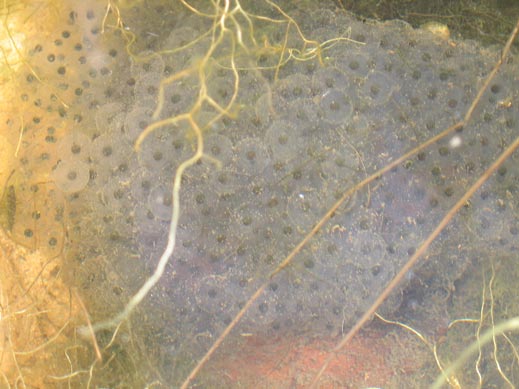
For the second year running we have got frogspawn in the office pond.  We had noticed a number of frogs around and in the pond over the last few days, but today on a quick tour of the office yard we have discovered a small amount of spawn close to the edge of the pond.  There are three frogs in the pond at the moment, they are relatively small and all are croaking.  We think these are males, calling for females, however, one frog has already spawned in the pond and we think that only male common frogs croak.  The spawning probably took place yesterday or very early this morning.

Frogspawn

We shall leave the frogs alone and see if the males can attract any more females to come and lay their eggs.

The Frogspawn laid in the Office Pond
Picture credit: Everything Dinosaur

In a Different Part of the Office Pond

The spawn has been laid in a different part of the pond this year.  The frogspawn laid last year was in the centre of the pond over a deep part of the pond, this year the spawn has been laid in a shallow part.  Folklore states that if frogs spawn in the shallow part of the pond it is going to be a wet spring.  The suggestion is that if frogs lay their eggs in the shallows they believe that there will be plenty of rain to keep the pond topped up and their eggs will not dry out.   We shall have to wait and see.  Hopefully, other frogs will spawn in the pond in the next few days.

6 03, 2009

The Dinosaur A-Z a Helpful Alphabet Teaching Guide based on Prehistoric Animals

By |2024-04-15T14:32:51+01:00March 6th, 2009|Categories: Educational Activities, Everything Dinosaur News and Updates, Main Page|2 Comments

A Dinosaur Alphabet from Everything Dinosaur

Members of the Everything Dinosaur team are qualified and trained teachers.  One of our many roles is to go into schools and reception classes and help young people learn more about science through their fascination with dinosaurs and other prehistoric animals.  We go into all sorts of schools and we get bombarded with questions, our staff get almost as many questions from the teachers and the teaching assistants as they do from the students.

As well as asking questions about prehistoric animals, the teachers often ask us to recommend some teaching materials to assist them in their work.  We try our best to help where we can and have just developed a prehistoric themed alphabet to help young children learn their letters.

A Typical Everything Dinosaur Activity – Indoor Fossil Hunt

Picture credit: Everything Dinosaur

Aimed at reception level classes, our new prehistoric animal inspired alphabet consists of twenty-six different cards, each one representing a letter of the alphabet and showing a picture of a prehistoric animal beginning with that letter.

The Everything Dinosaur – Dinosaur A – Z

From Ankylosaurus to Zuniceratops.

Picture credit: Everything Dinosaur

Each item can be downloaded and printed out to create a card, which illustrates a prehistoric animal and gives a guide to pronunciation.  The matching pairs game that has also been devised accompanies the alphabet cards and should ensure that young children soon get to grips with their letters as well as encouraging very young palaeontologists.

After all, you can have fun and learn at the same time.  These items should be available from Everything Dinosaur as a download shortly.

To see the range of dinosaur and prehistoric animal themed toys and gifts available: Visit Everything Dinosaur.

27 02, 2009

The A-Z of Dinosaurs – A Unique Guide

By |2024-04-15T14:22:43+01:00February 27th, 2009|Categories: Educational Activities, Everything Dinosaur News and Updates, Main Page|4 Comments

A Dinosaur Alphabet – From Ankylosaurus to Zuniceratops

Science and palaeontology have changed a lot since the naming of the first dinosaur (Megalosaurus – 1824), but people’s fascination with these remarkable creatures has not.  It seems that the more fossils we find the greater the number of questions that we have about dinosaurs and other prehistoric animals from the past.

Dinosaurs Alphabet

Children seem to be captivated by them and we are often told by proud parents that their child knows more about dinosaurs then anything else.  Some of these children are very young so we thought it would be a good idea to put our teaching skills to good use and create some learning materials to help children get to grips with the alphabet and numbers.  We have a number of products already aimed at helping children learn, combining their love of dinosaurs with creative play and cognitive development.  One such example is the wooden counting dinosaurs set.

This product combines a jigsaw concept where children can learn to recognise numbers with pictures of dinosaurs that can help them to grasp the concept of numeracy.  It is a great product and one that always performed well when put in a focus group for testing.

The Wooden Dinosaur Counting Set

Dinosaurs by Numbers.

Picture credit: Everything Dinosaur

To view the range of dinosaur and prehistoric animal themed gifts available from Everything Dinosaur: Dinosaur Toys and Gifts.

Inspired by Teachers

Inspired by comments from teachers, we are currently in the process of designing a Dinosaur Alphabet – the joke around the office is that we can handle the dinosaurs but learning the alphabet is a different matter.  We have twenty-six dinosaur cards, each one represents a letter in the alphabet.  They show a dinosaur beginning with the letter, a scale drawing, pronunciation and the letters themselves to help young learners recognise and remember them.

It has been fun to make and includes lots of popular dinosaurs such as Carnotaurus, Stegosaurus and of course Tyrannosaurus rex, as well as some more unusual ones to represent letters such as X and J.  We have had to take a little bit of licence with the letters H and Q, using marine reptiles and the pterosaur Quetzalcoatlus.  We could have commissioned drawings for dinosaurs such as Hadrosaurus and Qantassaurus, but instead we have opted to broaden the type of animals used in this series.

Our new dinosaur alphabet will now go forward into our testing programme and should be available as a download shortly.

From Ankylosaurus to Zuniceratops an Illustration from the Dinosaur Alphabet

An A-Z of the Dinosauria.  Helping young dinosaur fans to learn the alphabet.  A dinosaurs alphabet. Picture credit: Everything Dinosaur.

Picture credit: Everything Dinosaur (Zuniceratops)

Visit Everything Dinosaur’s website: Everything Dinosaur.

24 02, 2009

Sea Monsters – A New Magnetic Play Set

By |2024-04-15T14:23:21+01:00February 24th, 2009|Categories: Educational Activities, Everything Dinosaur News and Updates, Everything Dinosaur Newsletters, Main Page|0 Comments

Sea Monsters – Magnetic Play Set

Building on Everything Dinosaur’s work with a number of marine reptile and other creatures that lived in the ancient seas of the Mesozoic, the company has introduced a sea monster magnetic play set.

Now young dinosaur fans can create their own underwater scenes featuring such amazing and wonderful animals as Dolichorhynchops, Elasmosaurus and Tylosaurus.  These play sets don’t just focus on marine reptiles, the magnetic play sets include giant sharks, primitive fish and the torpedo shaped Xiphactinus.

The Magnetic Play Set from Everything Dinosaur

Picture credit: Everything Dinosaur

To view the huge range of dinosaur and prehistoric animal themed gifts available from the company’s award-winning website: Visit Everything Dinosaur.

On test this particular product proved very popular.  The set consists of two prehistoric scenes and a set of magnetic play pieces representing animals from the Age of Reptiles, from the Triassic right up to the end of the Cretaceous.  In the set, giant sharks such as Squalicorax, squid and the fearsome Xiphactinus fish are featured.  Naturally, the marine reptiles have the largest presence with nothosaurs, mosasaurs, elasmosaurids and even ichthyosaurs included.  The pieces are easy to move and place on the realistic underwater scenes and we found that lots and lots of different stories could be made up about the animals.

This proved an excellent item for creative play and linked into some key stage teaching areas such as building ecosystems and understanding food webs.  We certainly saw a huge number of different scenes, each one depicting a child’s view of an ancient seascape populated by fearsome sea monsters.

As well as stocking an large range of dinosaur and marine reptile toys and gifts, Everything Dinosaur also stock a huge range of prehistoric animal models and replicas including a wide range of marine reptile figures.

There are plesiosaurs, pliosaurs, mosasaurs, ichthyosaurs and also replicas of important fossil invertebrates such as ammonites, trilobites and belemnites.

To view the extensive range of prehistoric animal models available from Everything Dinosaur: Dinosaur and Prehistoric Animal Models.

12 02, 2009

Happy Birthday Charles Darwin Many Happy Returns!

By |2024-04-15T13:47:58+01:00February 12th, 2009|Categories: Dinosaur and Prehistoric Animal News Stories, Educational Activities, Famous Figures, Main Page, Palaeontological articles|0 Comments

200th Anniversary of the Birth of Charles Darwin

Today, February 12th marks the 200th Anniversary of the birth of Charles Darwin, the English naturalist and scientist who influenced scientific thinking through his theories on natural selection and evolution.

Charles Darwin

Darwin’s theories although not universally accepted, are the cornerstone of palaeontological research.  Although he is credited with coming up with the theory of natural selection, other researchers, scientists and thinkers had expressed similar ideas before Darwin.   In the early 19th century, how animals changed from one species to another was not properly understood but it was referred to as “transmutation”.

Indeed, Darwin was eventually forced into publishing his theory as a second English scientist, A. R. Wallace who had been working in the Far East; was about to publish a similar paper on the origins of species.  Darwin being the meticulous man he was had gathered together a vast amount of evidence to support his theory, so much so that when the book “The Origin of Species” was published, he described it as briefing paper as he had to leave out so much of the evidence to support his theory on natural selection.  A modern edition of the book still has over 450 pages.

The Origin of Species

With the publication of his revolutionary and ground breaking work in 1859, Charles Darwin established a view of the world that challenged the long held beliefs about Divine Creation and the development of life.  He challenged the notion that all animals were created at the same time and that they remain fixed, not changing over time.  His work has far reaching implications for humanity and remains one of the most hotly contended issues in science today.  Ironically, Darwin had no knowledge of genetics or DNA so the mechanism for evolution could not be explained.  It was to be another 30 years after his death before the work of the likes of Gregor Mendel came to be recognised and another 70 years or so before the nature of DNA began to be understood.

To read more about the publication of the “Origin of Species”:

Anniversary of the Publication of the “Origin of Species”.

The work and insight of Charles Darwin has made a lasting contribution to science and philosophy, a number of events are planned this year to mark the 200th anniversary of his birth.  The events are grouped under the collective term “Darwin 200” and include documentaries on television, a season of radio programmes exploring the impact of his work, as well as events, presentations and fossil festivals.

Happy Birthday Charles Darwin.

Visit Everything Dinosaur’s award-winning website: Everything Dinosaur.

22 01, 2009

Updating Unique Lesson Plans for Dinosaur Workshops

By |2024-04-15T14:49:43+01:00January 22nd, 2009|Categories: Educational Activities, Everything Dinosaur News and Updates|0 Comments

New Lesson Plans for Dinosaur Worksh0ps

The teaching team at Everything Dinosaur have been updating and adding more experiments and activities to their dinosaur workshops for schools programme. With increasing interest from teachers’s of particular age groups in schools, staff are having to adjust their dinosaur teaching in schools to accommodate the particular learning needs of these other groups.  These actions are all part of our on-going commitment to continuous improvement and also a desire to reflect the latest scientific discoveries when it comes to working with school children.

Dinosaur Workshops

We try, where possible, to build in aspects of real palaeontology into our teaching work, as we think there is no better way to get across scientific principles such as observation, enquiry and challenging assumptions.  We expect that when the national curriculum is reviewed, there will be even greater emphasis placed on mathematics, literacy and science, our teaching team intend to reflect these new initiatives in their support of the work of teachers and teaching support staff.

To learn more about Everything Dinosaur’s  stock of dinosaur and prehistoric animal themed toys and gifts: Everything Dinosaur.

It is also important that we keep learning fun, we are working on a number of physical activities that can be incorporated into our teaching work.  These activities will be aimed at reinforcing learning as well as allowing the session to appeal to different learning styles.

One example is a dinosaur themed letter writing exercise, such as a simple thank you letter from children after a visit from Everything Dinosaur.

A Typical Thank You Letter from a Pupil after a Visit from Everything Dinosaur

Key Stage 1 study dinosaurs in a dinosaur workshop.

Katie writes a thank you letter.

Picture credit: Everything Dinosaur

9 01, 2009

Fossil Sites in Running to be Nominated as Natural Wonders

By |2022-12-13T08:40:08+00:00January 9th, 2009|Categories: Dinosaur and Prehistoric Animal News Stories, Educational Activities, Geology, Main Page|0 Comments

Dinosaur Provincial Park and Flaming Cliffs up for “Seven Natural Wonders” Status

The Dinosaur Provincial Park Formation, one of the richest dinosaur fossil sites in the world is in the line up of contenders to be named one of the world’s top natural wonders.  However, amongst the competition for this prestigious accolade is the Flaming Cliffs site of Mongolia, the location of the discovery of many Asian dinosaurs, including the first fossilised dinosaur eggs and nests.

Fossil Sites

The on-line competition which permits the public to vote for their favourite natural wonder is being run by the New 7 Wonders Foundation.  This is a Swiss based, not-for-profit organisation, founded by Bernard Weber,  Swiss-born Canadian film maker and adventurer.

The list of nominees consists of 261 locations from around the world, split into categories like “mountain”, “river” and “rock formation”.  The United Kingdom is represented by a number of entries, Loch Ness in Scotland is joined by the Calf of Man (in the island category), and a nature reserve in the Channel Islands.

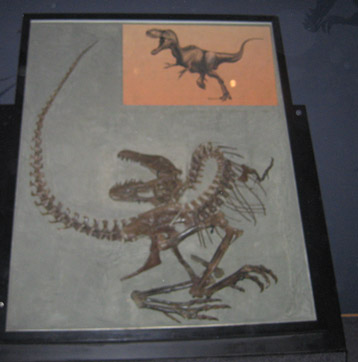
Many Superb Dinosaur Specimens Have Been Collected from the Dinosaur Provincial Park Formation

Albertosaurus fossil exhibit.  One of the famous dinosaur specimens from famous fossil sites.

The “Death Pose” of a dinosaur!  One of the famous tyrannosaur specimens from the Dinosaur Provincial Park Formation (Canada).

Picture credit: Everything Dinosaur

Natural Wonders Nominated

The list of nominations also includes natural wonders such as Niagara Falls, the Grand Canyon and Mount Fuji.

Commenting on the inclusion of the Dinosaur Provincial Park, Brad Tucker, visitor services co-ordinator for the park said:

“This is a wonderful thing. We want to encourage all Canadians to go online and vote for us”.

Acknowledging how stiff the competition was he added:

“We’re up against some stiff competition. We’re amazingly honoured to go to the next step.”

Once the votes have been counted and assessed a short-list of 77 entries will be created.  For Dinosaur Provincial Park, this moonscape of amazing rock formations, already a UNESCO World Heritage Site, just making the initial 261 locations is a real honour.

“It’s absolutely unique on a global scale,” said David Eberth, a senior research scientist at the Royal Tyrrell Museum, the world-renowned museum where many of the dinosaurs and other fossils from the Dinosaur Park are displayed.

In July, voting will close on the short-list and then a panel of experts will decide the top seven.  The announcement will be made sometime in 2011.

To view the nominations and to vote for the seven natural wonders of the world (hopefully a fossil site such as Dinosaur Provincial Park or Flaming Cliffs), you have to visit the official website for the competition.

In the meantime, take a look at the selection of replicas of iconic fossil animals available from Everything Dinosaur’s website: Replicas of Fossil Animals – Educational Toys and Games.

20 11, 2008

Ready to Start Exploring Dinosaurs – Christmas Gift Suggestion

By |2022-12-09T16:21:07+00:00November 20th, 2008|Categories: Educational Activities, Main Page, Press Releases|0 Comments

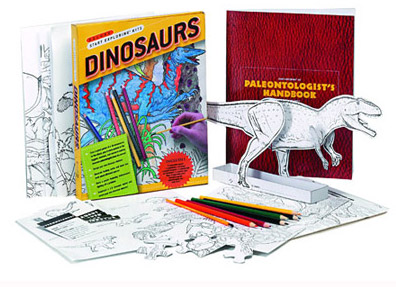
Start Exploring Dinosaurs – Box Set (Christmas Gift Idea)

This time of year we get lots of phone calls and emails from Mums, Dads, and Grandparents asking advice about purchasing Christmas gifts for children, how can they help them start exploring dinosaurs?  Since our company is made up of parents, teachers and dinosaur experts we are well placed to make recommendations.  Indeed, as we conduct our own focus groups and test products before they go into our shop we have a big database which helps us provide information and advice.

Often we are asked to recommend something that will entertain, educate and won’t be a “five minute wonder” to quote one parent.  There are a lot of very good quality and excellent items in our ranges but one particular gift idea is the Start Exploring Dinosaurs Kit.

Start Exploring Dinosaurs Activity Set

Picture credit: Everything Dinosaur

Discover the secrets of dinosaurs with this entertaining and educational activity pack.  Kit comes complete with watercolour pencils, paintbrush, young palaeontologist’s handbook, in fact everything you need to complete the posters, make the puzzle, build the model.  Lots and lots of dinosaur themed activities which can be used to help turn a child’s bedroom into their own “Jurassic Park”.

To view the huge range of dinosaur toys and prehistoric animal gifts available from Everything Dinosaur, visit the company’s website: Everything Dinosaur.

10 11, 2008

Teaching about Dinosaurs and Fossils in School

By |2022-12-09T13:36:36+00:00November 10th, 2008|Categories: Educational Activities, Everything Dinosaur News and Updates, Teaching|0 Comments

Dinosaur Workshops in School

Schools may be preparing for the culmination of the Autumn term ending in the Christmas festivities but team members at Everything Dinosaur are busy keeping up their appearances in schools to undertake dinosaur themed workshops and to help children learn all about dinosaurs and fossils.

As a term topic, something like “dinosaurs” or ” the Jurassic forest” lend themselves to a vast array of extension activities.  These activities encompass numeracy, literacy, creative writing, ICT as well as art and dance.  One of our dinosaur experts visiting a school to conduct a dinosaur workshop was treated to a dance by primary school children that helped explain the extinction of the Dinosauria.  On display in the classroom were lots of artwork as well as examples of prehistoric animal themed stories written by the children.

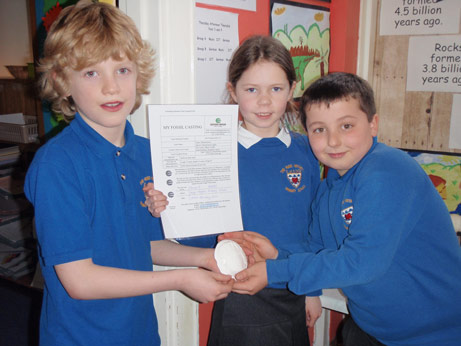
Primary School Children Participate in a Dinosaur Workshop in School

Everything Dinosaur's visit to a school.

Everything Dinosaur’s visit to a school. Picture credit: Everything Dinosaur.

Picture credit: Everything Dinosaur

The children were keen to show off their fossil casts of specimens from the Everything Dinosaur collection and they also were keen to ask our dinosaur expert lots of questions and to demonstrate their subject knowledge acquired through independent learning.

To learn more about the educational, dinosaur themed toys and games provided by Everything Dinosaur visit the company’s website: Everything Dinosaur.

The children had constructed a number of bar charts and pie diagrams as they classified dinosaurs in different ways.  This ties in very effectively to Key Stage 1 teaching objectives that involve how to express data and how to demonstrate the plotting and recording of figures.

9 11, 2008

Changing Views on Sauropods (New Research)

By |2024-04-15T13:16:36+01:00November 9th, 2008|Categories: Educational Activities, Main Page, Palaeontological articles|2 Comments

Changing Views on Sauropods – Long-necked Dinosaurs

The huge, long-necked sauropods such as Diplodocus and Brachiosaurus are extremely well known in popular culture but although many museums exhibit specimens of these enormous creatures, our level of scientific knowledge particularly the phylogeny of these creatures remains relatively poor.  Thanks to recent discoveries of some seemingly transitional forms from prosauropods to the true sauropods, dinosaurs such as Lessemsaurus from Argentina and Chinshakiangosaurus from China for example, our understanding of the evolution of these animals is more complete.

The sauropods were a truly remarkable group of dinosaurs, with some of the oldest sauropod fossils dating from the beginning of the Jurassic and with the last titanosaurs surviving in the Americas and other parts of the Southern Hemisphere right up to the end of the Cretaceous, approximately 66 million years ago.  Although these animals had their hey day in the Jurassic, no other type of herbivore has dominated terrestrial ecosystems quite like the sauropods.  With their massive bulk, animals like Apatosaurus for instance could weigh in excess of 30 tonnes; they decimated the vegetation within an environment before moving on in vast herds to find fresh feeding areas.

Sauropods represent a truly unique group of animals, there is nothing alive today to compare with them and their size, power and myriad of forms are truly amazing.  Most sauropods are classified into two distinct types, the Macronaria (big nostrils), nasal openings in skulls are bigger than the orbit (eye).  Sauropods typical of the Macronaria group are animals such as Brachiosaurus and Camarasaurus.

To see a scale model of Brachiosaurus and other sauropod figures: Dinosaur Models and Toys.

The other main type of sauropod are the Diplodocoidea, animals such as Diplodocus and Seismosaurus.  Some very bizarre forms of sauropod are known.  For example, scientists know that a number of later sauropods (titanosaurs) were armoured, but also many of the lesser known sauropods also possessed body armour, scutes and even clubs on the ends of the tail.

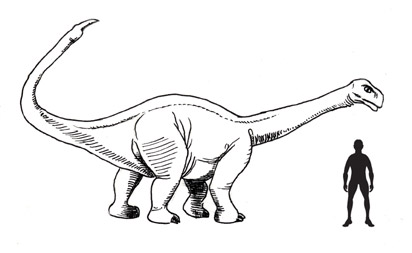
Shunosaurus from the mid Jurassic of China had a club on the end of its tail.  When the first fossils of this dinosaur were found in 1979, the tail was thought to have become damaged and the bones had not healed properly and had become infected, producing this abnormal growth in the single specimen discovered.  Several fully articulated fossil Shunosaurus are now known and all possess this club-like feature on the end of their tails.  Scientists were able to conclude that the swollen tail of this dinosaur was not the result of an injury or disease (pathology), but this dinosaur possessed the equivalent of a medieval mace on the end of its tail.

An Illustration of Shunosaurus

Picture credit: Everything Dinosaur

To view a model of Shunosaurus and other figures in the Safari Ltd model collection: Wild Safari Prehistoric World.

This particular sauropod is estimated to have reached lengths in excess of 9 metres and it was one of the most common type of long-necked dinosaur found in what was a vast, Jurassic floodplain now being excavated at the Dashanpu quarry site.

Go to Top