All about dinosaurs, fossils and prehistoric animals by Everything Dinosaur team members.

Everything Dinosaur’s work with schools and other educational bodies. Articles, features and stories about dinosaurs and their role in education and educating young people.

29 10, 2008

Anniversary of the Birth of Othniel Charles Marsh

By |2023-02-25T20:27:37+00:00October 29th, 2008|Categories: Educational Activities, Main Page, Palaeontological articles|0 Comments

Othniel Charles Marsh 1831 – 1899

On the 29th October 1831, Othniel Charles Marsh was born.  He was destined to become one of the most influential and important palaeontologists of the 19th century.

Othniel Charles Marsh

Born in New York, Charles was educated at Yale and went onto study geology and mineralogy.  Following this he travelled to Germany to study palaeontology.  Returning to America, he was appointed professor of vertebrate palaeontology at Yale University (the first professor of palaeontology ever appointed in the United States), he went onto persuade his uncle, the wealthy entrepreneur and philanthropist, George Peabody, to establish a museum of natural history (Peabody Museum at Yale).

Marsh was one of the great pioneers of American palaeontology, leading a number of successful exhibitions to the west of the United States as the geology of this territory began to be opened up and fully explored.  He described 19 different genera of dinosaur and competed fiercely with his rival Edward Drinker Cope to find the best specimens for the museums back in the east of the USA.  Their rivalry became known as the “Bone Wars”.  Marsh’s expeditions made a number of important discoveries, they unearthed the first American pterosaur fossils and Marsh went onto name and describe some of the most famous of all the dinosaurs Allosaurus, Apatosaurus and Diplodocus.

A Model of an Allosaurus

Mojo Fun Allosaurus dinosaur model (2020).

New for 2020 the Mojo Fun Allosaurus dinosaur model. Picture credit: Everything Dinosaur.

Picture credit: Everything Dinosaur

The Mojo Fun range of models and figures includes replicas of several prehistoric animals that were named and described by Othniel Charles Marsh: Mojo Fun Prehistoric and Extinct Animal Models.

A number of extinct species have been named in honour of this professor, for example the hypsilophodontid Othnielia (fossils found in Colorado, USA), was named after Othniel Charles Marsh.

Writing Scientific Papers

Marsh also devoted a great deal of his time to writing papers and attempting to find order amongst vertebrate evolution, describing a number of toothed birds and flying reptiles.   One of his greatest contributions to science was his study of the evolution of horses, published as the Darwinian debate raged.  Marsh’s paper outlining how horses evolved from small, many-toed browsers to fleet footed, large single-toed grazers was seen by many scientists of the day of evidence in support of Darwin’s theory of natural selection.

While travelling to the western USA in 1868, Marsh was told of a strange discovery of what was believed to be human bones in Nebraska.  He was curious but doubted that the bones belonged to an ancient race of humans, however, he did ask to view them and quickly identified them (correctly), as ancient horse fossils.  Marsh insisted on having the remains sent to him for further analysis.  He determined that they had come from an animal from Pliocene times that was barely three feet tall  and had long slender legs which ended with three toes on each foot. He dubbed the small horse Equus parvulus (now known as Protohippus).

In subsequent expeditions to the the western USA more fossils of horses were found, a mystery in itself as horses were not known in America until they were introduced by the Spanish.

Using the many different types of horse fossil found and relating each discovery to the age of the rocks from which the fossil was extracted, Marsh was able to build up a picture of the evolution of equines.  In a paper published in 1874 in the scientific journal “American Naturalist”, Marsh describes some of the horse fossils he found on an expedition in Wyoming and Utah. One of these skeletons, he named Eohippus, or “the dawn horse.”

By studying the numbers of toes and different degrees of variation, especially the variations in the leg bones Marsh was able to set out a chronological order of horse development from the small browser Eohippus to the modern horse.  Marsh determined the line of descent by examining the metacarpal bones (toe bones) of the different horses.  He compared what he found to the legs of modern horses, and found remnants of digits IV and II along the cannon bones (this is more evident in the forefeet that hind).

The time scale shows the Palaeogene on the left right up to modern times with the domestic horse.  Over millions of years the primitive horses gradually evolved into the larger, faster running animals we know today.

Darwin’s theory of natural selection operates on very small differences that exist between living things in a population.  Any slight mutation or modification that an animal has may give it an advantage over its contemporaries.  This animal is more likely to survive and pass on this trait to its offspring.  As a result of heredity it is likely that these descendants will have the features of the parent and will therefore pass this feature on when they breed too.  In this way, a mutation can become inherent in an entire population over time.

Support for Darwin’s theory was difficult to obtain as central to his argument was that these differences altered organisms over vast amounts of time.  Marsh’s study of the evolution of the horse from a four-toed small browser into the single-toed animal we know today was evidence supporting Darwin’s theory.

Charles Darwin himself, although quite elderly, expressed a desire to travel to America to see Marsh and his collection at Yale.  It was this work that helped popularise the theory of natural selection amongst New World scientists and it is for this ground-breaking study, as well as his work on the dinosaurs that Othniel Charles Marsh is best remembered.

9 10, 2008

Jellyfish Ancient Predators of the Palaeozoic

By |2022-12-09T10:57:53+00:00October 9th, 2008|Categories: Educational Activities, Main Page, Palaeontological articles|0 Comments

Jellyfish – An example of a “Living Fossil”

Most of us are familiar with jellyfish and have occasionally encountered them as washed up animals as we walk along a shoreline.  Others may have had the unfortunate experience of bumping into one whilst swimming and getting stung.  Depending on the species these stings can be very painful, but apart from the occasional thought about how curious these animals look, few of us rarely consider these animals or indeed recognise them as living fossils, unchanged for over 600 million years.

Jellyfish

Jellyfish belong to a phylum called Cnidaria (pronounced nigh-dare-ee-a).  This phylum consists of a huge range of animals, almost all of them associated with marine environments.  Cnidarians have a central mouth, surrounded by tentacles which possess stinging cells (called nematocysts).  The tentacles are used to catch and disable prey which is then drawn into the central mouth and consumed.  Within the fossil record, by far the most important type of Cnidarians represented are the corals.  These animals may live in colonies or have a solitary habit.  All corals secrete a hard, exoskeleton made up of calcium carbonate and the extant species today are known as scleratinian corals.  These scleratinian corals (solitary or can be linked together sharing a colonial skeleton), evolved relatively recently appearing at around the beginning of the Mesozoic, after the great Permian extinction event.  Older coral fossils found in the Palaeozoic fossil record are either rugose corals (solitary or colonial) or tabulate corals (always found in colonies).  These types of corals both went extinct at the end of the Permian but fossil corals are known to date right back to Ordovician aged sediments.

The Phylum Cnidaria

The phylum Cnidaria also has soft-bodied representatives, these are the sea anemones and jellyfish, scientists believe that these type of animals are even older than the first corals.  Being soft-bodied, jellyfish and sea anemones are very poorly represented in the fossil record, in fact these fossils are extremely rare and the number of fossil specimens found to date does not represent the diversity or indeed the abundance of these animals throughout the Phanerozoic eon (or indeed the Cryptozoic eon).

Jellyfish Fossils

There are some strange, preserved ripples and hollowed out round depressions found in very finely grained, sandstone, Cambrian sediments from around the world.  These are believed to be the fossilised remains of jellyfish.  It is thought that many of the fossils of these animals that we have were formed when mass strandings of jellyfish occurred after a storm.  Having been washed up onto a Cambrian or Ordovician shoreline, the carcases of these animals would not have been eaten by scavengers as there was no significant life on the land during these geological periods.  Some of them may have  been quickly buried and under exceptional conditions, preserved as impressions in the rocks.

It is thought that primitive life such as bacteria and cyanobacteria first evolved as far back as 3.5 billion years ago, but complex multi-celled animals appeared much later, sometime between 700 and 620 million years ago.  Multi-celled animals are termed metazoans (pronounced met-ah-zo-ans) and their appearance in the fossil record marks the ending of the Cryptozoic (hidden life also known as the Precambrian) and the start of the Phanerozoic eon (visible life).

Studying Early Life

Certainly, the fossil evidence for the first metazoans is extremely poor.  All the first complex creatures were entirely soft-bodied but their fossils are evidence of complex multi-celled organisms living in late Precambrian times.  The Ediacaran Hills in the Flinders range of mountains in South Australia was one of the first places studied.  This is why the fossils of such organisms are often referred to as “Ediacarans”.  This was a world dominated by jelly and from fossils found in places as diverse as Siberia and Namibia, scientists are able to calculate that even 620 million years ago, primitive life was abundant and diverse.  The jelly structures of the Ediacarans may have been more robust than those found in jellyfish, after all, jellyfish consist of 95% water, this may explain why Ediacaran animals may have been more readily fossilised than jellyfish.  However, certainly by the Cambrian, jellyfish were very much established and as carnivores would have been perhaps one of the most feared predators around during the early Palaeozoic.

An Illustration of a Jellyfish

Picture credit: Everything Dinosaur

The picture above is of a typical jellyfish with a bell-like structure and trailing tentacles.  Jellyfish are often termed Medusa, a reference to Greek mythology and the Gorgon Medousa who had snakes instead of hair.

To view replicas of fossil animals: Fossil Replica, Dinosaur Models, Prehistoric Animal Models.

Animals as diverse as jellyfish and corals are grouped in the Cnidaria phylum as all these organisms share a central mouth surrounded by stinging tentacles (termed nematocysts).  Scientists believe that corals, sea anemones and jellyfish are all descended from a common ancestor, that had these features.  There are many thousands of species of jellyfish found today.  They live in polar seas as well as the tropics and can be found right through the water column with nektonic forms (animals that live above the sea floor), being found in shallow seas and at extreme depths.  It is thought that there have been hundreds of thousands of species of jellyfish, but only a few specimens have been preserved in the fossil record.  Jellyfish have no definite head structure, no internal organs as such and most have only the most primitive senses.  Jellyfish are very much dependent on sea currents to move them, most species drift with the prevailing current, although a number of Classes can pulse their bells to help them move vertically through the water column.

Cambrian Animals

Although regarded as extremely simple animals when compared to the Chordates for example, during the Late Precambrian and into the Cambrian these types of animals may have been amongst the top predators around at the time.  Jellyfish predating on other organisms may have been a causal factor in the speeding up of evolution (known as the Cambrian explosion), as predator/prey relationships developed.  Our ancestors, those simple animals with a notochord would have fallen victim to the stinging tentacles of the jellyfish.  Perhaps they began to evolve improved senses, a significant head end to house these new senses and stronger groups of paired muscles around a central nervous strip to help them escape from their jellyfish foes.

The next time you see a jellyfish washed up on a beach as you walk along a shoreline, you might well give it a second glance.  It represents a type of animal that has been around for something like 600 million years and its evolution may well have contributed to the evolution of the earliest Chordates and the speeding up of evolution as predator/prey relationships developed.  Jellyfish can certainly be described as “living fossils”.

8 10, 2008

An Amazing Fossil Replica Set From Everything Dinosaur

By |2024-04-15T12:25:59+01:00October 8th, 2008|Categories: Educational Activities, Everything Dinosaur News and Updates, Main Page|0 Comments

Prehistoric Animal Fossil Replica Set

When members of the Everything Dinosaur team visit schools we get bombarded with questions from students and teachers about dinosaurs and we recommend our prehistoric animal fossil replica set to them.  These animals are certainly the super stars of palaeontology.  However, when we are carrying out experiments or teaching exercises with school children we like to introduce other prehistoric animals and their fossils to help pupils gain a more rounded picture regarding the evolution of life on Earth.

Not all fossils are dinosaur fossils for example, quite a difficult concept to get over to a dinosaur mad five-year old.  Some of the most important types of fossil are not huge when compared to the immense fossilised bones of a Tyrannosaurus rex, but they can be very important to scientists.  Certain types of fossil such as ammonites and trilobites are extremely important as they help scientists date the ages of strata relative to one another.

The use of fossils to help date the relative ages of different rock formations is called biostratigraphy.  It was the English engineer William Smith, known as the “Father of Geology” who along with the French scientists Georges Cuvier and Alexandre Brongniart observed that successive layers of sediment contained fossils that were characteristic of certain periods of ancient history.  The discovery of the relationship between fossils and certain geological periods opened up the prospect of using fossils to establish a relative sequence of rock deposition through time.

The types of fossil used to help date rocks in this way are called “zone fossils”.  Despite all the attention dinosaur fossils receive and the vast amount of museum gallery space allocated to them, dinosaur fossils along with most other types of vertebrate fossils are very poor zonal fossils.  Ideally, for a family or genus of animals to become useful zone fossils they should be rapidly evolving, be distinctive in appearance, wide ranging and abundant in the ecosystem.  If you live in a shallow sea, and have a hard exoskeleton or shell then this is even better as there is a greater chance of some members of your species being preserved as fossils buried in marine sediments.

Dinosaur fossils in contrast, are rare, often found as incomplete remains and not from marine environments (only in very unusual cases – Scelidosaurus springs to mind).  They are unsuitable as zone fossils.  Not so the ammonite and trilobite which make ideal zone fossils and have helped to date rock strata in relation to other rock formations all over the world.

The importance of fossils of animals such as belemnites, ammonites and trilobites cannot be underestimated.  What is more, most young palaeontologists start their fossil collection with the find of a fossil of an invertebrate, a brachiopod for instance, or perhaps their very own ammonite.

In recognition of the importance of invertebrates in the fossil record, Everything Dinosaur has introduced a set of replica models to illustrate these animals.

Everything Dinosaur Replica Fossil Set

Picture credit: Everything Dinosaur

The set consists of two different types of ammonite, a belemnite (close relative of ammonites) a typical trilobite and a model of a Medusa jellyfish as a representative of soft-bodied animals in prehistory.

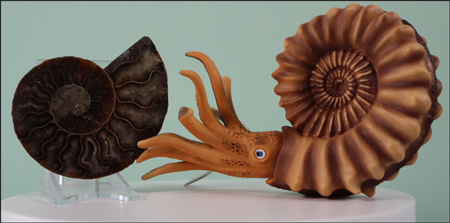
Model of an Ammonite

The Bullyland ammonite model next to a polished section of an ammonite fossil.

The Bullyland ammonite model is often used in museum displays to depict the living animal next to fossil material. Picture credit: Everything Dinosaur.

Picture credit: Everything Dinosaur

Each model comes with a fact sheet written by Everything Dinosaur team members, these robust and sturdy models with their detailed hand-painted designs represent other animals from the past.

To view dinosaur toys, dinosaur models and other fossil replicas: Replica Fossils and Dinosaur Models.

Whether it is for a school project, home study or just to add to a model collection, these accurate prehistoric animal models certainly hit the mark and can provide a stimulus for further study.

22 09, 2008

Animals in Armour – The Successful Trilobite

By |2022-12-08T12:52:26+00:00September 22nd, 2008|Categories: Dinosaur and Prehistoric Animal News Stories, Educational Activities, Everything Dinosaur News and Updates, Main Page|0 Comments

The Trilobite – An Arthropod with a Tremendous Fossil Record

Insects are regarded as the most diverse of all the animal classes on planet Earth.  To date something like 1,000,000 different species have been recognised and it has been estimated that there may actually be 30 million different species of insect around today.  These numbers are truly astronomical, especially when some members of staff at Everything Dinosaur remember estimates for the total biodiversity for all animal species on this planet being put at around 2 million species as recently as the mid-1970s.

The Trilobite

However, the class Insecta makes up just part of a remarkable phylum – the Arthropoda, a phylum that can be traced back to the Cambrian and in all likelihood these animals and their ancestors made up a great portion of the life that existed during the Cryptozoic, that vast eon of time, otherwise known as the Precambrian when there was life on Earth but it has left few traces in the fossil record.

Arthropods have evolved to fill a vast array of environmental niches, with types of arthropod found in most habitats – in water and on land.  Crustaceans, such as crabs, lobsters, barnacles and shrimps, along with all insects, scorpions, mites, spiders and millipedes are all members of this phylum.  A number of extinct types of arthropod are represented in the fossil record.  The most important extinct group are the Trilobita. These armoured animals evolved in the Early Cambrian and survived until the end of the Palaeozoic.  As a class, Trilobita finally died out around 250 million years ago, at the end of the Permian period, when approximately 90% of all life forms became extinct.

Ten Orders of Trilobita

Ten orders of Trilobita are recognised at present, although the taxonomic classification and phylogeny of trilobites is frequently reviewed and debated.  Despite the extensive fossil record of these animals, (their exoskeletons are partly comprised of calcite and this coupled with their marine existence gives them a high potential for preservation as fossils), there are still gaps in our knowledge regarding the evolutionary relationship between different orders.

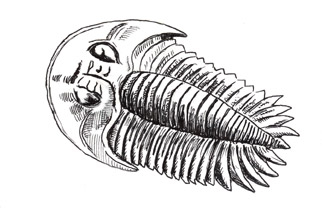
An Illustration of a Typical Trilobite

Picture credit: Everything Dinosaur

Approximately, 20,000 species of trilobite are known, they are regarded as the standard bearer for the entire fossil record represented by Palaeozoic strata, although as a group the Trilobita were at their most diverse and abundant in the early Palaeozoic.  All but one order of trilobites were extinct by the end of the Devonian, and by the end of Permian only two families of trilobite remained with a number of other families dying out in the mid Permian.  Changes in climate, rising sea levels and the evolution of efficient predators such as sharks have all been put forward as theories to explain the demise of the trilobite.

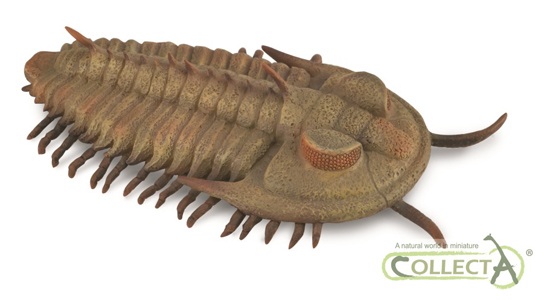
A Replica of a Trilobite

CollectA Redlichia rex trilobite.

CollectA Redlichia rex trilobite model.

CollectA offers a range of replicas of iconic fossil animals including a trilobite: CollectA Prehistoric Life Models and Figures.

They were certainly a remarkable and highly diverse group of animals and their importance in biostratigraphic processes as well as the assistance of their fossils in the relative dating of strata should not be underestimated.

We have recently introduced a model of a typical trilobite to our range.  This makes an excellent addition for the serious model collector or for school/home study.

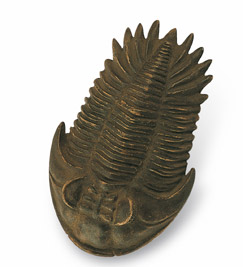
A Model of a Trilobite

Picture credit: Everything Dinosaur

To view the fossil replicas in stock at Everything Dinosaur as well as a huge range of prehistoric animal models and figures: Dinosaur Models and Prehistoric Animal Figures.

15 09, 2008

Blogging on a Beautiful Belemnite

By |2024-04-15T12:17:18+01:00September 15th, 2008|Categories: Educational Activities, Main Page|0 Comments

Belemnites – an Introduction to the Joys of Fossil Hunting

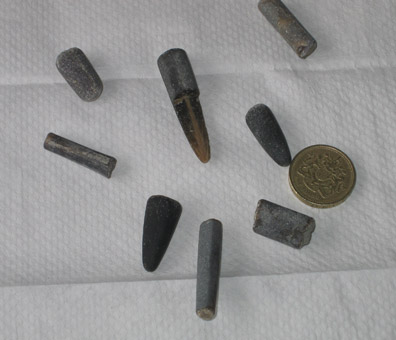
For many people a fossilised rostrum of a belemnite found on the shoreline, washed out of Mesozoic marine sediments is their first fossil find.  The bullet shaped fossils are easy to distinguish and often occur in large concentrations within fossil bearing strata.

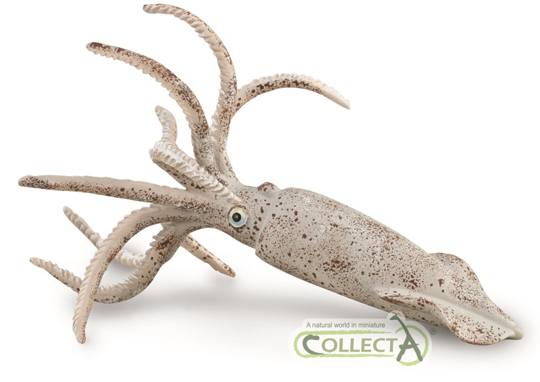
Belemnites are extinct cephalopods, related to the ammonites and although they superficially resemble squid they are more closely related to extant cuttlefish.  Many hundreds of different species are known, most are classified according to subtle differences in the shape of the rostrum (otherwise known as the guard).  Guards can be quite pointed, rounded or almost blunt at the rear end and it is these differences that enable scientists to identify various genera.  The word belemnite (pronounced Bell-em-night), is derived from the Greek for dart or javelin.  Looking at the fossilised calcite guards of these animals it is quite easy to see why.

Various Belemnite Fossilised Rostra from Southern England

Picture credit: Everything Dinosaur

The picture above shows various belemnite guards collected by Everything Dinosaur team members at Charmouth on the Dorset coast and at Ravenscar near Whitby on the Yorkshire coast.  The pound coin is shown for scale (I wonder if I will get it back)?

The large belemnite fragment in the centre has been split to show the calcite internal structure.  These types of fossils are very robust and are often transported away from their original sediments, washed out of marls and ending up in gravel beds and such like.  Belemnite fossil fragments such as these have been known to turn up in Quaternary dated river gravel sediments.

Belemnite

The numerous fossil belemnite guards we placed in the fossil hunting trays at our recent exhibition at the World Museum at Liverpool, proved extremely popular.  With many young people able to take home their own fossil of a belemnite guard.  Due to their abundance in some marine strata, belemnites can also be used by palaeontologists and geologists to date layers of rock, but ammonites often prove more effective key fossils as they have more diverse forms.  Certainly, the basic belemnite body plan seems to have been a very successful design as these animals evolved few variants on this body plan throughout late Palaeozoic right through to the end of the Mesozoic.

Unlike ammonite remains, scientists have been able to find preserved soft body tissue of belemnites and we therefore have a very good idea of what they actually looked like.  In very fine grained sediments in Wiltshire (England), and at the famous lithographic limestone beds of Solnhofen in Germany a number of fossils of belemnites have been found with traces of their soft body parts visible.  Solnhofen is particularly famous for fossils of the ancient bird Archaeopteryx, but this part of southern Germany has produced a huge number of fossils both vertebrate and invertebrates are represented.  The main fossil bearing strata are around the towns of Eichstatt, Kelheim and Solnhofen and to date some 360 different species of belemnites have been identified along with numerous fossil plants and vertebrates including fish, crocodiles, turtles, ichthyosaurs, pterosaurs and even dinosaurs.

The Late Jurassic of Europe

During the Late Jurassic much of this part of Europe was covered by shallow seas and the Solnhofen deposits represent the bed of a shallow, still lagoon.  The bed of this lagoon could not support life, so that if animals and plants were washed out into the water, they sank to the bottom and were not scavenged, permitting almost intact specimens to be preserved.  The very fine sediments and the still, anaerobic conditions enabled a great deal of detail to be preserved such as the arms and other soft tissues of belemnites that must have been washed into the lagoon from the open sea.

It is from these fossils that scientists have calculated that belemnites had ten equally sized arms, with hooks to grab and secure prey on them.  They had beak-like mouths, large eyes and there is some fossil evidence to suggest they possessed ink sacs like modern squid.

A Replica of a Belemnite

CollectA Belemnite model.

CollectA Age of Dinosaurs Popular Size Belemnite model.

To view a model of a Jurassic belemnite and other prehistoric animal invertebrate replicas in the CollectA model range: CollectA Prehistoric Animal Models and Figures.

Belemnites were preyed upon by a number of animals including small marine crocodiles, pliosaurs and ichthyosaurs.  Indeed, many small ichthyosaur fossil skeletons have hundreds of belemnite hooks preserved in the area where the stomach would have been.  It is thought that these animals vomited up the indigestible parts of the belemnite.

13 09, 2008

Ice Age Mammals make their Debut

By |2022-12-07T07:24:34+00:00September 13th, 2008|Categories: Educational Activities, Everything Dinosaur News and Updates, Main Page, Press Releases|2 Comments

Ice Age Mammal Models now Available

Animals that lived during the last Ice Age, the so called “megafauna” of the Pleistocene epoch, the Ice Age mammals, are almost as popular as dinosaurs.  In fact a number of animals such as Sabre-toothed cats, Mammoths and Woolly Rhinos frequently appear in our regular surveys amongst young people regarding favourite creatures from the past.

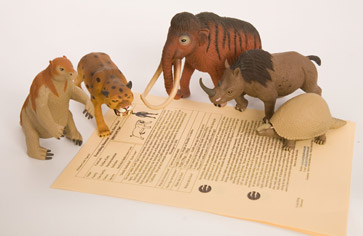
Designers from the London Natural History museum and team members at Everything Dinosaur have brought some of these animals back to life with the introduction of a range of prehistoric mammals that are now available to purchase as individual models as well as in a set.

As well as a large model of a Woolly Mammoth, a Woolly Rhino and of course the fearsome Sabre-toothed cat (Smilodon), the set also includes a Megatherium (giant ground sloth) and the bizarrely armoured, gigantic Glyptodon.  Both the Megatherium and Glyptodon represent animals that lived in the Americas.

The Set of Five Mammal Models

Picture credit: Everything Dinosaur

To view prehistoric mammal models and other replicas available from Everything Dinosaur: Prehistoric Animal and Dinosaur Models.

Beautifully designed and painted to show exquisite detail, these accurate prehistoric mammal models are great for creative play or school study.  Each model is supplied with its own animal fact sheet, produced by the experts at Everything Dinosaur.

We are currently living in what is termed the Quaternary Period of geologic time. This period began about 1.8 million years ago, but it is divided up into two epochs, the Pleistocene and the Holocene.  During the Quaternary ice ages, cold adapted species such as the Woolly Rhino and Mammoths evolved.  The Pleistocene period lasted until 10,000 years ago, when a sudden thaw occurred and the world’s climate warmed up dramatically.  This change took no more than fifty years to come about and resulted in several extinctions.  It is due to this sudden climate change that the Quaternary has been divided into two distinct epochs.

Since this period of rapid warming, the Earth’s climate has been more stable than during any other 10,000 year interval in at least the last 200,000 years.  Handy if you are the sole surviving species of hominid and you are just beginning to increase in numbers.

9 09, 2008

A Wonderful Thank you Letter from Becky

By |2024-04-15T12:20:22+01:00September 9th, 2008|Categories: Educational Activities, Teaching|0 Comments

School Pupil Writes Thank you Letter to Everything Dinosaur on Behalf of Her Class

After another visit to a primary school to teach about dinosaurs and fossils, this time one in Lancashire, our dinosaur expert was asked by the school teacher for a small favour.

Would it be all right with you,  if the children composed a thank you letter?

Fine by us, in fact we actively encourage creative writing in schools and we get asked for lots of ideas and advice when it comes to motivating young people at Key Stage 1 with creative writing tasks.

The teacher concerned (Miss O’ Hara), supported by her teaching assistant (TA) organised a brief session with the children in which they recalled and recounted some of the things they had done and what they had learned after the dinosaur workshop in school.  Flip chart paper was used by the children to list facts about dinosaurs that they had learned and from these sheets, what was going to be said in the actual letter was determined.  Then it was simply a question of briefing the children in what is expected when it comes to the layout of a letter.  For instance, the correct starting phrase, appropriate use of punctuation, connectives and so on.  I number of children wrote letters, and the teacher selected one to be sent on to the Everything Dinosaur offices.

Everything Dinosaur

It was Becky’s letter that was selected:

Young Becky (aged 6), wrote:

“Dear Everything Dinosaur,

Thank you for visiting our school this week, it was lovely to meet you.  Please, please come back to us as we all had such fun learning about dinosaurs.  We had fun with you and I liked making the fossil casts best.  We all laughed when Miss O’ Hara got to hold he dinosaur dung, we said she should wash her hands before she has her dinner.  I learned a lot and it helped me with my own dinosaur work.

From

Becky

(Class 1)”

Our team members get a lot of similar correspondence, however, we always acknowledge receipt of any such letters and email a reply to the school teacher responsible for the class. Glad we were able to make teaching about dinosaurs so much fun.

To learn more about Everything Dinosaur’s product range: Visit Everything Dinosaur’s Website.

5 09, 2008

Taking a Tyrannosaurus rex to Liverpool for a Special Event

By |2024-04-12T18:45:41+01:00September 5th, 2008|Categories: Educational Activities, Everything Dinosaur News and Updates, Main Page|0 Comments

Gearing up for the BA Festival of Science – Science Explosion

Team members have been busy all week preparing for the BA Festival of Science which is taking place at the Liverpool World Museum over the weekend.  Many of us have been “burning the midnight oil” going over the plans we have for our part of this exhibition that will feature the likes of the Open University and many national museums as well as ourselves waving the flag for palaeontology.

Our intention is to bring a little bit of the Mesozoic to Merseyside by recreating Charmouth beach at the museum and encouraging the young visitors to go on a fossil hunt to see what they can find.

We have built two, large collapsable wooden trays, each lined with plastic that will form the framework for our beach display.  These trays will be filled with pebbles, gravel and all sorts of typical items you would find on a beach.  However, in amongst all the stones will be fossils of belemnites, ammonites, crinoids, brachipods, pieces of ichthyosaur bone and other cool stuff, representing what you would find if you visited places like Church Cliffs or the Black Ven on the Dorset coast.

As well as providing a glimpse into the Jurassic, our team will be bringing over some life-size cast replicas of dinosaur fossils including the premaxilla and maxilla (upper jaw) of a Tyrannosaurus rex.

Tyrannosaurus Maxilla

Picture credit: Everything Dinosaur

The casts will give young people the chance to get to grips with some really exciting dinosaurs, as well as T. rex we have the dentary (lower jaw) of a Triceratops, some fossil dinosaur poo from a sauropod and lots of teeth and claws so that people can see for themselves just how big some of these critters got.

Should be a fun day, we will take a camera so expect a couple of pics.

Visit Everything Dinosaur’s award-winning website: Everything Dinosaur.

31 08, 2008

The Loveable and Adorable Ammonite

By |2024-04-13T08:37:24+01:00August 31st, 2008|Categories: Dinosaur and Prehistoric Animal News Stories, Educational Activities, Everything Dinosaur News and Updates, Main Page|0 Comments

Why Palaeontologists Love Ammonites

Surrounded by various dinosaur fossils such as bones, pieces of eggshell, gastroliths (stomach stones) and even some fossilised sauropod poo (coprolite), in our offices, it is easy to get carried away with dinosaurs.  However, over the weekend, whilst working on some new product additions we got the chance to discuss the importance of ammonites to scientists.

Ammonites are a large group of Mesozoic cephalopods, close relatives of squid, cuttlefish and the octopus, these are the animals that lived in flat-sided, coiled, planispiral shells (most ammonites had these type of shells).  Originating in the Late Silurian, most likely from more simple, straight shelled molluscs, the bactritoids these animals survived numerous mass extinction events and became one of the most abundant life forms in Mesozoic marine environments, along with their close cousins the belemnites.

The bactritoids (orthoconic shelled animals – means straight shells), originated sometime in the Devonianband persisted until the Early Triassic.  As well as being considered the ancestors of the ammonites and belemnites they are believed to be the ancestors of the soft-bodied cephalopods still around today (coleoids such as squid, octopus and cuttlefish).

To see a model of a Jurassic ammonite and other extinct invertebrate replicas such as Orthoceras and an example of the Trilobita: CollectA Prehistoric Animal Models.

Ammonites diversified during the Mesozoic and there were hundreds of different species.  Their shells (made of aragonite, a form of calcium carbonate), are readily preserved under the appropriate conditions and this is why we have such an extensive fossil record of this particular subclass of cephalopods.

A Typical Mesozoic Ammonite

Picture credit: Everything Dinosaur

As fossils of these creatures are very common they are important to palaeontologists and geologists as they can help identify the relative ages of different rock strata.  Their diversity and rapid evolution into many forms help scientists to work out the order in which sediment strata was laid down, in this way the relative age of rocks can be calculated in relation to each other.  Ammonite fossils provide a biological “key” with which palaeontologists can date the deposition of strata, in fact many layers and sequences of rocks are named after the ammonite fossils they contain.  This process of using fossils to help identify the age of deposits is known as biostratigraphy.  Due to the abundance of ammonite fossils and their world-wide distribution, rock sequences many thousands of miles apart can be dated using this method.  The particular ammonite fossils associated with each layer of rock are called “zonal fossils”.  Dinosaur fossils in contrast, do not make good zonal fossils.  They are very rare, usually found as incomplete and not laid down in a marine environment only very occasionally can dinosaur remains be considered as potential zonal fossils – the Hypsilophodon bed on the Isle of Wight being a possible example.

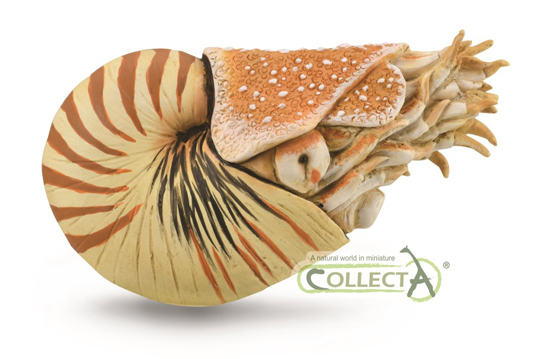
Towards the end of the Cretaceous the ammonites as a group began to decline.  The fossil record shows that there were fewer and fewer genera (although some evolved into very bizarre and ornate forms in the Late Cretaceous).  The group went extinct along with the belemnites at approximately the same time as the dinosaurs.  Why this particular group died out, yet the similar looking nautiloids survived is unclear.  There are two species of Nautilus around today, indeed, our studies of these animals have helped fill in the gaps in our knowledge about ammonites.  One theory as to why the Nautilus survived whilst the ammonites died out is that on close examination the shell of nautiloids are thicker than that of ammonites.  Modern day Nautilus live in relatively deep water, ammonites seem to have been a creature of shallow seas.  The thicker shells of the nautiloids are able to withstand the greater water pressure at depth.

An Example of a Nautiloid Model

CollectA Nautilus pompilius model.

CollectA Nautilus pompilius sometimes referred to as the “Emperor nautilus” because of its large size.

Picture credit: Everything Dinosaur

If the marine environment had been subjected to a prolonged period of darkness (dust in the atmosphere from a meteorite impact for example), then the photosynthesising plankton would have died off and this would have broken up the food chain.  The deeper living nautiloids may have been better able to cope than the surface dependent ammonites.  Also, such environmental impacts would have severely disrupted the breeding cycles and destroyed much of the larval stage populations.  This too could have contributed to the ammonite extinction.  In addition, if large amounts of carbon dioxide and sulphur hydroxide had been deposited in the seas, this would have led to extensive acidification of shallow, marine environments and this may have prevented the ammonites from being able to form their shells properly – again helping to reduce the population of these animals.  These factors along with the rapidly evolving new Teleost fish (modern fish) which may have predated on ammonites and the competition from other cephalopods may have resulted in the extinction of this very important, and once diverse animal group.

27 08, 2008

What Some of Us Did on our Fabulous Summer Holidays

By |2024-04-13T08:48:27+01:00August 27th, 2008|Categories: Educational Activities, Everything Dinosaur News and Updates, Main Page, Press Releases|0 Comments

What we Did on our Summer Holidays – Dinosaur Activity Days

Everything Dinosaur is a company staffed by qualified teachers, parents and real dinosaur experts.  Combining teaching skills with a knowledge of palaeontology, team members are able to assist teachers and youth group leaders by providing lesson plans and teaching resources to help young people learn more about Earth sciences.

Not only do we provide a support service to schools, educational establishments and home educators, supplying prehistoric animal themed teaching materials and advice in support of national curriculum criteria but we frequently are invited into schools to help bring a little bit of real life science to the classroom.

Dinosaurs continue to be a source of fascination for young people and interest in these animals can provide a basis for reinforcing knowledge, skills and understanding in many subject areas.  After all, not many people get the chance to talk to people who actually dig up dinosaurs, or handle real fossils including dinosaur teeth and bones.

For us, these sort of activities don’t stop when the schools break up for the holidays.  Our team members are in demand by play-schemes, leisure centre clubs and other local authority run programmes, helping to entertain and inform young people as part of the planned Summer activities.

Everything Dinosaur and Summer Activities

At the Science “coal face” Quizzed over Theropod teeth

Picture credit: Everything Dinosaur

The children really like to get hands-on with the fossils, and whether it is casting their own replicas, creating their own prehistoric scene or helping to solve the puzzle of what colour dinosaurs were; one thing is guaranteed – we get bombarded with lots of really amazing questions.  It can be hard work trying to answer them all, but is also a lot of fun for the team members who participate.

Dinosaur Drawings mini Conference

Picture credit: Everything Dinosaur

Exciting and Educational Products and Services

Team members at Everything Dinosaur are continually creating a range of accurate, exciting and educational products and services.  Our aim and intention is to motivate young people to learn more about science by participating in hands-on activities.   We are helping to engage and inspire the next generation of young scientists.  Outside visits can be arranged and the company remains dedicated to assisting with children’s understanding of science and helping to make learning fun.

Visit the Everything Dinosaur website: Everything Dinosaur.

Go to Top