All about dinosaurs, fossils and prehistoric animals by Everything Dinosaur team members.

Everything Dinosaur’s work with schools and other educational bodies. Articles, features and stories about dinosaurs and their role in education and educating young people.

20 08, 2008

Preparing Lesson Plans for the Next School Year

By |2023-02-25T18:01:01+00:00August 20th, 2008|Categories: Educational Activities, Teaching|0 Comments

Mary Anning, Evolution Preparations in Place for Dinosaur Workshops in School

Plans are well advanced at Everything Dinosaur to roll out new lesson plans for the company’s highly successful dinosaur workshops in school programme.  With the new school  year approaching, team members have been updating schemes of work and writing notes on extension activities to assist teachers and teaching assistants as they deliver dinosaur and fossil themed teaching topics.

We do a lot of work with schools and a visit from Everything Dinosaur certainly has a big wow factor.  Everything Dinosaur team members carry out a lot of work with schools and the pupil premium and our workshops are built around national curriculum aims and objectives including developing writing skills, aiding literacy and encouraging an understanding of simple scientific principles, relating to the National Curriculum.  Dinosaurs as a teaching theme lends itself to all sorts of ideas and extension activities and can really help enthuse young people to learn.

To learn more about Everything Dinosaur’s products and merchandise: Dinosaur Toys, Games and Models.

Everything Dinosaur is staffed by teachers and real dinosaur experts and we visit schools to conduct dinosaur themed teaching sessions whilst working with National Curriculum learning objectives and intended outcomes.  We build in real aspects of palaeontology into our teaching work, enabling students to experience some of the science behind the study of dinosaurs and other prehistoric creatures. Our costs are made up of a subsidised amount for the teacher/palaeontologist’s time, plus travelling expenses and a small charge to cover the packing of fossils and any materials used in experiments that we conduct.

Topics covered include Mary Anning, fossils and fossil formation plus the basic principles of natural selection and evolution.

3 08, 2008

Latest on the 2009 Fossil Festival at Lyme Regis

By |2022-11-26T08:51:01+00:00August 3rd, 2008|Categories: Dinosaur and Prehistoric Animal News Stories, Educational Activities, Main Page|0 Comments

Update on the Lyme Regis Fossil Festival

The organisers of the Lyme Regis Fossil Festival are still in the process of securing enough funding and sponsorship to enable the 2009 event to go ahead.  The first crucial deadline for the team behind this festival is next month when they will take a view with regards to the financial backing secured to date.  A final decision as to whether the festival can go ahead next year will be taken at Christmas.

Fossil Festival

The Lyme Regis Fossil Festival has established itself as an internationally recognised event showcasing the wonders of the UNESCO world heritage site of the Jurassic Coast.  Everything Dinosaur has been involved in this event since its inception four years ago and hopefully we will be able to attend next year.

Fossil Fun in Lyme Regis

Picture credit: Everything Dinosaur

Against the dramatic back drop of Lyme Bay, a number of events are planned for the festival, scheduled to run from Friday 22nd May until Sunday 24th May in 2009.  A number of different themes have been chosen for the event in previous years, from the Rising Seas event centred around the changes to the Dorset coastline and erosion to the concept of “Deep Time”.  The 2009 event will focus on the 200th anniversary of the birth of Charles Darwin, the Shropshire born naturalist who influenced scientific thought through his theory on evolution.

Lyme Regis

It was study of fossils such as those unearthed at Lyme Regis that influenced many of the great scientific minds of the 19th century, including Charles Darwin.  The Lyme Regis Fossil Festival is designed to show how much we can learn about the challenges of life today from what happened in the past. As well as covering the fascinating Earth Sciences, there is a strong focus on the arts, and these two disciplines are innovatively combined in order to engage with as wide an audience as possible with three days packed full of events and activities for everyone.  Team members at Everything Dinosaur, have been involved with the event since its inception, but lack of funding meant that last year’s festival had to be cancelled.

Hopefully, 2009 will be a different story, with the events in and around Lyme Regis and Charmouth helping to commemorate the birth of one of the world’s greatest thinkers.  Another exciting development is an announcement that, during the Festival, Lyme Regis will host the 2009 World Heritage Education Conference and Youth Summit being organised by the UK National Commission for UNESCO.  The Dorset coastal town has been selected to host this event because of the Festival’s strong commitment to education.

Everything Dinosaur stocks a range of replicas of animals associated with the fossil deposits of the Dorset coast including ammonites and belemnites: Models of Ammonites and Belemnites.

31 07, 2008

A Generous Thank you from Young Dinosaur Fans

By |2024-04-13T08:25:52+01:00July 31st, 2008|Categories: Educational Activities, Everything Dinosaur News and Updates, Main Page|0 Comments

Young Dinosaur Fans show their Appreciation

With the school summer holidays, team members at Everything Dinosaur organise a series of activities to help entertain and educate children as part of the County Council leisure services summer events.  A typical visit took place yesterday at Poynton Leisure Centre, near Stockport, Cheshire.  We arrived in the afternoon and carried out a number of activities and games with the children, culminating in the creation of a poster montage which we called “Prehistoric Poynton”.  Despite the advances made in the science of palaeontology, there is very little evidence available to indicate what colour dinosaurs actually were.  Although we are all familiar with dinosaurs and other prehistoric animals from films, books and of course television, the actual colouration of these animals is very much open to debate.

Dinosaur Teaching Lessons

During one of our many dinosaur teaching lessons we carry out a little exercise where we get the young dinosaur fans to interpret dinosaurs and other prehistoric animals and advance their own theories.  There are some wonderful ideas put forward and the children help us produce a colourful poster scheme on which they can display all their drawings and information on dinosaurs.  This exercise is certainly a fun and an informative activity and helps young learners to appreciate some of the ideas that we introduce when showing various fossils.

Young Dinosaur Fans

Earlier that day, in preparation for our visit, the children had created thank you cards to give to the Everything Dinosaur team members who were involved in this particular visit.  The children, working closely with the enthusiastic Leisure Centre staff and helpers produced a wonderful collection of thank you cards and pictures.  We added the cards to the poster display that was produced in our activity session, but we did take a card home so that we could pin it up onto our own display board in the warehouse.

A Thank you Card from the Children

Picture credit: Everything Dinosaur

The picture above was presented by a young girl to the Everything Dinosaur team members who took part in the activity session, we thought it a good idea to take a picture of it before we pinned it to our display board.  Always a pleasure to take a break from sorting out Everything Dinosaur toys and dinosaur models and to interact with young dinosaur fans.

Visit Everything Dinosaur’s award-winning website: Everything Dinosaur.

30 07, 2008

Thank you from Year 1 School Children

By |2023-02-25T17:15:11+00:00July 30th, 2008|Categories: Educational Activities, Teaching|0 Comments

Thank you Letters Received After Dinosaur Workshop in School

At the end of the Summer Term, Everything Dinosaur visited a primary school in Staffordshire (English midlands) to help with the Year 1 term topic of dinosaurs and the “Jurassic Forest”.  The children, aged between six and seven years of age had lots of questions for our dinosaur expert and they were keen to show off their dinosaur themed artwork.  This morning, the postman arrived with a big envelope with thirty thank  you letters that had been written by the children, one of the last things they did before the end of their school term.

After a school visit to teach about dinosaurs in schools, it is always a pleasure to receive letters from young dinosaur fans.  It is also a good way to get budding young palaeontologists to practice their writing skills.

Young Ryan wrote:

“I had a great time, my favourite part was when you showed me the dinosaur teeth.”

Everything Dinosaur Receives a Thank You

School chum Imogen said that she had lots of fun and that she enjoyed learning all about dinosaurs, her favourite exercise was the casting of the fossil dinosaur teeth.  Destiny really enjoyed the dinosaur workshop and she stated that when she gets older she wants to be go and dig up dinosaurs too.  Destiny also remembered the name of some of the fossilised remains that we had looked at, which was very clever of her.  Rhys on the other hand, explained that his favourite meat-eating dinosaur was Tyrannosaurus rex and that is favourite plant-eating dinosaur was the plated Stegosaurus.

Dinosaur workshop thank you letter

Polly says thanks. A dinosaur workshop thank you letter. Picture credit: Everything Dinosaur.

Picture credit: Everything Dinosaur

Thank You Letters

It seems that all the children enjoyed the dinosaur workshop and the standard of letter writing was very good.  All the letters stated with “dear” and there was lots of evidence of correct spelling and appropriate use of connectives and punctuation.  We shall pin the letters up onto one of our big message boards in our warehouse.

To visit Everything Dinosaur’s website: Everything Dinosaur.

24 07, 2008

Frog Blog Update – At Least one Made It

By |2022-11-26T07:39:09+00:00July 24th, 2008|Categories: Animal News Stories, Educational Activities, Everything Dinosaur News and Updates, Main Page|0 Comments

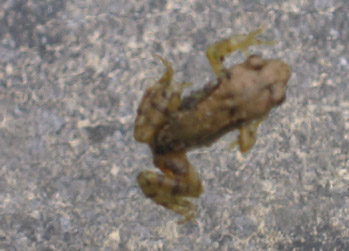
Frog Blog – Tiny Frog Spotted near Pond

Yesterday one of our team members spotted a tiny frog whilst they were outside watering the office tomato plants (another one of our projects).  The frog was one that had just emerged this year and it was discovered within 5 feet of the office pond.  Although we cannot prove it conclusively, we can surmise that this frog hatched in the pond and had been one of the tadpoles we had been attempting to observe.

Once the tadpoles hatched, within days they disappeared and we thought that they had all perished.  From late April until early July not one single tadpole was seen by any of our staff members.  We were quite surprised, as although the pond was relatively small and shallow we just could not find any amongst the weed.

The Baby Frog

Picture credit: Everything Dinosaur

However, the finding of a frog that had recently undergone metamorphosis so close to the office pond, with no other water source nearby may indicate that at least one of the tadpoles has made it to the frog stage.  We will keep a close look out in case we spot any more.

16 07, 2008

Dinosaur Sounds! What Sounds did Dinosaurs Make?

By |2022-11-26T06:50:52+00:00July 16th, 2008|Categories: Educational Activities, Main Page, Palaeontological articles|0 Comments

What sort of sounds did Dinosaurs Make?

No dinosaur film or TV documentary is complete without the roaring and bellowing sounds of the animals being portrayed.  However, the noises and calls added by the dubbing team to the soundtrack are based on assumptions and scientific guesswork.  The sound an animal makes is not preserved within the fossil record, so palaeontologists have to turn detective to try to work out what sort of sounds long extinct creatures would have made.

Dinosaur Sounds

Most reptile species around today are largely silent, however, herpetologists (people who study reptiles) are beginning to understand more about the complex communication between individuals of the same species and how reptiles react to their surroundings using their senses.  For example, for many years, scientists thought that as snakes show no signs of an external ear structure they were deaf.  However, research has shown that snakes are sensitive to vibrations of the ground and that they do possess a sense of hearing although the mode of its operation is unique to the Squamata order.  The quadrate, a bone located towards the back of the skull is able to respond to airborne sounds which are transmitted through the skin.  The vibrations that are produced are transmitted to the cochlea, converted to electrical signals which can then be interpreted by the brain.  It is believed that snakes can pick up low frequency airborne sounds in this manner, having a hearing range of around middle C to high C.  Indeed, some scientists have claimed that snakes are more sensitive to sounds in this frequency range than domestic cats.

Hearing in the Squamata Order

Snakes are related to lizards and lizards have a sense of hearing so it would be logical to assume that this sense has not been lost by the snakes, merely that the external ear has disappeared and modification to the receipt of sounds has evolved.

The noisiest reptiles in the modern world are the Crocodilians – the crocodiles, alligators, caymans and gharials.  The noise levels generated varies between the species, from hissing noises that are made as a threat gesture to the low-frequency sounds made by males to attract mates in the breeding season.  A lot of work has been done on the sounds made by American Alligators.  Studies have shown that the sounds produced by the males (called bulls), varies depending on the size of the animal.  Deeper and more penetrating sounds are made by the larger males.  The larger the male the louder the sound and the greater distance it will travel.

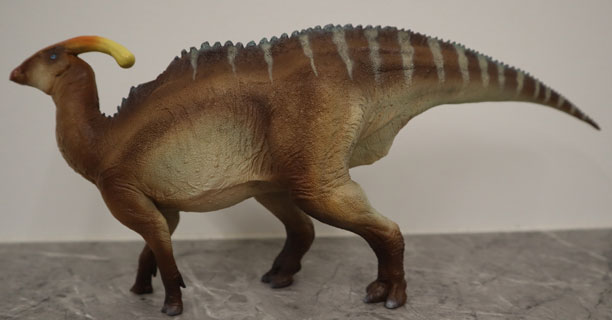
PNSO Wyatt the Parasaurolophus dinosaur model in lateral view.

PNSO Wyatt the Parasaurolophus dinosaur model in lateral view, a stunning replica of a Late Cretaceous duck-billed dinosaur.  The hollow crests of these dinosaurs could have helped them to vocalise.  Picture credit: Everything Dinosaur.

Picture credit: Everything Dinosaur

To view the PNSO range of models in stock at Everything Dinosaur including replicas of hadrosaurs: PNSO Museum Quality Dinosaur Models.

Alligators have no vocal cords as such but make noise by sucking air into their lungs and then forcing it out again.  The low frequency sounds produced are so intense that the water dances on their backs due to the vibration.  The sounds travel for long distances underwater (water is a better transmitter of sound than air).

Animals can use sounds for a variety of purposes, to keep in touch with their family group, to call to their parents (such as the beeping noise made by baby crocodiles), to ward off rivals and to attract a mate.  This kind of communication amongst dinosaurs would have been common place, however, the fossil record provides little actual evidence of the sounds dinosaurs made or indeed how their sense of hearing would have operated.

It is not clear whether dinosaurs had vocal cords, soft tissues are rarely preserved as fossils, perhaps the recently discovered Hadrosaur mummy, nicknamed “Dakota” will shed some further light on the sounds dinosaurs were capable of producing.

To read more about the discovery of this dinosaur fossil complete with skin and some internal organs preserved: Dinosaur Mummy unlocks Duck-Billed Dinosaur Secrets.

How do Birds Make Sounds?

Birds, like crocodiles are relatively close relatives of dinosaurs.  They can produce an extraordinary arrange of sounds, from beautiful, lilting birdsong to harsh cries and shrieks depending on the species.  Birds can also vary the tone and pitch of the noises they produce as well as controlling the volume of their calls.  Birds do possess a larynx, a small organ located near the top of the windpipe, but it is believed to have only a rudimentary role in sound creation, merely helping to control the flow of air.  The sounds we make are made by the larynx and our vocal cords, birds have a specialised sound producing organ (called the syrinx) at the base of their windpipe (trachea).  It is from the syrinx and the elasticated membranes within it that the sounds birds make are largely controlled.

Dinosaur Sounds

It has been assumed by scientists that vocalisation would have been very important to dinosaurs, with different species, and indeed different individuals within a species making distinct sounds.  The cheeks and beaks found in many ornithopods such as iguanodonts would have altered and helped modify the sounds these animals produced.  Perhaps, quieter, frequent chirps between herd members to keep in contact with each other and then louder, bellows to warn of danger.  The larger the animal the lower the frequency of the sound likely to be produced.  Compsognathus, a small bipedal dinosaur of the Jurassic, no more than 3 feet long would have probably produced high pitched squeaks and squawks, whilst a giant sauropod such as Apatosaurus would have produced very deep, low frequency sounds beyond the range of human hearing.  The sounds these huge animals produced would have caused vibrations (similar to the low frequency vibrations produced by alligators).  It is possible that these animals could have detected these vibrations through their feet.  Another method through which these large animals could keep in contact with each other.

The greatest amount of research into dinosaur sounds and hearing has involved studies of the duck-billed dinosaurs, known as the hadrosaurs.  The reasons for this are two-fold, there are a lot of hadrosaur fossils, particularly skull material to study and many of these animals had strange, hollow crests associated with their skulls (the lambeosaurine hadrosaurs had the most spectacular crests).

Advances in our understanding of dinosaur hearing were made when a very well preserved skull of a Corythosaurus (lambeosaurine), revealed an intact hearing bone – the columella.  Although, the Corythosaurus was over 9 metres long, the columella measured just 50 mm in length and was extremely delicate being only 2.5 mm wide at its widest part.  Such a delicate bone would have been extremely sensitive to airborne vibrations and this evidence in conjunction with studies of hadrosaur brain-cases which show a large part of the brain dedicated to hearing, indicates that these dinosaurs had a very good sense of hearing.

A Scale Drawing of Corythosaurus

Picture credit: Everything Dinosaur

A group of scientists at the Sandia National Laboratories in collaboration with palaeontologists at the New Mexico Museum of Natural History and Science took the study of dinosaur vocalisation to a new level when they used computer modelling to recreate the voice of a dinosaur.    The work, although now ten years old, represents one of the most sophisticated studies into the airways and nasal passageways of dinosaurs.

Lambeosaurine Skulls

A skull of another type of lambeosaurine duck-bill, a Parasaurolophus (P. walkeri) had been discovered in 1995, the skull was carefully cleaned and prepared before a series of CAT scans were taken to provide evidence of the internal structure of the skull.  From the analysis of the internal airways and nasal passages a computer model was constructed that would interpret the flow of air forced through the skull crest by the animal.  This enabled the team to generate sounds that the dinosaur would have made.  The result was a series of low-pitched growls and rumblings, the first dinosaur calls to have been heard for 65 million years.

It is not clear how accurate the sounds made were, but the notes produced were typical of the sounds made by a large animal with a long windpipe such as Parasaurolophus possessed.  Many scientists believe that the crests of Hadrosaurs helped them make distinctive calls as well as being used as visual signalling devices, hence the trend to show brightly coloured crests in the latest models of duck-billed dinosaurs.

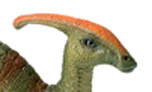
The Orange Crest of a Model Parasaurolophus

Picture credit: Everything Dinosaur

To view dinosaur models available and in stock at Everything Dinosaur: Dinosaur Models.

13 07, 2008

Summer Holiday Activities – Exciting Baking with Dinosaurs

By |2024-04-13T08:15:10+01:00July 13th, 2008|Categories: Educational Activities, Everything Dinosaur News and Updates, Main Page, Teaching|1 Comment

Summer Holiday Activities – Baking with Dinosaurs

A little summer holiday fun – baking with dinosaurs.

I am sure many young Dinosaur fans would have watched the ground breaking BBC Television series “Walking with Dinosaurs” first aired on BBC1 in 1999.  This ground-breaking television series used CGI imagery and animatronics coupled with the latest scientific research to bring back to life dinosaurs and other prehistoric creatures.

In total, six episodes were made, starting with “New Blood” which depicted the Late Triassic and showed the rise of the dinosaurs to “Death of a Dynasty” which covered the extra-terrestrial impact that marked the end of the Cretaceous.  This work was a collaboration between a number of universities, museums and designers to recreate as accurately as possible the world as it was during the Mesozoic.

The subsequent TV rights, merchandise, video and DVD sales have helped to swell the coffers of the BBC to a considerable extent.  The “Walking with” programmes have provided the BBC with very welcome revenue, these programmes have been some of the best-selling of all the BBC’s output.

Unfortunately, even the most avid home movie fan is unlikely to be able to recreate the BBC TV series, at least we at Everything Dinosaur can offer an alternative that might keep your little ones occupied for a part of the long summer holiday – Baking with Dinosaurs.

Baking with Dinosaurs

Our team has carried out a great deal of research and testing of home baking products in the late winter and early spring and they recommended several types of dinosaur shaped cookie cutters – ideal for making simple dinosaur shaped snacks or biscuits.

As well as testing the cookie cutters and such like, the team have published a number of recipes for making dinosaur themed biscuits.  This blog has published lots of recipe ideas including making dinosaur gingerbread and birthday cakes.  All the recipes have been tried out by our team members and our weblog provides pictures of the finished biscuits along with ingredients and instructions.

The recipes are simple to follow and are ideal to help pass a little bit of the summer holiday time, with a grown up supervising the cooking activities.  The biscuits are a great addition to any dinosaur party food and they are fun and easy to make.

We have also used dinosaur shaped cutters for modelling work using clay and other materials, the cutters work equally well whether making food or simply having fun with plasticine or other materials.

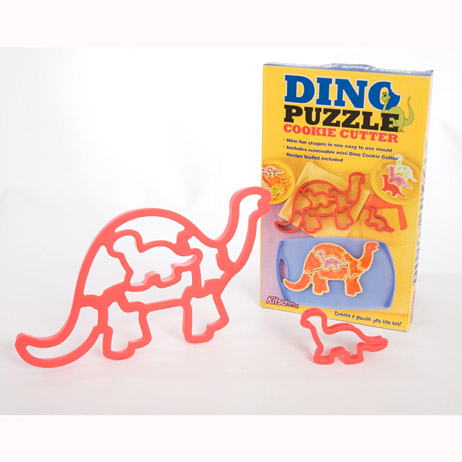
The dinosaur puzzle cookie cutter is a particularly clever product.  Made from robust, sturdy plastic, it consists of several pieces that fit together to make a large motif for a long-necked dinosaur (Sauropod).  You can make your own edible dinosaur puzzle.  The set even comes with a smaller long-necked dinosaur biscuit cutter that allows you to make smaller, dinosaur shaped biscuits and snacks.

The Dinosaur Puzzle Cookie Cutter

Picture credit: Everything Dinosaur

When some of our team members organised tests with this particular product, shortbread biscuits were made.  The young children we were working with found the cutters easy to use and had great fun decorating the biscuits once we had allowed them to cool.

As I recall, we simply made up some small amounts of icing sugar in several pots, a few drops of food colouring enabled our young chefs to colour the icing sugar and we had red, green, yellow and even pink dinosaurs.  These biscuits were then decorated in a variety of ways.  It was certainly a fun way to spend an afternoon, and once washed the biscuit cutters were ready to use again.  There were plenty of recipes for us to try in the little recipe book that was provided in the box.

Some of the Results of our Labours

Baking with dinosaurs, a fun activity for the summer holidays.

Picture credit: Everything Dinosaur

Everything Dinosaur is a UK-based supplier of dinosaur and prehistoric animal themed models, toys and merchandise, check-out our website: Everything Dinosaur.

12 07, 2008

Confirmation of Tadpole Sighting in Pond

By |2022-11-25T22:20:45+00:00July 12th, 2008|Categories: Educational Activities, Everything Dinosaur News and Updates, Main Page|0 Comments

Tadpole Sighting Confirmed

After the unconfirmed sighting of a tadpole in the pond at the back of our offices on Monday (July 7th), when we had thought that all the tadpoles in our pond had perished, we set a competition to see if anyone could prove some tadpoles were still alive.

The last tadpoles had been seen way back at the end of April, for the whole of May and June not a single tadpole had been observed by any of the Everything Dinosaur staff so we had assumed that none of them had survived.  However, last  Monday afternoon, one of our team members claimed to have seen a single tadpole in the shallows.

The prize for proving that at least one tadpole remained was to choose the biscuits we purchase for our tea breaks.  Team members have been taking turns to observe the pond life and no evidence had emerged by Friday so we thought that this little contest would run for a few more days.  However, a tadpole was watched for a few seconds by two members of staff before it disappeared again into the pond weed.

A sighting that had been verified by a second person is good enough so the biscuits for the week are going to be Viennese Whirls.  We debated for a while whether Viennese Whirls are biscuits or not, after all they described my many as “shortcake fancies” but we are not going to argue over a technicality.

Now all we need is photographic evidence, perhaps as the remaining tadpoles develop limbs and develop into the “froglet” stage, we may be able to see them more frequently in the pond shallows.  Perhaps, this will give us the best chance of taking a photograph.


9 07, 2008

Colour Coded Dinosaurs – Some New Research

By |2024-04-13T08:44:38+01:00July 9th, 2008|Categories: Dinosaur and Prehistoric Animal News Stories, Educational Activities, Main Page|0 Comments

Clue to the Colour of Dinosaurs

We have got used to seeing dinosaurs and other prehistoric animals depicted in glorious technicolour on our television screens, in cinemas and books, but scientists actually know very little about the colouration and markings of dinosaurs and other ancient animals.  Illustrations of dinosaurs for example, are created using a basis of conjecture, supposition and comparisons with living organisms.  Most sauropods (the long-necked dinosaurs), are often depicted in dull battleship grey, or browns similar to the colour of elephants, but we have no real evidence to support this.  The assumption has almost always been when you are a 30 metre, 15 Tonne Diplodocus there would be little point in having camouflaged colouration, you would simply be too big to hide.

However, a paper published in the scientific journal “Biology Letters”, by a group of American researchers, sheds light on the colouration of long extinct creatures that one day may help palaeontologists understand the colours of dinosaurs.

A team of palaeobiologists and other researchers at Yale University have been studying the colour hues of 100 million year old fossilised bird feathers and their findings may permit scientists to interpret other fossil structures and to build up a colour image of long, dead animals.  If the team’s interpretations are correct; then those dinosaurs that have been preserved with a covering of down or feathers could be studied and their markings and colouration deduced.

The colour of dinosaurs has long been debated, we at Everything Dinosaur run exercises in schools where we get the students to interpret fossil evidence about the size and shape of dinosaurs and the environment in which they lived.  From this work we get them to draw the dinosaur and colour it in.  A sort of dinosaur detective story, where the guesswork of 8 year-olds can be regarded as almost as scientifically valid as the pronouncements of the most meritorious professor.

The was some excitement when an analysis of fossilised skin from the tail area of Dakota, the superbly preserved Edmontosaurus mummy (the subject of a recent TV documentary), indicated that the animal might have had coloured bands running down its tail.  Such well preserved dinosaur fossils are extremely rare and any actual colouration can only be speculated at this stage as colours will have been altered and affected by the fossilisation process.

To read more about the amazing Dinosaur Mummy Dakota: Dinosaur Mummy unlocks Duck-Billed Dinosaur Secrets.

To read the latest update on Dakota: Update on “Dakota” the recently discovered Hadrosaurine Mummy.

The Yale University team analysed fossil feathers from Brazil and Denmark and carried out comparisons with the feathers of modern birds (Neornithines).  Their findings indicate that some fossilised bird feathers preserve microscopic components that when analysed and interpreted can reveal feather colouration.

The fossil feathers had stripes, these could easily be seen but it had been thought that these markings were the result of bacterial processes or geological effects during the period of preservation and fossilisation.

Could the colour of feathered dinosaurs be deduced from this work?

Commenting on the markings, Jakob Vinther one of the research team members said:

“We are quite confident that they (the markings) aren’t bacteria”

The research team targeted electron beams onto a fossil bird feather to reveal strange, sausage shaped structures that are believed to be responsible for the colour of plumage.  The species of bird from which the fossil feather came from is not known, but similar microscopic structures have been found in modern feathers and their shape, composition and orientation create colours and patterns.  By analysing these little packets, scientists hope to be able to build up a picture of the colouration of extinct creatures.

These structures are termed melanosomes and their analysis could help palaeobiologists understand the colours of the feathers on fossil dinosaurs, plus the colour of mammalian fur.

“We might able to get a palette of colours that we could assign to the fossils,” Jakob Vinther added.

By testing fossilised dinosaur feathers (such as those associated with the Liaoning Province of north-eastern China dating back to around 125 million years ago), for the presence of melanosomes scientists may be able to deduce the colour of these feathered dinosaurs.  The likes of Caudipteryx, Sinornithosaurus and Microraptor may be revealed in glorious technicolour.

As both birds and crocodiles have colour vision, scientists have long thought that dinosaurs as close relatives of these two extant groups would also have colour vision.  Being able to interpret the colouration of certain fossils will enable palaeontologists to build up a more accurate picture of what some of these animals looked like.  It will also provide evidence of sexual dimorphism in species, even help to identify males and females within a species.

Having an understanding of the colours and markings of an animal will also provide clues to the animal’s behaviour.  Gaudy colours may indicate the importance of displaying, perhaps for breeding, courtship or other social purposes, whereas, tones such as greens and browns would help these animals hide from predators.

How the melanosomes have survived the fossilisation process is not quite understood, most organic material, including DNA, decomposes quickly and does not survive the preservation process.  However, as our understanding of genetics improves and new techniques to analyse fossils are introduced we may be able to produce accurate illustrations of long extinct animals.

Future model makers depicting feathered dinosaurs, such as those produced in conjunction with the American Museum of Natural History may be able to get close to the real colours and markings of the animals they are depicting.

Some of the Dinosaurs Featured in the Dinosaur Tube Set

Feathered dinosaurs.

Picture credit: Everything Dinosaur

Feathered dinosaurs such as Dilong, Microraptor and Caudipteryx are included along with non-feathered dinosaurs (at least as far as we know), such as Protoceratops and a sauropod.

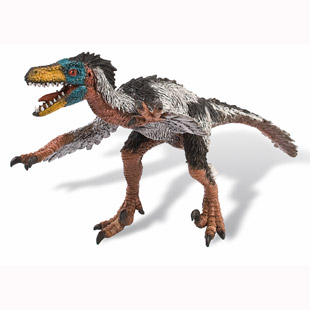
The latest model from the Bullyland range of Germany, continues the trend to interpret many theropod dinosaurs as feathered.  Although no fossils of Velociraptor mongoliensis have been found with evidence of feathers, a number of dromaeosaurs are known to have been covered in simple down or proto-feathers so Velociraptor is often depicted in this way too.

The large orbits in the skull of Velociraptor indicate that its sense of vision was exceptionally important to it, with an ability to discern colour, perhaps these animals were quite brightly coloured.  Helpful for an animal living in a social group where hierarchy and status would have been important.

The Velociraptor from Bullyland
Picture credit: Everything Dinosaur

To view the Bullyland model range: Bullyland Prehistoric Animal Figures.

8 07, 2008

The First Dinosaurs in Space – Maiasaura

By |2024-04-12T19:25:09+01:00July 8th, 2008|Categories: Dinosaur Fans, Educational Activities, Main Page|0 Comments

The First Dinosaurs in Space – Maiasaura

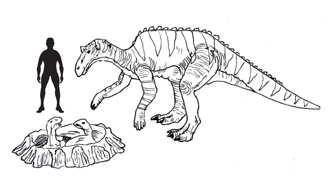
Maiasaura was a large hadrosaur (member of the hadrosaurine group of duck-billed dinosaurs – distinguished by their lack of adornments and head crests).  It was discovered by the American palaeontologist John Horner in 1978 and officially named a year later.  The remains of this dinosaur have been found in western Montana, in the Late Cretaceous rocks of the Two Medicine Formation.  Few dinosaurs left traces behind providing clues as to how these animals lived and behaved, however, Maiasaura is a definite exception to this.  Over 200 individual skeletons have been unearthed to date, from hatch-lings right up to mature adults.  Jack Horner and his team discovered a Maiasaura nesting site that has yielded a great deal of information about how this type of dinosaur raised its young.

Maiasaura

It seems that Maiasaura looked after its babies (the name means “Good Mother Lizard”), very apt in this dinosaur’s case.  Fossils recovered from the nesting site, show that these animals made nest mounds out of mud, and may have covered any eggs laid with vegetation to keep them warm.  Hatch-lings that have been fossilised show teeth wear but their legs are not fully formed (undeveloped legs is  feature seen in the chicks of many birds).  This indicates that the babies were fed at the nest, as they were unable to forage for themselves.   It can be surmised from this data that the parents looked after the youngsters to a degree.  The nesting site seems to have been vast, with many thousands of animals at the site, this indicates that Maiasaura lived in large herds, or at least congregated at communal nesting sites.

Maiasaura

The person in the picture provides a scale so the size of this dinosaur can be estimated.  Picture credit: Everything Dinosaur.

Dinosaurs in Space

Maiasaura’s other claim to fame is that this dinosaur was the first to be taken up into space.  A piece of fossilised bone from a baby Maiasaura along with a piece of Maiasaura eggshell was taken into space by astronaut Loren Acton on a NASA mission in 1985.  Not a bad record for Maiasaura, being totally unknown just 7 years earlier, and then the first dinosaur in space.  The second dinosaur to travel in space was the skull of a Coelophysis, (Triassic Theropod).  The skull was sent into space on the US space shuttle Endeavour on 22nd January 1998.  It travelled to the Mir space station, one of a number of trips made by space shuttles to the orbiting station in the Shuttle-Mir programme.

Dinosaurs were not the first representatives of the Class Reptilia to travel in space.  Tortoises were used in some of the research programmes as manned space flight was being developed.  The first tortoise in space was launched by the Soviet Union in September 1968, as part of the research programme monitoring the potential effect of long space flight on humans.  Tortoises were ideal “guinea pigs” for such experiments, due to their ability to survive hostile conditions and to live on little food and water, characteristics recognised by early explorers on Earth, who often sailed with tortoises and turtles on board ship to provide a source of fresh meat into the journey.  We have no record of what happened to this particular tortoise after the capsule in which it had travelled returned to Earth.

To models of ornithischian dinosaurs like Maiasaura: Dinosaur and Prehistoric Animal Models.

As far as we can tell no adult birds have been sent up into space.  Chicken embryos were sent up into space as part of an experiment kit to test the development of chicks in zero gravity by the Americans in 1989.  This particular experiment had been scheduled to take place three years earlier but it was lost when the space shuttle Challenger exploded shortly after launch on January 28th 1986.  Other fertilised bird’s eggs have been sent into space on subsequent occasions, no birds as far as our research shows.  It would be fascinating to find out how birds cope with zero gravity.  Effectively, once in motion they would not need to flap their wings, perhaps they could use their wings to stabilise themselves as they were subjected to zero G.

This article has been written in honour of Patrick,  for being such a well behaved little boy, we know he likes Maiasaura so we thought it would be a good idea to write an article for him.

Go to Top