All about dinosaurs, fossils and prehistoric animals by Everything Dinosaur team members.

Everything Dinosaur’s work with schools and other educational bodies. Articles, features and stories about dinosaurs and their role in education and educating young people.

7 07, 2008

Outsmarted by Clever Tadpoles – The Latest Frog Blog Update

By |2024-04-12T19:26:06+01:00July 7th, 2008|Categories: Dinosaur and Prehistoric Animal News Stories, Educational Activities, Main Page|0 Comments

Clever Tadpoles – Keeping Hidden for all this Time

Cryptozoologists claim to have evidence for the existence of mythical creatures or for animals long thought to be extinct.  The word cryptozoologist comes from the Greek (translated it means hidden life).  There are many tales of dinosaurs in the darkest depths of the Congo, or apes as big as chimpanzees in the South American rain-forests.

The staff at Everything Dinosaur, tend to be a little sceptical of such claims but we have witnessed for ourselves how Mother Nature can play tricks, although very much on a smaller scale.

In the pond outside our offices we were delighted to discover back in March (16/03/08) that for the first time that anyone could remember frogs had spawned in it.  This was very exciting for our team members (we don’t get out very much), and anyway in the UK all amphibians and reptiles are protected species.

To read more about our frogspawn discovery:  Frog Blog part 1 – We have Frog Spawn in the Pond.

It was then decided that we would take a photograph every seven days and write about the development of the tadpoles as a weekly blog feature.  Everything seemed to be going fine, the tadpoles developed quickly in their jelly and in a couple of weeks or so they hatched.  Then to our surprise the tadpoles disappeared.  By 8 weeks into the project we had to abandon the weekly web log feature, no tadpoles could be seen.  The last reported sighting we had was on April 29th when a single tadpole was spotted.

To read the last frog blog entry:  Frog Blog (week 8) and then there were none.

We were most upset at this turn of events.  Naturally, we expected some predation and we knew that most of our tadpoles would not make it to the froglet stage, but to have them disappear in just a few days was quite distressing.  That was that, or so we thought…

At last week’s team meeting preserving any future frog spawn was actually on our meeting agenda.  We are a fairly unconventional company at the best of times, but there must be very few businesses in the world who give up time to consider how best to protect any future tadpoles should any more frog spawn be laid in subsequent years.  A number of ideas were put forward, the one we agreed on was the proposal to utilise a more isolated and separate pond to create a sort of mini lagoon.  We could circulate water between the two sites using a small pump and to net this area off (to protect the tadpoles from bird attack).  Quite a convoluted plan, but we thought it would probably offer any future tadpoles the best protection.

However, this afternoon, to our surprise, a colleague reported seeing a large, well-developed tadpole in the pond.  He described the tadpole as having a large head but with no discernible limbs, he got a quick glimpse of it before it disappeared into a clump of algae.  Not that we wish to doubt our colleague, but no sign of any tadpoles had been seen over the previous 69 days.  What is more, the pond is approximately 8 feet by 5 feet wide and shallow enough to see the bottom.  It is hard to believe, but despite us all taking regular breaks and sitting by the pond (mainly to watch the frogs and to observe the water-boatmen), the tadpoles seem to have avoided detection.

We are going to start regular observations once again and a reward of first choice of biscuits for a week has been offered to the first member of staff who can produce proof that tadpoles still exist in the pond.  It seems that even, tiny ponds can hide one or two secrets and keep us on our toes, not surprising therefore that stories of bizarre monsters and living dinosaurs seep out of some of the remotest corners of our planet.
30 06, 2008

Fabulous Ferns – Part of a Dinosaur’s Diet

By |2022-11-25T16:30:16+00:00June 30th, 2008|Categories: Educational Activities, Everything Dinosaur News and Updates, Main Page|0 Comments

Ferns – Hangers on from the Age of Reptiles

There are an estimated 12,000 different species of ferns in the world, although ferns can be found in most gardens and some types of fern are a common sight, they are representatives of a very ancient and important group of plants.  They pre-date the evolution of humans, mammals, reptiles and birds, their origins can be traced to the Late Devonian period, approximately 360 million years ago.

Fabulous Ferns

The study of ferns is called Pteridology (pronounced ter-ree-doh-ol-low-gee), from the Greek word for ferns.  There are a number of ways in which plants can be classified as ferns but they are usually identified by their large, divided, frond-like leaves that carry the reproductive spore producing organs called sporangia.

Although it is difficult to trace the origin and evolution of ferns (there is a lack of fossil evidence to help scientists), we do know from the different types of fossil ferns discovered, that there were many more types of ferns in the past.  As a group they flourished, forming a substantial part of the diet of many ancient plant-eating creatures from mammal-like reptiles such as the sail-backed herbivore Edaphosaurus to the huge herbivorous dinosaurs that were to come later in the history of life on Earth.  Ferns thrived as the Age of Reptiles began, forming the dominant herbaceous, ground-layer plants.

Fossils of ferns from the time of the dinosaurs have been found all over the world, from the island of Spitsbergen in the north to Antarctica in the south.  They would have helped to feed of many of the best known and most famous plant-eating dinosaurs of all, Stegosaurus and Diplodocus in the Jurassic, and Ankylosaurus and Triceratops in the later Cretaceous for example.

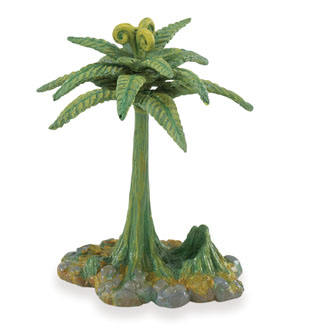
A Model of a Tree Fern

Tree fern model

Wild Safari Prehistoric World tree fern model.

Visit Everything Dinosaur’s website to see models and replicas of prehistoric plants: CollectA Prehistoric Life Models.

Ferns dominated the understorey of forests during the Age of Reptiles and would have been eaten by a range of prehistoric animals including dinosaurs.

Fossil Ferns

So abundant and diverse were ferns before the rise of flowering plants, that is has been estimated that for every species of fern living today, there are nine fossil species.  Indeed, palaeobotanists (those scientists who specialise in studying ancient plant life), have written ten times more scientific papers on extinct ferns than on the species around today.  In fact many of the ferns to be found in the more remote parts of the world, such as the jungles of Indonesia and Malaysia have yet to be studied in detail.

Now thanks to the scientists at Tomorrow Garden and their clever plant propagation technology, dinosaur fans have the chance to grow their own exotic ferns.  Tomorrow Garden sells a range of fascinating plants, with each kit being supplied with everything required to help preserve rare plants from around world, giving growers the chance to help protect endangered species.

In addition, to celebrate the launch of Tomorrow Garden, the company has organised a FREE PRIZE DRAW, recognising the role ferns played as dinosaur food, there are lots of dinosaur themed prizes including a top prize of an all-expenses trip to the Natural History museum, as well as hundreds of runners up prizes of dinosaur models supplied by Everything Dinosaur.

So if you or your school wants to have a go at growing some fern species that represent the type of food that the likes of Stegosaurus munched upon 145 million years ago, now’s your chance.

This competition is now closed.

28 06, 2008

Thank you Letters Received After Visit to School

By |2022-11-25T16:15:20+00:00June 28th, 2008|Categories: Educational Activities, Everything Dinosaur News and Updates, Teaching|0 Comments

Young Dinosaur Fans Say Thanks to Everything Dinosaur

Following a trip to Staffordshire to visit a primary school to work with Year 1 and Year 2 children as they studied dinosaurs, our fossil expert set the children a challenge.  Could they produce for her a thank you letter which began with a capital letter, had connectives and used punctuation correctly?

A couple of weeks later our mail bag was extra full as the post office delivered around forty letters. Encouraged by their teachers the children had written some lovely thank you letters to Everything Dinosaur.

For example, Taijah wrote:

“Dear Everything Dinosaur,

Thank you for teaching us about dinosaur fossils.  My favourite part was when you showed me the dinosaur bones.”

Milly added:

“Thank you for teaching us about dinosaurs.”

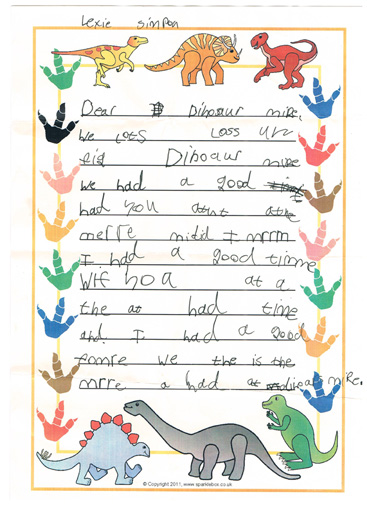
thank you letter

Lexie wrote to say she had a good time studying dinosaurs.  A typical thank you letter received by Everything Dinosaur.  Picture credit: Everything Dinosaur.

Picture credit: Everything Dinosaur

Dinosaurs as a term topic or even as part of a special science week in primary schools can really help young children get to grips with some fundamentals of science such as observation, investigation and experimentation.  Teaching about dinosaurs in school lends itself to all sort of other extension activities such as independent learning, creative writing and even numeracy exercises.

Everything Dinosaur stocks a rang of dinosaur themed, educational toys and games: Dinosaur Toys and Gifts.

Young Taylor-Joe summed out the benefits of a school visit from Everything Dinosaur when she wrote in her letter:

“I loved learning about dinosaurs and thank you for letting me help with the fossils that you showed the class.  I had a great time.”

To learn more about the team at Everything Dinosaur: About Us.

6 06, 2008

When is a Mass Extinction a Mass Extinction?

By |2022-11-25T06:52:34+00:00June 6th, 2008|Categories: Educational Activities, Everything Dinosaur News and Updates, Main Page, Palaeontological articles|0 Comments

Defining When a Mass Extinction Occurs

Mass extinctions by definition are substantial and significant events.   At any time in the history of life on Earth, there will be a level of background extinctions taking place as well as speciation – the evolution of new species.  The vast majority of species recorded in the fossil record have gone extinct as part of this normal background rate, this is a consequence of evolution and the process of adaptation.  However, it is the mass extinctions that grab the headlines, although the existence of such events in the geological record of this planet was not really understood and widely accepted until late on in the 19th century.

As scientists and geologists began to understand the stratigraphy (the sequences of rocks laid down in strata, indicating they were of different ages), and an appreciation of the development of life began to emerge, it was noted that many groups of fossils disappeared from the fossil record at about the same time.

Fossils such as ammonites, very abundant in strata dated from the Jurassic and Cretaceous, become more scarce and less diverse in rocks derived from Upper Cretaceous sediments, before finally disappearing from the fossil record completely.  Ammonite fossils are not found in rocks younger than approximately 65 million years.  Although present in older rocks, they are not known from younger rocks.

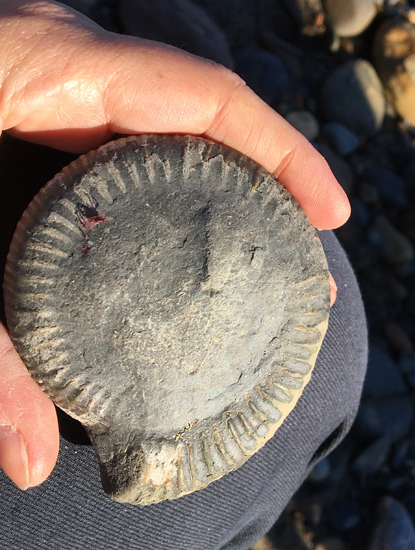
An ammonite fossil find.
An ammonite partially eroded out of a nodule. We think this is an example of Dactylioceras commune. Picture credit: Everything Dinosaur.

 Picture credit: Everything Dinosaur

It is partly due to the dramatic change in the fossil record that the boundaries between geological eras and periods are where they are in the chronological history of our planet.  For instance, the boundary between the Mesozoic and the Cenozoic eras is at approximately 65 million years ago – the time of a mass extinction that saw the end of the Dinosaurs, mosasaurs, pterosaurs and plesiosaurs.  The boundary between the Palaeozoic and the Mesozoic (Permian/Triassic periods), dated to approximately 248 million years ago marks what is believed to have been the greatest mass extinction of all time.

Geologically rapid, major reductions in the diversity of life on a global scale are termed mass extinctions.  Patterns of extinction and the severity of the extinction event are assessed by examining their impact on the taxonomic hierarchy.  Individual species may become extinct, indeed whole genera (the next taxonomic category up from species) may die out, but the term mass extinction is usually reserved for those events that impact on life at the family level – the next category up from genus/genera).  Geologists and palaeontologists have identified five especially severe mass extinction events in the history of life on planet Earth.  These are termed the “Big Five” and they are summarised in the table below.

The Big Five Mass Extinction Events (Phanerozoic Eon)

Mass Extinctions – the Big Five (Phanerozoic Eon)
EraPeriodDate (approx)Main Extinctions
PalaeozoicLate Ordovician443 million yearsTrilobites, Brachipods, Corals, Echinoderms
PalaeozoicLate Devonian355 million yearsReef dwellers – Corals, Bivalves, Sponges
Palaeozoic/MesozoicLate Permian248 million yearsCorals, Reef dwellers, Trilobites, Graptolites, Brachipods, Amphibia, Reptilia*
MesozoicLate Triassic206 million yearsGastropods, Cephalopods, Sponges, Reptila, Amphibia, Mammal-like Reptiles, Insects
Mesozoic/CenozoicLate Cretaceous65 million yearsCephalopods, Dinosauria, Pterosaurs, Plesiosaurs, Plankton, Echinoderms
Mass extinction events in Deep Time.

Source: Everything Dinosaur

Note

The Phanerozoic Eon refers to the geological time from approximately 545 million years ago to the present, this eon marks the presence of visible life in the fossil record (animals with hard parts such as shells).

The Permian mass extinction is believed to have been the greatest mass extinction of all with nearly 60% of all marine families becoming extinct.  Life on land was devastated too with many groups of amphibians, reptiles and the ancestors of mammals also perishing.  Such was the devastation that the term “dead clades walking” has been coined by scientists to describe those remnants of once diverse and abundant families of organism left behind.

It is possible for a fossil of an organism to be found in rocks which were formed after these organisms are believed to have become extinct.  This is not always due to some “living fossil” existing in a remote, isolated area after the rest of their species have died out, but perhaps due to a process called redistribution.  For example, a fossil of a sea urchin, preserved as an internal flint mould, laid down originally in Cretaceous chalk strata.  As the chalk is weathered and eroded the more robust flint nodule survives this physical process and eventually under the effects of wind and rain is deposited in a river where it mixes with sand and gravels before finally coming to rest at a bend where the river water slows down, losses energy and deposits its load of debris.  Thus the flint nodule, no doubt having suffered some weathering may find itself redistributed into younger sediments.

Everything Dinosaur stocks a range of replicas of iconic animals from the fossil record: Replicas of Iconic Fossil Animals.

5 06, 2008

A Recipe for Making Tyrannosaurus rex Gingerbread

By |2022-11-25T06:46:04+00:00June 5th, 2008|Categories: Educational Activities, Everything Dinosaur News and Updates, Everything Dinosaur Products, Main Page, Photos of Everything Dinosaur Products|0 Comments

Dinosaur Gingerbread Biscuits – a Tasty Tyrannosaurus Treat

Tyrannosaurus rex is regarded as one of the fiercest predators ever to have stalked the planet.  Although palaeontologists debate what proportion of its meat only diet was from prey that had been actively hunted, compared to scavenging the kills of other animals, it certainly had the tools for a position at the top of the food chain.

With keen eyesight, a superb sense of smell plus an immensely powerful set of jaws, Tyrannosaurus rex was one dinosaur best avoided in case it made a snack out of you.  However, you can get your own back, turning the tables on T. rex and eating him rather than have a T. rex have you for dinner, with this simple recipe for T. rex shaped gingerbread.  These biscuits are ideal for a snack for young children and great for dinosaur themed parties.

A Recipe for Tyrannosaurus rex Gingerbread Biscuits

A recipe for T. rex gingerbread biscuits.

T. rex gingerbread biscuits recipe.

Picture credit: Everything Dinosaur

Recipe for Tyrannosaurus rex shaped Gingerbread

To make the dinosaur shapes, we suggest you use a dinosaur shaped cookie cutter or a similar kitchen tool.

Ingredients (makes about 20 biscuits)

For the Biscuits

Unsalted butter, softened 125 grammes (4 oz)

Soft brown sugar 60 grammes (2 oz)

Golden syrup 90 grammes (3 oz)

One egg lightly beaten

Plain flour, sifted to remove any lumps 250 grammes (8 oz)

Self-raising flour 30 grammes (1 oz)

One tablespoon of ground ginger and one teaspoon of bicarbonate of soda

Icing for Decoration

Icing sugar, sifted 125 grammes (4 oz)

Softened unsalted butter 40 grammes (1.5 oz)

Assorted food colourings

Method

1).  Preheat the oven to 180° C/350° F (gas mark 4).  Line two baking trays with baking paper.

2).  Using electric beaters, cream the butter, sugar and golden syrup in a large mixing bowl until light and fluffy.  Add the egg gradually, beating well after each addition.  Sift the dry ingredients over the butter mixture and mix with a knife until just combined.  Combine the dough with your hands.  Turn onto a well-floured surface and knead for 1-2 minutes, or until smooth.  Roll out onto a chopping board, between two sheets of baking paper, to 5mm thick.  Chill on the board for 15 minutes to firm.

3).  Cut the dough into shapes with the dinosaur cutters.  Press the remaining dough together and re-roll.  Cut out shapes and place the biscuits on the trays.  Bake for 10 minutes, or until lightly browned.  Cool on the trays.

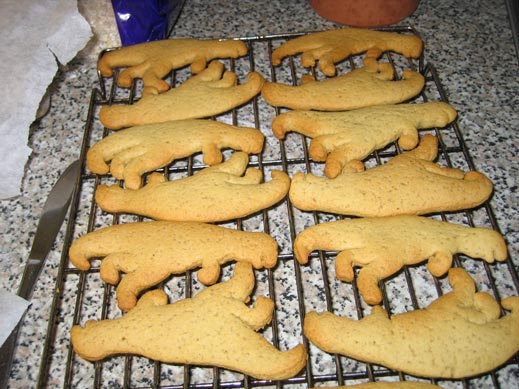
The Tyrannosaurus rex Gingerbread on a Cooling Tray

Picture credit: Everything Dinosaur

4).  To make the icing, place the sifted icing sugar and softened unsalted butter in a mixing bowl and beat with a wooden spoon until smooth, adding 1-2 tablespoons of water if necessary.

5).  Divide the icing among several bowls and add the food colourings.  Spoon into small paper icing bags.  Seal ends, snip the tips off the bags and pipe onto the biscuits.  You can also use all sorts of cake decorations – jellies, sprinkles and such like.

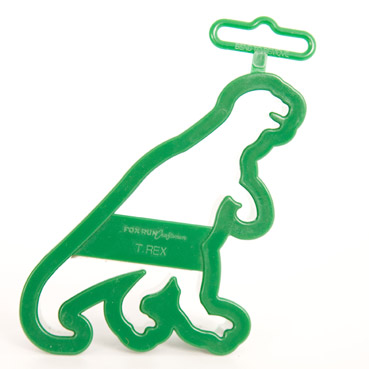
These gingerbread biscuits were made using the Tyrannosaurus rex biscuit cutter, a handy, robust cookie cutter in the shape of this famous dinosaur.

The Tyrannosaurus rex Biscuit Cutter

Picture Credit: Everything Dinosaur

Everything Dinosaur is a UK-based supplier of dinosaur and prehistoric animal themed models, toys and merchandise, check-out our website: Everything Dinosaur.

29 05, 2008

Dinosaurs in the Kitchen

By |2022-11-15T14:45:16+00:00May 29th, 2008|Categories: Educational Activities, Everything Dinosaur News and Updates, Everything Dinosaur Products, Main Page|0 Comments

Dinosaurs Baking and Making

The team at Everything Dinosaur have been busy in the kitchen again testing out a range of dinosaur shaped cookie cutters so that young dinosaur fans can make dinosaur shaped biscuits and other prehistoric animal themed snacks.

We have been trying out a whole range of different kitchen cutters and recipe ideas and after a careful selection process with our testers (and tasters in this case), we have used three types of dinosaur themed cookie cutter.

Dinosaurs in the Kitchen

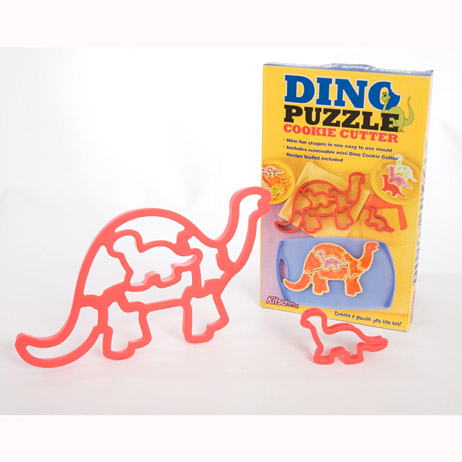
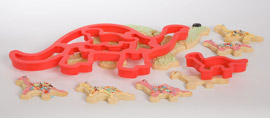
1). The Dinosaur Puzzle Cookie Cutter

A chance to create a dinosaur puzzle that you can eat!  A sturdy plastic cookie cutter set in the shape of a long-necked dinosaur, a sauropod.  Choosing a sauropod design for a biscuit making item was quite easy really, after all these animals had enormous appetites and must have spent a very large portion of their day eating.  It has been calculated for example, that a sauropod such as an adult Diplodocus would need to eat around 300 kilogrammes of food per day (that is the equivalent of over 3,000 lettuces)!

The Dinosaur Puzzle Cookie Cutter

Picture credit: Everything Dinosaur

Made from durable, robust plastic this cookie cutter set consists of several pieces that when fitted together form a long-necked dinosaur.  Young dinosaur fans can make biscuits that form a jigsaw puzzle, the set even comes with a biscuit cutter piece shaped like a baby dinosaur.

Dinosaur shortbread biscuits.

Picture credit: Everything Dinosaur

We used one of the recipes in the handy recipe leaflet included with this set to make some rather nice shortbread.  Our dinosaur testers then decorated them with coloured icing sugar and hundreds and thousands, we used a black jelly button to make the eye on the adult and edible, silver balls for the eyes of the babies.  They certainly proved very popular with our tasters and for the grown-ups the cookie cutter was easy to ease, the recipes simple to follow and best of all, the sturdy plastic cookie cutter was a doddle to wash and clean afterwards.

Cookie Cutters/Biscuit Cutters

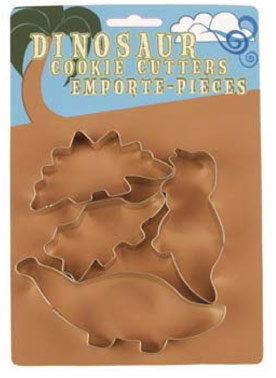
2). Dinosaur Metal Cookie Cutter Set

If lots of different prehistoric animal shapes are your requirement then our team members and their testers have this option covered as well with the dinosaur metal cookie cutter set.  This is a set of five, tin plated steel dinosaur shaped biscuit cutters in a handy storage box.

The Dinosaur Metal Cookie Cutter Set

Cookie cutters.

Picture credit: Everything Dinosaur

Each cutter is about 12 cm long and the set includes biscuit cutters shaped like Tyrannosaurus rex, Diplodocus, Triceratops and Stegosaurus plus a flying reptile for good measure.

Once again these items proved very versatile and our helpers made lots and lots of biscuits, like the other sets that we have tried, these items also doubled up as cutters when we were working with modelling clay.  The young children found them easy to use and once again there were no problems washing them up and clearing away.

The biscuits we made were fun to decorate and we had a whole range of multi-coloured dinosaurs at the end, we agreed that they would make super party food for a dinosaur themed party.

3. Tyrannosaurus rex shaped Biscuit Cutter

We couldn’t leave T. rex out of the mix, especially as this fierce dinosaur seems more popular than ever, so our team have tested a T. rex biscuit cutter too. 

The Tyrannosaurus rex Biscuit Cutter

Picture credit: Everything Dinosaur

This particular cutter makes dinosaur shaped biscuits that are about 11 cm tall, it was easy to use and was well suited for the particularly young children to try.  We made gingerbread and shortbread biscuits and they all proved to be very popular.  Once again we got the children to decorate them and they all had lots of fun.

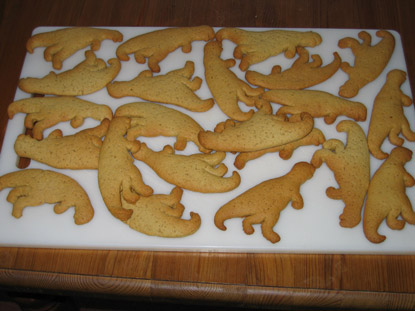
The Tyrannosaurus rex Biscuits just out of the Oven

T. rex biscuits.

Picture credit: Everything Dinosaur

As you can see we made lots of Tyrannosaurus rex shaped biscuits, the ones in the picture are gingerbread dinosaurs.  One of our dinosaur experts commented that with all these dinosaurs together on the tray like that it reminded him of a bone bed, although only a few theropod fossils have ever been found in close proximity to each other, indicating a social group or a family perhaps.

Still our biscuits did not remain in a group for long, once cooled and decorated our hungry helpers soon polished them off.  It makes a change, after all, T. rex would have considered us bite size had we been around 66 million years ago, now with these biscuits we can turn the tables on Tyrannosaurus rex, making him a bite-sized snack for us.

Visit Everything Dinosaur’s shop: Everything Dinosaur.

6 05, 2008

School Children Make Dinosaur Notebooks for Display

By |2022-11-14T22:58:57+00:00May 6th, 2008|Categories: Dinosaur Fans, Educational Activities, Teaching|0 Comments

Year 1 Children Display their Dinosaur Notebooks

Engaging Year 1 children (aged 5-6), with writing activities can be a challenge for teachers and their teaching assistants, however, if the term topic is dinosaurs and fossils, then it can be more of a case of getting them to stop writing about dinosaurs.  A team member at Everything Dinosaur, came across some marvellous notebooks and workbooks that had been prepared by Year 1 children as part of the study of dinosaurs and prehistoric animals.  With so many extension activities coming out of the lesson plans, the children ended up producing a notebook each all about their favourite prehistoric animal.

Children’s Dinosaur Notebooks on Display in the School Corridor

Helping to encourage young children with their writing.

Helping to encourage young children with their writing.

Picture credit: Everything Dinosaur

Teaching About Dinosaurs in School

Teaching about dinosaurs in school can certainly help and enthuse young children with their writing.  Our member of staff saw books about Tyrannosaurus rex, Triceratops, plesiosaurs and even one about Mary Anning.  Just like real scientists the children had been keen to put their own names on the workbook and it was fun reading them as our team member took a quick break from delivering a dinosaur themed workshop in the school.

To learn more about Everything Dinosaur’s dinosaur themed product range: Everything Dinosaur.

3 05, 2008

Exciting Frog Blog (week 8) And then there were None

By |2024-04-12T08:56:44+01:00May 3rd, 2008|Categories: Animal News Stories, Educational Activities, Everything Dinosaur News and Updates, Main Page|0 Comments

No sign of Tadpoles in the Pond

Spring has finally arrived and we have been enjoying a period of settled, warm weather with temperatures up to 20 degrees Celsius (not bad for our part of the world, at this time of year).

Staff have been keeping a close watch on the pond, after the virtual disappearance of the tadpoles just a few days after hatching.  The last sighting was on Tuesday morning (April 29th) when one tadpole was seen swimming close to the large clump of Elodea towards the centre of the pond.  The pond looks very healthy, the water is clear, well oxygenated and there is certainly plenty of invertebrate life in the pond, but no tadpoles.

No Tadpoles

We suspect that the tadpoles may have been eaten, it is certainly true that we would expect only a very few to reach the adult stage and leave the pond as little froglets.  According to informed literature mortality rates for these animals can be as high as 99.95% but it is slightly shocking to have to contend with the thought that hundreds of tadpoles met an untimely death just a few days after hatching and finally freeing themselves from their protective jelly.

Some team members had hoped that the tadpoles had simply concealed themselves amongst the pond weed and were remaining inconspicuous, but as the water has warmed up due to the higher temperatures we would have expected to find more signs of tadpole activity.  No tadpoles have been observed for over a week.

No Tadpoles Observed for a Week

As for what might have caused the demise of our tadpole population, we are still debating a number of theories.  Frustratingly we have no evidence to work with, the tadpoles were around in profusion a couple of weeks ago and now there are virtually no signs of them.  Many could be hiding in the weed or silt at the bottom of the pond but if this is not the case then we have to consider what might have wiped them out.

Tadpoles have many predators and succumb to fungal and viral infections.  The absence of any bodies to be seen, coupled with the relatively healthy state of the tadpole population and the healthy state of the pond itself leads us to discount these theories.

We think they have been eaten, but by what?  Certainly, Blackbirds and Robins eat tadpoles and catch them by wading into the shallows.  We have seen Blackbirds in particular around the pond, we are away of a nest site nearby and we have observed these birds taking a bath in the pond but no one has seen them catching and eating the tadpoles.

Tadpole Population Decimated

The majority of us suspect that the other pond life has decimated the tadpole population.  Once out of their protective jelly and swimming freely they would have been easy prey for the newly emerged water-boatmen.  However, the main culprits may be the numerous damsel-fly larvae that can be seen in the pond.  There are a large number and these are known to be voracious predators.  We suspect that many tadpoles may have ended up being eaten by these creatures.

Disappearing Tadpoles

We have a number of damsel-fly nymphs in the pond, they can be distinguished from other larvae by the three appendages that stick out like fans from the back of the thorax.  These are not part of the tail but the caudal lamellae, a set of gills.  There are a number of different sized larvae in the pond, this is not surprising considering that they can spend up to 5 years at this nymph stage

These larvae are ambush predators and hunt mainly at night and at the moment they are the number one suspects as we set out to investigate our tadpole disappearance.

Visit Everything Dinosaur’s website: Everything Dinosaur.

27 04, 2008

Exciting Frog Blog Week 7 – Where have all the Tadpoles Gone?

By |2024-04-12T18:35:10+01:00April 27th, 2008|Categories: Animal News Stories, Educational Activities, Everything Dinosaur News and Updates, Main Page|0 Comments

Frog Blog Week 7 – Disappearing Tadpoles

Typical April weather for England has continued over the last seven days or so, with lots and lots of showers interrupted by occasional sunny intervals.  As the sun is climbing quite high in the sky at the moment heading for the Summer solstice just 7 weeks away, when the sun does shine, it is very warm, with temperatures around the pond area being recorded as high as 20 degrees Celsius.

Disappearing Tadpoles

There has been lots of activity in the pond this week, particularly amongst the invertebrate residents, snail eggs (small blobs of jelly attached to pond weeds), have been found and relatively large numbers of pond snails, including rams-horns (those that survive bird attacks – see Frog Blog week 6) have been seen.  Everything Dinosaur team members observing the pond have counted at least two water boatmen that have hatched out.  Undoubtedly more will be observed over the coming weeks.  A careful study of the shallows reveals that quite large numbers of damsel fly nymphs can be seen.

These armoured invertebrate predators look quite prehistoric, perhaps resembling ancient Eurypterids, the savage water scorpions that dominated the Palaeozoic seas.  Given the opportunity they would certainly feed on the tadpoles, as indeed would the water boatmen.

Perhaps as a result of this increased predator activity the tadpoles have all but disappeared from the pond.  Over the last five days or so the number of tadpoles observed by team members has fallen dramatically.  A week ago, over a ten minute period nearly 100 tadpoles were counted, now no more than 6 or 7 are seen over the same time interval.

Predation of the Tadpoles

We suspect that many of the tadpoles will get eaten, only a very few will survive to escape the pond as miniature frogs, but we did not expect to see so few only after about 14 days after hatching.  Having considered this carefully we have concluded that the majority of the tadpoles are still fine, however, their survival strategy freed from the protective jelly that surrounded the developing embryo is to hide amongst the pond weed and algae, this may be why so very few can be seen by observers.

Tadpoles Gone

In the past, when tadpoles have been kept, these animals have always been in tanks, so it has always been easy to watch them.  In the natural pond, with so much more cover it is likely that the number of tadpoles is still quite high, but we just cannot see them anymore.

We will keep up our observations to see if we can spot more of them as they grow bigger.

Two frogs have been seen in the pond over the last few days, the smaller male frog has been joined by a larger one – at least they seem to be enjoying the rain.

20 04, 2008

Exciting Frog Blog Week 6 – Jelly beginning to go

By |2024-04-12T18:40:56+01:00April 20th, 2008|Categories: Animal News Stories, Educational Activities, Everything Dinosaur News and Updates, Main Page|0 Comments

Jelly beginning to Go

Weather in the northern part of the UK has been unseasonably cold with temperatures still dipping near to freezing during the night and an chilly wind blowing for the last couple of days.  There has not been a great deal of sign either, just showers and a very cloudy, grey sky with little breaks to permit the sunshine through.

This inclement whether has not seemed to have hindered the progress of the tadpoles, we think all those that are actually going to hatch have now hatched.  The first brave individuals have been spreading out across the pond, by Wednesday of this week they had ventured to the back of the pond and a few could be seen hanging from the pond sides a couple of inches under the surface.  By today, all parts of the pond have been conquered and some of the first of the tadpoles to hatch have spread themselves out amongst the pond weed and other hiding places.

Tadpoles

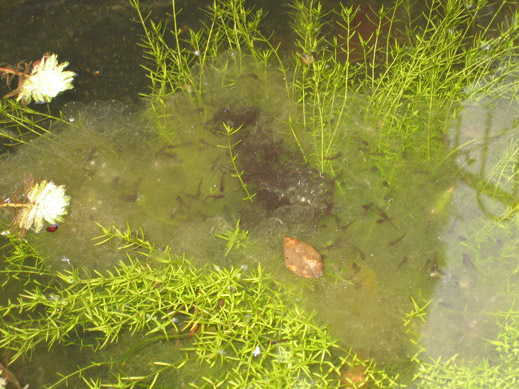
Incidentally, a large number of tadpoles seem content to remain in the projective jelly.  Perhaps these were amongst the last to emerge and therefore still have the remnants of the egg  yolk in their stomachs to sustain them.  They will have no need to leave the jelly until they have to seek food.  The jelly itself is now very discoloured and only a few of the spherical former eggs can be made out in this grey mass.

The Remnants of the Protective Jelly

Picture credit: Everything Dinosaur

The picture shows the grey, discoloured jelly in which a group of tadpoles can be clearly seen.  Other tadpoles, perhaps the first ones to hatch have now dispersed throughout the pond.  Perhaps those tadpoles remaining close to the jelly have still got the remnants of the egg yolk in their stomachs and so have not been forced to leave the protective jelly environment in order to find food.

Looking for Frogs

Members of the Everything Dinosaur team have not observed any frogs in the pond over the last week.  Even the small, male frog seems to have gone.  As far as we know adult Common Frogs tend not to feed in water, so the frogs may have left the pond to seek food.  Perhaps staying close to the pond or moving further out into the grassy area at the back of the yard.

Blackbird Feeding

Talking of food, we have worked out what has been happening to the Rams-horn snails that inhabit the pond.  A male blackbird was observed snatching up a snail from the shallows and attempting to fly off with it.  The snail was found in the middle of the yard in a battered and bloodied state.  It was returned to the water and seems to have survived its ordeal.

We wonder whether the blackbird is going to attempt to snatch a tadpole, they would certainly be more difficult to catch, but at least there is no hard shell to deal with.

Visit Everything Dinosaur’s award-winning website: Visit Everything Dinosaur.

Go to Top