All about dinosaurs, fossils and prehistoric animals by Everything Dinosaur team members.

Everything Dinosaur’s work with schools and other educational bodies. Articles, features and stories about dinosaurs and their role in education and educating young people.

17 04, 2008

Geological Hammers – What is so special about them?

By |2022-11-14T12:33:05+00:00April 17th, 2008|Categories: Dinosaur Fans, Educational Activities, Main Page|0 Comments

The Geology Hammer – a Useful Piece of Field Equipment

Although a geological hammer is often useful, much study of fossils can be done without the use of one.  When team members visit places such as Lyme Regis and Charmouth on the Dorset (Jurassic) coast we are often amazed at the number of people that we see bashing away at rocks with hammers.  Indiscriminate hammering is a form of vandalism and can be dangerous.  Parts of the shoreline at Lyme Regis are strewn with sharp rock fragments which can make crossing the area with bare feet a risky business for any unwary holiday maker.

Geology Hammer

Whilst we appreciate the desire to break open nodules to see if an Ammonite is present, this sort of work should really be done by those people who know what they are doing and are equipped to carry out such procedures.  There are certain tell tale signs that can indicate whether a rock may be worth splitting to see if there is a fossil inside it.  On many sites hammering is forbidden or even illegal and there is a high risk of damaging a specimen when trying to extract it.  Sometimes it can be almost as rewarding to leave a specimen in situ so that others may view it, besides hammering away at rocks can be dangerous.  Shards and splinters may break off, so it is always a good idea to wear a pair of safety goggles, if you attempt to split any rocks apart.

A Geological Hammer – Helpful for Finding Fossils
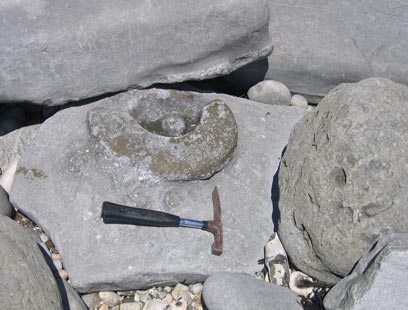
An Ammonite fossil.  The geological hammer provides a scale (geology hammer).

A big fossil close to the Ammonite Pavement.  The geological hammer provides a good scale.

Picture credit: Everything Dinosaur

Ideal for Breaking Rocks

An ordinary DIY hammer should not be used for rock breaking, or at least is should only be used on the softest of sediments such as loose shales and mudstones.  The metal used in the manufacture of ordinary hammers is too brittle and chips may fly off (another good reason to wear safety glasses).  Geological hammers are made of specially hardened steel and come in various shapes and sizes.  These hammers have been specifically designed to cope with the rigours of hitting and splitting rocks.

Whether you are an accomplished fossil hunter of just starting out it can be difficult to obtain advice and to find the equipment you need.  When it comes to geological and palaeontological supplies we use a company called GEO Supplies Limited, based in Sheffield, England.  Over the years, team members have purchased a number of items from them, we have never encountered a problem and they have always be most helpful.

For further information and advice: Contact Everything Dinosaur.
15 04, 2008

Would the Real Inspiration for Indiana Jones Please Step Forward?

By |2024-04-12T08:39:33+01:00April 15th, 2008|Categories: Educational Activities, Everything Dinosaur News and Updates, Main Page|0 Comments

Who was the Inspiration behind Indiana Jones?

With the imminent release of the fourth Indiana Jones movie – Indiana Jones and the Kingdom of the Crystal Skull (global release date May 22nd), a number of documentaries and radio programmes are being aired in preparation of this event.  The most prominent character in the  movies is Dr Henry “Indiana” Walton Jones Jr (most famously played in the films by the American actor Harrison Ford).  Apparently the he was nick-named “Indiana” after the family dog.

No doubt the new film will be a huge success, with the fictional professor of archaeology battling the villains with his trademark bullwhip whilst wearing his fedora.

Indiana Jones

However, it is intriguing to note that there is debate as to who was the inspiration behind the Indiana Jones character.  A documentary being shown in the UK, (channel five – 9pm), hopes to shed some light on this.  Two protagonists are put forward as the main inspiration behind Steven Spielberg’s character, Roy Chapman Andrews and Otto Rahn.

Cinema buffs and biography fans alike will be fascinated at how clues from the previous three films are compared to the little-known histories of these two adventurers.  Otto Rahn was a German scholar, whose real-life search for the Holy Grail ( the subject of the third film in the franchise), entangled him with the Nazi Party.  Roy Chapman Andrews was an American who played an integral part in the palaeontological discoveries of the 1920s and 1930s.

Roy Chapman Andrews was Instrumental in the Discovery of Protoceratops

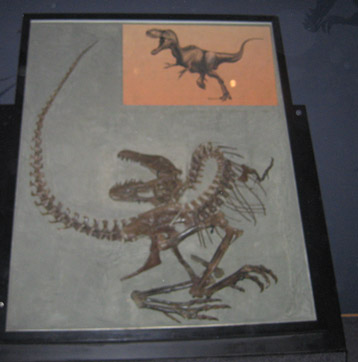
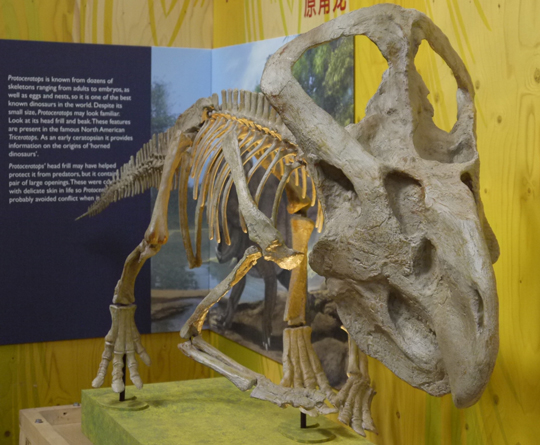
Protoceratops skeleton on display.

A skeleton of a Protoceratops on display. Picture credit: Everything Dinosaur.

Picture credit: Everything Dinosaur

Roy Chapman Andrews was a naturalist, explorer and writer.  He worked for the American Museum of Natural History (AMNH) , undertaking expeditions on the museum’s behalf to Alaska, Japan and Central Asia.  He led the first expedition from the AMNH to the Gobi desert of Mongolia and participated in further expeditions to this remote area helping to discover the first evidence of dinosaur nests and to unearth new fossils of many prehistoric mammals as well as Protoceratops, Oviraptor and Velociraptor.

Dinosaur and Prehistoric Animals

Everything Dinosaur stocks a huge range of prehistoric mammal and dinosaur models including Protoceratops, Oviraptor and Velociraptor.  To view the range: Dinosaur and Prehistoric Animal Models.

A crack shot, often picture with a rifle in his hand and with his trademark “ranger-style” hat, perhaps this American explorer is the inspiration behind the Steven Spielberg character.

Ironically, despite his excellent work for the museum, it was Roy’s team that first besmirched the good name of the dinosaur called Oviraptor.  When a fossil of this little, theropod dinosaur was found in association with a nest of eggs, it was presumed that this animal had been in the process of attacking the nest and eating the eggs.  This is how Oviraptor got its name (means egg-thief).  It was only in the 1990s that further, more intensive study using modern techniques revealed that Oviraptor had actually been sitting on the nest, in a similar way to modern birds.  The eggs were most likely its own.

What Oviraptor actually ate is still debated by palaeontologists today.

13 04, 2008

Exciting Frog Blog Week 5 – Tadpoles nearly all Hatched

By |2024-04-12T08:37:59+01:00April 13th, 2008|Categories: Animal News Stories, Educational Activities, Everything Dinosaur News and Updates, Main Page|0 Comments

Nearly all Tadpoles Hatched

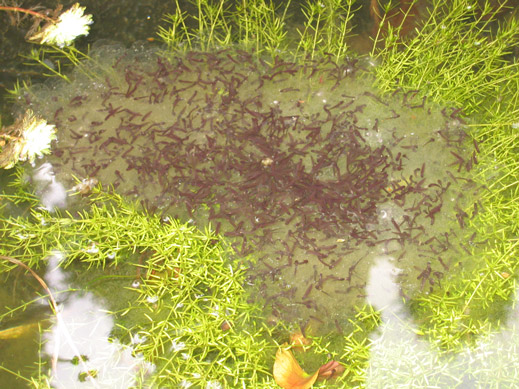
The weather over the last week or so has been unsettled, but fortunately we have not had any snow showers, just rain and sunny intervals.  The majority of the tadpoles have now hatched, although there are still several still within their transparent egg cases, but these are very active and we suspect that the remainder of the tadpoles will hatch in the next few days.

First Hatchlings

The first hatchlings emerged from the spawn that was in the middle and at the very top.  These animals hatched first perhaps due to the fact that the being at the top they received most sunlight and therefore were kept warmer, being in the middle of the spawn may have helped keep these embryos insulated and therefore protected better as the surface water cooled in the chilly nights.

Frogspawn is Hatching

By Thursday of this week some of the first hatched tadpoles had left the spawn and could be seen hanging vertically from pond weed and the fine fronds of algae, one of our team members remarked that they looked like little music notes hanging from the staves on a score sheet.  By today, Sunday,  a number of tadpoles have made the break from the spawn and are seeking shelter amongst the pond weed.  This might be as the yolk that nourished them once they had emerged, (the slightly brown bulge in the belly of the tadpole), has now been used up and the tadpoles are beginning to seek their own food.  Their black colouring whilst being effective in helping to absorb heat, does not provide them with a lot of camouflage in amongst the green Elodea.

Most of the Tadpoles have now Hatched

Picture credit: Everything Dinosaur

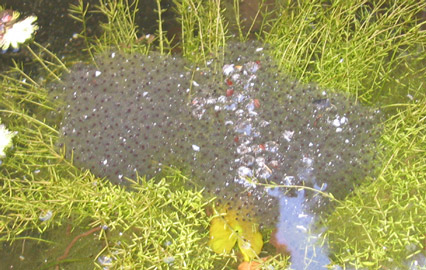
Tadpoles Have Hatched

The pictures shows that the majority of the tadpoles have now hatched.  They remain congregated around the spawn, especially on top of it where it is warmest.  Over the next few days it is likely that the tadpoles will disperse throughout the pond.

We noticed that during daylight hours the “clump” of hatched tadpoles spread out to form a rough doughnut shape, then as it grew darker and presumably colder the tadpoles seemed to gather together again, concentrating as a mass on top of the spawn again.  Whether this is an instinctive response to less daylight in order to keep warm so as to survive the colder night; or whether this is a strategy to avoid predation is unclear.

One adult frog has been spotted in the pond this week, the small adult male.  He has kept a low profile staying on the periphery of the pond away from the hatching tadpoles.  He has preferred to remain in cracks on crevices around the pond’s edge during daylight hours.

12 04, 2008

Thank you Letter Received from Young Dinosaur Fan

By |2022-11-14T12:03:00+00:00April 12th, 2008|Categories: Educational Activities, Teaching|0 Comments

Young Dinosaur Fan Writes to Everything Dinosaur

For young Holly, a visit to her school by Everything Dinosaur to teach about dinosaurs and prehistoric animals really made her day.  She was so thrilled to have taken part in a dinosaur workshop that she put pen to paper and wrote Everything Dinosaur a lovely letter telling us how much she enjoyed the event.

Holly wrote:

“Dear Everything Dinosaur,

I liked it when you came to visit our school the other day.  It was my favourite thing that I have done in school all year.  I liked it when you showed us the fossils and thank you for telling us some dinosaur facts.  It was hard to believe that a dinosaur could be as big as my house.  I didn’t know that a girl Tyrannosaurus rex was probably more scary than a boy Tyrannosaurus rex.  I like dinosaurs but I am glad they are not around and that they are extinct!  Dinosaurs can be very big and scary.

Thank you once again for coming to our school.

Holly.”

Thank You Letter

This letter from Holly is typical of the many letters that we receive from school children.  We aim to encourage literacy and creative writing as a result of one of our visits to a school to teach about dinosaurs.

Glad you enjoyed the day Holly.

A spokesperson from the award-winning, UK-based company praised Holly for her wonderful correspondence and thanked all her class mates for their super thank you letters.  The comments and feedback from the children was delightful.

A Thank You Letter Received by Everything Dinosaur

Thank you letter received by Everything Dinosaur.

School children thank Everything Dinosaur.  Picture credit Holly.

Picture credit: Holly

Visit Everything Dinosaur’s user-friendly website: Everything Dinosaur.

6 04, 2008

Exciting Frog Blog Week 4 – Tadpoles Starting to Hatch

By |2024-04-12T08:40:15+01:00April 6th, 2008|Categories: Animal News Stories, Educational Activities, Everything Dinosaur News and Updates, Main Page|1 Comment

The Tadpoles have Started to Hatch

Great excitement this week in the pond as the tadpoles have begun to hatch.  The first signs of movement were detected on Wednesday morning.  This was on the 2nd of April, just 17 days after the spawn was laid.  Given the quite cold weather that we had been experiencing we were surprised how quickly the tadpoles developed.  However, it is worth noting that despite the cold weather and the chilly pond water, the spawn had been laid in a central position in the pond and this allowed the spawn to get what sun there was for most of the day.  Also, the jelly swells and becomes buoyant thus permitting the spawn to stay at the surface, again helping to warm the eggs.  Sat on their bed of pond-weed (Elodea) the spawn has been fairly quick to develop.

The Latest Picture of the Frog Spawn

Picture Credit: Everything Dinosaur

Tadpoles Starting to Hatch

By Wednesday lunchtime, team members were taking turns to watch the spawn, every now and then a little tadpole would move slightly, either curling or uncurling.  By Friday the movements had become stronger and more frequent.  The embryos had assumed a more tadpole-like shape and could be seen moving inside the egg membrane.

The first hatchlings were observed on Saturday afternoon (5th April).  The tadpoles have developed a definite head end (a round bulge) and a basic tail.  However, it will be a few days before they are swimming freely.

At this stage, the muscular and circulation systems are developing, the gill arches either side of the head are now forming.  The tadpoles hatch at around the time these gills are able to function.  The eyes and mouth are not fully developed and there is an adhesive organ present on the top of the head.  This permits the tadpole to attach itself to pond weed and remain there until further changes have taken place.

Spotting the External Gills

If you can get close enough and look very carefully at a tadpoles head from the top downwards (called a dorsal view by scientists), you should be able to see two small tiny bumps, one on each side of the head.  These are the external gills and they should be visible for about 12 days or so.  Over this period a fold of skin known as the operculum develops on the first branchial arch just in front of the external gills.  It grows backwards until the external gills are covered.  The eyes and mouth begin to develop.

The operculum does not close up completely, a single hole (called a spiracle) remains on the left side of the body.  Water is taken in through the newly formed mouth, passes over the internal gills and is expelled through this spiracle.  By this time the mouth should have developed definite jaws and the adhesive organ on top of the head should have almost completely disappeared.

The digestive system should have expanded (for the first few days after hatching the tadpoles live on the remains of the yolk from the egg – this can be seen as a bulge in their tummies).  Soon the tadpoles will have acquired the ability to swim and they will have started their journey towards becoming frogs – metamorphosis.

Frog Observed

Only one frog has been observed in the pond during daylight hours.  We think this is a male, it has been seen around the spawn and some of us have jokingly speculated that this might be the “expectant father” waiting for his babies to hatch.  We know that many species of amphibian demonstrate some care for their offspring.  For example, male Midwife toads (Alytes obstetricans) gather up the eggs once they have been fertilised and they carry them around on their back legs, but we are not aware of any paternal instinct being demonstrated by Common Frogs (R. temporaria).

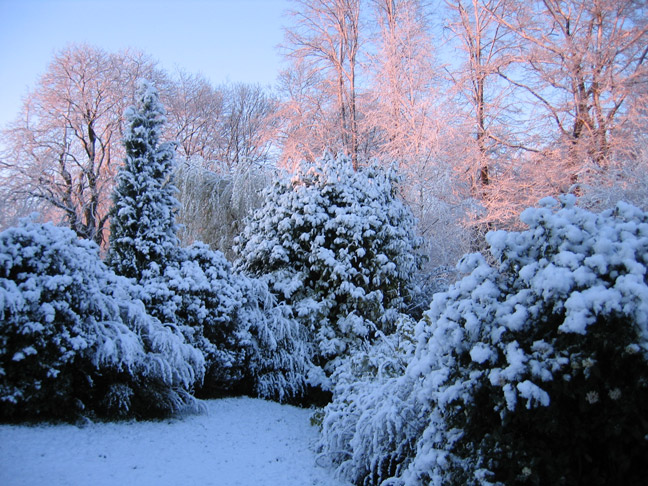
Much of the country has been covered in a blanket of snow, this morning.  Typical of the British weather, no snow in winter and then on the 5th April we get some.  This picture was taken of the area behind the office this morning.

Oh to be in England now that April’s Here!

Picture credit: Everything Dinosaur

1 04, 2008

Dinosaur Death Throes – Not what they Seem

By |2022-11-14T07:27:36+00:00April 1st, 2008|Categories: Dinosaur and Prehistoric Animal News Stories, Educational Activities, Main Page, Palaeontological articles|2 Comments

Dinosaur Death Throes – Not what they Seem

One of the questions we were asked recently was why do all meat-eating dinosaurs seem to fossilise in the same way?  A young dinosaur fan had pointed out that a picture in his dinosaur book showed two Coelophysis skeletons one of which had its neck and head curved backwards over the spine with the tail curling back on itself.  In the same book, there was a picture of a Compsognathus fossil with the head and neck also curved over the back.  How could these two dinosaurs have died in the same way?

Dinosaur Death Throes

We are familiar with these exhibits, the Coelophysis probably come from the famous Ghost Ranch deposits of New Mexico, where over 100 individual skeletons of this early Triassic theropod have been discovered.  The Compsognathus example probably relates to the nearly complete Solnhofen specimen from southern Germany.  This fossil was discovered in the lithographic limestone deposits in the same area as the first Archaeopteryx fossils.  Compsognathus was a resident of the Jurassic, Coelophysis the Triassic, how could these two animals separated by millions of years have died in virtually the same posture?  Indeed, when some of the Archaeopteryx fossils are studied, then they too show the head typically arched backwards over the spine.  The tail does not curve round to any real extent, perhaps the tails of these early birds were too ossified to permit such movement, or maybe it is to do with the conditions of fossilisation at the southern German sites.

This phenomenon is not restricted to just some dinosaurs, a large number of articulated theropod (meat-eaters) fossils show this trait.  Such postures are also seen in pterosaur fossils and birds.  As we have driven along on our travels in the USA and elsewhere we have observed birds that have hit car windscreens and been killed.  As the carcase dries out under the hot sun, the neck often adopts a curving posture.

An Exhibit of an Articulated Albertosaurus skeleton (Royal Tyrrell Museum)

Picture credit: Everything Dinosaur

The picture above shows a typical example of an articulated theropod fossil with the head and tail curving towards each other.

Most scientists believe that this common posture is caused by either one or a combination of two factors of post-mortem processes (after death).  The first of these processes involves muscle contractions causing the neck and tail to bend over.  Secondly, the posture could be caused by the the drying out of tendons and ligaments within the body as it remains exposed to the sun.  Whether it is due to rigor mortis or the desiccation of the body, both possibilities indicate that these bodies must have remained intact on the ground for sometime before finally being buried.

Examples from the Natural World

These are valid explanations, borne out from our own observations of roadkill in hot climates, however, having visited Africa on numerous occasions we also note how rare it is for dead animals to lay undisturbed without attracting the attention of scavengers.  One of our colleagues remembers working in the Masai Mara of Kenya when they had the misfortune to come across the body of a mature hippopotamus that had died only a few metres away from a small oasis which was being studied so that local elephant movements could be plotted.

Over the next few days, the pungent aroma of the rotting beast attracted a number of scavengers including hyenas, lions, marabou storks as well as vultures and the resident Nile crocodile.  It was not long before the remains of the hippo and been well and truly taken to pieces.  There were plenty of scavengers around in the Mesozoic, why were many of the bodies of the theropods not disturbed by other animals looking for an easy meal and the remains scattered about?

Another intriguing explanation for this death pose has recently been put forward.  There are certain conditions, most closely associated with warm-blooded animals such as mammals and birds that can lead to this posture.  A posture that is adopted when the animal is very much alive.  One such condition is opisthotonos, this can lead to animals adopting a very rigid posture with the head and tail curving towards each other.  This severe arching is caused by irritation of the membranes surrounding the brain or the spinal cord.  In humans this condition is associated with meningitis in infants.  Opisthotonos can also occur if there is brain damage (most notably the cerebellum), or any form of brain impairment leading to disruption to the nervous system.

There is some evidence of face biting amongst tyrannosaurs (another theropod), could many meat-eaters have suffered brain injuries when competing with other dinosaurs, this might have resulted in the condition that led to the “death pose” posture.

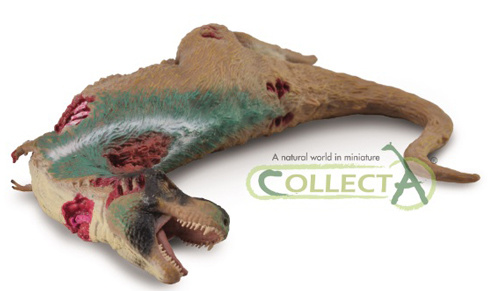
A Model of A T. rex Carcass

Dinosaur death throes

T. rex corpse.  An example of dinosaur death throes.

The picture (above) shows a model of a T. rex carcase, with the figure in the typical “death” position.  This model is part of the CollectA Age of Dinosaurs Popular range: CollectA Age of Dinosaurs Popular Range.

As this disorder is most commonly associated with higher animals (mammals and birds), which are warm-blooded could this theory if true, also lend weight to the hypothesis that dinosaurs, at least the active, hunting, theropods were endothermic?

31 03, 2008

The New Young Explorers Kit – Dinosaurs

By |2024-04-12T08:46:08+01:00March 31st, 2008|Categories: Educational Activities, Everything Dinosaur News and Updates, Main Page|0 Comments

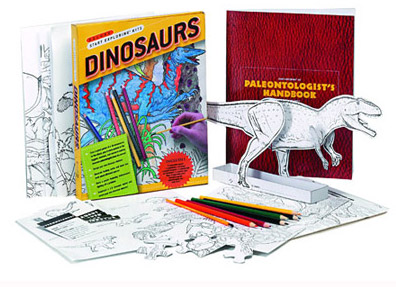
Start Exploring Dinosaurs Activity Pack

Uncover some of the secrets about dinosaurs and other prehistoric animals with this fun-filled and educational “Explore Dinosaurs Activity Pack”.   This new Dinosaur themed kit contains lots and lots of activities, there is a giant Tyrannosaurus rex poster, the chance to design your own dinosaur stickers, make dinosaur trading cards and even the opportunity to come up with your own new species of prehistoric animal.

Young Explorers Kit

The kit comes in a handy box and contains everything required to complete the tasks, including paint brush, watercolour pencils, pencil sharpener and even an eraser (to help make your mistakes extinct).  This American designed set even comes complete with a 16 page palaeontologist’s handbook with lots of information and facts about dinosaurs.

The Start Exploring – Discover Dinosaurs Activity Kits

Picture credit: Everything Dinosaur

In total there are 11 different posters featuring a variety of monsters from the Mesozoic, on test with our families and focus groups this kit has proved very popular.  Favourite items included the giant Tyrannosaurus rex poster to colour in – great for bedroom walls and the 3-D model of a meat-eater.  Art supplies are included in the kit, so it is a kind of self-contained activity centre of  young palaeontologists, there is even a little booklet that advises on different art techniques to try.  It is a great addition to the Everything Dinosaur toys and gifts range.

To see the kit and other craft items: Visit Everything Dinosaur.

30 03, 2008

Frog Blog – Week 3 – Our Little Black Commas

By |2022-11-11T22:20:01+00:00March 30th, 2008|Categories: Animal News Stories, Educational Activities, Everything Dinosaur News and Updates, Main Page|0 Comments

Frog Blog – Week 3 – Little Black Commas

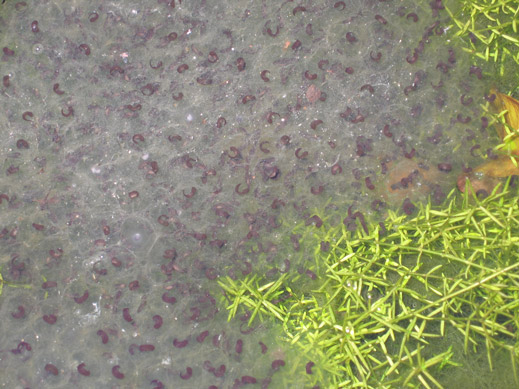
Our frog spawn in the office pond is approximately 2 weeks old and despite the very bad weather we have experienced in the last few days there are signs that things are beginning to happen.  The weather has been quite cold, although it is hard to say that it has been unseasonal, with the early Easter it is easy to forget that we are still in March and on the whole the winter has been relatively mild.

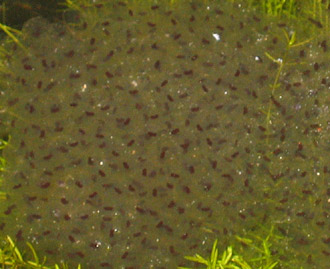
Only one warm sunny day over the last week, we have had heavy rain and blustery showers but fortunately not too many bonfires from the construction workers nearby polluting the water with ash drifting into the pond.  The water temperature remains cold but a close examination of the frog spawn shows that the little black dots we started with inside their protective jelly are beginning to change.  The majority of them are showing some definition, we have a lot of “little black commas”, the eggs are showing signs of development and we can see the start of a defined head end and a tail.

A Close up of the Frog Spawn

Picture credit: Everything Dinosaur

Despite the cold weather the spawn is beginning to change, the picture shows that the embryos are developing, becoming more elongated and showing signs of progress.  We suspect that the water temperature will still be determining the rate of development, perhaps the warmer weather forecast for next week will help the spawn to hatch in the next 10 days or so.

Only one adult frog has been observed in the pond during office hours.  Ironically, it has taken to sitting next to the frog spawn using the surround pond week (Elodea) to support its weight.  We were a little concerned about this frog, normally frogs confine themselves to the margins of the pond, where there is more cover.  However, this frog, (we think it is a male), seemed quite happy to sit amongst the pond week in the centre of the pond.

Some of us started to speculate that this was the father, checking on his family to be, but this was probably a bit too fanciful for the more rational members of the team.  Amphibians do adopt many strategies when it comes to looking after and raising their young.  It is not just the so called higher forms of life, the mammals and birds that adopt a benevolent attitude to their offspring.

23 03, 2008

Exciting Frog Blog Week 2 Update – The Tiny Black Dots

By |2024-04-12T08:33:01+01:00March 23rd, 2008|Categories: Animal News Stories, Educational Activities, Everything Dinosaur News and Updates, Main Page|0 Comments

Frog Blog Week 2 – Tiny Black Dots – no movement yet

We have been keeping a careful watch on the frog spawn in the office pond.  The frogs spawned for the first time in our pond last Sunday, so we have decided to keep an observational record of how the tadpoles get on.  Four frogs were in the pond, we suspect one female and three males.  Identifying males and female frogs is not our strong suit, but we estimated the ratio of boys to girls based on the fact that one frog was bigger than all the rest, so we speculated that this was the female.

During the breeding season, the male frogs develop pronounced dark pads on their first digits of the hand.  These pads are present all year round but swell up in the breeding season and help permit males to grip the usually larger females during mating.

Also, the smaller frogs croaked and we think that only the males do this.  The sound does not carry very far, it is certainly not the loudest frog croaking we have heard, many tropical frogs would easier drown out the noise made by these Common Frogs as these animals lack a vocal sac to help the sound resonate.

By Monday the pond was empty and the adult frogs had left, perhaps to hunt in the surrounding rockery, we did not expect to see all four of them together again, but surprisingly on Wednesday all four frogs (one big one and three smaller ones) returned to the pond and there was a lot of activity again but no further spawning.

Frog Blog – Week 2

Picture credit: Everything Dinosaur

The weather in the north-west of England has been particularly cold over the last few days.  We have experienced strong gales, hail storms and even some snow.  This is the earliest Easter for 95 years, we suspect that the development of the eggs will be dependent on the water temperature, so it may take a while for the embryos to start to develop.  The jelly surrounding the tiny black dots (each no more than about 2mm across), has swollen and this helps the spawn stay afloat and close to the surface of the pond.  In this way the spawn can be warmed by sunlight to the greatest extent (surface water of ponds tends to be warmest).

We have been concerned this week, as there has been a lot building work going on around us and the construction teams have lit several bonfires.  This has led to large deposits of ash and other debris getting blown into the pond.  The silvery “scum” surrounding some of the spawn that can be seen in the picture, is ash that has drifted into the pond, we are not sure what effect this pollution will have on the spawn’s development.

We will have to keep you posted on the spawn’s progress…

Science Bit

Amphibians were the first truly semi-terrestrial animals, evolving in the late Devonian and becoming more numerous and diverse during the Carboniferous and Permian periods before suffering in the Late Permian mass extinction.  At the end of the Permian there were about 35 known families of amphibians, many of them considerably larger than their modern counterparts.  After the mass extinction event, at the beginning of the Triassic (248 million years ago), there were about 10 families remaining.

About 70 percent of all the types of amphibians around at the time of the Late Permian went extinct.  Today, there are about 4,300 species of amphibians in the world (mostly frogs), but the amphibian class has never fully recovered from the Permian mass extinction.  Amphibians were at their most diverse (in terms of families) and spectacular something like 50 million years before our ancestors (the first mammals) evolved.

16 03, 2008

Frog Blog – We have Frogspawn in the Office Pond!

By |2022-12-20T22:43:17+00:00March 16th, 2008|Categories: Animal News Stories, Educational Activities, Everything Dinosaur News and Updates, Main Page|0 Comments

Frog Blog – We have Frogspawn in the Office Pond!

Four years ago whilst some of us were away in Canada working on some palaeontology projects, arrangements were made to build a small pond behind the office.  We had managed to persuade one of the designers of the animal enclosures from Chester Zoo to undertake the work and to produce a water feature with a seating area so that we could take our breaks and watch any wildlife that might be attracted to the water.

The work took about a week and our designer friend built two small ponds in a corner of the paved area behind the offices.  He even cleverly cast some ammonite fossils and installed these in various places in the rockery to make us palaeontologists and fossil collectors feel at home.

Using his expertise, our designer chum shaped the pond so that there would be plenty of shallow areas and margins, important when wanting to create a natural pond.  In addition, he advised on the planting and even provided the oxygenating water plants, the marginals and the lilies.  His final touch was to provide us with a population of snails to help maintain the pond.  We have two species at the moment a small pond snail and rams-horns (Planorbis sp.)

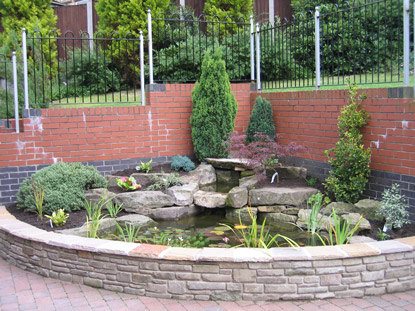
The Pond when it was First Built and Landscaped

Picture credit: Everything Dinosaur

Over the last few years this water feature has proved popular with the local birds who use the shallows as a bird bath and we have been fortunate to have damsel fly larvae as well as water boatmen take up residence.  Although, frogs had been seen in the vicinity and team members were able to count 3-4 individuals at anytime in the summer, (we even had a particularly large one that was nicknamed “Freddie” after Andrew Flintoff the England cricketer who took up residence in 2005);  no breeding had taken place.

However, this morning, whilst returning to the office to sort out some Everything Dinosaur paperwork, a quick check of the pond and hey presto – our first ever frogspawn was spotted.  There had been a number of frogs seen in the pond over the last month or so and apparently last night (a particularly dark and wet night) the spawning took place.

From the amount of spawn produced, we estimate that it is from just one female.  A total of four frogs have been observed in the pond this morning (the back of one can be seen partially hidden by the spawn to the right of the picture).  We have speculated that it is the female with her three suitors.  The frogs are Common Frogs (Rana temporaria), one of three species of frog that are found in the UK (excluding any escaped exotics).  Like all native British amphibians and reptiles they are a protected species.  With much of their habitat destroyed, areas such as landscaped offices and gardens are becoming increasingly important to them.

It is nice to know that after nearly 5 years the frogs have felt comfortable enough with our pond to breed in it, we are playing a small role in the conservation of this species and amphibians need all the help they can get, as they are globally the most endangered and threatened of all the animal classes.

Frogs are special to many of the Everything Dinosaur team members, they are very specialised Lissamphibians (the group of amphibians that includes frogs, toads, newts, salamanders and the leg-less caecilians).  The Lissamphibians were present in the Palaeozoic and it is thought that frogs evolved sometime in the Triassic,  however, the fossil record for frogs is very patchy to say the least.  They were probably relatively abundant during the Age of Reptiles, but the lack of fossil evidence inhibits palaeontologists when it comes to working out Anura (frog) evolution.  Fossil bones have been recorded from a number of Mesozoic sites but they are usually isolated fragments, ilia, humeri (limb bones) and the more robust skull elements.

Occasionally, fossils are found that demonstrate that some of these amphibians would have been formidable hunters, even capable of eating baby dinosaurs and young crocodilians.  The discovery of a giant frog from Mesozoic deposits in Madagascar is evidence of this.

To read about the discovery of fossils of a giant Cretaceous frog: Giant Frog from Madagascar.

Go to Top