All about dinosaurs, fossils and prehistoric animals by Everything Dinosaur team members.

Everything Dinosaur’s work with schools and other educational bodies. Articles, features and stories about dinosaurs and their role in education and educating young people.

15 03, 2008

Make Dinosaur Nests for Easter

By |2023-02-17T15:11:48+00:00March 15th, 2008|Categories: Educational Activities, Everything Dinosaur News and Updates, Main Page|0 Comments

Looking for something to do with your young dinosaur fans over the school holiday.  Here is a simple and fun recipe for dinosaur chocolate nests, an ideal activity for Easter time.  A super idea to help entertain the children, dinosaur chocolate nests for kids.

Dinosaur Chocolate Nests

Ingredients – (makes a batch of about 8 nests)

Plain or Milk cooking Chocolate 225 grammes (8oz)

Packet of Breakfast Cereal Cornflakes or Shredded Wheat variety

Packet of Sugar Coated Mini-chocolate Eggs

Pack of Small Cake Cases

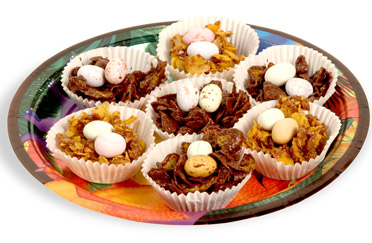
Dinosaur Nests – a Great Holiday Baking Activity
Picture Credit: Everything Dinosaur

Method

1.  Break the cooking chocolate into pieces and place in a heat-proof bowl.  Melt the chocolate over a pan of simmering water.

2.  Once the chocolate has melted remove it from the heat and give it a good stir in the bowl.

3.  Add some of the breakfast cereal until the mixture takes on a a brown twiggy look.

4.  Carefully spoon enough of the mix into each paper case so that a little nest is formed.  Make sure you push it down in the middle so that each nest has a hollow in the centre

5.  Place two chocolate mini-eggs in the centre of each chocolate nest, the eggs will stick when the chocolate sets. Two eggs is all you need for each nest (we know that some dinosaurs laid eggs in pairs so your chocolate nests would please a palaeontologist) – see notes below.

6.  Then leave the nests to set.

There you are a set of lovely dinosaur themed nests, an ideal activity for young palaeontologists over the Easter break.

For other baking ideas, recipes and for fun party items visit the section of the Everything Dinosaur website that deals with parties: Dinosaur Toys and Gifts.

Dinosaurs and their Nests (a little bit of science)

Many nests of dinosaurs have been discovered, particularly over the last fifteen years or so with the discovery of sauropod nesting sites in Argentina and Europe plus more evidence having been gathered from places such as the famous Flaming Cliffs area of Mongolia.

The first dinosaur eggs were discovered in 1859 (France). The first recognised dinosaur nests were uncovered by an American team of palaeontologists led by Roy Chapman Andrews during expeditions to Mongolia in the 1920s.  Over the last few years, scientists have been able to build up their knowledge about dinosaur reproduction and egg laying as egg-shell fragments, nests, and even fossils of unhatched baby dinosaurs inside eggs have been discovered.

The pairs of eggs laid in our pretend chocolate nests are based on the layout of eggs found in theropod dinosaur nests.  Many theropod nests (tyrannosaurs, allosaurs, Velociraptors, Oviraptors were theropods); consist of a dug out, roughly bowl shaped hole with pairs of eggs laid are in a circle, pushed into the earth and they are laid in pairs.

A Dinosaur Egg Spotted at a School (STEM Learning)
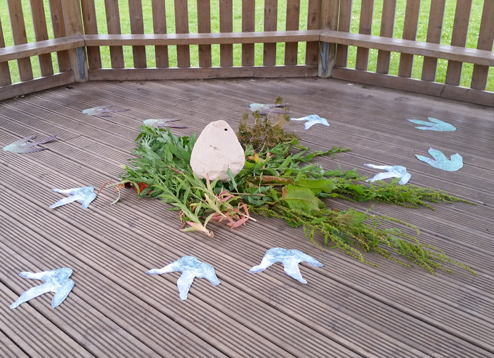
dinosaur nest found in a school

A dinosaur discovery at a school.

Picture credit: Everything Dinosaur

Dinosaur Eggs

The laying of eggs in pairs seems to be a unique characteristic of theropod dinosaurs.  No other group of animals either around today or found in the fossil record laid eggs in pairs.  Theropod eggs tend not to be very round, they are rounded at one end with a more pointed end opposite, a little like a loaf of French bread.  The more pointed end is often found buried in the rock which comprises of the fossil, this indicates that the female theropod that laid the eggs, pushed it into the dirt during the process of laying.  This is evidence of dinosaurs showing a delicate touch, in the same way that a crocodile cradles newly hatched baby crocodiles in her mouth in readiness to carrying them down to the nursery pool.

The eggs laid in pairs indicate that dinosaurs had two oviducts (the tube in female egg-laying animals where eggs are formed and through which they are laid).  The position of fossilised pairs of eggs in theropod nests indicate that eggs were laid from the two oviducts at the same time. This would be the equivalent of a double-barrelled shot gun firing both barrels at once.  This behaviour seems unique to theropods.  Crocodiles have two oviducts but they do not demonstrate egg laying in pairs.  Birds, (believed to be close relatives of theropod dinosaurs), only have one functioning oviduct and only one egg is formed by day.  Birds can take several days to lay a clutch of eggs.

Scientists believe that birds evolved only one functioning oviduct and the laying of eggs over a protracted period in order to help them escape from predators.  After all, it would be difficult to fly if a female had a clutch of six or seven heavy eggs inside her ready to be laid.

Other scientists have speculated that the laying of eggs over several days may help the pair bond and this may reinforce behaviour towards brooding and feeding the youngsters as they hatch.  Yet another theory is that with a delay in laying, comes a delay in the time of hatching, some birds end up with a nest full of offspring, but at slightly different ages.  If food becomes scarce then the older siblings can out compete the younger ones and these are the ones that will survive to reach the fledgling stage.

Palaeontologists have a lot to learn about dinosaurs and the egg laying habits, however whilst you contemplate these important aspects of dinosaur behaviour and social habit you can tuck into your own dinosaur nest as a treat.  Help yourself to Everything Dinosaur’s chocolate dinosaur nest recipe.
6 03, 2008

Friendly and Happy Stegosaurus Picture

By |2024-04-12T08:26:24+01:00March 6th, 2008|Categories: Educational Activities, Teaching|0 Comments

A Colourful Picture of a Stegosaurus

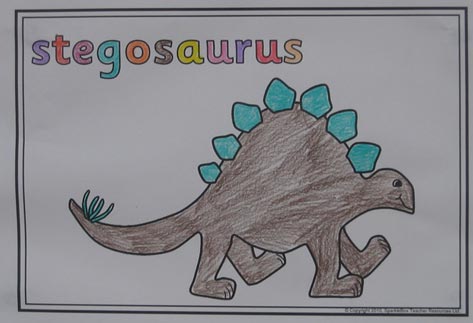
Team members from Everything Dinosaur, the UK based dinosaur company staffed by parents, teachers and real dinosaur experts saw a very colourful drawing of a friendly Stegosaurus whilst on a school visit to teach about dinosaurs.  The picture had been stuck up onto an outdoor white board in the nursery play area so that the young nursery and reception aged children could also get involved with the dinosaur workshop in school that had been planned for the day.

A Drawing of a Friendly Stegosaurus

A friendly "plated lizard"

A friendly “plated lizard” – a friendly Stegosaurus.  Picture credit: Everything Dinosaur.

Picture credit: Everything Dinosaur

Friendly Stegosaurus

This dinosaur certainly looks quite friendly, he has a big smile on his face.  We are sure the children enjoyed learning all about dinosaurs and fossils and drawing pictures of colourful, friendly dinosaurs as part of the dinosaur teaching activities in school.

To see the dinosaur themed products in stock: Visit Everything Dinosaur.

5 03, 2008

Dinosaur Jokes are Great Fun!

By |2024-04-12T08:26:52+01:00March 5th, 2008|Categories: Educational Activities, Teaching|0 Comments

Jokes About Dinosaurs

Whilst delivering dinosaur workshops in school, team members at Everything Dinosaur get told jokes about dinosaurs from the school children that they meet.  Here are a selection of dinosaur jokes that Everything Dinosaur team members came across recently whilst teaching about prehistoric animals in school.

Q. Why did the dinosaur cross the road?

A. Because chickens had not evolved yet!

Q. Why do museums have old dinosaur bones on show?

A. Because they can’t afford to buy new dinosaur bones!

Q. What do you call two dinosaurs bumping into each other?

A. Tyrannosaurus wrecks!

Q. What do you call a Tyrannosaurus rex with a machine gun?

A. Sir!

Q. What do you call a dinosaur that sat on a drawing pin?

A. A Mega-sore-ass!

Q. Why did Archaeopteryx catch the worm?

A. Because it was an early bird!

Dinosaurs as a term topic for Key Stage 1 or 2 children can help them develop their vocabularies, enthuse them about reading as well as to encourage them to write creatively.  When Everything Dinosaur delivers a dinosaur workshop in school, lots of ideas for extension activities follow, as for the children’s jokes, we appreciate them and we are glad to help out in schools.

To learn more about Everything Dinosaur: Visit Everything Dinosaur.

21 02, 2008

Which is Your Favourite Dinosaur? An Excellent Question!

By |2024-04-12T08:23:57+01:00February 21st, 2008|Categories: Educational Activities, Teaching|0 Comments

Protoceratops is Our Favourite Dinosaur

The other day team members at Everything Dinosaur were asked by a Year 3 pupil during a dinosaur workshop in school, what was our favourite dinosaur?  With over 1,100 genera to choose from there is certainly a wide choice, but after a little bit of discussion we choose Protoceratops.  A large number of fossils of this horned dinosaur have been found, from very old, mature individuals down to babies and of course nests of eggs.  With so much fossil material to study, Protoceratops is right up there as one of Everything Dinosaur’s favourites.

Favourite Dinosaur

An Illustration of the Early Horned Dinosaur Protoceratops

"First Horned Face"

“First Horned Face”.  Picture credit: Everything Dinosaur.

Picture credit: Everything Dinosaur

During this particular school visit we discussed with the Year 3 pupils Protoceratops and other horned dinosaurs, we then concluded our dinosaur work in schools on this occasion with a quick question and answer session with our palaeontologists.  It seems that our visit and the dinosaur term topic in general was a big success.

Protoceratops Model

During our discussions we stated how much we enjoyed working on this Asian dinosaur and highlighted a top-quality Protoceratops model.

A Replica of a Protoceratops (CollectA 1:6 Scale Protoceratops Model)

CollectA Deluxe 1:6 Protoceratops model.

The new for 2020 CollectA Deluxe Protoceratops dinosaur model.  Picture credit: Everything Dinosaur.

Picture credit: Everything Dinosaur

The model pictured above is a replica of Protoceratops (CollectA Deluxe), to view this range of scale models and figures in stock at Everything Dinosaur: CollectA Deluxe Prehistoric Life Models.

10 02, 2008

Helpful Half-Term Ideas and Suggestions

By |2024-04-11T10:33:10+01:00February 10th, 2008|Categories: Educational Activities, Everything Dinosaur News and Updates, Main Page|0 Comments

Half-Term Fun – Ideas and Suggestions

With the school half-term holidays getting underway in the next week or so, it can be difficult finding things to do with the children, particularly if the weather is bad and there is not much you can do outside. Everything Dinosaur team members have come up with some suggestions for dinosaur themed activities during the half-term holidays.

Parents of Dinosaur fans are always welcome to contact the team members at Everything Dinosaur, we would be happy to e-mail over dinosaur quizzes, drawing materials and other items to help keep young palaeontologists amused over the holidays.  We have even put together some ideas on how enthusiastic dinosaur fans of all ages can have a go at building their own Mesozoic landscape – we’ve tried it and it was a fun exercise, ideal for a couple of wet afternoons.

Contact Everything Dinosaur

To contact Everything Dinosaur: Contact Everything Dinosaur.

We have a “contact us” site and you are always welcome to drop our team members a line.  Next week on Primeval (ITV1, Saturday evening), a Mammoth makes an appearance, taking a stroll up the M25 motorway and causing considerable havoc.  The Mammoth depicted is a Columbian Mammoth (Mammuthus columbi), a species of Mammoth even larger than the famous Woolly Mammoth.

An adult, male Columbian Mammoth could perhaps have weighed as much as 10 tonnes and stood 4 metres high at the shoulder.  This Mammoth inhabited North America and is believed to have existed until around 9,000 years ago, when like many of the large mega fauna at the time it finally went extinct.  One interesting specimen from Nashville, Tennessee has been dated to around 7,800 years ago, indicating that a few Mammoths may have survived in remote isolated areas for a few generations longer.

Woolly Mammoths

The Mammoth had entered North America via Asia over the Bering Strait land bridge (formed when sea levels fell).  Why Mammoths died out is still open to conjecture.  However, by the time of last of these magnificent elephants the last Ice Age was coming to an end and the climate in the northern hemisphere was rapidly becoming warmer and wetter.  The grasslands in the southern range of this animal were quickly replaced by forests, in too short a time to allow these specialist grazers to adapt.  In the north of the Mammoth’s range the ice age melt-water turned their environment into a boggy marsh and tundra, quite unsuitable for large animals to live in.

With their slow breeding rates, the splintering up of the grasslands with the establishment of forested areas and the predation from man, the Mammoths were doomed.  One interesting spin on the theory that the sophisticated hunting methods of “Clovis” Man did for the Mammoths in the Americas is that the dogs these people brought with them carried disease and this also contributed to the decline and eventual extinction of the Columbian Mammoth.

An Activity for the Half-term Holidays

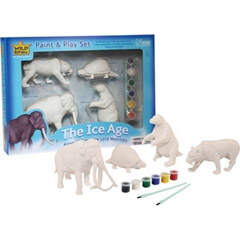
An ideal activity for the half-term holidays is to re-create many of these extinct giant mammals using the Paint and Play Ice Age Mammals Box set.  Each set comes with four famous Ice Age models a giant sloth, Glyptodon, a Sabre-Tooth cat and of course a Mammoth.  Paints and instructions are included and young children can paint their own models to depict these huge mammals from the last Ice Age – a kind of “Pleistocene Paint and Play”.

The Ice Age Mammals Box Set

Picture credit: Everything Dinosaur

Half-term Holidays

Palaeontologists have designed the models, the paints and brushes are included and it is up to you to bring these prehistoric mammals back to life.  The models are based on the actual model sets produced for sale in museums, so if it is cold and frosty outside you can create your very own Ice Age characters on your kitchen table.

Visit Everything Dinosaur’s award-winning website: Everything Dinosaur.

11 12, 2007

Prehistoric Tree Drawings for Use in Schools

By |2022-11-06T08:02:14+00:00December 11th, 2007|Categories: Dinosaur and Prehistoric Animal Drawings, Educational Activities, Everything Dinosaur News and Updates|0 Comments

Mesozoic Flora – Trees for use in Dinosaur Scenes

As well as producing fact sheets on prehistoric animals that team members can send out with every named dinosaur that Everything Dinosaur sells, the dinosaur experts in the company have also been working on the designs for some drawings of prehistoric trees, – cycads, bennettitales and so forth.  These drawings will be used to help our work in schools when we conduct dinosaur workshops.  We can show the young dinosaur fans the sort of plants that herbivorous dinosaurs ate. 

Drawings of Prehistoric Plants

Prehistoric plants.

Prehistoric plants!  Everything Dinosaur team members have been working on some prehistoric plant drawings including cycads and bennettitales.

Picture credit: Everything Dinosaur

Prehistoric Plants

CollectA have produced a range of accurate replicas of prehistoric plants including replicas of cycads, palms and a model of a Ginkgo biloba tree.

CollectA Ginkgo biloba model part of a range of replicas of prehistoric plants.

The CollectA Ginkgo biloba tree model.

To view the various prehistoric plant models available from Everything Dinosaur: CollectA Models of Prehistoric Plants and Prehistoric Animals.

When teaching about dinosaurs in schools, Everything Dinosaur team members build in aspects of the lesson plan that links to parts of the national curriculum such as food chains, food webs and the role of herbivores and carnivores in ecosystems.

6 12, 2007

Thank You letters after Dinosaur Workshop in School

By |2022-11-06T07:02:34+00:00December 6th, 2007|Categories: Educational Activities, Everything Dinosaur News and Updates|0 Comments

Everything Dinosaur Receives Thank You Letters from School Children

After a recent visit to a school to teach Year 1 children about dinosaurs and fossils, the team member at Everything Dinosaur who conducted the dinosaur workshop, was delighted to receive a number of thank you letters from the children who had taken part.  Team members visit a lot of schools to help children learn about fossils, palaeontology and of course dinosaurs and we work hard to ensure that our lesson plans include important topic areas as outlined by the National Curriculum.

Thank You Letters

The school children (and their teacher) were clearly impressed and we were delighted to receive this “fan mail”.

One of the Thank You Letters Sent into Everything Dinosaur after a School Visit

Thanks for coming to see us and delivering your dinosaur workshop.

Thanks for coming to see us and delivering your dinosaur workshop.

Picture credit: Rebecca (age 7)

Everything Dinosaur Receives Lots of Correspondence

We do get a lot of letters such as this, in fact, we encourage the teaching staff to undertake a creative writing task with their classes after one of our school visits to teach about fossils and dinosaurs.  In this way, our dinosaur workshops can support other areas of the National Curriculum such as literacy.

To contact Everything Dinosaur to learn more about our outreach work: Email Everything Dinosaur.

30 11, 2007

Note from Teacher after Everything Dinosaur Visits School

By |2023-02-24T15:55:02+00:00November 30th, 2007|Categories: Educational Activities|0 Comments

Teacher Sends Thank you Note after Dinosaur Workshop

With team members busy packing Christmas orders and getting them out as fast as possible, we have had to put some of our blog articles that we intended to write on the back burner for a while.  However, whilst we take a break from packing and despatching dinosaur themed gifts for Christmas, we have just got time to post up information contained in a letter received from a Year Two teacher after a dinosaur workshop was conducted by Everything Dinosaur with her class.

Lots of Examples of Excellent Handwriting from the Year 2 Class

Year 2 children study dinosaurs

A selection of letters received from the eager young palaeontologists at Great Wood Primary School (Morecambe, Lancashire).

Picture credit: Everything Dinosaur

Children Study Dinosaurs

The dinosaur workshop, which involved an entire morning of dinosaur themed activities and experiments all geared in support of the National Curriculum, was very well received by the children and the teaching staff.  In expressing her gratitude for the dinosaur themed school visit the teacher wrote:

“Dear Everything Dinosaur,

Just a quick note to say thank you for your visit to our school.  The visit was so worthwhile and the children have not stopped talking about it.  My class have kept referring to the things that Everything Dinosaur taught them whilst you were at our school and they have incorporated much of what was said into their own work related to dinosaurs.”

It is always a pleasure to receive feedback from one of our dinosaur themed visits to a school, it looks like the children got a great deal out of the morning they spent amongst the fossils and other amazing dinosaur themed objects that we brought into the school.

Dedicated Teaching Team

Everything Dinosaur stocks a wide range of dinosaur and prehistoric animal toys and games, all of which have been tested and approved by our dedicated teaching team.

To view the range of dinosaur models, toys and games available: Dinosaur Toys and Games.

24 10, 2007

Helping Your Children with their Reading

By |2023-02-16T08:15:03+00:00October 24th, 2007|Categories: Educational Activities, Everything Dinosaur News and Updates, Main Page|0 Comments

Start of “National Reading Year”  Encouraging Parents to Read to their Children

Today, Wednesday 24th October sees the start of “National Reading Year”  which aims to help more people, especially young people become avid readers.  As part of a series of campaigns that are due to run throughout the next 12 months, parents are being asked to read to their children before bed.

Helping Children with Reading

Many parents try to make time to do this, however, UK Government Ministers urged all parents to make an effort.  To make time for bed-time reading just as they would for time to brush the children’s teeth.  By reading to children in this way, it helps build up an affection for books at early age, hopefully this affection will stay with them for the rest of their lives.

By reading to children, parents can help young people understand more about language and sentence construction.  New words can be explored and explained helping to develop the child’s vocabulary.  The parent also benefits from this exercise, spending such quality time with the children is the perfect way to unwind after a difficult day at work.

The National Reading Year (NRY) will be led by Honor Wilson-Fletcher the Marketing Director at the London Southbank Centre.  The last  NRY was in 1998 and it was criticised for not making a lasting impact on the reading habits of the nation.

Books can help develop children’s imagination and also encourage them to write creatively as well.  It is best to choose a subject that the child is fond of, dinosaur books come in very handy.   There are many story books to choose from and the team at Everything Dinosaur are currently researching more books (approved by our dinosaur experts) to add to our shop.

Everything Dinosaur

A particular favourite is “Triceratops Gets Lost”, this book has been especially designed to help young people learn to read.  The story centres around a young Triceratops that has lost its herd, the book comes with a special cuddly Triceratops soft toy as a “bed-time buddy”.  The book also contains a CD-rom so that the child can have the book read to them and follow the story via a home computer.

Dinosaur themed gifts: Dinosaur Gifts and Prehistoric Animal Toys.

This book is one of a series of two (the other features T. rex looking for dinner), they have been designed for children between 3-6 years and the authors have made sure that the story contains words that can help children expand their word usage and reading skills.

20 07, 2007

Dinosaurs and Harry Potter – A Unique Relationship

By |2024-04-01T09:41:21+01:00July 20th, 2007|Categories: Dinosaur Fans, Educational Activities, Main Page|0 Comments

Dinosaurs and Harry Potter

Tonight sees the launch of the last book in the Harry Potter series.  We checked round the office and none of us have ever read a book, or gone to the cinema to see a movie.  In fact, no one admitted to actually sitting through an entire film when it has been shown on TV.  We must be immune to “Harry Potter fever”.

However, J. K. Rowling’s Hogwarts saga has had an impact on palaeontology.  In May of last year a new species of pachycephalosaur was named in honour of J. K. Rowling’s creation.

Dinosaurs and Harry Potter

The animal was named Dracorex hogwartsia (means dragon king of Hogwarts), Hogwarts is the fictional school of witchcraft and wizardry from the Harry Potter series.  So far only a skull and some neck vertebrae have been found.  Many types of pachycephalosaurs are known only from their skulls, they are very robust and their thick bone aids preservation.  Many of the skulls are badly eroded prior to fossilisation.  Palaeontologists speculate that the weathering is due to the skulls being carried along way in water before finally coming to rest and becoming buried in sediments.

This may indicate that many of these animals lived in mountainous areas, with those few animals that died near rivers having their bodies broken up and washed downstream before finally coming to rest.

Dracorex hogwartsia

To view dinosaur models, including Dracorex: Dinosaur and Prehistoric Animal Models.

The Dracorex specimen was found in the Hell Creek formation, it dates from 66 million years ago (Late Cretaceous).  The animal is estimated to be 3 – 4 metres long.  It lacked the thick domed skull, typical of the Pachycephalosaur group.  Instead the skull was flat and covered in spiky horns and many bumps.

A Replica of a Dracorex Model

Dracorex model.

Dracorex dinosaur model.

Dracorex was herbivorous, it has been reconstructed based on another pachycephalosaur called Stygimoloch, scientists speculate that it may have lived in small groups browsing on shrubs and flowering plants.

Go to Top