All about dinosaurs, fossils and prehistoric animals by Everything Dinosaur team members.

Everything Dinosaur’s work with schools and other educational bodies. Articles, features and stories about dinosaurs and their role in education and educating young people.

4 10, 2011

Natural History Museum is Getting the Bird

By |2023-01-21T12:12:11+00:00October 4th, 2011|Categories: Dinosaur and Prehistoric Animal News Stories, Dinosaur Fans, Educational Activities|0 Comments

“London” Specimen of Archaeopteryx is the Type Specimen

Perhaps one of the most famous fossils ever found, the beautifully preserved and almost complete fossil of Archaeopteryx that was discovered in 1861 and later purchased by Sir Richard Owen for what was to become the Natural History Museum (London) has been declared the type specimen.  Experts at the International Commission on Zoological Nomenclature (ICZN) have ruled that this fossil, known as the “London” specimen after Sir Richard bought it for £700,  has been declared the official representative of the Archaeopteryx species (A. lithographica).

Specimen of Archaeopteryx

Archaeopteryx, this tantalising mixture of bird and reptile was named and described by the German palaeontologist Hermann von Meyer in 1861.  The first fossil evidence of Archaeopteryx that came to the attention of science was a single, fossilised feather that had been preserved in the fine-grained limestone deposits at  Solhofen (Germany).

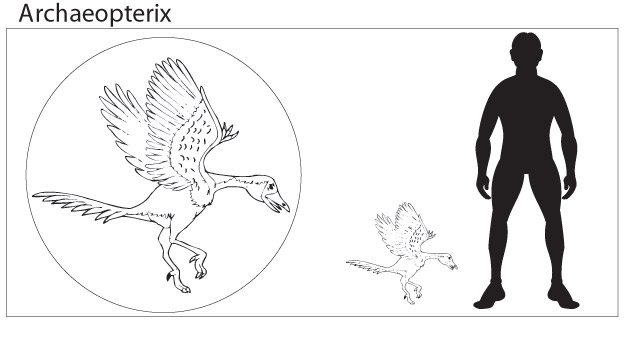
A Scale Drawing of Archaeopteryx

A scale drawing of Archaeopteryx. Picture credit: Everything Dinosaur.

Picture credit: Everything Dinosaur 

Please note, yes we know we have the name spelt wrong in the title above the drawing and our Archaeopteryx does remind us of a duck because of its “bill”, but we did what we could to give the artist a steer on the drawing – whether he listened to us, that’s a different matter.

The “London” Specimen

The “London” specimen was found just two years after Charles Darwin had published his ground-breaking theory on natural selection, and here was a transitional fossil showing a mix of bird and reptilian features – adding weight to Darwin’s conclusions.  The ICZN has ended five years of debate and discussion and now ruled that the “London” specimen should be the type specimen for this species – the specimen that scientists use to provide a scientific description of the characteristics of a species, a sort of blueprint to which all other Archaeopteryx fossils found have to be compared with.

The ICZN is the body responsible for regulating the naming of all extinct and extant species.  They help to ensure that names are used universally and they settle disputes over naming and the classification of organisms.

A spokesperson for Everything Dinosaur could not help using a pun when asked to comment on this ruling, he stated:

“The specimen held at the Natural History Museum [London] is a fantastically well-preserved fossil and provides researchers with the opportunity to study this 147-million-year-old creature in great detail.  The Natural History Museum based scientists and other researchers have already produced some amazing information and data on the bird/dinosaur link as well as the evolution of birds.  Having it declared the type specimen is a real feather in their cap.”

However, for every scientist that applauds this decision there will be others who contest it.  A number of palaeontologists and taxonomists felt that a change in the type specimen was unjustified.  The previous type specimen – that single feather referred to earlier, is now thought to belong to another fossil bird species discovered at Solnhofen and it may not relate to A. lithographica at all.

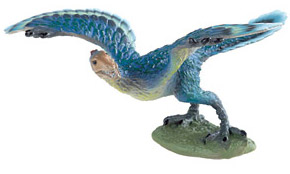
A Model of Archaeopteryx

A model of Archaeopteryx.

Picture credit: Everything Dinosaur

Commenting on the change, one that will see the debate amongst palaeontologists continue no doubt, Dr Ellinor Michel, the Executive Secretary of the ICZN stated:

“Changing type specimens is not done lightly.  What makes a specimen ideal can change with new methods and new philosophies of taxonomy.  However, this case was seen as truly exceptional, as Archaeopteryx lithographica is our most iconic fossil bird.”

The Importance of Archaeopteryx

The importance of Archaeopteryx, not least in the way it has helped to substantiate the theory of natural selection, cannot be underestimated.  One essential point to make is that just because this fossil was the first feathered creature of its kind to come to the attention of western science, does not make Archaeopteryx the first bird.  Calling Archaeopteryx the first bird, is a mistake we offer hear people making when they comment on the Late Jurassic creature.   We at Everything Dinosaur, explain the situation like this:

Imagine you have a bag of 10,000 marbles, all of which are numbered in sequence from one to 10,000.   We can calculate the probability of a person putting their hand into the bag and picking out the ball marked number “one” on their first pick. Put simply, the probability is one in ten thousand of this happening.  Just because the Solnhofen specimens were the first “marbles” out of the bag does not make them the fossils of the first bird-like creatures ever to evolve.  A point driven home by a group of Chinese scientists recently when they reviewed a number of Jurassic theropod specimens and postulated that Archaeopteryx may not be a bird at all but a cursorial feathered dinosaur.

To read more about this research: Is Archaeopteryx about to get Knocked off its Perch?

The decision by the ICZN does clear up a long-standing issue as to how the species was defined and it puts the “London” specimen at the very heart of research into the feathered creatures that once lived around a tropical lagoon in what was to become Germany.

For models of Archaeopteryx and other feathered prehistoric animals, whilst stocks last: Bullyland Dinosaurs and Prehistoric Animal Figures.

28 08, 2011

Oldest Fossils on Earth 3.4 Billion Years Old

By |2023-01-20T17:58:49+00:00August 28th, 2011|Categories: Dinosaur and Prehistoric Animal News Stories, Educational Activities, Main Page|0 Comments

Scientists Discover Oldest Fossils on Earth

A team of Anglo/Australian scientists have published their findings regarding the discovery of tiny, microbial fossils that could be the oldest fossils ever found on Earth.  The discovery in 3.4-billion-year-old sandstone, some of the oldest sedimentary rock known, suggests that bacteria had evolved early in the Archaen Eon a time when the Earth was virtually devoid of oxygen.  The discovery was made at the remote Strelley Pool location, Pilbara (Western Australia).  Not only does this discovery have significant implications for life on our own planet but such a find could help scientists search for evidence of microbial life on Mars.

Oldest Fossils on Earth

Pictures of the remote fossil location have been distributed, a site synonymous with Archaen microbial fossils.

The new research, published in the scientific journal “Nature Geoscience”, provides solid fossil evidence to date key branching points in the Earth’s evolutionary clock, although as with many microbe fossils, some scientists are challenging whether the tiny tube-like structures that have been discovered are organic remains suggesting that they could have been formed by chemical or other inorganic means.

Scientists based in The University of Western Australia’s Centre for Microscopy, Characterisation and Analysis in collaboration with Oxford University (England) have unearthed arguably the best-preserved pre-three-billion-year-old micro-fossils on Earth.  These consist of remarkably preserved carbonaceous cells along with the protective tubes (sheaths) that housed some of these cells.

Leading author University of Western Australia Postdoctoral Research Fellow Dr David Wacey said direct evidence for early life in the form of micro-fossils was exceedingly rare and evidence for what type of life came first had until now proved elusive.  Certainly, from what is known about the Archaen Eon, any life forms that may have lived during this immensely ancient time were likely to have been extremely tough – extreme extremophiles as it were.

Dr Wacey commented:

“Our research helps to answer the question: How did these microbes survive?  On the early Earth, where free oxygen was rare or absent, evolving life had to employ other means to survive.  Using a combination of electron microscopy and ion probe analysis, we were able to show that these particular microbes had a metabolism that was based on the use of sulphur.  This ability to essentially ‘breathe’ sulphur compounds has long been thought to be one of the earliest stages in the transition from a non-biological to biological world.”

The conditions that early life forms may have evolved in can still be found on our planet today.  Just a few decades ago marine biologists discovered a series of volcanic vents on the bottom of deep oceans.  These “black smokers” as they are called as they belch out columns of dense, black smoke rich in iron sulphides at temperatures of more than 400 degrees Celsius could mirror the conditions where the first life on Earth evolved.   Life may have thrived around such undersea vents, building a sulphur based ecosystem.

Dr Wacey went onto state:

“By showing the intimate association of these 3.4 billion-year-old micro-fossils with the mineral pyrite (FeS2), we have now provided the earliest direct evidence of micro-organisms employing a sulphur-based metabolism.”

The micro-fossils come from Strelley Pool, a remote region of the Pilbara about 60 kilometres west of the small town of Marble Bar (Western Australia).  They are the oldest micro-fossils ever to be found in sandstones, extending the record of life on Earth in such rocks by about 300 million-years.

Pictures show a computer generated 3-D model of a micro-fossil about 10 micrometres in diameter from Western Australia (left).  Cross sections through the reconstruction (right) emphasise the spheroidal nature of this ancient cell.

For models of prehistoric animals and other creatures: Replicas of Extinct Creatures.

Images show a highly magnified collection of tubular micro-fossils (resembling the protective sheaths of modern bacteria) found in between sand grains in a 3.4-billion-year-old sandstone from Western Australia

A team member, Martin Brasier, of Oxford University, made the additional claim that the remains were the Earth’s oldest fossils.

He said:

“At last we have good solid evidence for life over 3.4 billion years ago.”

However, as with a number of such discoveries dating from 3.49 to 3.4 billion years ago this research has attracted controversy.  Although the Strelley Pool area has provided evidence of micro-fossils such as simple bacteria filaments, a number of scientists question the findings.  Professor Brasier has been a leading critic of slightly older fossils, found in the Pilbara in 1993 by a Californian researcher, William Schopf.  He has argued these older fossils are not biological in origin, as Professor Schopf believes.

If the Strelley Pool discoveries are proof of ancient life on Earth then this evidence could assist scientists as they seek to discover if there was life on Mars.  Using this information, they could look for geological features that resemble the Pilbara location on the red planet and then aim to send unmanned probes to sample rock cores to see if the chemical signatures of micro-fossils could be found.

To read an Everything Dinosaur blog post on fossils that indicate the oldest animals known to science: The Oldest Animal Fossils.

25 08, 2011

We are Amongst an Amazing 8.7 million Species – Give or Take a Million

By |2024-04-22T11:52:07+01:00August 25th, 2011|Categories: Animal News Stories, Educational Activities, Main Page|0 Comments

New Estimate for the Number of Species on Planet Earth

It was the Swedish physician and naturalist Carolus Linnaeus (1707 – 1778), who formed the basis for the classification of organisms in his Systema naturae, first published in 1735.  He grouped organisms with shared features and characteristics into different sets, creating an interrelated hierarchy of life, sometimes referred to as a “tree of life” as a result of its branching structure.  The basic unit in this classification is the species.  A species is defined as a group of organisms whose members have the potential to breed together and produce fertile offspring. Species are grouped into genera, genera into sub-families, families and so on.

Number of Species

Families are grouped into orders, for example our species Homo sapiens is classified with apes, monkeys into the primates (order).  Orders themselves are grouped into classes, and these in turn are grouped into phyla.  Members of different phyla differ in fundamental features such as body organisation and methods of locomotion and respiration.  Phyla are finally grouped into the largest commonly used classification a kingdom, such as the kingdom plantae (plants) and animalia (animals).

Scientists have argued ever since the time of Linnaeus as to just how many species there are on our planet.  Back in 1975, I recall reading a paper that estimated (conservatively as it turned out) that there were around one million species of insect on the Earth, other estimates have been made over the years using a variety of techniques and the total number of individual species estimated has varied widely, with as many as 100 million species being cited in some literature.

Not knowing how many species inhabit the Earth is one of the most fundamental questions in science.  Efforts to sample the world’s biodiversity to date have been limited and thus have precluded direct quantification of global species richness, and because indirect estimates rely on assumptions that have proven highly controversial.  However, a group of international scientists have used the basis of the classification system first devised by Linnaeus to propose a new calculation for the number of species.  This team calculates that we humans are amongst 8.7 million other species (plus or minus 1.3 million).

In a paper published in the online scientific journal PLoS Biology (Public Library of Science), the team state that the higher taxonomic classification of species (i.e. the assignment of species to phylum, class, order, family, and genus) follows a consistent and predictable pattern from which the total number of species in a taxonomic group can be estimated. Their work was validated against well-known taxa, and when applied to all domains of life, it predicted 8.7 million species in total with a margin for error of +/- 1.3 million eukaryotic species globally (with a nucleus in the cell).  Seventy percent of our planet’s surface may be covered by sea water, but according to these new calculations there are only 2.2 million species present in the sea.

The Diversity of Planet Earth

The researchers including scientists from the Department of Biology, Dalhousie University, Halifax, Nova Scotia, Canada, the Department of Geography, University of Hawaii, Honolulu, Hawaii, and the United Nations Environment Programme World Conservation Monitoring Centre, Cambridge, United Kingdom, in conjunction with Microsoft research propose that some 86% of the species on Earth and 91% in the ocean, still await description.

Co-author Boris Worm of Dalhousie University stated that the recently-updated Red List issued by the International Union for the Conservation of Nature assessed 59,508 species, of which 19,625 are classified as threatened. This means the IUCN Red List, the most sophisticated ongoing study of its kind, monitors less than 1% of world species.

Our Planet’s Complex Biodiversity

Picture credit: Everything Dinosaur

It is important that scientists have an understanding of the biodiversity of planet Earth as without this, it would be very difficult to establish the current rate of extinction.  Many scientists believe that species are dying out at an alarming rate.  In what is known as the sixth mass extinction event, it has been estimated that as many as three species an hour are becoming extinct – many of these organisms are unknown to science.

To read Everything Dinosaur’s recent blog post about discovery of a new eel species: Primitive Eel Discovery “A Fishy Tale”.

As co-author of the study, Boris Worm of Dalhousie University points out:

“If we didn’t know – even by an order of magnitude (1m? 10m? 100m?) – the number of people in a nation, how would we plan for the future?  At its most basic, if we don’t know what we’ve got, we can’t protect it, and we can’t even be sure what we’re losing.”

For models and replicas of prehistoric and extinct creatures: Mojo Fun Prehistoric Life Models.

19 08, 2011

A Fossil Hunting We Will Go (Free Fossil Hunting Activity)

By |2024-04-22T11:53:44+01:00August 19th, 2011|Categories: Dinosaur Fans, Educational Activities, Everything Dinosaur News and Updates, Main Page|0 Comments

Bringing a Jurassic Beach to the Heart of Cheshire

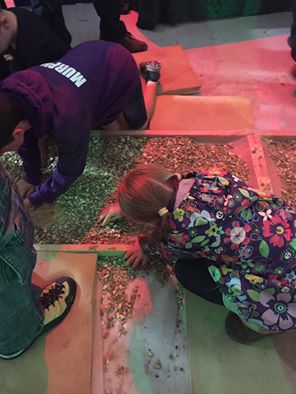
Today, team members at Everything Dinosaur have been invited to Alsager (Cheshire) to provide a “Walking with Dinosaurs” and fossil hunting experience for school children.  We are going to be undertaking a number of exercises and experiments with young dinosaur fans and their parents/guardians at the local leisure centre.  There is fossil casting, fossil show and tell, dinosaur runaround and we will also be making a mini-Jurassic beach and getting the enthusiastic young palaeontologists to help us find fossils – best of all, if they want to they can take home what they find.

Fossil Hunting

There are not many opportunities to fossil hunting in the county of Cheshire, we have to thank glacial action and the Permian for much of our exposed geology.  During the Permian Period, this part of the world resembled the Sahara desert, it was what is termed a “red desert” which meant there was little life.  Many of the exposed outcrops of rock are sandstone formed from these dunes and therefore they are largely devoid of fossils.

Everything Dinosaur Leading a Fossil Hunt (Indoors)

Everything Dinosaur organising fossil hunting for children.

Fossil hunting with Everything Dinosaur. Picture credit: Everything Dinosaur.

Picture credit: Everything Dinosaur

The picture shows team members at Everything Dinosaur helping young fossil finds discover fossils at an earlier event that we held.

It is a good job that we have brought plenty of fossils from our various expeditions with us, I’m sure all the boys and girls (plus their parents/guardians) will have a lot fun.

Visit Everything Dinosaur’s child-friendly and award-winning website: Click Here to Visit the Everything Dinosaur Website.

15 08, 2011

A Mystery Object – What Might This Be?

By |2023-01-20T15:01:42+00:00August 15th, 2011|Categories: Educational Activities, Main Page|0 Comments

Mystery Object from Everything Dinosaur

Every now and then we like to tease our readers by showing them a photograph of an object from our fossil collection.  Having written about the Very Reverend Dr William Buckland yesterday, the 155th anniversary of the death of this English geologist and academic – we thought we would put up this picture.

A Mystery Object – What is This?

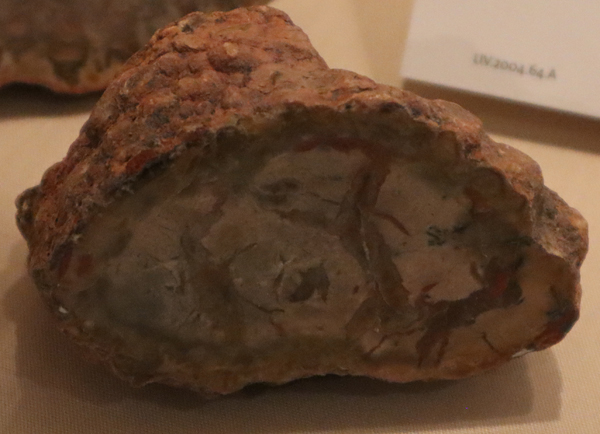
Mystery fossil object - a coprolite

What could this strange object be? Picture credit: Everything Dinosaur.

Picture credit: Everything Dinosaur

Fans of dinosaurs and fossils – any ideas?

Mystery Fossil Object

This is an example of a coprolite.  Dr William Buckland studied ichthyosaur coprolite, fossils found on the coast of Dorset.  The famous fossil collector at Lyme Regis – Mary Anning had described a number of strange, stony objects that were often found in the body cavities of ichthyosaur fossil skeletons.  These were known as “Bezoar Stones”, but no one was really sure what they represented.  It was Anning who noticed that if such stones were examined carefully and even broken apart they contained strange, blackened fragments.  These turned out to be the hard parts of belemnites and other squid, such as hooks and mouth parts, plus the occasional fish scale fragment

These observations by Anning lead William Buckland to propose in 1829 that the stones were fossilised faeces and the term coprolite was first used to describe them.  The term coprolite has come to mean the general name for all fossilized faeces.  Buckland also concluded that the spiral markings on the fossils indicated that ichthyosaurs had spiral ridges in their intestines similar to those of extant sharks.  He also postulated that some of these coprolites were black because the ichthyosaur that has produced them had ingested ink sacs from belemnites.

In the picture above, we show a polished section of a coprolite.  This gives palaeontologists the opportunity to assess the coprolite’s composition, that is, to work out what the animal had eaten.  This coprolite came from a sauropod dinosaur, the preserved remains of plant material can be observed inside the fossilised dinosaur dung.

To view replicas and models of sauropods and other dinosaurs: Schleich Sauropods and Other Dinosaur Models.

14 08, 2011

Remembering the Remarkable Dr William Buckland (1784 -1856)

By |2024-04-22T11:57:37+01:00August 14th, 2011|Categories: Dinosaur Fans, Educational Activities, Main Page|0 Comments

Died this Day – Dr William Buckland

The Very Reverend Dr William Buckland died this day (14th August) in 1856.  He was an English clergyman (became Dean of Westminster in 1845), geologist and scientist who dedicated himself to the study of geology and to the fossil bones that were being found in various parts of England.  Many academics at the time, postulated that these bones represented animals that had perished in the Biblical flood.  Indeed, Buckland’s early work focused on the study of such bones that had been found in cave deposits. In 1823, his first great work “Observations on the Organic Remains contained in caves, fissures and diluvial gravel attesting the Action of a Universal Deluge”, covered his study of the remains of prehistoric Hyenas and other such creatures.  My, how the Georgian’s liked to have snappy titles for their published work.

Dr William Buckland

Perhaps, William Buckland is best remembered for being tasked with describing and naming a prehistoric creature from a large fossilised jawbone.   He was asked to study the fossilised remains of a large, unknown animal whilst he was the first Professor of Geology at the University of Oxford.  This animal was to be named Megalosaurus (Megalosaurus bucklandii).  It has the distinction of being the first dinosaur named (1824), although the name Megalosaurus “Big Lizard”, was first used by James Parkinson and the Dinosauria was not classified as a particular Order in the Class Reptilia until the 1840s.

Megalosaurus Fossil Material (Skull and Jaws)

Megalosaurus bucklandii fossils.

A view of the skull and jaw material associated with the first dinosaur to be scientifically described (Megalosaurus). Picture credit: Everything Dinosaur.

Picture credit: Everything Dinosaur

Regarded as an eccentric, we think that William Buckland is credited with the naming of fossilised faeces as coprolites.  In other words, he was one of the first people to study fossilised poo, examining a number of coprolites that had been found in association with ichthyosaur remains on the English south coast.

To view models and replicas of Megalosaurus and other dinosaurs: Dinosaur Models – Natural History Museum Replicas.

8 08, 2011

Last Chance to See – Dinosaurs Unleashed

By |2023-01-20T14:08:11+00:00August 8th, 2011|Categories: Dinosaur and Prehistoric Animal News Stories, Dinosaur Fans, Educational Activities, Main Page|0 Comments

Last Few Days of Dinosaurs Unleashed – London 2011

This is the last week of the spectacular Dinosaurs Unleashed animatronic dinosaur exhibition at the Meridian Gardens at The O2 arena (London).  With just a few days left to come face to face with Tyrannosaurus rex and other amazing dinosaurs and prehistoric animals.  An additional day (today) has been added to accommodate the last minute rush to see the dinosaurs but the experience is being closed from the 11th August.

Dinosaurs Unleashed

Time travellers get your skates on as there are only three days left including today to travel back to the Mesozoic and explore the amazing prehistoric animals that roamed the Earth and swam in the seas many millions of years ago.

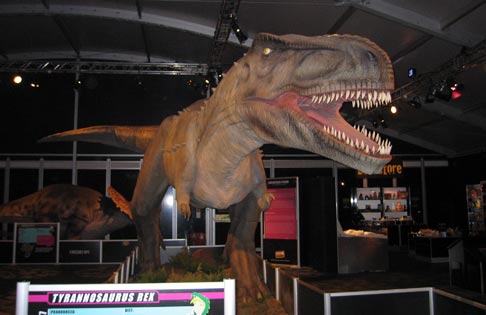
A Theropod Dinosaur on Display at Dinosaurs Unleashed

T. rex on display. Dinosaurs Unleashed.

Ferocious T. rex. Picture credit: Everything Dinosaur.

Picture credit: Everything Dinosaur

Staff at Dinosaurs Unleashed are encouraging families to book tickets now to avoid missing out on this unique summer attraction and advise that it is best to book in advance as they expect to be very busy over the event’s last few days.

This attraction is open until Wednesday 10th August with last entry at 16.30pm.

For further information on dinosaur visitor attractions check out this Everything Dinosaur blog.

For replicas and models of prehistoric animals featured in the Dinosaurs Unleashed exhibition: Nanmu Studio Jurassic Series Replicas.

28 07, 2011

Is Archaeopteryx About to Be Knocked off its Perch?

By |2023-01-20T13:03:12+00:00July 28th, 2011|Categories: Dinosaur and Prehistoric Animal News Stories, Educational Activities, Main Page|0 Comments

New Archaeopteryx-like Theropod Dinosaur Discovered

Researchers from the Chinese Academy of Sciences have published scientific papers describing the discovery of a new type of Jurassic theropod dinosaur which they believe is very closely related to the iconic prehistoric animal Archaeopteryx (A. lithographica).  As a result, they are challenging the long held assumption that Archaeopteryx was the “very first bird”.

In 1860, just one year after Charles Darwin published “The Origin of Species”, a single fossilised feather was discovered in the finely grained lithographic limestones at Solnhofen (Bavaria, Southern Germany).  An important cornerstone (no pun intended) of Darwin’s new theory was the gradual evolution of species via natural selection that would lead to new species – the search for what was to become known as “missing links” had begun.  In 1861, a virtually complete skeleton of the creature that had feathers was found in southern Germany, this was to become known as Archaeopteryx an example of a “missing link” between birds and reptiles as the fossil showed characteristics of both orders.  To be more precise, this transitional fossil, one of less than a ten fossils of Archaeopteryx known had a combination of reptilian and bird characters. There were of course the feathers and a breast bone, but this animal also had teeth and a long tail, just like a dinosaur.  Here was a transitional form that linked one major group of animals (birds) to an older, ancestral group (the reptiles) from which it had evolved.  This was evidence of Darwin’s theory – species were not immutable and Darwin had predicted that such transitional fossils would be discovered.

A Fossil Cast of Archaeopteryx
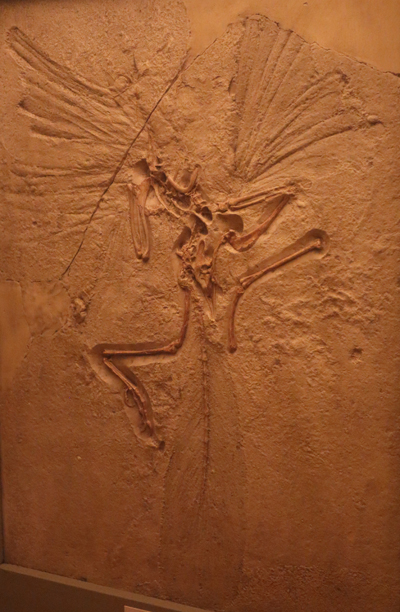
Archaeopteryx fossil cast

Archaeopteryx fossil cast. Picture credit: Everything Dinosaur.

Picture credit: Everything Dinosaur

Pictures show an almost complete and perfectly preserved fossil of the Late Jurassic creature known as Archaeopteryx (A. lithographica).  The feathers (a feature of birds) can clearly be seen along with the long tail (a feature of reptiles).

The Chinese scientists have identified a new species of Archaeopteryx-like theropod dinosaur from lake deposits formed about 160 million years ago in north-eastern China.  According to findings published online in the scientific journal “Nature”, the new dinosaur species Xiaotingia zhengi is a close relative of Archaeopteryx, which is widely accepted as the most primitive bird, known from the fossil record.  However, a phylogenetic analysis incorporating new information from this find suggests that Archaeopteryx is not a bird, which has significant implications for our understanding of bird origins the evolutionary relationship between Aves (birds) and the Reptilia.

Xiaotingia weighed about 800 grams, comparable to Archaeopteryx in size, and is one of the smallest non-avian theropod (carnivorous) dinosaurs ever identified by scientists.  The fossil shows evidence of conical teeth, as well as long, robust arms that are similar to those of primitive birds.  Its specialised feet have the highly extensible second toe characteristic of the Deinonychosauria, the group of bird-like dinosaurs that includes Velociraptor and Utahraptor.

Dr Xu Xing of the Institute of Vertebrate Palaeontology and Palaeoanthropology, Chinese Academy of Sciences, lead author of this paper and one of the world’s most influential dinosaur researchers stated:

“The most exciting result from our research is that both Xiaotingia and Archaeopteryx are primitive deinonychosaurs rather than birds.  In other words, Archaeopteryx is a kind of Velociraptor ancestor rather than a bird ancestor.”

This research is certainly going to challenge long held views about the significance of Archaeopteryx.

It is now widely accepted that birds are descended from dinosaurs, but scientists are still working hard to reconstruct how the dinosaur-bird transition occurred.  One of the most important jobs is to reconstruct a reliable family tree, based on this research, scientists can find out which dinosaurs evolved into birds and what the most primitive birds were actually like.  Xu’s team has made several significant discoveries related to this fundamental issue in the study of evolution.

For models and replicas of Archaeopteryx and other feathered theropods: PNSO Feathered Dinosaurs and Prehistoric Animal Figures.

Pictures show the holotype fossil the creature’s head is to the left of the images seen in media releases.

Dr Xu explained:

“We named the four-winged dinosaur Anchiornis huxleyi in 2008.  At that time we already noticed some striking similarities between Anchiornis huxleyi and Archaeopteryx, such as the presence of a long bony tail fully covered by large feathers.  Xiaotingia is from the same site as Anchiornis.  Like Anchiornis, it also bears long flight feathers on the feet, a feature that we suspected was also present in Archaeopteryx.  The discovery of Xiaotingia provides further support for a close relationship between these species.”

We at Everything Dinosaur note the reference to Thomas Huxley in the scientific nomenclature.  Thomas Huxley (1825-1895) was an English biologist who supported the ideas of Charles Darwin (he was known as “Darwin’s Bulldog”), he was one of the first scientists to realise the close anatomical links between birds and reptiles.

The researchers noticed that Archaeopteryx, Xiaotingia, and Anchiornis are more similar to other deinonychosaurs than to birds in having a lightly built skull, in stark contrast to the more robust skull seen in other known primitive birds and also the oviraptorosaurian dinosaurs.  A comprehensive analysis by the researchers indicates an interesting evolutionary divergence between a primarily herbivorous lineage leading to modern birds and a carnivorous lineage leading to the likes of the fearsome Cretaceous dinosaur Velociraptor.  This new pattern has significant implications for avian origins, and for related issues such as the early evolution of feathers and flight.

Archaeopteryx is perhaps, one of the most famous of all the prehistoric creatures named and described so far. Despite the paucity of fossils there is an extensive and on-going research programme based around this particular creature from the Upper Jurassic strata of Germany.

To read a recent article on Archaeopteryx research: New Fossil Study Shows Chemical Link between Reptiles and Birds.

We suspect that the feathers are about to fly once again in the world of palaeontology.

Everything Dinosaur is grateful to the Chinese Academy of Sciences for their press release information in helping to compile this article.


20 07, 2011

Yes, There are Cycads Around Today – Amazing Prehistoric Plants

By |2024-04-22T09:53:58+01:00July 20th, 2011|Categories: Educational Activities, Main Page|4 Comments

Cycads Survivors from the Palaeozoic

Cycads, those exotic, tree-like ferns originated sometime in the Palaeozoic probably during the Permian Period, although some scientists have suggested that they date back to the Carboniferous.  The trouble with plants is that they tend not to fossilise very well and as a result the fossil record for plant remains is very sparse.  To add to the problems encountered by palaeobotanists, plants tend not to fossilise as a whole, individual leaves, cones, pollen, roots and trunks are preserved.  As these different parts are found separately in the rock record, and are discovered at different times, each piece tends to get a different scientific name.  The tree-sized clubmoss (Lycopsid) Lepidodrendron has about ten binomial names associated with it.  For example, the fossilised roots are referred to as Stimaria and the base of the trunk is known as Knorria.

Cycads

All very confusing, but as we were reminded yesterday, prehistoric plants are all around us.  Sphenopsids (horsetails) originated perhaps as far back as the Devonian, but the Equiseteum, of which there are about twenty species are still around today.  You can purchase Japanese horsetails at most garden centres and very nice they look to planted close to water.  Cycads, we think a number of genera are still around today.  These palm-like seed plants with massive, thick stems and their crown of fern-like fronds were some of the most common types of plants to be found during the Jurassic and Cretaceous.  Cycads produced by means of seeds, mostly borne on modified fronds grouped together to form a cone.  The only living exception is the most primitive living example, Cycas, where modified fronds bearing seeds are separate from one another.  Modern cycads are relatively squat compared so some of their extinct relatives that could reach twenty metres tall or more.  They are found in frost free regions of the world and a number of genera can be found on several continents indicating a much wider distribution in the past.

The CollectA Cycad Model

What is a cycad?

A welcome addition to the CollectA model range, a replica of a cycad.

To view replicas of prehistoric plants in the CollectA range: Prehistoric Plant Models and CollectA Figures.

There were even cycads growing at the South Pole in Cretaceous times, although these types of cycads shed their leaves as winter commenced.

Visitors to Kew Gardens can see a giant Eastern Cape cycad, believed to be the world’s oldest pot plant.  This plant was brought to England in 1775.

17 07, 2011

Countdown to Sea Monster Exhibition

By |2023-01-20T10:08:50+00:00July 17th, 2011|Categories: Dinosaur and Prehistoric Animal News Stories, Dinosaur Fans, Educational Activities, Main Page|0 Comments

Sea Monster Exhibition Opens at the Bournemouth International Centre

The Purbeck Hall at the Bournemouth International Centre (BIC) is playing host to a whole new cast of prehistoric characters as the countdown to the opening of the BBC Sea Monsters Exhibition continues.  With just under a week to go; the enthusiastic staff are busy settling in their new charges – amazing creatures such as Anomalocaris the world’s first super-predator, giant sharks and fearsome marine reptiles, one time residents of Dorset.

An Illustration of Anomalocaris

Anomalocaris

Anomalocaris drawing. Picture credit: Everything Dinosaur.

Picture credit: Everything Dinosaur

Sea Monster Exhibition

The Sea Monsters Exhibition gives visitors the chance to come face to face with some of the largest predators that hunt the sea today, including the iconic great white shark and giant squid, whilst witnessing some of the strangest creatures and latest scientific discoveries from our most recent explorations of the deep in the fantastic deep sea submarine simulator.

Take a trip through the history of the World’s oceans and learn more about these incredible sea monsters, from the ancestors of all back-boned animals to the one of the largest known pliosaurs – Liopleurodon; who was named and described from just a single, huge tooth found across the channel.  Learn all about what is most likely the biggest fish to have ever lived – Leedsichthys, a fish with a mouth so big it could have served as a car park.  Explore the technology used to make these amazing creatures ‘swim again’ – bringing back leviathans from the deep.

Arthropods of the Palaeozoic

Scientists used to think that creatures like Anomalocaris lived during the Cambrian Period, but a recent discovery of giant fossils in Morocco suggest that this fearsome, distant relative of spiders survived well into the Ordovician Period.

To read more about this discovery: Anomalocaris Discovery.

 In “Sea Monsters : A Walking with Dinosaurs Trilogy”, the BBC used the same production team and technologies behind the highly acclaimed “Walking with Dinosaurs” and “Walking with Beasts” series to bring a number of these marine creatures “back to life”.

A spokes person for Everything Dinosaur commented:

“As far as we know life began in the sea and with three-quarters of our planet covered in water, there is still a lot to learn and discover.  However, animals in a marine environment generally have a better chance of becoming fossils than creatures that live far away from water and the fossil record is full of incredible evidence providing scientists with an insight into some of the bizarre and amazing creatures that once lived in the sea.  The Sea Monsters exhibition at the BIC is a great place to get acquainted with some of them.”

The BBC Sea Monsters exhibition runs from July 23rd until September 11th at the BIC (Bournemouth), for ticket enquiries and other information regarding Sea Monsters check out the Everything Dinosaur blog.

For models of marine reptiles and other ancient sea creatures: CollectA Deluxe Sea Monsters and Marine Reptiles.

Go to Top