All about dinosaurs, fossils and prehistoric animals by Everything Dinosaur team members.

Everything Dinosaur’s work with schools and other educational bodies. Articles, features and stories about dinosaurs and their role in education and educating young people.

1 05, 2013

School Children Measure a Beautiful Triceratops

By |2024-04-29T14:04:41+01:00May 1st, 2013|Categories: Educational Activities, Teaching|0 Comments

Measuring a Triceratops Footprint at Great Wood School

Children at Great Wood Primary have been busy studying dinosaurs as part of their summer term’s teaching activities.  The teaching team have developed a wide range of activities for their young charges and a team member from Everything Dinosaur visited Year 2 to help reinforce some of this learning and to provide some expertise to assist the budding young palaeontologists with their explorations.

What is Your Favourite Dinosaur?

The children had lots of questions, for example, one question asked was what is your favourite dinosaur?  A tricky question but perhaps Protoceratops would be a strong contender.  Known as the “sheep of the Cretaceous”,  a reference to the size of this dinosaur and to the amount of fossils of this dinosaur found in Mongolia, Protoceratops belonged to the same family group of dinosaurs as Triceratops.   An idea to help the school children learn about how to express data might be for them to produce a tally count recording the favourite prehistoric animals of the class.  This data could then be compiled into a bar chart.  The picture below shows a typical bar chart which has been generated following a tally count exercise by Year 2 children.

A Bar Chart Recording Favourite Dinosaurs

A tally count and then a bar chart to plot the data.

A tally count and then a bar chart to plot the data.

Picture credit: Everything Dinosaur

Dinosaurs as a Term Topic

Dinosaurs as a term topic, does lend itself to all sorts of extension activities.  Dinosaurs seem to have enthused both the pupils and the teachers at Great Wood Primary.

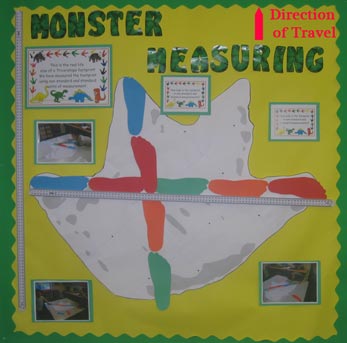
Miss Bolton and her class have been studying dinosaur footprints.  Scientists can learn a lot from the footprints and tracks preserved as trace fossils.  The class have created a colourful poster display of a Triceratops footprint.  Their poster shows the various ways in which the class could measure the size of the footprint of this four-legged, herbivorous dinosaur.

Pupils Measure a Triceratops Footprint

Triceratops Footprint Gets Measured

Triceratops footprint gets measured.

Picture credit: Everything Dinosaur

Dinosaur Footprints

The children compared the size of their feet to the scaled up version of the footprint made by a Triceratops.   Footprints can provide ichnologists (scientists who specialise in studying trackways) with a lot of information.  For example, the shape of the print provides an indication about the sort of animal that left that track.  Long-necked dinosaurs (sauropods) produced rounded or oval shaped prints, whilst meat-eating dinosaurs made three-toed prints (tridactyl) prints in most cases.

The direction of travel of the animal can be worked out.  In the picture above, showing the children’s poster, Everything Dinosaur has put an arrow in the top right-hand corner indicating the direction this Triceratops was moving in.  Just like our own footprints, the marks left by the toes show the direction of travel.

With Triceratops, this isolated print can tell us something more.  Triceratops had five toes on its front legs, but only four toes on its back legs.  By counting the toes, scientists can work out whether this print was made by a front foot, or a back foot.  There is a lot of information that can be obtained from studying fossilised footprints.  Dinosaur tracks have been found all over the world, although they are much rarer than fossilised bones.

Footprints are only preserved when conditions for potential preservation are absolutely right.  The ground must be soft enough to hold an impression of the print, but not too soft as the prints will soon collapse and fill in.  The footprints must be covered quickly by something that protects them such as sediment or sand. In these exceptional circumstances tracks made by a dinosaur or even a whole herd of dinosaurs might be preserved.

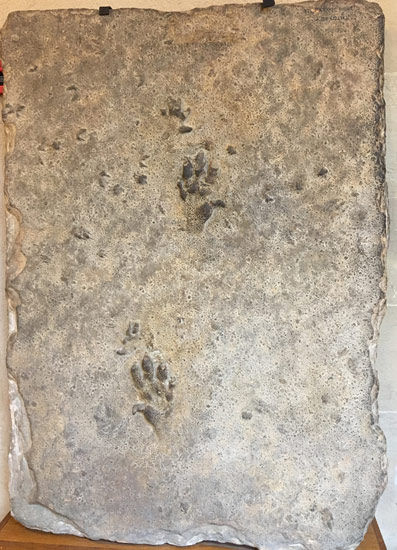
Prehistoric Animal Tracks – A Trace Fossil Preserving Behaviour

A Chirotheriuim trackway.

Chirotherium tracks on display at the Oxford University Museum of Natural History.

Picture credit: Everything Dinosaur.

To view the extensive range of dinosaur themed toys and gifts available from Everything Dinosaur: Dinosaur Toys and Gifts.

27 04, 2013

Very Creative and Imaginative Use of a Windowsill in a Classroom

By |2023-02-15T21:03:52+00:00April 27th, 2013|Categories: Educational Activities, Everything Dinosaur Products, Teaching|0 Comments

Dinosaur Scene Brightens up Classroom

It is important for teachers to create the right learning environment in a classroom.  The walls and cupboards are adorned with examples of the children’s drawings and posters, relating to the topics covered in the teacher’s scheme of work for the term.  Space is often at a premium and for one enterprising teacher the “dead space” of a windowsill in their classroom provided the perfect opportunity to create an imaginative prehistoric scene to inspire pupils.

Dinosaur Models

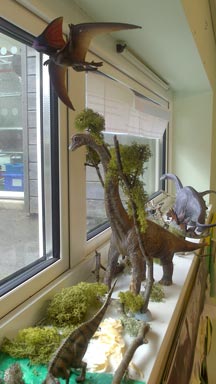
Mr Simon Riggs, took up the challenge of utilising a ledge next to a long window high up on one of the walls of his classroom. Turning the few square feet that was available into an attractive dinosaur diorama featuring the likes of a bellowing Styracosaurus, a meat-eating dinosaur feeding on a dead Triceratops and a pterosaur flying overhead surveying the scene below.

It looks as if the school children have got their own Jurassic Park to help inspire them when it comes to science topics, design and technology (DT) and creative writing.

The Classroom with its Own Jurassic Park!

A very clever and creative use of space in a classroom.

A very clever and creative use of space in a classroom.

The bellowing Styracosaurus can be seen in the foreground, it is looking out onto an array of dinosaur models including a Brachiosaurus, a Plateosaurus and several theropod dinosaurs.  Mr Riggs, skilfully modelled the trees using twigs with mosses and lichens providing the foliage for the herbivorous dinosaurs to feed on.  A pterosaur (flying reptile – Tapejara) is flying overhead, secured to the ceiling by a thin line.

The Pterosaur Flying Over the Dinosaur Diorama

The Pterosaur was attached to the ceiling by a thin line.

The pterosaur was attached to the ceiling by a thin line.

A Wonderful and Imaginative Dinosaur Scene

Mr Riggs, teacher of class 5B has created a wonderful, imaginative dinosaur scene, one that we are sure will inspire his pupils.  He commented:

“Following my purchase from Everything Dinosaur about a month ago, for which I am building a diorama for a ‘dead’ windowsill in my classroom, you asked me to send you some photos.  So here it is. I still need to get some ‘ground’ down on half of it – but with my current distractions – it may not happen for some time!  Cheers for all of your help.”

We do appreciate just how busy teachers and their support staff are at this time of year.  The summer term is a short term and there is so much to do, but we are grateful to Mr Riggs, for taking time out of his busy schedule to send us some pictures of his handiwork.

A Creative use of Limited Space in a Classroom

Inspiring the next generation of scientists and model makers.

Inspiring the next generation of scientists and model makers.

A spokesperson from Everything Dinosaur added:

“What a super way to use a bit of “dead space” in the classroom.  My colleagues and I were all very impressed.  The teacher has created a fascinating model scene, one that I am sure will inspire the pupils, it always amazes me how creative and clever our customers are.”

Our congratulations to Mr Riggs and our thanks to him for sending in some pictures of how prehistoric animal models can be used in such an innovative and enterprising way to brighten up a classroom.

To view the wide range of prehistoric animal models available from Everything Dinosaur: Dinosaur and Prehistoric Animal Models.

25 04, 2013

Dinosaurs Help Stop Bullying – Unique Poster Designs

By |2024-04-29T13:29:02+01:00April 25th, 2013|Categories: Educational Activities, Everything Dinosaur News and Updates|0 Comments

Dinosaurs Inspire Anti-Bullying School Poster

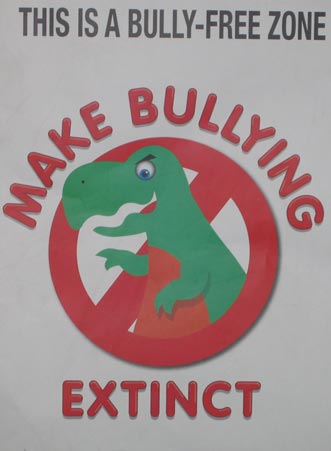
On a recent school visit to work with Year 1 and Year 2 children, teaching about dinosaurs and fossils, an anti-bullying poster was spotted in the school hall and we thought it was worth taking a picture of it and displaying it on the Everything Dinosaur blog.

Dinosaurs Help Stop Bullying

Getting the message across that bullying will not be tolerated is very important.  We applaud all efforts to help stop and indeed prevent bullying in schools.  This dinosaur themed poster says it all.  We thought that it was a very clever poster so top marks to the school staff!

Dinosaurs Inspire an Anti-Bullying Poster

Make Bullying Extinct!

Make bullying extinct!

Boosting a Child’s Confidence

Everything Dinosaur is in the process of creating its own dinosaur-themed, anti-bullying posters. We appreciate how important it is to make bullying extinct and we support such efforts.

To view the range of dinosaur themed gifts and toys available from Everything Dinosaur: Visit Everything Dinosaur.

20 04, 2013

Amazing Glow Fossil Science Kit Reviewed

By |2024-04-29T13:29:42+01:00April 20th, 2013|Categories: Educational Activities, Everything Dinosaur Products, Product Reviews|0 Comments

A Review of the Glow Fossil Science Kit

Budding young palaeontologists get the chance to build their own glow in the dark Tyrannosaurus rex skull, excavate a replica of fossilised shark’s tooth and to make casts of fossils in this well thought out and cleverly designed glow fossil science kit.

The Glow Fossil Science Kit

Ideal for budding young palaeontologists

Ideal for budding young palaeontologists.

Picture credit: Everything Dinosaur

This fun science kit is aimed at children from 8 years and upwards, although slightly younger children who are dinosaur fans would enjoy these activities too, although they may require more adult supervision.  The kit is supplied in a sturdy box and contains everything that is needed t play like a young palaeontologist and learn some of the aspects involved with studying fossils.  For example, the skull of the T. rex is easy to assemble and comes with a handy display stand to mount it on.  The glow in the dark shark’s tooth can be found in a gypsum plaster block and the tools required to dig it out, to excavate the shark’s tooth are contained within the kit.

Once the tooth has been freed, the leather cord, that also comes with the kit, can be used to make a shark’s tooth necklace, although we would advise some adult supervision when it comes to tying the tooth to the cord.  It is a good idea to put plenty of newspaper down and to work on a flat service, once the tooth has been excavated, the plaster remains can be disposed of.  Do not be tempted to throw the remains of the plaster block down the sink, there is a risk that the plaster could block the drain.

Jam Packed with Fossil Themed Activities

contains plaster, digging tool, paints, special glow paint, fossil moulds, brush etc.

The Glow Fossil Science kit contains plaster, digging tool, paints, special glow paint, fossil moulds, brush etc.

Picture credit: Everything Dinosaur

Included in this kit, there is a plastic tray that contains the moulds used to make fossil casts.  For instance, using the plaster of paris casting powder that is provided (two packets per science kit), a replica of the fossilised shell of an ammonite can be made.  There are also moulds for a trilobite, a fossilised fish and a three-toed, tridactyl dinosaur footprint.

To view Everything Dinosaur’s range of dinosaur themed science kits, toys and games: Dinosaur Themed Toys and Games.

A set of paints and a small paint brush is provided, along with some special glow paint that once applied makes the items glow in the dark.  We noted that it only took a few minutes exposure to a light source to make the fossils that we had created glow.  We advise that the paint brush be reserved for painting, it is best not to use it to brush away any pieces of plaster when excavating the various model pieces.

The moulds are very detailed and there is plenty of plaster in the kit to make several casts, this is a well-crafted junior science kit that will thrill young dinosaur fans.

18 04, 2013

Coelacanth Gets Its Genome Unravelled

By |2023-02-15T18:16:06+00:00April 18th, 2013|Categories: Animal News Stories, Dinosaur and Prehistoric Animal News Stories, Educational Activities, Teaching|0 Comments

Genome Analysis Shows that the Coelacanth May Not be Too Closely Related to Tetrapods

The genome of one of the most bizarre and enigmatic of all the vertebrates known to science, the coelacanth, has been decoded revealing how this animal may have remained virtually unchanged as a species for millions of years.  The data collected is also helping marine biologists and palaeontologists to understand how closely related the coelacanth group may be to the first land living animals with backbones.

Termed a “living fossil” by many lay people, two extant species are known, one from the waters around Indonesia and a second from the Indian Ocean.  The coelacanth is a member of the actinistian group of fishes, the first of these fleshy-finned fish with their distinctive tails with three lobes probably evolved in the Devonian geological period.  The last of the coelacanths were believed to have become extinct at the end of the Cretaceous period, that is until one was caught by a trawler fishing off the eastern coast of South Africa in 1938.
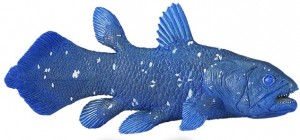
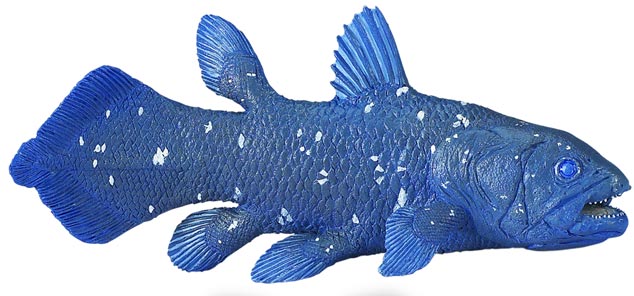
A Coelacanth Model

Ancient fish model – coelacanth.

Occasionally, specimens of these deep-water fish are caught, although marine biologists have expressed concern about the fate of this strange creature as overfishing and the development of industrial port facilities along the fringes of the Indian Ocean threatens their survival.

Coelacanth

With the genome having been sequenced, scientists are able to understand a little more about how this fish relates to other more advanced teleost fish and to also gain an insight into the evolution of land-living vertebrates, a significant moment in evolution of life on Earth as this led ultimately to the evolution of amphibians, reptiles, birds, mammals and of course, our own species.

The international team of researchers including some from the Broad Institute of the MIT (Harvard, USA), from the Uppsala University (Sweden) and Washington University (United States) were able to sequence and analyse the near 3 billion protein letter combinations from the DNA of the coelacanth as well as examining the RNA from both the African and the Indonesian species.  They then compared this data to the genomes of twenty other species of vertebrate as well as with typical representatives of the lungfish family.  The lungfish comparison would hopefully shed light on the evolutionary origins of tetrapods – were they more closely related to actinistians (coelacanths) or dipnoans (lungfishes)?

Published in the Journal “Nature”

This study, published in the academic journal “Nature” suggests that the lungfish has more genes in common with tetrapods than the coelacanth. It can be inferred from these results that the actinistians, assuming extant coelacanths are representative of this group, are not that closely related to the first animals that dragged themselves up onto the land.

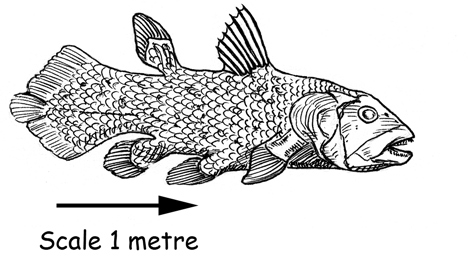
An Illustration of the Coelacanth (Latimeria genus)
Genome of the Coelacanth is Decoded.

Picture credit: Everything Dinosaur

Coelacanth Genome

The genome of the coelacanth is also providing scientists with additional data on how gene sequences may change over time.    The study suggests that some genes may evolve very slowly, this in part would help explain this prehistoric fish’s appearance, it having remained virtually unchanged for millions of years.  Such a stable gene assembly may be attributed to the coelacanth’s habitat and lifestyle.  It lives in relatively deep offshore waters, usually at depths of more than 300 metres.  It may live in sea caves, and it is largely nocturnal moving little during the day and then hunting at night.  The very uniform environment and an absence of other fish species competing for this particular niche in the offshore ecosystem may explain why the coelacanth has had little need to change and evolve over vast periods of time.

The international team of scientists admit there is much more to learn about the transition of vertebrates from water onto the land.  However, the lungfish genome represents more of a challenge than that of the coelacanth.  Although collecting specimens of lungfish is easier, after all, extant lungfish are all freshwater fishes, making them theoretically easier to collect, the lungfish genome is much larger, estimated to exceed 100 billion letters (C G A T), in length.  The more modestly sized genome of the extant coelacanth is permitting scientists to study changes that may have helped the first tetrapods to adapt to a terrestrial habitat.  Comparisons with tetrapods had led the researchers to isolate chains of genes that regulate and control other portions of the sequence, these studied in conjunction with an analysis of what genes are present in the coelacanth but absent in tetrapods has enabled some startling insights to be made.

Identifyin Differences Between the Coelacanth and Tetrapods

A number of immune-related regulatory differences have been identified between coelacanths and land-living animals.  The scientists have postulated that these changes reflect adaptations as a result to new pathogens the first tetrapods encountered as semi-aquatic vertebrates.  Other differences in the genomes provide clues to sensory development, senses such as a lateral line in a fish is not much use to a creature that lives on land.  Genes involved in smell perception and detecting airborne odours have been identified as a result of this research.

Similarities in genetic material have also been found between the marine coelacanth and animals that live entirely on land.  the HoxD strand of genetic material is common between coelacanths and tetrapods.  It is likely that this particular strand of genetic material was a prerequisite to enable the first land animals to develop hands and feet, to assist with locomotion, but as tetrapods evolved and became more specialised, this region of genetic material played a role in the evolution of our own dexterous, tool wielding hands.

Coelacanth Model

Safari Ltd have produced a model of a coelacanth, it forms part of the company’s Wild Safari Dinos & Prehistoric Life model series.  The model measures fifteen centimetres in length approximately and is a fine example of a replica of a lobe-finned fish.  Not only has this model been popular with collectors but it has also proved to be very useful for schools and home educators who have used this model in teaching topics on evolution and life on Earth.

A Useful Teaching Aid – Coelacanth Model
Ancient fish model - Coelacanth

To view the range of prehistoric animal figures: Safari Ltd. Models of Prehistoric Creatures.

One of the more unusual puzzles concerning the move to a terrestrial existence was the way in which waste products from the body were excreted.  Fish excrete ammonia into the water, this gets rid of waste nitrogen.  Land animals evolved a method of converting ammonia into the less toxic urea – the urea cycle, whereby ammonia is converted to the more inert urea, or uric acid.  If ammonia is allowed to build up in cells it will prove toxic to the cell, the researchers found that the most important gene involved in the regulation and control of urea or uric acid production had been modified and was present in tetrapods.

Commenting on the study, Chris Amemiya (Professor at the University of Washington), stated:

“This is just the beginning of many analyses on what the coelacanth can teach us about the emergence of land vertebrates, including humans, and, combined with modern empirical approaches, can lend insights into the mechanisms that have contributed to major evolutionary innovations.”

An International Research Project

This research project brought together a number of institutes and universities, it was a truly international effort, and it is hoped that the publishing of the genome will help to raise the profile of conservation efforts to help ensure the survival of the coelacanth.  A second team of scientists, a joint expedition from the South African Institute for Aquatic Biodiversity and the French National Museum of Natural History set out earlier this month to explore the sea cave home of a population of coelacanths living in the Sodwana Bay area (off the coast of South Africa).  By studying the coelacanth in its natural habitat, the scientists hope to learn more about how these strange creatures use their fleshy fins for locomotion and how they hunt and what prey animals are their preferred food.

To read more about this expedition: Scientists Set Off in Search of the Lair of the Coelacanth.

The scientists responsible for the genome research, acknowledge the importance of their work but also recognise that there is a lot more to learn when it comes to this “living fossil”.  Future studies will help to shed further light on that very significant period in the history of life on Earth when vertebrates first moved onto land.


17 04, 2013

School Children Create Their Own Special Dinosaur Land

By |2024-04-29T13:31:45+01:00April 17th, 2013|Categories: Dinosaur Fans, Educational Activities, Everything Dinosaur News and Updates|0 Comments

Pupils Study Dinosaurs at School

For children at a local school, this spring term has had them focusing on all things Dinosauria as studying dinosaurs and other prehistoric animals was their term topic.  Given the weather we have had in March, it might have been more appropriate to have studied the Ice Age, but at least the school children did manage to get their hands on a Woolly Mammoth tooth during a visit from one of the Everything Dinosaur team members.

Everything Dinosaur

The shape of fossil teeth can help scientists to understand a little more about what extinct creatures might have eaten and the eager young palaeontologists were keen to demonstrate their knowledge of herbivores and carnivores.  During a break in the teaching activities, our team member was given a quick tour of the school’s very own dinosaur land.  The wildlife area at the back of the playground had been converted into a “Jurassic Park” with brightly coloured dinosaur cut-outs adorning  this fenced in area.  There was a Diplodocus, (a herbivorous dinosaur), as we were informed by one enthusiastic pupil and propped up against the fence there was a meat-eating dinosaur plus a very fierce looking Triceratops complete with horns and sharp teeth.

 The School Triceratops

Colourful school Triceratops.

Colourful school Triceratops.

Picture credit: Everything Dinosaur

Triceratops Teeth

The pupils got the chance to examine some Triceratops teeth (T. horridus) and to compare them to the teeth of other dinosaurs who ate different types of food.  Imagining a dinosaur with a tongue about as tall as you are, is quite helpful when it comes to Key Stage 1 school children working out where in a food web might a Triceratops be placed.

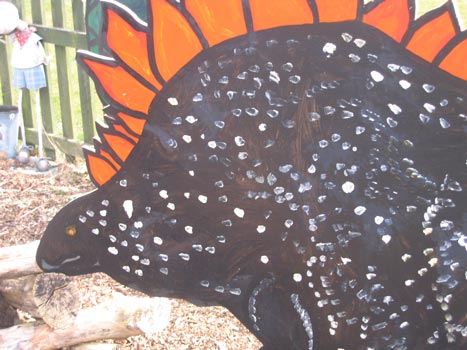
Alongside the Triceratops, was another plant-eating dinosaur which the children were delighted to show off.  It was a Stegosaurus, complete with very striking orange plates running along its back.

The Stegosaurus Cut-Out Dinosaur

A very brightly coloured Stegosaurus.

A very brightly coloured Stegosaurus.

Picture credit: Everything Dinosaur

Dinosaur Land

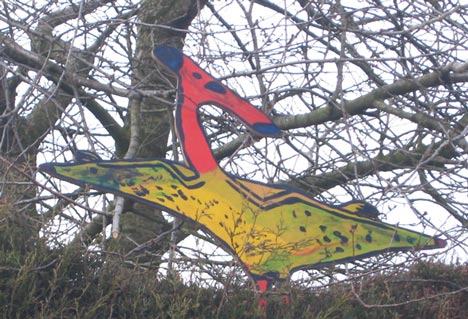
Perched high in a nearby tree, keeping a close eye on the proceedings was a large pterosaur (flying reptile).  The red crest and neck of this toothless pterosaur made the cut-out stand out against the branches.  It is very likely that pterosaurs had excellent colour vision, perhaps this was a flying reptile depicted in its mating regalia ready to display to any passing female Pteranodons should any fly by.

The Pterosaur (Pteranodon longiceps)?

A Pterosaur with its colourful neck and head crest.

A pterosaur with its colourful neck and head crest.

Picture credit: Everything Dinosaur

It seems that for the duration of the spring term, this part of the school playground has been turned into the children’s own dinosaur theme park.  Such an imaginative use of odd cuts of wood and spare paint, that was greatly appreciated by the children.  We explored what we do and what we don’t know about the colour of extinct creatures during our morning visit and the school children were very eager to display their knowledge and to talk about the dinosaur themed activities that they had been doing.

It seems that this spring term topic has been a big success, the enthusiastic teaching team using the dinosaurs theme to help develop the children’s numeracy, literacy and artistic skills.  Look out Steven Spielberg, you may have some challengers when it comes to designing the prehistoric animals that are going to feature in the film “Jurassic Park IV”!

To visit Everything Dinosaur’s website: Visit Everything Dinosaur.

12 04, 2013

K-W-L Charts Helping Children to Learn About Dinosaurs

By |2023-02-15T08:11:32+00:00April 12th, 2013|Categories: Educational Activities, Teaching|0 Comments

Know – Wonder- Learn How to Kick Start a Dinosaur Teaching Topic

Dinosaurs as a term topic for primary school children is a very appealing idea.  Most children are very familiar with dinosaurs and other prehistoric animals and they have some knowledge of the subject. Indeed, teachers might find themselves with their very own dinosaur expert in the class as some children obsess on dinosaurs and express a surprising amount of knowledge about them.  Here is a simple idea to help kick start a term topic on dinosaurs, create a K-W-L chart which will help shape the subsequent scheme of work, lesson plans that result and provide a stimulus for extension activities.

Everything Dinosaur

K-W-L stands for know, wonder, learn, one of these charts can provide a teaching team with a template for a topic, it works for all kinds of teaching themes but with a subject like dinosaurs, commencing with this activity can help to draw out what the children know, what they think they know and provide a method of checking understanding at the end of the teaching scheme.

Creating a K-W-L chart could not be simpler.  Take a sheet of flip-chart paper and divide it into three columns, write at the top of each column the words “what we know”, “what we wonder” and “what we learned”.  So the flip-chart will have the first column with the title “what we know”, the second column with the title “what we wonder” and the final column entitled “what we learned”.  If you have a smartboard, then of course the free draw facility can be utilised to create an electronic version of a K-W-L chart, but sometimes it is best to use a flip-chart sheet, as this permits the chart to be pinned up on a classroom wall and makes it easy to refer to throughout the teaching topic.

K-W-L Chart

You are then ready to start, get the class together sitting them in a group so that everyone can see the flip-chart paper.  Explain what the term topic or subject for study is going to be.  The very mention of dinosaurs usually causes quite a ripple of excitement amongst the children.  Then explain that the class are going to think about what they know about dinosaurs and this will get written onto the chart that will be produced.  Brainstorm with the children, encouraging them to tell their classmates what knowledge they have of dinosaurs and prehistoric animals.

Make sure that all the children have the chance to contribute, one way of doing this is to have a minute of quiet thinking time before the children are asked to participate in the task.

The K-W-L chart helps school children to recall prior knowledge and it will enable them to state facts about prehistoric animals that they are already aware of.  If the class has a teaching assistant, they can act as the scribe allowing the teacher to concentrate on guiding the children and helping them to sort out their statements as well as ensuring the involvement of all the pupils.

Teaching About Dinosaurs

Teaching about dinosaurs at primary school level provides the teaching team with lots of potential leads into different aspects of the national curriculum’s teaching remit – maths, creative writing, drama and of course science.  However, there is a need to introduce technical subject specific technical vocabulary.  The K-W-L chart technique gives the teaching team the chance to introduce and explore technical vocabulary with the class at the beginning of a term topic.  When creating such a  chart with an exploration of all things dinosaur some of the technical vocabulary encountered can include words such as “extinct”, “fossil”, “prehistoric” and “palaeontologist”.

Some of the statements made by children as the brainstorming session continues can be turned into questions by the teacher.   Statements may be incorrect, “facts” stated by the children can be turned into questions, these go into the second column, the “what we wonder” column.  This column can often provide a rich and diverse range of questions that can be explored during the term topic.  This permits the children to challenge assumptions and existing understanding in a non-threatening way.  The teaching team can also use the “W” column as a stimulus for thinking up creative experiments and activities that will permit their charges to test their understanding.  As the term topic progresses new questions will emerge and these too can be added to the “W” column of the chart.

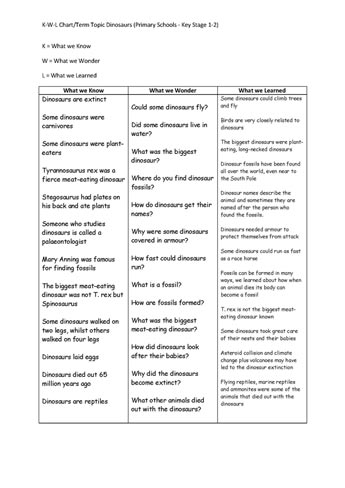
An Example of a K-W-L Chart (Term Topic Dinosaurs)

A chart to help kick-start a teaching topic about dinosaurs.

A chart to help kick-start a teaching topic about dinosaurs.

Picture credit: Everything Dinosaur

Review the K-W-L Chart

At the end of the term topic, time should be allocated by the teaching team to complete the third column of the chart, the “what we learned” section of the K-W-L.  The class can be asked to reflect on the first two columns of their chart and to  help the teacher to fill in the final part.  This permits the teacher to check learning, summarise and check understanding.  The children are demonstrating knowledge and shared learning as they complete the K-W-L flip-chart sheet.

There are of course, a number of ways in which this simple method can be varied and customised to fit a particular set of teaching circumstances.  For example, pupils can be encouraged to create their very own K-W-L chart in their topic books, all the class can be split into groups so that a number of charts can be created with each group taking ownership of their chart and the teaching team working with the entire the class to make sure the breadth and depth of the areas stated are covered in the term topic.

To view the range of toys and gifts with a prehistoric theme available from Everything Dinosaur: Dinosaur Themed Learning Activities and Toys.

K-W-L charts are an ideal way of kicking-off a term topic on the subject of dinosaurs.  Children share knowledge and are contributing to the structure of the teaching topic and scheme of work.  For the teaching team, they can quickly assess existing knowledge and use the chart as a guide for extension ideas and activities.  It also has the helpful benefit of allowing the teacher to be informed about dinosaurs and prehistoric animals, tapping into that reserve of knowledge that children passionate about all things dinosaur tend to have.

5 04, 2013

Thank you from School after Dinosaur Teaching Session

By |2023-02-15T07:25:55+00:00April 5th, 2013|Categories: Educational Activities|0 Comments

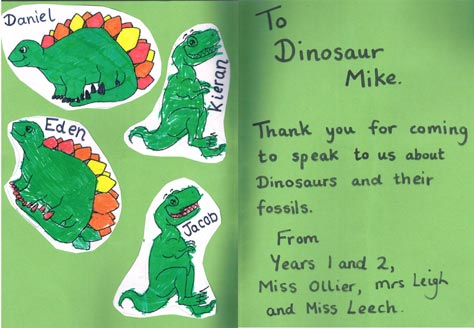
Thank you card from School after Learning All About Fossils and Dinosaurs

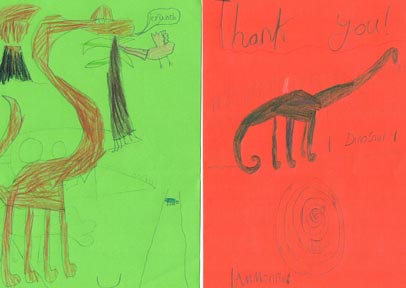
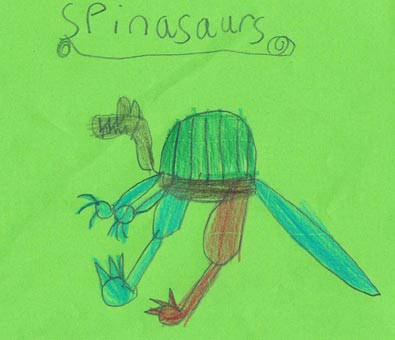
We received a big thank you card from Year 1 pupils a couple of days ago.  The very colourful dinosaur themed card had been sent into Everything Dinosaur after a recent school visit.  Each of the children had coloured in a dinosaur picture and this had been stuck to the card with their teacher adding a brief thank you note inside.

Everything Dinosaur

The card arrived with some thank you letters that the children had composed, an extension activity following a visit from one of our dinosaur experts that was aimed at helping to develop expressive writing amongst these Key Stage one pupils.

The Thank you Card we Received

A thank you card after a school visit.

A thank you card after a school visit.

Thank You Letters

We enjoyed reading all the letters and we are always keen to hear from young dinosaur fans.  A dinosaur themed term topic, aimed at Primary school children is a great way to help these enthusiastic young palaeontologists develop writing skills as they learn to express feelings, emotions and to extend their vocabularies.  We are pleased that the children and the teaching staff enjoyed our dinosaur workshop.

To view the range of dinosaur themed toys and gifts that are suitable for children on Everything Dinosaur’s award-winning website: Dinosaur Gifts and Toys.

2 04, 2013

New Puzzles Added to Everything Dinosaur’s Product Range

By |2023-02-15T06:32:10+00:00April 2nd, 2013|Categories: Dinosaur Fans, Educational Activities, Everything Dinosaur News and Updates, Press Releases|0 Comments

New Dinosaur Themed Puzzles – Have You Evolved Enough to Solve Them?

More puzzles have been added to the Everything Dinosaur product range.  After the completion of the  testing programme four travel puzzles/games have been approved and have been posted up on the company’s website.  The puzzles include a magnetic Tyrannosaurus rex jigsaw, plus a dinosaur themed magnetic pyramid puzzle, dinosaur draughts and a magnetic dinosaur themed brain teaser.

New Puzzles

The dinosaur draughts (dinosaur checkers), along with the other three items are designed to played on the move, to help keep young palaeontologists occupied on car, boat or plane journeys.  In the dinosaur draughts game, one set of counters has a picture of a Triceratops, these are pitted against the opposing counters that have an image of a T. rex on them.  It seems that this travel game actually reflects real dinosaur conflicts, as palaeontologists are fairly confident that based on substantial fossil evidence, T. rex and the herbivorous Triceratops really did battle it out.

The Dinosaur Checkers (Dinosaur Draughts Game)

T. rex versus Triceratops

T. rex versus Triceratops.

Picture credit: Everything Dinosaur

Travel Games

These travel games are light, pocket-sized and great for keeping budding young palaeontologists occupied on journeys.  They are suitable for children from four years and upwards and all the puzzles except the checkers can be played by an individual.  When these items were on test with our field testers, one of the ways in which the puzzles such as the Pyramid Magnetic Brain Teaser puzzle (picture below) could be adapted for a multi-player format  was to time how long each child took to solve the puzzle.  The winner was the one with the quickest time.

The puzzles are actually quite hard, there are thousands of possibilities but only one solution that lines up all the pictures of the stegosaurs, Velociraptors and Iguanodons in the correct way.

Dinosaur Themed Pyramid Magnetic Brain Teaser

Tougher than it looks!

Tougher than it looks!

Picture credit: Everything Dinosaur

The team members at Everything Dinosaur are proud of their educational games that they sell.  Each one has to be approved by the teachers/dinosaur experts in the company and of course they have to have an appropriate dinosaur theme.

To celebrate the addition of these new puzzles and games, over the weekend a new banner for the Everything Dinosaur website was created that features some of these new products.

Dinosaur Themed Puzzles and Educational Games

Dinosaur Themed Educational Puzzles and Games.

Dinosaur themed educational puzzles and games.

Picture credit: Everything Dinosaur

Just click on the banner image to be taken to the educational games section of the Everything Dinosaur website.  We look forward to adding more products over the next few weeks.

To view the range of dinosaur themed educational puzzles and games: Dinosaur Toys and Gifts.

29 03, 2013

Make Your Own Dinosaur Craft Kit Reviewed

By |2023-02-14T07:53:05+00:00March 29th, 2013|Categories: Educational Activities, Everything Dinosaur Products, Product Reviews|0 Comments

A “DIY Dinosaur” Craft Kit In Review

An ideal gift for a young dinosaur fan that combines a fascination for all things dinosaur with a practical craft kit.  This make your own dinosaur craft kit has proved popular both with young children and with their parents and guardians.  Each kit contains all that is required to make a felt, dinosaur soft toy.  The box contains felt shapes already cut to shape, stuffing material, glue, wiggly eyes, thread and a needle for the sewing.  The instructions are written in plain English and they are a little light on detail but there are some handy diagrams to assist budding young crafters.

The Make Your Own Dinosaur Craft Kits

A "DIY Dinosaur" Craft Kit

A “DIY Dinosaur” Craft Kit.

Picture credit: Everything Dinosaur

Two Different Dinosaurs

There are two different dinosaurs in the series, each kit is supplied with the materials to make one dinosaur.  There is a purple Stegosaurus complete with yellow felt spots and armour plates made from diamond-shaped felt pieces that have already been cut out for you.  The second dinosaur in the kit series is the carnivorous Tyrannosaurus rex.  The felt pieces in our kit were light green in colour, with some blue pieces to make the underside of the soft toy.  The set even included a series of pink felt spots that could be glued onto the flank of the T. rex, so that a pink, spotted “Tyrant Lizard King” could be made.

The teeth of this meat-eating dinosaur were made from pieces of white coloured felt that had already been pre-cut.   They were a little difficult to sew into the mouth, but a dab of glue to secure them first did the trick.

The Make Your Own Dinosaur – Purple Stegosaurus

A colourful and easy to make Stegosaurus soft toy.

A colourful and easy to make Stegosaurus soft toy.

Picture credit: Everything Dinosaur

How to “Plump Up” Your Dinosaur

The stuffing material provided was just enough to fill out the animal, however, if young dinosaur fans are concerned about this at all, cotton wool can be used to help “plump up” your dinosaur if required.  The first thing to do is to check that you have all the contents of the kit, they are supplied in clear plastic bags so that the contents can easily be checked.  Watch out for the sewing needle, the point of the needle was held securely by a small, bright yellow block of foam in our kits.  This would prevent anyone from pricking their finger as the kit was opened.  Once you are ready to start, the first job is to sew the body pieces together.  If the young dinosaur fan is not that good at sewing the pieces  they can always be glued first before stitching together.  Sew the underside to the rest of the body, but leave a gap for the pink or red mouth piece, as it is through the mouth that you push the stuffing material to fill out your dinosaur.

Once the mouth has been sewn in place, it is then a question of  sewing together the limbs, the front limbs of the T. rex proved to be the most fiddly, this is because they were much smaller than the back legs.  Don’t forget to stuff the limbs with the soft, stuffing material and then when this stuffing job has been completed, the limbs can be sewn onto the body.  A dab of glue can help to secure the legs and arms in place before sewing commences.  It is also a good idea to spend a little time working out where on the body the legs will go, a bit of care at this stage will help you create a more aesthetically pleasing end result.

The Make Your Own Dinosaur Tyrannosaurus rex Craft Kit

A DIY "Tyrant Lizard King".

A DIY “Tyrant Lizard King”.

Picture credit: Everything Dinosaur

Once the legs are finished, it is just a question of decorating your dinosaur.  With the Tyrannosaurus rex, as mentioned earlier, the set contained some pink felt dots that could be glued onto the body to make a spotted dinosaur.  The Stegosaurus kit comes with some yellow pre-cut felt shapes so that you can decorate your soft toy and add the row of spikes at the end of the tail.  The last thing to do is to glue the wiggly eyes in place (we call them “goggle eyes”) and you have made your very own soft toy dinosaur.

To view Everything Dinosaur’s wide range of dinosaur themed educational products and craft kits: Dinosaur Themed Crafts and Toys.

Dinosaur Craft Kit

This kit is suitable for children aged six years and upwards, although an adult with some craft and sewing skills on hand to assist where necessary would be very helpful.  It was difficult to make the bipedal T. rex stand upright but that did not seem to detract from the sense of achievement for having made a “prehistoric animal”.

A simple and fun to make dinosaur kit, with the added benefit of having everything you need to make your dinosaur contained in the box.  Ideal for young dinosaur fans from six years or older and a great hobby or craft idea.  After all, you can resist making their own “DIY dinosaur”.

Go to Top