All about dinosaurs, fossils and prehistoric animals by Everything Dinosaur team members.

Everything Dinosaur’s work with schools and other educational bodies. Articles, features and stories about dinosaurs and their role in education and educating young people.

14 03, 2013

Creating Your Own Unique Dinosaur Play Set

By |2024-02-22T12:38:19+00:00March 14th, 2013|Categories: Dinosaur Fans, Educational Activities, Photos|0 Comments

Clever Customers Show off their Jurassic Park Building Skills

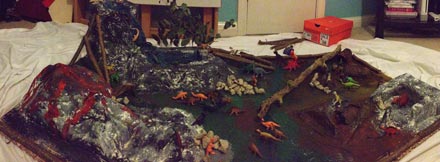
We are always pleased to hear from our customers and it never ceases to amaze us how creative and clever they are.  Take Mark from Essex (England), for example, he wanted to build a play set for his dinosaur mad son.  Purchasing a play set can be quite expensive and we have tested quite a few with our young dinosaur fans, but sometimes it can be better to create one yourself.  It is certainly cheaper and you don’t have to be Steven Spielberg to create your very own “Jurassic Park”.

The Dinosaur Land Made by Mark

Getting creative and making dinosaur play sets.

Getting creative and making dinosaur play sets.

Dinosaur Play Set

Mark set about making a dinosaur landscape complete with erupting volcano and a waterfall.  There are lots of habitats for his son’s dinosaurs and prehistoric animal figures to explore.

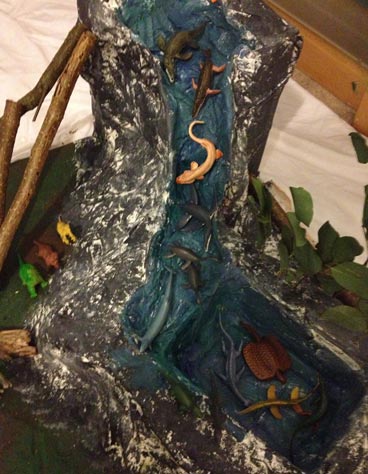
Water a place where dinosaurs congrugated.

Water a place where dinosaurs congrugated.

Creating a Pond or Water Source

Creating a pond or other water source as part of the dinosaur play set makes a lot of sense.  A number of dinosaur species would have congregated around water sources such as lakes and ponds, especially during the dry season.  Herbivores would have been attracted to the area as there would probably have been plenty of lush vegetation for them to eat.  Predatory dinosaurs would have staked out the water source in the hope of ambushing an unwary plant-eater.  The ground that was churned up by all the dinosaurs as they walked over the area even has a special name – dinoturbation!

The creatures swimming in the water come from the Prehistoric Sealife Toob, (Safari Ltd), a set of ten prehistoric animal models which was supplied by Everything Dinosaur. This detailed model set includes a turtle-like placodont called Henodus, plus elasmosaurs and even a model of a prehistoric whale.

To view the range of Safari Ltd models in stock: Wild Safari Dinos.

As Mark says himself:

“The Park didn’t cost me anything – only wallpaper paste for the papier mache, the wood is natural, the rocks real and the trees are eucalyptus stems.”

Inventive

It was very inventive of Mark to use stones and natural wood to make his prehistoric scene that more authentic.  It was interesting to note that Mark chose to use eucalyptus stems in his dinosaur land.  Intriguingly, the eucalyptus family are a very ancient group.  Fossils discovered recently in South America indicate that this tree, now strongly associated with Australia, may actually have first evolved in Argentina.  Whether there were ancient true eucalypts around during the Age of Reptiles is uncertain but the ancestors of the eucalypts probably would have been part of the Late Cretaceous landscape.

To read more about ancient eucalyptus trees: Fossils Show the Origins of Eucalyptus Trees.

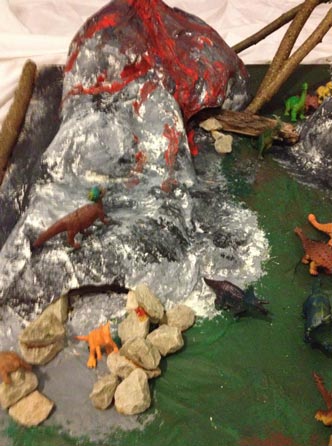
In addition, Mark decided to add an erupting volcano to his dinosaur landscape.  The papier mache volcano has been painted with lots of red to indicate lava flows – very creative.

Volcanic Eruption in the Land of the Dinosaurs

An active volcano in the dinosaur landscape

An active volcano in the dinosaur landscape.

Making a Play Set

Making such a play set is relatively easy, it just takes a little planning and time.  It can be great fun to involve your young palaeontologist in the project, especially when it comes to painting or moulding the rocks and other features.  Best of all you dinosaur land is unique, there is not one in the world quite like it – your own portrayal of life in prehistoric times.

With the Easter holidays coming up, this might be just the thing to keep your young dinosaur fans occupied.

Visit the award-winning Everything Dinosaur website: Everything Dinosaur.

8 03, 2013

Celebrating International Women’s Day 2013 (A Special Event)

By |2024-04-29T13:12:20+01:00March 8th, 2013|Categories: Educational Activities, Everything Dinosaur News and Updates, Famous Figures, Teaching|0 Comments

Celebrating The Role of Women in Science

Today, Friday 8th of March is International Women’s Day, a day that is celebrated across the world, celebrating the achievements of women in business, the arts, politics and of course in the sciences. This is the one hundred and second International Women’s Day, in some countries this day is a national holiday.

International Women’s Day

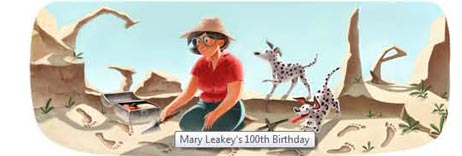
In this brief article, we celebrate the work of women, past and present in the Earth sciences.  It was very gratifying to see that last month, the Google Doodle acknowledged and celebrated the work of Mary Leakey.  Mary was an English palaeoanthropologist who with her husband Louis made significant fossil discoveries helping scientists to understand the evolution of hominids including ultimately, our own species.  Together, this husband and wife team proved that the birth place of human evolution was centred around the eastern part of Africa and that the human branch of the evolutionary family tree was much older than had been previously realised.  The Google Doodle was put on line to mark what would have been her 100th birthday.

The Leakey family are still very much involved with Earth sciences.  For example, Mary’s daughter Dr Meave Leakey, continues to study the origin of our species to this day and she is the co-leader of the world famous Koobi Fora Research Project in Kenya.

The Google Doodle Celebrating the Work of Mary Leakey

Celebrating the role of women in science.

Celebrating the role of women in science.

Picture credit: Everything Dinosaur/Google

Female Palaeontologists

In palaeontology, there are a great many female scientists, far too many to list but we pay our respects to them all and to those who championed the role of women in this particular branch of the sciences.  In 1905, Marie Stopes a palaeobotanist become the first science lecturer at Manchester University, her expertise on fossil plants earned the University a world-wide reputation for being a centre of excellence for the Earth Sciences.  Manchester University is today, the UK’s largest university and the Earth Sciences Department continues to contribute to the advancement of scientific understanding in a number of important areas.

Recently, BBC Radio 4 published a list of the top one hundred most powerful and influential women in the country.  The work of a number of notable scientists was acknowledged.  For instance, Professor Anne Glover, the first Chief Scientific Advisor to the European Commission  was included in this list. Her role is to provide expert advice to the EU policy decision makers on subject areas that include science and technology.

Top 100 Women Power List

In the past, she has also been the Chief Scientific Advisor for Scotland.  The first female Professor in the Engineering Department at the University of Cambridge, Ann Dowling also made the top 100 women of power list.  It is always pleasing to see the work of women in science and engineering recognised in this way.

Closer to home, the first woman Vice Chancellor of the University of Manchester, Professor Dame Nancy Rothwell also made the top 100.  Times have changed since Marie Stopes and her ground breaking role at the University.  A Professor of Physiology, Dame Rothwell has had a very distinguished academic career as well as helping to run a number funding and medical research bodies.

High Profile Female Scientists

Forensic anthropologist Professor Sue Black also made the list. She is the director  of the Centre for Anatomy and Human Identification at the University of Dundee.  Her extensive knowledge has proved vital in the successful prosecution of a number of high profile criminal cases in the United Kingdom.  She has also worked abroad, perhaps most notably in Kosovo where her knowledge of forensic anthropology helped to identify the victims buried in mass graves.  Professor Black and her fellow scientists have helped to promote and encourage other women to take up a career in the scientific field.

Only a few days ago, a new scientific paper was published detailing the research into 360 million year old fossilised sea-lilies (crinoids) that had revealed evidence of organic biomarkers preserved in the fossil record. One of the authors of this research paper was Christina O’ Malley, a PhD student in Earth Sciences currently based at Ohio State University (United States).

To view the article on the research into biomarkers in crinoids: New Research Identifies Organic Biomarkers in 360-million-year-old fossils.

Acknowledging the Contribution

Today we acknowledge the work of women in palaeontology, the study of vertebrates including dinosaurs and in all aspects of scientific endeavour.  It is important that we continue to enthuse and encourage girls to take up a career in the Earth Sciences.  Tomorrow, March 9th marks the 166th anniversary of the death of Mary Anning.  Mary was an amateur fossil collector who lived in Lyme Regis a town in Dorset, England, on what is now called the “Jurassic Coast”.  We will always remember Mary’s contribution to palaeontology and we are happy to talk about her work and her role in the study of long extinct creatures, her story is an inspiration to young women hoping to embark on a career in the sciences.

As team member Sue might say, take a look at Everything Dinosaur’s website: Everything Dinosaur.

7 03, 2013

Wonderful Thank You Letters from School Children

By |2024-04-29T13:10:43+01:00March 7th, 2013|Categories: Educational Activities, Teaching|0 Comments

School Pupils Say Thank you for Dinosaur Teaching Session

The Everything Dinosaur mail bag was even bigger today than normal.  The postman handed us a big envelope which contained thank you letters written to us by school pupils after a recent visit from one of our dinosaur experts to carry out some prehistoric animal themed experiments.

Thank You Letters

The Year two pupils (aged 6-7 years), at Rode Heath Primary School in Cheshire have been busy studying dinosaurs this term with their teacher Mrs Woollam and Miss Moss, Miss Gater and Mrs Hulse.  The children have been doing all sorts of dinosaur themed activities, we saw some amazing artwork in their classroom and we did our best to answer all the questions from the eager young palaeontologists that we met.

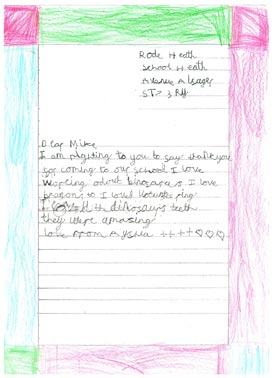
A Thank you Letter from Ayshia

Ayshia shows her appreciation of Everything Dinosaur.

Ayshia shows her appreciation of Everything Dinosaur.

Picture credit: Ayshia/Everything Dinosaur

Encouraging Creative Writing

By working on a thank you letter, the children can be encouraged to write creatively.  Learning and understanding can be checked along with sentence construction and writing ability.  It is always a good idea for a teacher to encourage her charges to write about any school visit and every letter that we receive at Everything Dinosaur is read by our team members.

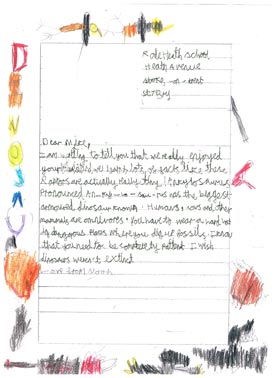
Thank you Noah.

Thank you Noah.

Picture credit: Noah/Everything Dinosaur

As a special treat, the class are going to the Great Orme, a prominent headland situated at Llandudno (North Wales).  The limestone rocks at the top of the Great Orme contain lots of fossils.  The children should be able to find fossils of brachiopods (look like clams but brachiopods are not closely related to shellfish) and fossils of ancient corals.  The fossils are very easy to find, there are lots of small rocks to examine around the man made limestone exposures and scree slopes.

North Wales in the Carboniferous

Around 330 million years ago (Carboniferous geological period), this part of North Wales was at the bottom of a shallow tropical sea.  There were extensive coral reefs and the waters teemed with life, the fossils are the ancient remains of these reefs and they are all at least 100 million years older than the vast majority of dinosaur fossils.

Thomas Thanks Everything Dinosaur for their Visit to his School

Thomas says thanks.

Thomas says thanks.

Picture credit: Thomas/Everything Dinosaur

We are sure that the children will have a great time and it is a lovely way to round off the teaching topic.

Our thanks to the teaching staff and the children at Rode Heath Primary for the lovely letters, examples of which we have reproduced below.

Thank you for your flying reptile drawing – Olivia the Oviraptor.  Good luck finding your own fossil on the school trip Amelie and we appreciate your comment about the dinosaur claws Ashton (A).  Aiden now knows that Spinosaurus was very probably bigger than T. rex and Ellie can draw super fossil bones and Hope can create a spotted dinosaur.  Aki was just brilliant wearing the hard hat and demonstrating some of the equipment that we use and we loved your letter Sam.

Dinosaur Teeth and a Fearsome Sea Monster

Emma drew us some dinosaur teeth and Sam (N) sent us a picture of a fearsome sea monster, whilst Jasmine told us she loved looking at the claws best.  Jonny (H) wrote that he was amazed when the size of the Ankylosaurus was revealed and Lucas sent us a picture of a big smiley face!  Lovely writing Codie and thank you for your red dinosaur it looks really good next to the ammonite picture that Millie kindly included in her letter to us.  James chose to put a bright red, meat-eating dinosaur on the top of his letter to us whilst Lottie sent us a picture of a purple Diplodocus feeding on some leaves.

Colourful Illustrations

We noted that the school now has a pupil called Ashtonosaurus (thanks Ashton), along with a Leilasaurus (thanks Leila).  A very colourful letter was sent in by Poem, the border was illustrated with pink and yellow and the writing was very neat – well done!

Thomas remembered what we said about dinosaurs and their teeth, whilst Noah ended his letter by wishing that dinosaurs were not extinct.  Esmee sent us pictures of three long-necked dinosaurs with her letter and we are pleased to hear that her mummy likes dinosaurs too.  Ayshia just loved learning about dinosaurs especially Dracorex and Albie sent us a bright yellow thank you letter which included a picture of a yellow, stripped dinosaur and a fact about Giganotosaurus.

Esmee says thank you.

Esmee says thank you.

Picture credit: Esmee/Everything Dinosaur

Encouraging school children to write a thank you letter after a school visit makes a great extension activity.  Once again our thanks to the pupils and teachers at Rode Heath Primary.

To view the range of dinosaur themed educational items available from Everything Dinosaur: Visit Everything Dinosaur.

1 03, 2013

Spot the Dinosaur – Wonderful Dinosaur Drawings

By |2024-04-29T10:33:39+01:00March 1st, 2013|Categories: Dinosaur and Prehistoric Animal Drawings, Dinosaur Fans, Educational Activities, Teaching|0 Comments

A Colourful Dinosaur Drawing

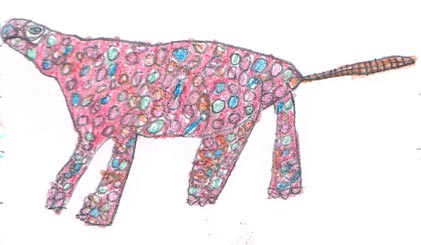
Amongst the many pictures, drawings and letters we receive each week we found a lovely picture of a spotty dinosaur that had been drawn by a Year 2 school girl (aged 6-7).  We read all the letters and emails we receive and we try our best to reply to them all.

“Spot” the Dinosaur

A spotty dinosaur.

A spotty dinosaur.

The green, blue and brown spots look like armour and from the beak and the strange tail we think that this is an interpretation of an armoured dinosaur, perhaps something like an Ankylosaurus from the Late Cretaceous  of North America.

Everything Dinosaur

Our team members love visiting schools and teaching about dinosaurs.  Each lesson plan they prepare contains experiments and activities that dovetail into the national teaching curriculum.

To view the range of dinosaur themed toys and gifts, including colouring books: Everything Dinosaur.

25 02, 2013

Primary School Children Showcase their Amazing Dinosaur Knowledge

By |2024-04-29T10:49:35+01:00February 25th, 2013|Categories: Educational Activities, Teaching|0 Comments

Blackford CE Primary School goes “Walking with Dinosaurs”

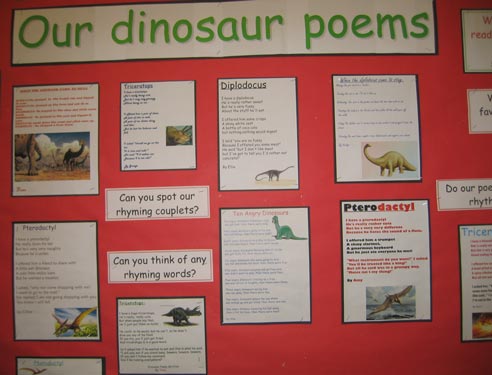
Last Friday, Everything Dinosaur travelled to Cumbria to provide some dinosaur teaching sessions to the eager, young palaeontologists at Blackford CE Primary School.  The morning was spent working with the juniors under the tutelage of Miss Thompson.  The children had been studying dinosaurs as their term topic and they has posted up some super dinosaur themed poems.  These poems made a great display on one of the walls of the classroom.

A Dinosaur Inspired Poetry Corner

Prehistoric Animal Poems.

Prehistoric animal poems.

Picture credit: Everything Dinosaur/Blackford CE Primary School

Dinosaur Teaching Workshop

There were lots of different prose writing techniques on display and it was interesting to note the various prehistoric animals that the children had chosen as the subject for their poems.  If we ever need to think up some rhymes for the likes of Triceratops and Diplodocus, Blackford CE Primary School will be our first port of call.

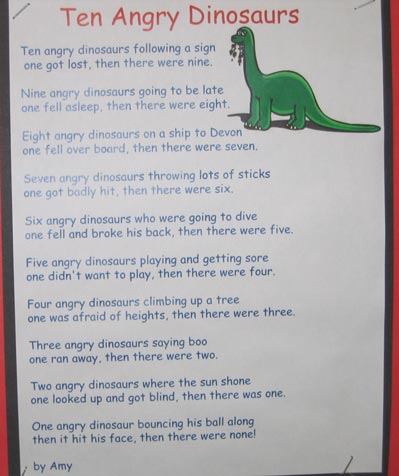
A Poem Entitled Ten Angry Dinosaurs (by Amy)

Ten Angry Dinosaurs Poem

Ten angry dinosaurs poem.

Picture credit: Everything Dinosaur/Blackford CE Primary School

Creative Extension Work

As a teaching topic, dinosaurs does lend itself to all sorts of creative extension work.  The subject area can touch upon design and technology, maths, geography as well as science and history.  With these poems Miss Thompson has encouraged her pupils to consider how poems are constructed as well as encouraging their creative writing skills.

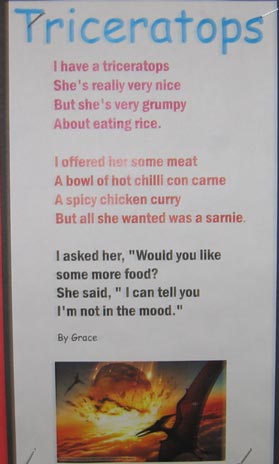
An Ode To Triceratops Written by Grace

"Three horned Face" has a poem written about it.

“Three horned Face” has a poem written about it.

Picture credit: Everything Dinosaur/Blackford CE Primary School

If the likes of Charles Dickens can write about dinosaurs (Bleak House), then it seems that the juniors at Blackford CE Primary are following in some very famous footsteps.

The children’s artistic talents were also encouraged by Miss Thompson, aided by teaching assistant Miss Turner.  Working in small groups the pupils had designed their own colourful dinosaur posters.  Each poster focused on a single genus of prehistoric animal and as well as drawings and pictures the children had researched facts about the animal and reproduced this information on their posters.

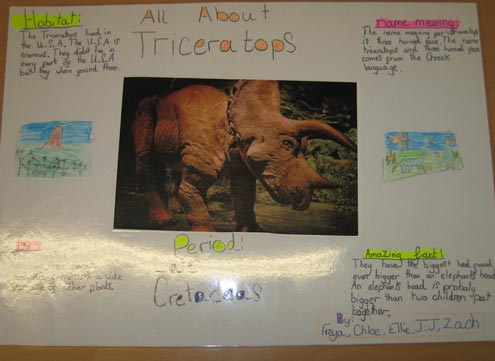
A Poster All About Triceratops

A Triceratops Dinosaur poster.

A Triceratops dinosaur poster.

Picture credit: Everything Dinosaur/Blackford CE Primary School

A very informative poster all about a very famous horned dinosaur made by Zach, J.J., Ellie, Chloe and Freya.  We loved the drawing on the left of the picture (as you look) showing a huge, brown volcano.  We talked about Triceratops during the dinosaur teaching session and we set the class a puzzle concerning this particular dinosaur.  The children had to consider the evidence and then come up with a theory to explain what they thought might have happened – interesting stuff!

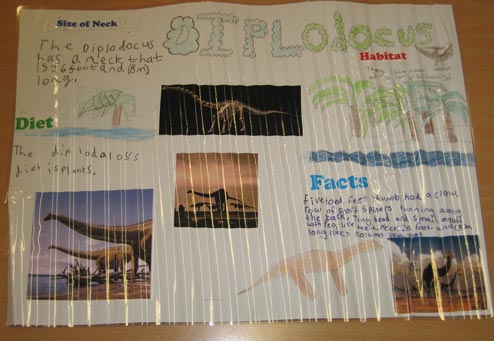
Another group of juniors had created a poster of Diplodocus.  As the poster was being laminated the laminating machine chewed it up a bit creating a rippled effect on the poster. Undaunted,  the pupils decided that the texture was probably like that of the skin of this particular long-necked dinosaur.  We had some casts of dinosaur skin with us on the day, but with all the other activities and experiments including testing to see if your tongue sticks to fossil material (an experiment inspired by budding dinosaur hunter Jack), we did not get round to showing these items.

Diplodocus Takes Centre Stage

A dinosaur poster by children at Blackford CE Primary.

A dinosaur poster by children at Blackford CE Primary.

Picture credit: Everything Dinosaur/Blackford CE Primary School

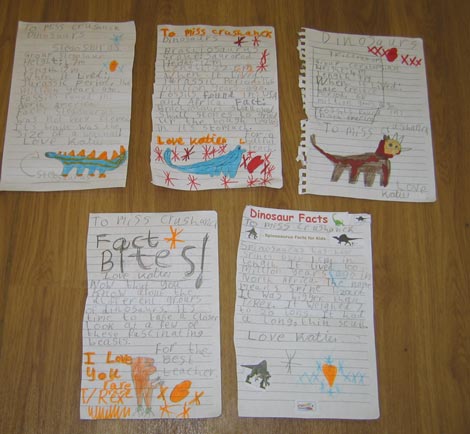
In the afternoon,  it was time to work with the younger children in the school.  Miss Cruickshank’s class were treated to some tactile fossil handling which involved an exploration of the properties of materials interspersed with some physical activities.  There were lots of questions, Nigella wanted to know all about Diplodocus and Elizabeth asked about Tyrannosaurus rex.  One of the pupils (Katie) had even made a set of dinosaur fact cards featuring the likes of Stegosaurus and the fearsome Spinosaurus – nice work Katie!

The Dinosaur Fact Cards Made by Katie

Katie's Dinosaur Fact Cards.

Katie’s dinosaur fact cards.

Picture credit: Everything Dinosaur/Blackford CE Primary School

We loved Katie’s illustrations on her “bite sized” fact cards, but all too soon it was time to pack up and go home.  However,  the pupils at Blackford CE Primary along with their teaching staff are going to have a few more weeks of this teaching topic and with the creative teaching team we are confident that there will be lots of exciting dinosaur themed teaching activities carried out.

To view the range of dinosaur themed toys and gifts available from Everything Dinosaur: Dinosaur Toys and Gifts.
14 02, 2013

Amazing Scientists at Remarkable School Studying Rare Fossils and Wonderful Dinosaurs

By |2024-04-29T13:03:47+01:00February 14th, 2013|Categories: Educational Activities, Photos/Schools, Teaching|0 Comments

Year 2 Demonstrate their Dinosaur Drawing Skills

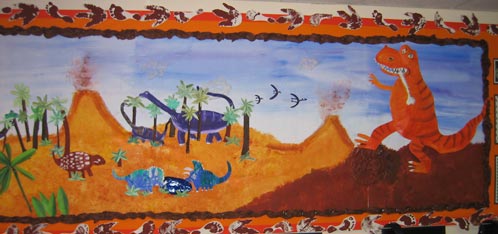
Another day and another school visit for Everything Dinosaur, this time to Rode Heath Primary School in Cheshire.  The year two children under the tutelage of Mrs Woollam the class teacher, have been studying dinosaurs this term.  There was lots of artwork on display including a very colourful wall mural showing, in the foreground, a bright orange Tyrannosaurus rex chomping on a bone.

Rode Heath Primary with their own “Walking with Dinosaurs” Wall Display

A very colourful dinosaur scene.

A very colourful dinosaur scene.

Picture credit: Everything Dinosaur

Tyrannosaurus rex

The T. rex is heading towards a group of herbivorous dinosaurs.  There are horned dinosaurs (Ceratopsians), and an Ankylosaurus whilst amongst the trees two titanosaurs lurk.  It is certainly a very impressive mural.  Forming a border around the picture there are some cut-out tridactyl (three-toed) dinosaur footprints intermingled with footprints made by the school children.

Year two have been busy making exhibits for their very own dinosaur museum.  Teaching Assistant Mrs Hulse was busy taking photographs of the fossils that we brought so that they too could be included in the class museum. Some of the pupils are going to be tour guides for the museum so they will have to “bone up” on lots of dinosaur facts and figures.

Dinosaur Term Topic

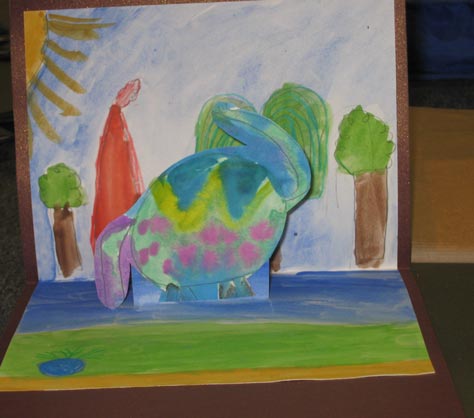
Dinosaurs and fossils make an excellent subject for a term topic.  Lots and lots of extension activities can be employed to help children develop writing and numeracy skills.   For example, Mrs Woollam’s class have been working on their own dinosaur “pop-up” books, showcasing some of the artwork they have produced as well as providing a great platform for creative writing.

Chloe Thompson (aged 7), decided to include a very fierce looking meat-eating dinosaur in her pop-up book.   Team members at Everything Dinosaur were very impressed with the big teeth.

Pink and Blue Meat-eating Dinosaur by Chloe Thompson

A very colourful dinosaur.

A very colourful dinosaur.

Picture credit: Chloe Thompson

If you look carefully you can see that Chloe has added some dinosaur bones in the foreground.  Part of the lesson covered the different types of dinosaur, herbivore, carnivore and even omnivores.

Millie and her Herbivorous Dinosaur

A Sauropod suns himself.

A sauropod suns himself.

Picture credit: Millie

Millie chose to depict a plant-eating dinosaur in her pop-up book.  The sauropod is painted with blues, greens and even a little bit of pink – nice one Millie.

Everything Dinosaur

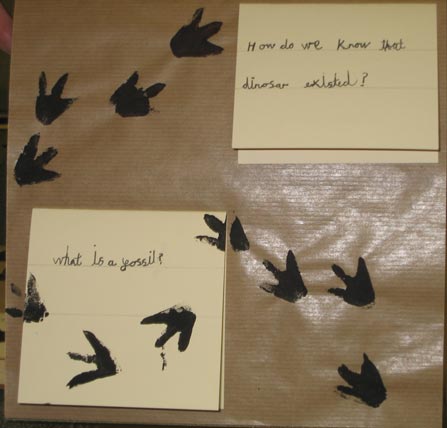
The pupils have had the chance to explore dinosaur footprints, we showed some bones and the children had guess which part of the dinosaur they were.  Jonny (aged 6) depicted a set of dinosaur tracks in his special dinosaur book.

Jonny Illustrates a Set of Dinosaur Footprints

Depicting a Dinosaur Trackway

Depicting a dinosaur trackway.

Picture credit: Jonny (aged 6)

The children had prepared lots of questions, including one about Giganotosaurus.  We did our best to answer them all and to explain about flying reptiles, dinosaurs and other prehistoric animals.  The team members at Everything Dinosaur were most impressed with the creative writing, the artwork and the knowledge demonstrated by the children.

To view the range of educational themed dinosaur toys and products available from Everything Dinosaur: Visit Everything Dinosaur.

1 02, 2013

Pupils Demonstrate their Dinosaur Knowledge

By |2023-02-12T08:55:22+00:00February 1st, 2013|Categories: Educational Activities, Everything Dinosaur News and Updates, Teaching|0 Comments

Young Palaeontologists at Primary School

It is always a pleasure to visit schools meeting eager young dinosaur fans and to spend some time helping out when the term topic is dinosaurs.  Yesterday, for example, one of our team members got the chance to visit a school where the children in years 3 and 4, under the enthusiastic tutelage of their teachers, were learning all about prehistoric animals.

Dinosaur Knowledge

A number of walls in the classrooms were already decorated with some superb examples of dinosaur inspired artwork, along with a series of maps which showed which types of dinosaurs lived on different continents.  A number of children had carried out independent research and written up their findings combining appropriate sentence construction with a surprisingly astute knowledge of palaeontology.

Clearly the teaching staff supported by the teaching assistants had developed a very creative scheme of work for the delivery of this topic, we were happy to play a small part in what will be an exciting and rewarding topic for the pupils at the school.

Brachiosaurus Poster

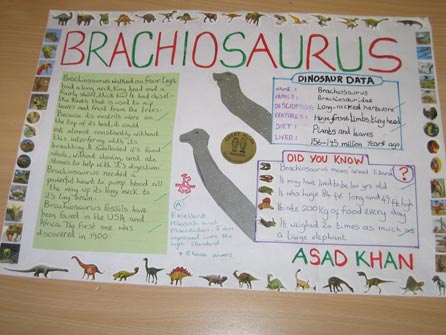
Amongst a number of splendid examples of individual work we noticed a poster created by Asad featuring one of his favourite dinosaurs – Brachiosaurus.  Not only was the poster very carefully designed and laid out, the information that it contained demonstrated that this young palaeontologist had researched his chosen dinosaur in remarkable detail.

Asad’s Excellent Poster on Brachiosaurus

An informative research poster on Brachiosaurus created by Asad.

An informative research poster on Brachiosaurus created by Asad.

Picture credit: Asad Khan

A very colourful poster it is too.  Not only did Asad use the name Brachiosaurus (genus name, often referred to as the generic name), he correctly identified that with the scientific classification of organisms, closely related genera (the plural of genus), are classified into families.    To have a child of around nine years of age using the term Brachiosauridae is very impressive indeed.  The teacher of the class awarded an “A” with five house points and Asad also received a “good work” sticker for his efforts.

Explaining the Poster

Asad demonstrated his dinosaur knowledge by very kindly talking through his poster with the Everything Dinosaur team member as some of the children prepared for lunch.  During our work with this particular class, we were able to update the school children on some of the latest research on members of the brachiosaur family, introducing the idea of the establishment of a new genus of brachiosaurid dinosaur – Giraffatitian (G. brancai) representing brachiosaur specimens excavated from Africa.

Lots of evidence of the year 3/4 pupils carrying out investigations, using drawings to communicate data,  assessing how animals in a habitat are suited to their environment, food chains, making comparisons, using data handling techniques – excellent academic work.

We managed to answer the questions that the children asked and no doubt both the pupils and the teaching team at the school will enjoy their “Working with Dinosaurs” for the rest of the term.

To view the range of dinosaur themed educational items available from Everything Dinosaur: Dinosaur Crafts, Toys and Games.

22 01, 2013

New Mini Dinosaurs Stegosaurus Dinosaur Book Reviewed

By |2024-04-29T06:01:01+01:00January 22nd, 2013|Categories: Book Reviews, Educational Activities, Product Reviews|0 Comments

A Review of the Mini Dinosaurs Stegosaurus Dinosaur Book

It is often quite a task to find a suitable dinosaur book for kids, when looking for something to help them with their reading.  Many parents try to encourage young children to develop a love of books by encouraging them to read books about subjects that they have a natural affinity for.  Many children under three years of age develop an interest in and a fascination for dinosaurs and other prehistoric animals, so finding a book about dinosaurs aimed especially at their age group can be a real boon for parents.

Dinosaur Book

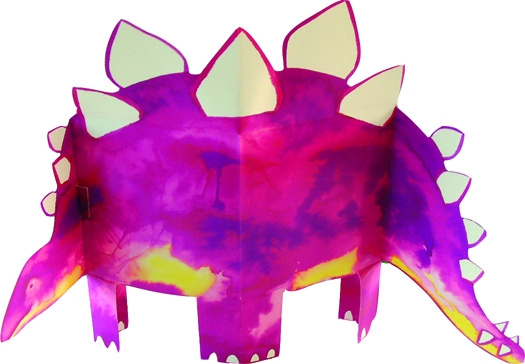
The Mini Dinosaurs Stegosaurus book is a delightful little hardback that ticks all the boxes as far as parents and very young dinosaur fans are concerned.  After all, a book that features a purple Stegosaurus is bound to be well received by very young palaeontologists.

The Mini Dinosaurs Stegosaurus Book

A book featuring a purple Stegosaurus.

Picture credit: Everything Dinosaur

This book is part of a set of dinosaur inspired books all aimed at children from approximately three years of age and upwards.   As the pages are turned a question about the dinosaur Stegosaurus is presented.  The text is printed in a very clear, large, black font so very young children can easily make out the words and work out what the sentence is.  Parents and grandparents can read through the book with their young charges, turning the pages to discover what questions are being posed about this particular armoured dinosaur from the Late Jurassic.  The answers can be found by lifting a flap, part of the animal’s body such as the plate covered back, the legs or the famous tail with its set of spikes on its end.

A Book for Very Young Dinosaur Fans

The adult can read through the book with the child, lifting the flap to reveal the answer to the question posed on that page about Stegosaurus.  For instance, one of the questions presented is why did Stegosaurus have big feet?  By lifting up the front leg of the picture of the Stegosaurus on that page, the answer is revealed.  There is even a little more information to be found on the inside face of each answer flap, this helps the grown-up to explain the answer to the child and provides some facts about Stegosaurus to support the information given.

The bright purple, friendly Stegosaurus certainly appeals to very young children, and the tough hardback cover means that the book can be wiped clean should any sticky hands touch it.  The spine of the book is quite thick and this makes it easy to grip, especially helpful when young children try to use the book on their own.  Best of all, in the final section of this book there is a large, purple Stegosaurus cut-out for the children to unfold.  By pulling the middle portion of the Stegosaurus drawing towards them and unfurling the tail a large stand-up drawing of a Stegosaurus is revealed.

Lift and Fold to Reveal the Cut-Out Stegosaurus

The fold out Stegosaurus model featured in the book.

Picture credit: Everything Dinosaur

The book has been carefully thought about by the design team and the publishers and it makes an ideal “my first dinosaur book” for a budding dinosaur enthusiast.  The simple layout and easy to read text will encourage children with their reading and word recognition and the fun questions and answers are based on what scientists think they know about this long extinct member of the Dinosauria.  Recommended for children from three years plus, a very suitable dinosaur book for kids.

To view Everything Dinosaur’s range of dinosaur themed toys and gifts: Dinosaur Themed Gifts and Toys.

21 01, 2013

Gigantopithecus the Inspiration behind the Famous King Kong

By |2024-04-29T06:01:27+01:00January 21st, 2013|Categories: Dinosaur Fans, Educational Activities|0 Comments

The Science Behind King Kong

The giant ape of the cinema screen known as King Kong, an ape that ruled Skull Island and then went onto to terrorise New York before meeting its end at the top of Empire State building, may be one of the most famous movie monsters of all time.  However, the science surrounding giant apes is just as fascinating as anything penned by a Hollywood script writer.

Rebor Gorilla Models in Three Colour Variants

Rebor Alpha Male Gorilla models.

The three Rebor Alpha Mail Gorilla Z replicas Primal (left), Patriarch (centre) and Albino (right). Picture credit: Everything Dinosaur.

Picture credit: Everything Dinosaur

To view the Rebor range of models and figures: Rebor Prehistoric Animal Models and Figures.

King Kong

The first King Kong film was released in 1933, the stop-motion prehistoric animals that shared Skull Island with Kong, the giant ape, amazed cinema goers.  The film, a parody of the fairy tale “beauty and the beast” was remade in 1976 and more recently Peter Jackson directed the CGI version which was released in 2005.  Depending on which film you watch and which parts of which film you watch (as the 1933 King Kong was approximately 25 feet tall for the jungle scenes and then it grew to nearly 5o feet high for the scenes on the Empire State building), King Kong’s actual size is difficult to ascertain.  Although it is almost certain that no gigantic hominid or simian creatures remotely near to King Kong’s size ever existed.

The fossil record for primates and early human ancestors is very incomplete although there is no evidence to suggest that giant gorillas roamed the planet in pre-history.

However, sometimes real life can reflect a fictional story depicted in a film.  Just two years after the 1933 movie was released a German palaeoanthropologist called Ralph von Koenigswald purchased a very large molar (back tooth) from a Hong Kong pharmacy, whilst on a visit to China and the Far East.   Fossils of all sorts were used in Chinese medicine, often described as “dragons teeth” or “dragons bone”.  Koenigswald new differently and he correctly identified that the tooth belonged to a new, very large primate species.  He went onto name the animal Gigantopithecus blacki.

An Illustration of G. blacki

A scale drawing of the giant ape.

Picture credit: Everything Dinosaur

Gigantopithecus blacki

Fossils of Gigantopithecus blacki (the name means gigantic ape), have been found in China and Vietnam.  It lived during the Pliocene and Pleistocene epochs and males may have reached heights in excess of 3.2 metres tall (more than 10 feet high).  A fully grown male might have weighed as much as five hundred kilogrammes, females were much smaller.  This giant ape, the largest known in the fossil record to date, was a peaceful herbivore having a very similar diet to the extant gorillas of Africa today.  The genus Gigantopithecus is known from a number of fossilised teeth and jawbones, very little of the post cranial skeleton material has been found.

It is likely that this large ape was encountered by hominids, early humans such as Homo erectus.  Although best avoided, scientists have no evidence to suggest how aggressive or passive these animals were, but if extant great apes such as gorillas and orangutans provide a template, it is likely that this ape was secretive and was not very aggressive.  Palaeoanthropologists believe that G. blacki was more closely related to Orangutans than to gorillas (a member of the sub-family for primates called the Ponginae).

20 01, 2013

Imaginative and Helpful Dinosaur Themed Teaching Activities

By |2024-04-29T06:01:55+01:00January 20th, 2013|Categories: Educational Activities, Teaching|1 Comment

Primary School Children Have Fun with Dinosaur Eggs

With the advent of a more creative curriculum in the United Kingdom, teachers and teaching assistants have more freedom in how they deliver lessons which dovetail into the teaching objectives and expected outcomes as provided in the framework of the national curriculum.  For children aged between five and seven years of age (primary school children in years 1 and 2), a suitable topic for the spring term might be “Dinosaurs”.  With the spring term ending at Easter, the addition of an imaginative series of lesson activities designed around looking at dinosaur eggs would help to tie in the term topic with the holiday period that comes immediately at the end of this term.

Dinosaur Nest

A dinosaur egg can be made very simply using a balloon and paper mache to create the desired effect.  A single, large egg can be created by the teacher and the teaching assistants or if school resources allow, the children themselves can have a go at making and painting their own paper mache dinosaur eggs.  Often the eggs that are made and represent a dinosaur egg are quite large, many people think that the dinosaurs hatched from huge eggs, this is not the case.

Although a number of dinosaur genera are known to have laid large eggs, most dinosaurs laid very much smaller eggs than most people imagine.  Egg size in egg-laying, terrestrial vertebrates is limited by a number of factors.  For example, the egg has to be strong enough to hold the volume of liquid that each one contains, but the egg shell cannot be too thick otherwise the baby inside would not be strong enough to break out of the egg (to hatch).

The largest dinosaur eggs known to science have been ascribed to a genus of titanosaurs (long-necked dinosaurs), which may have measured more than fifteen metres in length.  Even so the eggs of these prehistoric animals are about the same size as a football.

To read an article about the size of dinosaur eggs: The Big Eggs of a Dinosaur – Hypselosaurus.

When the egg has been made and painted, simply create a little nest for it, using leaves, twigs and such like.  If the class has a pet hamster or guinea pig, using some hay or straw that is normally reserved for this class pet also works well.   Then over the course of the spring team the children can observe their egg and record any differences in how it looks.  For example, once the egg has been put in the nest, take a picture of it and post it up on the class notice board.  Then after a week or so, turn the egg round in the nest and get the children to compare what they see with the earlier photograph.

A teacher can use this simple exercise to get children to think about what differences can they see and why might the differences have occurred?  What does it mean when the egg has moved, what may be going on inside the egg?

Over the next two weeks, the egg can be given a crack and the children made ready for the “hatching of their own dinosaur), again the change in the state of the egg can be used to encourage the children with a creative writing exercise as they compose short letters to their “baby dinosaur”.

A Typical Dinosaur Nest (Fossils)

Theropod nest model.

A replica of a typical theropod nest showing typical nest composition and layout.

Finally, the school day dawns (towards the end of the term topic) when the baby dinosaur hatches.  However, rather than have to go to the trouble of creating a baby dinosaur for the class, here is a simple tip for any teacher or teaching assistant, allow your dinosaur to escape.  To show the escape, simply break the egg open using a sharp pair of scissors before the children come in and ask the caretaker to move one of the ceiling tiles on the suspended ceiling (a feature of most classrooms).

The children can learn of their dinosaur’s escape into the roof space and the moved tile in the ceiling would be proof to them of the escape of their pet dinosaur.  The teacher can easily leave a trail of three-toed (tridactyl) dinosaur prints from the nest area to the floor immediately below the ceiling tile, creating a trail for the young pupils to follow.

Then it is simply a question of developing plenty of extension activities around the school’s pet dinosaur project.  For example, the children can be encouraged to draw what they think the dinosaur may have looked like, what name should it have been called and why?  In addition, the children can be asked to think up stories that they might want to read to the dinosaur, or to imagine the adventures that their escaped dinosaur might be having.

Such imaginative and creative ideas can help teachers and teaching assistants to develop interesting lesson plans that challenge pupils to observe, explore and ask questions about living things.   Reference materials can be used to find out what palaeontologists know about the fossilised eggs of dinosaurs.   As well as covering aspects of the science element of the national curriculum, cross curricula activities such as creative writing and grammar usage which relates to the objectives of the English element of teaching can be incorporated.

To learn more about Everything Dinosaur’s range of educational, dinosaur themed toys and games: Replica Fossils, Dinosaur Toys and Gifts.
Having your own dinosaur egg and watching the egg change and eventually hatch provides an excellent basis for the development of many enriching and challenging lesson ideas with key stage one children.

Go to Top