All about dinosaurs, fossils and prehistoric animals by Everything Dinosaur team members.

Everything Dinosaur’s work with schools and other educational bodies. Articles, features and stories about dinosaurs and their role in education and educating young people.

16 01, 2013

Wondeful Willow Green Academy – Waiting for their Unique Dinosaur Egg to Hatch

By |2024-04-29T06:04:49+01:00January 16th, 2013|Categories: Educational Activities|0 Comments

School Pupils Waiting for Dinosaur to Hatch

Pupils at Willow Green Academy are getting “egg-cited” over the prospect of having their very own dinosaur egg hatch,all part of the term topic of dinosaurs which is currently being run with some classes for the next few weeks.

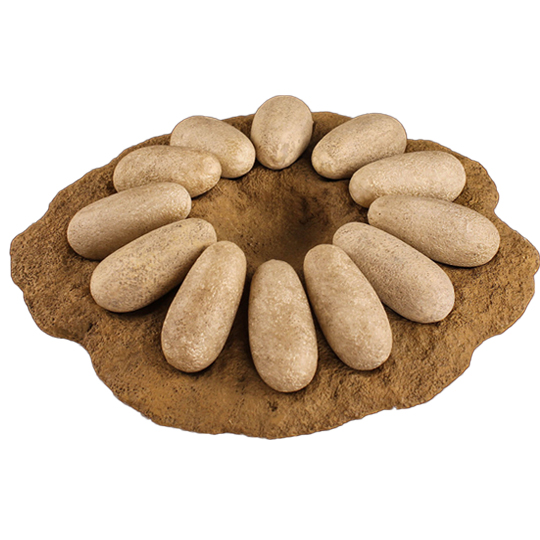
Dinosaur Egg

Rainbow fish class, the children who make up year 1, have been studying dinosaurs and other prehistoric animals and learning all about them with their teacher Miss Walker.  A team member from Everything Dinosaur visited the budding young palaeontologists yesterday as part of the school’s scheme of work for this term.  Lots of fossil handling and dinosaur exercises ensued and as a special treat some of the children took their visitor to show off the school’s very own dinosaur nest with a single, large, pink dinosaur egg, sitting snugly on a bed of hay.

There had been much excitement earlier in the week when the pupils discovered that the egg had cracked, so the dinosaur inside might be getting ready to hatch.

Willow Green Academy’s Dinosaur Egg

Some “egg-citing” times ahead for Rainbow Fish class.

Picture credit: Everything Dinosaur

The Dinosaur Nest

The picture shows the large dinosaur egg, sitting securely in one of the school’s raised beds.  It was decided not to get too close to the egg and to take a photograph of the nest through the window.  After all, as one of the year 1 pupils pointed out, it was not a good idea to get too near just in case the nest was disturbed.

Imaginative lesson activities such as this can help to motivate and enthuse young children and tap into all sorts of areas related to key objectives of the national curriculum.  For example, Miss Walker supported by the class’s teaching assistant Mrs Greenwood can encourage the children’s creative writing by getting them to compose letters to the baby dinosaur.  The young pupils can design their own dinosaurs and have a go at coming up with their very own scientific names for their creations.  Such activities will encourage the children to make observations, consider simple associations and patterns as well as to develop all important literacy skills.

Having been given one or two pointers about how dinosaurs moved by the visiting Everything Dinosaur expert, the Willow Green pupils could participate in a number drama based activities as they imagine what it would be like to be a dinosaur.

At Everything Dinosaur, we have conducted a number of similar schemes of work with primary school children.  Lots of extension topic related activities can been devised, team members have been discussing the time when their baby dinosaur “hatched” promptly escaped and then sent the class various emails and pictures telling the children all about where in the world the dinosaur had travelled to.  Using a world map, some pictures of famous land marks such as the leaning tower of Piza, the Pyramids of Giza and Victoria Falls all downloaded from the Internet, the dinosaur’s travels  were plotted and this helped the pupils learn about famous landmarks and places in different countries.

Dinosauria Laid Eggs

As far as we know all members of the Dinosauria laid eggs but different types of dinosaur adopted different strategies when it came to looking after the nest and the newly hatched babies.  For example, at one extreme some dinosaurs may have produced precocial offspring.  Precocial offspring are born or hatched as relatively well-developed creatures that are able to move around very soon after birth and show a high degree of independence.  Animals alive today that show this precocial behaviour include many birds such as ducks and geese plus mammals such as a number of hoofed animals. A young wildebeest for instance, can stand up and indeed run within a few minutes of being born.  Many palaeontologists believe that the large, sauropods (long-necked dinosaurs such as Diplodocus), may have adopted this strategy, essentially abandoning the nest of eggs once they had been laid.

Maiasaura

However, other dinosaurs such as the ornithopod known as Maiasaura, whose fossils have been found in Cretaceous-aged strata from Montana (United States), seem likely to have looked after their young.  These dinosaurs nested in large colonies, just like many birds do today.  Studies of fossilised, young Maiasaura hind limbs indicate that the leg bones were not fully formed (ossified) when these dinosaurs hatched.  These hatchlings were not able to leave the nest. Youngsters were not able to walk and so depended on the adults to bring them food.  This research, coupled with the large amount of crushed eggshell associated with the site in Montana, indicates that the young Maiasaura stayed in the nest for some time – looked after by parents.  This is an example of altricial behaviour, where adults dedicate a great deal of time and effort to looking after babies and juveniles.  Animals alive today that demonstrate this behaviour include cats, dogs, our own species, marsupials and most garden birds.

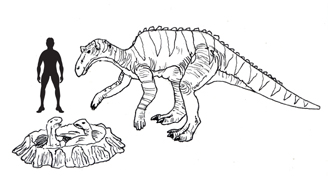
An Illustration of Maiasaura next to her Nest

The person in the picture provides a scale so the size of this dinosaur can be estimated.

Picture credit: Everything Dinosaur

The name Maisaura means “Good Mother Lizard”.  It is very likely that members of the Dinosauria exhibited altricial and precocial behaviour, with a number of genera showing intermediate behaviours between these two extremes.

For dinosaur models and figures, take a look at the Wild Safar Prehistoric World section of the Everything Dinosaur website: Wild Safari Prehistoric World Models.

11 01, 2013

Working with Early Years Foundation Stage Children (Fascination with Dinosaurs)

By |2023-02-11T21:56:26+00:00January 11th, 2013|Categories: Educational Activities, Teaching|0 Comments

A Creative Approach to Literacy and Numeracy Using Dinosaurs

Teachers can often find it quite challenging to settle children down in a reception class after spending time in nursery and yet it is important to help children make the transition towards more cognitive and structured learning.  Children move into reception from nursery schooling from around the age of four and nursery schools within the country operate a curriculum based around what is termed the Early Years Foundation Stage (EYFS).  This statutory framework sets out the standards that young children are to reach and provides the guidelines to help teaching professionals ensure that children learn and develop in healthy, stimulating and safe environments.

Dinosaurs

At the heart of the Early Years Foundation Stage is the need to develop the broad range of personal and group skills a  young child will need as they grow up and enter more formal education.  This framework helps to provide an appropriate foundation for the child’s academic career.  It has been subject to a number of revisions, the three key areas of a child’s communication and language development in conjunction with their physical well-being and their personal, social and emotional development have become even more central to the core aims of this Government initiative and this, surprisingly is where dinosaurs can help.

Children from around 36 months can begin to gain an appreciation of dinosaurs and prehistoric animals.  It is surprising what they can pick up from the many television documentaries, films and books dedicated to dinosaurs that these children are exposed to.  Many young children can obsess on dinosaurs and it is surprising how quickly they can learn the long, often complicated names of dinosaurs such as Tyrannnosaurus rex and Triceratops.

An Affinity for All Things Dinosauria

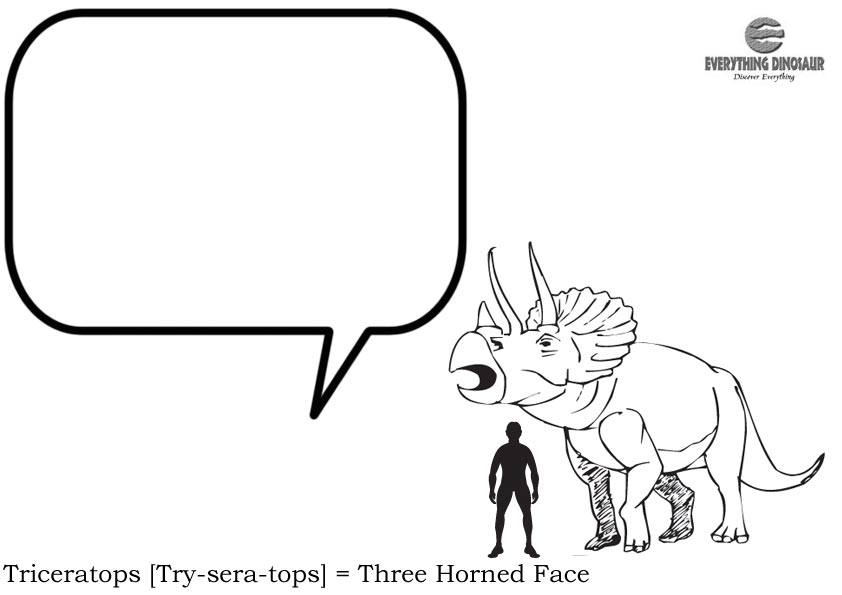
If children have a natural affinity for all things Dinosauria, then this fascination can be used to help them develop improved literacy and numeracy skills.  For example, when helping children to form sentences and the meaning of words,  a picture of a dinosaur with a speech bubble can help the child to consider what the dinosaur might be thinking or even saying.  The child can be encouraged to explore feelings and emotions using the dinosaur as an exemplar.

Using a Dinosaur to Help a Child Explore Emotions

Exploring emotions and helping to construct sentences.

Illustration credit: Everything Dinosaur

The same dinosaur picture can help a nursery school child with their numeracy skills.  Counting games can be devised such as counting the number of legs the dinosaur might have or the horns on its head for instance.  Dinosaur models make great counters for use in many numeracy based exercises, they are tactile and easy to handle and the games can be developed with the children encouraged to sort their dinosaurs into different groups based on simple criteria such as sorting by size, by colour and by which ones might be meat-eaters and which ones the herbivores.

An early fascination with dinosaurs and prehistoric animals can help a creative teacher to devise imaginative learning games thus helping their young charges to learn whilst having fun in a supportive environment.

Take a look at the educational, dinosaur themed items available from Everything Dinosaur: Models of Fossils and Dinosaur Themed Toys and Games.

5 01, 2013

New Mini Dinosaurs Apatosaurus Dinosaur Book Reviewed

By |2024-04-29T06:06:22+01:00January 5th, 2013|Categories: Book Reviews, Educational Activities, Everything Dinosaur Products, Product Reviews, Teaching|0 Comments

Lift the Book Flap and Find an Apatosaurus 

Finding a book that is tactile, just the right size for small hands to hold and helps young children with their reading can be a challenge, but the Mini Dinosaurs – Apatosaurus book fits the bill nicely.  In addition, there is a surprising amount of factual information about the dinosaur known as Apatosaurus within this little hardback book.

Dinosaur Book

Assisting children with their reading skills is an important task.  It can help young children prepare for more formal schooling when they enter the education system and even very young children can soon learn to recognise the letters of the alphabet and the sounds that these letters form, all part of helping to teach reading using phonetics and other cognitive processes.  Starting them off early can help a child to develop a lifelong appreciation of books and the enjoyment of reading.

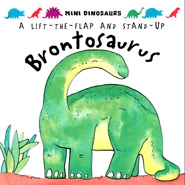
The Mini Dinosaurs Apatosaurus Dinosaur Book

Mini Dinosaurs Apatosaurus explains about the Dinosaur name change.

Picture credit: Everything Dinosaur

Choosing appropriate reading matter is important.  A book about a dinosaur, one that is designed with young readers in mind, is especially helpful, many children at around three years of age are beginning to show an interest in dinosaurs and other prehistoric creatures.  Reading about dinosaurs will help to engage the child and will help them to develop through their own imaginative, creative play.

Mini Dinosaurs Apatosaurus Book

The Mini Dinosaurs Apatosaurus book is a tough, hardback so it is ideal for use with young children from three years of age.  Both the front and back covers are laminated and can be wiped clean with a damp cloth, very helpful of the book designers to do this as this avoids damage to the book by sticky fingers.  On the front of the book is a bright green Apatosaurus and the book cover explains that this dinosaur was formerly called Brontosaurus.

Why a change in a dinosaur’s name?  The explanation is simple, a dinosaur was named from some fossil bones found in the state of Colorado in the late 1870s.  This dinosaur was called Apatosaurus (the name means “deceptive lizard”).  Brontosaurus was named from fossils found in the same part of the United States a couple of years later.  However, a subsequent re-examination of the fossils led scientists to conclude that their discoveries did not represent two different genera, but just one.  Since Apatosaurus was named first, under the laws laid down for the scientific naming of organisms the Apatosaurus name took precedence.  The book therefore tells a story about Apatosaurus, the dinosaur that was formerly known as Brontosaurus.

The book contains simple sentences laid out in a large, easy to follow font.  All the text is in black and bold to help young children follow the letters more easily.  This miniature dinosaur books poses questions for the child and the adult reader to explore, for instance, Why did Apatosaurus have a long neck?  Why did Apatosaurus have such thick legs?  If you lift up the clever flap on the picture of this dinosaur coinciding with the question page, the answer is revealed.  The answers are given in bold, easy to read text so that the child may read the answers.  For the grown-up, on the flap itself there is some helpful extra dinosaur information provided so that the adult can more fully explain the answer given.

To view Everything Dinosaur’s range of dinosaur themed learning materials: Dinosaur Crafts and Educational Toys.

By unfolding the card inserts to be found at the back of this little book, a picture of large, green, friendly-looking Apatosaurus can be created.  This is a cleverly designed little book about dinosaurs that will help young children with their reading skills as well as delighting them with the dinosaur information that it contains.  An excellent first dinosaur book for a very young, budding palaeontologist.

Please Note

Brontosaurus is now accepted as a valid genus following a taxonomic revision of the diplodocids.

11 12, 2012

New Census shows Mixed Results for Science and Maths in English Schools

By |2024-04-24T18:22:08+01:00December 11th, 2012|Categories: Educational Activities, Teaching|0 Comments

U.S. Research Suggest English School Children doing Better in Maths but Slipping When it Comes to Science

Everything Dinosaur reports on falling standards in schools in science knowledge and understanding.

In today’s busy world where UK-based businesses are having to compete in a truly global market place, governments and educational institutions are eager to see how their country’s pupils fare when compared to students from other nations.  There are a number of studies undertaken, most are published either annually or every two years.  In research published by U.S. based academics, pupils from England are showing signs of improving in mathematics, but their national ranking in the sciences is falling.

Everything Dinosaur

The research, compiled by academics at Boston College in the United States covers the results from two influential studies, the four-yearly trends in International Mathematics and Science Study, known by the acronym TIMSS and the Progress in International Reading Literacy Study (PIRLS).  The American research team have compared the results in key subjects from pupils in over sixty countries.  Northern Ireland is doing particularly well when the attainments of primary school children are examined, whilst England is still in the top ten countries for primary and secondary mathematics.

The highest rankings in this global education league table have been taken by Asian countries and reflect the growing emphasis on the education of children in rapidly growing economies.  The UK Census from 2011, may show that more citizens of the United Kingdom have a degree than ever before but when the efforts of younger pupils are analysed it is the students from Singapore, Hong Kong and South Korea that take the honours when it comes to doing best at maths.

In the Global Top Ten for Mathematics

England remains in the global top ten for mathematics, 9th for primary school aged pupils and 10th when it comes to secondary aged students.  The study highlights England as being one of the most improved countries in terms of mathematics over the last fifteen years or so, however, the outlook for the sciences is nowhere near as rosy.

English school pupils fall from 7th place (ranking in 2007) to 15th amongst primary aged school pupils (ten-year-olds) for science.  In secondary aged pupils this trend was also seen, with fourteen-year-olds falling from 5th down to 9th over the same five year period.

The Top Ranked Countries for Attainment in Primary School Science

  1. South Korea
  2. Singapore
  3. Finland
  4. Japan
  5. Russian Federation
  6. Taiwan
  7. United States of America
  8. Czech Republic
  9. Hong Kong
  10. Hungary

15.  England (down from 7th place)

Report author and Boston College professor, Michael Martin commented that the best-performing countries in these league tables are a reflection of the long-term investments in education made by governments.

Professor Martin stated:

“One thing you can learn from these is what’s possible.  That comes as a shock sometimes, what students in other countries can actually do and the gap sometimes between what your students are achieving and what students in other countries are achieving”.

England ranks relatively highly, despite slipping in science, it is pleasing to see the ranking in mathematics is still holding up when one considers the rapid globalisation and development in other countries, particularly those in the Far East.

A spokesperson from Everything Dinosaur, one of the teachers in the company who helps write lesson plans for primary school education providers stated:

“It is important to praise the efforts of the teachers, the teaching assistants and administrators who work extremely hard to deliver excellent teaching schemes helping to inspire and motivate the next generation of scientists.”

Foundation Stage Dinosaur Display

The Foundation Stage “wonder wall” full of dinosaur facts and information (Carlton Primary School).  Praising the efforts of teaching staff for their creative approach to subjects.

Picture credit: Everything Dinosaur

A good grounding in maths and science subjects is very important for school pupils, especially when one considers the future jobs market.  Helping young children learn about science principles such as observation, investigation and evaluation through their fascination with dinosaurs is a key aim of Everything Dinosaur’s teaching staff.

Today, Everything Dinosaur team members provided information on swimming dinosaurs, fact sheets, discussed plesiosaurs, the evolution of the Dinosauria – just some of the range of subjects covered when contacted by school teachers, museum staff etc.   All in a days work!

For educational prehistoric animal themed gifts and museum quality dinosaur models visit Everything Dinosaur’s award-winning website: Everything Dinosaur – Dinosaur Themed Gifts.

7 12, 2012

What are Coelacanths? That is a Great Question

By |2024-04-24T19:20:35+01:00December 7th, 2012|Categories: Educational Activities, Everything Dinosaur News and Updates|0 Comments

Fishy poser sent to Everything Dinosaur

At Everything Dinosaur we get sent lots of pictures and drawings from young dinosaur fans.  In addition, we get emails asking us various questions about dinosaurs and other prehistoric animals.  We do our best to try to answer each one that we receive.

The other day we got a question about Coelacanths, the emailer wanted to know when these strange fish first evolved and what the word “Coelacanth” means.

What are Coelacanths?

Coelacanths are members of an ancient class of fish called the Sarcopterygians (lobe-finned fishes).  These fish have muscles and large bones at the base of their fins and it was once thought that Coelacanths used their fleshy fins to “walk” on the seabed, providing scientists with a link to those vertebrates that were the first back-boned animals to walk on land.  This theory, once very popular amongst palaeontologists has now been largely disregarded and Coelacanths are not thought to be closely related to the terrestrial vertebrates.  The first fossils of Coelacanths can be found in Mid-Devonian aged rocks, indicating that this particular type of fish evolved around 380 million years ago.

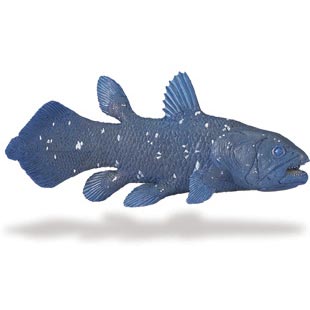
A Model of a Coelacanth (Safari Ltd)

Coelacanths – often described as “living fossils”.

Picture credit: Everything Dinosaur/Safari Ltd

Coelacanths were thought to have become extinct approximately 66 million years ago, however, in 1938, a trawler fishing off the Chalumna river estuary (South Africa) caught a strange looking fish and once this fish had been returned to port, Marjorie Coutney-Latimer, the curator of the nearby East London museum was notified and it was from her sketches and information that led to this specimen being identified as a Coelacanth.  It was not until 1952 that a second Coelacanth specimen was caught.  In 1997, a second species of Coelacanth was identified.  This Pacific species was discovered living in deep water off the islands of Indonesia.

The word Coelacanth means “hollow spines” a reference to the spines that support this primitive bony fish’s fleshy fins.  Extant specimens closely resemble a genus of prehistoric Coelacanth called Macropoma which became extinct at the end of the Cretaceous period, at around the same time the dinosaurs died out.  This extinction took place approximately sixty-six million years ago.

The largest specimens of Coelacanths living today can reach lengths in excess of five feet and these deep bodied fish with their large scales can weigh more than eighty kilogrammes, about as much as a man.  It is thought that these sluggish creatures feed mostly at night, sucking into their large mouths crabs, lobsters, shrimps, jellyfish and small fish.

To view a model of a Coelacanth and other amazing prehistoric creatures: Wild Safari Dinos – Prehistoric Animal Models.

18 11, 2012

Helping Out at the Recent Mary Anning Celebration Weekend

By |2023-02-07T09:03:35+00:00November 18th, 2012|Categories: Dinosaur Fans, Educational Activities, Everything Dinosaur News and Updates|0 Comments

Brandon Gets Busy with His Ammonites

Fossil experts and enthusiasts got together over the last weekend of September  to celebrate the contribution to palaeontology and the Earth sciences in general of Mary Anning.  Our chum Brandon Lennon was busy showcasing his fossil preparation skills at the Lyme Regis Museum over the weekend.

Many Anning

Young fossil hunters got the chance to prepare and polish their very own ammonite fossil under the supervision and guidance of Brandon, he kindly sent us in a press cutting from a local paper that reported on the weekend’s events.   Titled “Fossil Fish and Sharks”, the weekend’s festivities celebrated the role of Mary Anning with a series of family orientated activities, fossil displays, talks and lectures.

There were a number of rare fossil fish that had been discovered in and around the Lyme Regis area on display at the Lyme Regis Museum, which sits on the site of Mary Anning’s former home.

Brandon has found numerous vertebrate fossil remains including fish whilst on his regular fossil finding walks out onto the beaches that surround the picturesque Cob at Lyme Regis.

To learn more about Brandon’s fossil hunting walks: Brandon Lennon’s Guided Fossil Walks.

 Brandon Helping with the Ammonite Polishing

Helping young palaeontologists – ammonite polishing at the museum.

Picture credit: Local newspaper/Brandon Lennon

Brandon Makes the Headlines

We love the way Brandon has inserted his name in biro into the newspaper’s headline…cheeky.

Commenting on the work of the staff involved, a spokesperson from Everything Dinosaur stated:

It is important to remember the contribution made to palaeontology by people such as Mary Anning and her friend Elizabeth Philpot.  Hopefully, events such as this one will do a lot to encourage and motivate the next generation of scientists.”

The town of Lyme Regis also holds a fossil festival, one of the biggest events along the “Jurassic coast” of southern England, sources in the town have reported to Everything Dinosaur that the next festival is likely to take place in late May 2014.  With Brandon and his friends likely to play a big role, it is worth putting a note in your diary.

For replicas and models of iconic prehistoric animals associated with Lyme Regis such as ammonites, belemnites and ichthyosaur replicas: Models of Early Jurassic Animals and Dinosaurs (CollectA).

9 11, 2012

Teaching Science in Schools – Some Helpful Advice

By |2024-04-24T17:38:41+01:00November 9th, 2012|Categories: Educational Activities, Photos/Schools, Press Releases|0 Comments

Year 4 Meet up with Everything Dinosaur (Year 8 Helped)

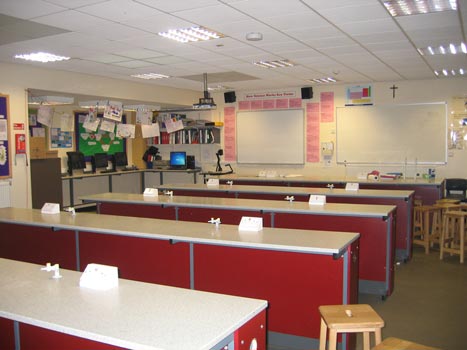
An interesting assignment this morning for Everything Dinosaur, working with a number of gifted and talented pupils from feeder Primary schools at Painsley Catholic College (Staffordshire).  Rated by OFSTED as “outstanding”, Painsley Catholic College is one of approximately 360 schools in the country that have the designation of being a specialist science school.  The facilities at the College are excellent.  The well appointed science department is staffed by an enthusiastic and knowledgeable team of teaching staff, laboratory technicians and administrators.  It has seven well resourced laboratories, including three ICT rooms designed to fit the needs of key stage three and four pupils.  The College also has five teaching laboratories designed to meet the requirements of teaching students aged sixteen plus.

One of the Science Labs at Painsley Catholic College where Everything Dinosaur was Teaching

Well resourced teaching facilities.

Picture credit: Everything Dinosaur

Superb School Facilities

The aim of the science department at the College is to make learning about how things work interesting and exciting and to make all students enthusiastic about learning scientific ideas, encouraging the scientists of the future.  The College wants to develop all students’ scientific skills and in an ever developing scientific world, ensure that all our students can embrace new ideas and understanding of the world around them.

Everything Dinosaur

We at Everything Dinosaur share this philosophy and this morning we worked with Year four pupils (aged 8-9) who had come in to the College to learn a little about Earth sciences with one of our teacher/dinosaur experts.  Students from Painsley Catholic College, year eight (aged 12-13), had been invited to help with the assignments – studying a dinosaur trackway and exploring some ideas about Triceratops horridus and Tyrannosaurus rex.

Mrs Rolfe, one of the science teachers at the College, took plenty of photographs and we look forward to seeing some of these pictures showing the young scientists hard at work studying fossils and using observation, investigation and evaluation to study scientific principles.

For educational and dinosaur themed games, models and toys: Educational Dinosaur Themed Toys, Models and Games.

6 11, 2012

Classroom Prepared in Readiness for Dinosaur Teaching Topic

By |2023-02-06T15:10:32+00:00November 6th, 2012|Categories: Educational Activities|0 Comments

Dinosaurs Greet Year 3 As They Return from Half-Term

Year 3 children at Foxhill Primary school (South Yorkshire) got a pleasant surprise when they returned to school after their half-term break this morning.  Teachers, Miss Faulkner and Miss Hartley had been busy preparing the classrooms in readiness for teaching about dinosaurs, which is Year 3’s topic for the rest of the winter term.

Teaching About Dinosaurs

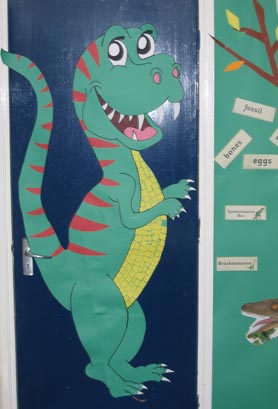
Lots of dinosaur pictures and information adorned the walls of the classrooms, along with questions about dinosaurs that the children had compiled as part of their preparation for this topic.  The segregated part of the classroom that had been designated as a quiet reading area had some wonderful cut-out dinosaurs and other prehistoric animals on the wall. Even the sign stating “Reading Area” had been created using dinosaur pictures – very imaginative.  Guarding the reading room was a big illustration of a meat-eating dinosaur, not a T. rex (three-clawed fingers) perhaps some sort of Allosaurus?

Fearsome Dinosaur Pictured on the Classroom Door

Having a “roaring” time in the reading area.

Picture credit: Foxhill Primary/Everything Dinosaur

A Clever Dinosaur Illustration

We love the way the tail has been shaped round the door handle.  Miss Faulkner made the yellow tummy by carefully placing sticky, yellow squares onto the dinosaur’s underside.  The children enjoyed spotting the changes that had taken place in their classroom over the half-term holiday period.  The teachers aided by teaching assistant Mrs Wainwright and Everything Dinosaur began the topic with a morning of dinosaur themed activities.  As Miss Faulkner had chosen “Collaboration” as one of the key objectives for her class this term, the children collaborated on making a cast of a dinosaur tooth, before going on to look the fossilised teeth of prehistoric animals.

In a second session with Miss Hartley’s class, the budding young palaeontologists explored the differences between carnivores and herbivores and Miss Hartley got the chance to handle and describe some fossils.  There was even some time to look at the questions the children had come up with as they thought about how the dinosaurs died out, where can fossils be found and which animals alive today most resemble dinosaurs?

A Dinosaur Timeline

We have sent over a template for creating a scale model of a dinosaur timeline, so that the children can learn about some of the geological periods and plot on the timeline when dinosaurs and other prehistoric animals lived.  Sounds like Year 3 are going to getting involved with plenty of extension activities as they explore this particular topic.

To view the range of educational dinosaur and prehistoric animal themed toys and gifts available from Everything Dinosaur: Everything Dinosaur’s Website.

2 11, 2012

Helping out with a School – Answering Questions from Pupils

By |2023-02-06T14:30:13+00:00November 2nd, 2012|Categories: Educational Activities, Everything Dinosaur News and Updates|0 Comments

Lots of Questions from Young Palaeontologists

Following a recent visit to Bestwood Village Hawthorne Primary school to work with the young dinosaur experts in the reception/foundation stage classes, Everything Dinosaur team members promised that if we could not answer all the questions posed on the day, we would respond to any that the teacher emailed over to us.

Answering Questions from Pupils

Sure enough, one of the Foundation stage teachers emailed over a list of questions that the children had compiled.  They all enjoyed their dinosaur workshop with Everything Dinosaur.  For a special treat Pam, the head dinner lady, the teachers and the teaching assistants organised a dinosaur backpackers picnic for the young palaeontologists on the afternoon of our visit.

The questions we were sent included:

  • Why do some dinosaurs have short arms?
  • How do they make their tails move?
  • What is our favourite dinosaur and why?
  • How many different types of dinosaur are there?
  • Which is the smallest dinosaur?
  • Which is the biggest dinosaur?
  • Did they go to sleep?

Everything Dinosaur

What fascinating questions.  True to our word, one of our dinosaur experts set about writing answers to all the questions received, fact sheets, and drawings were included to help explain our answers.   We even suggested extension activities that the teaching staff might want to consider so that the children themselves could explore the answers to the questions themselves – all aimed at learning and developing cognitive skills of course.

Bestwood Village Hawthorne Primary is a super school staffed by enthusiastic and capable staff all doing their bit to help encourage the next generation of scientists.

To see the extensive range of dinosaur themed educational toys, games and gifts available from Everything Dinosaur’s award-winning website: Visit Everything Dinosaur’s Website.

31 10, 2012

Great Dinosaur Themed Party Food – Ideal for Halloween

By |2024-04-24T17:08:45+01:00October 31st, 2012|Categories: Educational Activities, Everything Dinosaur videos|0 Comments

Prehistoric Insects in Amber Jelly – Simple Dinosaur Themed Treat

Another month is nearly at an end, it might be difficult to get over the concept of “Deep Time” when explaining aspects of the Earth Sciences but for us at the moment it is a question of wondering where 2012 has gone – time is whizzing by as we head towards Christmas.  Tonight being “All Hallows Eve” we thought we would get into the “spirit” of the occasion by putting up a short (4 mins 22 seconds) video that we made the other day explaining how to create prehistoric insects in amber – an ideal treat for Halloween fans or for budding palaeontologists.

In this video we explain how to make your very own preserved remains of insects in amber jelly squares.   It is easy to do, fun to make and with the jelly setting time taken into consideration this recipe takes about six hours (ten minutes to make up the jelly and so on but with about six hours required for the jelly pieces to set in the fridge).

We get asked a lot about dinosaur party food, this recipe is an ideal dessert for a dinosaur themed birthday party, but instead of individual portions we just make up a big bowl of jelly instead.

Prehistoric  Insects Preserved in Amber Jelly

https://youtu.be/QQsTSyBwbok
How to Make a Prehistoric Themed Halloween Treat – Prehistoric Insects Preserved in Amber by Everything Dinosaur.

Video credit: Everything Dinosaur

For further information on how to make up this tasty treat, check out our earlier article where we went through the recipe step-by-step and including plenty of pictures too.

Preserved Insects/Amber Recipe: Prehistoric Party Treats.

So have a safe and happy Halloween from everyone at Everything Dinosaur.

For prehistoric animal and dinosaur themed gifts, clothing and toys, visit Everything Dinosaur’s award-winning and user-friendly website: Dinosaur Toys, Gifts, Clothing and Replicas.

Go to Top