All about dinosaurs, fossils and prehistoric animals by Everything Dinosaur team members.

Everything Dinosaur’s work with schools and other educational bodies. Articles, features and stories about dinosaurs and their role in education and educating young people.

28 10, 2012

Insects in Amber – A Prehistoric Party Treat for Halloween

By |2023-02-06T14:01:52+00:00October 28th, 2012|Categories: Educational Activities, Press Releases|0 Comments

Dinosaur Birthday Party Food (Also a Tasty Halloween Treat)

With Halloween approaching the thoughts of many mums and dads might be turning towards preparing for the visits of trick or treaters on all Hallows Eve.  Here is a simple recipe our palaeontologists have come up with that gives a little bit of a dinosaur themed flavour to the night’s festivities.  This recipe also makes a smashing alternative to jelly when it comes to thinking about how to customise food for a dinosaur themed birthday party.  Whether it is creating some delicious treats to hand out to the children who come knocking at your door, or whether its a dinosaur themed birthday party you are planning, why not offer them some prehistoric preserved insects in amber, bite-sized treats that have a little bit of science behind them.  Time to link up the monsters associated with Halloween with another favourite children’s topic – the dinosaurs.

 Bite-Sized Party Treat – Prehistoric Insects in Amber
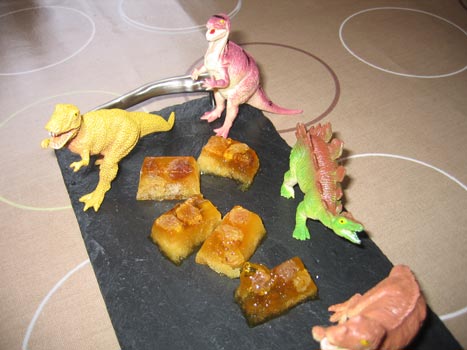
A fossil themed treat for Halloween or a dinosaur themed birthday party.

Picture credit: Everything Dinosaur

Amber Explained

Amber is the hardened remains of tree sap.  Certain types of trees, such as conifers for example, produce a sticky, scented resin which flows from damaged parts of the tree and helps to prevent against the spread of disease or the invasion of fungi into the living tree.  Trees have been producing tree resin, some of which has been turned into amber since the Jurassic geological period, a time when famous dinosaurs such as Diplodocus, Allosaurus and the armoured Stegosaurus roamed the Earth.  As the sap flows down the tree, it traps insects and other animals inside the sticky substance.  Plant remains too, can be caught up, pits of twig, bark, leaves and in later types of amber from the Cretaceous period even pollen from flowering plants can be captured.  The amber preserves these tiny organisms in exquisite detail providing palaeontologists with a unique and rich treasure trove of prehistoric remains to study.

To read an article about the remains of a spider’s web being preserved in amber: World’s Oldest Spiders Web Preserved in Amber.

Preserve some prehistoric fossils yourself this Halloween with this simple version of a Halloween party treat that is fun to make and you can even get your kids to help you with this fun recipe idea.

Things You Will Need

  • Small pack of orange or raspberry jelly
  • Pair of kitchen scissors
  • Handful of raisins, currants or dried cranberries
  • A jug with a pouring spout and a mixing metal spoon
  • A couple of plastic ice cube trays
  • A shallow dish which is slightly bigger than the ice cube tray

The Things that You will Need to Make this Recipe
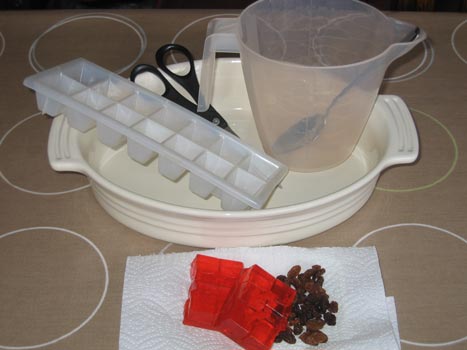
Prehistoric insects trapped in amber recipe.

Picture credit: Everything Dinosaur

Make up the jelly in the pouring jug.  Make sure you follow the instructions on the packet and mix the jelly cubes with the hot water according to the manufacturer’s recommendations.  Also check that the jug is suitable for holding hot water, a stout plastic jug or a kitchen jug is ideal. Put the jug with its liquid jelly aside to cool down.

Start by Making the Jelly
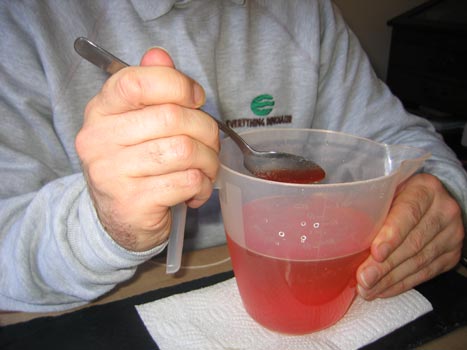
Palaeontologists get busy making jelly.

Picture credit: Everything Dinosaur

Creating the Fossilised Insects

To make the fossilised remains of the insects and other such prehistoric beasties, simply take the currants or raisins and cut them up roughly with the scissors.  If you are using cranberry pieces as well these can be chopped up nice and small using a kitchen knife.  The more frayed the better, they will look more realistic with your trick or treaters, or even your birthday party guests imagining that these are the petrified remains of prehistoric insects from the age of dinosaurs.

Making up our Prehistoric Insects Preserved in the Amber
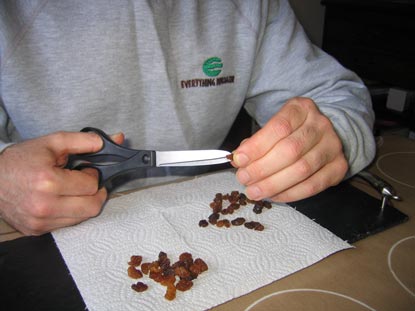
The more frayed the better!

Picture credit: Everything Dinosaur

When the jelly has cooled down a little, but is still liquid, carefully pour the mixture into the ice cube trays ensuring that all the individual cubes have roughly the same quantity of mixture in them, but do not overfill.  Then simply drop in a few pieces of the chopped dried fruit (currants, raisins etc), into the jelly.  Let the mixture cool a little more and then place on a shelf in the fridge to allow the jelly to set.

Placing our Insect Remains into the Jelly Amber
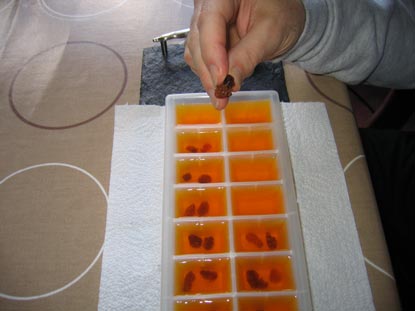
Ideal for parties or Halloween.

Picture credit: Everything Dinosaur

Of course, you don’t have to make up individual bite-size portions, handling jelly pieces can lead to a lot of sticky fingers so you can make up a big bowl of jelly instead.  We added candid peel to our big jelly mix, this looked like the remains of plant material that had become preserved in the amber too.

Take the ice cube trays out of the fridge and place them carefully into the shallow dish which you have prepared by putting in a small amount of hot water into it.  The hot water in contact with the sides of the ice cube trays will help to release the now set jelly pieces from the tray.  After letting the trays warm up in the water, the ice cube trays can be turned upside down and each container can be patted to release the jelly “amber” cube.  If the jelly proves a little reluctant the cubes can be slid out using a knife.

Use a Shallow Tray with Warm Water in it to Help Release the Cubes
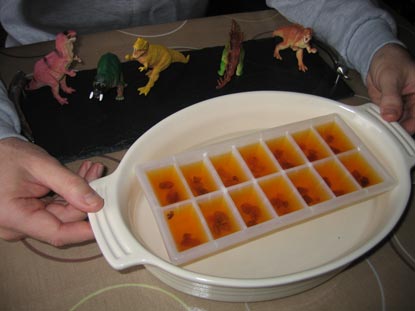
Steady as she goes, cubes ready for turning out.

Picture credit: Everything Dinosaur

Arrange the amber cubes with their fossils inside on a plate, with perhaps a couple of small, plastic dinosaur models for decoration and there you have it, a cheap and fun party treat for Halloween with a dinosaur theme.

One standard pack of jelly makes about twenty fossils in amber pieces and that’s all there is to it.  A simple and cheap Halloween or dinosaur themed birthday party treat that can either be made up in bite-size portions or a single dessert dish.

To view Everything Dinosaur’s huge range of prehistoric animal themed toys and gifts: Dinosaur Gifts and Prehistoric Animal Toys.

27 10, 2012

Dinosaurs Help Young School Children with their Sentence Construction

By |2023-02-06T13:38:04+00:00October 27th, 2012|Categories: Educational Activities, Press Releases, Teaching|0 Comments

Exploring Feelings Using Dinosaurs

For reception/foundation stage school children, one of the challenges can be getting to grips with sentence construction and expressing thoughts and feelings in words.  As many young children love dinosaurs and all things to do with the Dinosauria, Everything Dinosaur can help when it comes to their educational development.

Within the mandatory framework for the education and development of children in the United Kingdom from birth to five years of age, as set out by the Department of Education, there are key objectives for teachers and educationalists to try to attain.  For example, educational activities must involve programmes that give children opportunities to experience a rich language environment and to develop confidence when it comes to expressing themselves and to speak and listen in a range of situations.  In addition, an important cornerstone of early years development is literacy.

Everything Dinosaur

Dinosaurs can help children in these areas as teachers encourage their charges to link sounds and letters and begin to read and write.  At this age it is important to think of materials that can enable children to explore and share their own thoughts and feelings, their ideas and moods through a variety of different media.

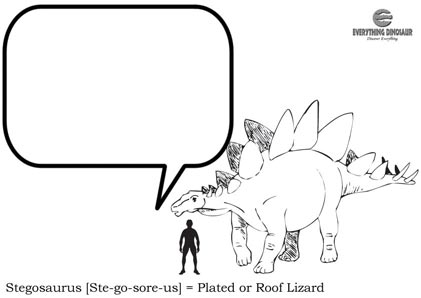
At Everything Dinosaur, our team members have created dinosaur drawings with speech bubbles in a bid to motivate children from four years and upwards to express themselves and develop sentence writing skills.

Stegosaurus Helps with Sentence Construction

A typical teaching resource provided by Everything Dinosaur.

Picture credit: Everything Dinosaur

The picture above shows one of our typical dinosaur themed educational resources.  This A4-sized document illustrates a Stegosaurus with a person next to it to show scale.  The dinosaur can be coloured in by the child and then their thoughts can turn to what the Stegosaurus might be thinking or saying.  It is their job to express the thoughts and feelings of the Stegosaurus using their sentence construction skills.

Providing Resources

The name of the dinosaur is included, plus a handy pronunciation guide and the actual meaning of the prehistoric animal’s name.  Team members supply a variety of such dinosaur themed resources, all aimed at helping young children develop and learn.

A spokesperson for Everything Dinosaur commented:

“Teaching professionals must consider the individual needs and interests of the children in their class.  Many children at reception/foundation stage already have a fascination for dinosaurs and so dinosaur themed activities can be used to create challenging and enjoyable learning experiences”.

With the likes of Stegosaurus, Triceratops and Tyrannosaurus rex already well known to most children of school age, it can help to utilise their love of dinosaurs in creative ways allowing key early years and foundation stage learning objectives to be achieved.

Visit Everything Dinosaur’s website: Dinosaur Gifts and Toys.

24 09, 2012

Have Fun Fossil Hunting in London

By |2024-04-24T16:36:31+01:00September 24th, 2012|Categories: Dinosaur Fans, Educational Activities, Everything Dinosaur News and Updates, Geology, Palaeontological articles|1 Comment

Fossils are Abundant in London – If you Know Where to Look

When asked where to go fossil hunting many people advise a trip to the seaside to explore cliffs or perhaps a trip to a local quarry to study the sediment being exposed, but ironically if you know what to look for and where to look, a trip to a big city can yield a surprising number of exciting fossil discoveries. For example, you can go fossil hunting in London.

Fossil Hunting in London

A visit to London is no exception.  This city may not be the obvious choice for a person to go fossil hunting but amongst the paved streets and buildings, an observant palaeontologist can find some remarkable evidence of ancient life.  London itself, has yielded many important fossil discoveries the London clay preserves a sub-tropical, estuarine environment recording a rich diversity of life including crocodiles, turtles, birds, mammals and a number of plant fossils from a time after the extinction of the dinosaurs.  The fossilised bones of Pleistocene lions and hippos have been discovered by workmen digging under Trafalgar Square, but you don’t need to excavate or even to carry a geological hammer to find fossils in a place like London.  All you need are a sharp pair of eyes and a camera to record your discoveries.

Fossils at St Paul’s Cathedral

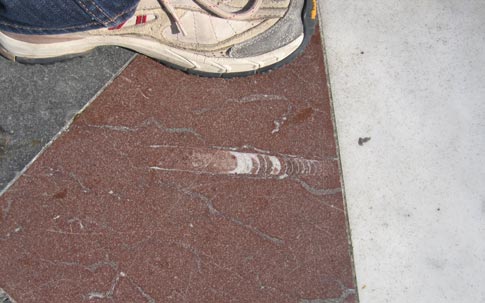
Take a visit to St Paul’s Cathedral for example.  Whilst visitors are admiring the dome and the beautiful facia of the cathedral designed by Sir Christopher Wren, take a moment to examine the steps that lead up to the main entrance.  The polished flagstones that can be found at the top of the steps leading up to the main thoroughfare contain a number of very well-preserved specimens of ancient cephalopods.  The stone for these flags came from Sweden.  They represent marine strata laid down something like 480 million years ago in the Early Ordovician geological period (Tremadocian faunal stage).  Preserved as fossils in these stones are the remains of straight-shelled nautiloids.  Nautiloids were actively swimming creatures distantly related to octopi and squid that lived in straight-chambered shells.  Some of these creatures evolved into huge predators, the first sea monsters that ever lived, with genera such as Cameroceras and Endoceras reaching lengths approaching ten metres.  These animals are only distantly related to the modern Nautilus but they had basically the same body plan.  Their long conical shells were divided internally into many chambers, these were joined by a long tube that was used to control the amount of water in each of the chambers (siphuncle).  The largest,  end chamber housed the actual animal with its head, powerful beak and grasping tentacles.

Ordovician Nautiloids at St Paul’s Cathedral

Fossils to be seen in London.

Picture credit: Everything Dinosaur (Geologist provides foot for scale)

The fossils seen on the steps of St Paul’s do not represent huge specimens but the individual chambers (septa) of the shells can be clearly made out as the specimens are viewed in cross-section. Some of these fossils are more than thirty centimetres in length.

Portland Stone

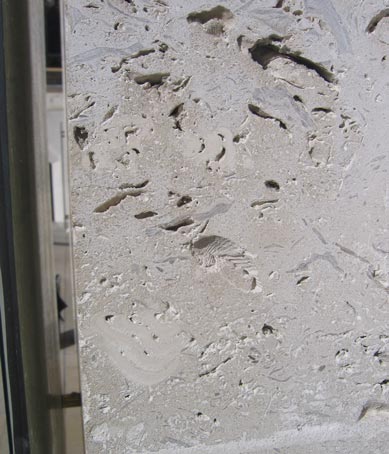
Much of the stone used to build the Cathedral is Portland stone.  This limestone, quarried from Portland in Dorset, was formed in a shallow, tropical Jurassic sea towards the end of this geological period (Tithonian faunal stage).  This type of stone adorns many of the well-known public buildings of London.   The white/grey limestone has been used as a building material in the United Kingdom since Roman times.  The splendid Guildhall of London, built in the fifteenth Century, is one such building and a careful examination of the stone blocks that make up the facia of the building opening out into the main courtyard, can yield some fossil finds for an observant palaeontologist.  The internal moulds of gastropods (snails), their argonite shells long dissolved away have been preserved, these are known as “Portland screws” as they are locally abundant in Portland limestone.  Alongside the gastropods the moulds and casts of bivalves and other invertebrate creatures can be clearly made out.  Many tourists visit the Guildhall to admire the galleries and the treasures they contain, but to a keen fossil hunter, there are 150 million year old treasures to be found in the stones that make up the building itself.

Evidence of Jurassic Invertebrates at the Guildhall

Looking for fossils of bivalves at the Guildhall.

Picture credit: Everything Dinosaur

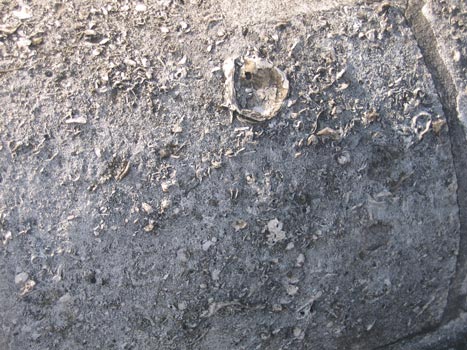
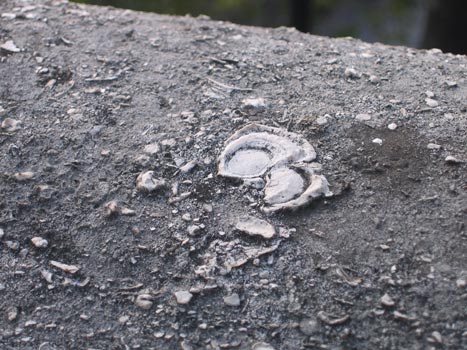
Cross the river Thames using Waterloo Bridge and take a little time to examine the coping stones that make up the supports to the pedestrian railings.  This bridge may be used by thousands of commuters and tourists each day, but how many of them stop to look carefully at the building stones on the side of the walkways.  These stones are also limestone, but they are not Portland stone.  However, they do contain fossil evidence of a catastrophe that devastated a marine environment during the age of the dinosaurs.  The limestone material represents Upper Jurassic strata and a close examination will reveal that it is packed with hundreds of fossils of marine invertebrates, all smashed up and jumbled together.  This sediment has preserved the devastation caused by a major storm event such as a tsunami that destroyed a marine ecosystem.  This habitat was probably close to shore and the shallow seascape took the fall force of huge natural disaster such as a hurricane or a tsunami.  The remains of bivales such as oysters can be clearly seen, the shells mostly a bleached white against the grey limestone matrix.  The remains of the calcite skeletons secreted by coralline algae can be made out as well, evidence of the destruction of a marine ecosystem preserved in the walls of a famous London landmark.

Fossils Preserved in the Limestone Used to Build Waterloo Bridge

Jurassic fossils on Waterloo Bridge.

Picture credit: Everything Dinosaur

It is not just London where such fossils can be found, many forms of sedimentary rock are used as building materials and with a keen eye fossils that record evidence of ancient life can be found at the very heart of big cities and towns.

For replicas of iconic fossil animals: Models of Iconic Fossil Animals.

You don’t need to go to a quarry or the seaside to go fossil hunting, next time you are in a big city take a close look at the stone building materials that are around you, or that you are walking on.  After all, most of these hidden treasures go unnoticed by the thousands of people who walk by them every day.

More Fossils found on Waterloo Bridge

Fossil hunting in the middle of London.

 Picture credit: Everything Dinosaur

19 09, 2012

New “Spot the Difference” Dinosaur Jigsaw Puzzle Reviewed

By |2024-04-24T16:38:18+01:00September 19th, 2012|Categories: Educational Activities, Everything Dinosaur Products, Product Reviews|0 Comments

A Novel Twist on the Traditional Jigsaw

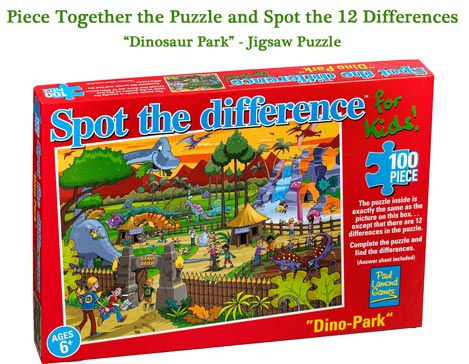
Dinosaur obsessed children aged six and over can have their observation skills tested with this novel, dinosaur jigsaw puzzle.  As well as putting together the colourful puzzle, young palaeontologists then have to spot the differences in their puzzle when compared to the puzzle picture on the box.  The puzzle is exactly the same as the picture, except there are twelve subtle differences.  Complete the jigsaw and then try to find the differences.

Dinosaur Jigsaw Puzzle

This one hundred piece jigsaw has been well made, the individual puzzle pieces measure approximately three centimetres in diameter, making them easy to handle for you young children.  The lugs on each piece are robust and the pieces fit together well, helpful when you have to spot small differences in the puzzle that the child has put together when compared to the picture displayed on the front of the box.

The Colourful “Dino Park” Jigsaw Puzzle

A dinosaur jigsaw with a twist.

Picture credit: Everything Dinosaur

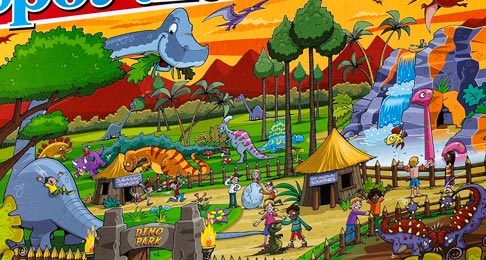
Jigsaws can help children develop hand-eye co-ordination as well as motor skills.  The puzzle pieces are very tactile and the colourful, cartoon style picture with its twelve differences to spot aids in a child’s development of their observation skills.  The theme of the jigsaw is a visit to an imaginary dinosaur theme park, a sort of cartoon dinosaur land.  Eleven dinosaurs are featured, there is even a blue and yellow Dimetrodon (a pelycosaur) lurking in the background.  This colourful puzzle also features a number of flying reptiles.  One thing to note is that there is a pterosaur nest hidden in the picture, can your child spot it?

Everything Dinosaur’s range of educational products for children: Learning with Everything Dinosaur.

All the popular and best known dinosaurs feature somewhere on the puzzle.  There is Stegosaurus, Brachiosaurus, Triceratops and the duck-billed dinosaur Parasaurolophus with its huge head crest amongst the herbivores in the dinosaur theme park.  There are even two armour plated Ankylosaurus battling with each other in one corner of the jigsaw.  As for the meat-eaters, there is of course, the obligatory Tyrannosaurus rex and by the looks of things this large, Late Cretaceous predator is about to make a meal of some of the visitors to the Park’s restaurant.  There is certainly a lot going on in the completed puzzle, it took a six year old more than thirty minutes to complete the jigsaw and then another fifteen minutes or so to find all the differences.  It was pleasing to note that the young girl thoroughly enjoyed making her dinosaur theme park and as each dinosaur was completed she insisted on telling us a little bit about it.

The Artwork in the Dinosaur Themed Jigsaw Puzzle

A busy Dinosaur Theme Park!

Picture credit: Everything Dinosaur

The answers to the spot the difference part of the puzzle are contained on an answer sheet provided in the jigsaw puzzle box.  This is very helpful, although we would recommend that the answer sheet be folded up to prevent the child seeing the answers prematurely.

This puzzle with its spot the difference element, being themed around the story of a dinosaur park we think would be especially popular with young boys who have a fascination with dinosaurs.  The puzzle is robust, colourful and we loved the additional element of finding the differences between our puzzle and the one featured on the box.

18 09, 2012

Turning Triceratops into a Innovative Trojan Horse

By |2024-04-24T16:38:52+01:00September 18th, 2012|Categories: Dinosaur Fans, Educational Activities, Everything Dinosaur News and Updates|0 Comments

Dinosaur Themed Activities Inspire Young Children to Learn About Science

A child’s fascination with dinosaurs and all things prehistoric is helping to motivate and inspire pupils at many schools. With the advent of a more creative curriculum, teachers and teaching assistants are using children’s love of dinosaurs to create dinosaur themed activities to help enthuse them about science subjects and to explore concepts such as how to develop and test theories.

Dinosaur Themed Activities

Described as using a “Triceratops as a Trojan Horse”, students are able to explore scientific concepts and methodologies using a range of activities enabling differentiation in the classroom setting as well as providing ready-made opportunities for extension activities and supported learning.  With a new dinosaur species being named every twenty to thirty days or so and something like twelve hundred dinosaur genera already described, these prehistoric animals always seem to have a high profile in the media.  This can help teachers to write inspiring lesson plans based on these long extinct reptiles.

Turning Triceratops into A Trojan Horse

Dinosaurs help school pupils.

Picture credit: Everything Dinosaur

Working with Key Stage Two Children

An example would be working with children studying the national curriculum key stage two (children aged between 7 and 9 years typically in primary school years 3 to 5).  The concept of “deep time” can be explained using a timeline which they construct showing when dinosaurs lived in relation to people the children may have already studied as part of previous term topics – The Romans, Ancient Greeks etc.  By plotting a scale line showing the millions of years that dinosaurs existed, students, under the supervision of the teaching staff can build up a linear diagram that shows when the dinosaurs lived and relates this time to the time of Ancient Rome, the Greek civilisation and such like.  With a time scale of one centimetre representing a million years the children can place events in the correct periods of time, an objective outlined within the national  curriculum teaching objectives.  By placing individual dinosaurs in the correct geological period, Apatosaurus within the Jurassic and Tyrannosaurus rex within the Cretaceous, pupils can gain an appreciation about which dinosaurs lived when and what other prehistoric animals lived at the same time.  Secondary resources can then be used to get the children to learn more about individual dinosaurs and this leads onto extension activities such as each child researching, drawing and writing about their own prehistoric animal.

Dinosaur Timeline

When making my own timeline with school children, my tip would be to use a scale of one centimetre equals one million years and plot the history of life on Earth from the present day back to 250 million years ago, the beginning of the Triassic geological period and just before the dinosaurs came to prominence in terms of land animal populations on Earth.  This means that a timeline some 2.5 metres in length can be created, easily able to be fitted along part of a classroom wall for display purposes.

With  children from under three years beginning to learn about and show knowledge about these long extinct reptiles, the Dinosauria lend themselves to working with reception/foundation aged children.  When consulting on Early Years Foundation Stage (EYFS) teaching it is important to help children understand the nature of materials and the world around them.  The EYFS framework has recently been revised and remains the statutory framework for the teaching standards required for early years providers.  This teaching framework helps to prepare reception/foundation aged children for school and ensures that children acquire the skills needed to help them make good progress in future through their academic studies.  A number of teachers are making “Dinosaurs” the first term topic that the children encounter, fossils and models can help them explore the properties of different materials and even different dinosaur toys can help them learn about different parts of the body.  Simple selection and counting games can be encouraged such as picking out all the models of prehistoric animals that have four legs,  count the number of green ones and such like.  These types of activities also lend themselves to a number of extension activities such as grouping animals together that share the same characteristics and such like.

Exploring the Properties of Different Materials with Dinosaurs

Examining dinosaur hands (Key Stage 2/3). Picture credit: Everything Dinosaur.

Picture credit: Everything Dinosaur

Simple Maths

When working with older children, a simple maths lesson can be made more challenging and fun by creating a dinosaur track way with pretend dinosaur foot prints.  The children can learn to measure and calculate using these simple yet imaginative props.  At one school, a headmaster was asked to step in and conduct a hour long maths class with a group of  year 7 children (Key Stage 3 age 11-12 years).  He borrowed some footprint drawings and laid out a series of dinosaur tracks in the school hall and then by splitting the class into groups he challenged them to use rulers and tape measures to  work out as much information about the animal that left the tracks as possible.  He was able to develop this lesson plan by introducing the concept of scale drawings and the average measures (the arithmetic mean).  It was certainly a memorable and rewarding maths based lesson that helped the pupils get to grips with simple scientific concepts such as mapping and plotting as well as introducing simple equations and use of numeracy.

To learn more about Everything Dinosaur’s wide range of dinosaur themed toys and gifts: Dinosaur Toys and Gifts.

Exploring Dinosaurs and Fossil Finds with Classroom Activities

“Hands on” practical dinosaur workshops.

Picture credit: Everything Dinosaur

Teachers and teaching assistants can use children’s interest in prehistoric animals to help them learn about the world around them and simple scientific principles.  Finding out about who the dinosaurs were, where they lived, what they ate, when they lived, how big they were etc. can all help teachers to ensure that the objectives of the national curriculum  are being met.  Importantly, it also means that imaginative and inspiring lesson plans are being devised, plans that will permit plenty of differentiation and extension as well as dove-tailing into different needs of pupils and learning styles.

5 09, 2012

Start of the Autumn Term – Dinosaur Topics

By |2023-02-04T14:55:06+00:00September 5th, 2012|Categories: Educational Activities, Everything Dinosaur News and Updates|0 Comments

Back to School with Dinosaurs

Not much of a Summer in terms of the weather and before you know it the school holidays are over and its back to school for the Autumn term.  Team members at Everything Dinosaur have been busy preparing for school visits that are going to be taking place in the next six weeks as it seems that more primary schools than ever are looking to provide a term topic based around dinosaurs and other prehistoric creatures.

Everything Dinosaur

True to form, we have dealt with every enquiry, advised, supplied and supported all we can.  One dedicated team member even managed to assist one Year 1 teacher over the phone in between dinosaur shows that he was conducting at a museum, talk about multi-tasking!  All in a day’s work as we prepare our dinosaur workshops.

Back to School with Dinosaurs

Autumn term teaching activities from Everything Dinosaur.

Picture credit: Everything Dinosaur

As well as exploring deep time using tactile fossil handling sessions, Everything Dinosaur team members are building on their recent work and involvement with the BBC “Planet Dinosaur” project to produce an informative and instructive workshop that tells the story of the discovery of Spinosaurus and compares this huge theropod with Tyrannosaurus rex.  Ensuring that different learning styles are catered for, that the aims and objectives of the science element of the National Curriculum are being met, these are all part of a day’s work for our trained teachers and palaeontologists.  This new workshop is tentatively titled “Battle of the Killer Giants” with the strapline – everything you wanted to know about killer dinosaurs but were afraid to ask.  Should be up on the STEM Directory (science, teaching, engineering and maths in schools) website shortly.

STEM Directories

The aim of the STEM Directories is to connect teachers with the wide range of activities in the UK that can help enhance their teaching in science, engineering and maths.  The project is maintained and managed by a consortium comprising of a number of Government organisations and is supported by the Department for Education.

Everything Dinosaur has a strong presence in the STEM Directory, just visit the STEM website and in the search field at the top of the page (right hand side as you look), type in the search phrase “Everything Dinosaur”.

To learn more about Everything Dinosaur’s huge range of dinosaur and prehistoric animal educational games and toys: Visit Everything Dinosaur’s Website.

28 08, 2012

Lyme Regis Prepares to Celebrate the Contribution of Mary Anning

By |2023-02-04T11:59:53+00:00August 28th, 2012|Categories: Dinosaur Fans, Educational Activities, Palaeontological articles|0 Comments

Mary Anning Weekend Approaches

The contribution to Earth science by the remarkable Georgian fossil collector Mary Anning is being celebrated in a weekend of special events at the end of September.  The pioneering English fossil collector and amateur palaeontologist  Mary was born in the small, seaside town of Lyme Regis (Dorset) an area of Britain’s coast famous for its Jurassic sediments and fossils of marine animals (and pterosaurs plus one dinosaur genus) as well as a whole host of prehistoric fish.

Mary Anning

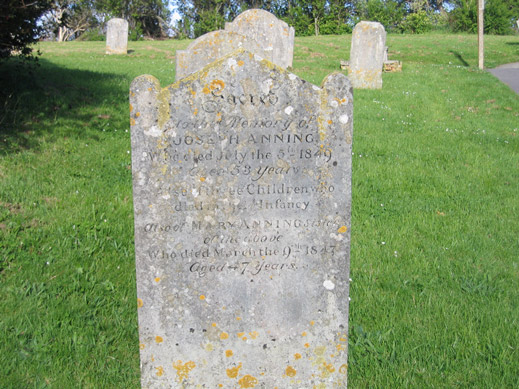
The Grave of Mary Anning at St Michael’s Church Lyme Regis

Mary Anning's grave.

Mary Anning’s grave at St Michael’s Church on the hill overlooking Lyme Regis.

Picture credit: Everything Dinosaur

Her father was a carpenter by trade, although he supplemented the family’s income by also selling curios (fossils) that they had found on the beach and in the cliffs that surround Lyme Regis.  Mary became prominent as an expert in fossils and fossil finding, although she did not receive the full credit for her contribution to science during her lifetime.  She discovered the first plesiosaur fossils in 1821 and the first Pterodactyl (flying reptile) fossils in England in 1828.  Many of her specimens can be seen in museums today, her finds helped to build up the collections of a number of wealthy individuals but often no record was kept of her contribution or role in the research and study of such specimens.

The Lyme Regis Museum

The Lyme Regis Museum, (Bridge Street, Lyme Regis), is planning a weekend of events (Saturday 29th and Sunday 30th September), to celebrate the work of the town’s most famous former resident and the focus will be on walks and talks with the chance to see some of the remarkable fossil fish that have been found on the Jurassic coast.

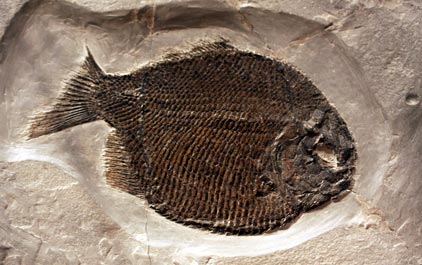
On Saturday 29th September, from 10am, the Lyme Regis museum will be displaying some of the amazing prehistoric fish fossils that have been found in the area.  Have a wander around the ground floor gallery and take a look at the bizarre  creatures that shared the Jurassic seas with giant marine reptiles.  There’s even a chance to get involved with artist Darrell Wakelam setting out to make a giant prehistoric fish sculpture.

Amazing Jurassic Fish Fossils on Display

Meet your Next of Fin!

Picture credit: Lyme Regis Museum

For models and replicas of prehistoric fish and other extinct animals: Mojo Fun Prehistoric Life Models.

Our chums Paddy, Chris and Brandon will be demonstrating ammonite polishing outside the museum from 11am (Saturday and Sunday).  Have a go and get the chance to take home your very own 190 million year old souvenir, for just a few pounds.

There will also be a series of talks given by leading scientists in the nearby Marine Theatre over the weekend.  If you have ever wanted to learn more about extinct species of ray-finned fish, now’s your chance.

Local experts will be on hand to take parties onto the beaches for a guided tour of the areas fossils and you might find one or two examples of Jurassic life yourself.

All in all, a fun weekend is planned, celebrating the diversity of vertebrate fauna that is to be found along this coast with its World Heritage status and commemorating the contribution to science made by a remarkable 19th Century amateur palaeontologist.

To catch up with Brandon Lennon on a fossil walk: Lyme Regis Fossil Walks.

18 08, 2012

Big Ichthyosaurs – Remarkable Fossil Discoveries

By |2024-04-24T16:27:41+01:00August 18th, 2012|Categories: Dinosaur Fans, Educational Activities|0 Comments

Shonisaurus – Vertebrae the size of Dinner Plates

At Everything Dinosaur we field the myriad of questions about dinosaurs and prehistoric animals as best we can.  One emailer asked which was the biggest ichthyosaur of all time?  An interesting question, there are certainly a number of contenders, for example the Triassic ichthyosaur Cymbospondylus at over ten metres long is worth consideration.  Fossils of this apex predator have been found in North America and Europe.  A streamlined predator, this animal hunted fish, cephalopods and probably other marine reptiles.  Cymbospondylus  fossils date from around 240 million years to approximately 210 million years ago.  The name means “boat vertebrae”.

Biggest Ichthyosaur

Larger still, was the Late Triassic Shonisaurus (S. popularis), not to be confused with the Jurassic sauropod from China Shunosaurus (Shunosaurus lii).  The first fossils of Shonisaurus, this giant marine reptile were found by miners around the now deserted mining town of Berlin, Nevada in North America.  The fossils were so plentiful that miners used them to decorate their dwellings and some of the large, flat vertebrae were even used as dinner plates!  Reports of these fossils had been made from as early as 1869 but the miners were too busy digging for gold and silver to worry.  Shonisaurus popularis is the largest ichthyosaur to have been discovered to date in the United States and was believed to be the biggest in the world until fossils of a new species of ichthyosaur over 23 metres long were unearthed in Canada.

For models and replicas of ichthyosaurs and other marine reptiles: Ichthyosaurs and Marine Reptile Models (CollectA).

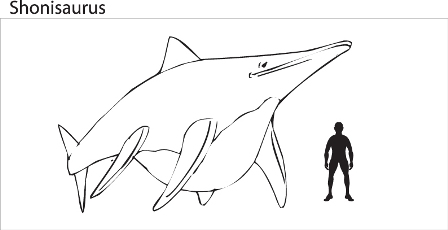
A Scale Drawing of Shonisaurus

Giant ichthyosaur of the Late Triassic and Early Jurassic.

Picture credit: Everything Dinosaur

To read a feature on giant ichthyosaurs: Giant Ichthyosaur Fossils Discovered.

12 08, 2012

Everything Dinosaur’s Exclusive Back to School Newsletter 2012

By |2024-05-02T12:27:20+01:00August 12th, 2012|Categories: Educational Activities, Everything Dinosaur News and Updates, Everything Dinosaur Newsletters, Press Releases|0 Comments

Back to School with Dinosaurs

We are well into August and as we await some decent summer weather, our thoughts are already turning to the autumn term.  Our team members have lots of dinosaur themed workshops and teaching sessions booked up and down the country. The teaching team at Everything Dinosaur have been busy preparing and revising lesson plans to ensure they encompass the science teaching objectives laid down in the national curriculum.

Everything Dinosaur

To view more details about Everything Dinosaur’s extensive range of educational products including replica fossils and models: Dinosaur Crafts and Educational Items.

In the meantime, stocks of dinosaur themed school items, everything from pencils and erasers to super quality backpacks and rucksacks have been selling well.  Mums and Dads keen to equip their young palaeontologist have been snapping up the Everything Dinosaur back to school range of school kits and stationery quicker than a T. rex tackles his dinner.

School Items in Stock at Everything Dinosaur

Dinosaurs for school.

Picture credit: Everything Dinosaur

We have an enormous range of dinosaur themed stationery, pens, notepads and lunch boxes all with a dinosaur inspired design available.  We even have a metal water bottle, exactly the same as the ones we take on fossil hunts, which has proved to be a big hit with young dinosaur fans wanting to have an extra-special drinks bottle for school.

Everything Dinosaur’s Back to School Newsletter

Updates about new products, dinosaur finds, even tips on fossil hunting.

Image:  Everything Dinosaur’s Back to School 2012 Newsletter

As part of Everything Dinosaur’s promotional activities we have sent out a newsletter.  It showcases some of the products we have in the “Back to School” range as well as providing updates on dinosaur news stories and tips on fossil hunting.

If you want to receive more information about Everything Dinosaur’s school products, the dinosaur themed items we supply or if you simply want to ask our experts a question about dinosaurs, drop the team an email: Email Everything Dinosaur.

24 07, 2012

Council Officials Warn Walkers and Fossil Collectors About Dangerous Cliffs

By |2023-03-09T10:22:46+00:00July 24th, 2012|Categories: Dinosaur and Prehistoric Animal News Stories, Dinosaur Fans, Educational Activities|0 Comments

Jurassic Coast “Unusually Unstable”

On July 6th team members at Everything Dinosaur published an article warning of the dangers of approaching to close to the unstable cliffs on the Jurassic coast.  A number of landslides had already been reported, the recent heavy rains saturating the cliff areas and making them particularly prone to landslips.

The Jurassic Coast

With the start of the school holidays for most of the UK and the onset of some sunny, warm weather in the country (at last), the beaches on the Dorset and Devon coasts are likely to get very crowded.  Council officials have warned fossil collectors and walkers to avoid the cliffs and there is also the added threat of invisible quicksand, areas of dangerous beach that has been created as a result of the recent flooding.

The county of Dorset  is still reeling from the landslide caused by the recent heavy rainfall that took place on July 7th in the area around  the Beaminster Tunnel.  Two people were killed when their car was crushed by hundreds of tonnes of mud.  The bodies were only discovered ten days later when the tunnel was finally cleared of debris.

Dorset council has stated that much of the World Heritage coastline poses a grave danger.

A spokesperson for the council warned of a risk of a landslip “anywhere and at any time along the coast”.

The person went on to add:

“Landslides have also delivered thick mudflows and quicksands to the beaches in many places.  One of the hidden hazards is that the sea can wash sand and shingle over the mud and quicksand, giving the appearance of a solid beach.  The advice is to stay well away from the cliffs at all times and to beware of mudflows and quicksand, especially when the tide is coming in as it is possible to become cut off from the normal exit points from the beaches.”

Risk of Landslides

The council has highlighted a number of known hazard areas between Lyme Regis and the Axmouth Undercliffs.

The list  includes: A massive mudslide at Seven Rock Point on Monmouth Beach, and a landslide at the start of the beach; several mudslides between Lyme Regis and Charmouth; the base of Stonebarrow Cliff east of Charmouth, said to be “shrouded in mudflows” with increased risk of rock fall and a “very real possibility of becoming trapped by the incoming tide.”;

Another substantial landslide has completely blocked the beach between Eype and West Bay to the east of Charmouth.  Temporary signs have been put up to warn tourists, but the council spokesperson stated that the situation was in constant flux.

To view models and replicas of iconic animals, fossils of which are found at Lyme Regis: Replicas of Ammonites and Belemnites.

A spokesperson for Everything Dinosaur, urged visitors to the area to heed the warning signs and to check the local information as well as staying well away from the cliffs.

To read the July 6th Everything Dinosaur article: Dangerous Cliffs in the Lyme Regis Area.

Go to Top