All about dinosaurs, fossils and prehistoric animals by Everything Dinosaur team members.

Everything Dinosaur’s work with schools and other educational bodies. Articles, features and stories about dinosaurs and their role in education and educating young people.

20 07, 2012

Grange Moor Primary School Pupils Tackle Special Dinosaur Tracks

By |2024-04-24T15:30:06+01:00July 20th, 2012|Categories: Educational Activities|1 Comment

Miss Allen’s Class Explore Dinosaur Footprints and Come Up with Fascinating Theories

One of the great things about palaeontology is that it is a very accessible science field.  When looking for the Higgs Boson particle a Large Hadron Collider is required but with palaeontology, going for a walk in an area where fossils can be found and turning a few rocks over might lead to a discovery that changes the way that scientists view the world.  Everything Dinosaur team members gave pupils a taste for palaeontology during a school visit which gave the children the chance to study some real dinosaur tracks.

For Miss Allen’s class of Year 5/6 pupils at Grange  Moor Primary School (Wakefield, West Yorkshire), they got the chance to get to grips with a real palaeontology puzzle by studying a bizarre set of fossilised dinosaur tracks that had recently been discovered in the United States.

Dinosaur Tracks

Miss Allen’s Class 3 were given the opportunity to take part in some real palaeontology and to come up some scientific theories of their own when they were invited to try to work out what a set of dinosaur tracks made many millions of years ago might reveal about the behaviour of prehistoric animals.

Dinosaurs as a term topic can be help provide students with challenging assignments and the teachers and teaching assistants at Grange Moor Primary School certainly came up with a number of creative and imaginative lesson plans for the pupils to enjoy.

In this particular lesson, involving year 5/6 students at the school, a series of pictures and drawings were shown to the class.  These illustrate a strange set of dinosaur tracks that were made next to a drying up lake by a dinosaur that lived during the Early Jurassic geological period.

The children were given a set of structured assignments to accomplish, using a worksheet and the scientific illustrations they were tasked with interpreting the fossil evidence and just like a real scientist, they had to come up with a theory to explain the strange foot prints and marks that had been preserved.

Pupils at Grange Moor Primary School Studying a Set of Dinosaur Footprints

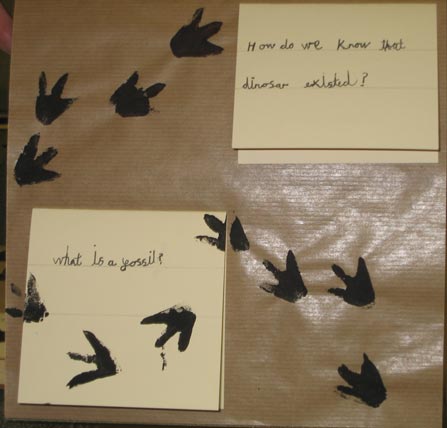
Depicting a dinosaur trackway.

Depicting a dinosaur trackway.

Picture credit: Everything Dinosaur

The picture above shows a recreation of a dinosaur trackway.

Studying Dinosaur Footprints

The pupils had to work out the direction of travel and why scientists include scale bars when presenting scientific information.  To conclude this exercise the children had to try to come up with a theory that might explain the strange tracks and markings preserved in the fossilised mud.  Just like a real palaeontologist they had to evaluate the evidence and come with their own hypothesis as to what might have happened.

Just like in real palaeontology, there were lots of different theories put forward.  Some of the children’s ideas are listed below:

Genevieve – she thought that more than one dinosaur had walked over the ground.

Olivia  – suggested that a hunting dinosaur may have dropped its catch and this had been preserved in the dinosaur tracks.

Amelia and Kelsey – proposed that the shore of the lake may have been slippy and the dinosaur may have fallen over.

Matthew – stated that the tracks and strange marks preserved as fossils may show where a mother dinosaur dropped its baby whilst carrying it along the side of the lake.

The pupils came up with a number of fascinating ideas, all or which could be relevant as since no scientists were around 190 million years ago, it is difficult to say exactly what actually happened.

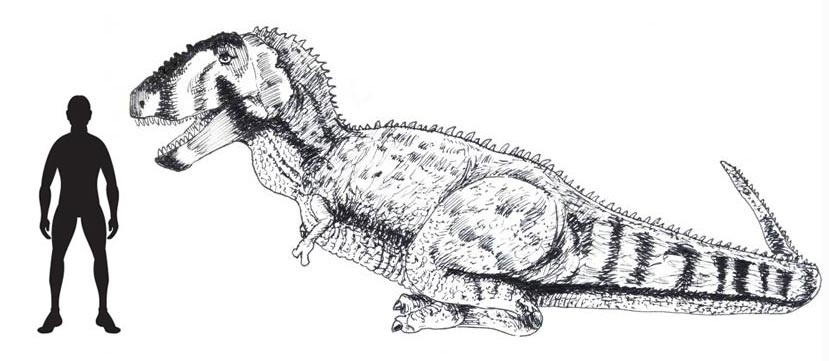
However, our theory is that a large, bipedal dinosaur had been to the lake to have a drink, it must have been a hot day so it decided to cool off by sitting in the mud for a short while to rest.  As the animal sat down it left its impression of its “hands” and bottom in the mud.

The “handprints”, as far as we at Everything Dinosaur know, are the first trace fossils of a meat-eating dinosaur’s front limbs found to date.  The resting position of the front limbs of this dinosaur can be calculated by looking at the fossilised marks in the mudstone and this is helping palaeontologists to understand more about how the “hands” of dinosaurs worked.

One Theory – A Dinosaur Takes a Rest on a Hot Day

Drawing of Daspletosaurus.

A dinosaur takes a rest and has a sit down.

Picture credit: Everything Dinosaur

Proposing Theories

The pupils came up with a variety of explanations, as well as learning about how scale measures are used in scientific drawings and calculating the actual size of the tracks.  All useful in helping to familiarise the students with aspects of mathematics such as scale drawings, simple calculations and accurate measuring objects.

To learn more about Everything Dinosaur’s science outreach work: Contact Everything Dinosaur via Email.

Miss Allen even entered into the spirit of the dinosaur day by coming into the classroom dressed as a dinosaur.  The pupils at Grange Moor Primary School are certainly very lucky to have such enthusiastic and hard working teachers and teaching assistants to encourage and motivate them.

Miss Allen and Amy as Dinosaurs

Two of the “dinosaurs” at Grange Moor Primary School.

Picture credit: Grange Moor Primary School.

The picture above shows Miss Allen (Class 3 teacher) dressed up as a dinosaur.  Alongside Miss Allen is Amy, a pupil at the school who, like a lot of her classmates came as a dinosaur for the special dinosaur day with Everything Dinosaur.

For dinosaur and prehistoric animal themed toys and games, visit: The Everything Dinosaur Website.

13 07, 2012

A Special Dinosaur Day at Grange Moor Primary

By |2024-04-23T16:08:43+01:00July 13th, 2012|Categories: Educational Activities, Everything Dinosaur News and Updates, Teaching|0 Comments

Rounding of a Dinosaur Themed Term Topic in Style

Last week team members at Everything Dinosaur were in Yorkshire (England) working with the enthusiastic young dinosaur fans at Grange Moor Primary.  For Mrs Fenton’s class this was an opportunity to round off their term topic on dinosaurs with a visit from one of our dinosaur experts.

Term Topic on Dinosaurs

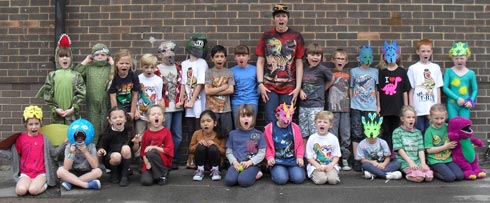
As a special treat, the children were allowed to come to school dressed as a dinosaur if they wanted to.  They made quite a colourful display with their dinosaur masks and costumes.  Some clever mums even made paper mache dinosaur hats, these were very impressive and they looked great in the classroom with all the dinosaur themed art and project work that the pupils had been creating.

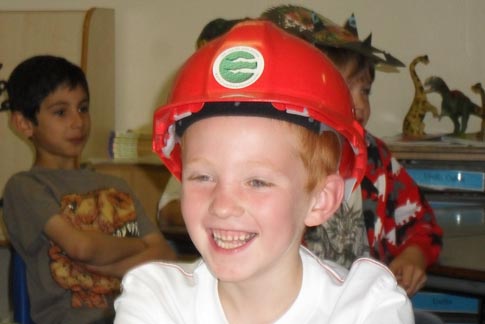
Enthusiastic dinosaur fan.

Picture credit: Grange Moor Primary

The children had certainly enjoyed their term topic.  There were lots of examples of their school-work on display, including some colourful dinosaurs that had been created using painted, paper plates to make the bodies.  The teachers and teaching assistants had taken great care to include a vast array of different types of lesson, all aimed at stimulating and enthusing the class.

To contact Everything Dinosaur to learn more about the company: Contact Everything Dinosaur (Email).

Dinosaur Day – Class Photograph

Roaring like a Dinosaur!

Picture credit: Grange Moor Primary School

All the young dinosaur fans enjoyed themselves and we were asked lots of questions (which we did our best to answer), we even met one young pupil who had decided to become a palaeontologist when he was older – good for him!

To visit Everything Dinosaur’s child-friendly and award-winning website: Toys and Games with a Dinosaur Theme.

10 07, 2012

Everything Dinosaur School Visit a “Roaring Success” – Helping Teachers and Providing Helpful Advice to Schools

By |2024-04-23T16:17:48+01:00July 10th, 2012|Categories: Educational Activities, Everything Dinosaur News and Updates, Product Reviews|0 Comments

Mayfield Primary School and their Young Palaeontologists

Team members at Everything Dinosaur spent a very pleasant morning recently in the company of the budding palaeontologists and young dinosaur fans at Mayfield Primary School (Oldham).   Dinosaurs had been the topic for the term for the reception class and the pupils has been busy “boning up” on prehistoric animals as well as demonstrating their developing writing and creative skills.

Everything Dinosaur School Visit

Exploring  dinosaurs can provide teaching staff with an effective scheme of work to help young children manage the transition from a nursery environment to reception as well as helping to reaffirm science objectives as laid out in the national curriculum when moving onto Key Stage 1.

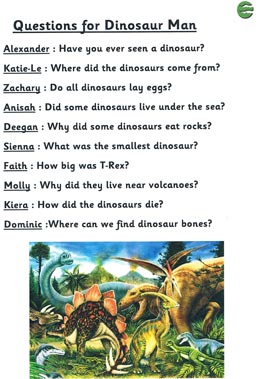
Dinosaurs and prehistoric animals in general seem to capture the imagination of many children and using dinosaur themed lessons can help children grasp important learning outcomes.   For the teachers and teaching assistants,  a dinosaur topic can be a lot of fun to deliver and in our experience there is always a dinosaur expert on hand in the class to help out if required.  The pupils had prepared a set of challenging questions which were fielded at a special assembly to begin Everything Dinosaur’s visit.  With a new dinosaur discovery every twenty days or so, there is always something new to talk about and the children’s enthusiasm for this subject area was very apparent.

The List of Assembly Questions

The questions compiled by pupils at Mayfield Primary.

Picture credit: Mayfield/Everything Dinosaur

Compiling Questions

Compiling a set of questions prior to a visit is always a useful exercise and enables pupils to feel involved with any school visit right from the start of the teaching session.

Certainly, the teaching team at Mayfield Primary had incorporated a wide range of activities within their scheme of work.  There are a number of reliable suppliers of workbook materials and other resources all aimed at enabling differentiation and catering for mixed age classes.  We, at Everything Dinosaur do our bit to help too, providing resources for all ranges and abilities that can be easily downloaded and photocopied – it’s all in a day’s work.

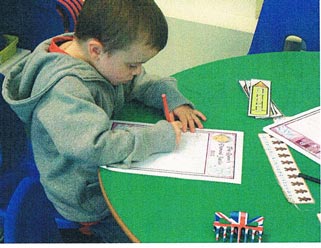
To help encourage imaginative, creative writing, dinosaur faces with speech bubbles can be used.  Pupils readily write short stories about “their” dinosaur and at reception age this method can help with the development of writing skills and the ability to write phonetically.

Creative Writing with Dinosaurs

Dinosaur themed stories great for helping with sentence construction.

Picture credit: Mayfield/Everything Dinosaur

When working with very young children, such as those in nursery, fossils and their physical properties can help children to make simple comparisons and identify associations between objects.  When working with nursery children dinosaurs can help to reinforce a child’s knowledge and understanding of the world around them.  Extension activities can be used to help encourage language and listening skills.

Working with Reception Children

For the reception aged children, the teaching team at Mayfield Primary had developed challenging and varied topic exploration tasks, everything from measuring a dinosaur footprint to recreating a model of a lost world in miniature in a corner of the classroom.   Such activities cater for a wide range of learning styles.  At Everything Dinosaur, we have an extensive library of dinosaur tracks and we have used these prints in a number of measuring exercises, we have helped many teachers create their very own dinosaur track-ways.  For the pupils at Mayfield they were given the opportunity of making cheesy dinosaur feet, another “hands-on” activity that enabled aspects of the Dinosauria to be explored.

Pupils Making Cheesy Dinosaur Feet

Making dinosaur themed snacks.

Picture credit: Mayfield/Everything Dinosaur

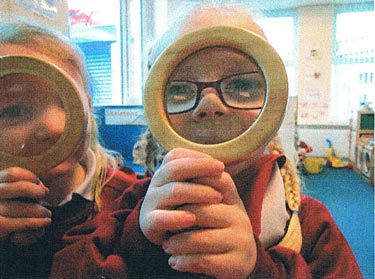
It was certainly a very full itinerary that the teaching staff had compiled and we were happy to assist by reinforcing some of the learning objectives and providing some expert knowledge to help check understanding and summarise some of the key learning outcomes.  Whether it was model making, role playing, naming their very own dinosaur or helping to build Mayfield’s dinosaur exhibition the children seemed to really enjoy learning about dinosaurs and prehistoric animals.

Dinosaur Explorers

Children getting to grips with dinosaurs.

Picture credit: Mayfield/Everything Dinosaur

We suspect a few grown-ups got to learn a thing or two when the children went home each day and explained what they had been doing.  With over 1,200 different dinosaur genera identified to date there is certainly a great deal of scope within this subject area.

Who knows, some of the enthusiastic dinosaur fans at the school may go onto study science and perhaps make their very own contribution to the field of palaeontology in the future.

Our thanks to all the teaching staff who helped make Everything Dinosaur so very welcome during our recent visit and a special thank you to Mrs Ellidge for compiling the photographs and examples of the pupil’s work .

To view the range of educational themed items including replicas of fossils and extinct creatures available from Everything Dinosaur: Dinosaur Themed Educational Items and Prehistoric Animal Models.

6 07, 2012

Bad Weather Making Fossil Collecting at Lyme Regis Hazardous

By |2023-02-02T09:08:08+00:00July 6th, 2012|Categories: Dinosaur and Prehistoric Animal News Stories, Educational Activities, Palaeontological articles|0 Comments

Rock Falls on Monmouth Beach

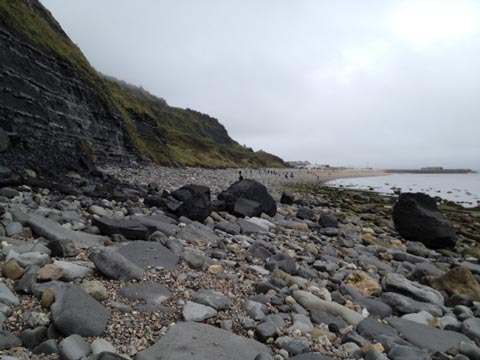
The heavy rainfall that has occurred along the south coast of England over the last few weeks has led to dangerous conditions for fossil collectors as they search along the beaches of Lyme Regis on England’s “Jurassic Coast”.  The cliffs at Lyme Regis are inherently unstable and rock falls are an ever present hazard for beachcombers as they search for ammonites and belemnites.  However, with the dreadful summer weather set to continue the cliffs are becoming saturated and rock falls and slides are more likely to occur. Fossil collecting at Lyme Regis can be dangerous in this weather.

A Recent Rock Fall on Monmouth Beach

Unstable cliffs pose a threat to beachcombers.

Picture credit: Brandon Lennon

Fossil Collecting at Lyme Regis

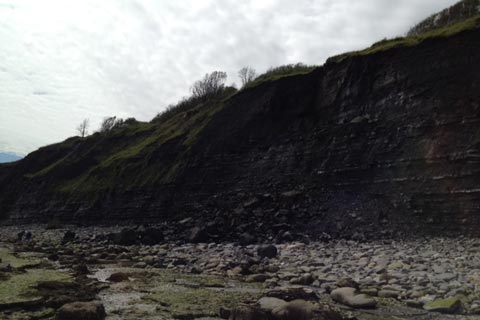
Local fossil expert Brandon Lennon reports that there have been several small rock falls in the Lyme Regis area over the last few days.  Brandon, who leads fossil collecting walks at Lyme Regis, commented that the cliffs at Monmouth beach were particularly unstable at the moment and yesterday (July 5th), there was a substantial rock fall with a number of sizeable boulders hurtling down onto the beach.

Brandon stated:

“The beach areas are particularly dangerous at the moment and I am concerned for the safety of visitors who come to Lyme Regis to explore this part of the Jurassic coast.  The bad weather has made the cliffs very unstable and I have already observed one large landslide that resulted in many tonnes of boulders and debris smashing onto Monmouth beach.”

The last major landslide in the area took place in May 2008, with over one hundred yards of cliff face collapsing.  Fortunately, this rock fall took place late in the evening at high tide so there were no casualties, but with thousands of would-be fossil hunters likely to hit the beaches at Lyme Regis with the onset of the Summer holidays, conditions exist for there to be a very serious incident.

A spokesperson from Everything Dinosaur commented:

“Whilst looking for fossils along the beaches of Lyme Regis can be tremendous fun, on no account should visitors stand directly under the cliffs and day trippers would be well advised to heed the warning signs and take advice from local experts who know all too well the hazards in the area”.

A Large Rock Fall on Monmouth Beach

Dangerous cliffs at Lyme Regis.

Picture credit: Brandon Lennon

One of the best ways to enjoy this part of the Jurassic Coast, a UNESCO World Heritage site, is to take advantage of a guided fossil walk where a professional fossil collector takes parties of visitors out to explore the beaches.  The guide can supervise the fossil hunting and take participants to less dangerous areas whilst still guaranteeing some exciting fossil finds.

To learn more about the fossil walks provided by Brandon Lennon (particularly suitable for families): Lyme Regis Fossil Walks.

4 07, 2012

Theropod Eggs Correlate Directly with Modern Bird Eggs According to New Study

By |2024-04-23T16:10:32+01:00July 4th, 2012|Categories: Dinosaur and Prehistoric Animal News Stories, Educational Activities, Palaeontological articles|0 Comments

Spanish Fossilised Eggs show Strong Link between Theropoda and Aves

Palaeontologists have been aware for some time, of the close anatomical links between certain members of the lizard-hipped dinosaurs known as the Theropoda and modern birds.  A great deal of evidence has been compiled to show that certain types of dinosaur such as the Dromaeosauridae, the raptors, were closely related to Aves (birds).  Scientists know for example, that many small, meat-eating theropods such as members of the Dromaeosauridae, dinosaurs such as Microraptor and Sinornithosaurus were covered in feathers, but there are also striking similarities between the skeletons of birds and the fossilised bones of these types of dinosaur. New research suggests that theropod eggs were extremely similar to modern bird eggs.

Some Types of Dinosaur were Feathered
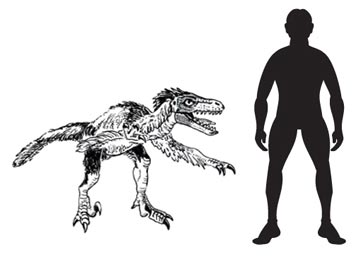
Feathered dinosaurs.

Picture credit: Everything Dinosaur

Dinosaurs and Birds

The link between dinosaurs and birds is not a new theory in palaeontology.  Granted, there have been a number of startling discoveries made of feathered dinosaurs, most notably in the Lower Cretaceous strata of Liaoning Province (northern China).  It was the likes of Thomas Henry Huxley who first proposed the dinosaur/bird link.

Thomas Henry Huxley was an English biologist and an ardent supporter of Darwinism.  When Sir Richard Owen purchased a nearly complete specimen of Archaeopteryx (A. lithographica) in the 1860s, Huxley used this fossil to support Darwin’s theory of natural selection and declared the Archaeopteryx specimen as a “transitional fossil” between reptiles and the evolution of birds.

However, one of the gaps in our knowledge regarding the relationship between certain members of the Dinosauria and the Order Aves, concerned the shape and composition of the eggs that these types of creatures laid.  A number of different shapes and sizes of dinosaur egg are known from the fossil record, but those fossil eggs ascribed to theropods do not closely resemble the shape of a modern bird’s egg such as the type of egg that a chicken would lay.  Typically, a small-meat eating dinosaur might produce relatively elongated eggs, not the ovoid shape that we are used to when we see a bird’s egg.

The discovery of the remains of dinosaur eggs in north-eastern Spain may change all that, as these eggs do resemble those of a modern bird.

Theropod Eggs

Nieves Lopez Martinez, a palaeontologist at the Complutense University of Madrid (Spain), with a doctorate in geology and biology, had been researching into the strange, ovoid and asymmetrical fossil eggs that had been found in the Montsec area of Lleida in north-eastern Spain.  Sadly, she passed away in December 2010.  Her work and that of her colleague Enric Vicens, a palaeontologist at the Universitat Autonoma de Barcelona (Spain), has just been published.  Their extensive research provides strong evidence linking theropod dinosaurs to modern birds, as the eggs found in Spain are very similar in shape and composition to those of extant birds.

The eggs were excavated from two dig sites, located on either side of the Terradets pass.  The strata in this part of Spain represents sediments laid down at the very end of the Cretaceous (Campanian and Maastrichtian faunal stages).  A number of different types of dinosaur are known from this strata – ornithopods, theropods and titanosaurs.  The geological record in this part of Spain is very important, as it is providing scientists with an insight into the flora and fauna that existed in Europe at the very end of the Age of Dinosaurs.

To read an article about “giant dinosaur eggs” being discovered: World’s Largest Dinosaur Eggs – The Facts are Scrambled.

Although, the scientists cannot determine exactly what sort of dinosaur laid the eggs, they have postulated that they were produced by a troodontid a type of dinosaur, closely related to birds.  Troodonts were small, agile, bipedal predators.  The egg fossils, which consist of many fragments plus some complete eggs have been given the scientific name of Sankofa pyrenaica.  The genus name relates to an ancient bird symbol which shows a bird looking over its back with an egg that has just dropped from its mouth.  The species name relates to the fact that the fossils were found in a part of the southern Pyrenees mountain chain.

Some of the Fossilised Dinosaur Eggs (S. pyrenaica)
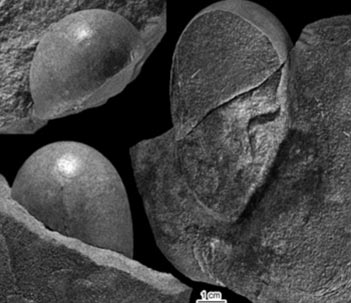
Oval-shaped and asymmetrical like a chicken’s egg.

Approximately seventy million years ago, this part of Spain was a low-lying coastal zone with many shallow lagoons that were bordered by lush, dense forests.  A number of fossils of dinosaur eggs have been found in this area, it seems that a number of different types of dinosaur laid eggs on the raised beaches that made up this coastal zone, but most of the fossil eggs found to date are large, rounded Titanosaur eggs.  These eggs are very different, measuring just seven centimetres high and with a diameter of approximately four centimetres.  The eggshell is roughly the same thickness of that of a hen’s egg.  The scientists measured the fossilised eggshell and found it to be around 0.27 mm thick.

Sectional Analysis of Theropod Eggs

Sectional analysis of those eggs that had been preserved intact showed that at the wider end of the egg there was a substantial air pocket.  Such air pockets are found in modern bird eggs.  If you take a hen’s egg and place it in water, a fresh egg will sink but it will have a degree of buoyancy.  The buoyancy is provided by a small air space contained within the egg.  The pocket of air allows the organism inside the egg to breathe during the last phases of its development prior to hatching.

Such oval-shaped, asymmetrical eggs are extremely rare in the Cretaceous fossil record.  The Spanish researchers related the shape of their eggs to that of a Late Cretaceous bird whose fossils have been found in South America.  The research team postulated that this bird and their dinosaur both laid eggs that were intermediate between modern bird eggs and those eggs laid by extinct non-avian theropods.

A microscopic analysis of the fossil eggshell of Sankofa pyrenaica did reveal significant differences in the shell structure when compared to that of a modern bird’s egg.   Bird and most reptile eggshell is composed almost entirely of calcium carbonate, the structure of the crystals and how they are organised in a bird’s egg differs from that seen in the internal structure of the eggshell ascribed to S. pyrnenaica.

The shape of an egg is dictated largely by the physiology of the organism that lays those eggs.  Asymmetry in bird eggs relates to the fact that birds only have one oviduct, they can only form one egg at a time as a result.  Most dinosaur nests show that eggs were laid in pairs, indicating that these animals had two oviducts.  Scientists believe that modern birds lost the second oviduct as an evolutionary response to the need to lighten their bodies so as to make powered flight more efficient.  The asymmetrical shape of the Spanish dinosaur eggs suggest that Sankofa pyrenaica also possessed just a single oviduct.

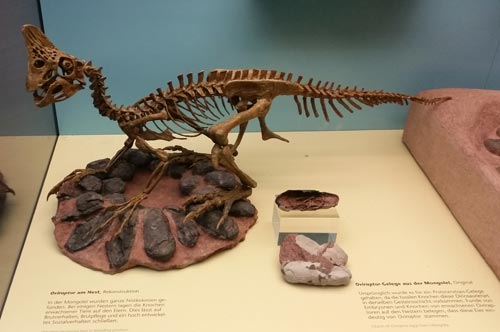
A Dinosaur Nest (Eggs Laid in Pairs)
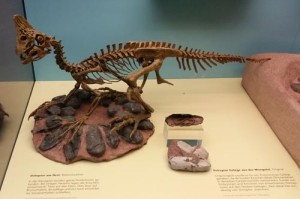
An Oviraptor and dinosaur eggs exhibit.

An Oviraptor and its nest.

Picture credit: Everything Dinosaur.

This fossil evidence strongly supports the theory that certain clades of dinosaur were indeed very closely related to birds.  Parts of the Dinosauria and Aves are very closely phylogenetically related.

Extrapolating this evidence, the next time you eat a boiled egg you are technically eating the egg of a creature very closely related to a dinosaur – or given the location where these fossil eggs were found, would you prefer a Spanish omelette?

Visit Everything Dinosaur: Our Award-winning Website.

2 07, 2012

Observation is Important in Palaeontology

By |2024-04-23T16:15:03+01:00July 2nd, 2012|Categories: Dinosaur and Prehistoric Animal News Stories, Educational Activities|0 Comments

Can you spot a Fossilised Hominid Tooth?

Observation is very important in science, whether you are looking for the Higgs Boson or simply conducting an experiment with Primary school children to see what happens when you deny some germinating cress seeds access to sunlight.  It is important that appropriate observations are made and that these are recorded properly. Observation is key in palaeontology.

When taking a group of young, enthusiastic palaeontologists fossil hunting we demonstrate to them the two main advantages over us “grown ups” when it comes to finding fossils.  Firstly, the children being smaller than us are closer to the ground and this is where the fossils can be found.  Secondly, as they are younger than us, there us are generally better able to focus on small objects, therefore they can spot fossils better than we can.

Observation is Key in Palaeontology

Most fossils are still found by people who are not palaeontologists, we make a point to emphasis the important discoveries made by children as we enthuse them about the Earth sciences.  Observation for a fossil hunter is extremely important.  It is not just a case of knowing where to look but also knowing what to look for.

To illustrate this point, let us recall an event that took place recently in a laboratory at the Witwatersrand University in South Africa.  The University is a world-leader in early hominid research and has led the way in helping to unravel the evolution of a two million year old hominid species known as Australopithecus sediba.

To read an article on the early hominin A. sediba: New Fossils May Help Define Human Ancestry.

Revision of the Hominin Family

The hominin family tree is constantly being revised as more fossil material is discovered.  The Australopithecines were an early group of hominins that evolved around 4.2 million years ago and went extinct around 1.8 million years ago.  A number of species have been described, their exact taxonomic relationship to our own species is debated.  Researchers at the Witwatersrand University (Johannesburg) had brought back to their preparation laboratory a number of rocks and fossils from a site where A. sediba fossils had been found.

However, for three years a large, one-metre wide rock lay undisturbed in the laboratory until a technician observed a tiny, whitish object sticking out of the matrix.  The turned out to be a fossil tooth of Australopithecus sediba and computerised tomography (CT) scans of the rock revealed that hidden inside were a number of fossilised bones of this early hominin.  Observation had resulted in the discovery of very rare and important fossil material, in a rock that had been in the laboratory and under people’s noses as it were for years.

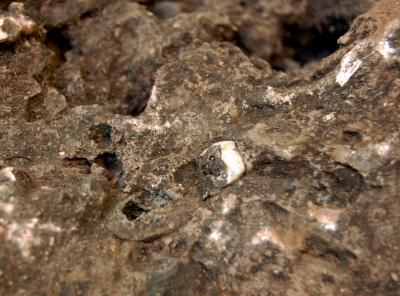
Can you spot the tooth in the rock?

Can you spot the Fossilised Tooth in the Rock?

Observation is very important in palaeontology.

Picture credit: University of Witwatersrand (Johannesburg)

Tooth Spotted in Rock

If the tooth had not been spotted the rock may not have been studied and the chance to learn more about one of the Australopithecines may have been missed.  As we say when we are teaching primary school children, the most important tool that a palaeontologist has are his or her eyes.  Careful observation can help us to uncover a lot of fascinating information as well as enabling us to spot fossils, even a fossil tooth from a 2-million-year-old, potential ancestor of our own species.

The Tooth Highlighted – Did you Spot It?

The tooth fragment i is circled in red.

Picture credit: University of Witwatersrand with additional input from Everything Dinosaur

For creative palaeontology themed crafts: Educational Dinosaur Themed Crafts and Toys.

Next time you are walking along a beach or wandering past a cutting in the road, take a good look you never know what you might find.

To read the article on the discovery of the fossil material inside the rock: Scientists Discover Amazing Early Human Fossil in Laboratory.

27 04, 2012

The Unique Lyme Regis Fossil Festival 2012

By |2024-04-23T07:36:39+01:00April 27th, 2012|Categories: Dinosaur Fans, Educational Activities|0 Comments

Jurassic Coast Fossil Festival 4th to 6th May 2012

The Lyme Regis and Charmouth annual fossil festival is rapidly approaching.  This yearly gathering of fossil experts, musicians, sculptors, actors and scientists is taking place next weekend and a number of exciting, family themed events have been organised to help celebrate this World Heritage location.

Counting Down to the Lyme Regis Fossil Festival

Fossil Festival from 4th to 6th May 2012.

Lyme Regis Fossil Festival

Team members at Everything Dinosaur, caught up with one of the participants Mike Jeffries of Mikes Minerals & Fossils in Drakes Way, Lyme Regis, to ask how his plans for the festival were coming along.

Mike stated:

“I am really looking forward to the Lyme Regis Fossil Festival, this year it seems it is going to be bigger than ever with activities planned right across the May Bank Holiday weekend.”

Mike will be displaying a large selection of fossils, many of which have been sourced from the area’s world famous Jurassic strata as well as crystals and a selection of jewellery.  In addition, Mike hopes to be able to find time in his busy schedule to attend one or two of the presentations given by the many palaeontologists and other experts who will be shedding light on such topics as the lives of ammonites and the history of the life, people and planet Earth in sixty minutes – a presentation entitled “What on Earth Happened?”   This unique, interactive workshop is performed by author, historian and former Sunday Times journalist, Christopher Lloyd.

The exhibition organisers are once again anticipating that the Lyme Regis and Charmouth part of the Jurassic coast will receive many thousands of visitors next weekend, this annual event has become the biggest gathering of its kind held in the UK.

Mike, a stalwart of the festival added:

The Lyme show is now probably the best fossil show in the country.  Let’s hope, in these difficult times, it continues for years to come.”

Team members at Everything Dinosaur, hoping to visit will be able to see Mike and his chums hard at work at the fossil fair and can pop into Mike’s fossil shop in Drake Way, which will be open all afternoon on each day the event is on.

Amongst the family orientated activities that the hard-working organisers have arranged there is the opportunity to study specimens brought from the Natural History Museum (London) and to talk to their experts, experience flying in the Jurassic Period, learn about dinosaur footprints with the University of Plymouth and to go on fossil walks along the coastline with professional fossil hunters.  Look out for Andy Cowap and Pete Langham’s stand at the fossil fair, they will be selling a range of beautiful ammonite fossils – so if you have ever wanted to pick up a Jurassic bargain…

For replicas of ammonites and belemnites: CollectA Age of Dinosaurs Popular Range.

The winter storms will have exposed a lot of new fossil material on the Dorset coast, so this is the perfect opportunity to come down to the Lyme Regis area, learn about this World Heritage site and participate in a range of fun and educational activities.  When on the beach, we would recommend sensible walking attire, with sturdy boots or wellingtons and don’t forget the waterproofs, although Lyme Regis seems to have a micro-climate all of its own, it is best to be prepared for the odd shower or two.  Besides, if you are dressed up you will be making the British Antarctic Survey team feel at home as they will be in the Grand Marquee showing fossils found on the most southerly of the continents as well as letting visitors experience life in the Antarctic .  If you have ever wondered what people eat at the South Pole and how they survive, check out the survey team’s tents, expedition equipment and rations for life at the bottom of the world.

Rockwatch

Our chums at Rockwatch will also be attending.  Rockwatch is the nationwide club for young geologists.  It is the junior club of the Geologists’ Association and is for all those interested in things geological – rocks, fossils, minerals and landscapes.  Sue and her team have lots of hands-on activities planned this year, be sure to say hello to the Rockwatch staff in the Grand Marquee.

For Brandon Lennon, a professional fossil collector and provider of highly informative fossil hunting walks in the area, the festival gives him an opportunity to help educate the public on how fossils are prepared.  On the first day of the festival (Friday), Brandon and his father Ian, will be assisting with the fossil walks, as Brandon himself comments:

“Having the start of the festival on a Friday, gives local schools the opportunity to participate.  The fossil collecting on the beach has been really good lately, with some great finds, so I am really looking forward to helping the school parties to explore the geology and to learn more about the fossils to be found at Lyme Regis.”

Brandon is certainly going to be busy over the weekend, he can be found down on the sea front in the grand marquee on both the Saturday and Sunday demonstrating how fossils are prepared for display.  Brandon, along with his chum Chris Andrew from the Philpot Museum, will be carrying out an ammonite polishing workshop, where for a small fee members of the public can have a go at preparing and polishing their very own Jurassic specimen.  The workshop will be open from 10am until 4pm on both Saturday and Sunday, so if you want to learn how the experts handle fossils and to have a go yourself, make sure you pop in to see Brandon and his colleagues.

To learn more about fossil walks that take place at Lyme Regis:  Fossil Walks with Brandon Lennon.

There is certainly something for everyone at the forthcoming Lyme Regis Fossil Festival.

24 04, 2012

Fortieth Anniversary of the First Paper on Computerised Tomography

By |2023-03-09T09:59:57+00:00April 24th, 2012|Categories: Dinosaur and Prehistoric Animal News Stories, Educational Activities, Palaeontological articles|0 Comments

Remembering Sir Godfrey Hounsfield (1919 – 2004)

Today, the 24th April, marks the fortieth anniversary of the publication of a scientific paper by Godfrey Hounsfield (knighted in 1981), which described his new invention – the C.T. scanner.  C.T. scanners (computerised tomography), are used throughout the world and images and data they provide has revolutionised the diagnosis of internal health problems as well as finding applications in all sorts of other fields including palaeontology.

Sir Godfrey Hounsfield

Sir Godfrey, an electrical engineer and scientist, was not regarded as a particularly intelligent or gifted pupil when he was at school, indeed, he was held back a year to enable him to progress with his studies.  However, with the outbreak of the second World War, he joined the RAF and soon his interest in electronics and mathematics was noticed.  He was assigned to work on RADAR projects and after the war he was recommended to pursue his education by attending a prestigious electrical engineering establishment based in London.  He joined EMI and worked on a number of projects, eventually becoming a senior researcher to the company.

Computers and X-rays

In the early 1970s he combined a fascination with computers and X-rays to devise a method of being able to identify the what was inside boxes by focusing X-rays on the object from multiple angles and using a computer to generate an image from the data recording the level and degree of X-ray penetration.

The multi-layered use of X-ray imagery and the analysis of absorption values using a computer has changed the way that many medical conditions are diagnosed.  Godfrey was awarded the Nobel Prize (in conjunction with Allan MacLeod Cormack) for his work on the development of computer X-ray tomography.

It is not just human beings that can be scanned, all sorts of objects can now be examined in a non-destructive manner to see what lies inside.  In palaeontology, whole body scanners can provide an in-depth picture of what exactly lies inside a block of stone (matrix).  This technique can also be used to analyse internal structures of fossils to provide palaeontologists with new insights into the anatomy and physiology of prehistoric animals.

To read about the application of C.T. scans in palaeontology: Birth of a Dynasty – Earliest Ancestor of T. rex Described.

Thanks to Sir Godfrey, palaeontology as well as a number of other scientific fields have an important tool to help further our knowledge.

To view Everything Dinosaur’s website: Everything Dinosaur.

6 04, 2012

Baby Mammoth Killed by Lions and then Butchered by Humans

By |2023-01-29T09:49:39+00:00April 6th, 2012|Categories: Dinosaur and Prehistoric Animal News Stories, Educational Activities|0 Comments

Yuka – The Siberian Baby Mammoth Killed by Steppe Lion and then Butchered by Humans

A number of television documentaries have aired recently concerning the discovery and the initial research on a baby Woolly Mammoth (Mammuthus primigenius) whose frozen carcase was recovered from Siberia.  Each spring, as the winter snows thaw, a number of Pleistocene animal remains are discovered as they are eroded out of the thawing ground by the action of rivers in spate.  These fossils, some of them beautifully preserved with internal organs and fur intact reveal that this part of the world during the Pleistocene Epoch was inhabited by some spectacular prehistoric mammals.

The habitat known as the Russian Mammoth steppe was a huge expanse of grassland that existed between the northern ice sheets and more wooded, mainly conifer forest that was to be found further south.  A number of large herbivores grazed on the plains.  As well as Mammoths, there were Woolly Rhinos (Coelodonta spp.), giant deer, several other types of now extinct antelope and horses.  Living alongside these herbivores there were several types of predator, a number of species of bear, plus Sabre-toothed cats and other members of the Felidae (cat family) such as Cave Lions and the slightly smaller Steppe Lion.

Baby Woolly Mammoth

Recently, the body of a baby Mammoth was discovered and scientists from the International Mammuthus organisation have been studying this carcase in a bid to find out more about Mammoths in general and to identify how this particular young animal met its end.  The baby Mammoth has been given the name Yuka, and as well as being remarkably well-preserved, this corpse reveals evidence with other inhabitants of the Mammoth steppe, including the possibility of human hunters.

The skull and pelvis have been removed from the corpse, they were found close to the body but most of the ribs and much of the spine is missing.  There is a long, straight cut along the top of the animal’s back, this was made by people, but whether it is evidence of the body being butchered as the remains rested on the steppe thousands of years ago or more recent human activity is difficult to determine.

The scientists are fairly certain that this young Mammoth was not actually killed by people.  Yuka shows signs of being attacked by an apex predator possibly a Cave Lion or a Steppe Lion, certainly a member of the Felidae (cat family).  It is very likely that this predator killed the Mammoth calf, human hunters may have discovered the carcase and removed some of the bones and meat, or perhaps they chased the lion(s) off the kill and took over the body, robbing the big cats of their meal.

Poor Yuka

Poor Yuka, seems to have had a very unfortunate and brief life.  Healed scratches on the preserved skin shows that this Mammoth survived another attack by a cat – possibly an Eurasian Cave Lion, but much deeper wounds and a broken leg which had not healed imply that a second attack was either fatal or severely weakened the young animal.

The carcase provides evidence of potential ancient human interaction.  Radio carbon dating indicates that this Mammoth lived right at the end of the Pleistocene epoch, perhaps it was one of the last Mammoths to live in this part of Siberia.  The corpse is estimated to be around 10,000 years old.  The long, straight cut along the back, in conjunction with other cut marks that show a distinctive pattern as if they were created by a saw-bladed cutting tool of some kind, provide evidence that humans have interfered with the body.

If the liver had been removed, then this could be further evidence that the carcase had been butchered for its meat.  The liver is regarded as one of the most nutritious parts of any mammal carcase.  Nomadic hunters today, when killing and butchering large mammals such as antelope often remove the liver first.  If the liver is missing and the body cavity shows signs of intrusion then this could confirm the hypothesis that some human hunters 10,000 years ago grabbed an opportunity to get some food from the young Mammoth’s remains.

International Mammuthus Organisation

The researchers from the International Mammuthus Organisation suggest that Yuka was about 30 months old at the time of death.  In Africa, lions are known to attack young elephants (African elephants – genus Loxodonta), but this is the first time that evidence has been found of a Woolly Mammoth being attacked by members of the Felidae.

Tackling an elephant is a substantial task, even for a pride of lions.  Often the elephants are aware of the big cats, but during daylight they can fend off any attacks.  The lions tend to wait until dark, their better night vision gives them an advantage over their much heavier intended victims.  It can only be speculated, but perhaps a Steppe Lion attacked a weakened Yuka at night, finally bring the young animal down.

Much of the soft tissue is still connected to the bones, and there is a substantial amount of Mammoth fur on the remains.  Fur is still on the flanks, on the rump and the feet, it is as strawberry blond colour, bearing out predictions made a few years ago on the potential colour of Mammoth fur after a detailed genetic analysis on another frozen baby Mammoth known as Lyuba.

Finding such beautifully, well-preserved remains of these ancient herbivores will help scientists to better understand Mammoth DNA and traits such as eye and hair colour.  Although, many Mammoths were a reddish-brown colour, the gene that contains fur/hair colour is very similar to the gene that controls the colour of human hair.  This means that Woolly Mammoths could be as varied in colour as human hair – Mammoths could be blond, ginger or even brunettes.

To view Woolly Mammoth soft toys and other prehistoric animal soft toys: Prehistoric Plush – Prehistoric Animal Soft Toys.

2 04, 2012

World Autism Awareness Day – Recognising a Significant Day

By |2024-04-23T06:59:40+01:00April 2nd, 2012|Categories: Educational Activities, Press Releases|0 Comments

World Autism Awareness Day 2012

Today, April 2nd is the fifth annual World Autism Awareness Day.  Every year, for the past five years, organisations with an involvement in autism or in related fields such as Asperger Syndrome on this day celebrate the uniqueness of these conditions.  Market research undertaken by the National Autistic Society in the UK a couple of years ago postulated that there were perhaps 500,000 people in the country with some form of autism.

World Autism Awareness Day

Autism is very debilitating  affecting the way that people with this condition interact and communicate with the rest of the world.  They can find it difficult to make sense of the world around them and can be over-sensitive to sensory stimuli.  A lot of research has been undertaken over recent years to try to understand these complex conditions.   One thing that now seems certain, neither Autism or other related conditions such as Asperger’s are related to low intelligence.

Children on the autistic spectrum, may have a tendency to obsess on certain objects or subjects.  Very young children, in our experience can become fixated with cartoon shows or television programmes, or indeed characters seen in these programmes.  Some older children obsess about dinosaurs and prehistoric animals, much to the vexation of their parents and guardians who struggle to keep up.  We at Everything Dinosaur try to assist where we can.  After all, we do supply a lot of dinosaur toys and games for autistic children.  For example, one of the attractions of dinosaurs to children on the Autism Spectrum are the long names and all the complicated facts associated with these prehistoric monsters

Some children on the spectrum, seem able to retain vast amounts of information related to their favourite dinosaurs and can recite an astonishing amount of factual information about these prehistoric creatures.  Team members send out fact sheets and pronunciation guides to parents/guardians who in turn pass these on to their charges.  We handle enquiries, answer specific questions, provide advice, email over drawing materials, send out fact cards – all sorts of things as with some of our team members coming from a teaching background we recognise the importance of offering such support.

The Uniqueness of the Individual

Today, on this special day our thoughts are even more with those sufferers and with their families, we celebrate the uniqueness of the individual.

The National Autistic Society (UK): National Autistic Society.

Celebrate World Autism Awareness Day on Facebook: World Autism Awareness Day on Facebook.

True to our word, whilst teaching at a school in London one of the TAs (Teaching Assistants) approached us requesting some assistance for her daughter who taught at a special school in the capital that catered for the needs of children on the autistic spectrum.  Within 24-hours of our visit, we had emailed a teaching contact with a dinosaur themed alphabet and our own set of prehistoric fact cards that could then be forwarded on to the teacher concerned.

To contact Everything Dinosaur team members for advice about prehistoric animal toys and dinosaur figures suitable for those on the austism spectrum: Send Everything Dinosaur an Email.

Go to Top