All about dinosaurs, fossils and prehistoric animals by Everything Dinosaur team members.

Everything Dinosaur’s work with schools and other educational bodies. Articles, features and stories about dinosaurs and their role in education and educating young people.

1 04, 2012

Exploding Prehistoric Animal Carcasses as they Rot – New Evidence

By |2023-01-29T08:37:07+00:00April 1st, 2012|Categories: Dinosaur and Prehistoric Animal News Stories, Educational Activities, Palaeontological articles|0 Comments

Gas Build Up in Rotting Prehistoric Animal Remains did not Cause them to Explode

A new study by scientists from the University of Zurich (Switzerland) has dispelled the theory that putrefaction gases produced by decomposition caused some dinosaur and other prehistoric animal carcasses to explode before they were fossilised.

Prehistoric Animal Carcasses

A number of animals preserved in the fossil record, their subsequent body fossils had puzzled scientists as to how the bones had come to be positioned in relation to other parts of the preserved skeleton or skeletons.  In particular, the fossilised remains of a pregnant ichthyosaur (marine reptile) found in the Lower Jurassic deposits of Holzmaden (southern Germany), has intrigued researchers.  The skeleton of the adult, is preserved with the majority of the bones in articulation, in the same relative positions as when the animal was swimming around in the Jurassic sea.

Ichthyosaur Embryos

The bones of the ichthyosaur embryos, preserved with this specimen however, are very different.  For the most part, they lie scattered outside the body of the mother.  Such peculiar bone arrangements are repeatedly found in ichthyosaur skeletons excavated from the finely, grained Holzmaden deposits.

Ichthyosaurs are believed to have evolved the ability to give birth to live young – viviparity.  These reptiles did not lay eggs like crocodiles and turtles, but they kept their embryos inside them, until they had reached a certain size before giving birth to independent young.

To read an article on a controversial fossil discovery that suggests that other marine reptiles such as plesiosaurs were also viviparous: Does Plesiosaur Fossil show Evidence of Viviparity?

Holzmaden “Exploded” Ichthyosaur Skeleton

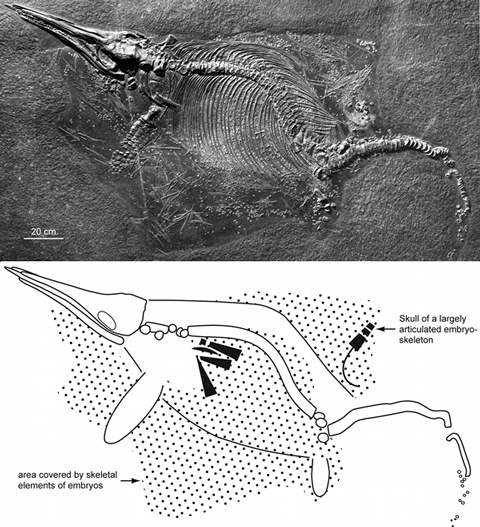
Puzzling ichthyosaur fossil.

Picture credit: University of Zurich

The picture above shows a photograph of the ichthyosaur fossil and an interpretative line drawing of the fossil showing underneath it.  The beautifully preserved adult skeleton is articulated but the fossils of the embryos are scattered over a large area.  The scale bar in the photograph represents twenty centimetres.

Embryo Fossils

Most scientists thought that the position of the embryo fossils and their disarticulation was due to the carcase having exploded as gases caused through the process of putrefaction built up in the body cavity.  These gases, created as a body decomposes would cause the carcass to swell up and become bloated before finally bursting.  It had been thought that through such explosions, even the bones of embryos would have been ejected out of the body.  The Zurich based researchers have challenged this hypothesis by carrying out a series of  elaborate  measurements and an analysis of the physical-biological parameters.  The scientific team, which included sedimentologists, palaeontologists and forensic scientists has put forward new evidence that may dispel the myth of exploding prehistoric animal remains.

In order to gauge the pressure of the particular gases that can actually develop inside a putrefying remains of an Ichthyosaurus, the researchers sought comparative models and found one in a surprising area of science – the forensic study of human corpses.  Humans and many ichthyosaur are similar in size and as vertebrates we do have roughly the same body plan and digestive tract.  As a result, the formation of similar amounts of putrefaction gas can be expected during decomposition of the dead body.   At the Institute of Forensic Medicine in Frankfurt, Germany, a manometer (device used to measure pressure) was inserted into the abdominal cavity through the umbilicus in one hundred corpses.

A Beautiful Ichthyosaur Fossil

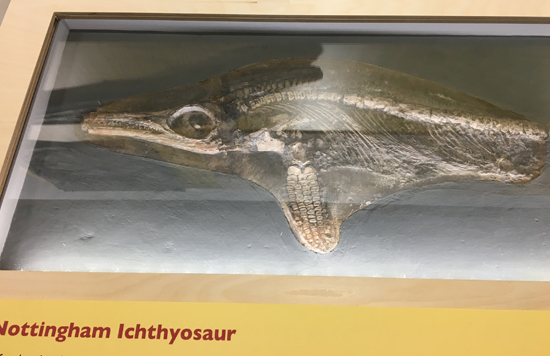
Protoichthyosaurus applebyi

The Nottingham ichthyosaur (P. applebyi).

Picture credit: Everything Dinosaur.

The putrefaction gas pressures measured were only 0.035 bar.  In the case of the ichthyosaur remains that came to rest in depths between fifty and one hundred and fifty metres of water, however, putrefaction gas pressures of over five to fifteen bar would have been necessary to cause a body to explode.

Zurich based palaeontologist Christian King, one of the researchers involved in this macabre study believes that gas pressures strong enough to cause a carcase to explode in this depth of water are impossible to achieve.

He stated:

“Large vertebrates that decompose cannot act as natural explosive charges.  Our results can be extended to lung-breathing vertebrates in general.”

So what did cause the anomaly of the adult body remaining virtually intact whilst the remains of any embryos associated with the fossil specimen to be scattered?

According to the researchers, the fate of ichthyosaur bodies can be reconstructed, they have theorised as follows:

Normally, the bodies sank to the seabed immediately post mortem.  In very deep, hospitable waters, they were broken down completely through putrefaction, scavengers, bone-destroying organisms and dissolving processes, in exactly the same way that marine mammal carcases are broken up today.  In shallower water (up to fifty metres in depth) and a temperature of over four degrees Celsius, however, the corpses often rose back to the surface on account of the putrefaction gases accumulating inside the body.   As the gases built up, they made the corpse buoyant forcing the body to rise to the water surface,  just like a cork when placed in a bucket of water floats to the top.  At the surface, exposed to the waves and scavengers, such as fish, pterosaurs and other marine reptiles, the bodies decomposed within anything from a few days to weeks and the bones which were not eaten whole by the likes of a pliosaur were scattered over a wide area on the seabed as they sank.

However, the scientists believe that under very special conditions, ichthyosaur bodies would remain preserved more or less in their anatomical position.  A lack of oxygen, medium water depths and insignificant bottom water currents could lead to the fossils that we see today.  Because only under these conditions were the putrefaction gases compressed strongly enough through the high water pressure and dissolved in the bodily fluids, and the carcasses not completely broken down due to a lack of scavengers on the seabed.  The carcass of the ichthyosaur female from Holzmaden, dated to around 182 million years ago, probably sank to the bottom of the sea, which was up to 150 metres deep, where it decomposed.  It was the action of minor underwater currents on the sea floor that carried the decomposing bodies of the embryos out of the mother and scattered their remains around the larger body.  The bigger bones of the adult ichthyosaur were less affected by the sea currents and therefore remained in situ.

The Hozmaden deposits have yielded some of the world’s best fossils of marine reptiles, especially plesiosaurs and ichthyosaurs.  This new study provides further information on how to interpret fossil vertebrate remains and can help shed light on the potential water depths at which these fossils came to rest.

To read about the discovery of a new species of European ichthyosaur earlier this year: New Ichthyosaur Species Swims into View.

Everything Dinosaur acknowledges the assistance of a press release from the University of Zurich in the compilation of this article.

For models and replicas of marine reptiles including ichthyosaurs: Sea Monsters and Prehistoric Animal Models.

31 03, 2012

The Young Palaeontologists at Kensington Primary School

By |2023-01-29T07:53:26+00:00March 31st, 2012|Categories: Dinosaur Fans, Educational Activities, Everything Dinosaur News and Updates, Teaching|0 Comments

Year 4 Pupils at School Demonstrate their Knowledge of Dinosaurs

Yesterday, one of Everything Dinosaur’s team members visited Year 4 pupils at Kensington Primary school as part of the school’s teaching topic which has focused on dinosaurs.  The budding young palaeontologists were keen to show off their special dinosaur hats that they had made under the supervision of their teacher’s Miss Rafique and Miss Vavrykovych.  The visit from Everything Dinosaur helped reinforce learning outcomes that had been covered during an earlier trip to the Natural History Museum, the classroom walls displayed the various stories and pictures that the children had created. There were even some dinosaur scenes on display that the children had made, surrounded by all these dinosaurs, we were certainly made to feel at home.

Young Palaeontologists

Three brave pupils in Miss Rafique’s class got the chance to cast a museum quality replica of a tyrannosaur manual ungual (finger claw most likely from a large, Late Cretaceous meat-eater known as Albertosaurus sarcophagus).  This would make an interesting addition to the classroom’s colourful dinosaur display, after all, not many school children get to see and handle dinosaur claws.

Some of the Colourful Artwork on Display Outside the Classrooms

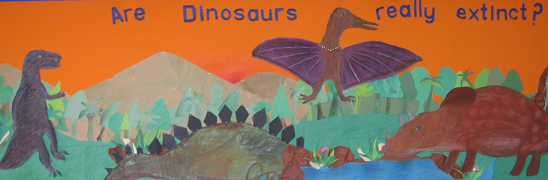
Are dinosaurs really extinct?

Picture credit: Everything Dinosaur/Kensington Primary School

As part of Everything Dinosaur’s commitment to the Earth Sciences we wanted to give the children an insight into some real palaeontology puzzles and problems. For example, one class looked briefly at the horned dinosaur Triceratops and why very few fossilised forelimbs seem to have been preserved in the fossil record, whilst the second class looked at Spinosaurus and what the fossils tell us about huge meat-eating dinosaurs.

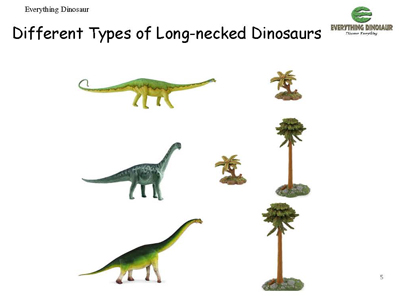
Building on this theme, with the assistance of Miss Rafique and the teaching assistant, Mrs Pate,l we explored how the sauropod (long-necked dinosaur), Brontomerus got its name.  Having examined some of the evidence, the pupils were given the chance to name their very own sauropod.

 Naming a Dinosaur – Different Sauropod Types

Thinking of a name for a long-necked dinosaur.

Picture credit: Everything Dinosaur

Based on the fossil evidence provided, the school children came up with a variety of amazing names for a herbivorous dinosaur whose long neck enabled it to reach high into trees to feed.

Dinosaur Names

Some of the names the children thought of:

Branchosaurus, Altisaurus, Reachosaurus, Antelopeohsaurus and Dinnerosaurus.

When classifying newly discovered dinosaurs, if you are given the job of describing the animal then you get to name it, so perhaps these young palaeontologists may inspire some amazing dinosaur names.

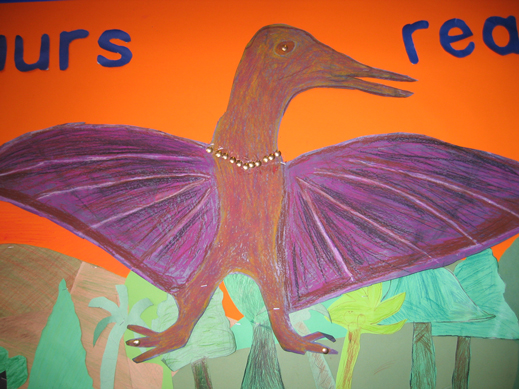
Close up of the Pterosaur (Flying Reptile) in the Artwork

Interesting use of drawing pins.

Picture credit: Everything Dinosaur/Kensington Primary School

On the very colourful dinosaur artwork that was on show outside Year 4’s classroom, we noticed a novel use of drawing pins.  The pictures had been pinned to the backdrop, but also a drawing pin had been used to make the eye of the pterosaur (flying reptile).  Drawing pins had also been used to make a dramatic, gold necklace-like marking on the neck of the creature.  We thought this was a lovely and very creative touch.  Perhaps if scientists were to discover a flying reptile fossil with distinctive markings on the cervical vertebrae (neck bones) they could call in “Machorhynchus” as the drawing pins reminded us of a chest medallion.

It was a pleasure to visit the school and to meet all the enthusiastic pupils, perhaps some of the children will go on to have a career in the Earth sciences.

Visit Everything Dinosaur’s website: Everything Dinosaur.

22 03, 2012

Remembering Adam Sedgwick – A Pioneer of Geology

By |2023-01-29T07:25:07+00:00March 22nd, 2012|Categories: Educational Activities, Famous Figures, Geology|0 Comments

Adam Sedgwick – One of the Founding Fathers of Geology

Today, the 22nd March, marks the 227th anniversary of Adam Sedgwick, one of the founding fathers of geology and perhaps one of the most influential Earth scientists of the 19th century.  Adam Sedgwick was born in Yorkshire (England) on March 22nd 1785.  A Cambridge University graduate, Sedgwick dedicated most of his adult life to the study of rocks, rock strata and geological features and was instrumental in helping to classify the strata of the United Kingdom.

Adam Sedgwick

Working with the soon to become be-knighted, Roderick Murchison, Sedgwick mapped the Lower Palaeozoic strata of Wales and using fossils found in rocks that he studied, defined the Cambrian geological period  and the later Devonian geological period (with Murchison).  This work took place during the 1830s when the extension of Britain’s canal system and the first railways led to there  being much more interest in strata and rocks in the United Kingdom, more than ever before.  The on set of the industrial revolution led to the need for more coal and the demand for this fossil fuel helped to develop a scientific interest in how rock layers are formed and how old they might be.

Sedgwick was instrumental in helping to lay the foundations for the science of biostratigraphy.  Biostratigraphy involves estimating the age of strata, which may be separated by hundreds of miles, by examining the fossils it may contain and comparing the fossil data to that found in other bands of rocks.  Widely separated outcrops of rock could be correlated using fossils to identify the relative age of different strata.  Adam Sedgwick studied theology as well as mathematics and was adopted into the English clergy.  Throughout his life he struggled to defend the established religious doctrine against the advancements made in the knowledge of the Earth’s age, formation and composition.  Although Charles Darwin was one of his geology students, he never accepted the theory of natural selection postulated by Darwin in his seminal book “On the Origin of Species”, which was published in 1859.  In fact, Sedgwick was an ardent critic of Darwin’s work and although he praised Darwin for his meticulous studies, he could not accept the consequences of the main theory that Darwin postulated – that of evolution by natural selection.

Scientific Controversies

Sedgwick was involved in a number of scientific controversies, one of the most famous of which was his long running dispute with his former friend and colleague Sir Roderick Murchison.  Whilst studying the rocks and strata of Wales, Sir Roderick in a re-assessment of some of the work carried out in conjunction with Sedgwick; subsequently lowered the base of the Silurian geological period, into the later part of the Cambrian period that had been established previously.  This debate as to when the Silurian began and the Cambrian ended was not fully resolved for many years.

Sedgwick was awarded the Woodwardian Professorship at Cambridge University, a post that he held for more than fifty years.  He played a significant role in the development and advancement of the principles of geology, and today we acknowledge his contribution to Earth Sciences.

To view replicas of iconic animals from the fossil record: Models of Iconic Fossil Animals.

12 03, 2012

Low Tides Attract Fossil Hunters to the Coast

By |2024-04-23T06:56:30+01:00March 12th, 2012|Categories: Educational Activities, Geology|0 Comments

Low Tides and Longer Days Bring Out the Fossil Hunters

Spring is in the air, it is time to dust off the overalls, get out the geological hammers, the sturdy boots, the safety goggles and the trusty high visibility clothing and to once again indulge in the hobby of fossil collecting.  At this time of year, the weather is getting a little milder, the worst of the winter storms are over and the bad weather will have eroded more exciting finds out of cliffs and onto beaches, making fossils much easier to obtain, and the low tides will attract many fossil hunters.

Fossil Hunters

Beaches can be a great place to find fossils.  Wave action exposes fossils on the shoreline and helps to erode rocks and fossils out of any overhanging cliffs.  Many exciting finds, even dinosaurs have been found after a careful examination of the rocks on the shore.

In particular, spring tides can be a blessing for any keen fossil hunter.  Spring tides occur just after a new and full moon and they mark the greatest difference between high and low water.  It is the very low tides that can make the difference allowing fossil hunters to access parts of the shoreline not normally exposed.  The high tides can have an effect of scouring the beach, especially if there are plenty of pebbles and gravel available.  The low tide/high tide combination can expose new fossil bearing rocks and permit some exciting finds to be made.

Time for some Fossil Hunting

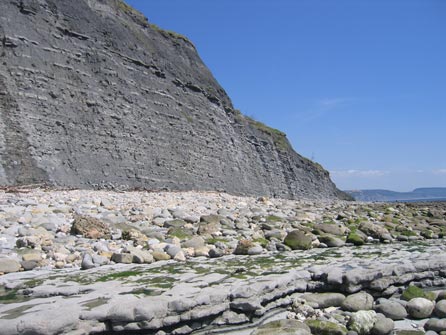
Avoid cliff edges as rock falls may be likely.

Picture credit: Everything Dinosaur.

Naturally, precautions should be taken.  For a modest investment, a local tide timetable can be purchased.  This provides invaluable information in the form of a set of tables, usually broken down into calendar months that show the time of the low tide and the time of the high tide for any given day.  Armed with this knowledge, you can venture onto the beach and exploit the shoreline at the low tide, whilst remaining confident that  you will not put yourself into harm’s way with  a rising tide, threatening to cut you off.

Sensible Precautions

Another sensible precaution before venturing onto the beach to look for fossils is to let someone know what time you will be expected back.  A mobile phone is useful in case you need to change you plans in mid trip, but it is still good advice to inform someone as to when you are likely to return.   If it is possible, bring a friend along to help you search.  This is much safer than venturing out onto the beach or around the bottom of cliffs on your own.  Two pairs of eyes are better than one when it comes to looking for fossils and it is always useful to have an extra pair of hands to help you carry your discoveries back home.

At low tide parts of the seabed not normally exposed to the air are available for you to explore.  After the winter storms, some large rocks may have been washed a long way down the beach and into the far reaches of the tidal zone.  This can lead to some interesting finds, especially if you are amongst the first to venture out.  It is also fascinating to see the beach at this time of year, in the early morning light it can look quite atmospheric and even though you may have visited the location on numerous occasions a low tide can make even the most mundane of beach views look entirely different.

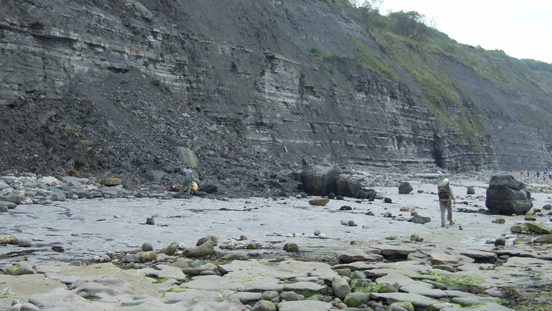
A View of the Beach at Low Tide (Dorset, England)

Lyme Regis at low tide.
Good idea to go fossil collecting on a falling tide and to keep away from the steep cliffs.

Picture credit: Everything Dinosaur.

When exploring the top of the beach, near to the cliff bottoms, it is best to be cautious and to look out for any signs of a potential rock fall.  Sometimes, speaking to locals can give fossil hunters an idea of how dangerous any cliffs might be and the frequency of land slips and rock falls.  If warning signs have been posted up then they are there for a very good reason and they must be heeded at all times.

Fossils can be found on many parts of Britain’s coastline.   A geological map will provide information on the age of rocks and indications as to whether or not they are likely to contain fossils.  There are many excellent guides that can be purchased for a small fee and plenty of other information resources available both on-line and off-line.  To get the most out of any visit to a beach to search for fossils it is best to do some reading and research before hand.

For models and replicas of iconic animals from the fossil record such as ammonites, ichthyosaurs and belemnites: CollectA Prehistoric Life Models.

Unfortunately, the weather cannot be guaranteed, so it is always a good idea take some waterproof clothing, there is nothing more frustrating than having to abandon a fossil hunting trip because rain gear was forgotten and the weather has taken a turn for the worse.  Sensible shoes are a must, even on the driest and sunniest of days.  A decent pair of walking boots is a sound investment for anyone with an interest in fossil collecting, alternatively, stout wellington boots can be worn.

For further information and advice about fossil hunting: Email Everything Dinosaur.

When searching for fossils on a low tide, it is worth remembering that many of the exposed rocks on the beach will be covered by seaweed, this can be extremely slippy and great care must be taken when traversing rocky areas.  A strong walking stick can be of assistance as can a rucksack as keeping things in a back pack enables you to have your hands free to help with clambering over any particularly large obstacles.

Fossil Hunting

If a geology hammer is to be used, perhaps to crack open a nodule searching for ammonites or such like, it is a very sensible precaution to slip on a pair of safety goggles.  Rock shards and other debris could fly up as you strike the surface of the rock and the goggles help protect your eyes.  It is certainly well worth while cracking a few nodules on certain beaches, such as those public beaches in Dorset that make up part of southern England’s Jurassic coast.  Many of these large nodules contain ammonite fossils and if you are lucky you might be able to find your own ammonite specimen.

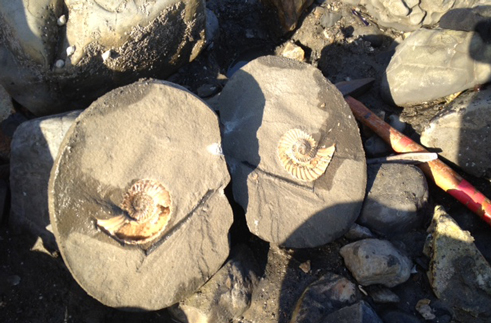
 At Low Tide Ammonites Appear

Crack open a rock nodule and you never know.

Picture credit: Brandon Lennon

The above picture shows a super ammonite – Asteroceras confusum found by Lyme Regis fossil expert Brandon Lennon.   A superb specimen collected at low tide.

With fossil hunting a few hours on the beach can result in some amazing and fascinating additions to your fossil collection.  To get the very best out of the spring low tides, we suggest you find out if there is a local fossil expert who conducts organised trips, let an expert take you on a fossil walk and help you to discover some truly fascinating natural wonders.

To read more about guided fossil walks around Lyme Regis: Guided Fossil Walks with Brandon Lennon.

9 03, 2012

A Slice through Deep Time at Lyme

By |2023-03-09T06:13:47+00:00March 9th, 2012|Categories: Dinosaur and Prehistoric Animal News Stories, Educational Activities, Everything Dinosaur News and Updates|0 Comments

Philpot Museum to Run More “Rock Cutting” Workshops

The Philpot Museum based in the historic seaside town of Lyme Regis is going to be running a series of workshops over the summer showcasing the skills of lapidary and fossil preparation.  Under the supervision of the museum’s dedicated staff and some of the professional fossil collectors at Lyme Regis, visitors will be able to test their own skills at preparing Jurassic aged fossils by having a go at polishing ammonites.

 2012 Workshop Dates at the Museum

Your chance to be a Rock Star!

Table credit: Everything Dinosaur

Lyme Regis

Building on the success of last year’s event the museum staff are expecting another high turnout with enthusiastic visitors observing how ammonites are carefully cut into sections using diamond bladed saws.

For a small fee, you can have a go at polishing your very own piece of the Jurassic coast.

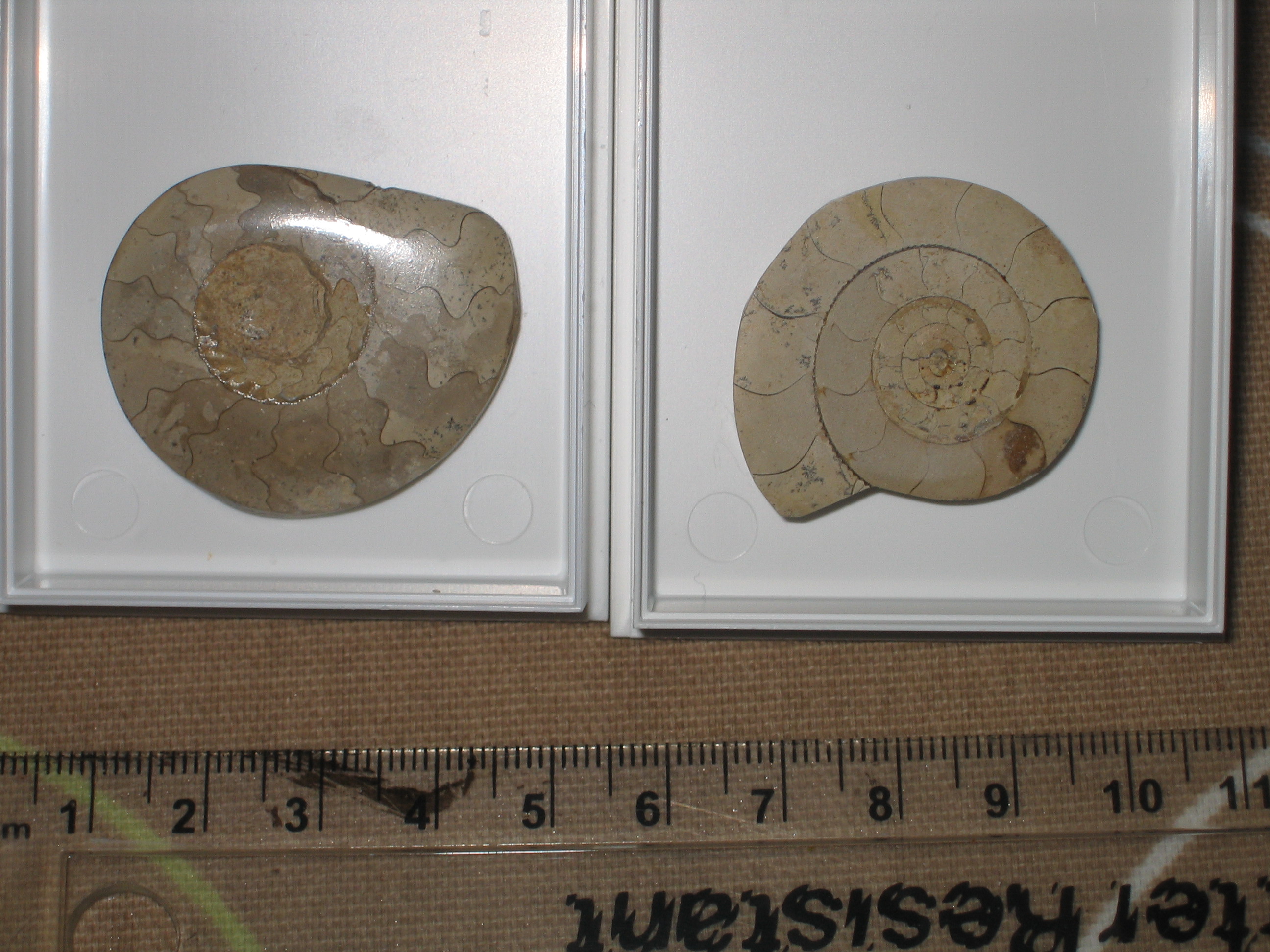
Ammonites are cephalopods (related to modern squid and cuttlefish).  They originated in the Devonian and survived right up to the end of the Mesozoic.  Most ammonites have planispiral shells consisting of a series of living chambers that increase  in size outwards from the centre of the spiral.  They are a particularly diverse group and by cutting a fossil specimen, an internal mould for example,  in cross section and then polishing it a lot of the internal structure can be clearly seen.

Elements of the structure, reviewed by these processes, the suture lines for example, help palaeontologists to recognise individual ammonite species.

Polished Ammonites Showing Internal Structure

Have a go at lapidary this summer. Picture credit: Everything Dinosaur.

Picture credit: Everything Dinosaur

Commenting on the museum’s plans, Brandon Lennon, a local fossil expert who takes Lyme Regis visitors on guided fossil walks along the Jurassic coast stated:

“Last year, hundreds of people attended the sessions, which lasted until 4.30pm each day, working on wonderful local specimens and gaining a real insight into the work of fossil preparation.”

This year, Brandon will once again be involved with the workshops.  He will be joined by Chris Andrews, a marine biologist and geologist who has been one of the main driving forces behind these events, helping to organise the museum’s outreach activities.

For Brandon, the spring tides and longer daylight hours will give him the chance to find more fossils along the beaches that surround Lyme Regis.  Experienced fossil hunter Brandon, conducts organised fossil walks along the Jurassic coast, giving visitors to the town an insight into the geological importance of this part of the Jurassic coast.

To learn more about Brandon’s fossil walks: Lyme Regis Fossil Walks with Brandon Lennon.

There will also be an opportunity to meet up with Brandon and Chris at this year’s Lyme Regis Fossil Festival (4th to the 6th of May), the pair intend to showcase some ammonite polishing skills over the festival weekend.

6 03, 2012

Young Artists at Openshaw Primary School Display their Unique Dinosaur Art

By |2024-04-23T06:58:13+01:00March 6th, 2012|Categories: Dinosaur and Prehistoric Animal Drawings, Educational Activities, Everything Dinosaur News and Updates|0 Comments

Dinosaur Artwork on Display

Following a visit from one of Everything Dinosaur’s teacher/palaeontologists to Higher Openshaw Community School in Manchester, the young, enthusiastic pupils were sent some dinosaur drawing materials to help illustrate some of the teaching topics covered that term by their teacher Ms Boyd and her colleagues.  The children produced some excellent illustrations and they were keen to have their dinosaur artwork on display.

Dinosaur Artwork on Display

We really enjoyed working with the junior palaeontologists at the school and their teacher very kindly sent us some examples of the children’s artwork that they had produced with the drawing materials we had sent them.

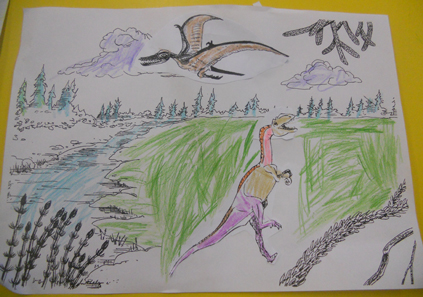
Dinosaur and Prehistoric Animals ( Higher Openshaw Community School)

A Jurassic scene.

Picture credit: Everything Dinosaur/Higher Openshaw

At Everything Dinosaur, we try to give pupils a sense of deep, geological time and that different prehistoric animals lived in different geological periods.  The drawing materials that we sent the school included a Jurassic landscape with authentic Jurassic aged plants.  The school children were then able to add their own Jurassic aged prehistoric animals , as we had emailed them specifically, dinosaurs and flying reptiles that lived during the Jurassic.

Pupils Illustrate Dinosaurs

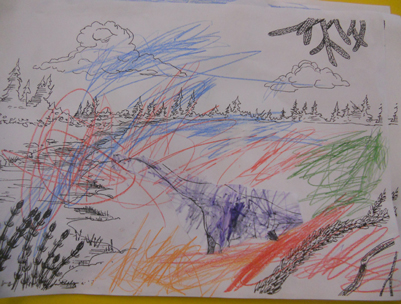
Jurassic Park – By Higher Openshaw Community School

School pupils illustrate dinosaurs.

Picture credit: Everything Dinosaur/Higher Openshaw

Our congratulations to all the school children involved in the dinosaur teaching topics, their artwork and illustrations are super.

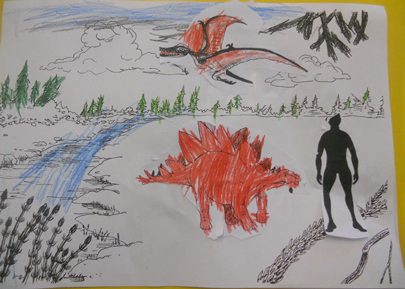
Dinosaurs on the Prowl

A bright red Stegosaurus on the prowl.

Picture credit: Everything Dinosaur/Higher Openshaw

The picture above shows a bright red Stegosaurus as drawn by one of the pupils with a Pterosaur (Rhamphorhynchus) flying overhead.  The colouration on the Stegosaur is particularly apt as palaeontologists believe that this plant-eating dinosaur could flush their plates with blood, making them turn bright red.  Scientist Ken Carpenter proposed that with such a rich blood supply to the dermal plates, they could have been flushed with blood at will making a colourful and impressive display.

Openshaw’s Young Dinosaur Illustrators

A very colourful Jurassic scene.

Picture credit: Everything Dinosaur/Higher Openshaw

They are certainly very colourful scenes and we enjoyed working with the school children and helping them to study dinosaurs.

An Allosaurus Hiding in the Ferns

A hiding Allosaurus.

Picture credit: Everything Dinosaur/Higher Openshaw

For dinosaur themed educational materials, toys and games: Learning Materials – Dinosaur Toys and Games.

28 02, 2012

“Oetzi” The Iceman – New Insights Thanks to Study of Genome

By |2023-01-28T17:28:50+00:00February 28th, 2012|Categories: Dinosaur and Prehistoric Animal News Stories, Educational Activities|0 Comments

5,300-Year-Old Mummy Yields Further Secrets

Since the body of a middle-aged man was found in 1991 by a party of hikers in the Italian Alps, the corpse has been the centre of intensive research.  The body was that of a person who had lived some 5,300 years ago, at first the body, which had been beautifully preserved in its icy surroundings, was thought to be that of a climber who had got into difficulties and perished on the mountain, but close examination revealed that this was the corpse of a person who had lived in the New Stone Age.

“Oetzi” the Iceman

Italian scientists have published a more complete study of the genome of this Stone Age person, someone who may have been murdered as the body was discovered with an arrow head buried in the shoulder.  This new research, building upon an earlier study into the corpses’s genetic material published in 2008 reveals that “Oetzi” had brown eyes, “O” type blood, was very probably lactose intolerant and was predisposed to heart disease.  The report has been published in the scientific journal “Nature Communications”.

The findings have been published by the Institute for Mummies and the Iceman at the European Academy of Bolzano (EURAC), in conjunction with Tuebingen and Saarland universities in Germany, which were also involved in this study.

Albert Zink, an anthropologist,  at the EURAC Institute for Mummies and the Iceman, based in Bolzano, Italy, stated that this new study adds to the database of knowledge on this Neolithic individual.  For example, earlier studies had suggested that “Oetzi” had no living relatives, but the fuller genetic picture as laid out in the nuclei of Oetzi’s cells suggest a different story.

Based on an analysis of nuclear DNA, this Stone Age person probably was descended from people of the Middle East who migrated out of that part of the world into Europe with the advent of more advanced agricultural systems.  Study of a series of anomalies in the “Iceman’s” DNA reveal him to be more closely related to modern inhabitants of the islands of Sardinia and Corsica than to modern human populations living in the Alps today.

Genome Analysis

The genome analysis involving the study of cells taken from inside the hip joint  also show him to be the first documented case of infection by a Lyme disease bacterium.  Lyme disease is one of the most common bacterial infections found in the Northern Hemisphere, it is spread by tick bites and causes headaches, fatigue and in more extreme cases problems with joints and the nervous system.  It can be effectively treated by antibiotics, but for “Oetzi” there would have been no relief.

Interestingly, the “Tyrol Iceman”, as “Oetzi” is sometimes called, weighed about fifty kilogrammes when he died.  He was not overweight and had a very different diet to us today, but he was still predisposed to cardiovascular disease.  This may have implications for how scientists treat obesity in modern human populations.

Commenting on the findings, Professor Zink said:

“We’ve been studying the Iceman for 20 years.  We know so many things about him – where he lived, how he died – but very little was known about his genetics, the genetic information he was carrying around.”

The lactose intolerance, identified through this “whole genome sequencing process”, used in the study was probably very common in the New Stone Age.  Cows and other milk producing creatures were only just beginning to be domesticated on any large scale and much of the human population was very probably lactose intolerant.  Our ability to digest milk from other animals probably built up in the population over many thousands of years as humanity moved towards an agrarian society.

Professor Zink added:

“This was really exciting and I think it’s just the start for a longer study on this level.  We still would like to learn more from this data – we’ve only just started to analyse it.”

Certainly, the discovery of a beautifully preserved specimen of a New Stone Age person, was one of the most amazing archaeological discoveries of the 20th century.  Advances in genetics are permitting scientists in the 21st century to gain a further insight into the life of this ancient human being, who perished on a Tyrol mountainside more than 5,300 years ago.

For models and replicas of ancient hominins: Ancient Hominins and Prehistoric Animal Models.

An interesting paper was published on “Oetzi” in 2010, it suggested that this person may have been a Stone Age VIP and as a result given a much more formal burial.

To read this article: “Oetzi” – The Chieftan.

21 02, 2012

Dinosaurs in Different Languages Providing Helpful Advice

By |2024-04-23T06:54:12+01:00February 21st, 2012|Categories: Dinosaur Fans, Educational Activities|0 Comments

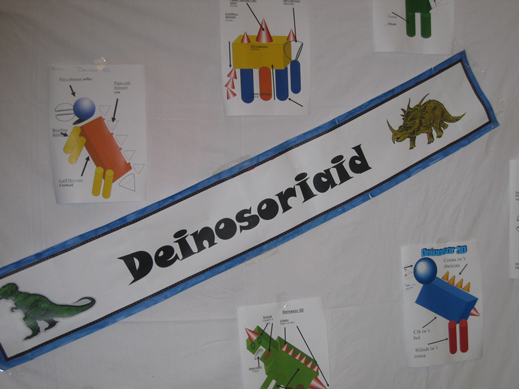
Introducing the Deinosoriaid

As part of Everything Dinosaur’s teaching activities, we get the opportunity to travel the length and breadth of the country delivering Earth Science related workshops to school children.  We also provide support to teachers outside of the UK via emails and such like.  One of the pleasures of doing such work is we get to see the amazing dinosaur themed projects that the children get involved with.

Everything Dinosaur

In a recent trip to North Wales (Gwynedd), we worked with Year 5 and Year 6 pupils who had just started a dinosaur themed topic for the term.

Dinosaurs in Different Languages

Dinosaurs in another name.

Picture credit: Ysgol y Gorlan (Tremadog)

It was fascinating to see the project work that the budding young palaeontologists had undertaken and intriguing to see a dinosaur topic delivered in the Welsh language.  The picture above shows part of the children’s wall display with the word “dinosaurs” written in Welsh.  The dinosaur workshops in school activities that team members undertake are popular in Wales as well as England.

“Dinosaures”, “Los Dinosaurios”, “Dinosaurier”

We come across the phrase “dinosaures”, “los dinosaurios”, “dinosaurier” – French, Spanish, German but we have not come across this phrase translated into Welsh – cool.

Visit Everything Dinosaur’s award-winning website: Everything Dinosaur.

14 02, 2012

Untangling Dinosaurs – A spot of Paint does the Trick

By |2023-01-28T12:58:08+00:00February 14th, 2012|Categories: Dinosaur Fans, Educational Activities, Everything Dinosaur News and Updates|0 Comments

Preventing Dinosaur Toy Confusion

Children often have friends over to play.  With the spring term, half-term holiday Mums and Dads may be glad that chums have come over to help play, anything to keep their young charges occupied.  Playing with dinosaur toys can be fun, but when another child brings his or her dinosaurs with them, then this can lead to problems.  The prehistoric models can get mixed up, how do you sor them out?  How to go about untangling dinosaurs?

Untangling Dinosaurs

Toys tend to get mixed up and even our dinosaur experts cannot tell which dinosaur toy belongs to which child.  This can lead to problems, but a suggestion provided by a busy Mum who did not want to have her daughter’s “herd” of dinosaurs mixed up with her friend’s collection may provide the answer.

Taking some water-based paint from one of her daughter’s paint sets, she applied a dab of green paint to the underneath of the dinosaur models.  She chose an area on the underside of the toy so that this little spot of paint did not spoil the look of the model.   She took care not to obscure any writing on the underside, as sometimes the prehistoric animal’s name is printed on the base or on the tummy of the beastie in question.  Now her daughter’s friends can bring over their own dinosaur toys and models without fear of them getting mixed up.  All the adults have to do when tidying up is to look at the underside of the toy and identify which is which by the dab of paint.

A Dab of Paint

This simple idea works well, most children have a paint set of some sort and by painting on a colour key, dinosaur toys should not be confused in future.  Blue or red works quite well when it comes to choice of colour.  Avoid yellow if you can, as often the belly of a dinosaur toy is a light shade and a yellow spot of paint might be more difficult to see.

Sorting Out Prehistoric Animal Models

Dinosaur and prehistoric animal models. Untangling dinosaurs.

Mini dinosaur and prehistoric animal models. If the models get mixed up during play, how do you sort them out?

Picture credit: Everything Dinosaur

If the child wants to take some dinosaur toys (or indeed any plastic toys), away with them as the family visits relatives then this is fine.  The paint job on the underside should ensure that all the child’s toys can be identified and returned home safely without any getting mixed up.

Robust Creative Play

With all the robust, creative play that dinosaur toys can encourage, the use of a spot of paint to help identify which models belong to which budding palaeontologist can save a lot of confusion and prevent tantrums.  The only thing that needs to be checked is to make sure that the Mum of the child you are visiting hasn’t had the same good idea.  After all, it would be hard to separate two sets of dinosaur toys, with each one having a red blob of paint on the belly – perhaps two dabs of paint is required, just to make sure.  Hopefully this little tip will avoid any difficulties when it comes to dinosaur toys for children.

For inexpensive dinosaur models, toys and games, visit Everything Dinosaur’s award-winning website: Dinosaur Toys and Gifts.

9 02, 2012

The Appalling Quality of Some Dinosaur Themed Merchandise

By |2023-01-27T22:19:26+00:00February 9th, 2012|Categories: Dinosaur Fans, Educational Activities, Teaching|1 Comment

Visit to a Trade Show – Guaranteed to Upset Us

One of the saddest sights for us as dedicated teachers and dinosaur enthusiasts is to see inaccurate dinosaur themed merchandise.  It is depressing to recall just how many of the prehistoric animal influenced toys, games, books and other products that we come across contain information that at best can be misleading, or at worst entirely wrong.

A recent visit to a trade show in the UK only served to highlight this problem once again.  Dinosaurs and other creatures preserved in the fossil record, animals such as the marine reptiles and the pterosaurs are universally popular with children.  We use dinosaurs as a teaching topic, helping to motivate young people to learn more about general science, mathematics and history.  At Everything Dinosaur, we are far from perfect and we tend not to be too pedantic over binomial conventions and other such matters, but when we come across products on sale to the public which purport to have some educational value, and facts/statements they contain are wrong – it makes us very upset.

Company’s are all too eager to exploit the public’s interest and fascination with dinosaurs.  Many firms take great care in how they go about producing merchandise, facts are checked and re-checked, and experts are appointed to oversee the development work, but we encounter examples all the time when perhaps through ignorance or perhaps just because of incompetence, information about prehistoric animals is provided that is just incorrect.

Poor Quality Dinosaur Information

For example, team members went to a trade show recently.  Amongst the many hundreds of exhibitors there were a few stands that had dinosaur themed products and merchandise on display.  A gift card manufacturer was launching a range of new cards which featured drawings of animals from prehistory.  One of the cards featured T. rex.  Like many businesses, this particular firm had attempted to provide some information about this famous theropod on the back of the gift card.  The attempts have to be commended, helping to provide information, to educate, is important.  However,  the brief paragraph of information they had provided on the “King of the Tyrant Lizards” contained a number of inaccuracies.  Every  young, budding palaeontologist knows that the dinosaurs died out approximately sixty-six million years ago.  The information on the back of the gift card stated that Tyrannosaurus rex existed around fifty-eight million years ago.  The fossil record suggests that this is completely inaccurate.

Sadly, such mistakes are not uncommon, one of these days we will go through our data files and produce a top ten of prehistoric animal themed merchandise blunders, but for the moment we will provide a couple of other examples from our more recent researches.

Poor Quality Dinosaur Information

Triceratops mistakes! Poor quality dinosaur information.

Triceratops? Not very good quality teaching resources.

Picture credit: Everything Dinosaur

Archaeopteryx may be one of the world’s most famous prehistoric creatures.  Fossils of this creature with reptilian and avian traits from Upper Jurassic strata have intrigued scientists for over one hundred and fifty years.  This “early bird” is the subject of intense research even today, but on numerous occasions we have encountered products that have got the spelling of this famous creature from the fossil record wrong.  Letters are missed or even added – such a shame, especially when firms are trying to add credibility to their various products by attempting to provide some information about the prehistoric animals they depict.

Products based around flying reptiles (pterosaurs) are also a happy hunting ground for those of us who spot these “bloopers”.  We are going to have to think of a better term to describe such mistakes on dinosaur toys and other items.  At the same trade show, we found a product which depicted a pterodactyl.  We don’t want to go into the issue surrounding the use of the word “pterodactyl” in this article, we have covered that treacherous ground for the uninitiated when it comes to providing information before, however, the picture of the flying reptile was no Pterodactylus, more like a member of the family Pteranodontidae, except that this creature had some very prominent teeth in its jaws.  If the objective was to produce an image of a Pteranodon, something like Pteranodon longiceps, then we think this particular drawing left a lot to be desired.

Whether it is duck-billed dinosaurs with their names spelt incorrectly, members of the tyrannosaur family from the Late Cretaceous with four-fingered hands or indeed a picture of a prehistoric animal in a dinosaur book with the wrong annotation attached to it, all these mistakes and inaccuracies can be avoided.

Many children have a passion for dinosaurs, their enthusiasm for all things prehistoric can provide a platform for them to go on to have a life-long interest in the natural world and science.  It is such a shame that there seems to be an increasing amount of inaccurate dinosaur and prehistoric animal themed merchandise available.  Some firms seem only too willing to exploit this interest, we do our best to provide support and to help stem the tide.

To view a range of quality prehistoric animal models and figures, all approved by Everything Dinosaur’s teaching team and dinosaur experts: Everything Dinosaur.

Go to Top